Research Article | | Peer-Reviewed

A Study on Drought Situation in North-West Part of Bangladesh by Using SPI Method

Received: 24 July 2026     Accepted: 7 August 2026     Published: 24 August 2026
Views:       Downloads:
Abstract

Rainfall has been extensively considered as one of the initial point towards the apprehension of climate change courses. Bangladesh is recently experiencing climate change impact related to hazards like cyclone, rainfall, flood, draught etc. Climate variable like rainfall is the main parameter which is linked with agricultural aspects too for this country. Drought is generally recognized as a phenomenon associated with scarcity of water. The Standardized Precipitation Index (SPI) expresses the actual rainfall as standardized departure from rainfall probability distribution function. In this study the daily rainfall data of Bangladesh Meteorology Department (BMD) recorded at meteorological stations located at North-West Regions (NWR) in Bangladesh for the last 40 years (1985-2024) used in the analyses. Estimated severity and spatial pattern of meteorological drought are analyzed in the North Western part of Bangladesh using multi-temporal SPI. The analyses suggest that the trend of annual and monsoon season average rainfall of this region at last 40 years are decreasing and drought assessment are facing trend from normal to moderately dry of the majority years. The result of this study will help to take necessary steps and measures for disaster management, agricultural production, drought mitigation etc. and also informed about the forecasting of rainfall and drought situation of North-West region of Bangladesh for next years. Finally, on the basis of this study, it is recommended that appropriate measures should be taken on behalf of the government so that the variation of drought can not affect environment and agriculture section in Bangladesh.

Published in American Journal of Applied Mathematics (Volume 14, Issue 4)
DOI 10.11648/j.ajam.20261404.18
Page(s) 259-266
Creative Commons

This is an Open Access article, distributed under the terms of the Creative Commons Attribution 4.0 International License (http://creativecommons.org/licenses/by/4.0/), which permits unrestricted use, distribution and reproduction in any medium or format, provided the original work is properly cited.

Copyright

Copyright © The Author(s), 2026. Published by Science Publishing Group

Keywords

Rainfall, Drought, Rainfall, Standardized Precipitation Index, Disaster Management
1. Introduction
Climate change has created a new challenge to hamper development process throughout the world. The impact of higher temperatures, more extreme weather events such as floods, severe drought, cyclones and sea level rise are already being felt in South Asia and will continue to intensify . Different studies established that Indian sub-continent is facing decreasing rainfall while trend of surface temperature is increasing . Bangladesh is one of the most vulnerable countries related to climatic change in the world. Rainfall has been extensively considered as one of the initial point towards the apprehension of climate change courses. Bangladesh is recently experiencing climate change impact related to hazards like cyclone, rainfall, flood, draught etc . Its economy strongly depends on agriculture and natural resources that are sensitive to climate change. Precipitation in Bangladesh shows clear intra seasonal variation with time scales of 7-25 days during the monsoon season . Rainfall is most important factor that determines the agricultural production in Bangladesh. The variability of rainfall and extreme high or low precipitations are very important for agricultural production as well as the economical growth of the country . The summer monsoon is the main rainy season in Bangladesh which accounts for about 72 percent of the annual rainfall during summer monsoon season. Agriculture is the mainstay of the economy in Bangladesh and the country largely depends on the rainfall from the summer monsoon. The life of all inhabitants of Bangladesh directly and indirectly depends on the summer monsoon rainfall .
Only 1.92% rainfall has occurred in winter in conformity with BMD data and only 1.60% rainfall has occurred in winter in conformity with MPI-ESM-LR (CMIP5) model data. The lowest rainfall occurred in Sydpur with 8.30 mm in winter for BMD data and only 2.17 mm rainfall occurred in Rajshahi and Ishurdi for MPI-ESM-LR (CMIP5) model data. Overall, the rainfall is decreasing in north-western region . The results showed an overall decrease of variability in annual and seasonal rainfall, but an increase in mean pre-monsoon rainfall and a decrease in mean monsoon rainfall . Rainfall assessment and meteorological drought assessment is very essential in identifying climate and water supply trends and thus to detect the probability of occurrence and the anticipated severity of drought . Climate change is anticipated to aggravate the frequency and intensity of extreme weather events in Bangladesh. Drought is one of the major setbacks for the agriculture and its development. There are some regions in Bangladesh where every steps of agricultural activities from field preparation to harvesting of crops dependents on rainfall . Droughts are the result of acute water shortage causing severe and sometimes catastrophic economic and social consequences. Out of all natural common disasters in the North-West Region (NWR), droughts affect more people and larger area than other regions of Bangladesh. Otherwise, drought -as an environmental phenomenon, is an integral part of climatic variability. Out of all common natural disasters, droughts affect more people and larger areas than any other. It is generally considered to be occurring when the rainfall in monsoon is scanty. Scarcity of rainfall in the monsoon may reduce crop productions, creates shortage of drinking water and also may affect the socio-economic life. Ishurdi, Rajshahi, Rangpur, Sayedpur and Dinajpur stations were found that a decreasing trend in annual rainfall was observed at all six stations . In Bangladesh, several researches have been investigated drought impacts on agriculture, food production, economy and society . According to the report of National Drought Mitigation Center of year 2006, Bangladesh has already shown an increased frequency of droughts in recent years. Additionally, agriculture, power generation and industrial production depend upon precipitation . In the last 50 years, Bangladesh has suffered about 20 drought conditions. A part from loss to agriculture, droughts have significant effect on land degradation, live stock population, employment and health. Past droughts have typically affected about 47 percent of the country and 53 percent of the population . On average, the North-West part of Bangladesh over 5% of the region had extreme droughts, while more than 12% experienced severe droughts during last decade . The severity and spatial pattern of the meteorological dry spell are investigated in the NWR of Bangladesh using multi-temporal SPI . The forecasting of drought was performed employing SPI and fuzzy logic . Assessment of meteorological drought was conducted for five rain gauge stations in the North-Western part of Bangladesh for the period 1975–2014. To estimated the drought classification as per SPI for this period. It is observed from this study the moderate and severe drought are occurs every station .
Generally, the amount of rainfall absorbed in any region provides idea about the occurrence of drought of that region. Since drought is closely associated with crop productions and thereby food security; hence, the study on drought hazards, especially drought monitoring is important to reduce its impact in any country. The present study has provided an assessment of rainfall variability and drought situation in NWR of Bangladesh based on analysis of historical data of rainfall recorded at six meteorological stations in Bangladesh.
2. Data Collection and Data Range
Data for this study have been extracted from the Bangladesh Meteorological Department (BMD). The BMD collects everyday surface data through weather stations situated all over Bangladesh. There are 34 old rain gauge stations under BMD in Bangladesh. Among them 6 (Ishurdi, Rajshahi, Bogra, Rangpur, Syedpur and Dinajpur) stations in NWR collected data for a period of 40 years during 1985 to 2024. Our study period is from January 1985 to December 2024. In this study, the missing rainfall values were estimated by expectation maximization (EM) method by using the precipitation records of the nearest gauging stations. The EM algorithm iteratively computes the maximum likelihood estimates to increase the relationship between the missing value and the unknown parameters of a data model. A full description of EM algorithm can be found in McLach-lan and Krishnan . The collected data have been compiled, tabulated and analyzed by MS Excel.
3. Methods
The Standardized Precipitation Index (SPI) can be computed for different time scales, can provide early warning of drought and help to assess drought severity, and is less complex than the Palmer. The SPI provides the forecasting of drought. The primary reason for using SPI is that SPI is based on rainfall alone so that drought assessment is possible even if other hydro meteorological measurements are not available. The SPI is defined over various timescales, which allows it to describe the situation of drought over a range of meteorological, hydrological and agricultural applications. The SPI also detects moisture deficit more rapidly which has a response time scale of approximately 3, 6, 12, 24, 48 months.
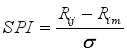
In this study the monthly rainfall data were used as in put for the calculation of SPI. The SPI is computed by fitting an appropriate probability density function to the frequency distribution of precipitation summed over the time scale of interest (usually 3, 6, 12, and 24 months). The SPI is computed by dividing the difference between the normalized seasonal precipitation and its long-term seasonal mean by the standard deviation. Thus
(1)
Where, is the seasonal precipitation at the i-th rain gauge station and j-th observation, is the long-term seasonal mean and is its standard deviation.
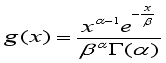
The fact that, precipitation is not normally distributed is overcome by applying a transformation (i.e., gamma function) to the distribution. The computation of SPI requires long term rainfall data. It was found by that the gamma distribution function fitted to the rainfall time series. The long-term record is fitted to a probability distribution, which is then transformed into a normal distribution so that the mean SPI for the location and desired period is zero . The rainfall series is fitted to the gamma distribution. It is defined by its frequency or probability density function. The gamma probability distribution function is given as follows.
The alpha and beta parameters of the gamma probability density function are estimated for each station.
for (2)
where, x = rainfall amount
shape parameter
= number of rainfall observations
= scale parameter =
gamma function
It is an index based on the probability of rainfall for any time scale. Many drought planners appreciate the SPI’s versatility. Define the criteria for a drought event for any of the time scales . A drought event may occur any time then the SPI is continuously negative and reaches an intensity of -1.0 or less. The event ends when the SPI becomes positive. SPI was calculated by using the daily rainfall data of six rain gauge stations of North West region in Bangladesh for the period of 1985-2024. The SPI values have been calculated by using the method which explained in seven classes of SPI shown in Table 1 are used to assess drought in the present study.
Table 1. Drought Classifications as per SPI.

SPI Range

Drought Classification

-2.0 and less

Extremely dry

-1.5 to -1.99

Severely dry

-1.0 to -1.49

Moderately dry

-0.99 to 0.99

Normal

1.0 to 1.49

Moderately wet

1.5 to 1.99

Severely wet

2.0 and above

Extremely wet

4. Results and Discussion
Since rainfall pattern of Bangladesh is of high variety in time and space, hence the pattern of distribution of rainfall in Bangladesh is most uneven and varies considerably from year to year and region to region. In Bangladesh the meteorologists divided the year into the following four principal seasons: (i) the cold weather season- December to February; (ii) the hot weather season- March to May; (iii) the southwest monsoon season- June to September; and (iv) the post monsoon season- October to November. During the summer monsoon season (June-September), much of the precipitation was brought by the monsoon low (pressure system) originated from the Bay of Bengal and moved along the Ganges. Prediction of heavy rainfall over NWR of Bangladesh is a challenging job. Attempt is therefore made to derive the variability of rainfall, rainy days and frequencies of rainfall with their trends over NWR of Bangladesh using the daily rainfall data recorded at Ishwardi, Rajshahi, Bogra, Rangpur, Dinajpur and Syedpur. The results of the present study on the rainfall variability and drought situation over the North-West part of Bangladesh have been analyzed and discussed.
4.1. Annual Average Rainfall Variability in NWR
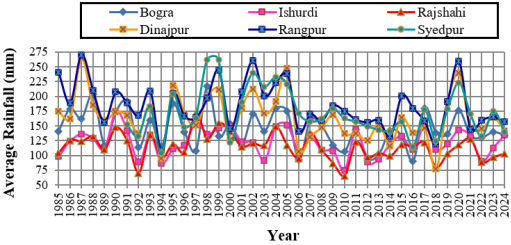
Investigation depicts that the variability of rainfall over NWR of Bangladesh are shown in Figure 1. The analyses show that the annual average rainfall over the study region was found between 101 mm to 193 mm respectively and the annual average rainfall was 150 mm. It was also noted that the annual average rainfall occurred in Ishurdi region lowest 75 mm (2010) and highest 175 mm (1990); In Rajshahi region lowest 66 mm (2010) and highest 172 mm (1992); In Bogra region lowest 90 mm (2016) and highest 217 mm (1998); In Rangpur region lowest 108 mm (1994) and highest 271 mm (1987); In Syedpur region lowest 104 mm (1994) and highest 262 mm (1998 and 1999); In Dinajpur region lowest 77 mm (2018) and highest 265 mm (1987). According to the Bangladeah Meteorological Department, the annual average normal rainfall in this region will be 160 mm.
Figure 1. Annual average rainfall in North West Region from 1985 to 2024.
4.2. Monsoon Season Average Rainfall Variability in NWR
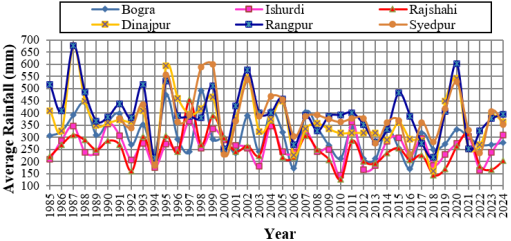
The data are analyzed to investigate the variation of monsoon season rainfall over NWR of Bangladesh is shown in Figure 2. The analysis shows that the monsoon average rainfall over the study region was found between 201 mm to 480 mm respectively and the average rainfall of this season was 327 mm. Moreover, it was also analyses that the monsoon season average rainfall occurred in Ishurdi region lowest 143 mm (2010) and highest 365 mm (1997); In Rajshahi region lowest 127 mm (2010) and highest 455 mm (1997); In Bogra region lowest 170 mm (2016) and highest 491 mm (1998); In Rangpur region lowest 215 mm (1994) and highest 677 mm (1987); In Syedpur region lowest 183 mm (1994) and highest 598 mm (1999); In Dinajpur region lowest 162 mm (2018) and highest 675 mm (1987).
Figure 2. Monsoon season average rainfall in NWR from 1985 to 2024.
4.3. Station Wise Annual Drought Situation on NWR
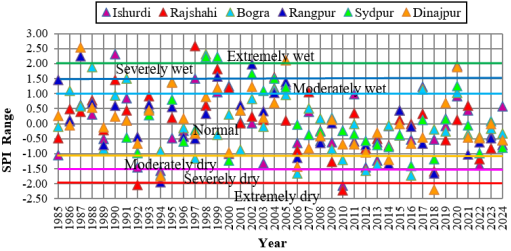
The annual drought situations of six rain gauge stations are shown in the Figure 3. Drought years for the six stations in the study were identified based on SPI criteria. It is observed that there were affected stations by extremely drought in the years Ishurdi (2010), Rajshahi (1992, 2010), Rangpur (1994, 2010) and Dinajpur (2018). There were severely drought affected stations in the years Ishurdi (1992, 1994, 2012), Rajshahi (1994, 2018), Bogra (2006, 2012, 2016) Rangpur (2018), Syedpur (1994) and Dinajpur (1994, 2006). The analysis suggests that the moderately drought were suffered stations in the years Ishurdi (1985, 2003, 2013, 2022), Rajshahi (2009, 2022), Bogra (1994, 1997, 2010, 2013), Rangpur (2000, 2006, 2014, 2021), Syedpur (1992, 2000, 2016, 2018, 2022) and Dinajpur (2000, 2012, 2014). Besides, 70 percent stations are occurred normal to moderately drought situation trends in the years 2006 to 2024.
Figure 3. Station wise annual drought assessment on NWR of Bangladesh as per SPI.
4.4. Annual Drought Situation on NWR
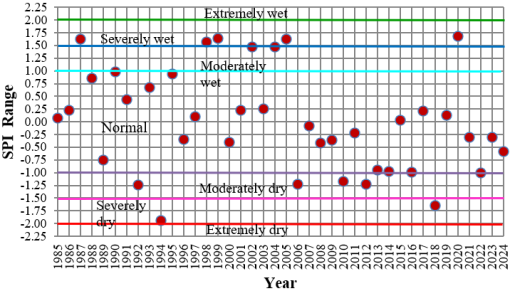
The annual drought situation on NWR is shown in Figure 4. Drought classification based on SPI criteria shows that the moderately drought was seen in the years 1989, 1996, 2000, 2008, 2009, 2011, 2013, 2014, 2021, 2023 and 2024. Otherwise, severely dry years were 1994 and 2018; and extremely dry year no found. The analysis also shows that the years 1978, 1980, 1985, 1989, 1996, 2009 and 2014 were suffered normal to moderate drought situation.
Figure 4. Annual drought assessment on NWR of Bangladesh as per SPI.
4.5. Station Wise Monsoon Drought Situation on NWR
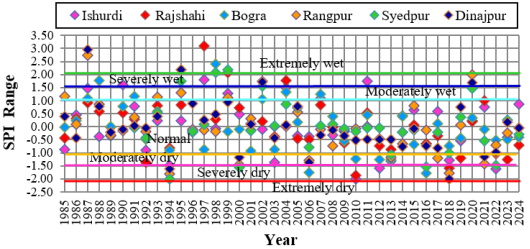
The monsoon season drought situations of six rain gauge stations are shown in the Figure 5. Drought years for the six stations in the study were identified based on SPI criteria. It is observed that there were affected stations by extremely drought in the years Ishurdi (2010), Syedpur (1994) and Dinajpur (2018). There were severely drought affected stations in the years Ishurdi (1994, 2012, 2022), Rajshahi (2010, 2018), Bogra (2006, 2016), Rangpur (1994, 2018), Syedpur (2000, 2016, 2022) and Dinajpur (1994). The analysis suggests that the moderately drought were suffered stations in the years Ishurdi (2003, 2013, 2018), Rajshahi (1992, 2019, 2022, 2023), Bogra (2010, 2012, 2013), Rangpur (2000, 2006, 2013, 2017, 2021), Syedpur (2013, 2018) and Dinajpur (2000, 2006, 2021). Besides, this analysis that 75 percent stations are occurred normal to moderately drought situation trends in the years 2003 to 2024.
Figure 5. Station wise monsoon drought assessment on NWR of Bangladesh as per SPI.
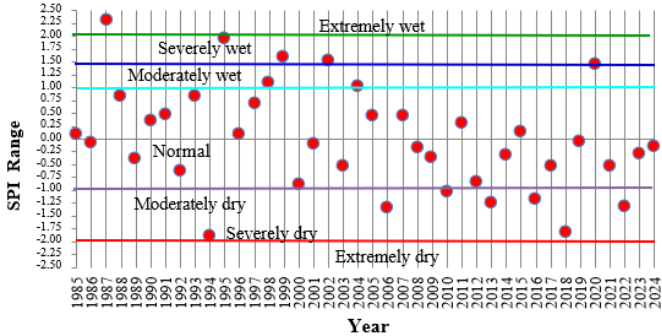
4.6. Monsoon Drought Situation on NWR
The monsoon season drought situation on NWR is shown in Figure 6. Drought classification based on SPI criteria shows that the moderately drought was seen in the years 2006, 2013, and 2022. Otherwise, severely dry years were 1994 and 2018; and extremely dry year no found. Besides, the analysis also shows that the years 1986, 1989, 1992, 2000, 2001, 2003, 2008, 2009, 2010, 2012, 2014, 2016, 2017, 2019, 2021, 2023 and 2024 were suffered normal to moderate drought situation.
Figure 6. Monsoon season drought assessment on NWR of Bangladesh as per SPI.

5. Conclusion
The analysis of the study on the variability and trends of annual and monsoon season rainfall of the study region of Bangladesh have been analyzed. It has been observed that the annual average rainfall amount was found to be between 101 mm to 193 mm, whereas the monsoon season’s average rainfall amount was found to be between 201 mm to 480 mm. The SPI values were calculated based on monthly rainfall values with monsoon and annual time scale for all the rain gauge stations in North-West region of Bangladesh. The SPI was designed to quantify the rainfall deficit for multiple time scales, which reflects the impact of drought on the availability of the different water resources. The SPI has been developed to identify and classify the drought by stations. SPI, the results were verified with past data on drought and have been found good consistency. Therefore, the Figures 3 to 6 shown that the plotting a time series of year against SPI provides a good indication of the drought history of a particular station, monsoon and annual.
The present study aimed to rainfall variability and drought assessment procedure in meteorological and agricultural contexts of the study region. The North-West part in Bangladesh is selected as the study area. The analysis of the study on the variability and trends of annual and monsoon season rainfall and drought situation of Ishurdi, Rajshahi, Bogra, Rangpur, Syedpur, Dinajpur and all over North-West region have been analyzed. The meteorological drought assessment was carried out using SPI method. The analyses suggest that the trend of annual and monsoon season average rainfall of this study region at last 40 years are decreasing and drought assessment over study region the majority years were facing trend from normal to moderately dry. Finally, it can be concluded that the amount of rainfall is in a decreasing trend and create drought in recent years due to climate change in Bangladesh.
Abbreviations

SPI

Standardized Precipitation Index

BMD

Bangladesh Meteorology Department

NWR

North-West Regions

EM

Expectation Maximization

Acknowledgments
The author is thankful to the Bangladesh Meteorological Department (BMD) for providing rain-gauge data and reference materials for preparing the article.
Author Contributions
Md Anisur Rahman: Conceptualization, Resources, Data curation, Investigation, Methodology, Formal analysis, Supervision, Validation, Visualization, Writing – original draft, Writing – review & editing
Conflicts of Interest
The authors declare no conflicts of interest.
References
[1] Huq, S., Karim, Z., Asaduzzaman, M., and Mahtab, F. (1998). Vulnerability and adaptation to climate change for Bangladesh. Kluwer Academic Publishers, Dordrecht, 135.
[2] Karim, Z., Ibrahim, A., Iqbal, A., and Ahmed, M. (1990). Drought in Bangladesh Agricultureand Irrigation Schedules for Major Crops, Bangladesh Agricultural Research Council, Dhaka.
[3] Rimi, R. H., Farzana, S., Sheikh, M. S., Abedin, M. Z. and Bhowmick, A. C. (2013). Climate Change Impacts on Shrimp Production at the South-West Coastal Region of Bangladesh. World Environment, 3(3), 116-125.
[4] Swart, R., Robinson, J. and Cohen, S. (2003). Climate Change and Sustainable Development: Expanding the Options. Climate Policy, 3(sup1), 19-40.
[5] Fujinami, H., D., Hatsuzuka, T., Yasunari, T., Hayashi, T., Terao, F., Murata, M., Kiguchi, Y., Yamane, J., Matsumoto, Islam, M. N., and Habib, A. (2011). Characteristics intraseasonal oscillation of rainfall and its effect on interannual variability over Bangladesh during boreal summer. International Journal of Climatology, 31(8), 1192−1204.
[6] Hatsuzuka, D., Yasunari, T., and Fujinami, H. (2014). Characteristics of low pressure systems associated with intraseasonal oscillation of rainfall over Bangladesh during boreal summer. Monthly Weather Review, 142(12), 4758−4774.
[7] Hossain, M. M., and Anam, S. (2012). Identifying the dependency pattern of daily rainfall of Dhaka station in Bangladesh using Markov chain and logistic regression model. Agricultural Sciences, 3(3), 385-391.
[8] Ahasan, M. N., Chowdhary, M. A. M., and Quadir, D. A. (2011). Variability and trends of Summer Monsoon rainfall over Bangladesh, Journal of Hydrology and Meteorology, 7(1), 1-17.
[9] Bhuyan, M., Islam, M., and Bhuiyan, M. (2018). A Trend Analysis of Temperature and Rainfall to Predict Climate Change for North-Western Region of Bangladesh. American Journal of Climate Change, 7(2), 115-134.
[10] Uddin, M. A., Kamal, A. S. M. M., Shahid, S., and Chung, E. S. (2020). Volatility in Rainfall and Predictability of Droughts in Northwest Bangladesh. Sustainability, 12(23), 1-20.
[11] Nandeesha and Ramu (2015). Assessment of rainfall patterns and meteorological drought in northern dry agro Climatic zone of Karnataka. International Journal of Computer Science and Information Technology Research, 3(2), 532-539.
[12] Abdullah, H. M., and Rahman, M. M. (2015). Initiating rain water harvest technology for climate change induced drought resilient agriculture: scopes and challenges in Bangladesh. Journal of Agriculture and Environment for International Development, 109(2), 189-208.
[13] Prodhan, M. M. H., Islam, M. B., and Rahman, S. M. (2024). Temporal Variations of Rainfall and Temperature in Northwestern Bangladesh Using Mann-Kendall Trend Test, Research Square, 1(1).
[14] Mazid, M., Mortimer, M. A., Riches, C. R., Orr, A., Karmaker, B., Ali, A., Jabbar, M. A., and Wade, L. J. (2005). Rice establishment in drought prone areas of Bangladesh. International Rice Research Institute, Manila, Philippines, 193-195.
[15] Shahid, S, and Behrawan, H. (2008). Drought risk assessment in the western part of Bangladesh. Natural Hazards, 46(3), 391-413.
[16] Devkota, L. P. (2006). Rainfall over SAARC region with special focus on tele-connections and long range forecasting of Bangladesh monsoon rainfall, monsoon forecasting with a limited area numerical weather prediction system. Report No-19, Published by SAARC Meteorological Research Centre (SMRC), Dhaka, Bangladesh.
[17] Ramamasy, S. and Baas, S. (2007). Climate Variability and Change: Adaptation to Drought in Bangladesh. A resource book and training guide, Institutions for Rural Development, Asian Disaster Preparedness Center, Food and Agriculture Organization of the United Nations, Rome.
[18] Sadiq, M. A., Sarkar, S. K., and Raisa, S. S. (2023). Meteorological drought assessment in northern Bangladesh: A machine learning-based approach considering remote sensing indices. Ecological Indicators, 157, 111233.
[19] Azam, M. N., Rahman, M. A., Kamal, S. M. M., and Yeasmin, M. (2017). Environmental concern: assessment of meteorological drought. International Journal of Environment and Sustainable Development, 16(2), 156-166.
[20] Rahman, M. A. (2021). Development of Fuzzy Membership Functions and Meteorological Drought Classification as Per SPI. Global Journal of Science Frontier Research: F Mathematics and Decision Sciences, 21(3), 73-74.
[21] Rahman, M. A., Kamal, S. M. M., and Billah, M. M. (2016). Rainfall Variability and Linear Trend Models on North-West Part of Bangladesh for the Last 40 Years. American Journal of Applied Mathematics, 4(3), 158-162.
[22] McLachlan, G. J., and Krishnan, T. (1997). The EM Algorithm and Extensions, Wiley, New York City, New York.
[23] Thom, H. C. S. (1966). Some Methods of Climatological Analysis: Report of the Working Group on Statistical Methods in Climatology. WMO Technical Note Number 81, Secretariat of the World Meteorological Organization, Geneva, Switzerland.
[24] Edwards, D. C., and McKee, T. B. (1997). Characteristics of 20th Century Drought in the United States at Multiple Times Scales. Atmospheric Science Paper, 634, 1-30.
[25] McKee, T. B., Doesken, N. J., and Kleist, J. (1993). The Relationship of Drought Frequency and Duration to Time Scales. Proceeding of the Eight Conference on Applied Climatology, Anaheim, California, 17-22.
Cite This Article
  • APA Style

    Rahman, M. A. (2026). A Study on Drought Situation in North-West Part of Bangladesh by Using SPI Method. American Journal of Applied Mathematics, 14(4), 259-266. https://doi.org/10.11648/j.ajam.20261404.18

    Copy | Download

    ACS Style

    Rahman, M. A. A Study on Drought Situation in North-West Part of Bangladesh by Using SPI Method. Am. J. Appl. Math. 2026, 14(4), 259-266. doi: 10.11648/j.ajam.20261404.18

    Copy | Download

    AMA Style

    Rahman MA. A Study on Drought Situation in North-West Part of Bangladesh by Using SPI Method. Am J Appl Math. 2026;14(4):259-266. doi: 10.11648/j.ajam.20261404.18

    Copy | Download

  • @article{10.11648/j.ajam.20261404.18,
      author = {Md Anisur Rahman},
      title = {A Study on Drought Situation in North-West Part of Bangladesh by Using SPI Method},
      journal = {American Journal of Applied Mathematics},
      volume = {14},
      number = {4},
      pages = {259-266},
      doi = {10.11648/j.ajam.20261404.18},
      url = {https://doi.org/10.11648/j.ajam.20261404.18},
      eprint = {https://article.sciencepublishinggroup.com/pdf/10.11648.j.ajam.20261404.18},
      abstract = {Rainfall has been extensively considered as one of the initial point towards the apprehension of climate change courses. Bangladesh is recently experiencing climate change impact related to hazards like cyclone, rainfall, flood, draught etc. Climate variable like rainfall is the main parameter which is linked with agricultural aspects too for this country. Drought is generally recognized as a phenomenon associated with scarcity of water. The Standardized Precipitation Index (SPI) expresses the actual rainfall as standardized departure from rainfall probability distribution function. In this study the daily rainfall data of Bangladesh Meteorology Department (BMD) recorded at meteorological stations located at North-West Regions (NWR) in Bangladesh for the last 40 years (1985-2024) used in the analyses. Estimated severity and spatial pattern of meteorological drought are analyzed in the North Western part of Bangladesh using multi-temporal SPI. The analyses suggest that the trend of annual and monsoon season average rainfall of this region at last 40 years are decreasing and drought assessment are facing trend from normal to moderately dry of the majority years. The result of this study will help to take necessary steps and measures for disaster management, agricultural production, drought mitigation etc. and also informed about the forecasting of rainfall and drought situation of North-West region of Bangladesh for next years. Finally, on the basis of this study, it is recommended that appropriate measures should be taken on behalf of the government so that the variation of drought can not affect environment and agriculture section in Bangladesh.},
     year = {2026}
    }
    

    Copy | Download

  • TY  - JOUR
    T1  - A Study on Drought Situation in North-West Part of Bangladesh by Using SPI Method
    AU  - Md Anisur Rahman
    Y1  - 2026/08/24
    PY  - 2026
    N1  - https://doi.org/10.11648/j.ajam.20261404.18
    DO  - 10.11648/j.ajam.20261404.18
    T2  - American Journal of Applied Mathematics
    JF  - American Journal of Applied Mathematics
    JO  - American Journal of Applied Mathematics
    SP  - 259
    EP  - 266
    PB  - Science Publishing Group
    SN  - 2330-006X
    UR  - https://doi.org/10.11648/j.ajam.20261404.18
    AB  - Rainfall has been extensively considered as one of the initial point towards the apprehension of climate change courses. Bangladesh is recently experiencing climate change impact related to hazards like cyclone, rainfall, flood, draught etc. Climate variable like rainfall is the main parameter which is linked with agricultural aspects too for this country. Drought is generally recognized as a phenomenon associated with scarcity of water. The Standardized Precipitation Index (SPI) expresses the actual rainfall as standardized departure from rainfall probability distribution function. In this study the daily rainfall data of Bangladesh Meteorology Department (BMD) recorded at meteorological stations located at North-West Regions (NWR) in Bangladesh for the last 40 years (1985-2024) used in the analyses. Estimated severity and spatial pattern of meteorological drought are analyzed in the North Western part of Bangladesh using multi-temporal SPI. The analyses suggest that the trend of annual and monsoon season average rainfall of this region at last 40 years are decreasing and drought assessment are facing trend from normal to moderately dry of the majority years. The result of this study will help to take necessary steps and measures for disaster management, agricultural production, drought mitigation etc. and also informed about the forecasting of rainfall and drought situation of North-West region of Bangladesh for next years. Finally, on the basis of this study, it is recommended that appropriate measures should be taken on behalf of the government so that the variation of drought can not affect environment and agriculture section in Bangladesh.
    VL  - 14
    IS  - 4
    ER  - 

    Copy | Download

Author Information
  • Department of Mathematics, Islamic University, Kushtia, Bangladesh