Abstract
Miyake et al., (2000) categorized executive functions into set shifting, updating and responses inhibition. The Wisconsin Card Sorting Test is understood as a “gold-standard” of executive function tasks, but however, it does not provide information on the different executive processes and treats it as a unifactorial construct. It has been established that set shifting best predict performance in the WCST, but little is known about inhibitory control. We aimed to see if there is any predictive relationship between the assessment of inhibitory control abilities through a Go/Nogo Task and the measurement of executive functions through WCST. Data from the participants (n=30) was collected through a purposive sampling design and was scored manually. Statistical analyses were conducted and the obtained findings were discussed in the light of the existing literature. Our findings reveal that the Nogo Errors had a significant effect in predicting almost 30% of variation in the number of incorrect responses, 24% of variation in the perseverative responses, 22% of variation in the perseverative errors, 20% of variation in the non-perseverative errors, 22% of variation in the conceptual level responses and 15% of variation in the number of categories completed but not number of trials needed to complete the first category; and Go Reaction Time had a significant effect in predicting 30% of variation in the probability of failure to maintain set.
|
Published in
|
American Journal of Applied Psychology (Volume 15, Issue 4)
|
|
DOI
|
10.11648/j.ajap.20261504.15
|
|
Page(s)
|
115-130 |
|
Creative Commons
|

This is an Open Access article, distributed under the terms of the Creative Commons Attribution 4.0 International License (http://creativecommons.org/licenses/by/4.0/), which permits unrestricted use, distribution and reproduction in any medium or format, provided the original work is properly cited.
|
|
Copyright
|
Copyright © The Author(s), 2026. Published by Science Publishing Group
|
Keywords
Executive Function, Inhibitory Control, Wisconsin Card Sorting Test, Go/Nogo Task
1. Introduction
Wisconsin Card Sorting Test and Executive Functions
Ach created a sorting task in 1900 as part of a tradition of measuring cognitive abilities or mental sets. Participants were required to arrange cards containing nonsensical words according to characteristics that the things the words represented had in common. Goldstein later reported in 1920 that individuals with brain injury were tested for concrete and abstract attitudes using sorting exercises
| [26] | Nyhus, E., & Barceló, F. (2009). The Wisconsin Card Sorting Test and the cognitive assessment of prefrontal executive functions: a critical update. Brain and cognition, 71(3), 437-451. https://doi.org/10.1016/j.bandc.2009.03.005 |
[26]
. The WCST was developed in 1948 by Grant and Berg as a measure of abstract reasoning, concept development, and response techniques to shifting contextual contexts, after the work of Ach and Goldstein
. After some time, Milner developed the WCST to evaluate patients with brain injuries for prefrontal lobe dysfunction
.
Today, the Wisconsin Card Sorting Test is primarily a concept identification task and is popularly known as the “gold standard of executive function tests”
| [2] | Baggetta, P., and Alexander, P. A. (2016). Conceptualization and operationalization of executive function. Mind, Brain, and Education, 10(1), 10-33.
https://doi.org/10.1111/mbe.12100 |
| [7] | Delis, D. C., Kaplan, E., & Kramer, J. H. (2001). Delis-Kaplan executive function system. Assessment.
https://doi.org/10.1037/t15082-000 |
[2, 7]
. Through trial and error and examiner feedback, subjects must determine the right sorting principle for the task. Once the subject selects the appropriate rule, they must ignore the other, now-irrelevant stimulus dimensions and stick to this sorting principle (called a set) under different stimulus situations. The categorization concept abruptly changes after ten successive correct matches, necessitating a flexible shift in the set. The WCST does not have a time limit; sorting proceeds until all cards are sorted or until six accurate sorting requirements are met
| [26] | Nyhus, E., & Barceló, F. (2009). The Wisconsin Card Sorting Test and the cognitive assessment of prefrontal executive functions: a critical update. Brain and cognition, 71(3), 437-451. https://doi.org/10.1016/j.bandc.2009.03.005 |
[26]
.
Current Conceptualization of Executive Functions
There seems to be a general consensus about the multidimensional nature of EF. However, in a review by Baggetta and Alexander (2016), the authors report that, 79% of the studies identified executive function as multidimensional, consisting of multiple unique components or processes. The remaining 21% presented executive function as a unitary or single-dimensional entity, or did not debate its unitary or non-unitary nature. Some researchers take a neurodevelopmental standpoint and claim that executive function begins as a unified process in new-borns and pre-schoolers and eventually becomes more complex and multidimensional as people age
| [23] | Miller, M. R., Giesbrecht, G. F., Müller, U., McInerney, R. J., and Kerns, K. A. (2012). A latent variable approach to determining the structure of executive function in preschool children. Journal of cognition and development, 13(3), 395-423. https://doi.org/10.1080/15248372.2011.585478 |
| [39] | Wiebe, S. A., Sheffield, T., Nelson, J. M., Clark, C. A., Chevalier, N., and Espy, K. A. (2011). The structure of executive function in 3-year-olds. Journal of experimental child psychology, 108(3), 436-452.
https://doi.org/10.1016/j.jecp.2010.08.008 |
[23, 39]
.
Disagreements in Findings
When we look into the components of this “multidimensionality” mentioned before, we find differences of opinion in researchers. That is, there seems to be a lack of consensus on the models of EF. Among the large review conducted by Baggetta and Alexander (2016), they could excavate at least 48 different models of EF, but with 34 occurrences, the model by Miyake et al., (2000) was the most often cited one (more than 20,000 as on April 2024) and hence the most widely accepted one.
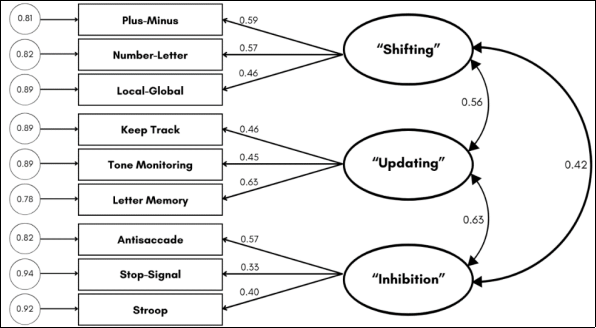
Miyake et al., (2000)’s Model: The researchers' proposed model is an integrative framework that includes three distinct but linked components (i.e., inhibition, set shifting, and updating) with an underlying common mechanism, as well as a unitary construct of executive function. Miyake et al., (2000) proposed the following three-factor structural model
| [25] | Miyake, A., Friedman, N. P., Emerson, M. J., Witzki, A. H., Howerter, A., and Wager, T. D. (2000). The unity and diversity of executive functions and their contributions to complex “frontal lobe” tasks: A latent variable analysis. Cognitive psychology, 41(1), 49-100. https://doi.org/10.1006/cogp.1999.0734 |
[25]
:
Figure 1. Three-factor Model (Miyake et al., 2000).
Gap in Literature
Through latent variable analyses such as confirmatory factor analysis and structural equation modeling, Miyake et al. (2000) determined that in their sample of younger adults, the three functions—set shifting, inhibitory control, and updating of working memory—while moderately correlated, were distinct and played varying roles in complex executive and frontal lobe tasks (
Figure 1). Specifically, they found that set shifting was the most influential factor in predicting performance on the Wisconsin Card Sorting Test (WCST). This suggests that among normal younger individuals, differences in WCST performance primarily stem from variations in set shifting abilities
| [11] | Gamboz, N., Borella, E., & Brandimonte, M. A. (2009). The role of switching, inhibition and working memory in older adults' performance in the Wisconsin Card Sorting Test. Aging, Neuropsychology, and Cognition, 16(3), 260-284.
https://doi.org/10.1080/13825580802573045 |
[11]
. In light of this, the question arises:
What is the significance of inhibitory control in Wisconsin Card Sorting Test (WCST) performance?
This inquiry was further explored by Gamboz et al., (2009), who utilized the Stop Signal Task (SST)
| [22] | Logan, G. D. (1994). On the ability to inhibit thought and action: A users' guide to the stop signal paradigm. |
[22]
as a measure of the speed of inhibitory processes involved in stopping a response. In this task, participants are required to respond quickly to stimuli, but occasionally encounter a stop signal instructing them to withhold their response after a variable delay. It is generally acknowledged by researchers that the ability to suppress a pre-planned response is a well-defined aspect of inhibitory control and is crucial for adapting one's actions dynamically when unexpected changes occur in the environment. But in the present literature, we have a many other tasks that claim to measure inhibitory control. One such most frequently used task is the Go/Nogo task. This brings us to the next question:
Is the “inhibition” measured by the SST, same as the one measured by the Go/Nogo Task?
In both paradigms, the primary task involves either a simple or a choice reaction task. In the Go/No-Go Task, a subset of stimuli is intermixed with a no-go stimulus, while in the Stop Signal Task, the go stimulus is consistently presented first, followed by a stop stimulus after a brief Stop Signal Delay (SSD). Both the no-go and stop stimuli prompt the participant to withhold their response, despite having prepared or potentially initiated a go response.
There is ongoing debate regarding whether the Go/No-Go Task (GNGT) and the Stop Signal Task (SST) engage similar or distinct inhibitory mechanisms. One proposed differentiation suggests that the GNGT primarily involves
action restraint, while the SST relies on
action cancellation | [33] | Schachar, R., Logan, G. D., Robaey, P., Chen, S., Ickowicz, A., & Barr, C. (2007). Restraint and cancellation: multiple inhibition deficits in attention deficit hyperactivity disorder. Journal of abnormal child psychology, 35, 229-238.
https://doi.org/10.1007/s10802-006-9075-2 |
[33]
. Action restraint in the GNGT pertains to the decision of whether to respond, whereas in the SST, there is no such decision as the default is to respond, thus action cancellation refers to suppressing this already initiated response.
Behavioral evidence supports the separation of these mechanisms, as performance in one task can deteriorate without observable deficits in the other
| [20] | Krämer, U. M., Solbakk, A. K., Funderud, I., Løvstad, M., Endestad, T., & Knight, R. T. (2013). The role of the lateral prefrontal cortex in inhibitory motor control. Cortex, 49(3), 837-849. https://doi.org/10.1016/j.cortex.2012.05.003 |
| [21] | Littman, R., & Takács, Á. (2017). Do all inhibitions act alike? A study of go/no-go and stop-signal paradigms. PloS one, 12(10), e0186774.
https://doi.org/10.1371/journal.pone.0186774 |
[20, 21]
. Pharmacological studies suggest that action restraint relies on serotonergic signaling, whereas action cancellation depends on noradrenergic neurotransmitter signaling
| [8] | Eagle, D. M., Bari, A., & Robbins, T. W. (2008). The neuropsychopharmacology of action inhibition: cross-species translation of the stop-signal and go/no-go tasks. Psychopharmacology, 199, 439-456. https://doi.org/10.1007/s00213-008-1127-6 |
[8]
and imply separate mechanisms for the two tasks, accompanied by distinct brain activations for each task in addition to shared activations.
Raud et al., (2020) addressed this discrepancy in findings and, by analyzing behavioral performance along with electromyography (EMG) and electroencephalography (EEG)-derived independent component activity,
they concluded that the Go/No-Go Task (GNGT) and Stop Signal Task (SST), commonly employed for assessing response inhibition, engage distinct brain mechanisms with different temporal dynamics. In both tasks, early signal detection plays a role in successful response suppression
.
In the GNGT, there is an initial activation of the fronto-parietal attentional system followed by engagement of motor control components, resulting in relatively delayed inhibition at the peripheral level around 316 milliseconds.
Conversely, in the SST, frontal control components appear to contribute significantly prior to stimulus detection, accompanied by early alterations in motor control components.
Therefore, proactive biasing of the sensory-motor system prior to the stop signal and a quick reflexive inhibitory process within the motor system upon the detection of the stop stimulus are how inhibition in the SST is accomplished. These findings by Raud et al., (2020) explain the discrepancies in behavioural and pharmacological studies mentioned before. Since the changes in both the tasks are in the temporal domain, and are not spatial in nature, and since behavioural tasks are less sensitive to temporal dynamics than pharmacokinetics, only the latter showed the temporal differences in both the paradigms.
Thus, we aim at trying to understand how much of “inhibition” can predict “execution” in the Wisconsin Card Sorting Test. We are particularly interested in focusing on the type of action restrain mechanism as measured by the Go/NoGo task to measure the inhibitory processes.
2. Methods
Objectives: The primary goal of this study is to see if there is any predictive relationship between the assessment of inhibitory control abilities through the classical Go/NoGo Task and the measurement of executive functions (particularly inhibitory control) through different parameters of the Wisconsin Card Sorting Test (WCST), namely:
1) Number of Incorrect Responses
2) Number of Perseverative Responses
3) Number of Perseverative Errors
4) Number of Non-Perseverative Errors
5) Number of Conceptual Level Responses
6) Number of Categories Completed
7) Number of Trials Required to Complete the First Category
8) Probability of Failure to Maintain Set
Hypotheses: -
1) H0(1): The Go/NoGo task (Go Accuracy, Go RT, Nogo Errors) does not significantly predict the number of incorrect responses in the WCST.
2) H0(2): The Go/NoGo task (Go Accuracy, Go RT, Nogo Errors) does not significantly predict the number of perseverative responses in the WCST.
3) H0(3): The Go/NoGo task (Go Accuracy, Go RT, Nogo Errors) does not significantly predict the number of perseverative errors in the WCST.
4) H0(4): The Go/NoGo task (Go Accuracy, Go RT, Nogo Errors) does not significantly predict the number of non-perseverative errors in the WCST.
5) H0(5): The Go/NoGo task (Go Accuracy, Go RT, Nogo Errors) does not significantly predict the number of conceptual level responses in the WCST.
6) H0(6): The Go/NoGo task (Go Accuracy, Go RT, Nogo Errors) does not significantly predict the number of categories completed in the WCST.
7) H0(7): The Go/NoGo task (Go Accuracy, Go RT, Nogo Errors) does not significantly predict the number of trials required to complete the first category in the WCST.
8) H0(8): The Go/NoGo task (Go Accuracy, Go RT, Nogo Errors) does not significantly predict the probability of failure to maintain set in the WCST.
Participants: The study involved 30 young adult participants who were recruited through a purposive sampling design, with a mean age of 22.6 (0.8) years, from Kolkata, India and its surrounding areas, all of whom were pursuing undergraduate or postgraduate education. No participants had any history of psychiatric and/or neurological illness and had normal or corrected-to-normal vision.
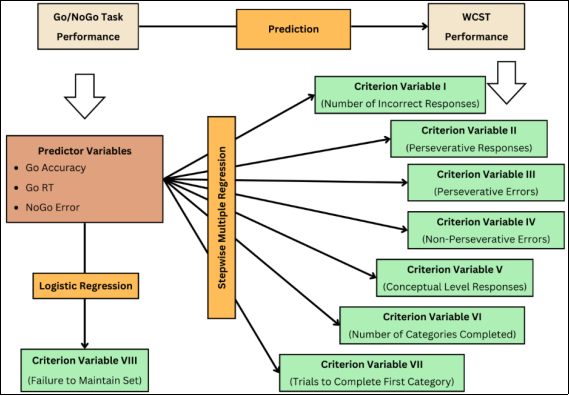
Design: The study was conducted following a predictive design
| [38] | van Witteloostuijn, A., Vanderstraeten, J., Slabbinck, H., Dejardin, M., Hermans, J., and Coreynen, W. (2022). From explanation of the past to prediction of the future: A comparative and predictive research design in the Social Sciences. Social Sciences and Humanities Open, 6(1), 100269.
https://doi.org/10.1016/j.ssaho.2022.100269 |
[38]:
Figure 2. Research Design and Statistics.
Tools: The participants were screened for handedness using the Edinburgh Handedness Inventory
and for general cognitive functioning using the Raven’s Standard Progressive Matrices
| [31] | Raven, J. C. (1936). Mental tests used in genetic, The performance of related indiviuals on tests mainly educative and mainly reproductive. MSC thesisUniv London. |
[31]
. Based on the results the only right-handed participants and the ones with ≤ Grade III ("intellectually average”) were considered for the study.
They had to perform two major neuro-cognitive tasks – Go/NoGo task and the Wisconsin Card Sorting Test.
The former was designed on PsychoPy based on the integrated neuropsychological test battery of attentional performances (TAP;
| [41] | Zimmermann, P., and Fimm, B. (2007). TAP: Testbatterie zur Aufmerksamkeitspru¨fung (Version 2.1). [TAP: Testbattery of attentional performances (version 2.1)]. Herzogenrath, Germany: Psytest. |
[41]
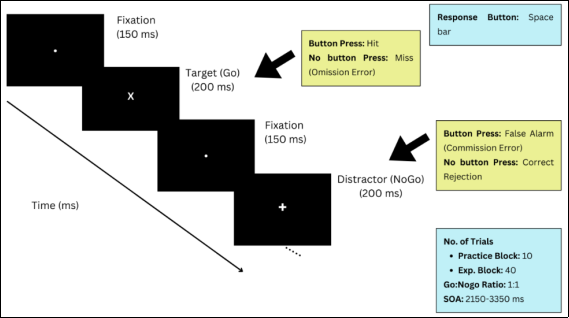
). The nature of the Go and NoGo stimuli remain constant throughout the test, making it a comparatively simple task for the participants to follow. The Go stimulus was a cross symbol (x), while the NoGo stimulus was a plus sign (+). The participants were initially shown a welcome screen that included basic details such as the names and designations of the authors, along with the purpose of the study. Following the welcome page, the participants were shown the instructions. It was made sure that the instructions were properly understood. Further, after reading the instructions, the participants had to perform the task in a practice block to make them familiar with the stimuli and the task in general. A fixation point (a dot) was presented on the screen for 150 milliseconds, followed by the stimulus for 200 milliseconds, during which the participants had to respond (for go stimuli) and remain passive (for nogo stimuli). The practice block consisted of 10 trials (5 go, 5 nogo), and the stimulus onset asynchrony varied between 2150 milliseconds and 3350 milliseconds. After completing the practice block, the participants were allowed to relax and begin the experimental block with the same task specifications (fixation time, stimulus presentation time, SOA, Go/NoGo ratio, etc.) The only difference was that the number of trials was increased to 40 trials (20 go, 20 nogo).
Figure 3 provides a schematic framework of the task build using PsychoPy.
Figure 3. Go/NoGo Task Design.
The Wisconsin Card Sorting Test (WCST) is one of the most widely utilized assessments for evaluating frontal lobe function in both clinical and research settings
| [35] | Strauss, E., Sherman, E. M., & Spreen, O. (2006). A compendium of neuropsychological tests: Administration, norms, and commentary. American chemical society. |
[35]
. The subject receives a set of 64 response cards, which can be categorized by color, shape, and number. The task is to match each response card to one of the four stimulus cards and receive feedback on the correctness of the match. This task requires establishing cognitive sets, such as sorting by color, which measures abstraction ability. Once a set is established, the subject must maintain it in response to positive feedback and shift to a new set following negative feedback. The WCST thus provides insights into various aspects of executive function beyond mere task success or failure. Key performance indices include the number of categories achieved (sequences of consecutive correct sorts), the number of perseverative errors (failures to shift sets in response to negative feedback), and the number of set-loss errors (failures to maintain sets in response to positive feedback). Several abbreviated versions of the WCST have been introduced, each with its own merits for specific situations. However, the 64-card version (WCST-64) stands out as the most logical and practical short form
.
Procedure
The data was collected from the participants at the Department of Psychology, University of Calcutta, by scheduling laboratory sessions at their convenience from 15
th March to 15
th May 2024. Before scheduling their session, the electronic version of an informed consent form (ICF) was sent to the participants, including details about the study, what they would need to do, and their time commitments along with their socio-demographic details. Upon arrival, the participants needed to undergo screening for “general cognitive ability”
through the Raven’s (Standard) Progressive Matrices and “handedness” using the Edinburgh Handedness Inventory. The EHI and RSPM response sheets were saved to calculate the Laterality Quotient (LQ) and RSPM scores (Number of Correct Responses) for general cognitive ability, respectively. After screening, they had to complete the Go/Nogo task and WCST. The order of administration of the Go/Nogo task and WCST was randomized across participants to reduce the order effect. The WCST sheets were retained to calculate different WCST parameters. The Go/Nogo task performance was auto-recorded by PsychoPy in comma-separated-values (.csv) format. The participants were allowed to rest in between tasks. The total duration of all the tasks involved was approximately 45-75 minutes per participant. After completing the tasks, the participants were thanked for participating in the study. Scoring for the different tasks (Edinburgh Handedness Inventory, Raven’s Standard Progressive Matrices and the Wisconsin Card Sorting Test) were done manually and the Go/Nogo task scores were calculated from the dot-csv files saved.
Data Analysis
There were a total of 12 variables (3 from Go/Nogo as predictors; rest from WCST) considered for the study. The descriptive analyses were conducted in IBM SPSS Statistics 25 and tabulated (
Table 1) which included the N (number of observations), Minimum, Maximum, Mean and Standard Deviation for each observation.
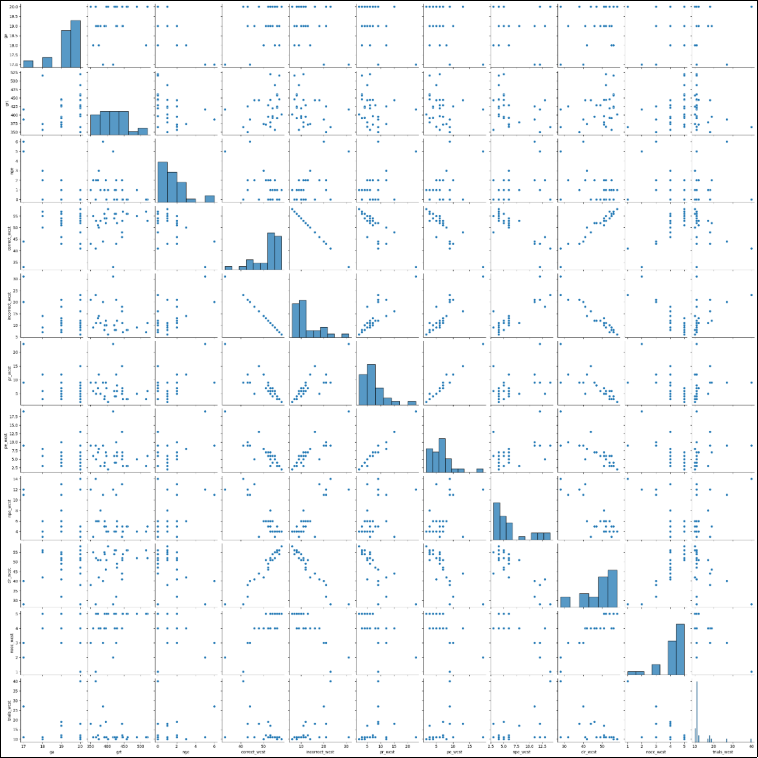
A pairplot was created using the
matplotlib (a comprehensive library for creating static, animated, and interactive visualizations in Python) (
Figure 4) for all the 11 variables (ftms_wcst was excluded as it is scored as a dichotomous variable). A total of eight regression models were computed in IBM SPSS Statistics 25 to answer the concerned research questions. They differed in terms of their criteria. The predictors were same (three Go/Nogo Task variables – Go Accuracy, Go Reaction Time, Nogo Errors) for all the WCST criteria. The following points are important to be noted: -
1) According to the scoring manual of WCST, both correct_wcst and incorrect_wcst are scored, but only the incorrect_wcst was considered for analyses, since both these variables have a perfect negative correlation (r= -1.00, p < 0.01).
2) The first seven criteria are scored as continuous measurement variables, hence stepwise multiple regression analyses were performed on them. On the other hand, the last criterion was scored as a dichotomous categorical variable (success or failure in maintaining a set), which necessitated the usage of a logistic regression.
3. Results
Table 1. Descriptive Statistics.
Continuous Measurement Variables |
Variables | N | Minimum | Maximum | Mean | Std. Dev |
ga | 30 | 17.00 | 20.00 | 19.2333 | .89763 |
grt | 30 | 350.00 | 520.00 | 418.7333 | 43.68140 |
nge | 30 | .00 | 6.00 | 1.1667 | 1.46413 |
correct_wcst | 30 | 33.00 | 58.00 | 51.4667 | 5.74596 |
incorrect_wcst | 30 | 6.00 | 31.00 | 12.5333 | 5.74596 |
pr_wcst | 30 | 2.00 | 23.00 | 6.8667 | 4.31304 |
pe_wcst | 30 | 2.00 | 19.00 | 6.2667 | 3.48329 |
npe_wcst | 30 | 3.00 | 14.00 | 6.2667 | 3.20488 |
clr_wcst | 30 | 28.00 | 58.00 | 48.5667 | 8.39410 |
nocc_wcst | 30 | 1.00 | 5.00 | 4.2333 | 1.00630 |
trials_wcst | 30 | 10.00 | 40.00 | 13.3667 | 6.25043 |
Categorical Variables |
Variables | N | Frequency of Success | Frequency of Failure |
ftms_wcst* | 30 | 7 | 23 |
Please note that “Success” does not refer to a success in maintaining the set. It refers to success in occurrence of a failure to maintain set, since it is the failure to maintain set, which is scored in WCST.
Further, quite a number of pairs of variables have statistically significant positive correlation coefficients. These include nge and pr_wcst, nge and pe_wcst, nge and npe_wcst, correct_wcst and clr_wcst, correct_wcst and nocc_wcst, pr_wcst and pe _wcst, pe_wcst and npe_wcst, npe_wcst and trials_wcst, clr_wcst and nocc_wcst (significant at α=0.01) ga and correct_wcst, grt and nocc_wcst, pr_wcst and npe_wcst (significant at α=0.05). Other pairs of variables have statistically significant negative correlation coefficients. These include ga and nge_wcst, nge and correct_wcst, nge and clr_wcst, correct_wcst and pr_wcst, correct_wcst and pe_wcst, correct_wcst and npe_wcst, correct_wcst and trials _wcst, pr_wcst and clr_wcst, pr_wcst and nocc_wcst, pe_wcst and clr_wcst, pe_wcst and nocc_wcst, npe_wcst and clr_wcst, npe_wcst and nocc_wcst, clr_wcst and trials_wcst, nocc_wcst and trials_wcst (significant at α=0.01); and ga and pr_wcst, ga and pe_wcst, grt and nge, nge and nocc_wcst (significant at α=0.05).
The remaining bivariate correlation coefficients were found not to be statistically significant.
Figure 4. Matrix Pair Plot (11 x 11).
Regression Analysis: Eight regression models were computed to address research questions - stepwise multiple regression for continuous variables and binary logistic regression for a categorical criterion.
Stepwise Multiple Regression: We had seven continuous criteria, for each of which, a regression model was constructed following the stepwise method – with ga, grt and nge and predictors. The seven criteria were incorrect_wcst, pr_wcst, pe_wcst, npe_wcst, clr_wcst, nocc_wcst and trials_wcst.
Table 2. Summary table of Stepwise Regression Models for all Continuous Criteria.
Criterion | Predictor | Model |
Included | Beta (β) | t | F | Adjusted R Square |
incorrect_wcst | nge | 0.567 | 3.642** | 13.267** | 0.297 |
pr_wcst | nge | 0.517 | 3.195** | 10.211** | 0.241 |
pe_wcst | nge | 0.498 | 3.039** | 9.238** | 0.221 |
npe_wcst | nge | 0.475 | 2.858** | 8.168** | 0.198 |
clr_wcst | nge | -0.471 | -2.825** | 7.978** | 0.222 |
nocc_wcst | nge | -0.425 | -2.486* | 6.179* | 0.152 |
trials_wcst | none | N/A | N/A | N/A | N/A |
* p < 0.05
Table 2 presents a detailed summary of the stepwise regression models for all continuous criteria. For each criterion, the table provides the β coefficient, t-value, F-value, and adjusted R-squared value, illustrating the strength and significance of the predictor. In Stepwise Multiple Regression, the "Variables Included" refers to the predictors selected by the automated procedure based on their statistical contribution to predicting the dependent variable, typically through addition or removal based on predetermined criteria like p-values. Based on the results presented in
Table 2, we can make decisions regarding the hypotheses H
0(1) through H
0(7) as follows:
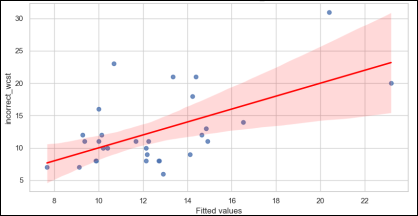
H0(1) is rejected.
'nge' significantly predicts the number of incorrect responses in the WCST (β = 0.567, t = 3.642, F = 13.267, Adjusted R-squared = 0.297, p < 0.01).
Figure 5. Regression plot for incorrect_wcst.
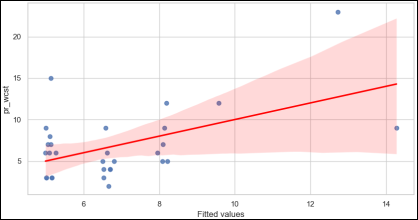
H0(2) is rejected.
'nge' significantly predicts the number of perseverative responses in the WCST (β = 0.517, t = 3.195, F = 10.211, Adjusted R-squared = 0.241, p < 0.01).
Figure 6. Regression plot for pr_wcst.
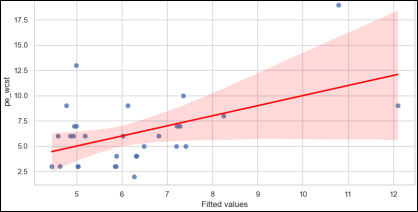
H0(3) is rejected.
'nge' significantly predicts the number of perseverative errors in the WCST (β = 0.498, t = 3.039, F = 9.238, Adjusted R-squared = 0.221, p < 0.01).
Figure 7. Regression plot for pe_wcst.
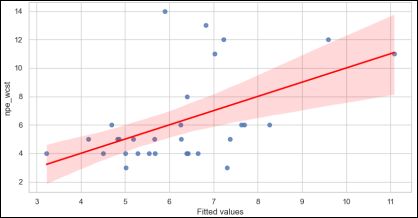
H0(4) is rejected.
'nge' significantly predicts the number of non-perseverative errors in the WCST (β = 0.475, t = 2.858, F = 8.168, Adjusted R-squared = 0.198, p < 0.01).
Figure 8. Regression plot for npe_wcst.
H0(5) is rejected.
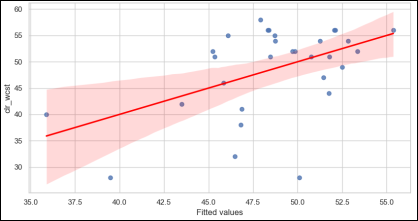
'nge' significantly predicts the number of conceptual level responses in the WCST (β = -0.471, t = -2.825, F = 7.978, Adjusted R-squared = 0.222, p < 0.01).
Figure 9. Regression plot for clr_wcst.
H0(6) is rejected.
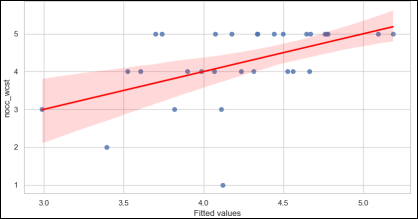
'nge' significantly predicts the number of categories completed in the WCST (β = -0.425, t = -2.486, F = 6.179, Adjusted R-squared = 0.152, p < 0.05).
Figure 10. Regression plot for nocc_wcst.
H0(7) is retained.
No significant predictors were found for the number of trials required to complete the first category in the WCST, as indicated by the model being non-applicable (N/A).
The results highlight the predictive power of 'nge' across multiple criteria, with varying degrees of explained variance as indicated by the adjusted R-squared values.
Binary Logistic Regression: Binary logistic regression was conducted for the categorical criterion variable, ftms_wcst using the Forward method (Wald) – with ga, grt and nge and predictors.
Starting with an empty model, variables are iteratively included if their Wald statistic meets a predefined criterion (such as a significance level of p < 0.05), indicating they contribute significantly to the model's predictive power. This automated approach continues until no additional variables meet the inclusion criterion.
Table 3. Logistic Regression Model for “Failure to Maintain Set” (ftms_wcst).
Model Summary |
Step | -2 Log likelihood | Cox & Snell R Square | Nagelkerke R Square |
1 | 26.029a | .197 | .297 |
a. Estimation terminated at iteration number 6 because parameter estimates changed by less than .001. |
Hosmer and Lemeshow Test |
Step | Chi-square | df | Sig. |
1 | 3.343 | 8 | .911 |
Classification Tablea |
| Observed | Predicted |
| ftms_wcst | Percentage Correct |
| 0.00 | 1.00 |
Step 1 | ftms_wcst | 0.00 | 21 | 2 | 91.3 |
1.00 | 5 | 2 | 28.6 |
Overall Percentage | | | 76.7 |
a. The cut value is .500 |
Variables in the Equation |
| B | S.E. | Wald | df | Sig. | Exp(B) |
Step 1a | grt | -.034 | .016 | 4.435 | 1 | .035 | .966 |
Constant | 12.743 | 6.468 | 3.881 | 1 | .049 | 342017.571 |
a. Variable(s) entered on step 1: grt. |
The model revealed that Go RT (grt) emerged as a statistically significant predictor (Wald = 4.435, df = 1, p < 0.05, Exp(B) = 0.966) of failure to maintain set, while Go Accuracy (ga) and Nogo Errors (nge) were not included in the final model.
The Nagelkerke R Square for the model was 0.297 - the predictors collectively explain a moderate amount (about 30%) of variance in the likelihood of failure to maintain set.
The Hosmer-Lemeshow goodness-of-fit test yielded a chi-square value of 3.343 with 8 degrees of freedom and a non-significant p-value (p=0.911), suggesting good model fit.
The classification table shows the performance of the model in predicting failure to maintain set. Overall, the model correctly classified 76.7% of cases, with 91.3% accuracy for predicting success in maintaining set (Specificity) and 28.6% accuracy for predicting failure to maintain set (Sensitivity). This is a decent level of accuracy overall. However, the low sensitivity suggests that the model may not be reliable in identifying positive cases.
Therefore, based on these results, we reject H0(8). The Go/NoGo task, particularly Go RT (grt), significantly predicts the probability of failure to maintain set during the WCST, as evidenced by its statistically significant coefficient in the logistic regression model.
4. Discussion
The overarching objective of the present study was to see how much of executive functions in the Wisconsin Card Sorting Test (WCST) could be accounted for by inhibitory cognitive control mechanisms, assessed through a typical Go/Nogo task. In doing so, we considered different criterion variables of the WCST, and three predictors, or indices from the Go/Nogo task –
1)
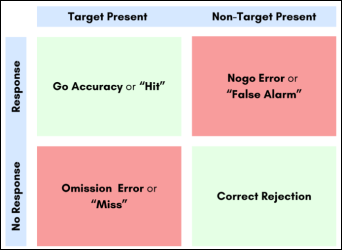
Go Accuracy, or how accurately participants identified and responded correctly to all the “Go” trials. This index is the complement of omission error i.e., number of “Go” trials, missed by the participants. As per the Signal Detection Framework, the “Go Accuracy” refers to the “Hit” and omission errors refer to the “Miss” (
Figure 11).
2)
Go Reaction Time, or the average reaction time across all the “Hit” trials. Reaction time is considered as an index of processing speed, or the speed of performing mental (and hence, neural) operations
| [4] | Buckhalt, J. A. (1991). Reaction time measures of processing speed: Are they yielding new information about intelligence?. Personality and Individual Differences, 12(7), 683-688.
https://doi.org/10.1016/0191-8869(91)90223-X |
[4]
. It is different from reflex actions, so to say, in terms of the complexity of conscious higher order neural processing associated with the former.
3)
Nogo Errors, or what is commonly known as commission errors (or, “False Alarms” according to the Signal Detection system) (
Figure 11), is the primary index for behavioural inhibition
| [1] | Aron, A. R., & Poldrack, R. A. (2005). The cognitive neuroscience of response inhibition: relevance for genetic research in attention-deficit/hyperactivity disorder. Biological psychiatry, 57(11), 1285-1292.
https://doi.org/10.1016/j.biopsych.2004.10.026 |
[1]
.
Figure 11. Go/Nogo Indices in the Signal Detection Framework.
Number of Incorrect Responses (incorrect_wcst): The total number of incorrect responses is a summation of the two major kinds of errors in WCST – perseverative and non-perseverative. Our findings reveal that Nogo errors (nge) is positively associated with this, and in fact, explains almost 30% (Adjusted R square = 0.297) of variation in the total number of errors/incorrect responses. This significant proportion of explained variance highlights the strong relationship between inhibitory control, as assessed by the Nogo task, and overall error rates in the WCST. Nogo errors reflect failures in inhibitory control
| [1] | Aron, A. R., & Poldrack, R. A. (2005). The cognitive neuroscience of response inhibition: relevance for genetic research in attention-deficit/hyperactivity disorder. Biological psychiatry, 57(11), 1285-1292.
https://doi.org/10.1016/j.biopsych.2004.10.026 |
[1]
, and suggest that individuals who struggle with inhibition are more likely to make both perseverative and non-perseverative (random) errors, on the WCST.
Perseverative Errors (pe_wcst): Perseverative errors are regarded as the main metric of frontal dysfunction
and our findings revealed that nge predicted about 22% of variations of perseverative errors (Adjusted R square = 0.221) with a moderately positive association, hence, nge has a significant capability to predict frontal dysfunction. Neurocognitive models of working memory offer a valuable conceptual framework for interpreting WCST errors associated with frontal dysfunction
| [18] | Kimberg, D. Y., & Farah, M. J. (1993). A unified account of cognitive impairments following frontal lobe damage: the role of working memory in complex, organized behavior. Journal of Experimental Psychology: General, 122(4), 411. |
| [19] | Knight, R. T., Staines, W. R., Swick, D., & Chao, L. L. (1999). Prefrontal cortex regulates inhibition and excitation in distributed neural networks. Acta psychologica, 101(2-3), 159-178. https://doi.org/10.1016/S0001-6918(99)00004-9 |
[18, 19]
. Working memory enables individuals to fluidly shift their mental set backward and forward in time to plan and execute subsequent actions. Ideally, a subject would maintain recent information online while discarding now-irrelevant categories, selecting one of the two remaining categories in the context of the WCST. If a previously established set rigidly determines the response in the early trials of a new series despite disconfirming feedback (i.e., exhibiting a "stuck-in-set" tendency,
), this may indicate an inability to shift sets. This difficulty in set-shifting arises from a failure to inhibit the previously formed set and initiate a new one by incorporating updated feedback into the cognitive system. This process involves the utilization of all three executive functions identified by Miyake et al., (2000): shifting, updating, and inhibition.
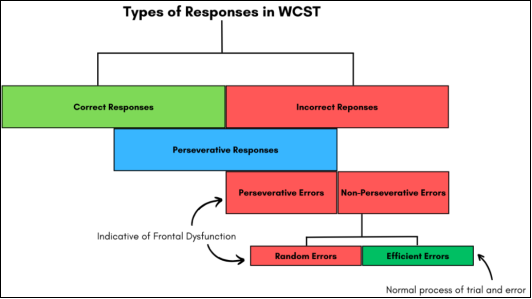
Non-perseverative Errors (npe_wcst): It is really thought that a certain amount of npe_wcst is desirable, where participants are forced to make non-perseverative mistakes in order to figure out what the next correct sorting rule is. For normal subjects, this is a very effective process of trial and error since they can quickly learn the new correct rule by remembering the previous incorrect ones. In addition to this, there are other types of non-perseverative errors (
Figure 12), which entail a change in set in addition to an ineffective utilization of previous contextual knowledge. One instance might be if the sorting rule is consistently ignored, or if there is only one single mistake in an otherwise coherent sequence like in case of a distraction error
which are more likely associated with errors of commission. Computational models of prefrontal function consider non-perseverative errors to be a significant deficit in patients with prefrontal damage, alongside perseverative response tendencies. Generally, the cognitive deficits believed to contribute to non-perseverative errors are linked to the strength and management of working memory representations
| [18] | Kimberg, D. Y., & Farah, M. J. (1993). A unified account of cognitive impairments following frontal lobe damage: the role of working memory in complex, organized behavior. Journal of Experimental Psychology: General, 122(4), 411. |
[18]
. Disruptions in cognitive components such as inhibition, task management, and monitoring
may all contribute to the occurrence of non-perseverative errors, thus confirming our findings.
While acknowledging the significance of perseverative errors, Barceló and Knight (2002) proposed that nonperseverative errors that happen randomly could also be a factor in PFC patients' deficiencies. Disinhibition is seen in the majority of their patients' difficulties keeping their attention on the newly relevant category when presented with distracting stimulus features.
Figure 12. Different types of responses in WCST.
Conceptual Level Responses (clr_wcst): According to the WCST-64 professional manual, conceptual level responses are named so, because there is a presumption that, to produce consecutive correct responses in runs of three or more, an individual would require some insight into the correct sorting category. Identifying the correct sorting category requires a significant degree of abstract intellectual functioning
| [28] | Perrine, K. (1993). Differential aspects of conceptual processing in the Category Test and Wisconsin Card Sorting Test. Journal of Clinical and Experimental Neuropsychology, 15(4), 461-473. https://doi.org/10.1080/01688639308402571 |
[28]
and the PFC has been associated with the maintenance of information at different levels of abstraction: from highly abstract task contexts, like the WCST, to concrete information, like specific objects and perceptual features (e.g.,
| [12] | Goldman-Rakic, P. S. (1987). Development of cortical circuitry and cognitive function. Child development, 601-622. |
[12]
). Our findings reveal that inhibitory control, which is also a PFC function, explains around 23% of variation in clr_wcst (Adjusted R-square = 0.222), which can be explained by the common neuroanatomical substrate of both constructs and is aligned to research by Chen et al. (2019) - cognitive control was more strongly associated with fluid intelligence—which is related to the capacity for problem-solving through abstraction, as in producing conceptual level responses—than with crystallized intelligence, which is related to learning from past experiences and knowledge
| [5] | Chen, Y., Spagna, A., Wu, T., Kim, T. H., Wu, Q., Chen, C.,... & Fan, J. (2019). Testing a cognitive control model of human intelligence. Scientific reports, 9(1), 2898.
https://doi.org/10.1038/s41598-019-39685-2 |
[5]
.
Number of Categories Completed (nocc_wcst): Also considered as an indicator of frontal lobe pathology like perseverative errors
, the nocc_wcst has a moderate negative association with nge according to our findings, meaning, as the number of nogo errors increase, participants are found to complete lesser number of categories. Additionally, the regression model explains about 15% of variations in the nocc_wcst (Adjusted R-square = 0.152). Hence, problems related to inhibitory control lead to higher error rates in WCST performance, which automatically reduce the number of attempts left (out of 64 attempts for WCST-64) to complete a series of 10 consecutive correct responses, and thus leading to a situation of inability to complete higher number of categories.
Failure to Maintain Set (ftms_wcst): Numerous researchers have advocated for the use of FTMS as a valid gauge of cognitive function, although its interpretation may vary
| [10] | Figueroa, I. J., & Youmans, R. J. (2013). Failure to maintain set: A measure of distractibility or cognitive flexibility?. In Proceedings of the human factors and ergonomics society annual meeting (Vol. 57, No. 1, pp. 828-832). Sage CA: Los Angeles, CA: Sage Publications.
https://doi.org/10.1177/1541931213571180 |
[10]
. Some contend that FTMS serves as an indicator of distractibility, indicating an individual's struggle to sustain concentration on a given task
| [3] | Barceló, F., & Knight, R. T. (2002). Both random and perseverative errors underlie WCST deficits in prefrontal patients. Neuropsychologia, 40(3), 349-356.
https://doi.org/10.1016/S0028-3932(01)00110-5 |
| [6] | Crone, E. A., Richard Ridderinkhof, K., Worm, M., Somsen, R. J., & Van Der Molen, M. W. (2004). Switching between spatial stimulus–response mappings: a developmental study of cognitive flexibility. Developmental science, 7(4), 443-455. https://doi.org/10.1111/j.1467-7687.2004.00365.x |
[3, 6]
. Conversely, others propose that the factors assessed within the WCST are not entirely independent, suggesting that FTMS might be closely linked to cognitive flexibility. This refers to the ability to adeptly switch strategies when confronted with changing environmental stimuli
| [14] | Greve, K. W., Love, J. M., Sherwin, E., Mathias, C. W., Ramzinski, P., & Levy, J. (2002). Wisconsin Card Sorting Test in chronic severe traumatic brain injury: Factor structure and performance subgroups. Brain Injury, 16(1), 29-40.
https://doi.org/10.1080/0269905011008803 |
| [15] | Greve, K. W., Stickle, T. R., Love, J. M., Bianchini, K. J., & Stanford, M. S. (2005). Latent structure of the Wisconsin Card Sorting Test: a confirmatory factor analytic study. Archives of Clinical Neuropsychology, 20(3), 355-364.
https://doi.org/10.1016/j.acn.2004.09.004 |
| [40] | Zabelina, D. L., & Robinson, M. D. (2010). Creativity as flexible cognitive control. Psychology of Aesthetics, Creativity, and the Arts, 4(3), 136. https://doi.org/10.1037/a0017379 |
[14, 15, 40]
. Figueroa and Youmans (2013) investigated this issue and concluded that FTMS evaluates distractibility rather than cognitive flexibility.
Our results show that almost 30% (Nagelkerke R-square = 0.297) of variance in FTMS, was explained by grt, which is an index of processing speed that is parallel with is some very recent literature especially on clinical cases (e.g., in patients recovering from stroke), that link processing speed with cognitive flexibility (e.g.,
| [37] | Tsiakiri, A., Christidi, F., Tsiptsios, D., Vlotinou, P., Kitmeridou, S., Bebeletsi, P.,... & Vadikolias, K. (2024). Processing Speed and Attentional Shift/Mental Flexibility in Patients with Stroke: A Comprehensive Review on the Trail Making Test in Stroke Studies. Neurology International, 16(1), 210-225. https://doi.org/10.3390/neurolint16010014 |
[37]
). Post-stroke cognitive impairment often involves deficits in processing speed, attention, and cognitive flexibility
| [17] | Jaillard, A., Naegele, B., Trabucco-Miguel, S., LeBas, J. F., & Hommel, M. (2009). Hidden dysfunctioning in subacute stroke. Stroke, 40(7), 2473-2479.
https://doi.org/10.1161/STROKEAHA.108.541144 |
| [32] | Renjen, P. N., Gauba, C., & Chaudhari, D. (2015). Cognitive impairment after stroke. Cureus, 7(9).
https://doi.org/10.7759/cureus.335 |
[17, 32]
. Frontal lesions, common in stroke, frequently lead to executive dysfunction, exacerbating cognitive deficits
| [16] | Han, M., Kim, D. Y., Leigh, J. H., & Kim, M. W. (2020). Value of the frontal assessment battery tool for assessing the frontal lobe function in stroke patients. Annals of rehabilitation medicine, 44(4), 261. https://doi.org/10.5535/arm.19111 |
[16]
. Reduced processing speed is a primary contributor to post-stroke cognitive dysfunction, while executive dysfunction, a facet of cognitive flexibility, significantly impacts patients' quality of life
| [36] | Su, C. Y., Wuang, Y. P., Lin, Y. H., & Su, J. H. (2015). The role of processing speed in post-stroke cognitive dysfunction. Archives of Clinical Neuropsychology, 30(2), 148-160. https://doi.org/10.1093/arclin/acu057 |
[36]
.
5. Conclusion
Our study examined the predictive relationship between inhibitory control abilities, as assessed by the Go/Nogo Task, and executive functions, particularly inhibitory control, as measured by the Wisconsin Card Sorting Test-64 (WCST-64). Contrary to the null hypotheses, significant associations were found between Go/Nogo performance and key executive function metrics in the WCST-64. This proves that a Go/Nogo task can significantly predict WCST performance. The WCST factor structure is clarified in part by this study. We shed light on how multiple facets of cognitive control interact within the WCST framework by analyzing the predicted link between executive functioning measures in the WCST-64 and inhibitory control abilities measured by the Go/NoGo Task (GNGT).
6. Future Directions and Implications
The Go/Nogo Task has potential as a quicker and less time-consuming frontal pathology assessment tool than the Wisconsin Card Sorting Test (WCST). Although the WCST-64 is a neuropsychological test that is frequently used to evaluate executive functioning, administering it might require a lot of time and resources. We provide empirical support for the usefulness of the Go/NoGo task as a proxy measure for evaluating inhibitory control and related cognitive processes by indicating substantial relationships between performance on the task and different indices of executive functioning in the WCST-64. However, the version of the Go/Nogo task that we have used, although is a standardized task from a battery of cognitive performances that had been validated, is just one of the various possible types of Go/Nogo that are used in research. The findings may or may not be similar across other variations in the Go/Nogo paradigm because there are differences in the processing of information in the nervous system in different variations. Future research could enhance the current study by employing advanced statistical techniques such as latent-variable analyses, confirmatory factor analyses, and structural equation modeling to uncover the nuances of inhibitory control in Wisconsin Card Sorting Test (WCST) performance and to elucidate the overall factor structure of the WCST.
Additionally, electrophysiological comparisons, such as quantitative electroencephalography (qEEG) or event-related potentials (ERP), between tasks like Go/No-Go and Stop-Signal could be valuable. These methods offer high temporal resolution and could improve our understanding of the predictive relationship between these tasks and WCST performance. Extending this research into functional imaging studies using modalities such as functional magnetic resonance imaging (fMRI) or positron emission tomography (PET) could provide insights into the spatial metabolic aspects of response inhibition in WCST and highlight differences among various inhibitory control tasks.
Abbreviations
correct_rspm | Number of Correct Responses (RSPM) |
ga | Go Accuracy |
grt | Go Reaction Time (ms) |
nge | NoGo Error |
correct_wcst | Number of Correct Responses (WCST) |
incorrect_wcst | Number of Incorrect Responses (WCST) |
pr_wcst | Perseverative Responses (WCST) |
pe_wcst | Perseverative Errors (WCST) |
npe_wcst | Non-Perseverative Errors (WCST) |
clr_wcst | Conceptual Level Responses |
nocc_wcst | Number of Categories Completed |
trials_wcst | Number of Trials to complete First Category |
ftms_wcst | Failure to Maintain Set |
Acknowledgments
We thank the Department of Psychology and the Centre with Potential for Excellence in a Particular Area (CPEPA), University of Calcutta for providing us with the access to the tools and software needed to collect and analyze data with ease.
Author Contributions
Arinjoy Bhattacharjee: Conceptualization, Data curation, Formal Analysis, Investigation, Methodology, Resources, Software, Visualization, Writing – original draft
Sanjukta Das: Conceptualization, Methodology, Resources, Supervision, Writing – review & editing
Data Availability Statement
The data that support the findings of this study are available on reasonable request from the corresponding author.
Conflicts of Interest
The authors declare no known conflicts of interest.
References
| [1] |
Aron, A. R., & Poldrack, R. A. (2005). The cognitive neuroscience of response inhibition: relevance for genetic research in attention-deficit/hyperactivity disorder. Biological psychiatry, 57(11), 1285-1292.
https://doi.org/10.1016/j.biopsych.2004.10.026
|
| [2] |
Baggetta, P., and Alexander, P. A. (2016). Conceptualization and operationalization of executive function. Mind, Brain, and Education, 10(1), 10-33.
https://doi.org/10.1111/mbe.12100
|
| [3] |
Barceló, F., & Knight, R. T. (2002). Both random and perseverative errors underlie WCST deficits in prefrontal patients. Neuropsychologia, 40(3), 349-356.
https://doi.org/10.1016/S0028-3932(01)00110-5
|
| [4] |
Buckhalt, J. A. (1991). Reaction time measures of processing speed: Are they yielding new information about intelligence?. Personality and Individual Differences, 12(7), 683-688.
https://doi.org/10.1016/0191-8869(91)90223-X
|
| [5] |
Chen, Y., Spagna, A., Wu, T., Kim, T. H., Wu, Q., Chen, C.,... & Fan, J. (2019). Testing a cognitive control model of human intelligence. Scientific reports, 9(1), 2898.
https://doi.org/10.1038/s41598-019-39685-2
|
| [6] |
Crone, E. A., Richard Ridderinkhof, K., Worm, M., Somsen, R. J., & Van Der Molen, M. W. (2004). Switching between spatial stimulus–response mappings: a developmental study of cognitive flexibility. Developmental science, 7(4), 443-455.
https://doi.org/10.1111/j.1467-7687.2004.00365.x
|
| [7] |
Delis, D. C., Kaplan, E., & Kramer, J. H. (2001). Delis-Kaplan executive function system. Assessment.
https://doi.org/10.1037/t15082-000
|
| [8] |
Eagle, D. M., Bari, A., & Robbins, T. W. (2008). The neuropsychopharmacology of action inhibition: cross-species translation of the stop-signal and go/no-go tasks. Psychopharmacology, 199, 439-456.
https://doi.org/10.1007/s00213-008-1127-6
|
| [9] |
Eling, P., Derckx, K., & Maes, R. (2008). On the historical and conceptual background of the Wisconsin Card Sorting Test. Brain and cognition, 67(3), 247-253.
https://doi.org/10.1016/j.bandc.2008.01.006
|
| [10] |
Figueroa, I. J., & Youmans, R. J. (2013). Failure to maintain set: A measure of distractibility or cognitive flexibility?. In Proceedings of the human factors and ergonomics society annual meeting (Vol. 57, No. 1, pp. 828-832). Sage CA: Los Angeles, CA: Sage Publications.
https://doi.org/10.1177/1541931213571180
|
| [11] |
Gamboz, N., Borella, E., & Brandimonte, M. A. (2009). The role of switching, inhibition and working memory in older adults' performance in the Wisconsin Card Sorting Test. Aging, Neuropsychology, and Cognition, 16(3), 260-284.
https://doi.org/10.1080/13825580802573045
|
| [12] |
Goldman-Rakic, P. S. (1987). Development of cortical circuitry and cognitive function. Child development, 601-622.
|
| [13] |
Greve, K. W. (2001). The WCST-64: A standardized short-form of the Wisconsin Card Sorting Test. The Clinical Neuropsychologist, 15(2), 228-234.
https://doi.org/10.1076/clin.15.2.228.1901
|
| [14] |
Greve, K. W., Love, J. M., Sherwin, E., Mathias, C. W., Ramzinski, P., & Levy, J. (2002). Wisconsin Card Sorting Test in chronic severe traumatic brain injury: Factor structure and performance subgroups. Brain Injury, 16(1), 29-40.
https://doi.org/10.1080/0269905011008803
|
| [15] |
Greve, K. W., Stickle, T. R., Love, J. M., Bianchini, K. J., & Stanford, M. S. (2005). Latent structure of the Wisconsin Card Sorting Test: a confirmatory factor analytic study. Archives of Clinical Neuropsychology, 20(3), 355-364.
https://doi.org/10.1016/j.acn.2004.09.004
|
| [16] |
Han, M., Kim, D. Y., Leigh, J. H., & Kim, M. W. (2020). Value of the frontal assessment battery tool for assessing the frontal lobe function in stroke patients. Annals of rehabilitation medicine, 44(4), 261.
https://doi.org/10.5535/arm.19111
|
| [17] |
Jaillard, A., Naegele, B., Trabucco-Miguel, S., LeBas, J. F., & Hommel, M. (2009). Hidden dysfunctioning in subacute stroke. Stroke, 40(7), 2473-2479.
https://doi.org/10.1161/STROKEAHA.108.541144
|
| [18] |
Kimberg, D. Y., & Farah, M. J. (1993). A unified account of cognitive impairments following frontal lobe damage: the role of working memory in complex, organized behavior. Journal of Experimental Psychology: General, 122(4), 411.
|
| [19] |
Knight, R. T., Staines, W. R., Swick, D., & Chao, L. L. (1999). Prefrontal cortex regulates inhibition and excitation in distributed neural networks. Acta psychologica, 101(2-3), 159-178.
https://doi.org/10.1016/S0001-6918(99)00004-9
|
| [20] |
Krämer, U. M., Solbakk, A. K., Funderud, I., Løvstad, M., Endestad, T., & Knight, R. T. (2013). The role of the lateral prefrontal cortex in inhibitory motor control. Cortex, 49(3), 837-849.
https://doi.org/10.1016/j.cortex.2012.05.003
|
| [21] |
Littman, R., & Takács, Á. (2017). Do all inhibitions act alike? A study of go/no-go and stop-signal paradigms. PloS one, 12(10), e0186774.
https://doi.org/10.1371/journal.pone.0186774
|
| [22] |
Logan, G. D. (1994). On the ability to inhibit thought and action: A users' guide to the stop signal paradigm.
|
| [23] |
Miller, M. R., Giesbrecht, G. F., Müller, U., McInerney, R. J., and Kerns, K. A. (2012). A latent variable approach to determining the structure of executive function in preschool children. Journal of cognition and development, 13(3), 395-423.
https://doi.org/10.1080/15248372.2011.585478
|
| [24] |
Milner, B. (1963). Effects of different brain lesions on card sorting: The role of the frontal lobes. Archives of neurology, 9(1), 90-100.
https://doi.org/10.1001/archneur.1963.00460070100010
|
| [25] |
Miyake, A., Friedman, N. P., Emerson, M. J., Witzki, A. H., Howerter, A., and Wager, T. D. (2000). The unity and diversity of executive functions and their contributions to complex “frontal lobe” tasks: A latent variable analysis. Cognitive psychology, 41(1), 49-100.
https://doi.org/10.1006/cogp.1999.0734
|
| [26] |
Nyhus, E., & Barceló, F. (2009). The Wisconsin Card Sorting Test and the cognitive assessment of prefrontal executive functions: a critical update. Brain and cognition, 71(3), 437-451.
https://doi.org/10.1016/j.bandc.2009.03.005
|
| [27] |
Oldfield, R. C. (1971). The assessment and analysis of handedness: the Edinburgh inventory. Neuropsychologia, 9(1), 97-113.
https://doi.org/10.1016/0028-3932(71)90067-4
|
| [28] |
Perrine, K. (1993). Differential aspects of conceptual processing in the Category Test and Wisconsin Card Sorting Test. Journal of Clinical and Experimental Neuropsychology, 15(4), 461-473.
https://doi.org/10.1080/01688639308402571
|
| [29] |
Raud, L., Westerhausen, R., Dooley, N., & Huster, R. J. (2020). Differences in unity: The go/no-go and stop signal tasks rely on different mechanisms. NeuroImage, 210, 116582.
https://doi.org/10.1016/j.neuroimage.2020.116582
|
| [30] |
Raven, J. (2003). Raven progressive matrices. In Handbook of nonverbal assessment (pp. 223-237). Boston, MA: Springer US.
https://doi.org/10.1007/978-1-4615-0153-4_11
|
| [31] |
Raven, J. C. (1936). Mental tests used in genetic, The performance of related indiviuals on tests mainly educative and mainly reproductive. MSC thesisUniv London.
|
| [32] |
Renjen, P. N., Gauba, C., & Chaudhari, D. (2015). Cognitive impairment after stroke. Cureus, 7(9).
https://doi.org/10.7759/cureus.335
|
| [33] |
Schachar, R., Logan, G. D., Robaey, P., Chen, S., Ickowicz, A., & Barr, C. (2007). Restraint and cancellation: multiple inhibition deficits in attention deficit hyperactivity disorder. Journal of abnormal child psychology, 35, 229-238.
https://doi.org/10.1007/s10802-006-9075-2
|
| [34] |
Smith, E. E., & Jonides, J. (1999). Storage and executive processes in the frontal lobes. Science, 283(5408), 1657-1661.
https://doi.org/10.1126/science.283.5408.1657
|
| [35] |
Strauss, E., Sherman, E. M., & Spreen, O. (2006). A compendium of neuropsychological tests: Administration, norms, and commentary. American chemical society.
|
| [36] |
Su, C. Y., Wuang, Y. P., Lin, Y. H., & Su, J. H. (2015). The role of processing speed in post-stroke cognitive dysfunction. Archives of Clinical Neuropsychology, 30(2), 148-160.
https://doi.org/10.1093/arclin/acu057
|
| [37] |
Tsiakiri, A., Christidi, F., Tsiptsios, D., Vlotinou, P., Kitmeridou, S., Bebeletsi, P.,... & Vadikolias, K. (2024). Processing Speed and Attentional Shift/Mental Flexibility in Patients with Stroke: A Comprehensive Review on the Trail Making Test in Stroke Studies. Neurology International, 16(1), 210-225.
https://doi.org/10.3390/neurolint16010014
|
| [38] |
van Witteloostuijn, A., Vanderstraeten, J., Slabbinck, H., Dejardin, M., Hermans, J., and Coreynen, W. (2022). From explanation of the past to prediction of the future: A comparative and predictive research design in the Social Sciences. Social Sciences and Humanities Open, 6(1), 100269.
https://doi.org/10.1016/j.ssaho.2022.100269
|
| [39] |
Wiebe, S. A., Sheffield, T., Nelson, J. M., Clark, C. A., Chevalier, N., and Espy, K. A. (2011). The structure of executive function in 3-year-olds. Journal of experimental child psychology, 108(3), 436-452.
https://doi.org/10.1016/j.jecp.2010.08.008
|
| [40] |
Zabelina, D. L., & Robinson, M. D. (2010). Creativity as flexible cognitive control. Psychology of Aesthetics, Creativity, and the Arts, 4(3), 136.
https://doi.org/10.1037/a0017379
|
| [41] |
Zimmermann, P., and Fimm, B. (2007). TAP: Testbatterie zur Aufmerksamkeitspru¨fung (Version 2.1). [TAP: Testbattery of attentional performances (version 2.1)]. Herzogenrath, Germany: Psytest.
|
Cite This Article
-
APA Style
Bhattacharjee, A., Das, S. (2026). The “Inhibition” in “Execution”: Exploring the Predictability of Performance in the Wisconsin Card Sorting Test by the Go/Nogo Paradigm. American Journal of Applied Psychology, 15(4), 115-130. https://doi.org/10.11648/j.ajap.20261504.15
 Copy
|
Copy
|
 Download
ACS Style
Bhattacharjee, A.; Das, S. The “Inhibition” in “Execution”: Exploring the Predictability of Performance in the Wisconsin Card Sorting Test by the Go/Nogo Paradigm. Am. J. Appl. Psychol. 2026, 15(4), 115-130. doi: 10.11648/j.ajap.20261504.15
Copy
|
Download
AMA Style
Bhattacharjee A, Das S. The “Inhibition” in “Execution”: Exploring the Predictability of Performance in the Wisconsin Card Sorting Test by the Go/Nogo Paradigm. Am J Appl Psychol. 2026;15(4):115-130. doi: 10.11648/j.ajap.20261504.15
Copy
|
Download
-
@article{10.11648/j.ajap.20261504.15,
  author = {Arinjoy Bhattacharjee and Sanjukta Das},
  title = {The “Inhibition” in “Execution”: Exploring the Predictability of Performance in the Wisconsin Card Sorting Test by the Go/Nogo Paradigm},
  journal = {American Journal of Applied Psychology},
  volume = {15},
  number = {4},
  pages = {115-130},
  doi = {10.11648/j.ajap.20261504.15},
  url = {https://doi.org/10.11648/j.ajap.20261504.15},
  eprint = {https://article.sciencepublishinggroup.com/pdf/10.11648.j.ajap.20261504.15},
  abstract = {Miyake et al., (2000) categorized executive functions into set shifting, updating and responses inhibition. The Wisconsin Card Sorting Test is understood as a “gold-standard” of executive function tasks, but however, it does not provide information on the different executive processes and treats it as a unifactorial construct. It has been established that set shifting best predict performance in the WCST, but little is known about inhibitory control. We aimed to see if there is any predictive relationship between the assessment of inhibitory control abilities through a Go/Nogo Task and the measurement of executive functions through WCST. Data from the participants (n=30) was collected through a purposive sampling design and was scored manually. Statistical analyses were conducted and the obtained findings were discussed in the light of the existing literature. Our findings reveal that the Nogo Errors had a significant effect in predicting almost 30% of variation in the number of incorrect responses, 24% of variation in the perseverative responses, 22% of variation in the perseverative errors, 20% of variation in the non-perseverative errors, 22% of variation in the conceptual level responses and 15% of variation in the number of categories completed but not number of trials needed to complete the first category; and Go Reaction Time had a significant effect in predicting 30% of variation in the probability of failure to maintain set.},
 year = {2026}
}
Copy
|
Download
-
TY  - JOUR
T1  - The “Inhibition” in “Execution”: Exploring the Predictability of Performance in the Wisconsin Card Sorting Test by the Go/Nogo Paradigm
AU  - Arinjoy Bhattacharjee
AU  - Sanjukta Das
Y1  - 2026/07/28
PY  - 2026
N1  - https://doi.org/10.11648/j.ajap.20261504.15
DO  - 10.11648/j.ajap.20261504.15
T2  - American Journal of Applied Psychology
JF  - American Journal of Applied Psychology
JO  - American Journal of Applied Psychology
SP  - 115
EP  - 130
PB  - Science Publishing Group
SN  - 2328-5672
UR  - https://doi.org/10.11648/j.ajap.20261504.15
AB  - Miyake et al., (2000) categorized executive functions into set shifting, updating and responses inhibition. The Wisconsin Card Sorting Test is understood as a “gold-standard” of executive function tasks, but however, it does not provide information on the different executive processes and treats it as a unifactorial construct. It has been established that set shifting best predict performance in the WCST, but little is known about inhibitory control. We aimed to see if there is any predictive relationship between the assessment of inhibitory control abilities through a Go/Nogo Task and the measurement of executive functions through WCST. Data from the participants (n=30) was collected through a purposive sampling design and was scored manually. Statistical analyses were conducted and the obtained findings were discussed in the light of the existing literature. Our findings reveal that the Nogo Errors had a significant effect in predicting almost 30% of variation in the number of incorrect responses, 24% of variation in the perseverative responses, 22% of variation in the perseverative errors, 20% of variation in the non-perseverative errors, 22% of variation in the conceptual level responses and 15% of variation in the number of categories completed but not number of trials needed to complete the first category; and Go Reaction Time had a significant effect in predicting 30% of variation in the probability of failure to maintain set.
VL  - 15
IS  - 4
ER  -
Copy
|
Download





 Share This Article
 Twitter
 Linked In
 Facebook