
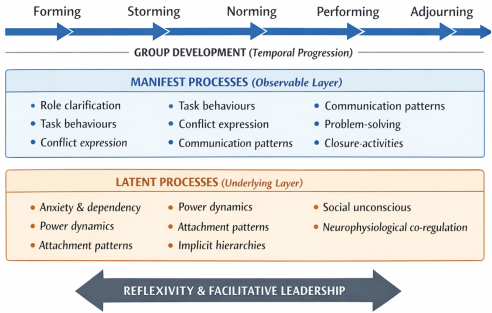
Human behaviour and interactions are complex, encompassing both what is immediately observable and what remains beneath the surface. Understanding these layers is particularly important in group therapeutic settings, where subtle dynamics can significantly influence outcomes. Literature explicitly addressing “manifest and latent processes” in group work remains limited. Most mainstream theories of group development, such as Tuckman’s stages, emphasize overt, measurable behaviours and structured task accomplishment, leaving latent processes, such as unspoken norms, emotional undercurrents, power dynamics, and unconscious motivations, underexplored. Recent trauma-focused group psychotherapy literature highlights this same gap, emphasising how latent relational and neurophysiological processes shape group functioning. This paper examines the interplay of manifest and latent processes in group development, emphasizing the importance of addressing both observable behaviours and hidden dynamics. The author intentionally anchors the conceptual foundation of this paper in classical groupwork theories, such as Tuckman’s stages of group development, Bion’s psychoanalytic insights, Vygotsky’s social constructivism, and the Johari Window due to their enduring relevance and widespread scholarly recognition. Concepts from the social unconscious sphere are also used to expand the understanding of latent dynamics beyond the individual psyche, acknowledging broader societal influences that shape the group space. This conceptual paper critically synthesizes these established and contemporary theories to explore the complex interaction between observable (manifest) and hidden (latent) processes within groupwork. Rather than proposing a new theory, it offers an integrated interpretation of existing scholarship by bringing classical and contemporary perspectives into dialogue. This synthesis advances a more nuanced understanding of group dynamics and highlights practical considerations for facilitation that attends to hidden or unspoken processes through a reflective, multidimensional lens. Practical implications are highlighted. This includes how facilitators can enhance group effectiveness by attending to both observable behaviours and underlying group dynamics, integrating reflective practice and awareness of personal bias to promote trust, psychological safety, and cohesive participation.
| Published in | American Journal of Applied Psychology (Volume 15, Issue 4) |
| DOI | 10.11648/j.ajap.20261504.17 |
| Page(s) | 151-156 |
| Creative Commons |
This is an Open Access article, distributed under the terms of the Creative Commons Attribution 4.0 International License (http://creativecommons.org/licenses/by/4.0/), which permits unrestricted use, distribution and reproduction in any medium or format, provided the original work is properly cited. |
| Copyright |
Copyright © The Author(s), 2026. Published by Science Publishing Group |
Group Dynamics, Manifest Processes, Latent Processes, Facilitation, Reflexivity
Theoretical perspective | Theoretical contribution towards an integrated understanding of group processes |
|---|---|
Tuckman’s Group Development Theory [5] | Provides a group developmental perspective for understanding observable group processes, including roles, conflict, cohesion, and collaboration, while acknowledging underlying relational influences on group progression. |
Bion’s Psychoanalytic Theory and Group Analytic Perspectives [6] | Illuminates latent group processes, including unconscious anxieties, defensive patterns, relational dynamics, and collective meanings that shape observable group behaviour. |
Vygotsky’s Social Constructivist Theory [7] | Positions group development as socially constructed through interaction, co-regulation, shared meaning-making, and reciprocal relationships between members. |
Leadership Theory [15] | Highlights the facilitator’s role in shaping group climate, psychological safety, participation, and the emergence of therapeutic factors through intentional relational leadership. |
Johari Window and Reflexive Practice [8, 12] | Support the movement of implicit processes into awareness by encouraging exploration of blind spots, assumptions, biases, and the facilitator’s influence as a participant-observer. |
| [1] | Brandler S, Roman N. Group Dynamics and Facilitation: A Practical Guide. Routledge; 2015. |
| [2] | Barlow DH, Burlingame GM, Fuhriman A. The efficacy of group therapy: a review of the literature. Int J Group Psychother. 2000; 50(4): 423-446. |
| [3] | Grossmark R. Trauma and enactments in group psychotherapy. In: Advances in Group Therapy Trauma Treatment. Routledge; 2025: 103-116. |
| [4] | Leiderman LM. A commentary on clinical practice guidelines for group psychotherapy. Int J Group Psychother. 2025; 75(1): 235-244. |
| [5] | Tuckman BW, Jensen MAC. Stages of small-group development revisited. Group Organ Stud. 1977; 2(4): 419-427. |
| [6] | Bion WR. Experiences in Groups. Tavistock Publications; 1961. |
| [7] | Vygotsky LS. Mind in Society: The Development of Higher Psychological Processes. Harvard University Press; 1978. |
| [8] | Luft J, Ingham H. The Johari window: a graphic model of interpersonal awareness. University of California, Los Angeles; 1955. |
| [9] | Hopper E, ed. The Tripartite Matrix in the Developing Theory and Expanding Practice of Group Analysis: The Social Unconscious in Persons, Groups and Societies. Vol 4. Taylor & Francis; 2023. |
| [10] | McCann M, Tudor K. Unintentional racial microaggressions and the social unconscious. Int J Appl Psychoanal Stud. 2022; 19(2): 202-216. |
| [11] | Åkerlund L, Jacobsson M, Lindahl B. Group processes in professional practice: exploring latent and manifest dynamics. J Appl Soc Psychol. 2020; 50(4): 234-247. |
| [12] | Finlay L. Reflecting on reflective practice. Pract Based Prof Learn. 2008; 10(1): 57-68. |
| [13] | Pines M, Hearst L, Behr H. Group analysis and group-analytic psychotherapy. In: The Journey From Psychoanalysis to Group Analysis. Routledge; 2025: 3-32. |
| [14] | Lorentzen S. Focused Group Analytic Psychotherapy: An Integration of Clinical Experience and Research. Routledge; 2022. |
| [15] | Cole MB. Group Dynamics in Occupational Therapy: Theoretical Basis and Practice Application of Group Intervention. 5th ed. SLACK Incorporated; 2018. |
| [16] | Carlucci S, et al. A group’s level of defensive functioning affects individual outcomes in group psychodynamic-interpersonal psychotherapy. Psychotherapy. 2022; 59(1): 57. |
| [17] | Braithwaite J. Reflective practice in group facilitation: tools and strategies. J Prof Pract. 2010; 12(2): 45-58. |
| [18] | Talia A, et al. An exploratory study on how attachment classifications manifest in group psychotherapy. Res Psychother. 2022; 25(3): 653. |
| [19] | Canales C. Somatic experiencing informed group psychotherapy online. In: The Virtual Group Therapy Circle. Routledge; 2023: 233-245. |
| [20] | Yalom ID. The Theory and Practice of Group Psychotherapy. 5th ed. Basic Books; 2005. |
| [21] | Givropoulou D, Tseliou E. Developing reflexivity through group processes in psychotherapy training: An interpretative phenomenological analysis of systemic family therapy trainees’ experience. Fam Process. 2021; 60(2): 346-360. |
APA Style
Syed, Z. (2026). The Hidden Currents of Groupwork: Latent and Manifest Processes Have to Highlight Changes Made in the Document. American Journal of Applied Psychology, 15(4), 151-156. https://doi.org/10.11648/j.ajap.20261504.17
ACS Style
Syed, Z. The Hidden Currents of Groupwork: Latent and Manifest Processes Have to Highlight Changes Made in the Document. Am. J. Appl. Psychol. 2026, 15(4), 151-156. doi: 10.11648/j.ajap.20261504.17
@article{10.11648/j.ajap.20261504.17,
  author = {Zarina Syed},
  title = {The Hidden Currents of Groupwork: Latent and Manifest Processes Have to Highlight Changes Made in the Document},
  journal = {American Journal of Applied Psychology},
  volume = {15},
  number = {4},
  pages = {151-156},
  doi = {10.11648/j.ajap.20261504.17},
  url = {https://doi.org/10.11648/j.ajap.20261504.17},
  eprint = {https://article.sciencepublishinggroup.com/pdf/10.11648.j.ajap.20261504.17},
  abstract = {Human behaviour and interactions are complex, encompassing both what is immediately observable and what remains beneath the surface. Understanding these layers is particularly important in group therapeutic settings, where subtle dynamics can significantly influence outcomes. Literature explicitly addressing “manifest and latent processes” in group work remains limited. Most mainstream theories of group development, such as Tuckman’s stages, emphasize overt, measurable behaviours and structured task accomplishment, leaving latent processes, such as unspoken norms, emotional undercurrents, power dynamics, and unconscious motivations, underexplored. Recent trauma-focused group psychotherapy literature highlights this same gap, emphasising how latent relational and neurophysiological processes shape group functioning. This paper examines the interplay of manifest and latent processes in group development, emphasizing the importance of addressing both observable behaviours and hidden dynamics. The author intentionally anchors the conceptual foundation of this paper in classical groupwork theories, such as Tuckman’s stages of group development, Bion’s psychoanalytic insights, Vygotsky’s social constructivism, and the Johari Window due to their enduring relevance and widespread scholarly recognition. Concepts from the social unconscious sphere are also used to expand the understanding of latent dynamics beyond the individual psyche, acknowledging broader societal influences that shape the group space. This conceptual paper critically synthesizes these established and contemporary theories to explore the complex interaction between observable (manifest) and hidden (latent) processes within groupwork. Rather than proposing a new theory, it offers an integrated interpretation of existing scholarship by bringing classical and contemporary perspectives into dialogue. This synthesis advances a more nuanced understanding of group dynamics and highlights practical considerations for facilitation that attends to hidden or unspoken processes through a reflective, multidimensional lens. Practical implications are highlighted. This includes how facilitators can enhance group effectiveness by attending to both observable behaviours and underlying group dynamics, integrating reflective practice and awareness of personal bias to promote trust, psychological safety, and cohesive participation.},
 year = {2026}
}
TY  - JOUR
T1  - The Hidden Currents of Groupwork: Latent and Manifest Processes Have to Highlight Changes Made in the Document
AU  - Zarina Syed
Y1  - 2026/08/10
PY  - 2026
N1  - https://doi.org/10.11648/j.ajap.20261504.17
DO  - 10.11648/j.ajap.20261504.17
T2  - American Journal of Applied Psychology
JF  - American Journal of Applied Psychology
JO  - American Journal of Applied Psychology
SP  - 151
EP  - 156
PB  - Science Publishing Group
SN  - 2328-5672
UR  - https://doi.org/10.11648/j.ajap.20261504.17
AB  - Human behaviour and interactions are complex, encompassing both what is immediately observable and what remains beneath the surface. Understanding these layers is particularly important in group therapeutic settings, where subtle dynamics can significantly influence outcomes. Literature explicitly addressing “manifest and latent processes” in group work remains limited. Most mainstream theories of group development, such as Tuckman’s stages, emphasize overt, measurable behaviours and structured task accomplishment, leaving latent processes, such as unspoken norms, emotional undercurrents, power dynamics, and unconscious motivations, underexplored. Recent trauma-focused group psychotherapy literature highlights this same gap, emphasising how latent relational and neurophysiological processes shape group functioning. This paper examines the interplay of manifest and latent processes in group development, emphasizing the importance of addressing both observable behaviours and hidden dynamics. The author intentionally anchors the conceptual foundation of this paper in classical groupwork theories, such as Tuckman’s stages of group development, Bion’s psychoanalytic insights, Vygotsky’s social constructivism, and the Johari Window due to their enduring relevance and widespread scholarly recognition. Concepts from the social unconscious sphere are also used to expand the understanding of latent dynamics beyond the individual psyche, acknowledging broader societal influences that shape the group space. This conceptual paper critically synthesizes these established and contemporary theories to explore the complex interaction between observable (manifest) and hidden (latent) processes within groupwork. Rather than proposing a new theory, it offers an integrated interpretation of existing scholarship by bringing classical and contemporary perspectives into dialogue. This synthesis advances a more nuanced understanding of group dynamics and highlights practical considerations for facilitation that attends to hidden or unspoken processes through a reflective, multidimensional lens. Practical implications are highlighted. This includes how facilitators can enhance group effectiveness by attending to both observable behaviours and underlying group dynamics, integrating reflective practice and awareness of personal bias to promote trust, psychological safety, and cohesive participation.
VL  - 15
IS  - 4
ER  -
Division of Occupational Therapy (DHRS), University of Cape Town, Cape Town, South Africa
Biography: Zarina Syed is an occupational therapist and health professions educator with extensive involvement in student education, including clinical supervision, undergraduate and postgraduate teaching, and research supervision within the field of mental health. She began her career in clinical practice across hospital settings in Cape Town and remains deeply passionate about advancing mental health practice through occupational therapy, with particular interests in group work interventions and therapeutic processes. Her academic work focuses on mental health, addiction care, public mental health, and the development of innovative approaches to health professions education. She also has a growing interest in policy literacy, curriculum development, and ethics in health professions education, particularly in strengthening the preparation of future healthcare professionals for equitable and reflective mental health practice.
Research Fields: Health Professions Education, Mental Health and Group-Based Interventions in Occupational Therapy, Addiction Care and Public Mental Health, Curriculum Development in Health Sciences, Policy Literacy in Higher education, professionalism, Ethics and social accountability in Professional Training.

Information



 Share This Article
 Twitter
 Linked In
 Facebook
 Copy
Copy Download