Abstract
In Côte d’Ivoire, malaria remains a major public health concern due to its persistent and high transmission. This study aimed to determine the prevalence of Plasmodium species and associated risk factors among 179 patients in Daloa. A cross-sectional study was conducted at the Regional Center for Mutuality and Social Welfare in the School Environment (CREMOSS) of Daloa. Malaria diagnosis was performed using both microscopy and molecular biology techniques (PCR). The prevalence of malaria was 37.98% by microscopy compared with 54.18% by PCR, highlighting an underestimation of infections by conventional diagnostic methods. Plasmodium falciparum was the predominant species; however, other species such as P. ovale, P. malariae, and P. vivax were also detected, including mixed infections. Children aged 6 to 15 years showed the highest prevalence, with a significantly greater risk of infection compared to adults (OR = 2.19; p = 0.029). The non-use of insecticide-treated bed nets was associated with an increased risk of infection, while fever appeared to be a strong predictive factor for malaria (OR = 4.83; p < 0.001). These findings confirm the high circulation of malaria in the study area and emphasize the importance of molecular tools in improving the detection of submicroscopic infections and non-falciparum species. They also highlight the need to strengthen prevention and surveillance strategies, particularly targeting school-aged children in malaria-endemic areas.
Keywords
Malaria, Plasmodium Falciparum, Non-falciparum Species, Risk Factors, Côte d’Ivoire
1. Introduction
Malaria remains a major global public health problem, particularly in sub-Saharan Africa, where it constitutes one of the leading causes of morbidity and mortality
| [1] | Kulohoma BW, Wesonga CS. Malaria prevention in children and pregnant women: a review of gaps and emerging challenges in sub-Saharan Africa. npj Women’s Health. 2026; 4(1): 1. https://doi.org/10.1038/s44294-025-00124-5 |
[1]
. This potentially life-threatening parasitic disease, caused by protozoa of the genus Plasmodium and transmitted to humans through the bites of infected Anopheles mosquitoes, represents a considerable health, economic, and social burden
. Despite international control efforts, malaria transmission remains intense and stable in many endemic regions, with the African region accounting for the majority of cases and deaths worldwide
.
In Côte d’Ivoire, malaria remains endemic despite the implementation of several control strategies, including the distribution of insecticide-treated bed nets, intermittent preventive treatment, and improvements in case management. It continues to represent one of the leading causes of consultation in healthcare facilities, particularly among children and pregnant women
| [3] | Gouamene TJR, Edi CAV, Kwadio E, Gbalegba CGN, Zahouli JZB, Koudou BG. Malaria transmission in the coastal zone and in the Centre of Côte d’Ivoire during the dry season. Malaria Journal. 2024; 23: 400.
https://doi.org/10.1186/s12936-024-05176-7 |
[3]
. Although
Plasmodium falciparum is the predominant species and the main cause of severe malaria, the circulation of other species such as
Plasmodium malariae,
Plasmodium ovale, and, more rarely,
Plasmodium vivax, has increasingly been reported due to advances in diagnostic tools. The distribution of these species varies according to geographical and ecological contexts, thereby influencing diagnostic, therapeutic, and preventive strategies.
Furthermore, the occurrence of malaria is closely associated with several risk factors, including environmental conditions, sociodemographic characteristics, individual behaviors, and access to preventive measures
| [4] | Villena OC, Arab A, Lippi CA, Ryan SJ, Johnson LR. Influence of environmental, geographic, socio-demographic, and epidemiological factors on presence of malaria at the community level in two continents. Scientific Reports. 2024; 14: 16734. https://doi.org/10.1038/s41598-024-67452-5 |
[4]
. In this context, accurate and early diagnosis represents a key component of malaria control. Traditionally, malaria diagnosis relies on microscopy (thick and thin blood smears) and rapid diagnostic tests (RDTs). However, these methods have important limitations, including reduced sensitivity in cases of low parasitemia, dependence on the expertise of the microscopist, and difficulty in accurately identifying Plasmodium species or mixed infections. These shortcomings justify the increasing use of molecular biology techniques such as polymerase chain reaction (PCR), which are recognized for their higher sensitivity and specificity
| [5] | Tamir Z, Animut A, Dugassa S, Gebresilassie A, Belachew M, Abera A, Erko B. Comparative performance of microscopy, rapid diagnostic tests, and multiplex real-time PCR for detection of malaria parasites among pregnant women in northwest Ethiopia. Malaria Journal. 2025; 24(1): 19.
https://doi.org/10.1186/s12936-025-05256-2 |
[5]
.
The city of Daloa, located in a high-rainfall area and characterized by intense agricultural activity, provides ecological conditions favorable for the proliferation of Anopheles mosquito vectors. However, updated data on the distribution of Plasmodium species and associated risk factors among patients attending healthcare facilities in this area remain limited. A better understanding of the prevalence of different Plasmodium species and the associated risk factors is essential for guiding prevention strategies, improving therapeutic management, and strengthening epidemiological surveillance. In this context, the present study aimed to determine the prevalence of Plasmodium species among patients attending the Regional Center for Mutuality and Social Welfare in the School Environment (CREMOSS) of Daloa and to identify the main risk factors associated with malaria infection in this locality. The expected findings will contribute to a better understanding of the epidemiological profile of malaria in Daloa and may support local malaria control interventions.
2. Methodology
2.1. Study Area
This cross-sectional study was conducted at the Regional Center for Mutuality and Social Welfare in the School Environment (CREMOSS), located in the city of Daloa, in west-central Côte d’Ivoire, from April to June 2025. This center was selected as the sampling site because it is a referral healthcare facility attended by a large number of students as well as a diverse population composed of both adults and children living in different neighborhoods. Its status as a community healthcare center makes it a primary healthcare facility frequently visited by local residents.
2.2. Sampling and Data Collection
The participants included in this study were patients of all age groups who were permanent residents of one of the departments of the Haut-Sassandra region and who had received a medical prescription for malaria diagnosis. Epidemiological data were collected using a structured questionnaire designed to obtain information on sociodemographic characteristics (age and sex), household socioeconomic status, and the use of preventive measures, particularly insecticide-treated bed nets. In addition, fever, the main clinical sign associated with malaria, was systematically documented.
Following the survey, a 5 mL venous blood sample was collected from each participant into ethylenediaminetetraacetic acid (EDTA) tubes by a qualified laboratory technician. Parasitological examination was performed by microscopy after staining thick blood smears with 10% Giemsa, according to the standard method described by
| [6] | Kyeremah C, Paul AS, Haehn D, Duraisingh MT, Yelleswarapu CS. Enhanced detection of malaria infected red blood cells through phase driven classification. Scientific Reports. 2025; 15(1): 30733. https://doi.org/10.1038/s41598-025-12899-3 |
[6]
, in order to determine parasitemia. Furthermore, 2 mL blood aliquots were collected from each sample, regardless of the thick smear result, and stored at −20°C in cryotubes for subsequent molecular analyses.
2.3. Ethical and Regulatory Considerations
Participants were informed about the objectives and methodology of the study in French or in a local language. Informed consent was obtained from the parents or legal guardians prior to inclusion in the study. Upon agreement, a consent form specifically designed for this purpose was provided to the participant or their legal representative and signed by both the latter and the investigator. No sample collection was performed without prior informed consent. To ensure the confidentiality of participants’ data, a unique identification code, known only to the principal investigator, was assigned to each enrolled participant.
2.4. Molecular Analysis
DNA was extracted from 200 µL of venous blood using the commercial QIAGEN kit (QIAamp DNA Blood Mini Kit), according to the manufacturer’s instructions.
The 18S ribosomal DNA of
Plasmodium species, also referred to as the small subunit ribosomal RNA (SSU rRNA) gene, was amplified using the polymerase chain reaction (PCR) technique. Amplification was performed using a two-step approach known as nested PCR. During the first amplification, a pair of primers targeting the conserved regions of the 18S ribosomal DNA of the genus
Plasmodium was used (
Table 1). A second amplification was subsequently carried out using the products of the first PCR as template DNA. This step relied on species-specific primers for the detection of different Plasmodium species, including
Plasmodium falciparum,
Plasmodium malariae,
Plasmodium ovale, and
Plasmodium vivax (
Table 1).
Reaction mixtures were prepared for each sample in a final volume of 25 µL, containing 4 µL of template DNA (1 ng/µL), 1 µL (10 pmol/µL) of each primer (Eurogentec, France), and 12.5 µL of GoTaq Green Master Mix (Promega, USA). The final volume was adjusted with sterile nuclease-free water (Eurogentec, France).
The thermal cycling program for the first PCR consisted of an initial denaturation at 95°C for 5 min, followed by 45 cycles including denaturation at 94°C for 1 min, annealing at 57°C for 2 min, and extension at 72°C for 2 min, with a final extension at 72°C for 5 min. The second PCR was performed under the same reaction conditions, replacing the template DNA with 4 µL of the first-round PCR product. Cycling conditions included an initial denaturation at 95°C for 5 min, followed by 45 cycles of denaturation at 94°C for 1 min, annealing at 55°C for 2 min for P. falciparum and P. malariae, and at 54°C for P. vivax and P. ovale, followed by extension at 72°C for 2 min. A final extension step was performed at 72°C for 5 min. All amplifications were carried out using a conventional Bio-Rad thermal cycler.
Amplification products obtained from the second PCR were visualized under ultraviolet (UV) light following electrophoresis on a 2% agarose gel stained with GelRed. The sizes of amplified fragments were estimated by comparison with a 100 bp molecular weight marker. The presence of species-specific bands corresponding to the expected fragment sizes was interpreted as confirmation of infection.
Table 1.
List of primers used for the diagnosis of Plasmodium species . PCR | Primer sequence (5'-3') | Amplicon size (bp) |
First PCR (genus Plasmodium) | F- TTTTTATAAGGATAACTACGGAAA | 1200 |
R- CCTGTTGTTGCCTTAAACTTC |
Second PCR | | |
P. falciparum | F- TTAAACTGGTTTGGGAAAACCAAATA | 206 |
R- ACACAATGAACTCAATCATGACTACCCGTC |
P. vivax | F- CGCTTCTAGCTTAATCCACATAACT | 120 |
R- ACTTCCAAGCCGAAGCAAAGAAAGTCCTTA |
P. ovale | F- ATCTCTTTTGCTATTTTTTAGTATTGGAGA | 800 |
R- ATCTAAGAATTTCACCTCTGACATCTG |
P. malariae | F- ATAACATAGTTGTACGTTAAGAATAACCG | 144 |
R- AAAATTCCCATGCATAAAAAATTATACAAA |
2.5. Statistical Data Analysis
The collected data were entered into Microsoft Excel spreadsheet software (Version 2016) and analyzed using appropriate statistical tests with R software (version 3.2.2, 2015) and its associated interfaces. Ninety-five percent confidence intervals (95% CI) were estimated according to the binomial distribution using the Wald approximation. Pearson’s Chi-square test of independence or Fisher’s exact test (for n < 5) was used to determine the association between malaria infection and qualitative variables. Statistical significance was set at a p-value of 0.05 with a 95% confidence interval.
3. Results
3.1. Characteristics of the Study Population
A total of 179 patients were included in this study, comprising 111 (62%) females and 68 (38%) males, resulting in an overall male-to-female sex ratio of 0.61. The age of the participants ranged from 5 months to 64 years, with a mean age of 21 years.
3.2. Malaria Prevalence According to Parasitological Tests
The overall prevalence of malaria determined by microscopy was 37.98% (68/179). A predominance was observed among children aged 6 to 15 years, who accounted for 38% of this age group and 19.55% of all malaria cases (35/179).
Molecular analyses revealed a higher prevalence, estimated at 54.18% (97/179). These analyses also enabled a more precise characterization of the distribution of
Plasmodium species, which was dominated by
Plasmodium falciparum with a frequency of 50.27% (90/179) (
Table 2). The other identified species included
Plasmodium ovale (5.29%; 9/179),
Plasmodium vivax (2.28%; 4/179), and
Plasmodium malariae (1.12%; 2/179) (
Table 2).
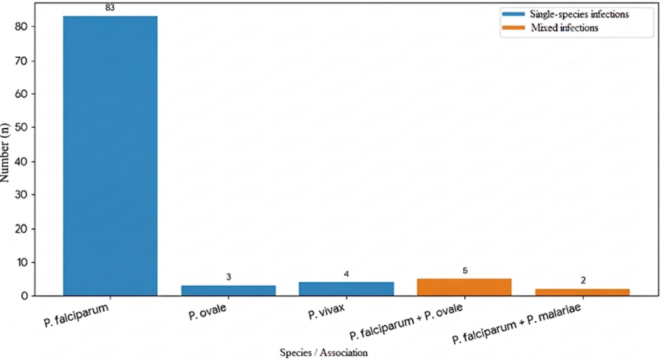
A total of seven (7) mixed infections were identified, including five co-infections involving
P. falciparum and
P. ovale, and two involving
P. falciparum and
P. malariae (
Figure 1). Furthermore, monospecific infections were predominantly caused by
P. falciparum (n = 83), followed by
P. ovale (n = 3) and
P. vivax (n = 4). However, no co-infection involving
Plasmodium vivax was observed (
Figure 1).
Table 2. Distribution of Plasmodium species identified by PCR with 95% CI (N = 179).
Species | Number (N) | Percentage (%) | 95% CI |
Plasmodium falciparum | 90 | 50,27 | [42,95 – 57,61] |
Plasmodium ovale | 9 | 5,29 | [1,83 – 8,23] |
Plasmodium vivax | 4 | 2,28 | [0,07 – 4,39] |
Plasmodium malariae | 2 | 1,12 | [0,00 – 2,67] |
95% CI: 95% Confidence interval
Figure 1. Distribution of single-species and mixed infections (N = 179).
3.3. Risk Factors Associated with Malaria
The crude prevalence of malaria infection was slightly higher among females (59.46%) than males. However, statistical analysis did not reveal any significant association between gender and the risk of malaria infection in the study population.
In contrast, age appeared to be a determining factor. The 6–15 years age group showed the highest prevalence (67.65%) (
Table 3). A statistically significant difference was observed between children in this age group and individuals older than 15 years (
p = 0.029). Moreover, children aged 6–15 years had a 2.19-fold higher risk of malaria infection compared to adults (
Table 3).
The prevalence of infection was markedly lower among individuals using insecticide-treated bed nets (47.37%) compared to those who did not use them (63.11%). A significant association (p = 0.009) was observed between malaria infection exposure and the use of insecticide-treated bed nets. Individuals not using insecticide-treated nets were 2.35-fold more likely to be exposed to malaria infection compared to those who reported using them (
Table 3).
The results indicate that fever is strongly associated with malaria infection. Nearly 74% of febrile individuals were infected, compared with only 37% of those without fever. Fever is a major clinical indicator and a highly reliable predictor of infection (
p < 0.001). Furthermore, individuals presenting with fever were nearly five times more likely (OR = 4.83) to be infected with malaria than those without fever in this study (
Table 3).
Table 3. Factors Associated with Malaria Infection Detected by PCR in the Study Population.
Variable | | Total | PCR positive (%) | OR | 95% CI | p-value |
Sex | | | | | | |
| F | 111 | 66 (59.46) | 1.16 | [0.63-2.13] | 0.753 |
| M | 68 | 38 (55.88) |
Age | | | | | | |
| 0-5 | 25 | 16 (64) | 1.86 | [0.74-4.67] | 0.268 |
| 6-15 | 68 | 46 (67.65) | 2.19 | [1.13-4.24] | 0.029 |
| > 15 | 86 | 42 (48.84) | - | | - |
ITN | | | | | | |
| yes | 57 | 27 (47.37) | 2.35 | [1.24-4.48] | 0.009 |
| no | 122 | 77 (63.11) |
Ins | | | | | | |
| yes | 118 | 70 (59.32) | 1.16 | [0.62-2.16] | 0.764 |
| no | 61 | 34 (55.74) |
Fever | | | | | | |
| yes | 103 | 76 (73.79) | 4.83 | [2.54-9.15] | < 0.001 |
| no | 76 | 28 (36.84) |
ITN: Insecticide-treated net; Ins: Insecticide; OR: Odds ratio; 95% CI: 95% Confidence interval
4. Discussion
This study aimed to assess the prevalence of malaria and associated risk factors in a symptomatic population of 179 patients. The malaria prevalence obtained by microscopy (37.98%) reflects a substantial circulation of malaria parasites in the Daloa area
| [8] | Koffi M, Abe IA, Ahouty BA, Silué D, Konan TK, Tidou AS. Prevalence and genetic diversity of Plasmodium falciparum in patients attending regional health center in Daloa, Cte dIvoire. International Journal of Genetics and Molecular Biology. 2019; 11(2): 50–56.
https://doi.org/10.5897/IJGMB2019.0179 |
[8]
. This level is comparable to those reported in several sub-Saharan African regions where malaria remains highly endemic, particularly among school-aged children
| [9] | Cohee LM, Opondo C, Clarke SE, Halliday KE, Cano J, Shipper AG, Barger-Kamate B, Djimde A, Diarra S, Dokras A, et al. Preventive malaria treatment among school-aged children in sub-Saharan Africa: a systematic review and meta-analyses. The Lancet. Global Health. 2020; 8(12): e1499–e1511.
https://doi.org/10.1016/S2214-109X(20)30325-9 |
[9]
. The high proportion of malaria observed in children aged 6–15 years confirms their particular vulnerability to malaria infection, as reported in several studies conducted in sub-Saharan Africa where school-aged children constitute an important reservoir for parasite transmission
| [9] | Cohee LM, Opondo C, Clarke SE, Halliday KE, Cano J, Shipper AG, Barger-Kamate B, Djimde A, Diarra S, Dokras A, et al. Preventive malaria treatment among school-aged children in sub-Saharan Africa: a systematic review and meta-analyses. The Lancet. Global Health. 2020; 8(12): e1499–e1511.
https://doi.org/10.1016/S2214-109X(20)30325-9 |
| [10] | Morlino C, Byrne I, Achan J, Baraka V, Barry A, Bousema T, Camara A, Chacky F, Chico RM, Clarke SE, et al. Barriers to uptake and implementation of malaria chemoprevention in school-aged children: a stakeholder engagement meeting report. Frontiers in Tropical Diseases. 2025 [accessed 2026 May 11]; 6. https://doi.org/10.3389/fitd.2025.1480907 |
[9, 10]
. This situation may be explained by increased exposure to mosquito bites due to frequent outdoor activities, as well as incomplete acquisition of anti-malarial immunity
| [11] | Mensah BA, Myers-Hansen JL, Obeng Amoako E, Opoku M, Abuaku BK, Ghansah A. Prevalence and risk factors associated with asymptomatic malaria among school children: repeated cross-sectional surveys of school children in two ecological zones in Ghana. BMC Public Health. 2021; 21(1): 1697.
https://doi.org/10.1186/s12889-021-11714-8 |
[11]
. Several studies have indeed shown that school-aged children represent a major asymptomatic reservoir of parasites in areas of stable transmission
| [10] | Morlino C, Byrne I, Achan J, Baraka V, Barry A, Bousema T, Camara A, Chacky F, Chico RM, Clarke SE, et al. Barriers to uptake and implementation of malaria chemoprevention in school-aged children: a stakeholder engagement meeting report. Frontiers in Tropical Diseases. 2025 [accessed 2026 May 11]; 6. https://doi.org/10.3389/fitd.2025.1480907 |
| [11] | Mensah BA, Myers-Hansen JL, Obeng Amoako E, Opoku M, Abuaku BK, Ghansah A. Prevalence and risk factors associated with asymptomatic malaria among school children: repeated cross-sectional surveys of school children in two ecological zones in Ghana. BMC Public Health. 2021; 21(1): 1697.
https://doi.org/10.1186/s12889-021-11714-8 |
[10, 11]
.
The overall malaria prevalence varied considerably depending on the diagnostic method used, ranging from 37.98% by microscopy to 54.18% by molecular biology (PCR). This significant discrepancy highlights the limited sensitivity of light microscopy, often considered the “gold standard” but less effective in detecting low parasitemia levels
| [12] | Ballard E, Wang CYT, Hien TT, Tong NT, Marquart L, Pava Z, Tarning J, O’Rourke P, McCarthy JS. A validation study of microscopy versus quantitative PCR for measuring Plasmodium falciparum parasitemia. Tropical Medicine and Health. 2019; 47: 49. https://doi.org/10.1186/s41182-019-0176-3 |
[12]
. The use of PCR revealed a substantial proportion of infections that would have gone undetected in routine clinical practice, confirming the need for molecular tools for accurate estimation of endemicity, particularly in settings with complex transmission patterns
| [13] | Opoku Afriyie S, Addison TK, Gebre Y, Mutala A-H, Antwi KB, Abbas DA, Addo KA, Tweneboah A, Ayisi-Boateng NK, Koepfli C, et al. Accuracy of diagnosis among clinical malaria patients: comparing microscopy, RDT and a highly sensitive quantitative PCR looking at the implications for submicroscopic infections. Malaria Journal. 2023; 22(1): 76.
https://doi.org/10.1186/s12936-023-04506-5 |
[13]
. These submicroscopic infections represent a major challenge for malaria control and elimination programs, as they may silently contribute to sustained transmission.
The distribution of
Plasmodium species observed in this study was largely dominated by
Plasmodium falciparum, accounting for more than 50% of detected infections. This predominance is consistent with epidemiological data reported in sub-Saharan Africa, where
P. falciparum remains the most widespread and pathogenic species
| [14] | Li J, Docile HJ, Fisher D, Pronyuk K, Zhao L. Current Status of Malaria Control and Elimination in Africa: Epidemiology, Diagnosis, Treatment, Progress and Challenges. Journal of Epidemiology and Global Health. 2024; 14(3): 561–579.
https://doi.org/10.1007/s44197-024-00228-2 |
[14]
. However, the detection of other species such as
Plasmodium ovale,
Plasmodium vivax, and
Plasmodium malariae highlights a non-negligible parasite diversity in the study area.
The detection of
Plasmodium vivax deserves particular attention, as this species has long been considered rare in West Africa due to the high prevalence of the Duffy-negative phenotype in African populations. However, recent studies have reported its circulation in this region, particularly in Senegal, suggesting parasite adaptation or alternative erythrocyte invasion mechanisms
| [15] | Badiane AS, Ngom B, Ndiaye T, Cunningham D, Campbell J, Gaye A, Sène A, Sy M, Ndiaye D, Nwakanma D, et al. Evidence of Plasmodium vivax circulation in western and eastern regions of Senegal: implications for malaria control. Malaria Journal. 2024; 23(1): 149.
https://doi.org/10.1186/s12936-024-04932-z |
[15]
. Its presence in our study may therefore reflect an evolving epidemiological pattern of malaria in the region.
Furthermore, the identified mixed infections, mainly involving
P. falciparum with
P. ovale or
P. malariae, indicate co-circulation of multiple
Plasmodium species in the study population. These co-infections are generally underestimated by conventional diagnostic methods, particularly microscopy, due to the dominance of
P. falciparum, which can mask minor species
| [16] | Kojom Foko LP, Hawadak J, Kouemo Motse FD, Eboumbou Moukoko CE, Kamgain Mawabo L, Pande V, Singh V. Non-falciparum species and submicroscopic infections in three epidemiological malaria facets in Cameroon. BMC Infectious Diseases. 2022; 22(1): 900.
https://doi.org/10.1186/s12879-022-07901-6 |
[16]
. The absence of co-infection involving
P. vivax may be related to its low prevalence in the study population or insufficient parasitemia levels preventing simultaneous detection with other species. Indeed, several recent studies have shown that
P. vivax infections are often characterized by low parasite densities, which may escape conventional diagnostic methods, especially in the presence of
P. falciparum | [17] | Abebe A, Menard D, Dugassa S, Assefa A, Juliano JJ, Lo E, Golassa L. Significant number of Plasmodium vivax mono-infections by PCR misidentified as mixed infections (P. vivax/P. falciparum) by microscopy and rapid diagnostic tests: malaria diagnostic challenges in Ethiopia. Malaria Journal. 2023; 22(1): 201. https://doi.org/10.1186/s12936-023-04635-x |
[17]
.
The strong predominance of monospecific
Plasmodium falciparum infections observed in this study confirms the major role of this species in local malaria dynamics. However, as reported by
| [18] | Miezan AJS, Gnagne AP, Bedia-Tanoh AV, Kone EGM, Konate-Toure AA, Angora KE, Bosson-Vanga AH, Kassi KF, Kiki-Barro PCM, Djohan V, et al. Molecular epidemiology of non-falciparum Plasmodium infections in three different areas of the Ivory Coast. Malaria Journal. 2023; 22(1): 211.
https://doi.org/10.1186/s12936-023-04639-7 |
[18]
in Côte d’Ivoire, the detection of non-falciparum species as well as mixed infections highlights the importance of integrating molecular diagnostic tools into epidemiological surveillance systems. Such approaches would improve the sensitivity of detection of circulating species, including mixed and submicroscopic infections, thereby strengthening malaria control and prevention strategies.
Risk factor analysis shows that age is a major determinant of infection. Children aged 6–15 years presented the highest prevalence (67.65%) with a 2.19-fold increased risk compared to adults (
p = 0.029). This finding is consistent with several recent studies conducted in sub-Saharan Africa identifying school-aged children as a particularly vulnerable group and a major reservoir of malaria transmission
| [19] | Buchwald AG, Vareta J, Nwagbata O, McCann RS, Sixpence A, Matengeni A, Kamzati M, Mangani C, Seydel KB, Wilson ML, et al. Asymptomatic school-age children carry the majority of transmissible Plasmodium falciparum infections. Communications Medicine. 2026; 6(1): 157.
https://doi.org/10.1038/s43856-026-01407-x |
[19]
. Indeed, unlike adults who gradually acquire partial immunity after repeated exposure to the parasite, younger children still have incomplete immunity, making them more susceptible to malaria infection. Several recent studies have also shown that school-aged children constitute a major asymptomatic reservoir of
Plasmodium, actively contributing to sustained community transmission
| [10] | Morlino C, Byrne I, Achan J, Baraka V, Barry A, Bousema T, Camara A, Chacky F, Chico RM, Clarke SE, et al. Barriers to uptake and implementation of malaria chemoprevention in school-aged children: a stakeholder engagement meeting report. Frontiers in Tropical Diseases. 2025 [accessed 2026 May 11]; 6. https://doi.org/10.3389/fitd.2025.1480907 |
| [19] | Buchwald AG, Vareta J, Nwagbata O, McCann RS, Sixpence A, Matengeni A, Kamzati M, Mangani C, Seydel KB, Wilson ML, et al. Asymptomatic school-age children carry the majority of transmissible Plasmodium falciparum infections. Communications Medicine. 2026; 6(1): 157.
https://doi.org/10.1038/s43856-026-01407-x |
[10, 19]
.
The use of insecticide-treated bed nets appears to be associated with a reduced malaria prevalence in this study. Individuals who did not sleep under bed nets were nearly twice as likely to be infected compared to users. Although the difference was at the threshold of statistical significance, this trend is consistent with extensive evidence demonstrating the effectiveness of insecticide-treated nets in preventing
Anopheles bites and reducing malaria transmission
| [20] | Tia J-PB, Tchicaya ESF, Zahouli JZB, Ouattara AF, Vavassori L, Assamoi J-B, Small G, Koudou BG. Combined use of long-lasting insecticidal nets and Bacillus thuringiensis israelensis larviciding, a promising integrated approach against malaria transmission in northern Côte d’Ivoire. Malaria Journal. 2024; 23(1): 168. https://doi.org/10.1186/s12936-024-04953-8 |
[20]
. The lack of statistical significance may be due to the relatively small sample size or reporting bias regarding actual and consistent bed net use. Nevertheless, these findings reinforce the importance of strengthening distribution and awareness strategies regarding proper and sustained use of insecticide-treated bed nets in at-risk populations.
Moreover, fever emerged as a strong clinical predictor of malaria infection in this population (OR = 4.83; p < 0.001). The strong association between fever and malaria observed in this study is consistent with the literature, which identifies fever as one of the primary clinical signs of malaria in endemic areas
| [21] | Tiono AB, Konaté AT, Kargougou D, Diarra A, Ouedraogo IN, Ouedraogo A, Pagnoni F, Modiano D, Sirima SB. Hospital-based surveillance of severe paediatric malaria in two malaria transmission ecological zones of Burkina Faso. Malaria Journal. 2023; 22(1): 6. https://doi.org/10.1186/s12936-022-04433-x |
[21]
. The high proportion of infected individuals among febrile subjects confirms that fever remains a key clinical indicator of malaria in endemic settings. The nearly fivefold increased risk of infection among febrile individuals underscores the diagnostic relevance of this symptom. However, the presence of a substantial proportion of infected but afebrile individuals also highlights the likely existence of asymptomatic infections in the study population
| [19] | Buchwald AG, Vareta J, Nwagbata O, McCann RS, Sixpence A, Matengeni A, Kamzati M, Mangani C, Seydel KB, Wilson ML, et al. Asymptomatic school-age children carry the majority of transmissible Plasmodium falciparum infections. Communications Medicine. 2026; 6(1): 157.
https://doi.org/10.1038/s43856-026-01407-x |
[19]
. These asymptomatic infections represent a major challenge for malaria control programs, as they constitute silent reservoirs capable of sustaining parasite transmission despite ongoing control efforts.
5. Conclusion
This study highlights a high prevalence of malaria in Daloa, with a predominance of Plasmodium falciparum, while also revealing the presence of non-falciparum species and mixed infections. The findings further show that children aged 6–15 years constitute the most exposed group to malaria infection. The discrepancy observed between microscopy and PCR underscores the value of molecular approaches in improving the detection of submicroscopic infections and enhancing malaria epidemiological surveillance. In addition, the use of insecticide-treated bed nets appears to contribute to a reduction in infection risk, while fever remains an important clinical indicator of malaria. These results emphasize the need to strengthen prevention strategies, molecular diagnostics, and surveillance efforts, particularly targeting school-aged children in endemic areas.
Abbreviations
PCR | Polymerase Chain Reaction |
RDT | Rapid Diagnostic Tests |
CREMOSS | Regional Center for Mutuality and Social Welfare in the School Environment |
EDTA | Ethylenediaminetetraacetic Acid |
DNA | Deoxyribonucleic Acid |
Acknowledgments
The authors would like to thank the staff of the Regional Center for Mutuality and Social Welfare in the School Environment (CREMOSS) of Daloa for allowing this study to be conducted in their facility. The authors also express their gratitude to the healthcare workers who assisted with sample collection. Special thanks are extended to all patients attending the center who agreed to participate in this study.
Author Contributions
Bernardin Ahouty Ahouty: Conceptualization, Data curation, Formal Analysis, Methodology, Validation, Writing – original draft, Writing – review & editing
Siriki Simaro: Investigation, Methodology, Writing – review & editing
Ahou Nicole Kouame-Yoboue: Formal Analysis, Validation, Writing – review & editing
Ouangbo Yaya Ouattara: Methodology, Writing – review & editing
Dago Lydia Karmelle Ornella: Formal Analysis, Methodology, Writing – review & editing
Georges Bohoussou Kassi: Formal Analysis, Writing – review & editing
Ble Gbacla Flora Dominique Yao: Methodology, Writing – review & editing
Allepo Innocent Abe: Formal Analysis
Kassi Martial N’djetchi: Formal Analysis, Methodology
Abla Edwige Sokouri: Methodology
Yao Mathurin Koffi: Formal Analysis, Methodology
Thomas Konan Konan: Formal Analysis & Methodology
Mathurin N’Goran Koffi: Supervision, Writing – review & editing
Data Availability Statement
The datasets used and/or analyzed during this study are available from the corresponding author upon reasonable request.
Conflicts of Interest
The author declares no conflict of interest.
References
| [1] |
Kulohoma BW, Wesonga CS. Malaria prevention in children and pregnant women: a review of gaps and emerging challenges in sub-Saharan Africa. npj Women’s Health. 2026; 4(1): 1.
https://doi.org/10.1038/s44294-025-00124-5
|
| [2] |
WHO. World malaria report 2022. 2022 [accessed 2026 May 16].
https://www.who.int/publications/i/item/9789240064898
|
| [3] |
Gouamene TJR, Edi CAV, Kwadio E, Gbalegba CGN, Zahouli JZB, Koudou BG. Malaria transmission in the coastal zone and in the Centre of Côte d’Ivoire during the dry season. Malaria Journal. 2024; 23: 400.
https://doi.org/10.1186/s12936-024-05176-7
|
| [4] |
Villena OC, Arab A, Lippi CA, Ryan SJ, Johnson LR. Influence of environmental, geographic, socio-demographic, and epidemiological factors on presence of malaria at the community level in two continents. Scientific Reports. 2024; 14: 16734.
https://doi.org/10.1038/s41598-024-67452-5
|
| [5] |
Tamir Z, Animut A, Dugassa S, Gebresilassie A, Belachew M, Abera A, Erko B. Comparative performance of microscopy, rapid diagnostic tests, and multiplex real-time PCR for detection of malaria parasites among pregnant women in northwest Ethiopia. Malaria Journal. 2025; 24(1): 19.
https://doi.org/10.1186/s12936-025-05256-2
|
| [6] |
Kyeremah C, Paul AS, Haehn D, Duraisingh MT, Yelleswarapu CS. Enhanced detection of malaria infected red blood cells through phase driven classification. Scientific Reports. 2025; 15(1): 30733.
https://doi.org/10.1038/s41598-025-12899-3
|
| [7] |
Snounou G, Singh B. Nested PCR analysis of Plasmodium parasites. Methods in Molecular Medicine. 2002; 72: 189–203.
https://doi.org/10.1385/1-59259-271-6
|
| [8] |
Koffi M, Abe IA, Ahouty BA, Silué D, Konan TK, Tidou AS. Prevalence and genetic diversity of Plasmodium falciparum in patients attending regional health center in Daloa, Cte dIvoire. International Journal of Genetics and Molecular Biology. 2019; 11(2): 50–56.
https://doi.org/10.5897/IJGMB2019.0179
|
| [9] |
Cohee LM, Opondo C, Clarke SE, Halliday KE, Cano J, Shipper AG, Barger-Kamate B, Djimde A, Diarra S, Dokras A, et al. Preventive malaria treatment among school-aged children in sub-Saharan Africa: a systematic review and meta-analyses. The Lancet. Global Health. 2020; 8(12): e1499–e1511.
https://doi.org/10.1016/S2214-109X(20)30325-9
|
| [10] |
Morlino C, Byrne I, Achan J, Baraka V, Barry A, Bousema T, Camara A, Chacky F, Chico RM, Clarke SE, et al. Barriers to uptake and implementation of malaria chemoprevention in school-aged children: a stakeholder engagement meeting report. Frontiers in Tropical Diseases. 2025 [accessed 2026 May 11]; 6.
https://doi.org/10.3389/fitd.2025.1480907
|
| [11] |
Mensah BA, Myers-Hansen JL, Obeng Amoako E, Opoku M, Abuaku BK, Ghansah A. Prevalence and risk factors associated with asymptomatic malaria among school children: repeated cross-sectional surveys of school children in two ecological zones in Ghana. BMC Public Health. 2021; 21(1): 1697.
https://doi.org/10.1186/s12889-021-11714-8
|
| [12] |
Ballard E, Wang CYT, Hien TT, Tong NT, Marquart L, Pava Z, Tarning J, O’Rourke P, McCarthy JS. A validation study of microscopy versus quantitative PCR for measuring Plasmodium falciparum parasitemia. Tropical Medicine and Health. 2019; 47: 49.
https://doi.org/10.1186/s41182-019-0176-3
|
| [13] |
Opoku Afriyie S, Addison TK, Gebre Y, Mutala A-H, Antwi KB, Abbas DA, Addo KA, Tweneboah A, Ayisi-Boateng NK, Koepfli C, et al. Accuracy of diagnosis among clinical malaria patients: comparing microscopy, RDT and a highly sensitive quantitative PCR looking at the implications for submicroscopic infections. Malaria Journal. 2023; 22(1): 76.
https://doi.org/10.1186/s12936-023-04506-5
|
| [14] |
Li J, Docile HJ, Fisher D, Pronyuk K, Zhao L. Current Status of Malaria Control and Elimination in Africa: Epidemiology, Diagnosis, Treatment, Progress and Challenges. Journal of Epidemiology and Global Health. 2024; 14(3): 561–579.
https://doi.org/10.1007/s44197-024-00228-2
|
| [15] |
Badiane AS, Ngom B, Ndiaye T, Cunningham D, Campbell J, Gaye A, Sène A, Sy M, Ndiaye D, Nwakanma D, et al. Evidence of Plasmodium vivax circulation in western and eastern regions of Senegal: implications for malaria control. Malaria Journal. 2024; 23(1): 149.
https://doi.org/10.1186/s12936-024-04932-z
|
| [16] |
Kojom Foko LP, Hawadak J, Kouemo Motse FD, Eboumbou Moukoko CE, Kamgain Mawabo L, Pande V, Singh V. Non-falciparum species and submicroscopic infections in three epidemiological malaria facets in Cameroon. BMC Infectious Diseases. 2022; 22(1): 900.
https://doi.org/10.1186/s12879-022-07901-6
|
| [17] |
Abebe A, Menard D, Dugassa S, Assefa A, Juliano JJ, Lo E, Golassa L. Significant number of Plasmodium vivax mono-infections by PCR misidentified as mixed infections (P. vivax/P. falciparum) by microscopy and rapid diagnostic tests: malaria diagnostic challenges in Ethiopia. Malaria Journal. 2023; 22(1): 201.
https://doi.org/10.1186/s12936-023-04635-x
|
| [18] |
Miezan AJS, Gnagne AP, Bedia-Tanoh AV, Kone EGM, Konate-Toure AA, Angora KE, Bosson-Vanga AH, Kassi KF, Kiki-Barro PCM, Djohan V, et al. Molecular epidemiology of non-falciparum Plasmodium infections in three different areas of the Ivory Coast. Malaria Journal. 2023; 22(1): 211.
https://doi.org/10.1186/s12936-023-04639-7
|
| [19] |
Buchwald AG, Vareta J, Nwagbata O, McCann RS, Sixpence A, Matengeni A, Kamzati M, Mangani C, Seydel KB, Wilson ML, et al. Asymptomatic school-age children carry the majority of transmissible Plasmodium falciparum infections. Communications Medicine. 2026; 6(1): 157.
https://doi.org/10.1038/s43856-026-01407-x
|
| [20] |
Tia J-PB, Tchicaya ESF, Zahouli JZB, Ouattara AF, Vavassori L, Assamoi J-B, Small G, Koudou BG. Combined use of long-lasting insecticidal nets and Bacillus thuringiensis israelensis larviciding, a promising integrated approach against malaria transmission in northern Côte d’Ivoire. Malaria Journal. 2024; 23(1): 168.
https://doi.org/10.1186/s12936-024-04953-8
|
| [21] |
Tiono AB, Konaté AT, Kargougou D, Diarra A, Ouedraogo IN, Ouedraogo A, Pagnoni F, Modiano D, Sirima SB. Hospital-based surveillance of severe paediatric malaria in two malaria transmission ecological zones of Burkina Faso. Malaria Journal. 2023; 22(1): 6.
https://doi.org/10.1186/s12936-022-04433-x
|
Cite This Article
-
APA Style
Ahouty, B. A., Simaro, S., Kouame-Yoboue, A. N., Ouattara, O. Y., Ornella, D. L. K., et al. (2026). Prevalence of Plasmodium Species and Associated Risk Factors Among Patients in Daloa, Côte d’Ivoire. American Journal of Biomedical and Life Sciences, 14(3), 45-52. https://doi.org/10.11648/j.ajbls.20261403.13
 Copy
|
Copy
|
 Download
ACS Style
Ahouty, B. A.; Simaro, S.; Kouame-Yoboue, A. N.; Ouattara, O. Y.; Ornella, D. L. K., et al. Prevalence of Plasmodium Species and Associated Risk Factors Among Patients in Daloa, Côte d’Ivoire. Am. J. Biomed. Life Sci. 2026, 14(3), 45-52. doi: 10.11648/j.ajbls.20261403.13
Copy
|
Download
AMA Style
Ahouty BA, Simaro S, Kouame-Yoboue AN, Ouattara OY, Ornella DLK, et al. Prevalence of Plasmodium Species and Associated Risk Factors Among Patients in Daloa, Côte d’Ivoire. Am J Biomed Life Sci. 2026;14(3):45-52. doi: 10.11648/j.ajbls.20261403.13
Copy
|
Download
-
@article{10.11648/j.ajbls.20261403.13,
  author = {Bernardin Ahouty Ahouty and Siriki Simaro and Ahou Nicole Kouame-Yoboue and Ouangbo Yaya Ouattara and Dago Lydia Karmelle Ornella and Georges Bohoussou Kassi and Ble Gbacla Flora Dominique Yao and Allepo Innocent Abe and Kassi Martial N’djetchi and Abla Edwige Sokouri and Yao Mathurin Koffi and Thomas Konan Konan and Mathurin N’Goran Koffi},
  title = {Prevalence of Plasmodium Species and Associated Risk Factors Among Patients in Daloa, Côte d’Ivoire},
  journal = {American Journal of Biomedical and Life Sciences},
  volume = {14},
  number = {3},
  pages = {45-52},
  doi = {10.11648/j.ajbls.20261403.13},
  url = {https://doi.org/10.11648/j.ajbls.20261403.13},
  eprint = {https://article.sciencepublishinggroup.com/pdf/10.11648.j.ajbls.20261403.13},
  abstract = {In Côte d’Ivoire, malaria remains a major public health concern due to its persistent and high transmission. This study aimed to determine the prevalence of Plasmodium species and associated risk factors among 179 patients in Daloa. A cross-sectional study was conducted at the Regional Center for Mutuality and Social Welfare in the School Environment (CREMOSS) of Daloa. Malaria diagnosis was performed using both microscopy and molecular biology techniques (PCR). The prevalence of malaria was 37.98% by microscopy compared with 54.18% by PCR, highlighting an underestimation of infections by conventional diagnostic methods. Plasmodium falciparum was the predominant species; however, other species such as P. ovale, P. malariae, and P. vivax were also detected, including mixed infections. Children aged 6 to 15 years showed the highest prevalence, with a significantly greater risk of infection compared to adults (OR = 2.19; p = 0.029). The non-use of insecticide-treated bed nets was associated with an increased risk of infection, while fever appeared to be a strong predictive factor for malaria (OR = 4.83; p < 0.001). These findings confirm the high circulation of malaria in the study area and emphasize the importance of molecular tools in improving the detection of submicroscopic infections and non-falciparum species. They also highlight the need to strengthen prevention and surveillance strategies, particularly targeting school-aged children in malaria-endemic areas.},
 year = {2026}
}
Copy
|
Download
-
TY  - JOUR
T1  - Prevalence of Plasmodium Species and Associated Risk Factors Among Patients in Daloa, Côte d’Ivoire
AU  - Bernardin Ahouty Ahouty
AU  - Siriki Simaro
AU  - Ahou Nicole Kouame-Yoboue
AU  - Ouangbo Yaya Ouattara
AU  - Dago Lydia Karmelle Ornella
AU  - Georges Bohoussou Kassi
AU  - Ble Gbacla Flora Dominique Yao
AU  - Allepo Innocent Abe
AU  - Kassi Martial N’djetchi
AU  - Abla Edwige Sokouri
AU  - Yao Mathurin Koffi
AU  - Thomas Konan Konan
AU  - Mathurin N’Goran Koffi
Y1  - 2026/06/18
PY  - 2026
N1  - https://doi.org/10.11648/j.ajbls.20261403.13
DO  - 10.11648/j.ajbls.20261403.13
T2  - American Journal of Biomedical and Life Sciences
JF  - American Journal of Biomedical and Life Sciences
JO  - American Journal of Biomedical and Life Sciences
SP  - 45
EP  - 52
PB  - Science Publishing Group
SN  - 2330-880X
UR  - https://doi.org/10.11648/j.ajbls.20261403.13
AB  - In Côte d’Ivoire, malaria remains a major public health concern due to its persistent and high transmission. This study aimed to determine the prevalence of Plasmodium species and associated risk factors among 179 patients in Daloa. A cross-sectional study was conducted at the Regional Center for Mutuality and Social Welfare in the School Environment (CREMOSS) of Daloa. Malaria diagnosis was performed using both microscopy and molecular biology techniques (PCR). The prevalence of malaria was 37.98% by microscopy compared with 54.18% by PCR, highlighting an underestimation of infections by conventional diagnostic methods. Plasmodium falciparum was the predominant species; however, other species such as P. ovale, P. malariae, and P. vivax were also detected, including mixed infections. Children aged 6 to 15 years showed the highest prevalence, with a significantly greater risk of infection compared to adults (OR = 2.19; p = 0.029). The non-use of insecticide-treated bed nets was associated with an increased risk of infection, while fever appeared to be a strong predictive factor for malaria (OR = 4.83; p < 0.001). These findings confirm the high circulation of malaria in the study area and emphasize the importance of molecular tools in improving the detection of submicroscopic infections and non-falciparum species. They also highlight the need to strengthen prevention and surveillance strategies, particularly targeting school-aged children in malaria-endemic areas.
VL  - 14
IS  - 3
ER  -
Copy
|
Download

 ,
Siriki Simaro
,
Siriki Simaro


 Share This Article
 Twitter
 Linked In
 Facebook