Abstract
As part of achieving Chartered status in Health Psychology in the UK one has to create an online intervention. This study showcases such an intervention to support care workers by addressing stress management, mindfulness, resilience, and sleep hygiene. The delivery of the intervention was via Microsoft Teams and it focused on a) psychoeducation, b) mindfulness, c) resilience-building, d) and peer support. The intervention assessments included the Perceived Stress Scale (PSS-10), Pittsburgh Sleep Quality Index (PSQI), Quality of life scale (EQ-5D), and the Visual Analog Mood Scale (VAS). The results demonstrated a reduction in stress and an improvement in sleep quality and mood; however no statistical significance in quality of life was observed. Qualitative feedback highlighted the benefits of psychoeducation, mindfulness training, and the buddy system. Staff reported a greater awareness over their stress, improved sleep hygiene and a sense of connection with colleagues. Despite the short duration the intervention was positively received, suggesting that structured targeted interventions can be beneficial for front-line care workers and can be created by small organisations. Future research should explore extending the intervention’s duration and incorporating follow-up support to enhance long-term effectiveness as well as training guidance for in-house teams.
Keywords
COVID-19, Frontline Care Staff, Stress Management, Sleep Hygiene, Resilience Training, Psychological Intervention, Stage 2 Training
1. Introduction
In order to become a Chartered Health Psychologist in the UK one has to complete a Doctorate level training with either an institution or the British Psychological Society. The training covers five different competences: 1) core units of generic professional competence, 2) core competencies in psychological interventions, 3) core units of research competence, 4) core units of consultancy competence and 5) core units of teaching and training competence. The intervention competence (No:2) is divided into a face-to-face intervention improving the health outcomes of a client and an intervention in different settings (i.e not involving contact with an individual) such as group work or online
. The current intervention covers the group-online work for competence No:2.
Traumatic stress due to Coronavirus 19 (COVID-19) in healthcare workers is not something new
| [2] | Benfante, A., Di Tella, M., Romeo, A., & Castelli, L. Traumatic stress in healthcare workers during COVID-19 pandemic: A review of the immediate impact. Frontiers in Psychology. 2020, 11, 569935. https://doi.org/10.3389/fpsyg.2020.569935 |
[2]
. In particular, there was a risk factor between being a frontline member, having less work experience and a high chance of exposure to the virus leading to traumatic stress responses
| [2] | Benfante, A., Di Tella, M., Romeo, A., & Castelli, L. Traumatic stress in healthcare workers during COVID-19 pandemic: A review of the immediate impact. Frontiers in Psychology. 2020, 11, 569935. https://doi.org/10.3389/fpsyg.2020.569935 |
| [3] | Kasdovasilis P., Cook N., Montasem A., Davis G. Healthcare support workers' lived experiences and adaptation strategies within the care sector during the COVID-19 pandemic. A meta-ethnography review. Home Health Care Serv Q. 2022; 41(4): 267-290. https://doi.org/10.1080/01621424.2022.2105771 |
[2, 3]
. It is imperative to identify and test various strategies of adaptation as a lot of strategies are reactive rather than proactive (e.g., trying to sort out personal protective equipment (PPE) shortages leading to stressful workforce instead of preparing for an emergency)
| [4] | Bender, A. E., Berg, K. A., Miller, E. K., Evans, K. E., & Holmes, M. R. Making sure we are all okay: Healthcare workers’ strategies for emotional connectedness during the COVID-19 pandemic. Clinical Social Work Journal. 2021, 49(4), 445–455. https://doi.org/10.1007/s10615-020-00781-w |
[4]
.
During 2022, the UK was the 6
th country globally with the most cases (23.4m) falling behind only to USA (92.6m), India (44.4m), Brazil (33.4m), France (33.4m) and Germany (31.9m)
| [5] | Kasdovasilis, P., Cook, N., & Montasem, A. UK healthcare support workers and the COVID-19 pandemic: an explorative analysis of lived experiences during the COVID-19 pandemic. Home Health Care Services Quarterly. 2022, 42(1), 14–39. https://doi.org/10.1080/01621424.2022.2123757 |
[5]
. Given the number of cases and the strain the pandemic put on the healthcare services, there was a clear need for a small scale targeted intervention that organisations could incorporate fast.
The current study aims to explore the feasibility and effectiveness of a small scale psychologically structured intervention delivered online to support care staff in managing after-pandemic-related stress. The intervention focuses on incorporating coping strategies (e.g., psychoeducation, mindfulness, self-care etc) as a medium to enhance emotional well-being and reduce the stress levels of staff particularly in frontline healthcare environments.
The current findings suggest that the coping strategies introduced supported the care staff either significantly or marginally significantly, however no improvement in the overall quality of life was observed.
2. Materials & Methods
2.1. Study Design and Participants
A three-day online intervention was delivered to 10 frontline staff members in the social care sector. Participants were recruited from a supported living service in East London UK after the pandemic.
2.2. Intervention Structure
This intervention was designed as part of the Stage 2 training in Health Psychology with the British Psychological Society. This intervention was designed to address stress management, resilience and well-being using evidence-based approaches.
Day 1: Psychoeducation, Mindfulness and Self-Care
1) Understanding stress and psychological responses to COVID-19
2) Mindfulness techniques: breathing exercises and body scans
3) Guided meditation
4) Self-care strategies
Day 2: Building Resilience, Sleep Hygiene and the Buddy System
1) Strategies for resilience and stress management
2) Sleep hygiene education
3) Establishing a buddy support system with each other
Day 3: Reinforcement, Experience Sharing, and Relapse Prevention
1) Revisit mindfulness exercises
2) Group discussion and experience sharing
3) Strategies for maintaining behavioural changes
4) Feedback on the intervention
2.3. Measures
To evaluate the intervention’s efficacy the following standardised tools were used:
1) Perceived Stress Scale (PSS-10): Measures perceived stress levels,
2) Pittsburgh Sleep Quality index (PSQI): Evaluates sleep patterns and quality of sleep,
3) EUROQol 5-Dimensions (EQ-5D): Assesses health-related quality of life,
4) Visual Analog Mood Scale (VAS): Captures mood variations
5) Open-ended Questionnaire: Gathers qualitative feedback on intervention experiences.
2.4. Method
A mixed method design was used for evaluating the effectiveness of the intervention. This included quantitative data to capture the changes in stress, sleep and mood as well as qualitative data to capture the experiences of the participants and the perceived benefits of the intervention.
2.5. Data Analysis
Quantitative data were analysed using paired t-tests to determine pre and post intervention differences. A significance level of p<0.005 was used to assess statistical significance. Qualitative data was analysed using Thematic Analysis identifying common themes and patterns in participants responses.
3. Results
The results obtained in the study regarding the changes in participants scores prior to and after the psychological intervention showed an increase across most measures highlighting the benefit of the programme.
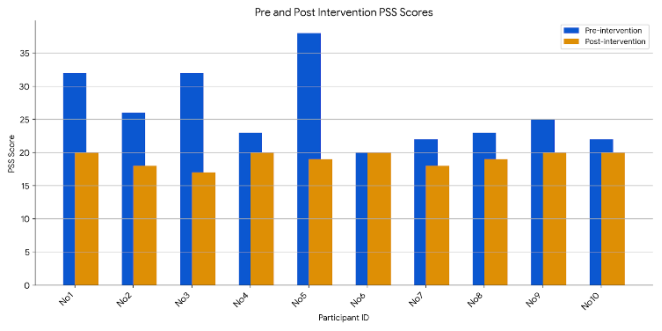
The Perceived Stress Scale (PSS-10) was reduced (see
Figure 1), with mean results declining from [pre] 26.3 (SD= 5.3) to [post] 19.1 (SD=1.25). The results show a moderate lowering of the perceived stress. A paired t-test validates the adjustment by showing that this change was statistically significant (t (9) =7.778), p<0.01), thus suggesting that the intervention supported the participants in managing their stress levels.
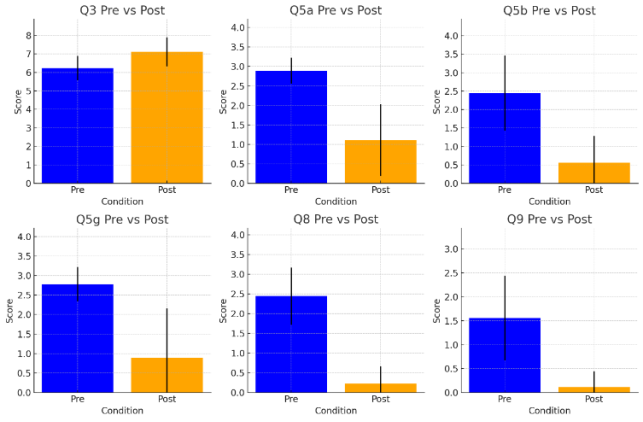
The Pittsburgh Sleep Quality index (PSQI) demonstrated some significant (see
Figure 2) or marginally significant cases. The mean scores for the significant results are 3.06 (pre) and 1.67 (post). The average DS score ranged from 0.68 (pre) to 0.75 (post). Post result indicate that there is more variability within the participants. Similarly to the PSS scale the scale was statistically significant, this means that the psychological intervention was effective in improving sleep.
Figure 2. Significant changes.
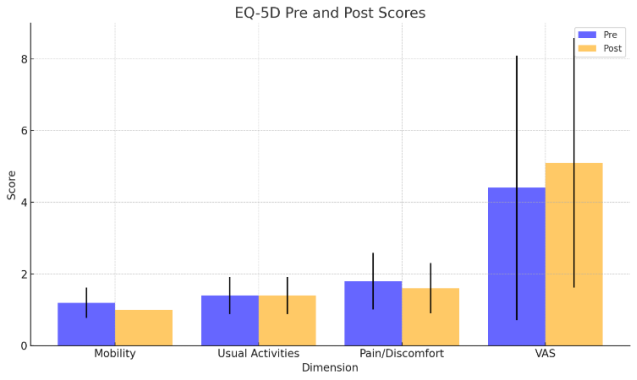
Pre and post measurements of the EQ-5D were taken to measure the overall quality of life and the potential impact of the intervention.
A paired t-test revealed no significant differences identified between the pre and post scores for any of the data analysed. This suggests that the intervention did not have a statistically significant impact on the participant’s QoL as measured by EQ-5D.
Figure 3 shows the four domains that a statistical significance was identified by not to the extent that it can suggest that the intervention had an effect on their quality of life.
Figure 3. EQ-5D pre- and post- scores.
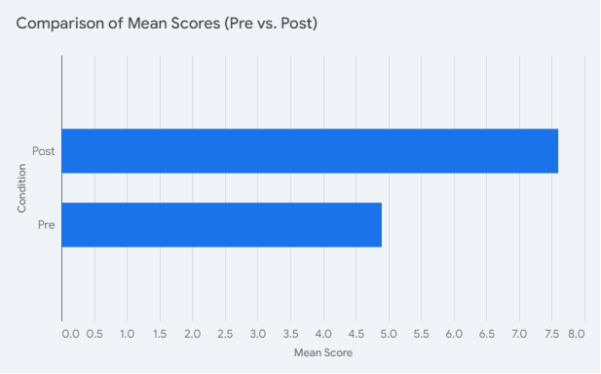
A Visual Analog Mood Scale was used to capture how participants felt at before the intervention started and after it finished. Participants were asked to rate how they are feeling from a scale of 0 (Not happy) to 10 (Extremely happy).
There was a significant increase in VAS score from the pre (M=4.90) to post (Mean=7.60) conditions (t=50.14, p=0.001) indicating that there is a statistically significant difference indicating the participants were happier after the delivery of the intervention (
see Figure 4).
Figure 4. VAS pre- and post-.
Lastly, the participants were asked to complete an anonymised questionnaire with open-ended questions to capture qualitatively the effectiveness of the intervention. 7 responses were received out of 10.
The open-ended questionnaire offered a deeper insight into the participant’s overall experience.
Participant responses confirmed that the psychoeducational part of the intervention worked well. The participants reported that (1) knowledge, (2) the introduction of the buddy system, (3) mindfulness, (4) psychosomatic education was really helpful as an outcome of the intervention, for example, participant 1 said:
Massively […] I felt I am more in control in a way.
[…] having the knowledge it’s very beneficial.
impact of breathing.
Participants were asked to rate the programme including the training on a scale of 1 to 5 stars. Both sections received a 5-star rating.
4. Discussion
The outcomes of this three-day intervention are broadly consistent with findings from other post-COVID psychological support programmes for healthcare and frontline workers.
Generally, brief mindfulness interventions have shown that they are effective in reducing stress and improving resilience in healthcare staff
| [6] | Rodriguez-Vega B, Palao Á, Muñoz-Sanjose A, et al. Implementation of a Mindfulness-Based Crisis Intervention for Frontline Healthcare Workers During the COVID-19 Outbreak in a Public General Hospital in Madrid, Spain. Front Psychiatry. 2020; 11: 562578. Published 2020 Oct 30. https://doi.org/10.3389/fpsyt.2020.562578 |
[6]
. A mindfulness intervention for hospital workers in Spain during the pandemic showed immediate positive results in stress reduction (8.4/10 in perceived stress relief)
| [6] | Rodriguez-Vega B, Palao Á, Muñoz-Sanjose A, et al. Implementation of a Mindfulness-Based Crisis Intervention for Frontline Healthcare Workers During the COVID-19 Outbreak in a Public General Hospital in Madrid, Spain. Front Psychiatry. 2020; 11: 562578. Published 2020 Oct 30. https://doi.org/10.3389/fpsyt.2020.562578 |
[6]
.
Self-help (e.g., self-care) was used as part of the intervention. However, there is sufficient evidence that self-help plus (SH+) intervention tool is a promising tool to support mental health in a larger population in difficult circumstances and in particularly amongst healthcare workers during the COVID-19 pandemic
| [7] | Li J, Luo R, Guo P, et al. Effectiveness of a WHO self-help psychological intervention to alleviate stress among healthcare workers in the context of COVID-19 in China: a randomised controlled trial. Epidemiology and Psychiatric Sciences. 2024; 33: e11. https://doi.org/10.1017/S2045796024000106 |
[7]
.
Peer support is supported by the current literature. In the current intervention the buddy system was used to support emotional support.
| [8] | Albott CS, Wozniak JR, McGlinch BP, Wall MH, Gold BS, Vinogradov S. Battle Buddies: Rapid Deployment of a Psychological Resilience Intervention for Health Care Workers During the COVID-19 Pandemic. Anesth Analg. 2020; 131(1): 43-54. https://doi.org/10.1213/ANE.0000000000004912 |
[8]
suggests that a ‘Battle Buddy’ resilience programme is effective in countering burnout and isolation amongst frontline staff.
A cluster randomised clinical trial around peer support has shown mixed results, with no overall effect on wellbeing however the results on protective benefits against general psychological distress and PTSD
| [9] | Meredith LS, Ahluwalia S, Chen PG, et al. Testing an Intervention to Improve Health Care Worker Well-Being During the COVID-19 Pandemic: A Cluster Randomized Clinical Trial. JAMA Netw Open. 2024; 7(4): e244192. Published 2024 Apr 1. https://doi.org/10.1001/jamanetworkopen.2024.4192 |
[9]
. This is in line with the current intervention’s results that even though the majority of the measurements were significant quality of life was not.
The current study has several limitations such as the sample size which affects its statistical power. Additionally, the sample was only from one organisation which means that a unique contextual factor may be influencing the results. Furthermore, the short duration of the intervention -lasting only three days- provided an intense but brief exposure. This raises the question of long-term effectiveness of the intervention.
Despite the limitation, the study has several practical implications particularly for small organisations with limited resources. Small scale interventions can be beneficial as they are not resource-draining
| [10] | Hendriks, T., Schotanus-Dijkstra, M., Hassankhan, A., De Jong, J., & Bohlmeijer, E., 2019. The Efficacy of Multi-component Positive Psychology Interventions: A Systematic Review and Meta-analysis of Randomized Controlled Trials. Journal of Happiness Studies, 21, pp. 357-390. https://doi.org/10.1007/s10902-019-00082-1 |
| [11] | Lim, W., & Tierney, S., 2022. The Effectiveness of Positive Psychology Interventions for Promoting Well-being of Adults Experiencing Depression Compared to Other Active Psychological Treatments: A Systematic Review and Meta-analysis. Journal of Happiness Studies, 24, pp. 249 - 273. https://doi.org/10.1007/s10902-022-00598-z |
| [12] | Prudenzi, A., Graham, C., Flaxman, P., Wilding, S., Day, F., & O'Connor, D., 2022. A workplace Acceptance and Commitment Therapy (ACT) intervention for improving healthcare staff psychological distress: A randomised controlled trial. PLoS ONE, 17. https://doi.org/10.1371/journal.pone.0266357 |
| [13] | De Kock, J., Latham, H., Cowden, R., Cullen, B., Narzisi, K., Jerdan, S., Muñoz, S., Leslie, S., Stamatis, A., & Eze, J., 2021. Brief Digital Interventions to Support the Psychological Well-being of NHS Staff During the COVID-19 Pandemic: 3-Arm Pilot Randomized Controlled Trial. JMIR Mental Health, 9. https://doi.org/10.2196/34002 |
| [14] | Wade, D., Georgieva, M., Gunnewicht, H., Finnigan, J., & MacCallum, N., 2020. Delivery of a psychological intervention to assess and reduce workplace stress among intensive care staff. Journal of the Intensive Care Society, 22, pp. 52 - 59. https://doi.org/10.1177/1751143719884855 |
| [15] | Plys, E., Law, M., Seward, M., & Vranceanu, A., 2024. STAFF FOCUS GROUP TO INFORM A DYADIC PSYCHOLOGICAL INTERVENTION FOR SHORT-STAYS IN NURSING HOME. Innovation in Aging, 8, pp. 1161 - 1162. https://doi.org/10.1093/geroni/igae098.3724 |
[10-15]
. Staff therapy can be costly therefore internal staff teams could potentially use the current type of intervention for in-house support.
5. Conclusions
The results of the current psychological intervention are quite promising on an individual level. The tools were able to add value and support the effectiveness and reliability of the psychological intervention. The participants enjoyed the sessions and found it a positive experience; however, one should consider the current results in the context of the limited time of the intervention (three-day) and the demands of the social care sector the participants are working in. By using the tools above, it is suggestive that the participants benefited from the knowledge and tools to improve their health and overall wellbeing. As the outcome of the current psychological intervention was not to produce results that could be applied to a more generic setting, it would be beneficial to introduce smaller sessions on a daily basis over a span of a longer period to improve on consistency.
Abbreviations
BPS | British Psychological Society |
COVID-19 | Coronavirus Disease 2019 |
EQ-5D | EUROQol 5-Dimensions |
PPE | Personal Protective Equipment |
PSS-10 | Perceived Stress Scale (10-item) |
PSQI | Pittsburgh Sleep Quality Index |
QoL | Quality of Life |
SH+ | Self-Help Plus |
UK | United Kingdom |
USA | United States of America |
UV | Ultraviolet |
VAS | Visual Analog Mood Scale |
Author Contributions
Pavlos Kasdovasilis: Conceptualization, Resources, Data curation, Software, Formal Analysis, Investigation, Visualization, Writing, Project Administration
Erica Cook: Review and Editing
Data Availability Statement
The data supporting the outcome of this research work has been reported in this manuscript.
Funding
This work is not supported by any external funding.
Conflicts of Interest
The authors declare no conflicts of interest.
References
| [1] |
British Psychological Society. Qualification in Health Psychology (Stage 2). Handbook for Candidates. Available from:
https://cms.bps.org.uk/sites/default/files/2022-07/QHP%20Candidate%20Handbook.pdf#page=23.04
[Accessed 05 March 2025].
|
| [2] |
Benfante, A., Di Tella, M., Romeo, A., & Castelli, L. Traumatic stress in healthcare workers during COVID-19 pandemic: A review of the immediate impact. Frontiers in Psychology. 2020, 11, 569935.
https://doi.org/10.3389/fpsyg.2020.569935
|
| [3] |
Kasdovasilis P., Cook N., Montasem A., Davis G. Healthcare support workers' lived experiences and adaptation strategies within the care sector during the COVID-19 pandemic. A meta-ethnography review. Home Health Care Serv Q. 2022; 41(4): 267-290.
https://doi.org/10.1080/01621424.2022.2105771
|
| [4] |
Bender, A. E., Berg, K. A., Miller, E. K., Evans, K. E., & Holmes, M. R. Making sure we are all okay: Healthcare workers’ strategies for emotional connectedness during the COVID-19 pandemic. Clinical Social Work Journal. 2021, 49(4), 445–455.
https://doi.org/10.1007/s10615-020-00781-w
|
| [5] |
Kasdovasilis, P., Cook, N., & Montasem, A. UK healthcare support workers and the COVID-19 pandemic: an explorative analysis of lived experiences during the COVID-19 pandemic. Home Health Care Services Quarterly. 2022, 42(1), 14–39.
https://doi.org/10.1080/01621424.2022.2123757
|
| [6] |
Rodriguez-Vega B, Palao Á, Muñoz-Sanjose A, et al. Implementation of a Mindfulness-Based Crisis Intervention for Frontline Healthcare Workers During the COVID-19 Outbreak in a Public General Hospital in Madrid, Spain. Front Psychiatry. 2020; 11: 562578. Published 2020 Oct 30.
https://doi.org/10.3389/fpsyt.2020.562578
|
| [7] |
Li J, Luo R, Guo P, et al. Effectiveness of a WHO self-help psychological intervention to alleviate stress among healthcare workers in the context of COVID-19 in China: a randomised controlled trial. Epidemiology and Psychiatric Sciences. 2024; 33: e11.
https://doi.org/10.1017/S2045796024000106
|
| [8] |
Albott CS, Wozniak JR, McGlinch BP, Wall MH, Gold BS, Vinogradov S. Battle Buddies: Rapid Deployment of a Psychological Resilience Intervention for Health Care Workers During the COVID-19 Pandemic. Anesth Analg. 2020; 131(1): 43-54.
https://doi.org/10.1213/ANE.0000000000004912
|
| [9] |
Meredith LS, Ahluwalia S, Chen PG, et al. Testing an Intervention to Improve Health Care Worker Well-Being During the COVID-19 Pandemic: A Cluster Randomized Clinical Trial. JAMA Netw Open. 2024; 7(4): e244192. Published 2024 Apr 1.
https://doi.org/10.1001/jamanetworkopen.2024.4192
|
| [10] |
Hendriks, T., Schotanus-Dijkstra, M., Hassankhan, A., De Jong, J., & Bohlmeijer, E., 2019. The Efficacy of Multi-component Positive Psychology Interventions: A Systematic Review and Meta-analysis of Randomized Controlled Trials. Journal of Happiness Studies, 21, pp. 357-390.
https://doi.org/10.1007/s10902-019-00082-1
|
| [11] |
Lim, W., & Tierney, S., 2022. The Effectiveness of Positive Psychology Interventions for Promoting Well-being of Adults Experiencing Depression Compared to Other Active Psychological Treatments: A Systematic Review and Meta-analysis. Journal of Happiness Studies, 24, pp. 249 - 273.
https://doi.org/10.1007/s10902-022-00598-z
|
| [12] |
Prudenzi, A., Graham, C., Flaxman, P., Wilding, S., Day, F., & O'Connor, D., 2022. A workplace Acceptance and Commitment Therapy (ACT) intervention for improving healthcare staff psychological distress: A randomised controlled trial. PLoS ONE, 17.
https://doi.org/10.1371/journal.pone.0266357
|
| [13] |
De Kock, J., Latham, H., Cowden, R., Cullen, B., Narzisi, K., Jerdan, S., Muñoz, S., Leslie, S., Stamatis, A., & Eze, J., 2021. Brief Digital Interventions to Support the Psychological Well-being of NHS Staff During the COVID-19 Pandemic: 3-Arm Pilot Randomized Controlled Trial. JMIR Mental Health, 9.
https://doi.org/10.2196/34002
|
| [14] |
Wade, D., Georgieva, M., Gunnewicht, H., Finnigan, J., & MacCallum, N., 2020. Delivery of a psychological intervention to assess and reduce workplace stress among intensive care staff. Journal of the Intensive Care Society, 22, pp. 52 - 59.
https://doi.org/10.1177/1751143719884855
|
| [15] |
Plys, E., Law, M., Seward, M., & Vranceanu, A., 2024. STAFF FOCUS GROUP TO INFORM A DYADIC PSYCHOLOGICAL INTERVENTION FOR SHORT-STAYS IN NURSING HOME. Innovation in Aging, 8, pp. 1161 - 1162.
https://doi.org/10.1093/geroni/igae098.3724
|
Cite This Article
-
APA Style
Kasdovasilis, P., Cook, E. (2025). Design and Delivery of a Holistic Three-Day Post-COVID-19 Psychological Intervention for Care Staff in the UK as Part of Stage 2 Health Psychology Training. American Journal of Clinical and Experimental Medicine, 13(2), 29-34. https://doi.org/10.11648/j.ajcem.20251302.12
 Copy
|
Copy
|
 Download
ACS Style
Kasdovasilis, P.; Cook, E. Design and Delivery of a Holistic Three-Day Post-COVID-19 Psychological Intervention for Care Staff in the UK as Part of Stage 2 Health Psychology Training. Am. J. Clin. Exp. Med. 2025, 13(2), 29-34. doi: 10.11648/j.ajcem.20251302.12
Copy
|
Download
AMA Style
Kasdovasilis P, Cook E. Design and Delivery of a Holistic Three-Day Post-COVID-19 Psychological Intervention for Care Staff in the UK as Part of Stage 2 Health Psychology Training. Am J Clin Exp Med. 2025;13(2):29-34. doi: 10.11648/j.ajcem.20251302.12
Copy
|
Download
-
@article{10.11648/j.ajcem.20251302.12,
  author = {Pavlos Kasdovasilis and Erica Cook},
  title = {Design and Delivery of a Holistic Three-Day Post-COVID-19 Psychological Intervention for Care Staff in the UK as Part of Stage 2 Health Psychology Training
},
  journal = {American Journal of Clinical and Experimental Medicine},
  volume = {13},
  number = {2},
  pages = {29-34},
  doi = {10.11648/j.ajcem.20251302.12},
  url = {https://doi.org/10.11648/j.ajcem.20251302.12},
  eprint = {https://article.sciencepublishinggroup.com/pdf/10.11648.j.ajcem.20251302.12},
  abstract = {As part of achieving Chartered status in Health Psychology in the UK one has to create an online intervention. This study showcases such an intervention to support care workers by addressing stress management, mindfulness, resilience, and sleep hygiene. The delivery of the intervention was via Microsoft Teams and it focused on a) psychoeducation, b) mindfulness, c) resilience-building, d) and peer support. The intervention assessments included the Perceived Stress Scale (PSS-10), Pittsburgh Sleep Quality Index (PSQI), Quality of life scale (EQ-5D), and the Visual Analog Mood Scale (VAS). The results demonstrated a reduction in stress and an improvement in sleep quality and mood; however no statistical significance in quality of life was observed. Qualitative feedback highlighted the benefits of psychoeducation, mindfulness training, and the buddy system. Staff reported a greater awareness over their stress, improved sleep hygiene and a sense of connection with colleagues. Despite the short duration the intervention was positively received, suggesting that structured targeted interventions can be beneficial for front-line care workers and can be created by small organisations. Future research should explore extending the intervention’s duration and incorporating follow-up support to enhance long-term effectiveness as well as training guidance for in-house teams.
},
 year = {2025}
}
Copy
|
Download
-
TY  - JOUR
T1  - Design and Delivery of a Holistic Three-Day Post-COVID-19 Psychological Intervention for Care Staff in the UK as Part of Stage 2 Health Psychology Training

AU  - Pavlos Kasdovasilis
AU  - Erica Cook
Y1  - 2025/04/29
PY  - 2025
N1  - https://doi.org/10.11648/j.ajcem.20251302.12
DO  - 10.11648/j.ajcem.20251302.12
T2  - American Journal of Clinical and Experimental Medicine
JF  - American Journal of Clinical and Experimental Medicine
JO  - American Journal of Clinical and Experimental Medicine
SP  - 29
EP  - 34
PB  - Science Publishing Group
SN  - 2330-8133
UR  - https://doi.org/10.11648/j.ajcem.20251302.12
AB  - As part of achieving Chartered status in Health Psychology in the UK one has to create an online intervention. This study showcases such an intervention to support care workers by addressing stress management, mindfulness, resilience, and sleep hygiene. The delivery of the intervention was via Microsoft Teams and it focused on a) psychoeducation, b) mindfulness, c) resilience-building, d) and peer support. The intervention assessments included the Perceived Stress Scale (PSS-10), Pittsburgh Sleep Quality Index (PSQI), Quality of life scale (EQ-5D), and the Visual Analog Mood Scale (VAS). The results demonstrated a reduction in stress and an improvement in sleep quality and mood; however no statistical significance in quality of life was observed. Qualitative feedback highlighted the benefits of psychoeducation, mindfulness training, and the buddy system. Staff reported a greater awareness over their stress, improved sleep hygiene and a sense of connection with colleagues. Despite the short duration the intervention was positively received, suggesting that structured targeted interventions can be beneficial for front-line care workers and can be created by small organisations. Future research should explore extending the intervention’s duration and incorporating follow-up support to enhance long-term effectiveness as well as training guidance for in-house teams.

VL  - 13
IS  - 2
ER  -
Copy
|
Download





 Share This Article
 Twitter
 Linked In
 Facebook