Research Article | | Peer-Reviewed

Groundwater Quality Assessment Using Pollution Indices and Human Health Risks Through Exposure to Trace Elements in the City of Kara, Togo

Received: 18 September 2024     Accepted: 20 October 2024     Published: 31 October 2024
Views:       Downloads:
Abstract

This study assesses the concentrations of trace elements in groundwater from Kara, focusing on their implications for water quality and health risks. Groundwater samples were collected and analyzed during the dry and post-monsoon seasons for pH, TDS, and trace metals using standard methods and for calculating pollution indices and noncarcinogenic and carcinogenic risks. Groundwater was found to be fresh but more acidic during the dry season. Only As, Pb, Sb, Fe, and Mn exceeded acceptable limits in some samples, highlighting potential health risks. Based on the heavy metal pollution index, groundwater is unsuitable for domestic purposes for 16.67% and 4.17% of samples in dry and post-monsoon seasons, respectively. According to the degree of contamination, 37.5% in the dry season and 20.8% in post-monsoon fell in high pollution classes. Most samples presented a hazard index above the unity for the resident children and adults. Carcinogenic risk assessment scores exceeded 10 to 100-fold higher than the safe point of 10-6. Adequate access to treated and safe drinking water and regular monitoring are essential to mitigate these risks in the Kara region.

Published in American Journal of Environmental Protection (Volume 13, Issue 5)
DOI 10.11648/j.ajep.20241305.15
Page(s) 163-174
Creative Commons

This is an Open Access article, distributed under the terms of the Creative Commons Attribution 4.0 International License (http://creativecommons.org/licenses/by/4.0/), which permits unrestricted use, distribution and reproduction in any medium or format, provided the original work is properly cited.

Copyright

Copyright © The Author(s), 2024. Published by Science Publishing Group

Keywords

Arsenic, Health Risks, Lead, Pollution Indices, Togo, Urban Groundwater, Water Quality

1. Introduction
Groundwater quality may deteriorate due to trace chemical constituents. Even at relatively low concentrations, trace elements such as lead, mercury, thallium, arsenic, chromium, cadmium, and antimony have undesirable impacts on human health and the environment through their persistent accumulation and biomagnification to a poisonous concentration level . Their harmful effects on humans include cardiovascular toxicity, genotoxicity, reproductive and developmental toxicity, skin toxicity, immunological toxicity, hepatotoxicity, nephrotoxicity, carcinogenicity, and neurotoxicity .
Trace elements in groundwater at higher concentrations compared to World Health Organization (WHO) permissible limits for drinking water have been reported in different parts worldwide . A global evaluation of heavy metals during the last three decades showed increasing concentrations with high heavy metal pollution indices in aquatic environments . Pollution indices are semi-empirical approaches that evaluate overall water quality based on the concentrations of water parameters value compared to quality standards. It integrates individual elements in concentrations different from the allowable limit for a particular purpose and can be applied to water resources, soil, and sediments . Several heavy metal pollution indices, such as Degree of Contamination (Cdi), Heavy Metal Pollution Index (HPI), and Heavy Metal Evaluation Index (HEI), have been applied to determine the pollution status of water ecosystems . In addition, the carcinogenic and non-carcinogenic health risks can orientate decision-making regarding public health and water resource allocation .
In Togo, there is great interest in urban groundwater. However, previous studies have reported a substantial deterioration of urban groundwater water quality based on major ions, microbiological, and trace elements characterization . Other studies in rural and mining areas showed the occurrence of heavy metals with potential health risks . This study focuses on heavy metal levels in groundwater and associated health risks in Kara, the second most urbanized city of Togo, under rapid urban expansion followed by intensive release of untreated effluents and pollution load without adequate sanitation systems . Traffic and industrial emissions, vehicle workshops disposal, waste disposal or discharge, and agrochemicals-based urban agriculture are potential sources for releasing heavy metals in the city environment. The city is underlain by orthogneissic, mafic, and ultramafic bedrocks, which can also release trace elements in water resources. Consequently, reports concerning trace element concentrations in groundwater become necessary and may serve as a line to improve water resource allocation strategies in the city. In this context, this study was conducted in urban Kara with the following objectives: (i) to characterize heavy metals concentrations in the groundwater of Kara, (ii) to assess groundwater quality using metal pollution indices, and (iii) to evaluate potential carcinogenic and non-carcinogenic risks for children and adults through water ingestion and dermal exposure pathways.
2. Methods
2.1. Study Area
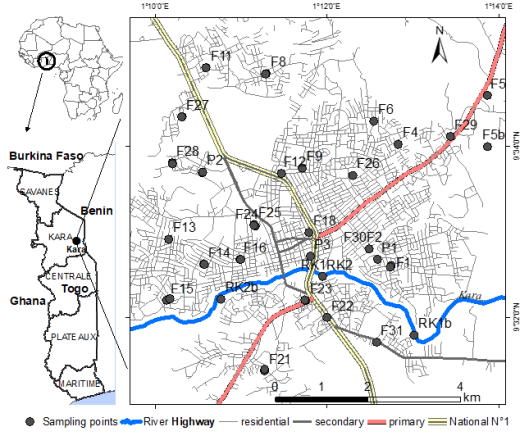
The study area encompassing the city of Kara covers an area of about 105 km2 extending between 1°09′ to 1°15′ E longitudes and 9°30′ to 9°36′ N latitudes (Figure 1), with a population approximating 190 000 inhabitants . The study area experiences a tropical sudanian climate controlled by the West African monsoon dynamics and characterized by a dry season lasting from November until March and a wet season lasting from April until October with an average annual rainfall of around 1300 mm and a mean annual temperature of around 28 °C . Kara River, sourced from the Atakora mountains in Benin, flows through the city following an irregular hydrological regime. With an altitude between 250 and 640 m asl, the study area is characterized by contrasting topography, ranging from flat to undulating, dotted with hills and irregular slopes. The diverse soils include ferralsols, acrisols, lixisols, leptosols, and fluviosols .
Metamorphic rocks, such as orthogneiss and granulites of the Pan-African Dahomeyide belt in North Togo, characterize the geology of the study area . Groundwater is from a heterogeneous and low-productive basement aquifer type composed of a weathered layer acting as a storage component, a fissured layer whose permeability depends on the number and connectivity of the fissures, and a very low permeability unfissured basement. The weathered layer thickness is about 12 m bgl, and borehole depths are around 55 m bgl .
2.2. Sampling and Analyses
A total of twenty-four groundwater samples and two samples from Kara River were collected twice, during the dry season (February 2021) and post-monsoon (October 2023), for the measurement and analyses of 12 parameters (pH, EC, Pb, Cr, Cu, Co, Cd, As, Zn, Fe, Mn, Ni, Sb, Sr) using standard procedures . The pH (±0.01) and electrical conductivity (EC ±2%, μS/cm), were measured in situ by calibrated portable pH and EC meters of HANNA® Instruments types. For the elemental analyses, samples were collected in 30 mL high-density polyethylene bottles, rinsed in distilled water, and rinsed again with the water to be sampled. Before analyses, water samples were filtered using a 0.45 μm membrane, preserved with 2 mL concentrated HNO3 solution (trace metal grade acid), filled to the brim of the bottle, and sealed and labeled. Samples were packed and sent in chilled conditions to the laboratory. We determine heavy metals and trace element concentrations in acidified aliquots using an inductively coupled plasma-optical spectrometry (ICP-OES) technology device by coupling an inductively coupled argon plasma with a spectrometer. The analyses were performed at the GEGENAA laboratory, University of Reims Champagne-Ardenne, France. Each study was repeated three times before considering the mean concentration. The analytical precession was checked by verifying the standards as well as blanks. For all calculations, concentrations below the detection limits are fixed to 10-3µg/L instead of nil.
Figure 1. Map showing the study area location, and sampling points.
2.3. Pollution Indices
The indices applied in this water quality study, are namely the Heavy Metal Pollution Index (HPI) , the Heavy Metal Evaluation Index (HEI) , and the Degree of Contamination (Cdi) .
Heavy metal pollution index (HPI)
The HPI is calculated using Eqs 1, 2, and 3, where Wi represents the unit weight of the ith parameter, while Qi (Eq. 2) denotes the sub-index of the ith parameter. The term n signifies the number of parameters under consideration, with Mi denoting the heavy metal concentration. Ii represents the ideal value, the necessary value for essential metals, and the zero value for toxic metals of the ith parameter. Ii and Si values are obtained from the WHO guidelines for drinking water quality .
HPI=i=1nWi*Qii=1nWi(1)
Qi=Mi-IiSi-Ii*100(2)
Wi=1Si (3)
Heavy metals evaluation index (HEI)
In the HEI formula (Eq. 4), Hc represents the monitored value of the ith parameter. At the same time, Hmac denotes the maximum permissible concentration of the ith parameter following the WHO standard values.
HEI=i=1nHcHmac (4)
Contamination degree index (Cdi)
The contamination index (Cdi) is calculated as the sum of all the contamination factors that exceed the maximum authorized values (Eq. 5). Ci represents the analytical values above the maximum permissible concentration (MACi).
Cdi=i=1nCiMACi-1(5)
The recommended standard (Si), permissible concentration MACi, and the ideal value Ii are presented in Table 1.
2.4. Noncarcinogenic Risk
This study conducted ingestion and dermal noncarcinogenic risk assessment following the methodologies outlined by the United States Environmental Protection Agency . To evaluate the non-carcinogenic risk linked with heavy metals, it's imperative to determine the Chronic Daily Intake (CDI) for each exposure pathway. Below are the parameters and equations used to calculate CDI (mg/kg-day) values (Eqs. 6 and 7).
Chronic daily intake (CDI) via ingestion and dermal absorption
CDIingestion=C*IR*ED*EFBW*ATnc(6)
CDIdermal=C*SA*Kp*ET*ED*EF*CFBW*ATnc (7)
where:
- C represents the concentration of the element in each water source (mg/L),
- BW denotes the average body weight (70 kg for adults and 15 kg for children),
- IR stands for the ingestion rate (2.5 and 0.75 L/day for adults and children, respectively),
- EF signifies exposure frequency (365 days/year),
- ED indicates exposure duration (30 and 6 years for adults and children, respectively),
- ATnc is the average exposure time for assessing non-cancer risks. (ED × 365 days),
-ATc is the amount of time for chronic assessments (e.g., cancer), and potential lifetime average daily dose (70 years). This value replaces the ATnc in CDIingestion the formula for carcinogenic purposes,
- SA denotes exposed skin surface area (18,000 cm² for adults and 6,600 cm² for children),
- ET signifies exposure duration (0.58 and 1 hour/day for adults and children, respectively),
- Kp is the skin water permeability coefficient (cm/h) presented in Table 1.
-CF Conversion factor of the concentration of the element in each water source (10-3 L/cm3).
Table 1. Standard values of Kp, RfD, and SF used to calculate health risks.

Metals

Kp (cm/ h)

RfDingestion (mg/kgday)

RfDdermal (mg/kgday)

SFingestion (mg/kgday)

Si/ MACi (µg/L)

I (µg/L)

Pb

0.0001

0.0014

0.00042

0.0085

10

0

Cr

0.002

0.003

0.00012

0.5

50

0

Cu

0.001

0.04

0.000062

-

2000

50

Co

0.0004

0.0003

0.000006

-

50

25

Cd

0.001

0.0001

0.000062

0.38

3

0

As

0.001

0.0003

0.000062

1.5

10

0

Zn

0.0006

0.3

0.000037

-

3000

15000

Fe

0.001

0.7

-

-

300

2000

Mn

0.001

0.14

0.000062

-

80

50

Ni

0.0002

0.02

0.000012328

-

80

10

Sb

0.001

0.0004

0.000061643

-

20

3

Sr

-

0,6

-

-

-

-

Hazard coefficients (HQ)
The assessment of the non-carcinogenic hazard quotient (Eqs. 8 and 9) resulting from the ingestion and dermal absorption of groundwater for the ith trace element was conducted as follows:
HQingestioni=CDIingestioniRfDingestioni(8)
HQdermali=CDIdermaliRfDdermali(9)
where HQ is the hazard quotient, and RfD is the reference dose in Table 1.
Hazard index (HI)
The hazard index (HI) indicates the integrated non-carcinogenic risk calculated by summating the hazard quotients (HQs) associated with the examined trace elements (Eqs. 10 and 11).
HIingestion=i=1nHQingestioni(10)
HIdermal=i=1nHQdermali (11)
2.5. Carcinogenic Risk
The carcinogenic potential was evaluated using the Excess Lifetime Cancer Risk (ELCR). In this study, As, Cd, Cr, and Pb were considered following the USEPA guidelines
ELCR=CDIingestion*SFingestion (12)
With SFingestion cancer slope factor (mg/kg day) presented in Table 1.
3. Results and Discussion
3.1. Trace Elements Concentrations in Groundwater
Table 2 presents the descriptive statistics of the measured parameters. The high coefficient of variation suggests high spatial variation during both seasons. Based on pH standards, groundwater tends to be more acidic in the dry season (16.67%) than in post-monsoon (3.8%). Generally, groundwater is more mineralized than river water sampled according to total dissolved solids (TDS). However, values lower than 1000 mg/L indicate freshwater types in the study area.
The elements Cr, Cu, Cd, Co, Zn, and Ni comply with the WHO standards for drinking water, probably due to a lesser impact of anthropogenic activities on the concentration of these ions or lesser leaching from solid phases in contact with water. Contrarily, for lead, all boreholes exceeded the acceptable limit in drinking water during the dry season against nearly 50% in the dry season. This suggests that Pb corrosion remains a worrying issue during both seasons. The most sensitive and vulnerable target for lead appears to be the nervous system, and exposure to lead in adults has been associated with hypertension, nephropathy, and anemia . The elements As, Fe, and Mn concentrations exceed threshold values in the dry and post-monsoon seasons. In the dry season, the concentration of these trace metals is above WHO guidelines values of 20.8, 12.5, and 29.2-58.3%, against 25.0, 33.3, and 33.3-70.8% in the post-monsoon season, respectively. Prolonged exposure to arsenic groundwater, even at low concentrations, may cause complications in body organ systems such as integumentary, nervous, respiratory, cardiovascular, hematopoietic, immune, endocrine, hepatic, renal, reproductive, and developmental systems .
Table 2. Descriptive statistics of in situ parameters and heavy metal concentrations in groundwater.

Parameters

WHO guidelines

Dry season (n =24)

Post-monsoon (n =24)

Mean

Min

Max

S.D

C.V (%)

Nb out of WHO guidelines

% out of WHO guidelines

Mean

Min

Max

S.D.

C.V (%)

Nb out of WHO guidelines

% out of WHO guidelines

pH (-)

6.5 - 8.5

6.76

5.95

7.32

0.3

4.6

04

16.7

7.39

6.42

7.96

0.4

5.1

01

3.8

TDS (mg/L

1000

383

230

650

117.9

30.8

0

-

357

269

492

69.0

19.3

-

-

CE (µS/cm)

-

587

300

1170

236.5

40.3

-

0

592

420

910

143.1

24.2

-

-

Cd (µg/L)

3

-

<LD

<LD

-

-

0

0

<LD

<LD

<LD

-

-

0

0

Ni (µg/L)

80-70*

-

<LD

<LD

-

-

0

0.0

2.54

<LD

16.53

3.4

132.8

0

0

Co (µg/L)

50

0.37

<LD

8.86

1.81

488.6

0

0

0.06

<LD

1.52

0.3

482.3

0

0

As (µg/L)

10

5.68

<LD

40.92

10.79

190.1

5

20.8

7.10

<LD

48.25

10.5

147.7

6

25.0

Cr (µg/L)

50

1.48

<LD

12.82

2.99

202.3

0

0

0.13

<LD

3.08

0.6

486.1

0

0

Cu (µg/L)

2000

4.29

<LD

16.66

4.60

107.2

0

0

1.91

<LD

9.10

3.0

154.9

0

0

Fetotal* (µg/L)

No HV-300

131.86

9.92

488.65

144.64

109.7

3

12.5

301.26

13.90

1571.50

434.8

144.3

8

33.3

Mn* (µg/L)

80 - 20*

98.24

<LD

610.15

155.13

157.9

7-14*

29.2-58.3*

100.40

<LD

445.40

137.4

136.9

8-17*

33.3-70.8*

Pb (µg/L)

10

32.81

15.69

54.21

7.84

23.9

24

100

9.06

<LD

16.39

3.8

41.8

10

41.7

Sb (µg/L)

20

16.13

3.73

105.40

21.15

131.1

4

16.7

3.51

1.17

14.90

2.6

73.4

0

0

Sr (µg/L)

-

264.56

70.04

555.80

132.44

50.1

-

-

282.43

77.79

667.20

129.1

45.7

-

-

Zn (µg/L)

3000 (NG)

8.52

0.39

33.50

8.62

101.2

0

0

9.99

1.41

30.64

8.4

84.2

0

0

*No health values (HV) for Iron, health value for Mn (80 µg/L) exceed threshold values (TV) of 20µg/L
The relatively high contents of As, Ni, Co, Mn and Cr were linked to mining activities in Kano state, Nigeria , Singhbhum region, India and Sabodala region, Senegal . Besides, a similar increase of Fe in Kampala and Mbarara districts, Uganda, was attributed to the corrosion of iron or steel used for the wells . Fe concentrations were significantly higher, with mean values of 1144.87 μg/L for groundwater and 115,548.15 μg/L for surface waters, due to mining wastes around Bangeli, Togo, .
Antimony, a pollutant of emerging concern often mixed with lead or other heavy metals, may cause symptoms of exposure, including headache, coughing, anorexia, troubled sleep, and vertigo . Sb was above the permissible limit only during the dry season for 16.7% of samples. High Sb was reported in Bangeli canton , whereas As, Cd, and Pb concentrations were found below their limits compared to this study. In general, Sr is not a health concern at drinking water levels. Groundwater Sr ranged from 70.04 to 555.80 µg/L with a mean of 264.56 µg/L in dry season and from 77.79 to 667.20 with a mean of 282,43µg/L in post-monsoon.
River water has a relatively high pH (means of 7.51 in the dry season and 8.11 in post-monsoon) than groundwater during both seasons. At the same time, mineralization was lower (means of 190 µS/cm in the dry season and 185 µS/cm in post-monsoon) than groundwater. The total iron concentration was significantly higher (1359 µg/L) in the post-monsoon season than in the dry season (54.9 µg/L), and one dry-season sample with a high Sb concentration (20.51 µg/L). All the parameters comply with WHO standards. The urban runoff may contribute to the higher concentrations of iron measured in the Kara River in post-monsoon.
3.2. Metal Pollution Indices
3.2.1. Heavy Metal Pollution Index (HPI)
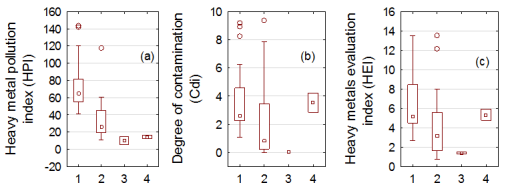
The drinking water critical value for HPI is 100, and the groundwater quality can be classified into five categories, namely excellent (<25), good (25-50), poor (50-75), very poor (75-100), and unsuitable (>100) . The HPI results (Figure 2) suggested that all surface water samples are of excellent quality concerning heavy metal contamination compared to values as high as 455.8, as reported by a study [32]. The HPI values in groundwater samples ranged from 41.4 to 143.0, with a mean value of 73.6 in the dry season, and from 10.8 to 117.6, with a mean value of 33.4 in post-monsoon. Only one sample (4.17%) is unsuitable post-monsoon against four (16.67%) in the dry season due to Fe, Mn, Pb, As, and Sb. High values of up to 470 were reported in other urban areas, such as Linares, Mexico .
Figure 2. Pollution indices for water quality evaluation (1 = GW Dry season; 2 = GW post-monsoon; 3= River dry season; 4 = River post-monsoon).
The pollution level related to poor quality categories decreased in the wet season (12.5%) compared to the dry season (70.8%). Previous studies depicted the evolution of unsuitable groundwater samples decreasing in the post-monsoon season, as in the urban Delhi environs in India and Wuhan City, China . Although heavy metal contamination occurs, rapid infiltration of rainwater may diffuse into open conditions groundwater tables and dilute the metal concentrations contained therein . In Kampala and Mbarara districts, Uganda, an increase in the percentage of samples under the excellent category was also observed in the wet season , supporting the dilution influence. Rupias et al., found no seasonal variation of HPI values in the alluvial plain of Atibaia River- Campinas, Brazil. These variations suggest an influence of the sources, the extent, and the spatial variation of recharge and geochemical processes on the seasonal variation of heavy metal loads in urban groundwater environments.
3.2.2. Contamination Degree Index (Cdi)
The contamination index (Cdi) is calculated for As, Fe, Mn, Pb, and Sb. The critical value for Cdi is 3, and water deterioration can be categorized into three classes of pollution that are low (<1), moderate (1-3), and high (>3) . The results (Figure 2) showed that all surface water samples fall in the low pollution class in the dry season, while moderate and high classes were found post-monsoon. Much higher values, ranging from 7.4 to 39.5, with a mean of 21.1 in surface water, were reported in locations of high-density settlements in the Lower Cross River Basin, southeastern Nigeria . Higher values of 14.8 suggest a high pollution level was observed in the Buriganga River, Bangladesh . The level of Kara River contamination presumes a low load of heavy metals in the water. However, further studies should consider a significant number of samples and sediments because of the potential sources of contamination, such as agrochemicals in vegetable gardening and discharge of domestic and industrial effluents. Heavy metals can accumulate in surface water sediments and pose environmental and human health risks, limiting the efficiency of freshwater management plans, as observed in the Olt River, Romania .
The groundwater values ranged from 0 to 9.2, with a mean value of 3.5 in the dry season, and from 0 to 9.2, with a mean value of 2.2 post-monsoon. In the dry season, 37.5% fall in the high pollution class, and the remaining 62.5% in the moderate pollution class. In post-monsoon, 20.8%, 12.5%, and 37.5% fall in high, moderate, and low pollution classes. Previous results reported a similar trend but with higher values in Shiraz City, Iran , Arang, Chhattisgarh, India, , and Kumasi, Ghana, . Such results indicate that heavy metal pollution of water resources is a global concern, and constraining efforts are required to reduce human exposure.
3.2.3. Heavy Metals Evaluation Index (HEI)
The HEI varied for groundwater samples from 2.7 to 13.5 with a mean of 6.4 and from 0.7 to 13.5 with a mean of 4.1 in the dry season and post-monsoon, respectively. According to the critical value 400 , all water samples are at low risk of heavy metal pollution. Based on the multiple mean approaches, the computed mean was 5.0 for all collected samples, supposing that 29.17% in the dry season and 4.17% in post-monsoon fall in the high pollution category (HEI > 10).
Defining a global scale of groundwater pollution indices, particularly for HEI, appears difficult because of the significant differences in classes in different parts of the globe .
The overall results in this study suggest that the Cdi, HPI, and HEI are highly correlated, as observed in other studies . This may not happen, according to other studies . However, samples fall into different pollution levels from one index to another, suggesting that integrated criteria should be considered for efficiently allocating water sources. Although heavy metal pollution indices are easy to calculate, their values vary worldwide, and the subjectiveness of the critical points appears as a fundamental limitation. Properly studying water resources and their quality evolution at a reconnaissance scale can help define these indexes' application rules. However, they remain undeniably sophisticated tools for water quality assessment and decision-making.
3.3. Health Risk Assessment
3.3.1. Chronic Daily Intake (CDI)
The mean CDI from groundwater is 2.8 10-2 mg/kg-day for children and 2.7 10-2 mg/kg-day for adults through ingestion during the dry season and 3.6 10-2 mg/kg-day for children and 2.6 10-2 mg/kg-day for adults during the post-monsoon (Table S1). Through the dermal route, the mean values are 6.0 10-5 mg/kg-day for children, 2.0 10-5 mg/kg-day for adults in the dry season, and 5.3 10-5 mg/kg-day for children, 1.8 10-5 mg/kg-day for adults in post-monsoon. These values are relatively lower for river water (Table S1).
Although ingestion CDI is substantially higher than dermal CDI, both ingestion and dermal CDI are lower for adults than children due to the difference in exposure conditions and anthropometric characteristics. This suggests more potential negative impact of metal exposure on children's health. The results also showed a seasonal variation of CDI as the seasonal variation of the elemental composition of water samples. The contribution order changed mostly for Zn, Pb, As, Sb, and Ni in groundwater. In river water, the contribution is highly variable for all elements except for Fe, Mn, and Sr, which are the top metal contributors to high CDI.
3.3.2. Hazard Quotient (HQ) and Hazard Index (HI)
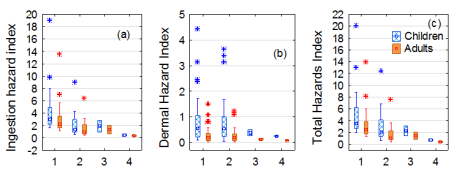
Figure 3 and Table S2 present the descriptive statistics of HQ and HI for children and adults via ingestion and dermal routes.
Figure 3. Results of (a) ingestion hazard index (b) dermal hazard index and (c) total hazard index (1 = GW Dry season; 2 = GW post-monsoon; 3= River dry season; 4 = River post-monsoon).

Hazard Quotient (HQ) values were above 1 in the dry season for Sb, Pb, As, and Co. Sb can harm the eyes, skin, lungs, heart, and stomach . A more stringent limit of 5 µg/L in drinking water similar to that of arsenic is set by some countries . These results suggest considering Sb, As, and Pb among pollutants of priority interest when elaborating and implementing water resources development programs in the Kara region to minimize exposure. During post-monsoon, the ingestion HQ is above 1 for only As and Sb for children and adults. Based on the dermal HQ model, Mn presented cases above 1, with children and adults during the dry season and post-monsoon.
Figure 3c shows that the corresponding hazard index (HI) was above 1 for all the collected groundwater samples in the dry season. The mean values of the HI through ingestion and dermal pathways and the total HI were 4.29, 0.97, and 5.26 for children and 3.07, 0.33, and 3.40 for adults. In post-monsoon, HI was above 1 for all the collected groundwater samples at 87.5% based on the children's model and 66.67% based on the adult model. The corresponding mean values of the HI through ingestion and dermal pathways and the total HI were 2.05, 0.89, and 2.95 for children, 1.47, 0.30, and 1.77 for adults. These results are indicative of the high level of non-carcinogenic health risk in the study area and also suggest that, on average, children are more exposed to a health risk.
Many other studies have been conducted to evaluate water quality using HI. Most of them found children among age groups as the most vulnerable populations to increased non-carcinogenic health risks reflected by higher HI metals . The non-carcinogenic risks model indicated negligible health risks of metals in the surface water and groundwater of Isfahan, Iran . Substantial, persistent non-carcinogenic risks due to Cd and Pb in urban groundwater were reported in Southeast Nigeria .
3.3.3. Cancer Risks to Human
The contents of As, Pb, Cr, and Cd possessing CSF values were considered to have the potential to induce cancer risks for humans in the study area through ingestion. The calculated excess lifetime cancer risk must be lower than the safe point of 10-6, that is, 1 in 1,000,000 chance of acquiring cancer . The results (Table 3) showed that the calculated mean ELCR values exceed the safe point 10 to 100 times, irrespective of age groups, season, and water sources, corresponding to the chance of 2 to 20 cases per 200,000 inhabitants acquiring cancer. This suggests grim potential carcinogenic risks from ingesting groundwater and surface water in the study area.
Further, the risk could be higher due to the hot climatic conditions influencing the daily drinking water consumption rate, which can increase. Public efforts are required to supply affordable, safe drinking water for all in the city and surrounding areas. This requires extending the public treated water supply system to all and providing inexpensive treatment technologies for removing heavy metals.
Table 3. Cancer risk results.

Mean

Min

Max

Mean

Min

Max

GW dry season. Children

GW post-monsoon. Children

Cd

1.6.E-09

1.6.E-09

1.6.E-09

1.6.E-09

1.6.E-09

1.6.E-09

As

3.6.E-05

6.4.E-09

2.6.E-04

4.6.E-05

6.4.E-09

3.1.E-04

Cr

3.2.E-06

2.1.E-09

2.7.E-05

2.8.E-07

2.1.E-09

6.6.E-06

Pb

1.2.E-06

5.7.E-07

2.0.E-06

3.3.E-07

3.6.E-11

6.0.E-07

ELCR

4.1.E-05

1.0.E-06

2.6.E-04

4.6.E-05

3.2.E-07

3.1.E-04

GW dry season. Adults

GW post-monsoon. Adults

Cd

5.8.E-09

5.8.E-09

5.8.E-09

5.8.E-09

5.8.E-09

5.8.E-09

As

1.3.E-04

2.3.E-08

9.4.E-04

1.6.E-04

2.3.E-08

1.1.E-03

Cr

1.1.E-05

7.7.E-09

9.8.E-05

9.9.E-07

7.7.E-09

2.4.E-05

Pb

4.3.E-06

2.0.E-06

7.1.E-06

1.2.E-06

1.3.E-10

2.1.E-06

ELCR

1.5.E-04

3.6.E-06

9.4.E-04

1.7.E-04

1.2.E-06

1.1.E-03

River water dry season. Children

River water post-monsoon. Children

Cd

1.6.E-09

1.6.E-09

1.6.E-09

1.6.E-09

1.6.E-09

1.6.E-09

As

4.7.E-06

6.4.E-09

9.3.E-06

8.4.E-06

6.4.E-09

1.7.E-05

Cr

2.1.E-09

2.1.E-09

2.1.E-09

2.1.E-09

2.1.E-09

2.1.E-09

Pb

3.6.E-11

3.6.E-11

3.6.E-11

1.4.E-07

1.4.E-07

1.4.E-07

ELCR

4.7.E-06

1.0.E-08

9.3.E-06

8.5.E-06

1.5.E-07

1.7.E-05

River water dry season. Adults

River water post-monsoon. Adults

Cd

5.8.E-09

5.8.E-09

5.8.E-09

5.8.E-09

5.8.E-09

5.8.E-09

As

1.7.E-05

2.3.E-08

3.3.E-05

3.0.E-05

2.3.E-08

6.0.E-05

Cr

7.7.E-09

7.7.E-09

7.7.E-09

7.7.E-09

7.7.E-09

7.7.E-09

Pb

1.3.E-10

1.3.E-10

1.3.E-10

5.1.E-07

5.1.E-07

5.1.E-07

ELCR

1.7.E-05

3.7.E-08

3.3.E-05

3.0.E-05

5.5.E-07

6.0.E-05

Similar high carcinogenic risks were in mining areas in the south of the country , gold mining areas in Ghana , and Nigeria, but due to Cd and Pb . In the Jamalpur Sadar area, Bangladesh, higher lifetime carcinogenic risks were also more significant from groundwater intake than surface water . It was also seen elsewhere that children were more susceptible to non-carcinogenic health risks. In contrast, the carcinogenic risk was higher for adults in the urban and industrial region of southern Sonbhadra, Uttar Pradesh, India, , in the Monterrey Metropolitan Area, Mexico , and Târgoviște Plain, a densely populated area in Romania where ELCR was extremely high as 10-3 to 10-2. These regions' findings provide a comprehensive perspective on groundwater quality issues worldwide. Since it highlights common challenges faced by various communities, a global perspective for solution development can boost the urgent needs and action for effective mitigation strategies against heavy metals pollution of groundwater. The global synergy might contribute to the population's use of safely managed drinking water services to achieve target 6.2 of the sustainable development goal, which aims at universal and equitable access to safe and affordable drinking water for all.
Although heavy metal pollution and health risk assessment are significant, the results may suffer from uncertainties due to the parameters of the models, which may vary according to climatic region, culture, daily food, and occupational habits . Despite these limits, the current study and findings are meaningful for orientation regarding water supply systems in Kara. The results also serve as a baseline database for water resources management since such studies have not yet been performed in the study area.
4. Conclusion
The findings of this study highlight significant seasonal variations in the concentration of trace elements with a dilution effect during the post-monsoon season. The groundwater and surface water are fresh and circumneutral. Elements like Cr, Cu, Cd, Co, Zn, and Ni generally complied with WHO standards for drinking water, while Pb, As, Fe, Mn, and Sb were above the permissible limits. The pollution indices indicate the unsuitability of groundwater for drinking and domestic purposes in some households. The health risk assessment highlighted both non-carcinogenic and carcinogenic risks associated with the ingestion and dermal exposure to contaminated groundwater. Children are more vulnerable to metal exposure than adults, emphasizing the need for protective measures for younger populations. The groundwater and surface water should be treated before drinking and domestic use. Despite some limitations, such as small river water samples, variability of critical values for pollution indexes classification, and uncertainties linked to health risk parameters, this study and its findings are meaningful for orientation regarding water quality in the city of Kara.
Abbreviations

CDI

Chronic Daily Intake

Cdi

Degree of Contamination

ELCR

Excess Lifetime Cancer Risk

HEI

Heavy Metal Evaluation Index

HI

Hazard Index

HPI

Heavy Metal Pollution Index

HQ

Hazard Quotient

WHO

World Health Organization

Acknowledgments
The authors would like to thank the Regional Board of Water Resources, Kara, for support during sampling activities and the GEGENAA laboratory at the University of Reims Champagne-Ardenne for providing analytical assistance. The manuscript has benefitted substantially from the comments of the handling Editors and anonymous reviewers.
Author Contributions
Kossitse Venyo Akpataku: Conceptualization, Methodology, Formal analysis, Writing - Original Draft, Writing - Review & Editing
Akpénè Amenuvevega Dougna: Data Curation, Formal analysis, Writing - Original Draft, Writing - Review & Editing
Agbessi Koffi Sodomon: Methodology, Formal analysis, Writing - Original Draft, Writing - Review & Editing
Mozimwè Ani: Methodology, Writing - Original Draft, Writing - Review & Editing
Seyf-Laye Alfa-Sika Mande: Conceptualization, Validation, Writing - Review & Editing
Limam Moctar Bawa: Supervision, Validation
Serigne Faye: Supervision, Validation
Data Availability Statement
The data is available from the corresponding author upon reasonable request.
Funding
This work is not supported by any external funding.
Conflicts of Interest
The authors declare no conflicts of interest.
Supplementary Material

Below is the link to the supplementary material:

Supplementary Material 1

References
[1] WHO, 2022, Guidelines for Drinking-Water Quality: Fourth Edition Incorporating the First and Second Addenda, World Health Organization.
[2] Wexler, P., 2024, Encyclopedia of Toxicology [9 Volume Set], Academic Press, Elsevier. [Online]. Available:
[3] Mitra, S., Chakraborty, A. J., Tareq, A. M., Emran, T. B., Nainu, F., Khusro, A., Idris, A. M., Khandaker, M. U., Osman, H., Alhumaydhi, F. A., and Simal-Gandara, J., 2022, “Impact of Heavy Metals on the Environment and Human Health: Novel Therapeutic Insights to Counter the Toxicity,” Journal of King Saud University - Science, 34(3), p. 101865.
[4] Prasad Ahirvar, B., Das, P., Srivastava, V., and Kumar, M., 2023, “Perspectives of Heavy Metal Pollution Indices for Soil, Sediment, and Water Pollution Evaluation: An Insight,” Total Environment Research Themes, 6, p. 100039.
[5] Ibrahima, M., Moctar, D., Maguette, D. N., Diakher, M. H., Malick, N. P., and Serigne, F., 2015, “Evaluation of Water Resources Quality in Sabodala Gold Mining Region and Its Surrounding Area (Senegal),” Journal of Water Resource and Protection, 07(03), pp. 247-263.
[6] Kumar, V., Parihar, R. D., Sharma, A., Bakshi, P., Singh Sidhu, G. P., Bali, A. S., Karaouzas, I., Bhardwaj, R., Thukral, A. K., Gyasi-Agyei, Y., and Rodrigo-Comino, J., 2019, “Global Evaluation of Heavy Metal Content in Surface Water Bodies: A Meta-Analysis Using Heavy Metal Pollution Indices and Multivariate Statistical Analyses,” Chemosphere, 236, p. 124364.
[7] Moradnia, M., Attar, H. M., Hajizadeh, Y., Lundh, T., Salari, M., and Darvishmotevalli, M., 2024, “Assessing the Carcinogenic and Non-Carcinogenic Health Risks of Metals in the Drinking Water of Isfahan, Iran,” Sci Rep, 14(1), pp. 1-9.
[8] Ahoudi, H., Gnandi, K., Tanouayi, G., and Ouro-Sama, K., 2015, “Caractérisation Physico-Chimique et Etat de Pollution Par Les Élements Traces Métalliques Des Eaux Souterraines de Lomé (Sud Togo): Cas Du Quartier Agoe Zongo,” LARHYSS Journal ISSN 1112-3680, (24), pp. 41-56.
[9] Akpataku, K. V., Gnazou, M. D. T., Nomesi, T. Y. A., Nambo, P., Doni, K., Bawa, L. M., and Djaneye-Boundjou, G., 2020, “Physicochemical and Microbiological Quality of Shallow Groundwater in Lomé, Togo,” Journal of Geoscience and Environment Protection, 8(12), pp. 162-179.
[10] Kpiagou, P., Tchegueni, S., Boguido, G., Sama, D., Gnandi, K., Tchacondo, T., and Glitho, I., 2022, “Evaluation de La Pollution Des Ressources En Eau Du Bassin Versant de Didagou (Dapaong, Nord-Togo),” International Journal of Biological and Chemical Sciences, 16, pp. 481-497.
[11] Napo, G., Akpataku, K. V., Seyf-Laye, A.-S. M., Gnazou, M. D. T., Bawa, L. M., and Djaneye-Boundjou, G., 2021, “Assessment of Shallow Groundwater Quality Using Water Quality Index and Human Risk Assessment in the Vogan-Attitogon Plateau, Southeastern (Togo),” Journal of Environment Pollution and Human Health, 9(2), pp. 50-63.
[12] Bissang, B. T., Aragón-Barroso, A. J., Baba, G., González-López, J., and Osorio, F., 2024, “Integrated Assessment of Heavy Metal Pollution and Human Health Risks in Waters from a Former Iron Mining Site: A Case Study of the Canton of Bangeli, Togo,” Water, 16(3), p. 471.
[13] Segbeaya, K. N., Koledzi, K. E., Baba, G., and Feuilade-Cathalifaud, G., 2019, “The Impact of Household and Similar Solid Wastes on Kara River Quality Due to Their Potential to Release Nitrogen,” J. Environ. Chem. Ecotoxicol., 11(3), pp. 29-42.
[14] INSEED-Togo, 2023, Résultats Finaux Du 5e Recensement Général de La Population et de l’Habitat (RGPH-5) de Novembre 2022: Distribution Spatiale de La Population Résidente Par Sexe, Institut national de la statistique et des études économiques et démographiques, Lomé, Togo.
[15] Badjana, H. M., Fink, M., Helmschrot, J., Diekkrüger, B., Kralisch, S., Afouda, A. A., and Wala, K., 2017, “Hydrological System Analysis and Modelling of the Kara River Basin (West Africa) Using a Lumped Metric Conceptual Model,” Hydrological Sciences Journal, 62(7), pp. 1094-1113.
[16] Ani, M., 2023, “Fonctionnement Des Aquifères Des Socle Ouest-Africain Par Une Approche Combinée: Hydroclimatologie, Hydrogéologie, Hydrogéochimie - Application Au Bassin Versant de La Rivière Kara Au Nord Du Togo,” These de Doctorat, Université de Reims Champagne-Ardenne. [Online]. Available:
[17] Tairou, M. S., and Affaton, P., 2013, “Structural Organization and Tectono-Metamorphic Evolution of the Pan-African Suture Zone: Case of the Kabye and Kpaza Massifs in the Dahomeyide Orogen in Northern Togo (West Africa),” International Journal of Geosciences, 04(01), pp. 166-182.
[18] Rodier, J., Legube, B., Merlet, N., and coll., 2009, L’analyse de l’eau, Dunod, Paris, France.
[19] Mohan, S. V., Nithila, P., and Reddy, S. J., 1996, “Estimation of Heavy Metals in Drinking Water and Development of Heavy Metal Pollution Index,” Journal of Environmental Science & Health Part A, 31(2), pp. 283-289.
[20] Edet, A. E., and Offiong, O. E., 2002, “Evaluation of Water Quality Pollution Indices for Heavy Metal Contamination Monitoring. A Study Case from Akpabuyo-Odukpani Area, Lower Cross River Basin (Southeastern Nigeria),” GeoJournal, 57(4), pp. 295-304.
[21] Backman, B., Bodiš, D., Lahermo, P., Rapant, S., and Tarvainen, T., 1998, “Application of a Groundwater Contamination Index in Finland and Slovakia,” Environmental Geology, 36(1), pp. 55-64.
[22] USEPA, 1989, Risk-Assessment Guidance for Superfund. Volume 1. Human Health Evaluation Manual. Part A. Interim Report (Final), EPA/540/1-89/002, Environmental Protection Agency, Washington, DC (USA). Office of Solid Waste ….
[23] USEPA, 2004, Risk Assessment Guidance for Superfund Volume I: Human Health Evaluation Manual (Part E, Supplemental Guidance for Dermal Risk Assessment) Final, EPA/540/R/99/005, OSWER 9285.7-02EP, PB99-963312. [Online]. Available:
[24] USEPA, 2005, Guidelines for Carcinogen Risk Assessment, EPA/630/P-03/001F, U.S. Environmental Protection Agency, Washington, DC.
[25] OEHHA, 2024, Technical Support Document for Cancer Potency Factors 2009, Appendix A: Hot Spots Unit Risk and Cancer Potency Values. Updated April 2023, California Office of Environmental Health Hazard Assessment (OEHHA). [Online]. Available:
[26] Shaji, E., Santosh, M., Sarath, K. V., Prakash, P., Deepchand, V., and Divya, B. V., 2021, “Arsenic Contamination of Groundwater: A Global Synopsis with Focus on the Indian Peninsula,” Geoscience Frontiers, 12(3), p. 101079.
[27] Bello, S., Nasiru, R., Garba, N. N., and Adeyemo, D. J., 2019, “Carcinogenic and Non-Carcinogenic Health Risk Assessment of Heavy Metals Exposure from Shanono and Bagwai Artisanal Gold Mines, Kano State, Nigeria,” Scientific African, 6, p. e00197.
[28] Giri, S., Singh, A. K., and Mahato, M. K., 2020, “Monte Carlo Simulation-Based Probabilistic Health Risk Assessment of Metals in Groundwater via Ingestion Pathway in the Mining Areas of Singhbhum Copper Belt, India,” Int J Environ Health Res, 30(4), pp. 447-460.
[29] Sanusi, I. O., Olutona, G. O., Wawata, I. G., and Onohuean, H., 2024, “Heavy Metals Pollution, Distribution and Associated Human Health Risks in Groundwater and Surface Water: A Case of Kampala and Mbarara Districts, Uganda,” Discov Water, 4(1), p. 27.
[30] Nishad, P. A., and Bhaskarapillai, A., 2021, “Antimony, a Pollutant of Emerging Concern: A Review on Industrial Sources and Remediation Technologies,” Chemosphere, 277, p. 130252.
[31] Singha, S., Pasupuleti, S., Singha, S. S., and Kumar, S., 2020, “Effectiveness of Groundwater Heavy Metal Pollution Indices Studies by Deep-Learning,” Journal of Contaminant Hydrology, 235, p. 103718.
[32] Bhuiyan, M. A. H., Dampare, S. B., Islam, M. A., and Suzuki, S., 2014, “Source Apportionment and Pollution Evaluation of Heavy Metals in Water and Sediments of Buriganga River, Bangladesh, Using Multivariate Analysis and Pollution Evaluation Indices,” Environ Monit Assess, 187(1), p. 4075.
[33] De León-Gómez, H., Martin Del Campo-Delgado, M. A., Esteller-Alberich, M. V., Velasco-Tapia, F., Alva-Niño, E., and Cruz-López, A., 2020, “Assessment of Nitrate and Heavy Metal Contamination of Groundwater Using the Heavy Metal Pollution Index: Case Study of Linares, Mexico,” Environ Earth Sci, 79(18), p. 433.
[34] Sharma, K., Janardhana Raju, N., Singh, N., and Sreekesh, S., 2022, “Heavy Metal Pollution in Groundwater of Urban Delhi Environs: Pollution Indices and Health Risk Assessment,” Urban Climate, 45, p. 101233.
[35] Han, W., Pan, Y., Welsch, E., Liu, X., Li, J., Xu, S., Peng, H., Wang, F., Li, X., Shi, H., Chen, W., and Huang, C., 2023, “Prioritization of Control Factors for Heavy Metals in Groundwater Based on a Source-Oriented Health Risk Assessment Model,” Ecotoxicology and Environmental Safety, 267, p. 115642.
[36] Boum-Nkot, S. N., Nlend, B., Komba, D., Ndondo, G. R. N., Bello, M., Fongoh, E. J., Ntamak-Nida, M.-J., and Etame, J., 2023, “Hydrochemistry and Assessment of Heavy Metals Groundwater Contamination in an Industrialized City of Sub-Saharan Africa (Douala, Cameroon). Implication on Human Health,” HydroResearch, 6, pp. 52-64.
[37] Rupias, O. J. B., Pereira, S. Y., and De Abreu, A. E. S., 2021, “Hydrogeochemistry and Groundwater Quality Assessment Using the Water Quality Index and Heavy-Metal Pollution Index in the Alluvial Plain of Atibaia River- Campinas/SP, Brazil,” Groundwater for Sustainable Development, 15, p. 100661.
[38] Iordache, A. M., Nechita, C., Zgavarogea, R., Voica, C., Varlam, M., and Ionete, R. E., 2022, “Accumulation and Ecotoxicological Risk Assessment of Heavy Metals in Surface Sediments of the Olt River, Romania,” Sci Rep, 12(1), p. 880.
[39] Badeenezhad, A., Soleimani, H., Shahsavani, S., Parseh, I., Mohammadpour, A., Azadbakht, O., Javanmardi, P., Faraji, H., and Babakrpur Nalosi, K., 2023, “Comprehensive Health Risk Analysis of Heavy Metal Pollution Using Water Quality Indices and Monte Carlo Simulation in R Software,” Sci Rep, 13(1), p. 15817.
[40] Boateng, T. K., Opoku, F., and Akoto, O., 2019, “Heavy Metal Contamination Assessment of Groundwater Quality: A Case Study of Oti Landfill Site, Kumasi,” Appl Water Sci, 9(2), p. 33.
[41] Opasola, O. A., and Otto, E., 2024, “Evaluation of Heavy Metal Levels and Contamination Indices of Groundwater Sources in Kaduna South Local Government Area, Kaduna State, Northern Nigeria,” jasem, 28(6), pp. 1841-1852.
[42] WHO, 2018, A Global Overview of National Regulations and Standards for Drinking-Water Quality, World Health Organization, Geneva, Switzerland.
[43] Ayejoto, D. A., and Egbueri, J. C., 2024, “Human Health Risk Assessment of Nitrate and Heavy Metals in Urban Groundwater in Southeast Nigeria,” Ecological Frontiers, 44(1), pp. 60-72.
[44] USEPA, 2016, “Human Health Risk Assessment,”
[45] USEPA, 1992, Guidelines for Exposure Assessment, EPA/600/Z-92/001.
[46] Zakir, H. M., Sharmin, S., Akter, A., and Rahman, Md. S., 2020, “Assessment of Health Risk of Heavy Metals and Water Quality Indices for Irrigation and Drinking Suitability of Waters: A Case Study of Jamalpur Sadar Area, Bangladesh,” Environmental Advances, 2, p. 100005.
[47] Ahamad, A., Raju, N. J., Madhav, S., and Khan, A. H., 2020, “Trace Elements Contamination in Groundwater and Associated Human Health Risk in the Industrial Region of Southern Sonbhadra, Uttar Pradesh, India,” Environ Geochem Health, 42(10), pp. 3373-3391.
[48] Ramos, E., Bux, R. K., Medina, D. I., Barrios-Piña, H., and Mahlknecht, J., 2023, “Spatial and Multivariate Statistical Analyses of Human Health Risk Associated with the Consumption of Heavy Metals in Groundwater of Monterrey Metropolitan Area, Mexico,” Water, 15(6), p. 1243.
[49] Bretcan, P., Tanislav, D., Radulescu, C., Serban, G., Danielescu, S., Reid, M., and Dunea, D., 2022, “Evaluation of Shallow Groundwater Quality at Regional Scales Using Adaptive Water Quality Indices,” IJERPH, 19(17), p. 10637.
Cite This Article
  • APA Style

    Akpataku, K. V., Dougna, A. A., Sodomon, A. K., Ani, M., Mande, S. A., et al. (2024). Groundwater Quality Assessment Using Pollution Indices and Human Health Risks Through Exposure to Trace Elements in the City of Kara, Togo. American Journal of Environmental Protection, 13(5), 163-174. https://doi.org/10.11648/j.ajep.20241305.15

    Copy | Download

    ACS Style

    Akpataku, K. V.; Dougna, A. A.; Sodomon, A. K.; Ani, M.; Mande, S. A., et al. Groundwater Quality Assessment Using Pollution Indices and Human Health Risks Through Exposure to Trace Elements in the City of Kara, Togo. Am. J. Environ. Prot. 2024, 13(5), 163-174. doi: 10.11648/j.ajep.20241305.15

    Copy | Download

    AMA Style

    Akpataku KV, Dougna AA, Sodomon AK, Ani M, Mande SA, et al. Groundwater Quality Assessment Using Pollution Indices and Human Health Risks Through Exposure to Trace Elements in the City of Kara, Togo. Am J Environ Prot. 2024;13(5):163-174. doi: 10.11648/j.ajep.20241305.15

    Copy | Download

  • @article{10.11648/j.ajep.20241305.15,
      author = {Kossitse Venyo Akpataku and Akpénè Amenuvevega Dougna and Agbessi Koffi Sodomon and Mozimwè Ani and Seyf-Laye Alfa-Sika Mande and Limam Moctar Bawa and Serigne Faye},
      title = {Groundwater Quality Assessment Using Pollution Indices and Human Health Risks Through Exposure to Trace Elements in the City of Kara, Togo
    },
      journal = {American Journal of Environmental Protection},
      volume = {13},
      number = {5},
      pages = {163-174},
      doi = {10.11648/j.ajep.20241305.15},
      url = {https://doi.org/10.11648/j.ajep.20241305.15},
      eprint = {https://article.sciencepublishinggroup.com/pdf/10.11648.j.ajep.20241305.15},
      abstract = {This study assesses the concentrations of trace elements in groundwater from Kara, focusing on their implications for water quality and health risks. Groundwater samples were collected and analyzed during the dry and post-monsoon seasons for pH, TDS, and trace metals using standard methods and for calculating pollution indices and noncarcinogenic and carcinogenic risks. Groundwater was found to be fresh but more acidic during the dry season. Only As, Pb, Sb, Fe, and Mn exceeded acceptable limits in some samples, highlighting potential health risks. Based on the heavy metal pollution index, groundwater is unsuitable for domestic purposes for 16.67% and 4.17% of samples in dry and post-monsoon seasons, respectively. According to the degree of contamination, 37.5% in the dry season and 20.8% in post-monsoon fell in high pollution classes. Most samples presented a hazard index above the unity for the resident children and adults. Carcinogenic risk assessment scores exceeded 10 to 100-fold higher than the safe point of 10-6. Adequate access to treated and safe drinking water and regular monitoring are essential to mitigate these risks in the Kara region.
    },
     year = {2024}
    }
    

    Copy | Download

  • TY  - JOUR
    T1  - Groundwater Quality Assessment Using Pollution Indices and Human Health Risks Through Exposure to Trace Elements in the City of Kara, Togo
    
    AU  - Kossitse Venyo Akpataku
    AU  - Akpénè Amenuvevega Dougna
    AU  - Agbessi Koffi Sodomon
    AU  - Mozimwè Ani
    AU  - Seyf-Laye Alfa-Sika Mande
    AU  - Limam Moctar Bawa
    AU  - Serigne Faye
    Y1  - 2024/10/31
    PY  - 2024
    N1  - https://doi.org/10.11648/j.ajep.20241305.15
    DO  - 10.11648/j.ajep.20241305.15
    T2  - American Journal of Environmental Protection
    JF  - American Journal of Environmental Protection
    JO  - American Journal of Environmental Protection
    SP  - 163
    EP  - 174
    PB  - Science Publishing Group
    SN  - 2328-5699
    UR  - https://doi.org/10.11648/j.ajep.20241305.15
    AB  - This study assesses the concentrations of trace elements in groundwater from Kara, focusing on their implications for water quality and health risks. Groundwater samples were collected and analyzed during the dry and post-monsoon seasons for pH, TDS, and trace metals using standard methods and for calculating pollution indices and noncarcinogenic and carcinogenic risks. Groundwater was found to be fresh but more acidic during the dry season. Only As, Pb, Sb, Fe, and Mn exceeded acceptable limits in some samples, highlighting potential health risks. Based on the heavy metal pollution index, groundwater is unsuitable for domestic purposes for 16.67% and 4.17% of samples in dry and post-monsoon seasons, respectively. According to the degree of contamination, 37.5% in the dry season and 20.8% in post-monsoon fell in high pollution classes. Most samples presented a hazard index above the unity for the resident children and adults. Carcinogenic risk assessment scores exceeded 10 to 100-fold higher than the safe point of 10-6. Adequate access to treated and safe drinking water and regular monitoring are essential to mitigate these risks in the Kara region.
    
    VL  - 13
    IS  - 5
    ER  - 

    Copy | Download

Author Information
  • Laboratory of Organic Chemistry and Environmental Sciences, Department of Chemistry, University of Kara, Kara, Togo; Laboratory of Applied Hydrology and Environment, University of Lomé, Lome, Togo

  • Laboratory of Organic Chemistry and Environmental Sciences, Department of Chemistry, University of Kara, Kara, Togo; Laboratory of Applied Hydrology and Environment, University of Lomé, Lome, Togo

  • Laboratory of Organic Chemistry and Environmental Sciences, Department of Chemistry, University of Kara, Kara, Togo

  • Laboratory of Applied Hydrology and Environment, University of Lomé, Lome, Togo; Study Group on Geomaterials and Anthropized Environments, University of Reims Champagne-Ardenne, Reims, France

  • Laboratory of Organic Chemistry and Environmental Sciences, Department of Chemistry, University of Kara, Kara, Togo; Laboratory of Applied Hydrology and Environment, University of Lomé, Lome, Togo

  • Laboratory of Applied Hydrology and Environment, University of Lomé, Lome, Togo

  • Department of Geology, Faculty of Science and Technology, Cheikh Anta Diop University, Dakar Fann, Senegal