Research Article | | Peer-Reviewed

Epidemiological Characteristics, Incidence Trends and Prediction of Lung Cancer in Kailu County from 2009 to 2022 Based on APC and ARIMA Models

Received: 3 May 2026     Accepted: 4 June 2026     Published: 11 July 2026
Views:       Downloads:
Abstract

Objective: To understand the epidemiological characteristics of lung cancer in Kailu County from 2009 to 2022, to analyze the long-term trend of lung cancer incidence by age-period-cohort (APC) model, and to predict the incidence from 2023 to 2025 by using the autoregressive integral moving average model (ARIMA) model. Methods: Based on the incidence and death data of lung cancer and household registration in Kailu County from 2009 to 2022, the crude morbidity (death) rate, the standardized incidence (death) rate of China's population, and the standardized incidence (death) rate of the world population were calculated by gender and age. The Joinpoint regression model was used to calculate the APC of China's population standardization rate. The APC model was constructed to study the age distribution characteristics, incidence trend and birth cohort effect of lung cancer. The ARIMA model was used to predict the trend of lung cancer incidence from 2023 to 2025. Results: The crude incidence and crude mortality rate of lung cancer in Kailu County from 2009 to 2022 were 44.75/100,000 and 34.86/100,000, respectively. The standardized incidence (death) rate of China's population is 41.96/100,000 (32.85/100,000), and the standardized incidence (death) rate of the world population is 36.17/100,000 (33.42/100,000). The incidence and mortality rates were significantly higher in males than in females (P<0.05). The standardized incidence of lung cancer in China showed an upward trend from 2009 to 2014 (APC=24.86%, P<0.05), decreased year by year from 2014 to 2022 (APC=-8.07%, P<0.05), and the standardized mortality rate of the Chinese population increased from 2009 to 2014 (APC=36.26%, P<0.05), and showed a downward trend from 2014 to 2022 (APC=-9.33%, P<0.05); The results of the APC model showed that the risk of lung cancer peaked at the age of 50-54 in men and reached the peak at the age of 60-64 in women. The prediction results of the ARIMA(0,1,0) model show that the incidence of lung cancer in the county will show a slow downward trend from 2023 to 2025. Conclusion: From 2009 to 2022, the epidemic characteristics of lung cancer in Kailu County showed a trend of first rising and then decreasing, and there were obvious age and gender differences in incidence and death, it was necessary to continue to carry out lung cancer surveillance and strengthen prevention and control publicity and intervention in high-risk groups to reduce the burden of lung cancer disease.

Published in American Journal of Health Research (Volume 14, Issue 4)
DOI 10.11648/j.ajhr.20261404.12
Page(s) 189-197
Creative Commons

This is an Open Access article, distributed under the terms of the Creative Commons Attribution 4.0 International License (http://creativecommons.org/licenses/by/4.0/), which permits unrestricted use, distribution and reproduction in any medium or format, provided the original work is properly cited.

Copyright

Copyright © The Author(s), 2026. Published by Science Publishing Group

Keywords

Lung Cancer, Epidemiological Characteristics, Trend, Age-Period-Cohort Model, Prediction

1. Background
Lung cancer is one of the malignant tumors with relatively high incidence and mortality rates worldwide. In China, lung cancer is the leading cause of death among malignant tumors, imposing a heavy disease burden . In 2022, there were approximately 1,060,600 new lung cancer cases and nearly 733,300 deaths globally . China, as a high-incidence area for lung cancer, accounts for more than 40% of both new cases and deaths worldwide . The risk of lung cancer incidence and mortality is influenced by various factors such as air pollution, smoking, and the allocation of medical resources, with significant regional differences . Kailu County, as one of the earliest rural cancer surveillance sites in the Inner Mongolia Autonomous Region, has continuous and complete cancer registration data; however, studies focusing on long-term trends and predictions of lung cancer in this area remain limited. This study is based on lung cancer incidence and mortality data in Kailu County from 2009 to 2022, utilizing Joinpoint regression and the age-period-cohort (APC) model to analyze epidemiological characteristics and trends of change, and applying the ARIMA model to predict incidence rates for 2023–2025. The aim is to provide a scientific basis for lung cancer prevention and control, high-risk population interventions, and health resource allocation in the area.
2. Materials and Methods
2.1. Data Sources
The lung cancer data for this study were obtained from the cancer registry of Kailu County, covering the period from 2009 to 2022. The dataset includes information on newly diagnosed and deceased lung cancer cases, as well as corresponding household registration details in Kailu County. The surveillance data from Kailu County have been included multiple times in the national and Inner Mongolia Autonomous Region cancer annual reports. Tumor coding followed the 10th edition of the International Classification of Diseases (ICD-10), screening for all malignant tumors (C00-C97), and the data were reported by medical institutions in Kailu County through an online system.
2.2. Quality Control
The data from Kailu County were strictly coded according to ICD-10 and the 'International Classification of Diseases for Oncology' (3rd edition) (ICD-O-3) standards, and evaluated for completeness according to the 'China Guidelines for Cancer Registration' (2016 edition) and the inclusion and exclusion criteria of the International Agency for Research on Cancer. The reported content was ultimately subjected to checks for completeness, validity, and consistency. Data evaluation was conducted using indicators such as the percentage of morphological verification (MV%), the percentage of death certificate only cases (DCO%), and the mortality to incidence ratio (M/I). From 2009 to 2022, the MV%, DCO%, and M/I in Kailu County were 72.98%, 0.48%, and 0.60, respectively, indicating that the data are complete and reliable.
2.3. Statistical Analysis
Data were organized and analyzed using SPSS 27.0 and Excel to calculate the crude incidence/mortality rates of lung cancer in Kailu County, the age-standardized rates using the Chinese population (based on the 2010 standard population age structure), and the age-standardized rates using the world population (based on Segi's world population age structure). Joinpoint 5.4 software was used to analyze the annual percentage change (APC) of the standardized rates to evaluate trends, with P < 0.05 indicating statistical significance. Stata 19.0 was used to construct an APC model to explore the relationship between lung cancer incidence risk and age, period, and cohort. SPSS was used to construct an ARIMA model to predict the standardized incidence rate of lung cancer in Kailu County. Due to the need for balanced grouping in the APC model and the large volatility of data during the monitoring startup phase from 2009-2012, this study selected ten-year data from 2013-2022 to construct the age-period-cohort model, with age groups in 5-year intervals. Since the number of lung cancer cases in younger age groups was zero, the age analysis was conducted for the population aged 25-84 years, and periods were divided into 5-year intervals. There are various methods for model constraints, and this study used the intrinsic estimator (IE) method. For the ARIMA model, to ensure the stationarity of time series, data on the standardized incidence rates of lung cancer from 2010-2022 were used for modeling and prediction.
3. Results
3.1. Characteristics and Trends of Lung Cancer Incidence and Mortality in Kailu County from 2009 to 2022
From 2009 to 2022, a total of 2,438 new cases of lung cancer were recorded in Kailu County, Inner Mongolia Autonomous Region, with 1,374 cases in males and 1,064 cases in females, resulting in a male-to-female incidence ratio of 1.29 (male/female). The crude incidence rate for the overall population was 44.75 per 100,000, the age-standardized incidence rate was 41.96 per 100,000, and the world-standardized incidence rate was 36.17 per 100,000. The crude incidence rate in males was 49.65 per 100,000, higher than the 39.70 per 100,000 observed in females, with a χ² value of 30.14, P < 0.05.
There were 1,899 deaths from lung cancer, including 1,113 men and 786 women, with a male-to-female mortality ratio of 1.42. The crude mortality rate for the entire population was 34.86 per 100,000, the standardized mortality rate was 32.85 per 100,000, and the world standardized mortality rate was 33.42 per 100,000. The crude mortality rate for men was 40.22 per 100,000, higher than the crude mortality rate for women at 29.32 per 100,000, with a χ2 value of 46.35, P<0.05.
Joinpoint regression analysis showed that the lung cancer epidemic trend in Kailu County first increased and then decreased, with the turning point occurring in 2014. From 2009 to 2014, the age-standardized incidence rate in the entire population increased by an average of 24.86% per year (P<0.05), and the age-standardized mortality rate increased by an average of 36.26% per year (P<0.05). From 2014 to 2022, the age-standardized incidence rate decreased by an average of 8.07% per year (P<0.05), and the age-standardized mortality rate decreased by an average of 9.33% per year (P<0.05). The trends in incidence and mortality in males were consistent with those in the entire population. Female incidence significantly increased from 2009 to 2013 (APC=42.73%, P<0.05), and then decreased from 2013 to 2022, but the decrease was not statistically significant (P=0.08). Female mortality showed a trend of first increasing and then decreasing, both with statistical significance (P<0.05), as shown in Table 1.
Table 1. Joinpoint Analysis of ASIRC and ASMRC for Lung Cancer, 2009–2022.

Graph

Category

Time Period (Year)

APC(%)

95%CI

t

P

Incidence

Total

2009-2014

24.86

11.15~40.26

4.32

P<0.05

2014-2022

-8.07

-13.14~-2.70

-3.35

P<0.05

Male

2009-2014

21.73

9.07~35.85

4.05

P<0.05

2014-2022

-8.71

-13.47~-3.69

-3.85

P<0.05

Female

2009-2013

42.73

13.41~79.63

3.50

P<0.05

2013-2022

-5.55

-11.62~0.93

-1.95

P=0.08

Mortality

Total

2009-2014

36.26

17.03~58.64

4.60

P<0.05

2014-2022

-9.33

-15.81~-2.34

-2.98

P<0.05

Male

2009-2014

34.03

14.16~57.36

4.13

P<0.05

2014-2022

-9.25

-16.34~-2.15

2.89

P<0.05

Female

2009-2013

53.94

22.72~93.11

4.31

P<0.05

2013-2022

-6.15

-12.43~-0.19

-2.33

P<0.05

3.2. Trends in Lung Cancer Incidence and Mortality by Sex and Age in Kailu County from 2009 to 2022
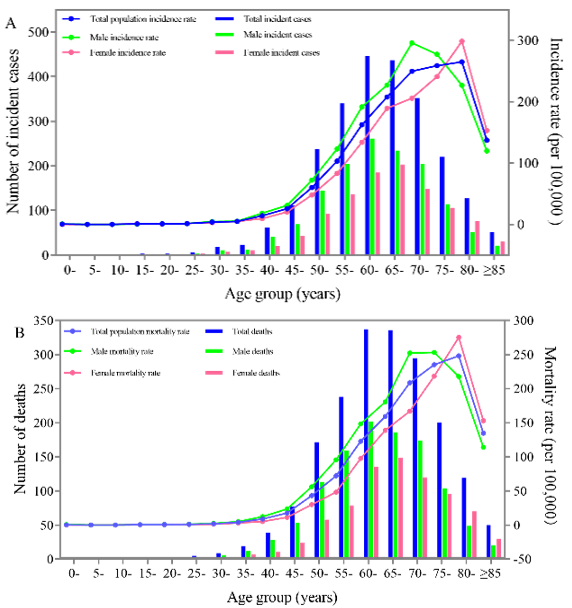
From 2009 to 2022, the incidence of lung cancer in the entire population of Kailu County (male and female) increased with age initially and then decreased. The highest number of cases in males occurred in the 60-year-old group, with the incidence peaking in the 70-year-old group before declining. For females, the highest number of cases was in the 65-year-old group, and the incidence peaked at 80 years old. In the overall population, the incidence rate peaked at 80 years old before decreasing. Regardless of gender, the incidence rate began to change significantly after age 40 (Figure 1A). The mortality rate of lung cancer in the entire population of Kailu County, as well as male and female mortality rates, increased with age initially and then decreased. The highest number of male lung cancer deaths occurred in the 60-year-old group, with the mortality rate starting to decline after 70 years old. For females, the highest number of deaths occurred in the 65-year-old group, and the mortality trend was consistent with that of the overall population, peaking at 75 years old before declining. Lung cancer mortality rates in both sexes showed significant changes starting at age 40 (Figure 1B).
Figure 1. Age and Gender Differences in Incidence and Mortality of Lung Cancer, Kailu County, 2009–2022.
3.3. 2013-2022 Kailu County Sex-Specific Lung Cancer Incidence Age-Period-Cohort Model
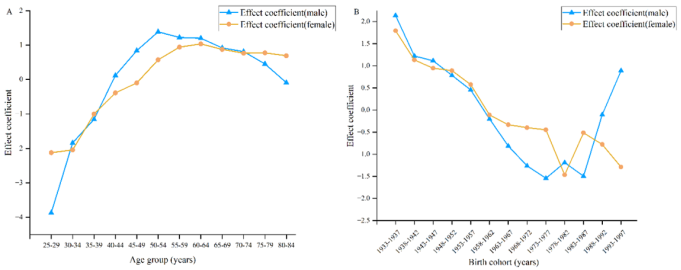
The results of the APC model analysis indicate that in terms of age effect, the risk of lung cancer among males in Kailu County gradually increases from ages 25-29, reaching a peak at 50-54 years, after which it slowly declines but remains at a relatively high level. Except for the 40-year and 80-year age groups, where the differences in age effect are not statistically significant, the P-values for all other groups are less than 0.05. For females, the increase in incidence risk is relatively gradual, peaking at ages 60-64 and then slowly declining. The differences in age effect among the 40-54 age groups are not statistically significant, while the differences in other age groups are significant (P<0.05).
In terms of period effects, comparing the two periods of 2013–2017 and 2018–2022, the risk of lung cancer in both men and women showed a declining trend over time, but the effect coefficients were not statistically significant.
Regarding birth cohort effects, the risk of lung cancer in men shows a pattern of first decreasing and then increasing with successive birth years. The birth cohorts from 1933 to 1957 had the highest risk, after which the risk began to decline with later cohorts, and then gradually increased again after 1978. In women, the overall birth cohort risk shows a decreasing trend, with fluctuations observed only in the 1978 cohort. The differences in birth cohort effects among men born between 1933-1957 and 1963-1987 were statistically significant (P<0.05), and the differences among women born between 1933-1957 and 1978-1982 were also statistically significant (P<0.05), as shown in Table 2 (Figure 2).
Table 2. Age-Period-Cohort Model Analysis for Lung Cancer Incidence in Kailu County, 2013–2022.

Effect

Male

Female

Coefficient

Standard Error

P

Coefficient

Standard Error

P

Age(years)

25-29

-3.868

0.967

0.000

-2.124

0.841

0.012

30-34

-1.838

0.573

0.001

-2.044

0.516

0.000

35-39

-1.152

0.476

0.015

-1.003

0.471

0.033

40-44

0.120

0.448

0.790

-0.388

0.477

0.415

45-49

0.840

0.401

0.036

-0.098

0.426

0.819

50-54

1.386

0.333

0.000

0.573

0.360

0.112

55-59

1.222

0.259

0.000

0.940

0.284

0.001

60-64

1.199

0.186

0.000

1.035

0.206

0.000

65-69

0.916

0.136

0.000

0.877

0.150

0.000

70-74

0.811

0.141

0.000

0.766

0.154

0.000

75-79

0.453

0.209

0.031

0.773

0.227

0.001

80-84

-0.089

0.347

0.799

0.693

0.351

0.049

Period (year)

2013-2017

0.121

0.051

0.813

0.021

0.056

0.712

2018-2022

-0.121

0.051

0.813

-0.021

0.056

0.712

Birth cohort (year)

1933-1937

2.140

0.399

0.000

1.796

0.395

0.000

1938-1942

1.223

0.254

0.000

1.133

0.270

0.000

1943-1947

1.115

0.166

0.000

0.947

0.182

0.000

1948-1952

0.786

0.140

0.000

0.891

0.160

0.000

1953-1957

0.455

0.175

0.009

0.576

0.201

0.004

1958-1962

-0.203

0.242

0.401

-0.112

0.274

0.684

1963-1967

-0.814

0.316

0.010

-0.333

0.354

0.345

1968-1972

-1.264

0.389

0.001

-0.399

0.428

0.351

1973-1977

-1.543

0.450

0.001

-0.448

0.486

0.357

1978-1982

-1.188

0.486

0.015

-1.467

0.502

0.003

1983-1987

-1.496

0.494

0.002

-0.515

0.488

0.291

1988-1992

-0.105

0.585

0.857

-0.778

0.635

0.220

1993-1997

0.893

1.136

0.432

-1.290

1.208

0.286

Intercept

-7.466

0.080

0.000

-7.765

0.104

0.000

Figure 2. Effect Coefficients of Age and Birth Cohort on Lung Cancer Incidence in Kailu County.
3.4. ARIMA Model Prediction of Lung Cancer Incidence in Kailu County from 2023 to 2025
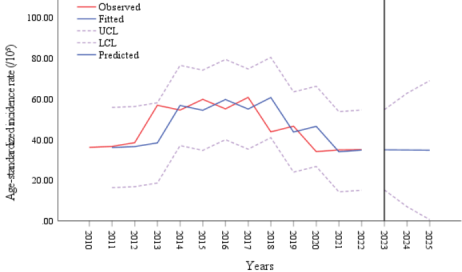
Based on the lung cancer incidence data from Kailu County from 2010 to 2022, after first-order differencing stabilization, the optimal model ARIMA(0,1,0) was obtained. The Ljung-Box test yielded P>0.05, and the mean absolute percentage error (MAPE%) was within 10% for all years except 2013, 2018, and 2020, indicating a good model fit. Using the ARIMA(0,1,0) model to predict the incidence from 2023 to 2025, as shown in Table 3 and Figure 3, the lung cancer incidence in Kailu County shows a slow downward trend from 2023 to 2025, with incidence rates of 34.97/100,000, 34.88/100,000, and 34.79/100,000, respectively.
Table 3. Prediction of ASIRC for Lung Cancer in Kailu County, 2023–2025.

Year

Actual value

Predicted value

95%CI

Percentage error (%)

2010

36.15

-

-

-

2011

36.65

36.06

16.33~55.78

1.61

2012

38.45

36.56

16.83~56.28

4.92

2013

56.87

38.36

18.63~58.08

32.55

2014

54.49

56.78

37.05~76.50

4.20

2015

59.78

54.40

34.67~74.12

9.00

2016

55.09

59.69

39.96~79.41

8.35

2017

60.76

55.00

35.27~74.72

9.48

2018

43.79

60.67

40.94~80.39

38.55

2019

46.58

43.70

23.97~63.42

6.18

2020

34.07

46.49

26.76~66.21

36.45

2021

34.93

33.98

14.25~53.70

2.72

2022

35.06

34.84

15.11~54.56

0.63

2023

-

34.97

15.24~54.69

-

2024

-

34.88

6.89~62.77

-

2025

-

34.79

0.62~68.95

-

Figure 3. Observed, Fitted and Predicted Incidence Rates of Lung Cancer in Kailu County, 2010–2022.

4. Discussion
The mortality rate of lung cancer ranks high globally, causing pain to humanity while continuously eroding the foundations of ordinary families, and slowing down national development. As a populous country, China bears a particularly heavy disease burden from lung cancer . The results of this study show that from 2009 to 2022, the standardized incidence rate of lung cancer in Kailu County was 41.96 per 100,000, and the standardized mortality rate was 32.85 per 100,000, which is basically consistent with the lung cancer incidence levels in other rural areas of China . Both the incidence and mortality rates in men are significantly higher than those in women, consistent with national and most regional study results , possibly related to higher exposure levels of risk factors among men such as smoking, alcohol consumption, and occupational exposure . Joinpoint regression analysis shows that both the standardized incidence and mortality rates of lung cancer in the general population experienced an inflection point in 2014, rising rapidly from 2009 to 2014 and declining continuously from 2014 to 2022. The incidence and mortality of lung cancer in both men and women also showed a trend of first rising and then falling. The rising trend may be related to the gradual improvement of the monitoring system in Kailu County, enhanced health awareness among residents, and improved clinical diagnostic capabilities ; the declining trend indicates that local comprehensive prevention and control measures, such as tobacco control, environmental management, and screening of high-risk populations, have begun to show effectiveness.
Age-specific analysis shows that the incidence and mortality rates of lung cancer rapidly increase after the age of 40, reaching a peak in the 80-year-old group, indicating that middle-aged and elderly populations are the key target groups for lung cancer prevention and control. With increasing age, the decline in immune function and long-term cumulative exposure to carcinogens collectively lead to higher incidence levels . Therefore, health education should be conducted as early as possible, and the frequency of medical examinations for middle-aged and elderly individuals should be increased. The peak incidence and mortality in men occur in the 70-year-old group, whereas women follow the trend of the overall population, peaking about ten years later than men. This may be related to women being exposed to factors such as domestic cooking fumes and passive smoking at a later stage .
The results of the APC model indicate that age is the most significant factor influencing the incidence of lung cancer. The risk of lung cancer for both sexes rises and then falls with age, but the risk in older age groups is higher than that in younger age groups, and the effect in most age groups is significant. This may be related to the cumulative effect of lung cancer . The peak incidence risk occurs at age 50 for men and age 60 for women, suggesting that, considering age alone, the probability of developing lung cancer is highest for men at age 50 and for women at age 60 in Kailu County. Targeted prevention and control for different populations are therefore necessary. Period effects were not statistically significant, indicating that from 2013 to 2022, the incidence of lung cancer in Kailu County was influenced only by age and birth cohort, while external factors such as the social environment and healthcare policies did not have a significant impact. This implies that future efforts in Kailu County should focus on long-term risk factor control and management for lung cancer. The birth cohort effect shows that the incidence risk for men first decreases and then increases with birth year, peaking in the 1933-1957 birth cohorts. For women, the overall trend is decreasing, with fluctuation observed only in the 1978 cohort. This may be related to the fact that northern China was a core area of national heavy industry in earlier years, and people born in earlier cohorts were long exposed to air pollution . The decline in risk for more recent birth cohorts suggests that measures such as smoking control, environmental management, and health education can reduce the risk of lung cancer .
The ARIMA (0,1,0) model was used to predict the incidence of lung cancer from 2023 to 2025. The results indicate that the incidence rate in Zhongbiao is expected to show a slow downward trend. This finding is suggested that the lung cancer prevention and control efforts in Kailu County are sustainable and that the disease burden is expected to gradually decrease. The overall model fit is good, although the errors for 2013, 2018, and 2020 were slightly higher, possibly due to fluctuations in early monitoring data or sudden increases in case numbers caused by improved diagnostic capacity in certain years. Overall, this does not affect the reliability of the predictions.
The study has certain limitations. First, the research only covered Kailu County, so caution is needed when extrapolating the results to other regions. Second, data on risk factors such as smoking, alcohol consumption, occupational exposure, and environment were not included, making it impossible to further analyze their impact on disease trends. Finally, the ARIMA model fundamentally relies on the assumption of a linear time series, which imposes strict requirements on the completeness and stationarity of the data, performing well in short-term forecasts but slightly weaker in medium- and long-term predictions . The APC model, on the other hand, is limited by data grouping and period spans, which may introduce some bias in effect estimation . Future studies are expected to carry out individual-based epidemiological investigations of risk factors and combine the two models to explore etiologies in depth, providing a basis for precise prevention and control.
5. Conclusions
In summary, the prevalence of lung cancer in Kailu County shows a trend of first increasing and then decreasing, with significant differences in gender and age. The risk of onset among middle-aged and elderly populations remains relatively high. Although the future trend in incidence is expected to continue improving, it is still necessary to maintain routine lung cancer monitoring, strengthen preventive measures such as tobacco control and environmental management, and carry out early screening, diagnosis, and health interventions targeting high-risk groups such as men over 50 and women over 60, in order to continuously reduce the burden of lung cancer.
Abbreviations

APC

Annual Percentage Change

ARIMA

Autoregressive Integrated Moving Average

ICD-10

10th Revision

MV%

Percentage of Morphological Verification

DCO%

Percentage of Death Certification Only

M/I

Mortality-To-Incidence RAtio

AAPC

Average Annual Percentage Change

Author Contributions
Wang Hao: Conceptualization, Data curation, Formal analysis, Writing – original draft, Investigation
Geng Xin-Yao: Data curation, Validation, Visualization
Li Zhi-Hui: Resources, Data acquisition
Ni Xiao-Na: Methodology, Formal Analysis
Buren Ba-tu: Project administration
Li Na: Conceptualization, Supervision, Funding acquisition
Conflicts of Interest
The authors declare that they have no conflicts of interest.
References
[1] Diao X, Guo C, Jin Y, et al. Cancer situation in China: an analysis based on the global epidemiological data released in 2024. Cancer Commun (Lond). 2025; 45(2): 178-197.
[2] Han B, Zheng R, Zeng H, et al. Cancer incidence and mortality in China, 2022. J Natl Cancer Cent. 2024; 4(1): 47-53. Published 2024 Feb 2.
[3] Xia C, Dong X, Li H, et al. Cancer statistics in China and United States, 2022: profiles, trends, and determinants. Chin Med J (Engl). 2022; 135(5): 584-590. Published 2022 Feb 9.
[4] de Groot P, Munden RF. Lung cancer epidemiology, risk factors, and prevention. Radiol Clin North Am. 2012; 50(5): 863-876.
[5] Zhou J, Xu Y, Liu J, Feng L, Yu J, Chen D. Global burden of lung cancer in 2022 and projections to 2050: Incidence and mortality estimates from GLOBOCAN. Cancer Epidemiol. 2024; 93: 102693.
[6] Qi J, Li M, Wang L, et al. National and subnational trends in cancer burden in China, 2005-20: an analysis of national mortality surveillance data. Lancet Public Health. 2023; 8(12): e943-e955.
[7] Zheng RS, Chen R, Han BF, et al. Zhonghua Zhong Liu Za Zhi. 2024; 46(3): 221-231.
[8] Ho V, Parent ME, Pintos J, et al. Physical activity and lung cancer risk in men and women. Cancer Causes Control. 2017; 28(4): 309-318.
[9] Li X, Galea G. Healthy China 2030: an opportunity for tobacco control. Lancet. 2019; 394(10204): 1123-1125.
[10] Wu F, Wang L, Zhou C. Lung cancer in China: current and prospect. Curr Opin Oncol. 2021; 33(1): 40-46.
[11] Caballero-Vázquez A, Romero-Béjar JL, Albendín-García L, et al. Risk Factors for Short-Term Lung Cancer Survival. J Clin Med. 2021; 10(3): 519. Published 2021 Feb 1.
[12] Albano D, Dhamija A, Liao Y, et al. Lung cancer in nonsmokers- A risk factor analysis. Cancer Epidemiol. 2023; 86: 102439.
[13] Wu F, Wang L, Zhou C. Lung cancer in China: current and prospect. Curr Opin Oncol. 2021; 33(1): 40-46.
[14] Yang D, Liu Y, Bai C, Wang X, Powell CA. Epidemiology of lung cancer and lung cancer screening programs in China and the United States. Cancer Lett. 2020; 468: 82-87.
[15] Wang W, Meng L, Hu Z, et al. The association between outdoor air pollution and lung cancer risk in seven eastern metropolises of China: Trends in 2006-2014 and sex differences. Front Oncol. 2022; 12: 939564. Published 2022 Sep 29.
[16] Islami F, Nargis N, Liu Q, et al. Averted lung cancer deaths due to reductions in cigarette smoking in the United States, 1970-2022. CA Cancer J Clin. 2025; 75(3): 216-225.
[17] Li M, Hu M, Jiang L, Pei J, Zhu C. Trends in Cancer Incidence and Potential Associated Factors in China. JAMA Netw Open. 2024; 7(10): e2440381. Published 2024 Oct 1.
[18] Wang M, Pan J, Li X, et al. ARIMA and ARIMA-ERNN models for prediction of pertussis incidence in mainland China from 2004 to 2021. BMC Public Health. 2022; 22(1): 1447. Published 2022 Jul 29.
[19] Perea LME, Antunes JLF, Peres MA. Approaches to the problem of nonidentifiability in the age-period-cohort models in the analysis of cancer mortality: a scoping review. Eur J Cancer Prev. 2022; 31(1): 93-103.
[20] Bell A, Jones K. The impossibility of separating age, period and cohort effects. Soc Sci Med. 2013; 93: 163-165.
Cite This Article
  • APA Style

    Hao, W., Xin-Yao, G., Zhi-Hui, L., Xiao-Na, N., Ba-Tu, B., et al. (2026). Epidemiological Characteristics, Incidence Trends and Prediction of Lung Cancer in Kailu County from 2009 to 2022 Based on APC and ARIMA Models. American Journal of Health Research, 14(4), 189-197. https://doi.org/10.11648/j.ajhr.20261404.12

    Copy | Download

    ACS Style

    Hao, W.; Xin-Yao, G.; Zhi-Hui, L.; Xiao-Na, N.; Ba-Tu, B., et al. Epidemiological Characteristics, Incidence Trends and Prediction of Lung Cancer in Kailu County from 2009 to 2022 Based on APC and ARIMA Models. Am. J. Health Res. 2026, 14(4), 189-197. doi: 10.11648/j.ajhr.20261404.12

    Copy | Download

    AMA Style

    Hao W, Xin-Yao G, Zhi-Hui L, Xiao-Na N, Ba-Tu B, et al. Epidemiological Characteristics, Incidence Trends and Prediction of Lung Cancer in Kailu County from 2009 to 2022 Based on APC and ARIMA Models. Am J Health Res. 2026;14(4):189-197. doi: 10.11648/j.ajhr.20261404.12

    Copy | Download

  • @article{10.11648/j.ajhr.20261404.12,
      author = {Wang Hao and Geng Xin-Yao and Li Zhi-Hui and Ni Xiao-Na and Buren Ba-Tu and Li Na},
      title = {Epidemiological Characteristics, Incidence Trends and Prediction of Lung Cancer in Kailu County from 2009 to 2022 Based on APC and ARIMA Models},
      journal = {American Journal of Health Research},
      volume = {14},
      number = {4},
      pages = {189-197},
      doi = {10.11648/j.ajhr.20261404.12},
      url = {https://doi.org/10.11648/j.ajhr.20261404.12},
      eprint = {https://article.sciencepublishinggroup.com/pdf/10.11648.j.ajhr.20261404.12},
      abstract = {Objective: To understand the epidemiological characteristics of lung cancer in Kailu County from 2009 to 2022, to analyze the long-term trend of lung cancer incidence by age-period-cohort (APC) model, and to predict the incidence from 2023 to 2025 by using the autoregressive integral moving average model (ARIMA) model. Methods: Based on the incidence and death data of lung cancer and household registration in Kailu County from 2009 to 2022, the crude morbidity (death) rate, the standardized incidence (death) rate of China's population, and the standardized incidence (death) rate of the world population were calculated by gender and age. The Joinpoint regression model was used to calculate the APC of China's population standardization rate. The APC model was constructed to study the age distribution characteristics, incidence trend and birth cohort effect of lung cancer. The ARIMA model was used to predict the trend of lung cancer incidence from 2023 to 2025. Results: The crude incidence and crude mortality rate of lung cancer in Kailu County from 2009 to 2022 were 44.75/100,000 and 34.86/100,000, respectively. The standardized incidence (death) rate of China's population is 41.96/100,000 (32.85/100,000), and the standardized incidence (death) rate of the world population is 36.17/100,000 (33.42/100,000). The incidence and mortality rates were significantly higher in males than in females (PPPPPConclusion: From 2009 to 2022, the epidemic characteristics of lung cancer in Kailu County showed a trend of first rising and then decreasing, and there were obvious age and gender differences in incidence and death, it was necessary to continue to carry out lung cancer surveillance and strengthen prevention and control publicity and intervention in high-risk groups to reduce the burden of lung cancer disease.},
     year = {2026}
    }
    

    Copy | Download

  • TY  - JOUR
    T1  - Epidemiological Characteristics, Incidence Trends and Prediction of Lung Cancer in Kailu County from 2009 to 2022 Based on APC and ARIMA Models
    AU  - Wang Hao
    AU  - Geng Xin-Yao
    AU  - Li Zhi-Hui
    AU  - Ni Xiao-Na
    AU  - Buren Ba-Tu
    AU  - Li Na
    Y1  - 2026/07/11
    PY  - 2026
    N1  - https://doi.org/10.11648/j.ajhr.20261404.12
    DO  - 10.11648/j.ajhr.20261404.12
    T2  - American Journal of Health Research
    JF  - American Journal of Health Research
    JO  - American Journal of Health Research
    SP  - 189
    EP  - 197
    PB  - Science Publishing Group
    SN  - 2330-8796
    UR  - https://doi.org/10.11648/j.ajhr.20261404.12
    AB  - Objective: To understand the epidemiological characteristics of lung cancer in Kailu County from 2009 to 2022, to analyze the long-term trend of lung cancer incidence by age-period-cohort (APC) model, and to predict the incidence from 2023 to 2025 by using the autoregressive integral moving average model (ARIMA) model. Methods: Based on the incidence and death data of lung cancer and household registration in Kailu County from 2009 to 2022, the crude morbidity (death) rate, the standardized incidence (death) rate of China's population, and the standardized incidence (death) rate of the world population were calculated by gender and age. The Joinpoint regression model was used to calculate the APC of China's population standardization rate. The APC model was constructed to study the age distribution characteristics, incidence trend and birth cohort effect of lung cancer. The ARIMA model was used to predict the trend of lung cancer incidence from 2023 to 2025. Results: The crude incidence and crude mortality rate of lung cancer in Kailu County from 2009 to 2022 were 44.75/100,000 and 34.86/100,000, respectively. The standardized incidence (death) rate of China's population is 41.96/100,000 (32.85/100,000), and the standardized incidence (death) rate of the world population is 36.17/100,000 (33.42/100,000). The incidence and mortality rates were significantly higher in males than in females (PPPPPConclusion: From 2009 to 2022, the epidemic characteristics of lung cancer in Kailu County showed a trend of first rising and then decreasing, and there were obvious age and gender differences in incidence and death, it was necessary to continue to carry out lung cancer surveillance and strengthen prevention and control publicity and intervention in high-risk groups to reduce the burden of lung cancer disease.
    VL  - 14
    IS  - 4
    ER  - 

    Copy | Download

Author Information
  • Abstract
  • Keywords
  • Document Sections

    1. 1. Background
    2. 2. Materials and Methods
    3. 3. Results
    4. 4. Discussion
    5. 5. Conclusions
    Show Full Outline
  • Abbreviations
  • Author Contributions
  • Conflicts of Interest
  • References
  • Cite This Article
  • Author Information