
 ,
Bashir Saidu,
Abdulganiyyu Abdullahi Ahmad,
Jabir Muhammad Ahmad,
Nafisat Abdulazeez,
Zaid Shehu,
Shurhabilu Ja’afar
,
Bashir Saidu,
Abdulganiyyu Abdullahi Ahmad,
Jabir Muhammad Ahmad,
Nafisat Abdulazeez,
Zaid Shehu,
Shurhabilu Ja’afar
Occupational exposure to solder paste fumes is common among handset repairers and workers in electronic and industrial settings, particularly in underdeveloped countries where protective measures are often lacking. Despite known health concerns, experimental evidence on the histopathological effects of solder paste fumes on vital organs remains limited. This study investigated the impact of chronic inhalation of solder paste fumes on the heart and lungs of Wistar rats. Forty rats were divided into control (n = 12) and exposed (n = 28) groups. The exposed group inhaled solder paste fumes at a dose of 0.18 g twice daily for eight weeks. Tissue samples were collected at two-week intervals for histopathological evaluation. Results revealed hyperemia and distortion of cardiac muscle fibers in the hearts of exposed rats, while lung tissues showed severe degenerative and necrotic changes in alveolar sacs and ducts. These findings demonstrate that prolonged inhalation of solder paste fumes causes significant cardiac and pulmonary tissue damage, highlighting serious cardiovascular and respiratory risks. The study underscores the importance of implementing appropriate occupational safety measures to protect individuals routinely exposed to solder fumes.
| Published in | American Journal of Life Sciences (Volume 14, Issue 3) |
| DOI | 10.11648/j.ajls.20261403.13 |
| Page(s) | 85-91 |
| Creative Commons |
This is an Open Access article, distributed under the terms of the Creative Commons Attribution 4.0 International License (http://creativecommons.org/licenses/by/4.0/), which permits unrestricted use, distribution and reproduction in any medium or format, provided the original work is properly cited. |
| Copyright |
Copyright © The Author(s), 2026. Published by Science Publishing Group |
Histopathology, Heart, Lung, Solder Paste, Rats
PCB | Printed Circuit Boards |
SMT | Surface Mount Technology |
Pb | Lead |
Sn | Stanum |
RoHS | Restriction of Hazardous Substances |
GSM | Global System for Mobile Communication |
FAREC | Faculty Animal Research and Ethics Committee |
| [1] | Keating, M. (2012). Introduction to Solder Paste. IPC – Association Connecting Electronics Industries. |
| [2] | Tummala, R. R., Rymaszewski, E. J. and Klopfenstein, A. G. (1997). Microelectronics Packaging Handbook. 3rd edition. |
| [3] | Ndukwe, E. (2003). The role of telecommunication in national development.’ The Guardian, 38. |
| [4] | Arab, M. R., Mirzaei, R., Karimi, M., & Mashhadi, R. (2010). The study of histological effects of solder fumes in rat lungs. Iranian Journal of Basic Medical Sciences, 13, 63–68. |
| [5] | Antonini, J. M., Leonard, S. S., Roberts, J. R., Solano, Lopez, C., Young, S. H. and Shi, X. (2005). Effect of stainless steel manual arc welding fume on free radical production, DNA damage and apoptosis. Molecular and Cellular Biochemistry 279(1-2): 17-23. |
| [6] | Pippen, D. L. (1999). A primer on hand soldering electronic connections. New Mexico State University Press. 1–10. |
| [7] | Borska, L., Fiala, Z., Smejkalová, J., & Tejral, J. (2019). Health risk of occupational exposure in welding processes I: Genotoxic risk. Acta Medica (Hradec Králové, Czech Republic), 46(1), 25–29. |
| [8] | Mendy, A., Gasana, J., Forno, E., Vieira, E. R., & Dowdye, C. (2012). Work-related respiratory symptoms and lung function among solderers in the electronics industry: A meta-analysis. Environmental Health and Preventive Medicine, 17(3), 183–190. |
| [9] | Palmer, K. and Crane, G. (1997). Respiratory disease in workers exposed to colophony solder flux fumes: Continuing health concerns. Occupational Medicine. 47(8): 491-6. |
| [10] | Yu, I. J., Song, K. S., Maeng, S. H., Kim, S. J., Sung, J. H. and Han, J. H. (2004). Inflammatory and genotoxic responses during 30 day welding fume exposure period. Toxicology Letters. 154(1-2): 105-15. |
| [11] | Kim, J. Y., Chen, J. C., Boyce, P. D. and Christiani, D. C. (2005). Exposure to welding fumes is associated with acute systemic inflammatory responses. Occupational Environmental Medicine. 62(3): 157-63. |
| [12] | Mozaffari, S., Heibati, B., Jaakkola, M. S., Lajunen, T. K., Kalteh, S., Alimoradi, H., Nazari, M., Karimi, A., & Jaakkola, J. J. K. (2023). Effects of occupational exposures on respiratory health in steel factory workers. Frontiers in Public Health, 11, Article 1082874. |
| [13] | Patwa, A. and Shah, A. (2015). Anatomy and physiology of respiratory system relevant to anaesthesia. Indian Journal Anaesthesia. 59(9): 533–541. |
| [14] | IPC (2015). Association Connecting Electronics Industries. IPC J-STD-005 Requirements for Soldering Pastes. |
| [15] |
ICT Directorate Sokoto State Government (2023).
https://sokotostate.gov.ng/history-ofsokoto/the-land/ retrieved 15-07-2023. |
| [16] | Tonetto, S., Weikop, P., Brudek, T., & Thomsen, M. (2023). Behavioral and biochemical effects of alcohol withdrawal in female C3H/HeNRj and C57BL/6JRj mice. Frontiers in Behavioral Neuroscience, 17. |
| [17] | Barnhart, C. D., Yang, D., & Lein, P. J. (2015). Using the Morris water maze to assess spatial learning and memory in weanling mice. PLoS ONE, 10(4). |
| [18] | Reza, R. and Singh, G. (2010). Heavy Metal Contamination and Its Indexing Approach for River Water. International Journal of Environmental Sciences Technology, 7, 785-792. |
| [19] | Hameed, R., V., R., Cleetus, M., Augustine, J., & R., D. (2022). Soldering fume exposure as a cause of acute hypersensitivity pneumonitis. European Journal of Pharmaceutical and Medical Research, 9(4), 123–129. |
| [20] | Courtney, D. (1985). Health hazards of soft soldering in the electronics industry. Reviews on Environmental Health, 5(1), 1–26. |
| [21] | Gupta, B. N., Rastogi, S. K., Husain, T., Mathur, N., & Pangtey, B. S. (1991). A study of respiratory morbidity and pulmonary function among solderers in the electronics industry. American Industrial Hygiene Association Journal, 52(2), 45–51. |
APA Style
Dahiru, A., Saidu, B., Ahmad, A. A., Ahmad, J. M., Abdulazeez, N., et al. (2026). Histopathological Alterations in Cardiac and Pulmonary Tissues Following Solder Paste Fume Inhalation in Wistar Rats. American Journal of Life Sciences, 14(3), 85-91. https://doi.org/10.11648/j.ajls.20261403.13
ACS Style
Dahiru, A.; Saidu, B.; Ahmad, A. A.; Ahmad, J. M.; Abdulazeez, N., et al. Histopathological Alterations in Cardiac and Pulmonary Tissues Following Solder Paste Fume Inhalation in Wistar Rats. Am. J. Life Sci. 2026, 14(3), 85-91. doi: 10.11648/j.ajls.20261403.13
@article{10.11648/j.ajls.20261403.13,
  author = {Ashiru Dahiru and Bashir Saidu and Abdulganiyyu Abdullahi Ahmad and Jabir Muhammad Ahmad and Nafisat Abdulazeez and Zaid Shehu and Shurhabilu Ja’afar},
  title = {Histopathological Alterations in Cardiac and Pulmonary Tissues Following Solder Paste Fume Inhalation in Wistar Rats},
  journal = {American Journal of Life Sciences},
  volume = {14},
  number = {3},
  pages = {85-91},
  doi = {10.11648/j.ajls.20261403.13},
  url = {https://doi.org/10.11648/j.ajls.20261403.13},
  eprint = {https://article.sciencepublishinggroup.com/pdf/10.11648.j.ajls.20261403.13},
  abstract = {Occupational exposure to solder paste fumes is common among handset repairers and workers in electronic and industrial settings, particularly in underdeveloped countries where protective measures are often lacking. Despite known health concerns, experimental evidence on the histopathological effects of solder paste fumes on vital organs remains limited. This study investigated the impact of chronic inhalation of solder paste fumes on the heart and lungs of Wistar rats. Forty rats were divided into control (n = 12) and exposed (n = 28) groups. The exposed group inhaled solder paste fumes at a dose of 0.18 g twice daily for eight weeks. Tissue samples were collected at two-week intervals for histopathological evaluation. Results revealed hyperemia and distortion of cardiac muscle fibers in the hearts of exposed rats, while lung tissues showed severe degenerative and necrotic changes in alveolar sacs and ducts. These findings demonstrate that prolonged inhalation of solder paste fumes causes significant cardiac and pulmonary tissue damage, highlighting serious cardiovascular and respiratory risks. The study underscores the importance of implementing appropriate occupational safety measures to protect individuals routinely exposed to solder fumes.},
 year = {2026}
}
TY  - JOUR
T1  - Histopathological Alterations in Cardiac and Pulmonary Tissues Following Solder Paste Fume Inhalation in Wistar Rats
AU  - Ashiru Dahiru
AU  - Bashir Saidu
AU  - Abdulganiyyu Abdullahi Ahmad
AU  - Jabir Muhammad Ahmad
AU  - Nafisat Abdulazeez
AU  - Zaid Shehu
AU  - Shurhabilu Ja’afar
Y1  - 2026/05/19
PY  - 2026
N1  - https://doi.org/10.11648/j.ajls.20261403.13
DO  - 10.11648/j.ajls.20261403.13
T2  - American Journal of Life Sciences
JF  - American Journal of Life Sciences
JO  - American Journal of Life Sciences
SP  - 85
EP  - 91
PB  - Science Publishing Group
SN  - 2328-5737
UR  - https://doi.org/10.11648/j.ajls.20261403.13
AB  - Occupational exposure to solder paste fumes is common among handset repairers and workers in electronic and industrial settings, particularly in underdeveloped countries where protective measures are often lacking. Despite known health concerns, experimental evidence on the histopathological effects of solder paste fumes on vital organs remains limited. This study investigated the impact of chronic inhalation of solder paste fumes on the heart and lungs of Wistar rats. Forty rats were divided into control (n = 12) and exposed (n = 28) groups. The exposed group inhaled solder paste fumes at a dose of 0.18 g twice daily for eight weeks. Tissue samples were collected at two-week intervals for histopathological evaluation. Results revealed hyperemia and distortion of cardiac muscle fibers in the hearts of exposed rats, while lung tissues showed severe degenerative and necrotic changes in alveolar sacs and ducts. These findings demonstrate that prolonged inhalation of solder paste fumes causes significant cardiac and pulmonary tissue damage, highlighting serious cardiovascular and respiratory risks. The study underscores the importance of implementing appropriate occupational safety measures to protect individuals routinely exposed to solder fumes.
VL  - 14
IS  - 3
ER  -
Department of Veterinary Physiology and Biochemistry, Usmanu Danfodiyo University, Sokoto, Nigeria
Department of Veterinary Physiology and Biochemistry, Usmanu Danfodiyo University, Sokoto, Nigeria
Department of Veterinary Physiology and Biochemistry, Federal University of Agriculture, Zuru, Zuru, Nigeria
Department of Veterinary Physiology and Biochemistry, Usmanu Danfodiyo University, Sokoto, Nigeria
Department of Veterinary Physiology and Biochemistry, Usmanu Danfodiyo University, Sokoto, Nigeria
Department of Veterinary Medicine, Usmanu Danfodiyo University, Sokoto, Nigeria
Department of Veterinary Anatomy, Yakubu Gawon University, Abuja, Nigeria
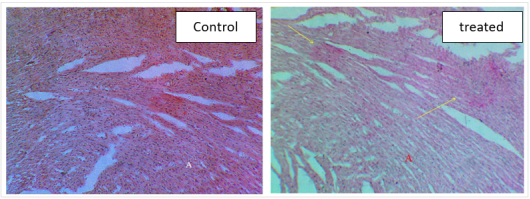
Figure 1. Control: Showing Cardiomyocytes of the control group with normal histological architecture of the heart at two weeks exposure. treated: Showing distorted Cardiomyocytes, multiple arrows showing areas of hyperemia at two weeks exposure.
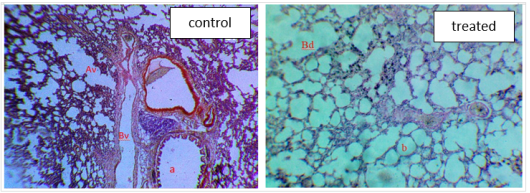
Figure 2. Control: showing normal alveolar tree (a), the Alveolar duct (Av), and blood vessels (Bv) of the control group at two weeks exposure. treated: showing alveolar sac (b) and alveolar duct of sample specimen showing necrotic changes at two weeks exposure.
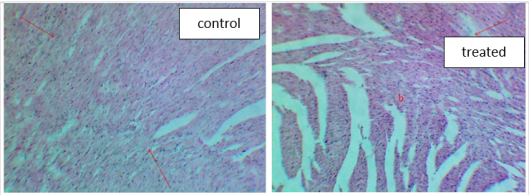
Figure 3. Control: multiple arrows showing cardiac muscle cells of the control group at four weeks exposure. treated: showing cardiomyocytes with arrow showing necrotic area at four weeks exposure.
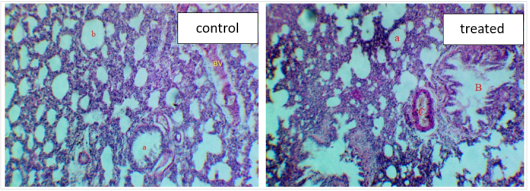
Figure 4. Control: showing alveolar tree (a), the Alveolar sac (b), and Blood vessels (Bv) of the control group at four weeks exposure. while treated: Alveolar sac (a), Alveolar tree (B) and Blood vessels (C); showing degenerative changes of sample specimen at four weeks exposure.
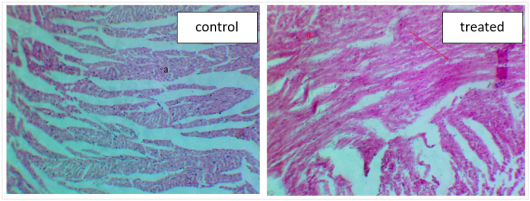
Figure 5. Control: Showing cardiomyocytes of the control group with normal histological architecture of the heart at six weeks exposure. treated: Showing Cardiomyocytes with arrow showing areas of severe hyperemia at six weeks exposure.
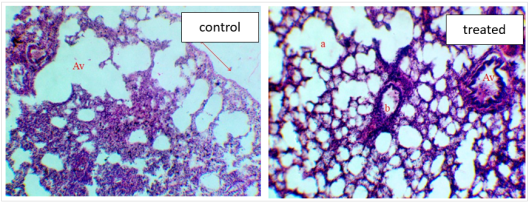
Figure 6. Control: Showing alveolar duct, with arrow showing the epithelial lining of the control group at six weeks exposure. treated: showing degenerative changes of alveolar sac (a), blood vessels (b) and alveolar tree (Av) of sample specimen at six weeks exposure.
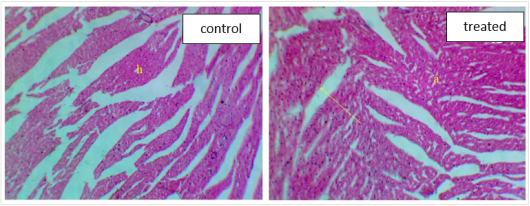
Figure 7. Control: showing cardiomyocytes of the control group with normal histological architecture of the heart at eight weeks exposure (h). treated: showing cardiomyocytes (a) with arrow showing areas of severe hyperemia at eight weeks exposure.
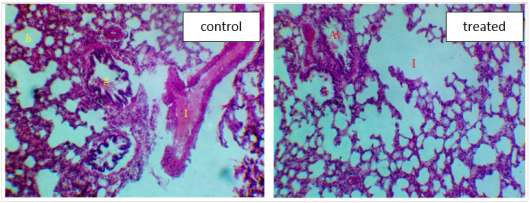
Figure 8. Control: showing alveolar tree (g), the alveolar sac (h) and blood vessels (I) of the control group at eight weeks exposure. treated: alveolar sac (a), alveolar tree (Av) with degenerative changes of sample specimen at eight weeks exposure. while blood vessels surrounded with necrotic changes and multiple dilations of the air sacs.

Information


 Share This Article
 Twitter
 Linked In
 Facebook
 Copy
Copy Download