Research Article | | Peer-Reviewed

Nonlinear Magneto-convective Flow of Jeffery Fluid Through a Poro-elastic Medium with Fluid-structure Interaction

Received: 21 August 2026     Accepted: 31 August 2026     Published: 30 September 2026
Views:       Downloads:
Abstract

Consideration of non-Newtonian fluid flow in combination with deformable porous materials is necessary for many engineering applications involving thermal transport. These applications combine fluid dynamics, heat transport, and structural deformation, with or without interaction. This work analyses nonlinear convective heat transfer of a Jeffery fluid flowing through a deformable porous medium under the effect of fluid-structure interaction, variable fluid properties, nonlinear buoyancy, magnetic forces, and viscous dissipation and Ohmic heating. A coupled fluid flow and heat transport solid deformation problem is formulated and converted to a set of nonlinear PDEs. These equations are used to construct the model, and the SCCM is used for the numerical solution. The fourth-order Runge– Kutta shooting method is used to check the results and control the accuracy of the numerical solution. Viscous dissipation and Ohmic heating study showed that the combination of both effects assists internal energy generation, leading to an increase in temperature, while fluid velocity and solid deformation are altered. The influence of a magnetic field is realized when the Lorentz force acts on the fluid. An increase in porosity leads to an increase in the fluid flow and solid deformation. Stronger nonlinear buoyancy strengthens convection, harnessing the fluid’s motion and thermodynamic transport capacity. The overall results show that fluid-structure interaction modeling with inhomogeneous properties, nonlinear buoyancy, magnetism, viscous friction, and Ohmic dissipation captures a more accurate description of transport phenomena occurring in deformable porous media. The results add to existing literature and provoke new directions for the study and determination of optimal configurations of engineering systems in which viscoelastic fluids interact with porous medium structures.

Published in American Journal of Mechanics and Applications (Volume 13, Issue 3)
DOI 10.11648/j.ajma.20261303.13
Page(s) 47-58
Creative Commons

This is an Open Access article, distributed under the terms of the Creative Commons Attribution 4.0 International License (http://creativecommons.org/licenses/by/4.0/), which permits unrestricted use, distribution and reproduction in any medium or format, provided the original work is properly cited.

Copyright

Copyright © The Author(s), 2026. Published by Science Publishing Group

Keywords

Convective Flow, Viscoelastic Fluid, Deformable Porous Medium, Variable Properties, Ohmic Heating, Viscous Dissipation

1. Introduction
Heat transfer and convection within porous media are one of the fastest-growing research domains due to the broad range of applications that are found in biology, geophysics, and engineering. Some examples would be the enhancement of oil recovery, geothermal energy recovery, filtration, and biofluid dynamics. The analysis of the fluid flow within the porous medium is essential for efficient heat transfer and optimisation of the process of transporting the fluid from one place to another. Several investigations have been carried out regarding fluid flow through porous media considering different physical settings such as Darcy effects, convective conditions, mixed convection flow, and the effect of radiation. For example, Sreepada and Ontela investigated nonlinear free convective Casson fluid flow in a non-Darcy porous medium with convective boundary conditions, while Bawazeer and Alsoufi examined natural convection in a square cavity under varying Rayleigh and Prandtl numbers. Shoaib, et al. presented a numerical treatment for nonlinear mixed convection and thermal radiative Newtonian fluid flow, whereas Nazir, et al. analysed thermal and solutal transport in Casson nanofluid flow subjected to mixed convection and radiation effects. Jan, et al. ; Gangadharaiah, et al. and Khan, et al. also explored convective transport phenomena in different porous and cavity configurations. Furthermore, Shafiq, et al. ; Nalini, et al. and Milon, et al. studied nonlinear squeezing flow, magnetohydrodynamic convective transport, and unstable free convective flow in porous systems under different thermal conditions.
Besides, non-Newtonian fluid models have also been considered extensively due to their capability to depict the non-Newtonian nature of various industrial fluids. Non-Newtonian fluid models like power-law fluid, Casson fluid, and Jeffery fluid have been used to describe those materials exhibiting both viscosity and elasticity . The Jeffery fluid model has lately drawn a great deal of attention because of its ability to describe fluids showing memory effects arising due to the ratio of relaxation to retardation times. Such properties are very important in polymeric solutions, biological fluids, and industrial process fluids. Moreover, thermal processes such as Ohmic heating and dissipation play a significant role in generating internal energy by influencing fluid flow and temperature field distribution. Such processes are very pertinent in electrically conducting fluids owing to the interaction between electromagnetic, momentum, and heat transfer processes. Banjo, et al. recently investigated the second-law analysis of reactive electroosmotic flow of couple-stress fluids with temperature-dependent properties and two-step chemical reactions, highlighting the importance of coupled thermal and reactive mechanisms in non-Newtonian transport systems. Khalid, et al. discussed the recovery of valuable substances using Ohmic heating-assisted extraction, while Saeedabad, et al. investigated Ohmic heating enhancement of sesame protein isolate properties. Altay, et al. examined the combined effect of ultrasonication and Ohmic heating on cheese protein functionality, whereas Das, et al. incorporated Ohmic heating into a Casson quadra-hybrid nanofluid model. In addition, Jafari, et al. ; Sousa, et al. and Maspeke, et al. highlighted the growing relevance of Ohmic heating in food processing, microalgae biomass extraction, and industrial thermal systems.
However, in practical applications, deformable porous media can interact with each other through fluid-structure interaction (FSI). In this case, deformation of the porous structure increases the role of the coupling between fluid motion, thermal processes, and structural reactions. Earlier work provided the theoretical background to modelling deformable porous media and poro-elastic systems, where the key role of multi-physics couplings is demonstrated. Auriault and Lewandowska and Muljadi examined the theory and transport dynamics of deformable porous media. The pioneering work of Biot established the general theory of three-dimensional consolidation, while Coussy ; Bowen ; Auriault and Lewis and Schrefler contributed significantly to poromechanics and deformable porous medium modelling. More recently, Bui and Nguyen ; Turjanicová, et al. and Vernerey further demonstrated the importance of coupled fluid-solid interactions in deformable porous structures.
Nevertheless, despite considerable progress in the field of deformable porous systems, most studies focus only on several factors simultaneously. Currently, there is no systemic approach taking into account Jeffery viscoelastic fluid behaviour, deformable porous material, variable thermal properties, nonlinear buoyancy force, and two types of dissipation arising from viscous dissipation and Ohmic heating. Babu, et al. investigated nonlinear magneto-convection under thermal and compositional buoyancy, while Mayeli and Sheard studied weakly nonlinear bifurcation behaviour in horizontal convection. Khait and Voskov analysed nonlinear flow and transport with buoyancy effects, whereas Asiri, et al. and Rehman, et al. examined entropy generation and nonlinear coupled heat transfer systems in magnetised enclosures. Furthermore, Rehman, et al. explored thermally reactive bioconvection influenced by activation energy and buoyancy forces, while Kersalé, et al. investigated nonlinear magnetic buoyancy instabilities. Mallikarjuna, et al. also carried out a spectral numerical study of magneto-convective viscoelastic biofluid flow through poroelastic media with thermal radiation and buoyancy effects. However, these studies did not simultaneously account for Jeffery viscoelastic fluid behaviour, deformable porous structure, nonlinear buoyancy, viscous dissipation, and Ohmic heating within a unified framework. For this reason, standard models are unable to adequately describe real-life thermofluid-structural coupling.
Thus, motivated by existing gaps, this study intends to formulate a systemic model of non-linear Jeffery viscoelastic fluid incorporating heat transfer and convective flow in deformable porous media. The current work proposes a mathematical model accounting for FSI effects, nonlinear buoyancy, variable thermal properties, viscous dissipation, and Ohmic heating to represent real-life multi-physics couplings. The problem is numerically solved with the help of the Spectral Chebyshev Collocation Method (SCCM), and its accuracy is validated through a method based on a fourth-order Runge-Kutta shooting procedure. The impact of the main physical parameters on velocity profile, temperature distribution, and solid displacement has been extensively analysed. The obtained insights can be used to improve understanding of the relationships between viscoelastic fluid behaviour, deformable porous media, and thermal processes in various areas of technology and engineering, including bioengineering, energy systems, and porous material improvement. The other sections of the paper are structured as follows: the mathematical formulation is presented in Section 2, numerical approaches are described in Section 3, the results are analysed in Section 4, and conclusions are made in Section 5.
2. Mathematical Formulation
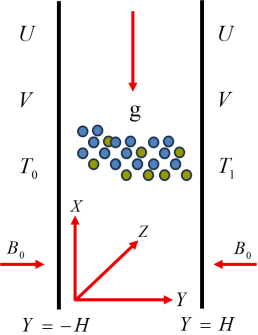
The steady flow and heat transfer of Jeffery fluid through a non-rigid porous medium is examined through a vertical channel experience magnetic field and thermal radiation. The channel walls are assumed to be infinitely long and perpendicular with the horizontal wall and positioned Y = ±H and acts primary boundaries as shown in Figure 1. The Jeffery fluid is further assumed to be electrical-conducting and experiences the retarding Lorentz force effects due to the presence of magnetic field.
Considering the incompressible nature of Jeffery fluid and taking the effects of viscous diffusion, solid displacement due to deformation of the porous frame and thermal expansion into consideration, the solid displacement and momentum equations are formulated. Furthermore, the energy equation considered the variation of thermal conductivity, energy loss due to viscosity and other heatings due to electrical resistance, Ohmic and viscous dissipation. In this regard, the dimensional equations governing the flow and thermal structure can be written as:
Figure 1. Model configuration.
μd2UdY2-1-ϕdPdX+KV=0 (1)
2μa1+λad2VdY2-ϕdPdX-KV-σB02V+ρgβ0T-T0+ρgβ1T-T02=0  (2)
1ρcρddYkTdTdY+2μa1+λaρcρdVdY2-1ρcρdqrdY+K+σB02V2ρcρ=0 (3)
Additional terms in (1)-(3) are due to the inclusion of nonlinear buoyancy, variable thermal conductivity, and Ohmic heating of the fluid. The variability of the fluid properties is dependent on temperature.
The boundary conditions are:
UY=0, VY=0,TY=1,Y=±1(4)
Introducing the parameters and dimensionless variables
y=Yh, x=Xh, v=2μaVρgβh2T1-T0, u=μUρgβh2T1-T0,θ=T-T0T1-T0,
p=PρgβhT1-T0,κ=ρ2g2β2h2T1-T02μaK0,δ=Kh22μa, M=B0hσ2μa ,(5)
Substituting the dimensionless variables of equation (6) in (1) to (3) and (5) to have
d2udy2-1-ϕdpdx+δv=0,11+λ1d2vdy2-ϕdpdx-δv-M21+εθv+θ1+γθ=0,1+κθd2θdy2+κdθdy2+α1+λ1dvdy2+δ+M21+εθαv2=0(6)
The appropriate boundary conditions are:
uy=0, vy=0,θy=1,y=±1(7)
Table 1. Nomenclature.

μ

Dynamic viscosity

U

Displacement of the solid.

ϕ

Proportion of medium porous volume

dPdX

Gradient pressure

K

Media coefficient of porous drag

V

Velocity flow

μa

Lame's constant

λ1

Ratio of retardation and relaxation time

σ

Electrical conductivity

B0

Magnetic field

ρ 

Density

β

Expansion of the heat coefficient

T 

Temperature

T0

Arbitrary temperature

K0

Thermal conductivity

cp

Constant pressure specific heat

qr

Flux radiation parameter

M

Magnetic parameter

ε

Variable electrical conductivity

γ

Nonlinear buoyancy parameter

N

Viscous dissipation parameter

θ

Dimensionless temperature

3. Method of Solution
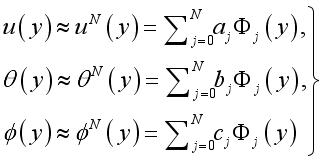
The Spectral Chebyshev Collocation Method (SCCM) together with the shooting method that uses the fourth-order Runge-Kutta (RK4) scheme will establish a solid framework to resolve the nonlinear coupled differential equations presented in equations (6) and (7). The SCCM delivers excellent spectral accuracy through its exponential-convergence method, which handles strong nonlinearities and tightly coupled systems by converting the governing equations into an algebraic equation system. The system employs Chebyshev-Gauss-Lobatto collocation points that concentrate near the domain boundaries to achieve superior boundary-layer and steep-gradient detection capabilities.
By assuming an admissible solution of the Chebyshev polynomials form Φjy as a sum of N+1 in which
(8)
where aj,bj,cj are coefficients that are established in accordance with the boundary conditions mentioned in (7)
R1=uyyN-1-ϕdpdx+δvyN,R2=11+λ1vyyN-ϕdpdx-δvN- M21+εθNvN+θN1+γθN,R3=1+κθθyyN+κθy2N+N1+λ1vy2N+δ+M21+εθNNv2N(9)
together with
uN±1=0, θN±1=θW, ϕN±1=1(10)
The residues are forced to zero at the Gauss-Lobato points to get a system of nonlinear algebraic equations at
R1yj=R2yj=R3yj=0, j=0,1,2,…, N(11)
where yi are defined
yj=121-cos⁡jπN,j=0,1,2,...,N(12)
Finally, substituting equation (9) into equation (11) and using Wolfram Mathematica environment, the validation, convergence and parametric analysis are presented in tabular and graphical results in the next section.
4. Results and Discussion
The Spectral Chebyshev Collocation Method (SCCM) was verified using the Shooting Runge Kutta fourth-order (SRK4) method to confirm the correctness and dependability of the numerical solutions. The governing non-linear equations were written as an initial value problem and numerically solved using Mathematica for the sake of comparison to each other, as found in Tables 2-4, each having small relative errors, thereby validating the convergence and computational accuracy of each respective numerical method.
Table 2. Result for u(y) with Ny=30, ϕ=0.6, δ=1, G=-1, H=1, R=1, λ1=0.2, m=1.

Y

u(y)

SCCM

SRK4

Relative Error

-1

1.6417068614×10⁻¹⁷

0.

1

-0.75

0.1749999157

0.1749999164

4.134705×10⁻⁹

-0.5

0.3097479308

0.3097479303

1.778895×10⁻⁹

-0.25

0.3942412865

0.3942412846

4.824829×10⁻⁹

0.0

0.4229887146

0.4229887129

4.158816×10⁻⁹

0.25

0.3942412865

0.3942412851

3.653926×10⁻⁹

0.5

0.3097479308

0.3097479307

2.63787×10⁻¹⁰

0.75

0.1749999157

0.1749999183

1.484882×10⁻⁸

1

1.6457589859×10⁻¹⁷

4.6963672825×10⁻⁹

1

Table 3. Result for v(y) with Ny=30, ϕ=0.6, δ=1, G= -1, H=1, R=1, λ1=0.2, m=1.

v(y)

Y

SCCM

SRK4

Relative Error

-1

1.3109106540×10⁻¹⁷

1.3552527156×10⁻²⁰

0.

-0.75

0.2517736142

0.2517735949

7.659969×10⁻⁸

-0.5

0.4099793099

0.4099792960

3.397799×10⁻⁸

-0.25

0.4968334652

0.4968334574

1.558807×10⁻⁸

0.0

0.5244965819

0.5244965773

8.905337×10⁻⁹

0.25

0.4968334652

0.4968334630

4.295449×10⁻⁹

0.5

0.4099793099

0.4099793089

2.604824×10⁻⁹

0.75

0.2517736142

0.2517736123

7.53224×10⁻⁹

1

1.0356672335×10⁻¹⁷

3.5892569560×10⁻¹⁰

1

Table 4. Result for θ(y) with Ny=30, ϕ=0.6, δ=1, G=-1, H=1, R=1, λ1=0.2, m=1.

θ(y)

Y

SCCM

SRK4

Relative Error

-1

0.

1.

0

-0.75

1.01130789

1.01130788

5.208678×10⁻⁹

-0.5

1.01866951

1.01866951

3.527268×10⁻⁹

-0.25

1.02306047

1.02306047

4.608086×10⁻¹⁰

0.0

1.02454119

1.02454119

1.840019×10⁻⁹

0.25

1.02306047

1.02306047

2.026174×10⁻⁹

0.5

1.01866951

1.01866950

6.534957×10⁻⁹

0.75

1.01130789

1.01130786

2.774393×10⁻⁸

1

3.

0.99999994

5.69141590×10⁻⁸

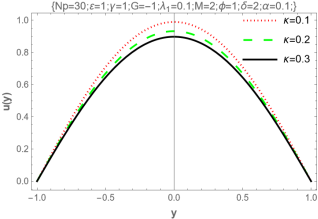
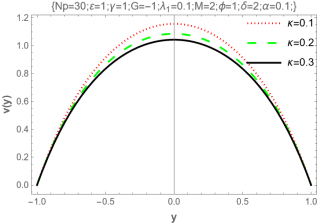
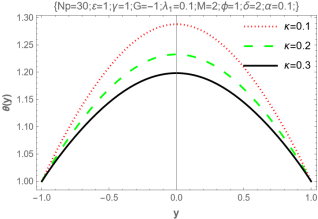
Figures 2-4 illustrate the influence of the thermal conductivity parameter k upon both physical processes (i.e., displacement and the velocity) and temperature distributions. Specifically, it can be seen that there is a continual decrease in all three profiles due to the increase in, k, after controlling for other variables. The increase in the thermal conductivity will assist in the diffusion of thermal energy within the liquid, which in turn will reduce localized thermal accumulations resulting in a decrease in temperature distributions throughout the channel. As temperature decreases, the hydrodynamic forces (that promote fluid motion due to buoyancy), will decrease along with fluid velocities. Since the fluid and solid interface is very dependant upon the momentum transfer in the channel between the two phases: decreasing fluid velocities equate to a reduction in the solid displacement distribution. Thus, an enhancement in the thermal conductivity decreases the overall strength of the flow and temperature of the fluid.
Figure 2. Thermal conductivity parameter for solid displacement.
Figure 3. Thermal conductivity parameter on velocity.
Figure 4. Thermal conductivity parameter on temperature.
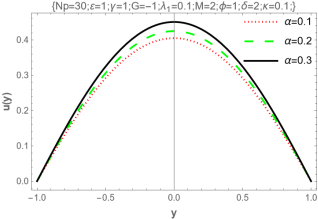
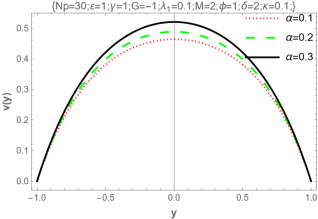
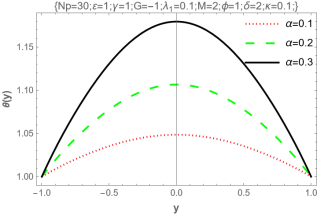
Figures 5, 6, and 7 illustrate the impact of the viscous dissipation parameter α. The results reveal that increasing α produces increased solid displacements, as well as higher fluid velocities and temperatures. Viscous dissipation is a mechanism of converting kinetic energy into heat energy through internal resistance in the fluid due to friction, which generates additional heat within the fluid that causes an increase in temperature, hence increasing the buoyancy force, which leads to enhanced fluid flow and an increase in velocity profiles. This also strengthens the buoyancy force acting on the fluid, which further leads to increased fluid motion and greater interaction between the fluid and the deformable porous medium, thus producing a greater displacement of solid. The results indicate that viscous heating contributes significantly to both thermal and momentum transport phenomena connected with a reactive Jeffery fluid system.
Figure 5. Viscous dissipation parameter on solid displacement.
Figure 6. Viscous dissipation parameter on flow velocity.
Figure 7. Viscous dissipation parameter on fluid temperature.
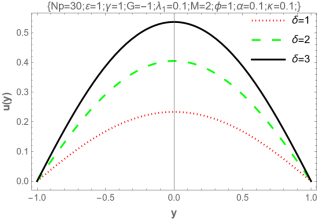
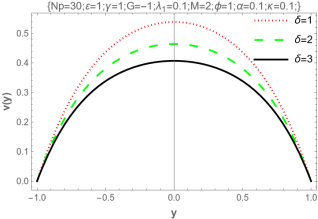
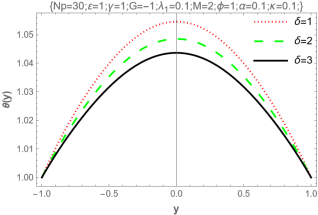
Figure 8, 9, and 10 depict the influence of the porous permeability δ on the displacement, temperature and velocity distributions. The results show that increasing δ enhances the solid displacement profile while reducing both the velocity and temperature distributions. Physically, larger values of δ increase the resistance offered by the porous medium to fluid motion. The increased resistance suppresses the velocity profile and weakens convective heat transport, thereby reducing the temperature distribution within the channel. However, the stronger resistance force within the porous structure increases the interaction in the solid-fluid structure, which consequently enhances the deformation of the porous material and increases the solid displacement profile.
Figure 8. Porous permeability on solid displacement.
Figure 9. Porous permeability on flow velocity.
Figure 10. Porous permeability on fluid temperature.
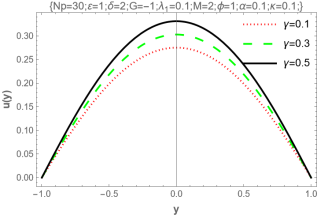
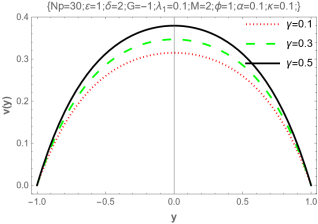
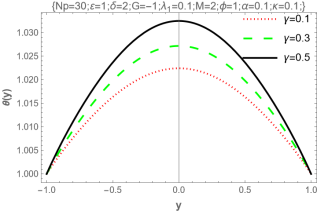
In Figures 11-13 we see the impact of nonlinear buoyancy parameter γ to the flow characteristics. It is observed that increasing γ significantly increases the solid displacement, velocity, and temperature distributions. Physically, the nonlinear buoyancy parameter strengthens the thermal buoyancy force generated by density differences within the fluid. Increased buoyancy force increases the flow of fluid and the velocity in the system as well. Increased convective transport from that higher velocity allows for an increase in the temperature distribution along the channel. Higher velocity also means there is increased interaction between the fluid and the deformable porous medium, resulting in greater displacements of solids. The results demonstrate that nonlinear buoyancy effects dominate the enhancement of both thermal and momentum transport processes.
Figure 11. Non-linear buoyancy parameter on solid displacement.
Figure 12. Non-linear buoyancy parameter on velocity.
Figure 13. Non-linear buoyancy parameter on fluid temperature.
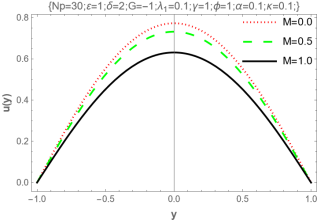
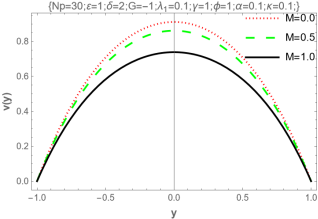
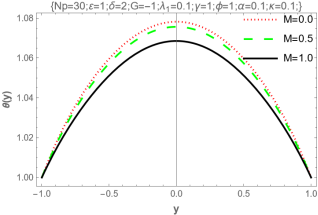
Figures 14-16 reveals the influence of the magnetic parameter M on the temperature and fluid flow. The outcome shows that when the magnetic parameter is increased, the solid displacement, velocity, and temperature profiles are all decreased. The reason for this is that when an external magnetic field is applied there is a Lorentz force acting against the motion of the flow, which is created due to the motion of the electrically conducting fluid. Thus, the Lorentz force is a resistive force suppressing fluid velocity and hence, weakens the momentum transport in the flow system. As a result of the reduction in the motion of the fluid, convective heat transfer is reduced and therefore the temperature distribution is also decreased. In addition, due to the decrease in fluid motion, the interaction between the fluid and the deformable porous medium is also decreased, resulting in a decrease in the amount of solid displaced. The magnetic field acts as a stabilizing mechanism by suppressing both fluid motion and thermal transport.
Figure 14. Magnetic parameter on solid displacement.
Figure 15. Magnetic parameter on flow velocity.
Figure 16. Magnetic parameter on fluid temperature.
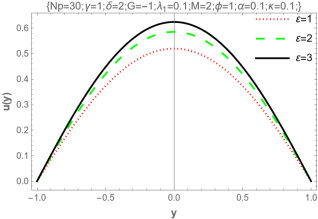
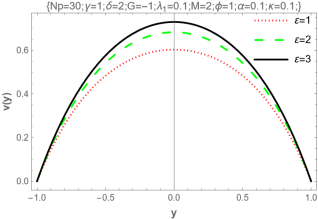
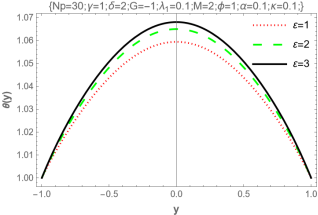
The three Figures 17, 18 and 19 illustrate how a variable electrical conductivity parameter ε can influence: the fluid's displacement, its velocity, and its temperature profile. As the electrical conductivity increases, it was found that all three of the above profiles increase as well. The increase in fluid electrical conductivity allows for better electrical transport within the fluid, and creates more Joule heating in the flow system. The increased thermal energy that results increases the fluid's temperature profile and will create greater buoyancy-driven motion in the fluid; thus, the fluid's velocity will also increase dramatically. The momentum transport that results from a stronger interaction between the fluid and the deformable porous structure will increase the solid displacement profile as well. The result demonstrate the importance of varying electrical conductivity for the regulation of the temperature and electromagnetic coupling behavior of the reactive non-Newtonian fluid flow.
Figure 17. Variable electrical conductivity on solid displacement.
Figure 18. Variable electrical conductivity on fluid velocity.
Figure 19. Variable electrical conductivity on fluid temperature.
It is concluded that the flow characteristics are largely dictated by how thermal conductivity, viscous dissipation, porous resistance, nonlinear buoyancy, magnetic field effects and variable electrical conductivity all interact with each other. The combined effect of these factors can significantly impact momentum transport, heat transfer properties, and the amount of deformation occurring within the deformable porous medium. The results provide a valuable source of physical information that could have many practical applications, such as biofluid transport systems, geothermal energy systems, thermal energy management systems, enhanced oil recovery operations, and transport of reactive non-Newtonian fluids through porous structures.
5. Conclusion
This work numerically investigated magneto-convective heat transfer in a Jeffery viscoelastic fluid flowing through a porous, deformable medium with variable thermophysical parameters. The nonlinear equations governing the flow and heat transfer were modelled, non-dimensionalised and solved numerically due to coupling and nonlinear dependence of the fluid’s physical parameters on temperature. A reliable and convergent Spectral Chebyshev Collocation Method (SCCM) was used to solve the dimensionless boundary value problem and the numerical solution was validated by using shooting-Runge Kutta approach as the only validation for the SCCM results. The results are shown to be computationally accurate as evident in the table for validation of results. The computations show the controlling effects of temperature-dependent electrical conductivity on the electromagnetic force, resistance due to elastic nature of porous skeleton, on the overall flow and thermal structure.
Summarily, the proposed model is a generalization of the model used in as it reveals how temperature dependence of electrical conductivity, Ohmic heating and nonlinear buoyancy effects interacts in contract to the earlier model where these flow-driving mechanism were neglected.
Abbreviations

SCCM

Spectral Chebyshev Collocation Method

SRK4

Shooting Runge Kutta Fourth-order

Acknowledgments
The authors wish to acknowledge the use of Grammarly in the writing of this paper. This tool was used to help improve the language and grammar in the paper.
Transparency:
The authors confirm that the manuscript is an honest, accurate, and transparent account of the study; that no vital features of the study have been omitted; and that any discrepancies from the study as planned have been explained. This study followed all ethical practices during writing.
Copyright:
© 2026 by the authors. This article is an open-accessarticle distributed under the terms and conditions of the Creative Commons Attribution (CC BY) license (https://creativecommons.org/licenses/by/4.0/).
Author Contributions
Osho Femi Timothy: Conceptualization, Methodology, Resources, Writing – original draft
Adesanya Samuel Olumide: Supervision, Validation, Writing – review & editing
Lebelo Ramoshweu Solomon: Investigation, Resources, Project administration
Conflicts of Interest
The authors declare no conflicts of interest.
References
[1] S. Sreepada and S. Ontela, "Spectral analysis of nonlinear free convective flow of a Casson fluid in a non-Darcy porous medium with convective boundary condition," Results in Engineering, vol. 9, pp. 101043, 2025.
[2] S. A. Bawazeer and M. S. Alsoufi, "Natural convection in a square cavity: Effects of Rayleigh and Prandtl numbers on heat transfer and flow patterns," Case Studies in Thermal Engineering, vol. 73, pp. 106680, 2025.
[3] M. Shoaib, S. Naz, M. A. Z. Raja, K. Arshad, I. Ahmad, and K. S. Nisa, "Numerical treatment for nonlinear mixed convection and thermal radiative Newtonian fluid flow system," Journal of Radiation Research and Applied Sciences, vol. 18, pp. 101675, 2025.
[4] F. Nazir, J. Ahmed, T. Abdeljawad, A. Alshamrani, K. M. Abualnaja, and M. A. Elkotb, "Analysis of thermal and solutal transport in Casson nanofluid flow around a rotating cylinder subject to mixed convection and radiation," Case Studies in Thermal Engineering, vol. 74, pp. 106663, 2025.
[5] N. Jan, D. N. K. Marwat, A. Althobaiti, A. Shafee, A. Khan, and F. Ghani, "Double diffusive convection in flow along a heated and non-uniform cylinder with nonlinear kinematics," Kuwait Journal of Science, vol. 53, pp. 100489, 2026.
[6] G. Y. H. Gangadharaiah, V. Kumar, M. N, N. H, M. A. Alghafli, I. Ayoob, and N. Mlaiki, "Convective stability in porous structures for energy and biosensing applications using viscosity-driven flow control and couple-stress fluid," Case Studies in Thermal Engineering, vol. 75, pp. 107189, 2025.
[7] M. J. Khan, M. F. R. J. Islam, and S. Saha, "Free convective flow of Ostwald-de Waele fluid in a Π-shaped cavity with a heated strip and lateral wall cooling," Results in Engineering, vol. 24, pp. 103167, 2024.
[8] A. Shafiq, T. N. Sindhu, M. A. Iqbal, and T. A. Abushal, "Nonlinear squeezing flow of stratified fluids: A comprehensive study on convective conditions and probable errors," International Journal of Thermofluids, vol. 28, pp. 101290, 2025.
[9] R. Nalini, A. Meena, L. Rajendran, and M. Izadii, "A nonlinear mathematical analysis of nanoparticle's velocity, temperature and concentration in magnetohydrodynamic convective flow," Partial Differential Equations in Applied Mathematics, vol. 14, pp. 101193, 2025.
[10] M. H. Milon, M. Hasanuzzaman, A. Barmon, and M. Asaduzzaman, "Impact of internal heat production and absorption on unstable MHD free convective flow through an inclined porous plate," International Journal of Thermofluids, vol. 29, pp. 101403, 2025.
[11] P. O. Banjo, R. S. Lebelo, S. O. Adesanya, and E. I. Unuabonah, "Second-law analysis of reactive electroosmotic flow of couple-stress fluids with temperature-dependent properties and two-step chemical reactions," Alexandria Engineering Journal, vol. 129, pp. 441-457, 2025.
[12] S. Khalid, S. A. Hassan, A. B. Altemimi, K. Chaudhary, S. Raana, H. Javaid, M. Naeem, Z. F. Bhat, and R. M. Aadil, "Recovery of valuable substances from food waste by ohmic heating-assisted extraction: A step towards sustainable production," Future Foods, vol. 9, pp. 100365, 2024.
[13] S. S. Saeedabad, H. S. Tabarestani, M. Ghorbani, and A. M. Ziaiifar, "Ohmic heating as a novel approach for enhancing the techno-functional properties of sesame protein isolate," Food Science and Technology, vol. 214, pp. 117151, 2024.
[14] I. Altay, Y. Kominami, L. S. Queiroz, T. Huppertz, J. J. Sloth, and M. A. Mohammadifa, "Combined effect of ultrasonication and ohmic heating on protein functionality of Cheddar cheese," International Dairy Journal, vol. 160, pp. 106116, 2025.
[15] T. K. Das, A. Paul, J. M. Nath, and N. Sarma, "The Yamada-Ota model-based Casson quadra hybrid nanofluid stagnation flow configured by ohmic heating, heat source, and Newtonian boundary heating across an exponentially stretched cylinder," Partial Differential Equations in Applied Mathematics, vol. 14, pp. 101159, 2025.
[16] S. Jafari, M. Keramat, M. A. Nematollahi, M.-T. Golmakani, and M. Niakousari, "Optimisation and kinetic study of butyl capryl production by ohmic heating," Food Science and Technology, vol. 223, pp. 117678, 2025.
[17] V. Sousa, R. Novais, T. M. Mata, A. A. Martins, and R. N. Pereira, "Life cycle assessment of protein extraction from microalgae biomass using ohmic heating," Algal Research, vol. 86, pp. 103962, 2025.
[18] P. N. S. Maspeke, S. Salengke, J. Muhidong, and A. Dirpan, "A bibliometric analysis of ohmic heating on food processing in the last two decades," Heliyon, vol. 10, pp. e39315, 2024.
[19] J. L. Auriault and J. Lewandowska, "Hydro-mechanical coupling in damaged porous media containing isolated cracks or/and vugs: Model and computations," Poromechanics V - Proceedings of the 5th Biot Conference on Poromechanics, pp. 1955-1963, 2013.
[20] B. P. Muljadi, "Multiscale method for Oseen problem in porous media with non-periodic grain patterns," Transport in Porous Media, vol. 116, pp. 1-18, 2017.
[21] M. A. Biot, "General theory of three-dimensional consolidation," Journal of Applied Physics, vol. 12, pp. 155-164, 1941.
[22] R. M. Bowen, "Incompressible porous media models by use o the theory of mixtures," International Journal of Engineering Science, vol. 18, no. 9, pp. 1129-1148, 1980.
[23] J. L. Auriault, "Heterogeneous medium. Is an equivalent macroscopic description possible?," International Journal of Engineering Science, vol. 29, no. 7, pp. 785-795, 1991.
[24] R. W. Lewis and B. A. Schrefler, Finite Element Method in the Static and Dynamic Deformation and Consolidation of Porous Media, Wiley, 1998.
[25] H. H. Bui and G. D. Nguyen, "A coupled fluid-solid SPH approach to modelling flow through deformable porous media," International Journal of Solids and Structures, vol. 125, pp. 244-264, 2017.
[26] J. Turjanicová, E. Rohan, and V. Lukeš, "Homogenization-based two-scale modelling of ionic transport in fluid saturated deformable porous media," Computers and Mathematics with Applications, vol. 78, pp. 3211-3235, 2019.
[27] F. J. Vernerey, "A theoretical treatment on the mechanics of interfaces in deformable porous media," International Journal of Solids and Structures, vol. 48, pp. 3129-3141, 2011.
[28] A. B. Babu, G. S. K. Reddy, and S. G. Tagare, "Nonlinear magneto convection due to horizontal magnetic field and vertical axis of rotation due to thermal and compositional buoyancy," Results in Physics, vol. 12, pp. 2078-2090, 2019.
[29] P. Mayeli and G. J. Sheard, "Weakly nonlinear bifurcation behaviour at the onset of instability in horizontal convection using an advective buoyancy approximation," International Communications in Heat and Mass Transfer, vol. 149, pp. 107134, 2023.
[30] M. Khait and D. Voskov, "Adaptive parameterisation for solving of thermal/compositional nonlinear flow and transport with buoyancy," SPE Journal, vol. 23, pp. 522-534, 2018.
[31] F. Asiri, S. Rehman, and S. Nasr, "Entropy generation with heat and mass transfer of radiated buoyancy driven MHD tangent hyperbolic nanofluid over a stretching surface: Numerical approach," Journal of Radiation Research and Applied Sciences, vol. 18, pp. 101697, 2025.
[32] K. U. Rehman, W. Shatanawi, and L. Y. Yian, "On nonlinear coupled differential system for heat transfer in magnetised enclosure with T-shaped baffle using machine learning," Partial Differential Equations in Applied Mathematics, vol. 13, pp. 101078, 2025.
[33] M. I. U. Rehman, H. Chen, A. Hamid, W. Qan, R. Ghodhbani, and M. Hussein, "A comprehensive numerical study exploring the significance of thermally reactive bioconvection in Falkner-Skan flow of Williamson nanomaterials influenced by activation energy and buoyancy forces," Case Studies in Thermal Engineering, vol. 66, pp. 105785, 2025.
[34] E. Kersalé, D. W. Hughes, and S. M. Tobias, "The nonlinear evolution of instabilities driven by magnetic buoyancy: A new mechanism for the formation of coherent magnetic structures," The Astrophysical Journal, vol. 663, pp. L113-L116, 2007.
[35] B. Mallikarjuna, J. Srinivas, G. K. Gopi Krishna, O. A. Beg, and A. Kadir, "Spectral numerical study of entropy generation in magneto-convective viscoelastic biofluid flow through poro-elastic media with thermal radiation and buoyancy effects," ASME Journal of Thermal Science and Engineering Applications, vol. 14, no. 1, pp. 011008, 2022.
Cite This Article
  • APA Style

    Osho, F. T., Adesanya, S. O., Lebelo, R. S. (2026). Nonlinear Magneto-convective Flow of Jeffery Fluid Through a Poro-elastic Medium with Fluid-structure Interaction. American Journal of Mechanics and Applications, 13(3), 47-58. https://doi.org/10.11648/j.ajma.20261303.13

    Copy | Download

    ACS Style

    Osho, F. T.; Adesanya, S. O.; Lebelo, R. S. Nonlinear Magneto-convective Flow of Jeffery Fluid Through a Poro-elastic Medium with Fluid-structure Interaction. Am. J. Mech. Appl. 2026, 13(3), 47-58. doi: 10.11648/j.ajma.20261303.13

    Copy | Download

    AMA Style

    Osho FT, Adesanya SO, Lebelo RS. Nonlinear Magneto-convective Flow of Jeffery Fluid Through a Poro-elastic Medium with Fluid-structure Interaction. Am J Mech Appl. 2026;13(3):47-58. doi: 10.11648/j.ajma.20261303.13

    Copy | Download

  • @article{10.11648/j.ajma.20261303.13,
      author = {Femi Timothy Osho and Samuel Olumide Adesanya and Ramoshweu Solomon Lebelo},
      title = {Nonlinear Magneto-convective Flow of Jeffery Fluid Through a Poro-elastic Medium with Fluid-structure Interaction},
      journal = {American Journal of Mechanics and Applications},
      volume = {13},
      number = {3},
      pages = {47-58},
      doi = {10.11648/j.ajma.20261303.13},
      url = {https://doi.org/10.11648/j.ajma.20261303.13},
      eprint = {https://article.sciencepublishinggroup.com/pdf/10.11648.j.ajma.20261303.13},
      abstract = {Consideration of non-Newtonian fluid flow in combination with deformable porous materials is necessary for many engineering applications involving thermal transport. These applications combine fluid dynamics, heat transport, and structural deformation, with or without interaction. This work analyses nonlinear convective heat transfer of a Jeffery fluid flowing through a deformable porous medium under the effect of fluid-structure interaction, variable fluid properties, nonlinear buoyancy, magnetic forces, and viscous dissipation and Ohmic heating. A coupled fluid flow and heat transport solid deformation problem is formulated and converted to a set of nonlinear PDEs. These equations are used to construct the model, and the SCCM is used for the numerical solution. The fourth-order Runge– Kutta shooting method is used to check the results and control the accuracy of the numerical solution. Viscous dissipation and Ohmic heating study showed that the combination of both effects assists internal energy generation, leading to an increase in temperature, while fluid velocity and solid deformation are altered. The influence of a magnetic field is realized when the Lorentz force acts on the fluid. An increase in porosity leads to an increase in the fluid flow and solid deformation. Stronger nonlinear buoyancy strengthens convection, harnessing the fluid’s motion and thermodynamic transport capacity. The overall results show that fluid-structure interaction modeling with inhomogeneous properties, nonlinear buoyancy, magnetism, viscous friction, and Ohmic dissipation captures a more accurate description of transport phenomena occurring in deformable porous media. The results add to existing literature and provoke new directions for the study and determination of optimal configurations of engineering systems in which viscoelastic fluids interact with porous medium structures.},
     year = {2026}
    }
    

    Copy | Download

  • TY  - JOUR
    T1  - Nonlinear Magneto-convective Flow of Jeffery Fluid Through a Poro-elastic Medium with Fluid-structure Interaction
    AU  - Femi Timothy Osho
    AU  - Samuel Olumide Adesanya
    AU  - Ramoshweu Solomon Lebelo
    Y1  - 2026/09/30
    PY  - 2026
    N1  - https://doi.org/10.11648/j.ajma.20261303.13
    DO  - 10.11648/j.ajma.20261303.13
    T2  - American Journal of Mechanics and Applications
    JF  - American Journal of Mechanics and Applications
    JO  - American Journal of Mechanics and Applications
    SP  - 47
    EP  - 58
    PB  - Science Publishing Group
    SN  - 2376-6131
    UR  - https://doi.org/10.11648/j.ajma.20261303.13
    AB  - Consideration of non-Newtonian fluid flow in combination with deformable porous materials is necessary for many engineering applications involving thermal transport. These applications combine fluid dynamics, heat transport, and structural deformation, with or without interaction. This work analyses nonlinear convective heat transfer of a Jeffery fluid flowing through a deformable porous medium under the effect of fluid-structure interaction, variable fluid properties, nonlinear buoyancy, magnetic forces, and viscous dissipation and Ohmic heating. A coupled fluid flow and heat transport solid deformation problem is formulated and converted to a set of nonlinear PDEs. These equations are used to construct the model, and the SCCM is used for the numerical solution. The fourth-order Runge– Kutta shooting method is used to check the results and control the accuracy of the numerical solution. Viscous dissipation and Ohmic heating study showed that the combination of both effects assists internal energy generation, leading to an increase in temperature, while fluid velocity and solid deformation are altered. The influence of a magnetic field is realized when the Lorentz force acts on the fluid. An increase in porosity leads to an increase in the fluid flow and solid deformation. Stronger nonlinear buoyancy strengthens convection, harnessing the fluid’s motion and thermodynamic transport capacity. The overall results show that fluid-structure interaction modeling with inhomogeneous properties, nonlinear buoyancy, magnetism, viscous friction, and Ohmic dissipation captures a more accurate description of transport phenomena occurring in deformable porous media. The results add to existing literature and provoke new directions for the study and determination of optimal configurations of engineering systems in which viscoelastic fluids interact with porous medium structures.
    VL  - 13
    IS  - 3
    ER  - 

    Copy | Download

Author Information
  • Department of Mathematics, Adeyemi Federal University of Education, Ondo, Nigeria;Department of Mathematics and Statistics, Redeemer’s University, Ede, Nigeria

  • Department of Mathematics and Statistics, Redeemer’s University, Ede, Nigeria;Education Department, Vaal University of Technology, Vanderbijlpark, South Africa
  • Applied Physical Sciences Department, Vaal University of Technology, Vanderbijlpark, South Africa