
Coffee remains Ethiopia's top export commodity and is the most significant crop in the country's economy. The crop's production and quality are extremely low, despite its economic significance. The decline in Ethiopian coffee quality is mostly caused by improper postharvest processing methods, such as harvesting immature cherries, not sorting during grading and processing, improper drying without considering drying time, drying place, layer thickness, and drying material, transportation, storage, over-fermentation, etc. The processing of coffee beans is a critical step that influences the quality of the final product. Effective demucilaging is essential to remove mucilage while preserving the integrity of the beans. This study focuses on the development and performance evaluation of a manually operated coffee bean demucileger, aimed at improving the efficiency of coffee processing while minimizing operational costs. The objective was to design a user-friendly, effective demucilaging device for small-scale coffee production settings. The demucileger was constructed using locally sourced materials, and its performance was evaluated based on parameters such as efficiency, ease of operation, and quality of demucilaged beans. Results indicated that the device successfully removed mucilage with an efficiency rate and washing capacity of 86% and 86.86 kg/hr. while maintaining the integrity of the beans. This manual operated demucileger presents a viable solution for smallholder coffee farmers, potentially enhancing their productivity and product quality in an economically sustainable manner.
| Published in | American Journal of Mechanical and Industrial Engineering (Volume 11, Issue 1) |
| DOI | 10.11648/j.ajmie.20261101.11 |
| Page(s) | 1-7 |
| Creative Commons |
This is an Open Access article, distributed under the terms of the Creative Commons Attribution 4.0 International License (http://creativecommons.org/licenses/by/4.0/), which permits unrestricted use, distribution and reproduction in any medium or format, provided the original work is properly cited. |
| Copyright |
Copyright © The Author(s), 2026. Published by Science Publishing Group |
Coffee, Fermentation, Efficiency, Capacity, Demucileger
Feed rate *fermentation time | |||||||
|---|---|---|---|---|---|---|---|
Feed rate (kg) | Fermentation time (hr) | Feed rate | Mean | Fermentation time | Mean | ||
0 | 12 | 24 | |||||
5 | 75.93b | 91.08a | 89.67a | 5 | 85.56b | 0 | 84.12b |
6 | 88.02a | 91.10a | 85.96a | 6 | 88.36a | 12 | 90.92a |
7 | 88.40a | 90.58a | 85.95a | 7 | 88.31a | 24 | 87.19ab |
Mean | 87.41 | ||||||
CV | 6.74 | ||||||
Feed rate *weight of operator | |||||
|---|---|---|---|---|---|
Feed rate (kg) | Weight of operator (kg) | Weight of operator | Mean | ||
55 | 65 | 75 | |||
5 | 88.77a | 80.51b | 87.39a | 55 | 88.06a |
6 | 87.44a | 89.75a | 87.89a | 65 | 86.39a |
7 | 87.95a | 88.28a | 88.91a | 75 | 87.96a |
Mean | 87.41 | ||||
CV | 4.90 | ||||
Feed rate *fermentation time | |||||||
|---|---|---|---|---|---|---|---|
Feed rate (kg) | Fermentation time (hr) | Feed rate | Mean | Fermentation time | Mean | ||
0 | 12 | 24 | |||||
5 | 70.78bcd | 100.49b | 137.94a | 5 | 103.07a | 0 | 61.53c |
6 | 55.21d | 96.62bc | 136.87a | 6 | 96.24b | 12 | 86.12b |
7 | 58.59d | 61.25d | 64.02cd | 7 | 61.29c | 24 | 112.95a |
Mean | 86.86 | ||||||
CV | 13.35 | ||||||
Feed rate * weight of operator | |||||
|---|---|---|---|---|---|
Feed rate (kg) | Weight of operator (kg) | Weight of operator | mean | ||
55 | 65 | 75 | |||
5 | 73.38c | 98.76b | 137.07a | 55 | 66.82b |
6 | 68.25cd | 89.78b | 130.68a | 65 | 81.18b |
7 | 58.83d | 61.56d | 64.44cd | 75 | 116.52a |
Mean | 87.41 | ||||
CV | 4.90 | ||||
JAERC | Jimma Agricultural Engineering Research Center |
CV | Coefficient of Variance |
DE | Demucilager’s Efficiency |
ANOVA | Analysis of Variance |
| [1] | S. T. Argaie, “The Impact of Exchange Rate on Ethiopia’s Coffee Export,” Eur. Sci. J. ESJ, vol. 17, no. 23, Jul. 2021, |
| [2] | “REPORT ON THE ETHIOPIAN ECONOMY 2016 Agricultural Transformation in Ethiopia: Prospects and Challenges Ethiopian Economics Association (EEA),” 2016, Accessed: Nov. 05, 2025. [Online]. Available: |
| [3] | B. Girma Adugna, “Review on Coffee Production and Quality in Ethiopia,” Agric. For Fish, vol. 10, no. 6, p. 208, 2021, |
| [4] | R. Cerda, J. Avelino, C. Gary, P. Tixier, E. Lechevallier, and C. Allinne, “Primary and secondary yield losses caused by pests and diseases: Assessment and modeling in coffee,” PLoS One, vol. 12, no. 1, Jan. 2017, |
| [5] | “(PDF) Review on Coffee Production and Quality in Ethiopia.” Accessed: Nov. 05, 2025. [Online]. Available: |
| [6] | T. Kidist, G. Zerihun, and E. Biniam, “Assessment of pre and post-harvest management practices on coffee (Coffea arabica L.) quality determining factors in Gedeo zone, Southern Ethiopia,” African J. Agric. Res., vol. 14, no. 28, pp. 1216-1228, Jul. 2019, |
| [7] | G. Bizimungu, R. H. Ahouansou, and G. C. Semassou, “Design, fabrication and evaluation of small-scale disc and drum pulpers for Arabica (Coffea arabica L.) and Robusta (Coffea canephora L.) coffee,” J. Saudi Soc. Agric. Sci., vol. 23, no. 6, pp. 404-414, Sep. 2024, |
| [8] | K. Teshome, Z. Girma, and B. Eshetu, “African Journal of Agricultural Research Assessment of pre and post-harvest management practices on coffee (Coffea arabica L.) quality determining factors in Gedeo zone, Southern Ethiopia,” vol. 14, no. 28, pp. 1216-1228, 2019, |
| [9] | B. Ollika Fufa, M. Bekele Etana, and M. Chewaka Aga, “Review on Post-Harvest and Green Bean Coffee Processing in Ethiopia,” Acta Sci. Agric., vol. 3, no. 7, pp. 157-162, Jun. 2019, |
| [10] | “A Detailed Review on Common Causes of Postharvest Loss and Quality Deterioration of Fruits and Vegetables in Ethiopia,” J. Biol. Agric. Healthc., Apr. 2019, |
| [11] | “(PDF) Factors Affecting the Quality of Ethiopian Coffee (Coffea Arabica L.).” Accessed: Nov. 05, 2025. [Online]. Available: |
| [12] | M. Regassa, “Factors Affecting the Quality of Ethiopian Coffee (Coffea Arabica L.),” Agric. For Fish, vol. 13, no. 5, pp. 175-181, Sep. 2024, |
| [13] | C. Marsh, S. Taylor, P. Milliken, and G. Senaratne, “DEVELOPING AN UNDERSTANDING OF WASHING MACHINE DYNAMICS”. |
| [14] |
“(PDF) Calculation and selection of machine components.” Accessed: Nov. 05, 2025. [Online]. Available:
https://www.researchgate.net/publication/385627488_Calculation_and_selection_of_machine_components |
| [15] | “Applied Tribology: Bearing Design and Lubrication, 3rd Edition”. |
| [16] | A. Lee, M. H. Seo, S. Yang, J. Koh, and H. Kim, “The effects of mechanical actions on washing efficiency,” Fibers Polym., vol. 9, no. 1, pp. 101-106, Feb. 2008, |
| [17] | “(PDF) Design, Construction and Performance Evaluation of A Coffee (Coffea Arabica) Threshing Machine.” Accessed: Nov. 05, 2025. [Online]. Available: |
| [18] | C. M. Villanueva et al., “Total and specific fluid consumption as determinants of bladder cancer risk,” Int. J. Cancer, vol. 118, no. 8, pp. 2040-2047, Apr. 2006, |
APA Style
Wirtu, R., Berhanu, T. (2026). Development and Performance Evaluation of Manual Operated Coffee Bean Demucilager. American Journal of Mechanical and Industrial Engineering, 11(1), 1-7. https://doi.org/10.11648/j.ajmie.20261101.11
ACS Style
Wirtu, R.; Berhanu, T. Development and Performance Evaluation of Manual Operated Coffee Bean Demucilager. Am. J. Mech. Ind. Eng. 2026, 11(1), 1-7. doi: 10.11648/j.ajmie.20261101.11
@article{10.11648/j.ajmie.20261101.11,
  author = {Rebira Wirtu and Tolasa Berhanu},
  title = {Development and Performance Evaluation of Manual Operated Coffee Bean Demucilager},
  journal = {American Journal of Mechanical and Industrial Engineering},
  volume = {11},
  number = {1},
  pages = {1-7},
  doi = {10.11648/j.ajmie.20261101.11},
  url = {https://doi.org/10.11648/j.ajmie.20261101.11},
  eprint = {https://article.sciencepublishinggroup.com/pdf/10.11648.j.ajmie.20261101.11},
  abstract = {Coffee remains Ethiopia's top export commodity and is the most significant crop in the country's economy. The crop's production and quality are extremely low, despite its economic significance. The decline in Ethiopian coffee quality is mostly caused by improper postharvest processing methods, such as harvesting immature cherries, not sorting during grading and processing, improper drying without considering drying time, drying place, layer thickness, and drying material, transportation, storage, over-fermentation, etc. The processing of coffee beans is a critical step that influences the quality of the final product. Effective demucilaging is essential to remove mucilage while preserving the integrity of the beans. This study focuses on the development and performance evaluation of a manually operated coffee bean demucileger, aimed at improving the efficiency of coffee processing while minimizing operational costs. The objective was to design a user-friendly, effective demucilaging device for small-scale coffee production settings. The demucileger was constructed using locally sourced materials, and its performance was evaluated based on parameters such as efficiency, ease of operation, and quality of demucilaged beans. Results indicated that the device successfully removed mucilage with an efficiency rate and washing capacity of 86% and 86.86 kg/hr. while maintaining the integrity of the beans. This manual operated demucileger presents a viable solution for smallholder coffee farmers, potentially enhancing their productivity and product quality in an economically sustainable manner.},
 year = {2026}
}
TY  - JOUR
T1  - Development and Performance Evaluation of Manual Operated Coffee Bean Demucilager
AU  - Rebira Wirtu
AU  - Tolasa Berhanu
Y1  - 2026/04/13
PY  - 2026
N1  - https://doi.org/10.11648/j.ajmie.20261101.11
DO  - 10.11648/j.ajmie.20261101.11
T2  - American Journal of Mechanical and Industrial Engineering
JF  - American Journal of Mechanical and Industrial Engineering
JO  - American Journal of Mechanical and Industrial Engineering
SP  - 1
EP  - 7
PB  - Science Publishing Group
SN  - 2575-6060
UR  - https://doi.org/10.11648/j.ajmie.20261101.11
AB  - Coffee remains Ethiopia's top export commodity and is the most significant crop in the country's economy. The crop's production and quality are extremely low, despite its economic significance. The decline in Ethiopian coffee quality is mostly caused by improper postharvest processing methods, such as harvesting immature cherries, not sorting during grading and processing, improper drying without considering drying time, drying place, layer thickness, and drying material, transportation, storage, over-fermentation, etc. The processing of coffee beans is a critical step that influences the quality of the final product. Effective demucilaging is essential to remove mucilage while preserving the integrity of the beans. This study focuses on the development and performance evaluation of a manually operated coffee bean demucileger, aimed at improving the efficiency of coffee processing while minimizing operational costs. The objective was to design a user-friendly, effective demucilaging device for small-scale coffee production settings. The demucileger was constructed using locally sourced materials, and its performance was evaluated based on parameters such as efficiency, ease of operation, and quality of demucilaged beans. Results indicated that the device successfully removed mucilage with an efficiency rate and washing capacity of 86% and 86.86 kg/hr. while maintaining the integrity of the beans. This manual operated demucileger presents a viable solution for smallholder coffee farmers, potentially enhancing their productivity and product quality in an economically sustainable manner.
VL  - 11
IS  - 1
ER  -
Jimma Agricultural Engineering Research Center, Oromia Agricultural Research Institute, Addis Ababa, Ethiopia
Jimma Agricultural Engineering Research Center, Oromia Agricultural Research Institute, Addis Ababa, Ethiopia
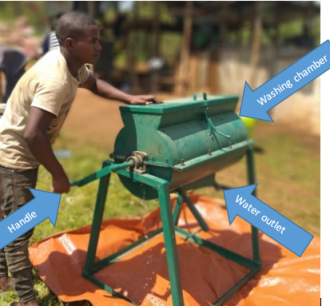
Figure 1. Photo taken during an on-farm test of Coffee Bean Demucilager.
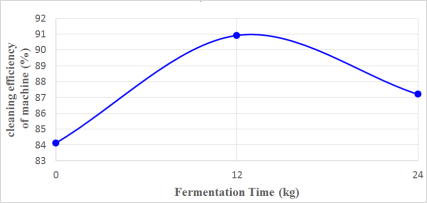
Figure 2. Effect of Fermentation Time on the Cleaning Efficiency of the Machine.
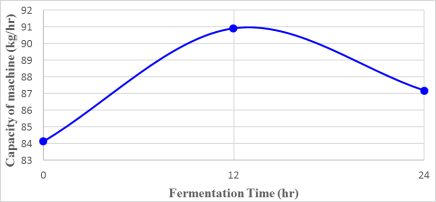
Figure 3. Effect of fermentation Time on the capacity of the machine.
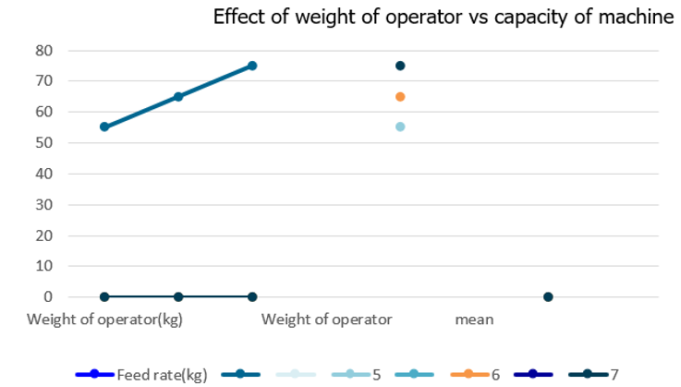
Figure 4. Effect of the weight of the operator on the capacity of the machine.
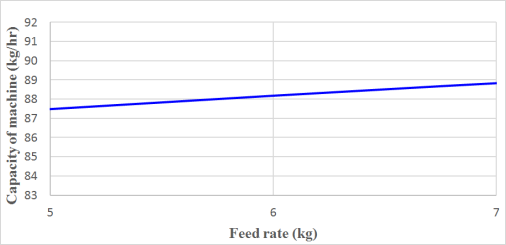
Figure 5. Effect of Feed Rate on the Capacity of the Machine.

Information



 Share This Article
 Twitter
 Linked In
 Facebook
 Copy
Copy Download