Abstract
The transition from OPRAS to PEPMIS indicates significant digital transformation for performance management in the Tanzanian public sector. This study assessed factors influencing the shift from OPRAS to PEPMIS at the National Social Security Fund (NSSF) in Dodoma. Specifically, the study focused on users’ perceptions that influence the shift from OPRAS to PEPMIS, the influence of organizational policies and regulations on the shift to PEPMIS, and the evaluation of training and support needs for successful implementation of PEPMIS. A descriptive research design was used, utilizing mixed approaches that combine both qualitative and quantitative approaches. A sample size of 44 respondents was employed, selected through simple random sampling and purposive sampling techniques. The study collected both primary data and secondary data using questionnaires, interviews, and documentary review as the methods. The study was anchored on expectancy theory and goal-setting theory to provide deep insight. The findings of the study revealed that users’ perceptions were positive about PEPMIS compared with OPRAS and were highly satisfied with PEPMIS, also it was noted that PEPMIS was transparency because provided transparent appraisal process. The study indicates that OPRAS could not handle modern performance evaluation needs. Furthermore, the findings revealed that organizational policies and regulation support the adoption of PEPMIS. Moreover, the findings found that training and support provided to the employee for the aims of success in the implementation of PEPMIS. The study concluded that employees had different perceptions of OPRAS and PEPMIS, some support PEPMIS as more user-friendly system, transparent and provide real-time feedback compared with OPRAS. Also, organizational policies and regulations played a significant role in shifting to PEPMIS. Additionally, training and support had a strong influence on the successful implementation of PEPMIS. The study recommended that organizations should provide adequate training and support to employees to make them familiar with the system. Also, revision of organizational policies and regulations should be conducted to ensure clarity, inclusivity, and acceptance of policies and regulations, and some adjustments should be made.
Keywords
PEPMIS, OPRAS, Digital Transformation, Employee Perception, Organizational Policies, Training and Support, Performance Management, Tanzania Public Sector
1. Introduction
The performance management has been traced back during 20
th century under the influence of industrial revolution in Europe that led to the high growth of larger organization. Hence, the rapid growth of larger organizations influenced the good way of managing personnel; for example, in countries such as Britain, Germany, France, Belgium, Russia, and the United States of America
| [32] | Smither, J. W., London., & Reilly, R. R. (2005).’’Performance Appraisal: State of the Art in Practice.’’ Jossey-Bass. |
[32]
. These needs for managing personnel led to the development of more methods for evaluating the performance of personnel.
Globally, Metawie and Gilman
| [24] | Metawie and Gilman, M. (2005). Problems with the implementation of Performance Measurement system in the Public Sector where Performance linked to pay, is University of Kent at Canterbury. |
[24]
argued that most public organizations around the world increased the demand for service, improved the quality of service, and ensured accountability. Hence, most of countries like the United Kingdom, Germany, France, Spain, Russia, and Belgium adopted the system of evaluating employees’ performance which was Management by Objectives (MBO) and Balanced Scorecard and have recognized the importance of moving towards performance management frameworks that offer clear metrics and foster open communication as well as emphasize accountability (Schiemann)
| [30] | Schiemann, W A. (2011). Aligning Performance Management Systems with Organizational Success. Leadership Excellence Essentials. |
[30]
.
The idea of performance management in the public sector was also spread in African countries because most of countries like Tanzania were not lagged in implementing performance appraisal system so as to evaluate the performance of public employees and to ensure transparent, fair, and objective evaluation of employee’s, ultimately driving better public service delivery and improves organizational efficiency
| [2] | Akinola, O. (2019). Performance Management in Africa: A Comparative Study: African Journal of Management. |
[2]
. African countries like South Africa, Nigeria, and Kenya also have introduced performance appraisal systems that align employee performance with national development goals, focusing on key sector such as health, education and infrastructure development
| [4] | Armstrong, M. (2006). A Handbook of Human Resource Management Practice: 10thed. London and Philadelphia: Kogan Page. |
| [18] | Mafini, C. (2015). Public Sector Performance Management in South Africa: A Focus on the Local Government. African journal of Public Affairs. |
[4, 18]
.
The Government of Tanzania introduced the Open Performance Review and Appraisal System (OPRAS) in 2004 and implemented through Establishment Circular no. 2 of 2004 to replace the Closed Annual Confidential Report System (CACRS) that was more confidential performance appraisal system, and which was more bureaucratic and lacked feedback. Hence, OPRAS was introduced to align an organization’s values, vision, and performance with its objectives and strategies as well as to improve performance management across all Ministries, Departments, Agencies (MDAs) and local Government Authorities (LGAs) in the public sectors (POPSM)
| [29] | President’s Office - Public Service Management and Good Governance (2024) "Govt Issues Ultimatum for PEPMIS Registration." Daily News. Retrieved from [Daily News]. |
[29]
. The purpose of introducing Open Performance Review and Appraisal System (OPRAS) in Tanzania was to manage individual performance in the Tanzanian public service through a more open and transparent system and considered a significant innovation in Human Resource Management (HRM) within the Tanzania public service.
Mgoma
, point out that, due to its nature, OPRAS may foster a culture of accountability and promote continuous improvement within public sector institutions in Tanzania. The reality is that OPRAS faced with some challenges in its implementation, and it causes the system to be weak. These challenges include insufficient training of employees about the system and most of employees may resist changing due to bureaucratic practice of the public organizations (Mhando)
| [26] | Mhando, J. E. (2016). Challenges of implementing OPRAS among public secondary teachers in Arusha City Council/ |
[26]
. So far, the system is based on paper to evaluate the performance of public employees; hence, it may result in inefficiencies such as delays in processing appraisals
| [6] | Bana, B. A, (2009). Performance Management in the Tanzania Public Service: Governance. |
[6]
. It was observed that it is difficult to maintain accurate records of employees because the system is too paper-oriented. Therefore, these challenges undermine the effectiveness of OPRAS and lead to a reduction in employees' and managers' accountability (Musiba)
| [27] | Musiba, E. V, (2015). “Factors affecting Implementation of Open Performance Review and Appraisal System (OPRAS) in Tanzania's public service. A case of Temeke Municipal Council. |
[27]
. The inability to accurately assess and develop human resources has impeded the growth and adaptability of public sector institutions and consequently may erode trust in government institutions.
Therefore, the Government of Tanzania observed these weaknesses of the Open Performance Review Appraisal System (OPRAS) and decided to shift from OPRAS as old system to a more advanced performance management system, which was the Public Employee Performance Management Information System (PEPMIS) in 2024. PEPMIS was introduced by the government as a digital platform to effectively evaluate and manage the performance of public sector employees. The digital nature of PEPMIS addresses many of the logistical and administrative issues associated with OPRAS, providing more efficient and user-friendly platform for performance management.
Hence, the shift from OPRAS to PEPMIS was a problem in Tanzania. Therefore, this study addressed the problem through assessing the factors influencing the shift from OPRAS to PEPMIS by focusing on determining users’ perception influenced shift from OPRAS to PEPMIS and examining how organizational policies and regulations influencing the shift from OPRAS to PEPMIS. As well as evaluating training and support needs for successful implementation of PEPMIS.
1.1. Statement of the Problem
The shift from Open Performance Review Appraisal System (OPRAS) to the Public Employee Performance Management Information System (PEPMIS) was part of a trend toward digital transformation of performance management in Tanzania. This was observed by Mutahaba, after conducting research on the adoption and use of performance management systems including measurement, monitoring, and evaluation. The findings could be applied in Tanzania to improve performance. Also, Gwimile
| [11] | Gwimile, A. (2017). Effectiveness of Open Review and Appraisal System in evaluating employee performance at the Open University of Tanzania, Kinondoni Municipal Council (Master's thesis, Open University of Tanzania). |
[11]
, through his study on the effectiveness of the Open Review and Appraisal System in evaluating employee performance at the Open University of Tanzania, Kinondoni Municipal Council, established that 58% of employees acknowledge that the OPRAS system influences their work performance and have a positive attitude towards the evaluation system at OPRAS. On the other hand, 75% of employees agreed that they do not participate in setting OPRAS targets and 80% of the employees agreed that the feedback mechanism in OPRAS needs major improvement to improve its efficiency.
Even though OPRAS is very important, the system observed to have some weaknesses that reduce the effectiveness of the system. This is because OPRAS is the manual and paper-based in nature that has led to inefficiencies such as delays in the appraisal process, increased administrative burden, and difficulties in maintaining accurate records, and was based on bias (Brown et al)
| [8] | Brown, Green, & Taylor, L. (2022). Transitioning to PEPMIS: Challenges and Solutions in Organizational Performance Management. Journal of Performance Management, 15(4), 112-129. |
| [12] | Issa, F, (2011). Public Sector Human Resource Managers promoting Professionalism and implementing the Public Service Charter at the national Level: Facilitating and Inhibiting Factors and strategic actions. Workshop on "Promoting Professionalism in the public service: held in Addis Ababa, Ethiopia, 14 to 18 March, 2011. |
[8, 12]
. Consequently, Tanzania may shift from OPRAS to new modern performance management system which was PEPMIS.
However, most of studies conducted in Tanzania were focused on the effectiveness of OPRAS but still the finding shows that OPRAS has several weaknesses, as it based on paper to evaluate the performance of public employee and it’s difficult to maintain accurate records of employees. Williams
| [35] | Williams, T. (2019). Technological Advances in Performance Management: The Role of PEPMIS. Journal of Organizational Innovation, 10(2), 201-219. |
[35]
, due to this weakness of the system, Tanzania shift from OPRAS to PEPMIS to improve public sector performance. But all in all, despite having many studies which are already done by other researchers concerning OPRAS, still yet there was not any study that focusing on the shift from OPRAS to PEPMIS. Therefore, this study assesses the factors influencing the shift from OPRAS to PEPMIS at National Social Security Fund (NSSF) in Dodoma.
2. Literature Review
2.1. Performance Appraisal
According to Cardy & Leonard
| [9] | Cardy, R. L., & Leonard, B. (2023). Performance Management: Concepts, Skills, and Exercise (4TH ED.). Rutledge. |
[9]
, performance appraisal is defined as the periodic assessment of an employee’s job performance, typically through a structured review process. It aims to provide feedback to employees, identify strengths and areas for development, and align individual performance with organizational goals.
Agnuis
| [1] | Aguinis, H. (2019). Performance Management: 4th Ed. Pearson. |
[1]
defines performance appraisal as a systematic process of evaluating an employee’s job performance and productivity. It typically involves assessing an employee’s achievements, strengths, weaknesses, and areas for improvement over a specific period. The appraisal results are used for various purposes such as making decisions on promotions, salary increments, training needs, and identifying areas where support or development is required.
Therefore, in this study, “performance appraisal” can be defined as the systematic evaluation of employee job performance to check how well an employee is doing their job. This process focuses on assessing employee strengths, weaknesses and achievements through assessing an individual’s skills and determining the area for improvement.
2.2. Performance Management
According to Aguinis
| [1] | Aguinis, H. (2019). Performance Management: 4th Ed. Pearson. |
[1]
, was defined the term performance management as a continuous process of identifying, measuring, and developing the performance of individuals and teams and aligning performance with strategic goals of the organization. This highlights that performance management considers both the performance of individuals and teams within the organization, also focus on improving the development of employees not only just evaluating performance but also actively working to improve it through development initiatives and linked to the overall objectives of the organization.
According to Boas
| [7] | Boas, A. A. (2024). Human Resource Management - An update. Federal University of Lavras. Brazil. |
[7]
, performance management as the process of planning, supervising, and improving the performance of individuals, teams, and organization. This involves identifying performance goals, measuring goals, providing feedback, and managing performance development and growth to focus on how to achieve an organizational goal through effective and efficient performance.
Therefore, in this study, “performance management” was defined as the ongoing process whereby organizations set a clear goal and monitor progress as well as provide feedback to help employees improve their skills and job performance. Hence, this process ensures that employee efforts align with the general organizational objectives and lead to better overall results by focusing on continuous improvement and development.
2.3. Concept of OPRAS
Nchimbi
| [28] | Mwakibete, A. (2015). Assessing the effectiveness of the Open Performance and Review Appraisal System (OPRAS) in performance management in Local Government Authorities (LGAs). |
[28]
defines OPRAS as a unique tool in the history of Human Resource Management within the Tanzania Public Service, aimed at fostering a performance management culture. It was introduced as part of the performance of public servants through structured and transparent appraisal processes.
Management Sciences for Health and Training Resources Group, terms Open Performance Review and Appraisal System (OPRAS) is an open, formal and systematic procedure designed to assist both the employer and an employee in planning, managing, evaluating and effecting performance improvement in the organization with the aim of realizing organizational goals.
Therefore, in this work, the Open Performance Review and Appraisal System was defined as a systematic approach used primarily in Tanzania for managing and accessing employee performance in the public sector.
2.4. Features of OPRAS
According to the OPRAS guide of 2004, the Open Performance Review and Appraisal System (OPRAS) possesses different features, including participation, whereby employees were actively involved in setting objectives, targets, and criteria’s that fostering a high sense of ownership over their work, also accountability is the feature of OPRAS whereby employees are required to sign annual performance agreement that outline clearly their duties and responsibilities and expected outcomes. Not only that but also, OPRAS was characterized by goal alignment whereby employee objectives were directly linked to the broader organizational goals, that was ensuring everyone contributes to the overall success of the organization.
2.5. Concept of PEPMIS
PEPMIS stands for “Public Employee Performance Management Information System”, which is a system used to evaluate and monitor the performance of public employees in the country. This modern system was introduced by the Government of Tanzania in 2024 to assess how well their workers are doing in their jobs and allowing for setting goals, tracking progress, and providing feedback on employee performance.
According to the Government of Tanzania
| [10] | Government of Tanzania (2023)."New E-Systems to Discard OPRAS."Daily News. Retrieved from [Daily News]. |
[10]
, provided the concept of PEPMIS as a performance management tool integrated with several government system and its function and practices based online.
Therefore, in this work, PEPMIS was defined as new system introduced by the government of Tanzania to measure the performance of public servants and achieve fairness in performance evaluation of employees. This system allows public servants to fill in the system the everyday tasks that he or she performs and shall be approved by supervisors.
2.6. Features of PEPMIS
Public Employee Performance Management Information System (PEPMIS) offers several key features to effectively manage and improve the performance of public sector employees. Those features provided under the PEPMIS Guide of 2024 were including centralized goal setting whereby under PEPMIS employees are required to set clear, measurable, achievable, relevant and timely (SMART) goals within the system, also PEPMIS has performance monitoring where by regular progress updates on goal achievement are tracked and documented through the system hence, allowing supervisors to monitor employee performance throughout the year. Also, PEPMIS allows regular feedback mechanisms to employees on their performance both positive and constructive to guide improvement
| [33] | University of Dar es Salaam. (2024). "Public Employees Performance Management Information System (PEPMIS) Training Report. “University of Dar es Salaam. |
[33]
. So far, PEPMIS has linked performance to rewards and recognition such as salary adjustment or promotion. Not only that but also PEPMIS was a digital platform for data management hence, allowing for easy access to employee performance data, reporting and analysis by both employee and supervisors.
2.7. Theoretical Framework
2.7.1. Expectancy Theory
This theory was developed by Vroom
| [34] | Vroom. (1964). Work and Motivation. New York. Wiley. |
[34]
and has become a prominent theory, especially in the field of motivation studies, which suggest that individuals are highly motivated to act in a certain way based on their beliefs and efforts which lead to the desired outcomes. Not only that but also the expectation that successful performance enhances rewards or positive outcomes. Also, the theory emphasizes the alignment between individuals’ expectations and achievable goals, ensuring that the rewards offered are perceived as valuable and fair, that consequently enhancing motivation and performance
| [21] | Mayer, K. J. & Rowan, B. (1977). Institutionalized Organizations; Formal Structure as Mythand Ceremony. American Sociological Review, 83(2), 340-363.
https://doi.org/10.1086/226550 |
[21]
.
This theory relates much with this study that aims to examine factors influencing the shift from OPRAS to PEPMIS because it proposed that individuals were motivated to act in a certain way under the influence of their expectation on efforts that lead to a desired outcome. The theory seems to have strength because it has predictive power since it predicts behavior well when individuals have clear expectations, while its weakness is complexity because it can be subjective and very complex to calculate and align expectancy and valence for every individual.
Therefore, this theory contributes to this study because was helped understanding users’ perceptions that influenced shift from OPRAS to PEPMIS by examining how users’ expectations of the system align with their experience. If users believe that using PEPMIS will lead to good and favorable results, such as career development, recognition or improved performance, their satisfaction and perception of the system will likely to be positive.
2.7.2. Goal Setting Theory
This theory was developed by Edwin Locke in 1981. The theory provided that clear and well-defined goals provide individuals with a clear target to strive which enhances motivation and focus because the setting of clear goals helps to motivate an employee in fulfilling their task and achieving goals. So far, the theory emphasizes feedback in the goal achievement process because it allows individuals to improve their strategies and efforts to stay on track towards accomplishing their goals.
The setting of clear, measurable, achievable, relevant and timely (SMART) goals motivate employees to perform their duties and responsibilities effectively and provide clarity and focus that shows clear targets for individuals and teams within the organization as well as improving the overall organizational performance through feedback mechanism
| [13] | Johnson, & Lee, S. (2020). Resistance to Change in Performance Management Systems: A Case Study of PEPMIS Implementation. International Journal of Management Studies, 25(1), 44-59. |
[13]
. On the other hand, the theory has weaknesses because it overemphasis on quantifiable goals that may lead to some critical aspects of performance to not be easily quantifiable.
Therefore, this theory has high application to this study’s objectives because it highlights the significance of clear, specific and challenging goals in influencing users’ perception towards the shift from OPRAS to PEPMIS. When employees are presented with clear performance goals linked to using this system, they are more motivated and satisfied with the system if they perceive that these goals are achievable and will lead to positive outcome. Also, through understanding the theory it will help in formulating the clear organizational policies and regulations that align with specific performance standards and goals that guide the adoption of PEPMIS. Hence, this theory will be significant in this study simply because applying goals setting theory in this research may help identify how to set goals related to PEPMIS.
2.8. Empirical Literature Review
Muhammad
et al, | [19] | Muhammad, S., Khan, I., & Hameed, F. (2021). The Impact of Performance Management System on Employees Performance. International Journal of Business Management Sciences, and 2(3), 38-47. |
[19]
conducted the study on the impact of performance management system on employee’s performance at airline industry to investigate the impact of performance management on employee’s performance, the study utilize quantitative mono were by deductive approach and survey strategy where used as the study test the effect of performance management system on employee performance. This study employed questionnaires as the data collection method, and 160 employees were selected as a sample. The study used regression and correlation methods to analyze data and to check the relation of variables; they found that there was an important effect of the performance management system on employee performance, it was also concluded that there was a positive and significant relationship between performance management and employee performance. Therefore, the study was done by mainly quantitatively, with only a questionnaire, and thus the respondents were either unable to give full answers do not provide explanations,
Kadir
et al, | [14] | Kadir, Tan, & Lee, C. (2022). Employee’s perception on performance appraisal system: a study of multinational organizations in southeast Asia. International journal of Human Resource Management, 33(5), 1120-1145
https://doi.org/10.1080/09585192.2020.1771783 |
[14]
conducted a study on employee’s perception on performance appraisal system in Southeast Asia. This study was multinational study because was conducted across multinational organizations in Southeast Asia, where was aimed to explore employee’s view on performance appraisal systems including OPRAS across multinational organization in Southeast Asia. This study employed a sample size of 300 employees which was selected by using stratified sampling techniques, with both qualitative and quantitative approaches. This study was applied to include Herzberg motivation-hygiene theory and the expectancy theory to explore how employees perceive fairness and effectiveness of performance appraisal system. Therefore, the finding of this study was concluded by showing that, employees favored transparent and consistent system but expressed concerns about the reliability of feedback.
Maley and Hayes
| [20] | Maley, Robertson & Hayes, J. (2021). The role of performance management in multinational corporation: A global perspective, journal of business research, 110(6), 204-212. |
[20]
, were conducted research on the role of performance management in multinational corporations in Australia; this study was focusing on sectors like finance, technology, and manufacturing. This study was aimed to explore the role of performance management system (PMS) in aligning individual and organization goals. This study comprised a sample of 300 employees who was selected from targeted population by using stratified sampling techniques from a group to ensure the representation across different industries. The study was a mixed-method study because it used both qualitative and quantitative approaches. Therefore, this study was concluded by remarked that, performance management system (PMS) was significantly contributed to employee’s development and goal alignment. Moreover, the study recommended that multinational corporations adopt more performance management practices to enhance organizational resilience.
Almulaiki
| [3] | Almulaiki, A. M. (2023). The impact of performance management on employee performance and challenges in implementing system: Journal of Human Resource Management, 12(3), 45-67. |
[3]
conducted a study on the impact of performance management on employee performance and its challenges faced when implementing the system. The study utilized a sample size of 250 employees which had been selected through stratified sampling to ensure a diverse representation across an organizational section, and this study uses a combination of qualitative and quantitative approaches as employed in the collection of data. The study was grounded in goal-setting theory and expectancy theory of motivation to assess the relationship between performance management practices and employees’ output. The study findings have a significant conclusion that the performance system has a significant moral impact on how well workers perform in firms. This study provided conclusive evidence that working conditions, compensation, and promotion are organizational elements that influence employees’ performance. Hence, the study points out that performance planning has a limited impact on workers' performance, while performance appraisal has been the most precise of employees’ performance.
Awan
et al. | [5] | Awan, A. G., Habib, A., & Iqbal, M. S. (2020). The effectiveness of performance management systems for employee performance through engagement: Journal of Business and Management, 22(3), 45-60.
https://doi.org/10.1177/2158244020969383 |
[5]
conducted research that aimed to explain the effectiveness of a performance management system for employees’ performance through engagement. The study employed a sample size of 300 employees from multiple organizations across public and private sectors; these samples were selected through simple random sampling techniques and adopted a mixed-method approach combining quantitative and qualitative approaches to collect the data. The research was applied social exchange theory and the job characteristics model, which provide the framework for understanding how engagement through performance management influences employees’ outcomes. The study pointed out that the performance management system effectiveness (PMSE) was determined by the extent of its accuracy and fairness. The results of this study provided significant outcome of performance management system effectiveness (PMSE) and work engagement on employees' task and contextual performance. The findings of the research were helpful for the development of HR and PMSE strategy and the study suggested that, a comprehensive PMSE model including the perception of fairness as a mandatory part may be introduced for employees' work engagement.
McKinsey report
| [23] | McKinsey & Company report, (2023). Performance management that puts people first: evolving appraisal system in the digital age. McKinsey insight. Retrieved from
https://www.mckinsey.com |
[23]
, according to the report, performance management that puts people first, evolving appraisal system in the digital age in the United States. This study focused on digital and technology companies to explore the nature of performance management. The research surveyed 150 senior executives as a sample from a global tech firm and used both qualitative and quantitative approaches in data collection process. The study revealed that companies shift from traditional performance appraisal (OPRAS) to continuous feedback systems that focus on individual development and growth. The study recommended that organization move towards more personalized and developmental approach to performance reviews, emphasizing ongoing feedback.
Mbore and Thomas
| [22] | Mbore, M., & Thomas, A. (2017). Employee performance measurement and management in the African public sector: A review of performance management system design and a framework for comparing alternative approaches. African Journal of Public Sector Studies, 10(2), 45-68. |
[22]
conducted the study on employee performance measurement and management in the African public sector. The study reviews the different performance management system design processes and create a framework for comparing alternative approaches. The study employed a sample of 350 employees which were selected through stratified sampling techniques, and both qualitative and quantitative approaches were utilized to collect and analyze data. The researchers grounded their study in goal-setting theory and public service motivation (PSM) theory. The finding of the study was founded that, the performance measurements is at the stage of identifying difficulties and pitfalls to be avoided based on practitioner’s experience and many attempts to introduce the results-based management in the African public sector are still unsuccessful. Hence, it's recommended that management of these systems of performance measurements should be effective to measure the performance of the public employees. Therefore, it concluded that, specific processes are required to continuously align the performance measurement system with outcome-based performance management.
Gwimile
| [11] | Gwimile, A. (2017). Effectiveness of Open Review and Appraisal System in evaluating employee performance at the Open University of Tanzania, Kinondoni Municipal Council (Master's thesis, Open University of Tanzania). |
[11]
conducted the study on effectiveness of Open Review and Appraisal System in evaluating the employee performance at Open University of Tanzania, Kinondoni municipal council. 100 employees were used as a sample in this study and were selected using simple random samplings specific to staff members and purposive sampling specifically for managers and directors due to their positions. This study employed both qualitative and quantitative approaches and used goal setting theory and expectancy theory. The findings of the study have established that 58% of employees acknowledge that OPRAS system influences their work performance and have positive attitude towards the evaluating system at out. On the other hand, 75% of employees agreed that they do not participate in setting OPRAS targets and 80% of the employees have agreed that, feedback mechanism in OPRAS needs major improvement to improve its efficiency. The study shows that management should enhance the feedback mechanism by making sure that all employees should be aware of their performance scores hence, the recommendation was to improve the system through feedback mechanism to allow the stakeholders to evaluate employee efficiency.
Leonia
et al, | [16] | Leonia, F., Mrema, J., & Nkya, C. (2022). An assessment of the uses of Open Performance Review Appraisal System (OPRAS) on organizational performance: A study conducted at Moshi Municipal Council. International Journal of Public Administration and Management, 12(3), 45-58. |
[16]
conducted research that aimed at assessing the uses of Open Performance Review Appraisal System (OPRAS) on organizational performance, the study was conducted at Moshi municipal council. The study employed a sample of 150 employees which were selected through stratified sampling techniques, where the research was both qualitative and quantitative approach utilized to collect and analyze data. The researchers grounded use goal setting theory, expectancy theory and balance scorecard framework. The study found that employees agreed that uses of OPRAS were for promotion to different ranks, monetary rewards, staff career development, salary increase and transfer but furthermore, the finding was clarifying that OPRAS results for the performance review were not used for motivating employees and training employees. So far, the research finding concluded by agreed that the use of OPRAS, for organizational performance, was not effective. Hence, the system needs improvement, and policymakers overseeing Local Government Authorities (LGAs) to train supervisors on OPRAS so that they acquire skills and knowledge in implementing the system relating to organizational performance.
Mwakibete
| [28] | Mwakibete, A. (2015). Assessing the effectiveness of the Open Performance and Review Appraisal System (OPRAS) in performance management in Local Government Authorities (LGAs). |
[28]
also conducted a study that aimed on assessing the effectiveness of the Open Performance and Review Appraisal System (OPRAS) in performance management in Local Government Authorities (LGAs). The study employed a sample of 120 respondents, which were selected through stratified and purposive sampling techniques, where the researcher uses mixed-method approach to collect and analyze data. The researchers grounded use goal setting theory, expectancy theory and performance management framework. The study finding shows that OPRAS is not effective for performance management in Local Government Authority (LGAs) and is still faced by different challenges that failed its predecessor. It's recommended that, there was misinterpretation of the OPRAS to mean a tool for promotion and its role of providing performance feedback. Therefore, this study points out that, OPRAS was not effective in its practices.
2.9. Conceptual Framework
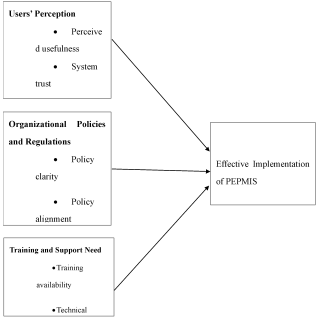
The Conceptual framework it shows the relationship between variables. Based on the above literature, the conceptual model tested in this paper is presented in
Figure 1. The independent variable in this research were the factors influencing the shift from OPRAS to PEPMIS and the dependent variable was effective implementation of PEPMIS. The factors include users’ perception and satisfaction, organizational policies and regulations and training and support needs.
The figure shows the relationship between independent variable and dependent variable, where effective implementation of PEPMIS was the dependent variable because it depends on the factors like users’ perception, organizational policies and regulation and training and support. Hence, these factors may influence the shift from OPRAS to PEPMIS.
Figure 1. Conceptual framework.
3. Research Methods
3.1. Research Approach
The study was employed a mixed-method research approach which combine both qualitative and quantitative method to provide the comprehensive understanding of users’ perception, satisfactions levels and the impact of organizational policies and regulations. This approach was appropriate for measuring the extent to which employee perceives and satisfies with each system and the influence of organizational policies and regulations on the transition to the new system. Therefore, by mixing this method, the study was benefited from both approaches and ensuring a balance analysis of the research objectives
| [15] | Kothari C. R (2004) Research Methodology-methods and techniques, 2nd edition New Delhi; K. K Gupta for New Age International (P) Ltd. |
[15]
. A research was preferred to use this approach simply because it enhance the validity and reliability of data and comprehensive analysis and interpretation of data for instance was enhance better interpret of employee satisfaction level, policy impact, and support needs that leading to more actionable recommendation, and was enhanced methodological complementarity because quantitative method allows statistical analysis of data while qualitative method provide in-depth explanations of the factors influencing the shift from OPRAS to PEPMIS.
3.2. Research Design
This study was employed descriptive research design to examine the factors influencing the shift from OPRAS to PEPMIS, this design it allows the collection of data both quantitative and qualitative data to offer insights into the overall level of satisfactions with OPRAS and PEPMIS, as well as the training and support needs perceived by the users. Hence, this design was helped to present clear picture of how users’ feel about the shift, the effectiveness of the system and the training and support needs for successful implementations and allows collection of in-depth information from respondents.
4. Results of Findings
4.1. Users’ Perception Influenced Shift from OPRAS to PEPMIS
This study focused to determine how users’ perception influenced shift from OPRAS to PEPMIS, where by respondents were required to indicate their perception with OPRAS and PEPMIS through questionnaire with five statements which were in five-point Likert scale and they required to indicate the level of extent to which they agree or disagree with the provided statements using a scale of 1 to 5, where by 1 - Strong disagree, 2 - Disagree, 3 - Neutral, 4 - Agree, and 5 - Strong agree. Hence, the results obtained were presented in a table.
Table 1. Respondents' Responses on Users’ Perception Influenced Shift from OPRAS to PEPMIS.
Statement | Strong Disagree | Disagree | Neutral | Agree | Strong Agree |
F | % | F | % | F | % | F | % | F | % |
OPRAS has been effective in evaluating employee performance | 6 | 13.6 | 12 | 27.3 | 11 | 25.0 | 15 | 34.1 | 0 | 0.0 |
PEPMIS is expected to provide a more transparent appraisal process | 0 | 0.0 | 0 | 0.0 | 3 | 6.8 | 24 | 54.5 | 17 | 38.6 |
OPRAS lacked the ability to handle modern performance evaluation needs | 2 | 4.5 | 1 | 2.3 | 11 | 25.0 | 24 | 54.5 | 6 | 13.6 |
PEPMIS is user-friendly compared to OPRAS | 1 | 2.3 | 1 | 2.3 | 6 | 13.6 | 19 | 43.2 | 17 | 38.6 |
Source: Field Data (2025)
With respect to Users’ Perception, the study investigated whether OPRAS has had been effective in evaluating employee performance The results indicate that 34.1% of respondents agree that OPRAS was effective in evaluating employee’s performance, this indicate that those employees were satisfied with OPRAS in some extent and in one way it was simple to use as the system of performance evaluation. Also, 27.3% of respondents disagreed with the statement, which suggests that OPRAS has been ineffective in evaluating employee performance, indicating that employees were not satisfied with OPRAS as the system of evaluating employees’ performance. in line with this, 13.6% of respondents strongly disagreed and suggested that OPRAS was not effective in evaluating employee performance.
For this study, interviews were conducted with key informants to get deep insight into the transition from OPRAS to PEPMIS. I interviewed the respondents, and she said that;
“OPRAS was not an effective system in evaluating employees’ performance because we used a lot of paper, which sometimes led to high costs and was time-consuming. It was very difficult system as based on filling manual forms, and submit to supervisor for review and then waiting for the feedback which was long process that was took a week and sometimes a month to complete but now the introduction of PEPMIS making the performance management effective because everything was done digitally as i submit my performance appraisal online, track my progress easier and quick receive feedback from my supervisor”.
Regarding statement that PEPMIS was expected to provide a more transparent appraisal process, The results show that, 54.5% of respondents were agreed that PEPMIS was expected to provide a more transparent appraisal process and about 38.6% of respondents were strongly agree, indicating that majority of employees satisfied with the modern system of evaluating employee performance Also, few employees constitute 6.8% were remaining neutral and there was none disagree which indicating that, majority of employee perceived that PEPMIS was more transparent in evaluating employee performance and were satisfied with the system.
During the interview, respondent II, who was among the supervisors, was interviewed and she remarked that;
“I appreciate PEPMIS because it promotes transparency and fairness in performance evaluation. There was no favoritism or any personal biases; this was good compared with OPRAS, where there was a lot of bias and favoritism because they relied on a single supervisor who assessed my performance, and sometimes I worked hard but was I not fairly recognized; but in PEPMIS my performance was assessed based on clear metrics, and I have access to see my evaluation results at any time”.
OPRAS could not handle modern performance evaluation needs: the majority of respondents, which constitute about 54.5% agreed that OPRAS could not handle modern performance evaluation needs, and 13.6% of respondents strongly agreed. Some of employees, who constitute 25%, remained neutral without showing that they either agree directly or disagree; this means that those employees were faced with some challenges while using OPRAS. While 2.3% and 4.5% of respondents disagreed and strongly disagreed suggest that OPRAS was not lacked the ability to handle modern performance evaluation needs indicating that, they see some significant and strength of OPRAS.
For statement that “PEPMIS was user-friendly compared to OPRAS”, the study founded that majority of respondents which constitute about 43.2% they were agreed and 38.6% of respondents they were strongly agreed that PEPMIS is user-friendly compared to OPRAS, Also, 13.6% of respondents were remaining neutral without indicate their level either they agree or direct disagree, this means that they were started to use PEPMIS and faced with some hurdles in practicing the system while 2.3% of the respondents they were disagreed with the statement and show that PEPMIS was not user-friendly compared with OPRAS.
Based on users’ perception, respondents were asked one open-ended question within a questionnaire to express their perceptions on the challenges of using OPRAS compared to PEPMIS in evaluating employee performance, and the majority of them remarked that, “OPRAS faced with a lot of challenges such as paperwork, biases and delaying on real feedback while PEPMIS has fewer challenges such as technical issues”. Hence, from this data it indicates that OPRAS was not effective in evaluation process, while on the other hand PEPMIS was more effective.
One participant from the Benefits Department, Respondent III, and a supervisor were interviewed during the interview; he said that;
“OPRAS was not effective as it has a lot of weaknesses compared to PEPMIS, especially in providing feedback. Most said that in OPRAS they had to fill the appraisal form and wait for feedback, and that can take up to a week or month without knowing how they perform”
4.2. Organizational Policies and Regulation Influenced Shift from OPRAS to PEPMIS
The study focused on examining how organizational and regulatory factors influenced the shift from OPRAS to PEPMIS, of which respondents were provided with questionnaires that contain different statements related to this specific objective. Respondents were required to indicate their level of extent to which they agree or disagree with the statements provided in the questionnaire by using a scale of 1 to 5 whereby 1 stand for Strong disagree, 2 stands for Disagree, 3 stands for Neutral, 4 stands for Agree, and 5 stands for Strong agree. Hence, the below were the presentation of findings based on this specific objective as guided by organizational policies and regulation as independent variable.
Table 2. Respondents' Responses Regarding Organizational Policies and Regulations Influencing the Shift from OPRAS to PEPMIS.
Statement | Strong Disagree | Disagree | Neutral | Agree | Strong Agree |
| F | % | F | % | F | % | F | % | F | % |
Organizational policies support the adoption of PEPMIS | 0 | 0.0 | 2 | 4.6 | 4 | 9.1 | 25 | 56.8 | 13 | 29.6 |
Regulations governing performance appraisal system are clear and well-implemented | 0 | 0.0 | 2 | 4.6 | 7 | 15.9 | 28 | 63.6 | 7 | 15.9 |
The shift to PEPMIS aligns with the strategic goals of National; Social Security Fund (NSSF) | 0 | 0.0 | 0 | 0.0 | 10 | 22.7 | 21 | 47.7 | 13 | 29.6 |
There is a need to revising existing policies to support the use of PEPMIS | 0 | 0.0 | 0 | 0.0 | 5 | 11.4 | 27 | 61.4 | 12 | 27.3 |
Source: Field Data, (2025)
With respect to organizational policies and regulations, the study investigated whether organizational policies support the adoption of PEPMIS. The findings show that 56.8% of respondents agree, and 29.6% strongly agree that the organizational policies support the adoption of PEPMIS, while a small number of respondents, who constitute 9.1% remained neutral without standing either agree or disagree. However, 4.5% of respondents disagreed and there were none who strongly disagreed. Hence, the presence of respondents who remained neutral and those who disagreed indicates that some employees may not clearly understand the existing policies, and there may be gaps in policy implementation; this creates difficulties in adoption of the new system.
One of the participants, who was Respondent IV, was interviewed and she remarked that;
“Yes, there are policies provided to ensure that every employee in the organization follows the new performance management system. While there is a need for more campaigns to educate employees on how to comply with the new regulations that guide performance management systems”
Regarding the second statement that regulations governing the performance appraisal system are clear and well-implemented, the results indicate that 63.6% of respondents agree, and 15.9% strongly agree that regulations governing the performance appraisal system are clear and well-implemented. While some respondents, who constitute 15.9%, remained neutral without expressing their level of agreement or disagreement. However, a small percentage of respondents, which forms about 4.5%, disagreed, and there were none who strongly disagreed.
For third statement which state that, “the shift to PEPMIS aligns with the strategic goals of national social security fund (NSSF)”, the results show that 47.7% and 29.6% of respondents they agree and strongly agree that, the shift to PEPMIS aligns with the strategic goals of National Social Security Fund (NSSF), However, small numbers of remaining respondents which constitute 22.7% they remained neutral, maintaining no agree or disagree with the statement while the results show that no respondents disagreed or strongly disagreed with the statement.
Regarding the statement that “There is a need to revising existing policies to support the use of PEPMIS”, the findings show that the majority of respondents, who form about 61.4%, agree that there is a need to revise existing policies to support the use of PEPMIS, and 27.3% strongly agree. However, 11.4% of respondents remained neutral, while there were not any respondents who disagree or strongly disagree, this means that most of respondents agreed and some remained neutral maintaining no agree or disagree totally.
One among the participants was Respondent V, and a supervisor was interviewed during the interview, and he said that;
“Some policies need to be revised to accommodate the digital nature of PEPMIS because the current policies were designed for OPRAS, and some sections do not fully align with the new system even though there was a guideline for PEPMIS implementation, but the organization should also review their policies to comply with the new system”.
Under organization policy and regulations, respondents were asked one open-ended question within a questionnaire and were required to show ways in which policies and regulations of the organization influenced the transition from OPRAS to PEPMIS. Respondents were responded to this question based on different views, some of them narrate ways such as through performance management of employees, through change of fund structure, through the needs of workforce efficiency and productivity policies while most of respondents were not remarked answer and remained to write “NILL” indicating that they not aware much on what ways does the organizational policies and regulations influenced the transition from OPRAS to PEPMIS.
4.3. Training and Support Needs for Successful Implementation of PEPMIS
Based on this independent variable, Study was focused to evaluate training and support needs for successful implementation of PEPMIS, of which respondents were provided with five-point Likert scale questionnaire contain statements relating to the training and supports needs. Respondents were required to fill in a questionnaire by indicating the level of extent to which they agree or disagree with the statements provided. The answer options were 1 - Strongly disagree, 2 - Disagree, 3 - Neutral, 4 - Agree, 5 - Strongly agree.
Table 3. Respondents' Responses Regarding Training and Support Needs for Successful Implementation of PEPMIS.
Statement | Strong Disagree | Disagree | Neutral | Agree | Strong Agree |
| F | % | F | % | F | % | F | % | F | % |
Employees have received adequate training on using PEPMIS | 0 | 0.0 | 1 | 2.3 | 3 | 6.8 | 33 | 75.0 | 7 | 15.9 |
Continuous support is available for employee during the PEPMIS implementation | 0 | 0.0 | 2 | 4.6 | 3 | 6.8 | 27 | 61.4 | 12 | 27.3 |
Training programs provided are relevant to the functionality of PEPMIS | 0 | 0.0 | 0 | 0.0 | 3 | 6.8 | 30 | 68.2 | 11 | 25.0 |
Management has provided sufficient resources to support the transition from OPRAS to PEPMIS. | 0 | 0.0 | 0 | 0.0 | 11 | 25.0 | 21 | 47.7 | 12 | 27.3 |
Source: Field Data, (2025)
With respect to training and support needs for successful implementation of PEPMIS. The study investigated whether “employee have received adequate training on using PEPMIS” The results show that, majority of respondents which constitute 75% agreed, and 15.91% they were strongly agree that they have received adequate training on using PEPMIS. But only 6.8% of respondents remained neutral, without indicating whether they agree or disagree totally. However, only one respondent (2.3% disagreed; this means that he did not receive adequate training on using PEPMIS and was not aware of how to use the new system, but there was not strongly disagree respondent.
One participant from the Data Management Department was interviewed, and she said that;
“During the transition, some employees were provided with training on PEPMIS, but most are not very aware on using the system; I think training should be provided to all staff members to ensure that no one is left behind”
The study also investigated whether “continuous support was available for employees during the PEPMIS implementation”. The results of the findings indicate that the majority of respondents, about 61.4% agree, and 27.3% strongly agree that continuous support was available for employees during the PEPMIS implementation. While the results show that only 6.8% of respondents remained neutral, this means that they were not totally agreed if the organization provided the continuous support during PEPMIS implementation or they were not totally disagreed. However, the results show that only two respondents, which constitute 4.6%, disagreed while there was none who strongly disagreed with respondents.
Regarding the statement that “training programs provided were relevant to the functionality of PEPMIS”, the findings indicates that many respondents which constitute 68.2% agree, and 25% strongly agree that training program provided were relevant to the functionality of PEPMIS. While a small number of respondents, who constitute 6.8%, remained neutral, and there were no any respondents who disagreed or strongly disagreed.
Also, the study investigated whether “management has provided sufficient resources to support the transition from OPRAS to PEPMIS”. The results shows that 47.7% of respondents agree that the management has provided sufficient resources to support the transition from OPRAS to PEPMIS, and 27.3% of respondents they were strongly agreed, forming a total of 75% they were agree and strongly agree with the statement provided that the management provided sufficient resources to support the transition to the modern system introduced in the organization. However, 25% of respondents remained neutral,
Furthermore, respondents were asked one open-ended question under this specific objective and were required to show any types of training and support needs that help them to use the system more effectively, but some of respondents they respondents by shown that they need more technical support and continuous training so as to master in using system, while some respondents were not respondents, this indicating that they receive adequate training and they not need further training and support.
5. Discussion of Findings
5.1. Users’ Perception Influenced Shift from OPRAS to PEPMIS
The findings of this study found that, users of the system were perceived positively by PEPMIS compared with OPRAS and were highly satisfied with PEPMIS as the modern system used in evaluating employee performance compared with OPRAS. This was due to fact that most of respondents express their perception and satisfaction level by agreed that PEPMIS is more user-friendly compared with OPRAS because was more effective, efficient and was more accessible system of which employee was able to access and use the system easier, not only that but also the system align with the performance management target settled by the organization. Hence, due to efficiency and effectiveness of the system, most employees perceived in positively way compared with OPRAS. This finding was aligned with expectancy theory because positive users’ perception resulted from their expectations about the effectiveness of PEPMIS as a modern performance management system. As the study conducted by Kadir, Tan, and Lee
| [14] | Kadir, Tan, & Lee, C. (2022). Employee’s perception on performance appraisal system: a study of multinational organizations in southeast Asia. International journal of Human Resource Management, 33(5), 1120-1145
https://doi.org/10.1080/09585192.2020.1771783 |
[14]
, was aimed to examine the employee perception of performance appraisal system in Asia, whereby their findings was related with the findings of this study because was founded that, employees were favored with performance management system which were simple to use, easy to access and more transparently in providing feedback. Also, the study conducted by William was concluded that the introduction of a digital performance appraisal system influences performance evaluation to be more accessible and interactive. Hence, PEPMIS receives positive perception from users.
The findings also revealed that, PEPMIS expected to provide transparent appraisal process, as majority of respondents agreed that PEPMIS as the modern system of evaluating employee’s performance was more transparent compared with OPRAS. Hence, the implementation of PEPMIS appear as the new version of the old system because the old system was not transparent in evaluating employee performance as was based on paper work and the whole assessment was done by only one supervisor, that was different in PEPMIS because all appraisal was done digitally and was easy for employees to review their performance progress. Hence, through these, the system was observed as more transparent compared with OPRAS. The findings of this study were aligned with expectancy theory because the theory suggests that individuals are motivated and satisfied if they believe that their effort could result to positive outcome; as in these findings, employees are expected that PEPMIS could provide a transparent appraisal process
. Similarly, with the findings of the study done by Kadir, Tan, and Lee
| [14] | Kadir, Tan, & Lee, C. (2022). Employee’s perception on performance appraisal system: a study of multinational organizations in southeast Asia. International journal of Human Resource Management, 33(5), 1120-1145
https://doi.org/10.1080/09585192.2020.1771783 |
[14]
, which was found that, employees were favored with performance management systems which were simple to use, easy to access and more transparently. Hence, the transparent nature of PEPMIS influences the system more effectively in the appraisal process.
Furthermore, the study found that OPRAS was cannot handle modern performance evaluation needs, as majority of respondents expressed their level of agreement that OPRAS could not handle the modern performance evaluation needs because was outdated system and ineffective system which was difficult to meet the performance evaluation demands in current work environment. This was due to fact that most organizations, including NSSF, undergo digital transformation, especially in the way of managing workforce. Hence, due to the outdated nature of OPRAS, the organization shifted from OPRAS to PEPMIS and the adopted modern system was observed to have the ability to handle the modern performance evaluation needs of the organization. This finding was align with the findings conducted by Gwimile
| [11] | Gwimile, A. (2017). Effectiveness of Open Review and Appraisal System in evaluating employee performance at the Open University of Tanzania, Kinondoni Municipal Council (Master's thesis, Open University of Tanzania). |
[11]
who was focused to examine effectiveness of the OPRAS in Open University of Tanzania, and was founded that OPRAS was paper-based system that was led to inefficiency and ineffective such as delaying on appraisal process and difficult to maintain accurate records as well as biases based system. Hence, through these weaknesses, the system observed cannot handle the modern performance evaluation needs.
Moreover, the study revealed that the ineffectiveness of OPRAS as the old performance management system was caused by the poor structure and lack of interactivity in the organization due to bureaucratic nature. Smith
| [31] | Smith, A. (2021). From OPRAS to PEPMIS: Understanding the Transition in Performance Evaluation Systems. Organizational Research Review, 22(3), 85-98. |
[31]
. conducted the study and founded that tradition appraisal system was characterized by bureaucratic nature that hinder employee involvement in appraisal process and may reduce the effectiveness of employee performance assessment
| [35] | Williams, T. (2019). Technological Advances in Performance Management: The Role of PEPMIS. Journal of Organizational Innovation, 10(2), 201-219. |
[35]
.
Therefore, the findings show that despite of positive users perception on PEPMIS, some of respondents were remained neutral suggesting that there was still challenges in implementing PEPMIS as the modern system used in evaluating employee performance, these challenges were including inadequate training about PEPMIS and how it work, challenge related to the limited digital literacy as some employee they not fully aware about the system, and challenges related to the resistance to change as employees they were familiar with the old system that bring difficult in adopting the new system.
5.2. Organizational Policies and Regulations Influenced SHIFT from OPRAS to PEPMIS
Organizational policies and regulations were founded as crucial factor influencing shift from OPRAS to PEPMIS as finding revealed that, organizational policies support the adoption of PEPMIS as majority of respondents expressed their level of extent by agreed that the policies of NSSF support the adaptation of PEPMIS. This was due to the fact that the adoption of PEPMIS as the modern system of evaluating employee performance was stated in the PEPMIS guideline due to performance targets set by the Tanzania Government. This finding was related and aligned with goal-setting theory because the theory emphasizes setting clear and specific goals that guide employee behavior and performance; as in this finding, organizational policies and regulations helped much in setting clear goals that support the transition from OPRAS to PEPMIS. Similarly, with the finding conducted by Smith
| [31] | Smith, A. (2021). From OPRAS to PEPMIS: Understanding the Transition in Performance Evaluation Systems. Organizational Research Review, 22(3), 85-98. |
[31]
, who founded that strong policies play significant roles in influencing the adoption and implementation of a new performance management system. Hence, both studies have found that effective policies may support the adoption of the new system.
The study also revealed that regulations governing performance appraisal are clearer and well implemented, with a high number of respondents agreeing and strongly agreeing. This indicates that the organizational regulations are very clearly and well implemented to support the adoption of the modern system. This finding was related with the finding done by Mbore and Thomas
| [22] | Mbore, M., & Thomas, A. (2017). Employee performance measurement and management in the African public sector: A review of performance management system design and a framework for comparing alternative approaches. African Journal of Public Sector Studies, 10(2), 45-68. |
[22]
that conducted study on the employee performance measurement and management in African banking sector and was founded that well-structured regulations foster the effectiveness of performance management system. So far, this finding has been aligned with goal setting theory because the theory helps in formulating regulations governing performance appraisal that align with organizational goals. Hence, this finding proposed that clear and well-implemented regulations enhance effectiveness in the performance management system such as PEPMIS.
Furthermore, the study found that there was a need to revise existing policies and regulations for better support of PEPMIS implementation. Despite having clear and well-implemented policies and regulations, there was a need to revise as was suggested by majority of respondents, and this revise on existing policies and regulations could be made to align with the digital nature of the new performance management system (PEPMIS). Brown et al,
| [8] | Brown, Green, & Taylor, L. (2022). Transitioning to PEPMIS: Challenges and Solutions in Organizational Performance Management. Journal of Performance Management, 15(4), 112-129. |
[8]
in his study suggested that shifting from traditional to digital performance management system needs ongoing policy update to align with technological changes.
5.3. Training and Support Needs for Successful Implementation of PEPMIS
The study indicates that, training and support were provided to the employees with the aim of gain success in the implementation of PEPMIS, as high number of respondents agreed and strongly agreed that they had received training on PEPMIS and understood how this new system operates. The study revealed that total of 75% of respondents that had agreed that they received adequate training on PEPMIS. Hence, the high rate of agreed respondents suggests that most of employees received training on the modern performance management system but, it requires additional training and guidelines to be provided to employees for clear adoption of PEPMIS. This finding was linked very closely with expectancy theory because theory emphasizes that individuals can perform well when they believe that their effort that supported by training and good guidance which resulted to positive outcome. Also, the finding was relevant to the study that was conducted by Almulaiki
| [3] | Almulaiki, A. M. (2023). The impact of performance management on employee performance and challenges in implementing system: Journal of Human Resource Management, 12(3), 45-67. |
[3]
on the impact of training on performance management systems, and it was found that adequate training significantly enhances employee productivity because it adds some digital literacy to employees.
Furthermore, the finding revealed that, continuous support was available for employee during PEPMIS implementation, through this finding it was observed that continuous support was available when employees need as larger number of respondents they had agreed and strongly agreed while some of respondents were remained neutral which indicate that some employees in the organization did not receive adequate continuous support or did not aware about availability of support such as technical support. This finding was more relevant with the findings of Awan et al
| [5] | Awan, A. G., Habib, A., & Iqbal, M. S. (2020). The effectiveness of performance management systems for employee performance through engagement: Journal of Business and Management, 22(3), 45-60.
https://doi.org/10.1177/2158244020969383 |
[5]
, who found that continuous support such as managerial support was essential for transition to new performance management system. So far, this finding has been linked and aligned with expectancy theory because employees expect successful implementation of PEPMIS if there were continuous support.
Moreover, the study founded that training programs provided were relevant to the functionality of PEPMIS of which majority of respondents were agreed and strongly agreed indicating that management was very committed to conduct training session so as to ensure all employee aware with the new system as introduced in the organization, while some of respondents were remained neutral suggesting that they not well satisfied with the training program organized by the management. Also, the finding goes far and found that management provided sufficient resources to support the transition from OPRAS to PEPMIS, while some employees were not satisfied with the resource allocation done by the management such as technological tools like computers. This finding was supported by the finding done by Metawie and Gilman
| [24] | Metawie and Gilman, M. (2005). Problems with the implementation of Performance Measurement system in the Public Sector where Performance linked to pay, is University of Kent at Canterbury. |
[24]
who found that resources allocation was essential in the implementation of digital performance management system.
6. Conclusion and Recommendations
6.1. Conclusion
This study concluded that employees had different perception of OPRAS and PEPMIS where by majority of them had positive perception with PEPMIS compared to OPRAS because it was noted that PEPMIS was user friendly system, more transparent in performance evaluation, easy and offering real time feedback, also employees appreciate the effectiveness of PEPMIS as a digital PEPMIS that maintain data security. In OPRAS, employees perceive the system as ineffective due to its nature because it was based in too much paperwork and training for providing feedback, and a lack of transparency in the evaluation process. Also, it was found that OPRAS has a lot of biases because the whole assessment was done by one supervisor. Hence, due to this weakness, OPRAS lacked ability to handle modern performance evaluation needs.
Also, the study concluded that organizational policies and regulations played a significant role in the shift from OPRAS to PEPMIS. The study noted that clear and strong organizational policies and regulations contribute to effective implementation of PEPMIS; not only that but also organizational policies and regulations need some adjustment and updating for better support of PEPMIS implementation.
Moreover, after evaluating training and support needs for successful implementation of PEPMIS, the study concluded that training and support needs had a stronger influence on the successful implementation of PEPMIS. It was found that most of employees receive training and support. However, some employees do not receive adequate training and make them difficulties in using the system effective. Also, technical support was identified as important in addressing the challenges related to the system. Therefore, the study concluded that, adequate training and support influence employees to utilize PEPMIS effectively.
6.2. Recommendations
This study was recommended on different areas for improvement to ensure effective implementation of PEPMIS. These recommendations include the following;
This study recommended that, organizations should provide adequate training and support to employees to make them familiar with the system. Hence, study emphasizes organization to conduct more training programs to create employee comfortability. Also, organizations should provide continuous support such as technical support, financial support and resource support when needed. Therefore, by conducting continuous learning, organizations increase users’ confidence and reduce resistance to adopting changes.
Furthermore, the study recommended that a revision on organizational policies and regulations should be conducted to ensure clarity, inclusivity, and acceptance of policies and regulations, and some adjustments should be made. Also, organizations should strengthen policy awareness for employees to ensure all employees are aware of policies and regulations that govern the system. So far, organizations should allocate adequate resources for effective implementation of PEPMIS. These resources include technological resources like computers and internet to ensure clear access of internet connectivity.
Moreover, organizations should establish monitoring and evaluation PEPMIS performance to assess the effectiveness of PEPMIS as a new modern performance management system. This monitoring and evaluation should be based on the key performance evaluation indicators such as system usability and effect on performance tracking.
Abbreviations
CACRs | Closed Annual Confidential Report System |
HRM | Human Resources Management |
LGAs | Local Government Authoritie |
MDAs | Ministries Department Agencies |
OPRAS | Open Performance Review and Appraisal System |
PEPMIS | Public Employee Performance Management Information System |
PMS | Performance Management Systems |
PMSE | Performance Management System Effectiveness |
PSM | Public Service Motivation |
Author Contributions
Valentine Mathias Juma: Conceptualization, Data curation, Formal Analysis, Project administration, Resources, Software, Supervision, Validation, Writing – original draft
Rahma Hussein Yassin: Funding acquisition, Investigation, Methodology, Writing – review & editing
Conflicts of Interest
The authors declare no conflicts of interest.
References
| [1] |
Aguinis, H. (2019). Performance Management: 4th Ed. Pearson.
|
| [2] |
Akinola, O. (2019). Performance Management in Africa: A Comparative Study: African Journal of Management.
|
| [3] |
Almulaiki, A. M. (2023). The impact of performance management on employee performance and challenges in implementing system: Journal of Human Resource Management, 12(3), 45-67.
|
| [4] |
Armstrong, M. (2006). A Handbook of Human Resource Management Practice: 10thed. London and Philadelphia: Kogan Page.
|
| [5] |
Awan, A. G., Habib, A., & Iqbal, M. S. (2020). The effectiveness of performance management systems for employee performance through engagement: Journal of Business and Management, 22(3), 45-60.
https://doi.org/10.1177/2158244020969383
|
| [6] |
Bana, B. A, (2009). Performance Management in the Tanzania Public Service: Governance.
|
| [7] |
Boas, A. A. (2024). Human Resource Management - An update. Federal University of Lavras. Brazil.
|
| [8] |
Brown, Green, & Taylor, L. (2022). Transitioning to PEPMIS: Challenges and Solutions in Organizational Performance Management. Journal of Performance Management, 15(4), 112-129.
|
| [9] |
Cardy, R. L., & Leonard, B. (2023). Performance Management: Concepts, Skills, and Exercise (4TH ED.). Rutledge.
|
| [10] |
Government of Tanzania (2023)."New E-Systems to Discard OPRAS."Daily News. Retrieved from [Daily News].
|
| [11] |
Gwimile, A. (2017). Effectiveness of Open Review and Appraisal System in evaluating employee performance at the Open University of Tanzania, Kinondoni Municipal Council (Master's thesis, Open University of Tanzania).
|
| [12] |
Issa, F, (2011). Public Sector Human Resource Managers promoting Professionalism and implementing the Public Service Charter at the national Level: Facilitating and Inhibiting Factors and strategic actions. Workshop on "Promoting Professionalism in the public service: held in Addis Ababa, Ethiopia, 14 to 18 March, 2011.
|
| [13] |
Johnson, & Lee, S. (2020). Resistance to Change in Performance Management Systems: A Case Study of PEPMIS Implementation. International Journal of Management Studies, 25(1), 44-59.
|
| [14] |
Kadir, Tan, & Lee, C. (2022). Employee’s perception on performance appraisal system: a study of multinational organizations in southeast Asia. International journal of Human Resource Management, 33(5), 1120-1145
https://doi.org/10.1080/09585192.2020.1771783
|
| [15] |
Kothari C. R (2004) Research Methodology-methods and techniques, 2nd edition New Delhi; K. K Gupta for New Age International (P) Ltd.
|
| [16] |
Leonia, F., Mrema, J., & Nkya, C. (2022). An assessment of the uses of Open Performance Review Appraisal System (OPRAS) on organizational performance: A study conducted at Moshi Municipal Council. International Journal of Public Administration and Management, 12(3), 45-58.
|
| [17] |
Locke, E. A. (1968). Theory of Task Toward a Motivation and Incentives. Organizational behavior and Human Performance, 3(2), 157-189.
https://doi.org/10.1016/0030-5073(68)90004-4
|
| [18] |
Mafini, C. (2015). Public Sector Performance Management in South Africa: A Focus on the Local Government. African journal of Public Affairs.
|
| [19] |
Muhammad, S., Khan, I., & Hameed, F. (2021). The Impact of Performance Management System on Employees Performance. International Journal of Business Management Sciences, and 2(3), 38-47.
|
| [20] |
Maley, Robertson & Hayes, J. (2021). The role of performance management in multinational corporation: A global perspective, journal of business research, 110(6), 204-212.
|
| [21] |
Mayer, K. J. & Rowan, B. (1977). Institutionalized Organizations; Formal Structure as Mythand Ceremony. American Sociological Review, 83(2), 340-363.
https://doi.org/10.1086/226550
|
| [22] |
Mbore, M., & Thomas, A. (2017). Employee performance measurement and management in the African public sector: A review of performance management system design and a framework for comparing alternative approaches. African Journal of Public Sector Studies, 10(2), 45-68.
|
| [23] |
McKinsey & Company report, (2023). Performance management that puts people first: evolving appraisal system in the digital age. McKinsey insight. Retrieved from
https://www.mckinsey.com
|
| [24] |
Metawie and Gilman, M. (2005). Problems with the implementation of Performance Measurement system in the Public Sector where Performance linked to pay, is University of Kent at Canterbury.
|
| [25] |
Mgoma, V. S. (2010). Open Performance Review and Appraisal System in Tanzania on Article, retrieved on 1st Nov. 2011, from
http//www.articlebase.com/humanresource-articles/open-performancereview-andappraisal-system
|
| [26] |
Mhando, J. E. (2016). Challenges of implementing OPRAS among public secondary teachers in Arusha City Council/
|
| [27] |
Musiba, E. V, (2015). “Factors affecting Implementation of Open Performance Review and Appraisal System (OPRAS) in Tanzania's public service. A case of Temeke Municipal Council.
|
| [28] |
Mwakibete, A. (2015). Assessing the effectiveness of the Open Performance and Review Appraisal System (OPRAS) in performance management in Local Government Authorities (LGAs).
|
| [29] |
President’s Office - Public Service Management and Good Governance (2024) "Govt Issues Ultimatum for PEPMIS Registration." Daily News. Retrieved from [Daily News].
|
| [30] |
Schiemann, W A. (2011). Aligning Performance Management Systems with Organizational Success. Leadership Excellence Essentials.
|
| [31] |
Smith, A. (2021). From OPRAS to PEPMIS: Understanding the Transition in Performance Evaluation Systems. Organizational Research Review, 22(3), 85-98.
|
| [32] |
Smither, J. W., London., & Reilly, R. R. (2005).’’Performance Appraisal: State of the Art in Practice.’’ Jossey-Bass.
|
| [33] |
University of Dar es Salaam. (2024). "Public Employees Performance Management Information System (PEPMIS) Training Report. “University of Dar es Salaam.
|
| [34] |
Vroom. (1964). Work and Motivation. New York. Wiley.
|
| [35] |
Williams, T. (2019). Technological Advances in Performance Management: The Role of PEPMIS. Journal of Organizational Innovation, 10(2), 201-219.
|
Cite This Article
-
APA Style
Juma, V. M., Yassin, R. H. (2026). Factors Influencing Shift from Open Performance Review and Appraisal System to Public Employees’ Performance Management Information System at the NSSF, Dodoma. American Journal of Operations Management and Information Systems, 11(3), 57-71. https://doi.org/10.11648/j.ajomis.20261103.12
 Copy
|
 Download
ACS Style
Juma, V. M.; Yassin, R. H. Factors Influencing Shift from Open Performance Review and Appraisal System to Public Employees’ Performance Management Information System at the NSSF, Dodoma. Am. J. Oper. Manag. Inf. Syst. 2026, 11(3), 57-71. doi: 10.11648/j.ajomis.20261103.12
Copy
|
Download
AMA Style
Juma VM, Yassin RH. Factors Influencing Shift from Open Performance Review and Appraisal System to Public Employees’ Performance Management Information System at the NSSF, Dodoma. Am J Oper Manag Inf Syst. 2026;11(3):57-71. doi: 10.11648/j.ajomis.20261103.12
Copy
|
Download
-
@article{10.11648/j.ajomis.20261103.12,
  author = {Valentine Mathias Juma and Rahma Hussein Yassin},
  title = {Factors Influencing Shift from Open Performance Review and Appraisal System to Public Employees’ Performance Management Information System at the NSSF, Dodoma},
  journal = {American Journal of Operations Management and Information Systems},
  volume = {11},
  number = {3},
  pages = {57-71},
  doi = {10.11648/j.ajomis.20261103.12},
  url = {https://doi.org/10.11648/j.ajomis.20261103.12},
  eprint = {https://article.sciencepublishinggroup.com/pdf/10.11648.j.ajomis.20261103.12},
  abstract = {The transition from OPRAS to PEPMIS indicates significant digital transformation for performance management in the Tanzanian public sector. This study assessed factors influencing the shift from OPRAS to PEPMIS at the National Social Security Fund (NSSF) in Dodoma. Specifically, the study focused on users’ perceptions that influence the shift from OPRAS to PEPMIS, the influence of organizational policies and regulations on the shift to PEPMIS, and the evaluation of training and support needs for successful implementation of PEPMIS. A descriptive research design was used, utilizing mixed approaches that combine both qualitative and quantitative approaches. A sample size of 44 respondents was employed, selected through simple random sampling and purposive sampling techniques. The study collected both primary data and secondary data using questionnaires, interviews, and documentary review as the methods. The study was anchored on expectancy theory and goal-setting theory to provide deep insight. The findings of the study revealed that users’ perceptions were positive about PEPMIS compared with OPRAS and were highly satisfied with PEPMIS, also it was noted that PEPMIS was transparency because provided transparent appraisal process. The study indicates that OPRAS could not handle modern performance evaluation needs. Furthermore, the findings revealed that organizational policies and regulation support the adoption of PEPMIS. Moreover, the findings found that training and support provided to the employee for the aims of success in the implementation of PEPMIS. The study concluded that employees had different perceptions of OPRAS and PEPMIS, some support PEPMIS as more user-friendly system, transparent and provide real-time feedback compared with OPRAS. Also, organizational policies and regulations played a significant role in shifting to PEPMIS. Additionally, training and support had a strong influence on the successful implementation of PEPMIS. The study recommended that organizations should provide adequate training and support to employees to make them familiar with the system. Also, revision of organizational policies and regulations should be conducted to ensure clarity, inclusivity, and acceptance of policies and regulations, and some adjustments should be made.},
 year = {2026}
}
Copy
|
Download
-
TY  - JOUR
T1  - Factors Influencing Shift from Open Performance Review and Appraisal System to Public Employees’ Performance Management Information System at the NSSF, Dodoma
AU  - Valentine Mathias Juma
AU  - Rahma Hussein Yassin
Y1  - 2026/11/11
PY  - 2026
N1  - https://doi.org/10.11648/j.ajomis.20261103.12
DO  - 10.11648/j.ajomis.20261103.12
T2  - American Journal of Operations Management and Information Systems
JF  - American Journal of Operations Management and Information Systems
JO  - American Journal of Operations Management and Information Systems
SP  - 57
EP  - 71
PB  - Science Publishing Group
SN  - 2578-8310
UR  - https://doi.org/10.11648/j.ajomis.20261103.12
AB  - The transition from OPRAS to PEPMIS indicates significant digital transformation for performance management in the Tanzanian public sector. This study assessed factors influencing the shift from OPRAS to PEPMIS at the National Social Security Fund (NSSF) in Dodoma. Specifically, the study focused on users’ perceptions that influence the shift from OPRAS to PEPMIS, the influence of organizational policies and regulations on the shift to PEPMIS, and the evaluation of training and support needs for successful implementation of PEPMIS. A descriptive research design was used, utilizing mixed approaches that combine both qualitative and quantitative approaches. A sample size of 44 respondents was employed, selected through simple random sampling and purposive sampling techniques. The study collected both primary data and secondary data using questionnaires, interviews, and documentary review as the methods. The study was anchored on expectancy theory and goal-setting theory to provide deep insight. The findings of the study revealed that users’ perceptions were positive about PEPMIS compared with OPRAS and were highly satisfied with PEPMIS, also it was noted that PEPMIS was transparency because provided transparent appraisal process. The study indicates that OPRAS could not handle modern performance evaluation needs. Furthermore, the findings revealed that organizational policies and regulation support the adoption of PEPMIS. Moreover, the findings found that training and support provided to the employee for the aims of success in the implementation of PEPMIS. The study concluded that employees had different perceptions of OPRAS and PEPMIS, some support PEPMIS as more user-friendly system, transparent and provide real-time feedback compared with OPRAS. Also, organizational policies and regulations played a significant role in shifting to PEPMIS. Additionally, training and support had a strong influence on the successful implementation of PEPMIS. The study recommended that organizations should provide adequate training and support to employees to make them familiar with the system. Also, revision of organizational policies and regulations should be conducted to ensure clarity, inclusivity, and acceptance of policies and regulations, and some adjustments should be made.
VL  - 11
IS  - 3
ER  -
Copy
|
Download





 Share This Article
 Twitter
 Linked In
 Facebook