
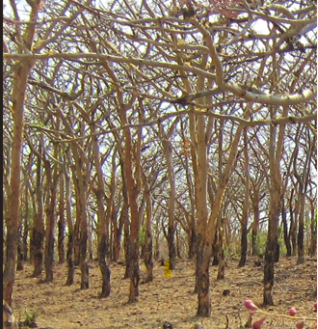
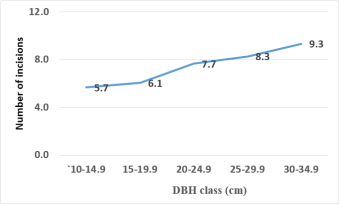
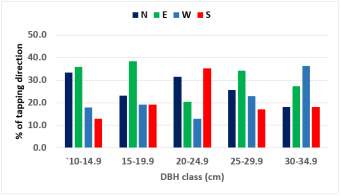
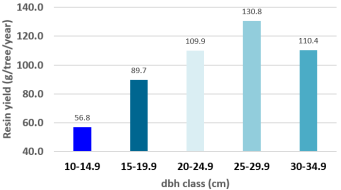
We conducted this research in a 10-ha Boswellia papyrifera plantation established in 1972 in Jebel El Garrie Natural Forest Reserve (JENFR) in southeastern Sudan. We aimed at evaluating the tapping regime and assessing yield of Frankincense. We randomly distributed thirty-three circular sample plots (0.10 ha each) in which we measured diameter at breast height (DBH)(cm) and bole height (m) of trees. From within these plots, we randomly selected 87 trees to record tapping height (m) and quantify frankincense yield (g). In addition, we examined 165 tapping incisions made on 23 subset of randomly selected trees, measured their width, length, and depth, and calculated their frequency per tree, across DBH classes, and by tapping direction. We examined Pearson correlation between tree DBH and mean frankincense yield and assessed differences in mean numbers of tapping incisions among tapping directions using one?way Analysis of Variance (ANOVA). Results showed that DBH values of B. papyrifera ranged from 10 to 32cm, with a mean of 21.8(±6.5)cm, and bole height varied between 1.4 and 6.0m, averaging 3.0(±0.8)m. Mean tapping upper and lower heights were 1.7(±0.2m) and 0.6(± 0.2m), and the average untapped portion of the bole constituted 41.1% of the total bole height. Mean tapping intensity was 7.4(±2.8), with incision frequency increasing with DBH. Mean end-of season width, length and depth were 4.1(±1.4)cm, 3.4(±2.3)cm, and 3.5(±1.3)mm, respectively. Approximately 9.2% of all trees, including 1.1% of first?time tapped individuals, were tapped below the recommended tapping lower height of 0.5m, while only 49.1% of trees in the small DBH classes were tapped on the prescribed east and west orientations. The mean annual frankincense yield (g/tree/year) was 100.8(±70.7), increasing steadily with DBH and peaking at 130.8(±81.5)g in the 25–29.9 cm DBH class before declining in larger DBH classes. These findings underscore the need for stricter adherence to size?specific and direction?specific tapping guidelines to reduce physiological stress and improve long?term productivity of B. papyrifera populations.
| Published in | American Journal of Plant Biology (Volume 11, Issue 3) |
| DOI | 10.11648/j.ajpb.20261103.16 |
| Page(s) | 86-94 |
| Creative Commons |
This is an Open Access article, distributed under the terms of the Creative Commons Attribution 4.0 International License (http://creativecommons.org/licenses/by/4.0/), which permits unrestricted use, distribution and reproduction in any medium or format, provided the original work is properly cited. |
| Copyright |
Copyright © The Author(s), 2026. Published by Science Publishing Group |
Resin Harvesting, Tapping Intensit, Boswellia Papyrifera, Plantation, Sudan
JENFR | Jebel Elgarrie Natural Forest Reserve |
AGNFR | Abugadaf Natural Forest Reserve |
DBH | Diameter at Breast Height |
TUht | Tapping Upper Height |
TLht | Tapping Lower Height |
| [1] | Gonzalez, K. Impacts of unsustainable harvesting of frankincense?producing Boswellia trees. M. Sc. Thesis. Oregon State University. Corvallis, Oregon. 2020. |
| [2] | Sun, X., Yang, Y., Peng, C., Huang, Q., Wei, J., and Yang, X. Frankincense from Boswellia: A review of species, traditional uses, phytochemistry, pharmacology and toxicology. Journal of Ethnopharmacology. 2025. 237, 1–21. |
| [3] | Nigussie, G., Eshete, M., Shumie, A., Alene, Y., Worie, B., Semahegn, A., Asmare, S. Ecological Status and Socioeconomic Significance of Boswellia papyrifera in Lowland Areas of Wag-Himra Zone, Northern Ethiopia. International Journal of Forestry Research. 2025. 5577770, 9 pages, |
| [4] | Ballal, M. E. Formulating a strategy for production, value addition, and marketing of products from arid and semi-arid lands (ASAL) in Sudan. In S. J. M. Munyua and S. Mbiru (Eds.). 2011. Report on formulating a strategy for production, value addition, and marketing of products from arid and semi-arid (ASAL) in the IGAD Region. Intergovernmental Authority on Development. Nairobi, Kenya. |
| [5] | Fadul, K. E. M., Ali A. H., Eltahir M. E. S., Adam I. M., Elkhidir H. A., Fadual S. M., Massaud M. M. Frankincense Production from Boswellia papyrifera “(Del.) Hochst” in South Kordofan State, Sudan (Production, Opportunities and Value Chain). Agriculture, Forestry and Fisheries. 2025, 14(5), 173-185. |
| [6] | Adgo, Y., and Mekoya, A. Review on the uses, factors, conservation, and restoration measures of Boswellia papyrifera trees in Ethiopia and Eritrea: Review. Agrology, 2025, 8(2), 65–72. |
| [7] | Cherenet E., Abiyu A., Getnet A., Sisay K., Dejene T. Tapping height and season affect frankincense yield and wound recovery of Boswellia papyrifera trees. Journal of Arid Environments. 2020, 179: 104176. |
| [8] | DeCarlo, A., Johnson, S., Agieb, S., Satyal, P., Sorensen, A., and Setzer, W. N. Compositional analysis of cultivated and wild?harvested Boswellia sacra frankincense resin essential oils in Oman. Chemistry and Biodiversity. 2025, 22(12), e02268. |
| [9] | Singh, R., Priya, H., Kumar, S. R., Trivedi, D., Prasad, N., Ahmad, F., Chengaiyan, J. G., Haque, S., and Rana, S. S. Gum Ghatti: A comprehensive review on production, processing, remarkable properties, and diverse applications. ACS Omega. 2024, 9, 9974–9990. |
| [10] | Bhakshu L. M. and Ratnam, K. V. Extraction of oleogum resin (frankincense/olibanum) from Boswellia species. In Frankincense – Gum Olibanum: Botany, Oleoresin, Chemistry, Extraction, Utilization, Propagation, Biotechnology, and Conservation, Pullaiah, T., Ratnam, K. V., Swamy, M. K., and Bhakshu, L. M., Eds., (1st ed.). Apple Academic Press. Palm Bay, Florida, USA. 2023, pp. 28–52. |
| [11] | Sharma, M., Prasad, R., Pandey, A., and Giri, K. Gum and resin tapping techniques in India: A review. International Journal of Chemical Studies. 2018, 6(4), 331–336. |
| [12] | Lepakshi, G., and Ratnam, M. Traditional gum and resin extraction practices and their implications for sustainable harvesting in dryland tree species. Journal of Non?Timber Forest Products. 2023, 30(2), 45–54. |
| [13] | Lemenih, M., and Kassa, H. Management guide for sustainable production of frankincense: A manual for extension workers and companies managing dry forests for resin production and marketing. Center for International Forestry Research (CIFOR); 2011, 30 pp. |
| [14] | American Herbal Products Association, AHPA. Good stewardship harvesting of Boswellia (Boswellia Serrata Roxb.). 2023. |
| [15] | Dafa-Alla, M., Hashim, A., Abuelbashar, A. I., and Musab, H. H. Boswellia papyrifera a tree of economic importance in dry land Sudan: Dendrometric parameters and tapping characteristics. Asian Journal of Forestry. 2023, 7(1), 10 – 16. |
| [16] | Dafa-Alla D. M. and Abdelhalim A. Frankincense a Non-Wood Forest Product of Economic Importance in Sudan: Harvest Population, Tapping System and Yield from a Natural Mountainous Boswellia papyrifera Forest. International Journal of Forestry and Horticulture. 2025, 11(1): 1-10. |
| [17] | Khan, M. A. Propagation of Boswellia papyrifera through branch-cuttings. The Indian Forester. 1972, 98, 437-440. |
| [18] | Ismail, M. A., and Elsheikh, A. M. Ecological assessment and diversity of woody species in Boswellia papyrifera plantations in Blue Nile State, Sudan. Mediterranean Journal of Applied Biological Sciences. 2023, 2(1), 1–10. |
| [19] | Republic of the Sudan. Forests and Renewable Natural Resources Act, 2002 (Act No. 11 of 2002). Ministry of Justice, Khartoum. 2002, 34 pp. |
| [20] | Johnson, S. P. and Ablard K. M. Frankincense: Tapping into a sustainable future. International Journal of Professional Holistic Aromatherapy. 2020, 9(3): 45–56. |
| [21] | Hassan, B. A., Glover, E. K., Luukkanen, O., Kanninen, M., and Jamnadass, R. Boswellia and Commiphora species as a resource base for rural livelihood security in the Horn of Africa: A systematic review. Forests. 2019. 10(7), 551, 1-22. |
| [22] | Gessmalla, A. F., Raddad, E. Y. A., and Ibrahim, G. E. A. Effects of tapping date, tapping direction and elevation on resin yield from Boswellia papyrifera in the Blue Nile State Sudan (NAF International Working Paper Series No. 15/12, 12 pp.). University of Pavia, Pavia, Italy. |
| [23] | Adam, I. M., Hassan, A. A., and Fadl, K. E. M. Effect of position of tapping, tree stem diameter and tapping tools on frankincense yield of Boswellia papyrifera in South Kordofan State, Sudan. Forest, Trees and Livelihoods. 2009, 19(1), 19–26. |
| [24] | Birhane E., Tesfay A., Siyum Z. G., Gidey T., Gebretsadik Y., Bongers F., Hagazi N., Noulèkoun F. Yield and chemical composition of frankincense from Boswellia papyrifera cutting-based planted trees. Journal of Arid Environments. 2025, 229: 105374. |
| [25] | Ali, A. H., Fadl, K. E. M., and Adam, I. M. Effect of position of tapping, tree stem diameter and tapping tools on frankincense yield of Boswellia papyrifera in South Kordofan State, Sudan. Forests, Trees and Livelihoods. 2009, 19(1), 19–26. |
| [26] | Eshete, A., Sterck, F. J., and Bongers, F. Frankincense production is determined by tree size and tapping frequency and intensity. Forest Ecology and Management. 2012, 274, 136–142. |
| [27] | Lema, A., Eshete, A., and Sterck, F. J. Impacts of tapping practices on frankincense yield and stem wound dynamics in Boswellia papyrifera woodlands of northern Ethiopia. Journal of Arid Environments. 2024, 216, 105077. |
| [28] | Chabot, B. F. New tapping guidelines. Maple Research News. 2005, 13–15. Proctor Maple Research Center, University of Vermont. Burlington, Vermont, USA. |
| [29] | Nour, A. M. L. Production and productivity of Boswellia papyrifera in Jebel Algarry Area, Blue Nile State. M. Sc. Thesis. University of Khartoum, Khartoum, Sudan. 2008. |
| [30] | Abtew A. A, Pretzsch J, Mohamoud T. E., Adam Y. O. Population status of Boswellia papyrifera (Del.) Hochst in the dry woodlands of Nuba mountains, south Kordofan state, Sudan. Agriculture & Forestry. 2012, 54(8)(1-4), 41-50. |
| [31] | Gebrehiwot, K., Muys, B., Haile, M., and Mitloehner, R. 2003. Introducing Boswellia papyrifera (Del.) Hochst and its non?timber forest product, frankincense (DCG Report No. 11, 73 pp.). Drylands Coordination Group, Oslo, Norway. |
| [32] | Tolera M, Sass-Klaassen U, Eshete A, Bongers F, Sterck F. J. Frankincense tree recruitment failed over the past half century. Forest Ecology and Management. 2013, 304: 65–72. |
| [33] | Abiyu, A., Bongers, F., Eshete, A., Gebrehiwot, K., Kindu, M., Lemenih, M., Moges, Y., Ogbazghi, W., and Sterck, F. J. Incense woodlands in Ethiopia and Eritrea: Regeneration problems and restoration possibilities. In Degraded forests in Eastern Africa: Management and restoration, Bongers, F. and T. Tennigkeit, T., Eds., Earthscan, London, UK; 2010, pp. 133–152. |
| [34] | Melese, A. M., Abarca, E. L., Bongers, G., Asmare, B. D., Gashu, G., and Negirew, B. Assessing Boswellia papyrifera population structure and frankincense harvesting practices in Metema District, Northwest Ethiopia. Discover Environment. 2026, 00608?4, 1–18. |
| [35] | Harch, B. D., McLachlan, A. R. G., and Skabo, S. Variation in oleoresin flow and wound response among individual trees: Implications for tapping productivity. Forest Ecology and Management. 2003, 179(1–3), 231–240. |
| [36] | Ishraga, Y. A. The economics of Boswellia papyrifera in southern Kordofan. M. Sc. Thesis. University of Khartoum, Khartoum, Sudan. 2004. |
| [37] | Khamis M. A. Management of Boswellia papyrifera stands for resin production in Jebel Marra area, W. Sudan, present situation, and future prospects. M. Sc. Thesis. Technische Universität Dresden, Dresden, Germany. 2001. |
| [38] | Sterck, F. J., and Bongers, F. Crown development in tropical rain forest trees: Patterns with tree height and light availability. Journal of Ecology. 2001 ,89(1), 1–13. |
| [39] | Sterck, F. J., Poorter, L., and Schieving, F. Leaf traits determine the growth–survival trade-off across rain forest tree species. The American Naturalist. 2005, 166(5), 496–505. |
| [40] | Rijkers, T., Ogbazghi, W., Wessel, M., and Bongers, F. The effect of tapping for frankincense on sexual reproduction in Boswellia papyrifera. Journal of Applied Ecology. 2006, 43(6), 1188–1195. |
| [41] | Alamri, S., and Al?Shanfari, M. Carbon allocation strategies and resin biosynthesis in frankincense?producing trees: Implications for sustainable tapping. Journal of Arid Environments. 2024, 220, 105012. |
| [42] | Tolera, M., Eshete, A., Sterck, F. J., and Bongers, F. Frankincense yield and tree characteristics of Boswellia papyrifera along environmental gradients in Ethiopia. Forest Ecology and Management. 2015, 343, 1–8. |
| [43] | Sabo P., Salako K. V., Glèlè Kakaï R., Ouédraogo A. Combined effects of tree size and tapping techniques on resin production of Boswellia dalzielii Hutch., an African frankincense tree. Trees. 2022, 36(6): 1697-1710. |
| [44] | Arshad, I., Bibi, A., Ayub, M. A., Zafar, M. N., Zafar, M. M., Hussain, A. I., Farid, M., and Zubair, M. Oleo-gum-resins: Occurrence, extraction, and biological potential. In Natural products, Ramawat K. G. and Mérillon J. M., Eds., Springer. Berlin, Germany; 2025, pp. 1–20). |
| [45] | Ali A. H., Gebauer J. Effect of Tree Stem Diameter, Date of Tapping, and Intensity of Tapping on Frankincense Yield of Boswellia papyrifera in the Nuba Mountains, Central Sudan. In Tropentag 2007, Utilization of diversity in land use systems: Sustainable and organic approaches to meet human needs, Witzenhausen, Germany, 2007, October 9–11, pp. 1–4. |
| [46] | Kineya, J., Gebrehiwot, K., and Muys, B. Sustainable frankincense production and the regeneration ecology of Boswellia papyrifera in northern Ethiopia. ETFRN News. 2003, 39/40, 32–36. |
| [47] | Denie M., Gezie, M. and Aynalem, M. Regeneration status, population structure, and frankincense yield trends of Boswellia papyrifera. Trees, Forests and People, 2026, 26, 101323. |
APA Style
Ahmed, D. M. D., Fadul, K. E. M., Abdelkarim, H. A. (2026). Tapping Practices, Tree Attributes, and Frankincense Yield in a Boswellia papyrifera Plantation in Jebel Elgarrie Natural Forest Reserve - Southeastern Sudan. American Journal of Plant Biology, 11(3), 86-94. https://doi.org/10.11648/j.ajpb.20261103.16
ACS Style
Ahmed, D. M. D.; Fadul, K. E. M.; Abdelkarim, H. A. Tapping Practices, Tree Attributes, and Frankincense Yield in a Boswellia papyrifera Plantation in Jebel Elgarrie Natural Forest Reserve - Southeastern Sudan. Am. J. Plant Biol. 2026, 11(3), 86-94. doi: 10.11648/j.ajpb.20261103.16
@article{10.11648/j.ajpb.20261103.16,
  author = {Dafa-Alla Mohamed Dafa-Alla Ahmed and Kamal Eldin Mohammed Fadul and Hashim Adam Abdelkarim},
  title = {Tapping Practices, Tree Attributes, and Frankincense Yield in a Boswellia papyrifera Plantation in Jebel Elgarrie Natural Forest Reserve - Southeastern Sudan},
  journal = {American Journal of Plant Biology},
  volume = {11},
  number = {3},
  pages = {86-94},
  doi = {10.11648/j.ajpb.20261103.16},
  url = {https://doi.org/10.11648/j.ajpb.20261103.16},
  eprint = {https://article.sciencepublishinggroup.com/pdf/10.11648.j.ajpb.20261103.16},
  abstract = {We conducted this research in a 10-ha Boswellia papyrifera plantation established in 1972 in Jebel El Garrie Natural Forest Reserve (JENFR) in southeastern Sudan. We aimed at evaluating the tapping regime and assessing yield of Frankincense. We randomly distributed thirty-three circular sample plots (0.10 ha each) in which we measured diameter at breast height (DBH)(cm) and bole height (m) of trees. From within these plots, we randomly selected 87 trees to record tapping height (m) and quantify frankincense yield (g). In addition, we examined 165 tapping incisions made on 23 subset of randomly selected trees, measured their width, length, and depth, and calculated their frequency per tree, across DBH classes, and by tapping direction. We examined Pearson correlation between tree DBH and mean frankincense yield and assessed differences in mean numbers of tapping incisions among tapping directions using one?way Analysis of Variance (ANOVA). Results showed that DBH values of B. papyrifera ranged from 10 to 32cm, with a mean of 21.8(±6.5)cm, and bole height varied between 1.4 and 6.0m, averaging 3.0(±0.8)m. Mean tapping upper and lower heights were 1.7(±0.2m) and 0.6(± 0.2m), and the average untapped portion of the bole constituted 41.1% of the total bole height. Mean tapping intensity was 7.4(±2.8), with incision frequency increasing with DBH. Mean end-of season width, length and depth were 4.1(±1.4)cm, 3.4(±2.3)cm, and 3.5(±1.3)mm, respectively. Approximately 9.2% of all trees, including 1.1% of first?time tapped individuals, were tapped below the recommended tapping lower height of 0.5m, while only 49.1% of trees in the small DBH classes were tapped on the prescribed east and west orientations. The mean annual frankincense yield (g/tree/year) was 100.8(±70.7), increasing steadily with DBH and peaking at 130.8(±81.5)g in the 25–29.9 cm DBH class before declining in larger DBH classes. These findings underscore the need for stricter adherence to size?specific and direction?specific tapping guidelines to reduce physiological stress and improve long?term productivity of B. papyrifera populations.},
 year = {2026}
}
TY  - JOUR
T1  - Tapping Practices, Tree Attributes, and Frankincense Yield in a Boswellia papyrifera Plantation in Jebel Elgarrie Natural Forest Reserve - Southeastern Sudan
AU  - Dafa-Alla Mohamed Dafa-Alla Ahmed
AU  - Kamal Eldin Mohammed Fadul
AU  - Hashim Adam Abdelkarim
Y1  - 2026/07/28
PY  - 2026
N1  - https://doi.org/10.11648/j.ajpb.20261103.16
DO  - 10.11648/j.ajpb.20261103.16
T2  - American Journal of Plant Biology
JF  - American Journal of Plant Biology
JO  - American Journal of Plant Biology
SP  - 86
EP  - 94
PB  - Science Publishing Group
SN  - 2578-8337
UR  - https://doi.org/10.11648/j.ajpb.20261103.16
AB  - We conducted this research in a 10-ha Boswellia papyrifera plantation established in 1972 in Jebel El Garrie Natural Forest Reserve (JENFR) in southeastern Sudan. We aimed at evaluating the tapping regime and assessing yield of Frankincense. We randomly distributed thirty-three circular sample plots (0.10 ha each) in which we measured diameter at breast height (DBH)(cm) and bole height (m) of trees. From within these plots, we randomly selected 87 trees to record tapping height (m) and quantify frankincense yield (g). In addition, we examined 165 tapping incisions made on 23 subset of randomly selected trees, measured their width, length, and depth, and calculated their frequency per tree, across DBH classes, and by tapping direction. We examined Pearson correlation between tree DBH and mean frankincense yield and assessed differences in mean numbers of tapping incisions among tapping directions using one?way Analysis of Variance (ANOVA). Results showed that DBH values of B. papyrifera ranged from 10 to 32cm, with a mean of 21.8(±6.5)cm, and bole height varied between 1.4 and 6.0m, averaging 3.0(±0.8)m. Mean tapping upper and lower heights were 1.7(±0.2m) and 0.6(± 0.2m), and the average untapped portion of the bole constituted 41.1% of the total bole height. Mean tapping intensity was 7.4(±2.8), with incision frequency increasing with DBH. Mean end-of season width, length and depth were 4.1(±1.4)cm, 3.4(±2.3)cm, and 3.5(±1.3)mm, respectively. Approximately 9.2% of all trees, including 1.1% of first?time tapped individuals, were tapped below the recommended tapping lower height of 0.5m, while only 49.1% of trees in the small DBH classes were tapped on the prescribed east and west orientations. The mean annual frankincense yield (g/tree/year) was 100.8(±70.7), increasing steadily with DBH and peaking at 130.8(±81.5)g in the 25–29.9 cm DBH class before declining in larger DBH classes. These findings underscore the need for stricter adherence to size?specific and direction?specific tapping guidelines to reduce physiological stress and improve long?term productivity of B. papyrifera populations.
VL  - 11
IS  - 3
ER  -
Faculty of Forestry-Shambat, University of Khartoum, Khartoum, Sudan
Biography: Dafa-Alla Mohamed Dafa-Alla Ahmed is an Associate Professor of Forest Economics at the Faculty of Forestry, University of Khartoum. He holds B. Sc.(Forestry) from the University of Juba, M. Sc. (Tropical Forestry) from Wageningen Agricultural University, and Ph. D. (Forestry) from the University of Khartoum. With over four decades of experience in forestry research and management, his work focuses on forest economics, valuation of non?wood forest products, sustainable forest management, and environmental conservation. He has published widely and led numerous national research and consultancy projects.
Research Fields: Forest management economics, valuation of forest ecosystem goods and services, non-timber forest products value chains, windbreaks, Frankincense production and economics.

Agricultural Research Corporation, El-Obeid Research Station, El-Obeid, Sudan
Faculty of Forest Science and Technology, University of Gezira, Wad-Medani, Sudan

Information



 Share This Article
 Twitter
 Linked In
 Facebook
 Copy
Copy Download