
Green synthesis method is used to prepare the Cadmium Sulphide Nanoparticles (CdS NPs) using various cadmium salts. CdS NPs are prepared by using the Cadmium Chloride, Cadmium Nitrate along with Cadmium Sulphate additionally Sodium Sulphide as precursors and Aloe vera leaf gel extract is used as stabilizing agent. The materials are characterized by X-ray Diffraction (XRD) technique to know its structure. The XRD trends display broad peaks at 2θ values of around 26.38˚, 29.84˚, 44.42˚, 51.96˚ and 71.14˚ which could be indexed to scattering from (111), (200), (220), (311) and (331) planes of cubic phase respectively of Cadmium Sulphide. The Band gap of the sample is found from UV-Visible absorbance spectroscopy and its value determined as 5.04 eV, 5.18 and 5.09 eV for the precursors cadmium chloride, cadmium nitrate and cadmium sulphate respectively apart from this cadmium sulphate precursor shows 3.58 eV that means there are two size distribution of NPs formed for cadmium sulphate precursor. Fourier Transform Infrared (FTIR) spectroscopy, Scanning Electron Microscopy (SEM) as well as Energy Dispersive Spectroscopy (EDS) techniques are employed to know the functional groups, morphology and elemental analysis of the as synthesized material. The average particle size of CdS NPs determined from TEM is around 3 nm for all the precursors and it is further confirmed by Small Angle X-ray Scattering (SAXS).
| Published in | Advances in Materials (Volume 15, Issue 1) |
| DOI | 10.11648/j.am.20261501.11 |
| Page(s) | 1-13 |
| Creative Commons |
This is an Open Access article, distributed under the terms of the Creative Commons Attribution 4.0 International License (http://creativecommons.org/licenses/by/4.0/), which permits unrestricted use, distribution and reproduction in any medium or format, provided the original work is properly cited. |
| Copyright |
Copyright © The Author(s), 2026. Published by Science Publishing Group |
CdS NPs, Aloe Vera, Environmentally Friendly Materials, Cadmium Nitrate, Cadmium Chloride, Cadmium Sulphate, Sodium Sulphide
Sl.No. | Wave Number (cm-1) | Bonding of Chemical Compounds |
|---|---|---|
1 | 3451 | –OH stretching of water molecule |
2 | 2088 | Anti symmetric as well as symmetric vibrations of the –CH2 groups of hydro carbons |
3 | 1631 | Assigned to C=C stretching |
4 | 1383 | CH3 bending deformation or sulfate S=O group |
5 | 1110 | Attributed to C-H bending vibrations |
6 | 570 | Cd-S stretching |
S.No. | Natural stabilizer | Cd Precursor | Mole fraction of Cd: S | Source of Sulfur | StirringTime(hrs) | pH | Extract wt.% inCd source |
|---|---|---|---|---|---|---|---|
1 | Aloe vera Gel extract | CdCl2 | 1:2 | Na2S | 4 | 11 | 40 |
Cd(NO3)2 | 1:2 | Na2S | 4 | 11 | 30 | ||
CdSO4 | 1:1 | Na2S | 4 | 6 | 30 |
S.No | Surfactant | Notation | Source of Cd | XRD(nm) | SEM(nm) | SAXS(nm) | TEM(nm) |
|---|---|---|---|---|---|---|---|
1 | Aloe vera GelExtract | A | CdCl2 | 8 | 2.10 | 2-4 | 2.61 |
B | Cd(NO3)2 | 3 | 2.16 | 5-12 | 2.51 | ||
C | CdSO4 | 3 | 1.60 | 3-9 | 2.62 |
S.No. | Natural Stabilizer | Cd Source | Atomic wt.% Cd: S | SCR; Cd: S | Band gap (eV) Max-Min | Morphology of CdS NPs |
|---|---|---|---|---|---|---|
5 | Aloe vera leaf Gel extract | CdCl2 | 7.89:10.34 | 1:1.31 | 5.04 | Both spherical, facet shape |
Cd(NO3)2 | 1.43:1.97 | 1:1.37 | 5.18 | Both spherical, irregular shape | ||
CdSO4 | 5.83:10.95 | 1:1.87 | 5.09-3.58 | Spherical and irregular shape |
 →Vbvalence band edge. The luminescent emission peak located at 493 nm almost coincides with the reported value and peak position at 499 nm little deviates with 5 nm to that of the reported value and these peaks are due to an excitonic emission which comes under near band edge emission.
  acceptor levels
  → Cbconduction band edge.
 CdS NPs | Cadmium Sulfide Nanoparticles |
XRD | X-ray Diffraction |
FTIR | Fourier Transform Infrared Spectroscopy |
UV Vis. Spectrum | Ultraviolet Visible Spectrum |
SEM | Scanning Electron Microscopy |
EDS | Energy-Dispersive Spectroscopy |
SAXS | Small Angle X-ray Spectroscopy |
TEM | Transmission Electron Microscopy |
MB | Methylene Blue |
RhB | Rhodamine B |
FWHM | Full Width at Half Maximum |
IRENA | A Data Manipulations and Analysis Tool Box for SAXS |
SAED | Selected Area Electron Diffraction |
| [1] | Youtie Y, Shapira P, Porter A L: Nanotechnology Publications and Citations by Leading Countries and Blocs, J. Nanopart. Res., 10 (2008) 981-986. |
| [2] | Prathna T C, Chandrasekaran N, Raichur A M, Mukherjee A: Kinetic Evolution Studies of Silver Nanoparticles in a Bio based Green Synthesis Process, Colloids Surf. A, 377 (2011) 212–216. |
| [3] | Murai H, Abe T, Matsuda J, Sato H, Chiba S, Kashiwaba Y: Improvement in the Light Emission Characteristics of CdS: Cu/CdS Diodes, Appl. Surf. Sci., 244 (2005) 351-354. |
| [4] | Wang Y, Ramanathan S, Fan Q, Yan F, Morkoe H, Bandyopadhyay R S: Electric Field Modulation of Infrared Absorption at Room Temperature in Electro Chemically Self Assembled Quantum Dots, J. Nano-sci. Nanotechnol., 6 (2006) 2077-2080. |
| [5] | Duan X, Huang Y, Agarwal R, Lieber C M: Single-Nanowire Electrically Driven Lasers, Nature, 421 (2003) 241-245. |
| [6] | Huynh W V, Dittmer J J, Alivisatos A P: Hybrid Nanorod-Polymer Solar Cells, Science, 295 (2002) 2425-2427. |
| [7] | Oladeji I O, Chow L, Ferekides C S, Viswanathan V, Zhao Z: Metal/CdTe/Cds/Cd1-xZnxS/TCO/Glass: A New CdTe Thin Film Solar Cell Structure, Sol. Energy Mater. Sol. Cells, 61 (2000) 203-211. |
| [8] | Cha D, Kim S, Huang N K: Study on Electrical Properties of CdS Films Prepared by Chemical Pyrolysis Deposition, Mater. Sci. Eng. B, 106 (2004) 63-68. |
| [9] | Singh V, Chauhan P: Structural and Optical Characterization of CdS Nanoparticles Prepared by Chemical Precipitation Method. Journal of Physics and Chemistry of Solids, 70 (2009) 1074–1079. |
| [10] | Phuruangrat A, Thongtem T, Thongtem S: Characterisation of One-Dimensional CdSNanorodsSynthesised by Solvothermal Method, J. Exp. Nanosci., 4 (2009) 47-54. |
| [11] | Lalayan A, Avetisyan A, Djotyan A: The Luminescence Properties of the Colloidal GaAs and CdS Semiconductor Quantum Dots, Laser Phys. Lett. 2 (2005) 12-15. |
| [12] | Jinxin Z, Gaoling Z, Gaorong H: Preparation of CdS Nanoparticles by Hydrothermal Method in Microemulsion, Front Chem. Chin., 2 (2007) 98-101. |
| [13] | Marandi M, Teghavinia N, Iraji A, Mahadevi S M: A Photo Chemical Method For Controlling the Size of CdS Nanoparticles, Nanotechnology, 16 (2005) 334-338. |
| [14] | Wada Y, Kuramoto H, Anand J, Tikamura T, Sakata T, Mori H, Yangida S: Microwave-Assisted Size Control of CdSNanocrystallites, J. Mater. Chem., 11 (2001) 1936-1940. |
| [15] | Torimoto T, Reyes J P, Iwasaki K, Pal B, Shibayama T, Sugawara K, Takahashi H, Ohtani B: Preparation of Novel Silica-Cadmium Sulfide Composite Nanoparticles Having Adjustable Void Space by Size-Selective Photoetching, J Am Chem Soc. 125 (2003) 316-317. |
| [16] | Wang G Z, Chen W, Liang C H, Wang Y W, Meng G W, Zhang L D: Preparation and Characterization of CdS Nanoparticles by Ultrasonic Irradiation, Inorgonic Chemistry Communications, 4 (2001) 208-210. |
| [17] | Singh V, Sharma P K, Chauhan P: Synthesis of CdS Nanoparticles with Enhanced Optical Properties, Materials Characterization, 62 (2011) 43-52. |
| [18] | Khan Z R, Zulfequar M, Khan M: Chemical Synthesis of CdS Nanoparticles and Their Optical and Dielectric Studies, J. Mater. Sci., 46 (2011) 5412-5416. |
| [19] | SivakumarSivalingam, JyotiKavirajwar, K. Seethalakshmi, JayagopiGayathri and A.Roniboss. Green synthesis of cadmium oxide nanoparticles (CdO-NPS) using syzygiumcumini: exploring industrial applications of CdO NPs as a corrosion inhibitor of mildsteel in the acidic environment. RSC Adv., 2024, 14, 7932-7939. |
| [20] | Maurya, A. K., Varshney, S., Upadhyay, S., Gupta, A., Jeyakumar, E., Lawrence, R., &Mishra, N. Green synthesis of copper oxide nanoparticles using Ficusracemosa leafextract and investigation of its antibacterial properties. Advances in Materials andProcessing Technologies, ((2024) 1–21. |
| [21] | Azmand, A., Firoozi, S. &Haghshenas, D. F. Facile Green Synthesis of CdS Nanoparticles in a Glycine Medium for Waste Valorization of Ni-Cd Battery. Waste Biomass Valor 16, 5939–5951 2025. |
| [22] | Akhilesh Kumar Maurya, ShagunVarshney, Vinod Verma, Hifzur R., Siddique, Nidhi Mishra. Synthesis of Silver and Copper oxide nanoparticles using Ficusracemosaleaf extract: characterization, anticancer potential, and dye degradation efficacy. Journal of Umm Al-Qura University for Applied Sciences. 2025, 11, 581–594. |
| [23] | RashaShakir Mahmood, DhiaHadi Hussain, Nibras Abdul Ameer Aboud. Green laser-ablated CdS nanoparticles in aloe vera medium: structural, optical, electrochemical, andsynergistic photocatalytic–adsorptive performance for pentachlorophenol degradation. Journal of Materials Science: Materials in Electronics. 2025, 36: 2135. |
| [24] | Suresh K: A Multi-Functional Dual-Energy Laboratory Mo-Cr-SAXS System, J. applied Crystallography, 48 (2015) 2040-2043. |
| [25] | Ilavsky J, Jemian P R: Irena: Tool Suite for Modeling and Analysis of Small-Angle Scattering, J. Appl. Crystallogr., 42 (2009) 347–353. |
| [26] | Naranthatta S, Janardhanan P, Pilankatta R, Nair S S: Green Synthesis of Engineered CdS Nanoparticles with Reduced Cytotoxicity for Enhanced Bioimaging Application, ACS Omega, 6 (2021) 8646−8655. |
| [27] | Josias H. Hamman: Composition and Applications of Aloe vera Leaf Gel. Molecules, 13 (2008) 1599-1616. |
| [28] | Rao M D, Pennathura G: Green Synthesis and Characterization of Cadmium SulphideNanopart- icles from ChlamydomonasReinhardtii and their Application as Photo- catalysts. MRB (Materials Research Bulletin) 8929 (2016) 1-44. |
| [29] | Kamble M M, Rondiya S R, Bade B R et al.: Optical, Structural and Morphological Study of CdS Nanoparticles: Role of Sulfur Source, Nanomaterials and Energy, 9 (2020) 72-81. |
| [30] | Shruti G, Kumar T K: Catalytic Reduction of Organic Dyes with Green Synthesized Silver Nanoparticles Using Aloe vera Leaf Extract, Journal of Nanoscience, Nano Engineering and Applications, 9 (2019) 1-13. |
| [31] | Kulkarni P, Abhijit N, Omkar K, Rahul S, Dhanshri L, Pooja K: Phytochemical and FTIR Analysis of TinisporaCordfilia, International Journal of Current Research, 10(2018) 75331-75334. |
| [32] | Alivisatos A P: Semiconductor clusters, Nano Crystals and Quantum Dots, Science, 271 (1996) 933-937. |
| [33] | Moghaddasi S M, Kumar V S: Aloe vera their Chemicals Composition and Applications: A Review, Int J Biol Med Res. 12 (2011) 466-471. |
| [34] | Dwivedi D, Dayashankar K, Dubey M: Synthesis, Structural and Optical Characterization of CdS Nanoparticles, Journal of Ovonic Research, 6 (2010) 57-62. |
| [35] | Zhang T, Oyama T, Horikoshi S, Hidaka H, Jhao J N: Serpone, Photocatalyzed N-Demethylation and Degradation of Methylene Blue Titania Dispersions Exposed to Concentrated Sun Light. Sol., Energy Matter. Sol., Cells. 73 (2002) 287-303. |
| [36] | Salian A. R, Henriques S. K, Ardra S. S. Synthesis of Cadmium Sulfide Nanoparticlesvia Green Route for Photocatalytic Degradation of Methylene Blue Dye. Orient J Chem2025; 41(1). |
| [37] | Hong L, Cheung T L, Rao N, Ouyang Q, Wang Y, Zeng S, Yang C B, Cuong D, Han P, Chong J, Liu L, Law W C and Yong K T: Millifluidic Synthesis of Cadmium Sulfide Nanoparticles and Their Application in Bioimaging, RSC Adv., 7 (2017) 36819–36832. |
| [38] | Khanna P K, Singh N: Light Emitting CdS Quantum Dots in PMMA: Synthesis and Optical Studies.Journal of Luminescence, 127 (2007) 474–482. |
| [39] | Nanda K K, Sarangi S N, Sahu S N: Visible Light Emission from CdS Nanocrystals, Journal of Physics D, 32 (1999) 2306 –2310. |
| [40] | Nesheva D, Raptis C, Levi Z, Popovic Z, Hinic I: Photoluminescence of CdSe Nanocrystals Embedded in a SiO2Thin Film Matrix. Journal of Luminescence, 82 (1999) 233–240. |
| [41] | Chahboun A, Rolo A G, Filonovich S A, Gomes M J M: Factors Influencing the Passivation of CdS Quantum Dots Embedded in Silica Glass. Solar Energy Materials and Solar cells., 90 (2006), 1413–1419. |
| [42] | Alipour A, Lakouraj M M, Tashakkorian H: Study of The Effect of Bandgap and Photoluminescence on Biological Properties of Polyaniline/CdS QD Nanocomposites Based on Natural Polymer., Nature Research - Scientific Reports., 11 (2021) (1-15). |
| [43] | Alani R R, Ibrahim O A: Effect of Point Defects on the Structural and Optical Properties of CdS Nanoparticles Synthesized by Chemical Method, International Journal of Mechanical Engineering, 7 (2022) 5156-5165. |
| [44] | SrinivasaGoud B., Suresh Y., Annapurna S., BhikshamaiahG., TarunBabu M., A. K. Singh: Photoluminescence and Photocatalytic studies of rice water and papaya fruit extract encapsulated cadmium sulfide nanoparticles, Journal of the Korean Ceramic Society, 60 (3) (2022) 1-20. |
| [45] | Chaure S, Chaure N B, Pandey R K, Ray A K: Stoichiometric Effects on Optical Properties of Cadmium Sulphide Quantum Dots, IET Circuits Devices Syst., 1 (2007) 215–219. |
| [46] | Berry A K, Amirtharaj P M, Jing-Tong Du, Boone J L, Martin D D: Photoluminescence and Raman Studies of CdS Films Grown by Metal-Organic Chemical Vapour Deposition on Si{111} Substrates, Thin Solid Films, 219 (1992) 153-156. |
APA Style
Goud, B. S., Odelu, G., Rajesh, K. (2026). Preparation and Characterization of Aloe Vera Extract Capped CdS Nanoparticles and Their Photocatalytic, Luminescence and Optical Studies. Advances in Materials, 15(1), 1-13. https://doi.org/10.11648/j.am.20261501.11
ACS Style
Goud, B. S.; Odelu, G.; Rajesh, K. Preparation and Characterization of Aloe Vera Extract Capped CdS Nanoparticles and Their Photocatalytic, Luminescence and Optical Studies. Adv. Mater. 2026, 15(1), 1-13. doi: 10.11648/j.am.20261501.11
@article{10.11648/j.am.20261501.11,
  author = {Bandaru Srinivasa Goud and Gudikandula Odelu and Keerthi Rajesh},
  title = {Preparation and Characterization of Aloe Vera Extract Capped CdS Nanoparticles and Their Photocatalytic, Luminescence and Optical Studies},
  journal = {Advances in Materials},
  volume = {15},
  number = {1},
  pages = {1-13},
  doi = {10.11648/j.am.20261501.11},
  url = {https://doi.org/10.11648/j.am.20261501.11},
  eprint = {https://article.sciencepublishinggroup.com/pdf/10.11648.j.am.20261501.11},
  abstract = {Green synthesis method is used to prepare the Cadmium Sulphide Nanoparticles (CdS NPs) using various cadmium salts. CdS NPs are prepared by using the Cadmium Chloride, Cadmium Nitrate along with Cadmium Sulphate additionally Sodium Sulphide as precursors and Aloe vera leaf gel extract is used as stabilizing agent. The materials are characterized by X-ray Diffraction (XRD) technique to know its structure. The XRD trends display broad peaks at 2θ values of around 26.38˚, 29.84˚, 44.42˚, 51.96˚ and 71.14˚ which could be indexed to scattering from (111), (200), (220), (311) and (331) planes of cubic phase respectively of Cadmium Sulphide. The Band gap of the sample is found from UV-Visible absorbance spectroscopy and its value determined as 5.04 eV, 5.18 and 5.09 eV for the precursors cadmium chloride, cadmium nitrate and cadmium sulphate respectively apart from this cadmium sulphate precursor shows 3.58 eV that means there are two size distribution of NPs formed for cadmium sulphate precursor. Fourier Transform Infrared (FTIR) spectroscopy, Scanning Electron Microscopy (SEM) as well as Energy Dispersive Spectroscopy (EDS) techniques are employed to know the functional groups, morphology and elemental analysis of the as synthesized material. The average particle size of CdS NPs determined from TEM is around 3 nm for all the precursors and it is further confirmed by Small Angle X-ray Scattering (SAXS).},
 year = {2026}
}
TY  - JOUR
T1  - Preparation and Characterization of Aloe Vera Extract Capped CdS Nanoparticles and Their Photocatalytic, Luminescence and Optical Studies
AU  - Bandaru Srinivasa Goud
AU  - Gudikandula Odelu
AU  - Keerthi Rajesh
Y1  - 2026/02/02
PY  - 2026
N1  - https://doi.org/10.11648/j.am.20261501.11
DO  - 10.11648/j.am.20261501.11
T2  - Advances in Materials
JF  - Advances in Materials
JO  - Advances in Materials
SP  - 1
EP  - 13
PB  - Science Publishing Group
SN  - 2327-252X
UR  - https://doi.org/10.11648/j.am.20261501.11
AB  - Green synthesis method is used to prepare the Cadmium Sulphide Nanoparticles (CdS NPs) using various cadmium salts. CdS NPs are prepared by using the Cadmium Chloride, Cadmium Nitrate along with Cadmium Sulphate additionally Sodium Sulphide as precursors and Aloe vera leaf gel extract is used as stabilizing agent. The materials are characterized by X-ray Diffraction (XRD) technique to know its structure. The XRD trends display broad peaks at 2θ values of around 26.38˚, 29.84˚, 44.42˚, 51.96˚ and 71.14˚ which could be indexed to scattering from (111), (200), (220), (311) and (331) planes of cubic phase respectively of Cadmium Sulphide. The Band gap of the sample is found from UV-Visible absorbance spectroscopy and its value determined as 5.04 eV, 5.18 and 5.09 eV for the precursors cadmium chloride, cadmium nitrate and cadmium sulphate respectively apart from this cadmium sulphate precursor shows 3.58 eV that means there are two size distribution of NPs formed for cadmium sulphate precursor. Fourier Transform Infrared (FTIR) spectroscopy, Scanning Electron Microscopy (SEM) as well as Energy Dispersive Spectroscopy (EDS) techniques are employed to know the functional groups, morphology and elemental analysis of the as synthesized material. The average particle size of CdS NPs determined from TEM is around 3 nm for all the precursors and it is further confirmed by Small Angle X-ray Scattering (SAXS).
VL  - 15
IS  - 1
ER  -
Department of Physics, Vivekananda Government Degree College (Autonomous), Hyderabad, India
Department of Botany,Government Degree College, Huzurabad, India
Department of Physics,Sri Raja Rajeshwara Government Arts & Science College (Autonomous), Karimnagar, India
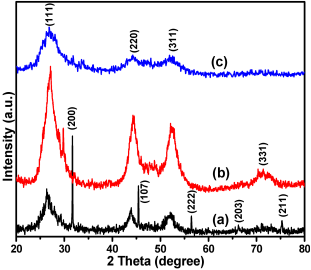
Figure 1. XRD spectrums of Aloe vera extract assisted CdS NPs produced by using: (a) cadmium chloride, (b) cadmium nitrate including (c) cadmium sulphate precursors.
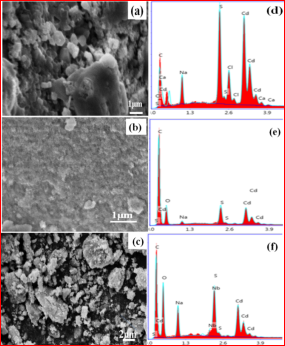
Figure 2. SEM images (a-c) and EDS spectrums (d-f) of Aloe vera leaf gel capped CdS NPs extracted from: (a, d) cadmium chloride, (b, e) cadmium nitrate along with (c, f) cadmium sulphate precursors.
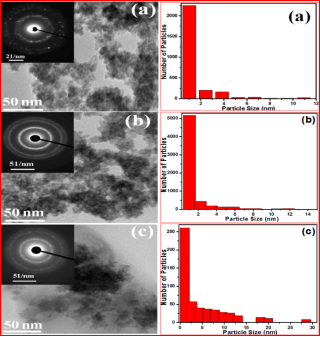
Figure 3. TEM micrographs, size distribution of Aloe vera leaves gel stabilized CdS NPs prepared from: (a) cadmium chloride, (b) cadmium nitrate including (c) cadmium sulphate.
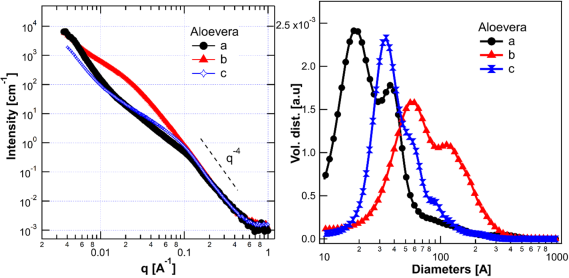
Figure 4. SAXS patterns and volume distribution curves of Aloe vera gel extract stabilized CdS NPs obtained by: (a) cadmium chloride, (b) cadmium nitrate including (c) cadmium sulphate precursors.
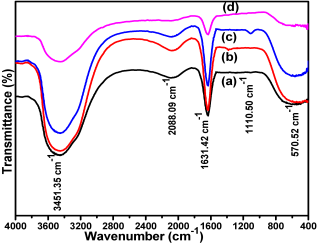
Figure 5. FTIR spectra of Aloe vera leaf gel extract stabilized CdS NPs concocted out of: (a). cadmium chloride, (b) cadmium nitrate, (c) cadmium sulphate including the (d) Infrared spectrum of Aloe vera leaf gel extract.
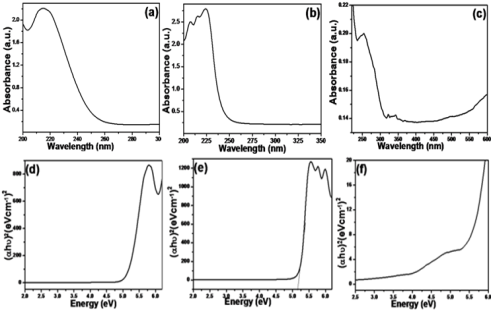
Figure 6. Absorption spectra and band gap energy plots of Aloe vera gel stabilized CdS NPs attained from cadmium chloride (a, d), cadmium nitrate (b, e) including cadmium sulphate (c, f) metal precursors.
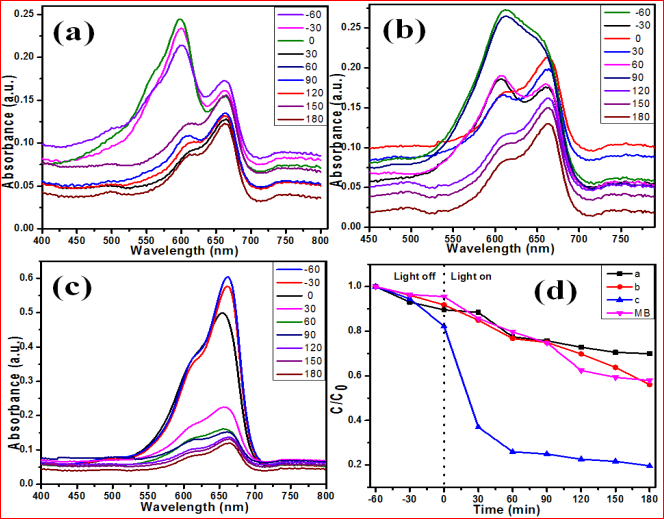
Figure 7. Photocatalytic activity (a-c) and the degradation trend (d) of MB as a function of irradationtime of Aloevera leaf gel extract capped CdS NPs composed out of: (a) cadmiumchloride,(b) cadmium nitrate including (c) cadmium sulphate salts towards the decrease in absorbance.
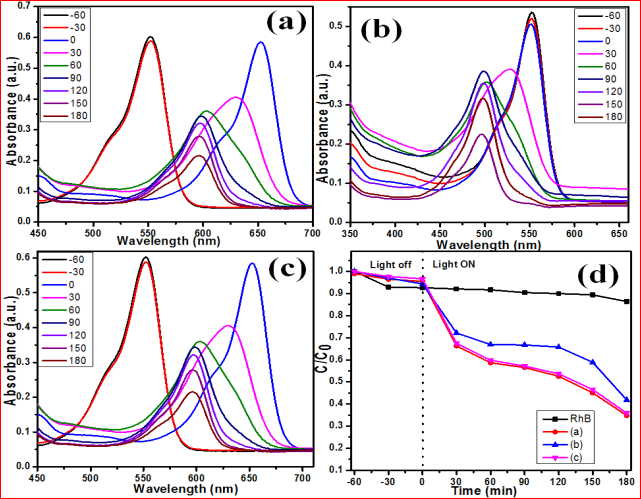
Figure 8. Photocatalytic activity (a-c) including the degradation trend (d) of RhB as a function of irradation time of Aloevera leaf gel stabilized CdS NPs prepared from: (a) cadmium chloride,(b) cadmium nitrate, (c) cadmium sulphate towards decrease in absorbance.
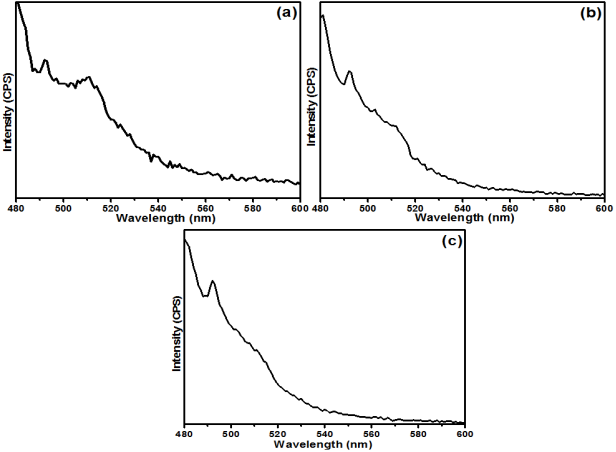
Figure 9. Photoluminescence emission spectra of Aloe vera leaves gel extract encapsulated CdS NPs preparedfrom:(a)cadmiumchloride,(b)cadmiumnitrateincluding, (c)Cadmium sulphatesalts.

Information



 Share This Article
 Twitter
 Linked In
 Facebook
 Copy
Copy Download