
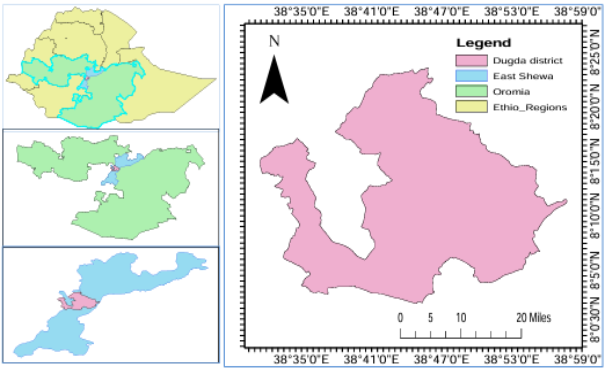
The Integrated Soil Fertility Management (ISFM) is to maintain soil health and crop production. A study was carried out in East Shewa Zone, Dugda District, on farmers’ fields to evaluate the combined effects of vermicompost (organic fertilizer) and NPS (inorganic fertilizer) on soil chemical properties and Tef production. Integrated soil fertility management, involving the use of both organic and inorganic fertilizers, aims to sustain soil fertility and enhance crop yields. Although analysis of variance revealed no significant differences (p≥ 0.05) in Tef grain yield, panicle length, plant height, and harvest index among treatments, the highest grain yield of Tef (1750.33 kg ha-1) was recorded in the treatment where 50% of the Nitrogen requirement was supplied through vermicompost. Composite soil samples collected before fertilizer application and after harvest were analyzed to assess the residual effects of vermicompost on soil physicochemical properties. Results showed that soil pH was not significantly influenced (p≥ 0.05) by vermicompost application. However, soil organic carbon (SOC), cation exchange capacity (CEC), available phosphorus (P), and total nitrogen (TN) significantly improved (P≤0.05) with vermicompost use. Initial soil tests indicated low levels of SOC, CEC, available P, and TN, highlighting the positive residual impact of vermicompost on soil fertility. A partial budget analysis identified the economically optimal treatment as the one combining 50% vermicompost with NPS fertilizer, yielding the highest net benefit of 202,540 Birr per hectare. Therefore, the study concludes that integrating 50% vermicompost (1.725 t/ha) with 46 kg ha-1 P2O5 (100kgDAP) fertilizer enhances Tef productivity and soil fertility in the study area and similar agro-ecological zones.
| Published in | American Journal of Bioscience and Bioengineering (Volume 14, Issue 2) |
| DOI | 10.11648/j.bio.20261402.11 |
| Page(s) | 14-21 |
| Creative Commons |
This is an Open Access article, distributed under the terms of the Creative Commons Attribution 4.0 International License (http://creativecommons.org/licenses/by/4.0/), which permits unrestricted use, distribution and reproduction in any medium or format, provided the original work is properly cited. |
| Copyright |
Copyright © The Author(s), 2026. Published by Science Publishing Group |
Organic Fertilizer, Soil Fertility, Soil Physiochemical Properties
No. | Treatment | Grain yield kg ha-1 | Total BM kg ha-1 | Av. HI (%) | PH (cm) | PL (cm) |
|---|---|---|---|---|---|---|
1 | Recommended NP | 1720.00 | 6546.67a | 26.37 | 79.53 | 28.13 |
2 | 100%Equiv. VC+RP | 1686.67 | 5913.33b | 28.72 | 80.00 | 31.40 |
3 | 75%Equiv.VC+25%N+RP | 1722.00 | 6246.67ab | 27.55 | 80.20 | 31.47 |
4 | 50%Equiv.VC+50%N+RP | 1750.33 | 6350.00ab | 27.60 | 81.67 | 30.13 |
5 | 25%Equiv.VC+75%N+RP | 1736.67 | 6540.00a | 26.66 | 80.33 | 31.40 |
CV (%) | 10.28 | 8.58 | 11.38 | 6.79 | 10.72 | |
LSD (0.05) | 185.75 | 554 | 3.27 | 4.74 | 3.33 | |
P-value | 0.63 | 0.012 | 0.08 | 0.77 | 0.14 | |
No. | Treatments | Grain yield in kg ha-1 | Total BM kg ha-1 | ||||
|---|---|---|---|---|---|---|---|
2022 | 2023 | 2024 | 2022 | 2023 | 2024 | ||
1. | Recommended NP | 1733.33 | 1700.00 | 1733.33 | 6433.33ab | 6583.33 | 6020.00 |
2. | 100%Equiv. VC+RP | 1683.33 | 1783.33 | 1500.00 | 5683.33c | 6333.33 | 5533.33 |
3. | 75%Equiv.VC+25%N+RP | 1650.00 | 1866.67 | 1566.67 | 6183.33abc | 6583.33 | 5700.00 |
4. | 50%Equiv.VC+50%N+RP | 1650.00 | 1966.67 | 1633.33 | 6050.00bc | 6783.33 | 6033.33 |
5. | 25%Equiv.VC+75%N+RP | 1683.33 | 1808.33 | 1700.00 | 6683.33a | 6416.67 | 6300.00 |
CV (%) | 9.81 | 7.45 | 10.80 | 6.97 | 8.25 | 9.09 | |
LSD 0.05 | 279.60 | 237.89 | 495 | 729.00 | 911.60 | 1480 | |
P-value | 0.90 | 0.14 | 0.92 | 0.002 | 0.79 | 0.14 | |
Treatments | HI (%) | Plant height (cm) | Panicle length (cm) | ||||||
|---|---|---|---|---|---|---|---|---|---|
2022 | 2023 | 2024 | 2022 | 2023 | 2024 | 2022 | 2023 | 2024 | |
Recommended NP | 27.01 | 25.95 | 25.92 | 78.83 | 79.00 | 82.00 | 29.33 | 27.00 | 28.00 |
100%Equiv. VC+RP | 29.11 | 28.20 | 27.68 | 82.33 | 77.67 | 80.00 | 30.17 | 31.50 | 33.67 |
75%Equiv.VC+25%N+RP | 26.71 | 28.41 | 27.53 | 82.17 | 79.33 | 78.00 | 31.83 | 31.33 | 31.00 |
50%Equiv.VC+50%N+RP | 27.33 | 29.77 | 27.10 | 81.33 | 83.17 | 79.33 | 28.83 | 34.00 | 31.00 |
25%Equiv.VC+75%N+RP | 24.83 | 28.36 | 26.93 | 79.50 | 79.33 | 84.00 | 31.50 | 31.67 | 30.67 |
CV (%) | 10.29 | 10.40 | 14.31 | 6.99 | 5.02 | 6.84 | 11.32 | 10.17 | 12.11 |
LSD (0.05) | 5.73 | 5.11 | 10.95 | 8.22 | 6.78 | 14.83 | 5.94 | 5.20 | 9.76 |
P-value | 0.160 | 0.63 | 0.45 | 0.61 | 0.21 | 0.70 | 0.917 | 0.06 | 0.76 |
Treatment description | Soil pH | SOC (%) | CEC (cmol(+) kg-1) | Av.P in ppm | TN (%) |
|---|---|---|---|---|---|
Recommended NP | 6.17 | 1.21d | 10.90d | 14.03d | 0.19c |
100%Equiv. VC+RP | 6.81 | 3.24a | 20.43a | 24.11a | 0.3oa |
75%Equiv.VC+25%N+RP | 6.59 | 2.28b | 17.03b | 20.78b | 0.29a |
50%Equiv.VC+50%N+RP | 6.42 | 1.92c | 16.22b | 18.20c | 0.22b |
25%Equiv.VC+75%N+RP | 6.35 | 1.67c | 12.71c | 16.60c | 0.18cd |
Initial soil analysis | 6.10 | 1.27d | 9.25d | 13.68d | 0.17d |
CV (%) | 2.90 | 13.80 | 8.80 | 10.40 | 11.90 |
LSD (0.05) | 0.67 | 0.29 | 1.65 | 2.20 | 0.02 |
Significance | NS | ** | ** | ** | ** |
Treatments | N kg ha-1 (Urea) | P2O5 kg ha-1 (DAP | VC kun ha-1 | TVC (ETB) | GY kg ha-1 | Gross benefit (ETB) | Net benefit (ETB) |
|---|---|---|---|---|---|---|---|
Recommended NP | 150 | 100 | 0.00 | 10500 | 1720.00 | 206400 | 195,900 |
100% Equiv.. V.C +R. P | 0.00 | 100 | 34.50 | 4500 | 1686.67 | 202400 | 197,900 |
75% Equiv.. V.C+25%N+R. P | 34.5 | 100 | 25.87 | 6000 | 1722.00 | 206640 | 200,640 |
50% Equiv.. V.C+50%N+R. P | 75 | 100 | 17.25 | 7500 | 1750.33 | 210039 | 202,540 |
25% Equiv.. V.C+75%N+R. P | 112.5 | 100 | 8.625 | 9000 | 1736.67 | 208400 | 199,400 |
R. P | Recommended Phosphorous |
V. C | Vermicompost |
TVC | Total Variable Cost |
VC | Variable Cost |
GY | Grain Yield |
| [1] | Abebe, W., & Ronda, F. (2014). Rheological and textural properties of tef [Eragrostis tef (Zucc.) Trotter] grain flour gels. Journal of Cereal Science, 60(1), 122-130. |
| [2] | Aira, M., Monroy, F., & Domínguez, J. (2005). Ageing effects on nitrogen dynamics and enzyme activities in casts of Aporrectodea caliginosa (Lumbricidae). Pedobiologia, 49(5), 467-473. |
| [3] | Assefa, K., Yu, J. K., Zeid, M., Belay, G., Tefera, H., & Sorrells, M. E. (2011). Breeding tef [Eragrostis tef (Zucc.) trotter]: conventional and molecular approaches. Plant breeding, 130(1), 1-9. |
| [4] | Ayoola, O. T. (2006). Effects of fertilizer treatments on soil chemical properties and crop yields in a cassava-based cropping system. J. Appl. Sci. Res., 2, 1112-1116. |
| [5] | Bekele, A., Lemma, W., & Samuel, F. (2021). Soil survey and characterization of soil of argo-gedilala sub watershed in dugda district, central rift valley of Ethiopia. Journal of Soil Science and Environmental Management, 12(3), 94-106. |
| [6] | Dejene, K., Dereje, A., & Daniel, G. (2011). Synergistic effects of combined application of organic and inorganic fertilizers on the yield and yield components of tef (Eragrostis tef (Zucc.) Trotter) under terminal drought at Adiha, Northern Ethiopia. Journal of the Drylands, 3(1). |
| [7] | Devi, K. N., Singh, M. S., Singh, N. G., & Athokpam, H. S. (2011). Effect of integrated nutrient management on growth and yield of wheat (Triticum aestivum L.). Journal of Crop and Weed, 7(2), 23-27. |
| [8] | Domínguez, J., Aira, M., & Gómez-Brandón, M. (2010). Vermicomposting: earthworms enhance the work of microbes. Microbes at work: from wastes to resources, 93-114. |
| [9] | Fernandez-Luqueno et al. (2010). Vermicompost as a soil supplement to improve growth, yield and quality of greenhouse tomatoes. Journal of Plant Nutrition, 33(10), 1510-1523. |
| [10] | Getachew, A. and Y. Chilot. 2009. Integrated Nutrient Management in Faba Bean and Wheat on Nitisols of central Ethiopian Highlands. Research Report No. 72. Ethiopian Institute of Agricultural Research (EIAR), Addis Ababa, Ethiopia, pp. 24. |
| [11] | Kasahun Kitila and Mekonnen, 2023. Evaluation of Compost Integrated with Chemical Fertilizer for better production of wheat in Shashemene District of West Arsi Zone, Oromia, AJAR, 2023; 4: 43. |
| [12] | Lim, S. L., Wu, T. Y., Lim, P. N., & Shak, K. P. Y. (2015). The use of vermicompost in organic farming: overview, effects on soil and economics. Journal of the Science of Food and Agriculture, 95(6), 1143-1156. |
| [13] | Mahajan, G. R., Pandey, R. N., Datta, S. C., Kumar, D., Sahoo, R. N., & Parsad, R. (2014). Fertilizer nitrogen, phosphorus and sulphur prescription for aromatic hybrid rice (Oryza sativa L.) using targeted yield approach. Proceedings of the National Academy of Sciences, India Section B: Biological Sciences, 84, 537-547. |
| [14] | Merga, M., & Alemu Dabi, A. D. (2019). Performance Evaluation of Tef [Eragrostis tef (Zucc.) Trotter] Genotypes for the Non-traditionally Tef Growing Area, Western Ethiopia. American Journal of Bioscience and Bioengineering, 7(5), 65-70. |
| [15] | Pedra F, Plaza C, Garcia-Gill JC, Polo, A. Effects of municipal waste compost and sewage sludge on proton binding behavior of humic acids from Portuguese sandy and clay loam soils. Bio resource Technology. 2008; 99: 2141-2147. |
| [16] | Raza, S. T., Zhu, B., Yao, Z., Wu, J., Chen, Z., Ali, Z., & Tang, J. L. (2023). Impacts of vermicompost application on crop yield, ammonia volatilization and greenhouse gases emission on upland in Southwest China. Science of the Total Environment, 860, 160479. |
| [17] | Theunissen, J., Ndakidemi, P. A., & Laubscher, C. P. (2010). Potential of vermicompost produced from plant waste on the growth and nutrient status in vegetable production. International Journal of the Physical Sciences, 5(13), 1964-1973. |
| [18] | Tufa, A. (2023). Vermicompost and NPSZnB fertilizer levels on Tef (Zea mays L.) growth, yield component, and yield at Guto Gida, western Ethiopia. International Journal of Agronomy, 2023(1), 7123826. |
| [19] | Vanlauwe, B., Kihara, J., Chivenge, P., Pypers, P., Coe, R., & Six, J. (2011). Agronomic use efficiency of N fertilizer in maize-based systems in sub-Saharan Africa within the context of integrated soil fertility management. Plant and soil, 339, 35-50. |
| [20] | Wakene, N., Kefyalew, N., Friesen, D. K., Ransom, J. and Abebe, Y., 2001. Determination of optimum farmyard manure and NP fertilizers for Tef on farmers’ fields. pp. 387-393. In: Seventh Eastern and Southern Africa Regional Tef Conference. |
APA Style
Hunde, K. K., Lindi, M. W. (2026). Evaluation of Vermicompost Integrated with Chemical Fertilizer on Yield and Yield Components of Tef in Dugda District of East Shoa Zone, Oromia. American Journal of Bioscience and Bioengineering, 14(2), 14-21. https://doi.org/10.11648/j.bio.20261402.11
ACS Style
Hunde, K. K.; Lindi, M. W. Evaluation of Vermicompost Integrated with Chemical Fertilizer on Yield and Yield Components of Tef in Dugda District of East Shoa Zone, Oromia. Am. J. BioSci. Bioeng. 2026, 14(2), 14-21. doi: 10.11648/j.bio.20261402.11
@article{10.11648/j.bio.20261402.11,
  author = {Kasahun Kitila Hunde and Mekonnen Workineh Lindi},
  title = {Evaluation of Vermicompost Integrated with Chemical Fertilizer on Yield and Yield Components of Tef in Dugda District of East Shoa Zone, Oromia},
  journal = {American Journal of Bioscience and Bioengineering},
  volume = {14},
  number = {2},
  pages = {14-21},
  doi = {10.11648/j.bio.20261402.11},
  url = {https://doi.org/10.11648/j.bio.20261402.11},
  eprint = {https://article.sciencepublishinggroup.com/pdf/10.11648.j.bio.20261402.11},
  abstract = {The Integrated Soil Fertility Management (ISFM) is to maintain soil health and crop production. A study was carried out in East Shewa Zone, Dugda District, on farmers’ fields to evaluate the combined effects of vermicompost (organic fertilizer) and NPS (inorganic fertilizer) on soil chemical properties and Tef production. Integrated soil fertility management, involving the use of both organic and inorganic fertilizers, aims to sustain soil fertility and enhance crop yields. Although analysis of variance revealed no significant differences (p≥ 0.05) in Tef grain yield, panicle length, plant height, and harvest index among treatments, the highest grain yield of Tef (1750.33 kg ha-1) was recorded in the treatment where 50% of the Nitrogen requirement was supplied through vermicompost. Composite soil samples collected before fertilizer application and after harvest were analyzed to assess the residual effects of vermicompost on soil physicochemical properties. Results showed that soil pH was not significantly influenced (p≥ 0.05) by vermicompost application. However, soil organic carbon (SOC), cation exchange capacity (CEC), available phosphorus (P), and total nitrogen (TN) significantly improved (P≤0.05) with vermicompost use. Initial soil tests indicated low levels of SOC, CEC, available P, and TN, highlighting the positive residual impact of vermicompost on soil fertility. A partial budget analysis identified the economically optimal treatment as the one combining 50% vermicompost with NPS fertilizer, yielding the highest net benefit of 202,540 Birr per hectare. Therefore, the study concludes that integrating 50% vermicompost (1.725 t/ha) with 46 kg ha-1 P2O5 (100kgDAP) fertilizer enhances Tef productivity and soil fertility in the study area and similar agro-ecological zones.},
 year = {2026}
}
TY  - JOUR
T1  - Evaluation of Vermicompost Integrated with Chemical Fertilizer on Yield and Yield Components of Tef in Dugda District of East Shoa Zone, Oromia
AU  - Kasahun Kitila Hunde
AU  - Mekonnen Workineh Lindi
Y1  - 2026/06/27
PY  - 2026
N1  - https://doi.org/10.11648/j.bio.20261402.11
DO  - 10.11648/j.bio.20261402.11
T2  - American Journal of Bioscience and Bioengineering
JF  - American Journal of Bioscience and Bioengineering
JO  - American Journal of Bioscience and Bioengineering
SP  - 14
EP  - 21
PB  - Science Publishing Group
SN  - 2328-5893
UR  - https://doi.org/10.11648/j.bio.20261402.11
AB  - The Integrated Soil Fertility Management (ISFM) is to maintain soil health and crop production. A study was carried out in East Shewa Zone, Dugda District, on farmers’ fields to evaluate the combined effects of vermicompost (organic fertilizer) and NPS (inorganic fertilizer) on soil chemical properties and Tef production. Integrated soil fertility management, involving the use of both organic and inorganic fertilizers, aims to sustain soil fertility and enhance crop yields. Although analysis of variance revealed no significant differences (p≥ 0.05) in Tef grain yield, panicle length, plant height, and harvest index among treatments, the highest grain yield of Tef (1750.33 kg ha-1) was recorded in the treatment where 50% of the Nitrogen requirement was supplied through vermicompost. Composite soil samples collected before fertilizer application and after harvest were analyzed to assess the residual effects of vermicompost on soil physicochemical properties. Results showed that soil pH was not significantly influenced (p≥ 0.05) by vermicompost application. However, soil organic carbon (SOC), cation exchange capacity (CEC), available phosphorus (P), and total nitrogen (TN) significantly improved (P≤0.05) with vermicompost use. Initial soil tests indicated low levels of SOC, CEC, available P, and TN, highlighting the positive residual impact of vermicompost on soil fertility. A partial budget analysis identified the economically optimal treatment as the one combining 50% vermicompost with NPS fertilizer, yielding the highest net benefit of 202,540 Birr per hectare. Therefore, the study concludes that integrating 50% vermicompost (1.725 t/ha) with 46 kg ha-1 P2O5 (100kgDAP) fertilizer enhances Tef productivity and soil fertility in the study area and similar agro-ecological zones.
VL  - 14
IS  - 2
ER  -
Oromia Agricultural Research Institute (OARI), Adami Tulu Agricultural Research Center (ATARC), Ethiopia
Oromia Agricultural Research Institute (OARI), Adami Tulu Agricultural Research Center (ATARC), Ethiopia

Information



 Share This Article
 Twitter
 Linked In
 Facebook
 Copy
Copy Download