
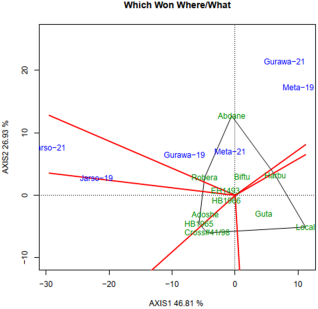
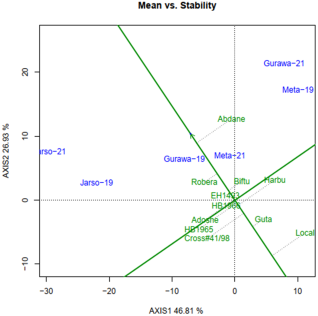
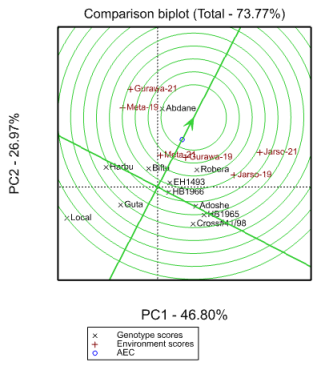
Food barley is a staple crop in the Ethiopian highlands, yet productivity remains low due to the use of low-yielding local varieties. This study evaluated the performance and adaptability of 11 food barley varieties (Abdane, Adoshe, Biftu, Guta, Robera, Cross#41/98, EH-1493, Harbu, HB-1965, HB-1966, and one local check) across six environments (Gurawa, Jarso, and Meta districts over 2019 and 2021 main cropping seasons). The experiment was conducted using a randomized complete block design with three replications. Combined analysis of variance revealed highly significant differences (p < 0.01) among varieties, environments, and their interactions for all traits. AMMI analysis indicated that environment explained 62.71% of total variation, genotype 5.74%, and genotype-by-environment interaction (GEI) 14.13%. The first two principal components of GEI accounted for 77.37% of the interaction variation. Varieties Abdane (4.81 t ha-1) and Robera (4.41 t ha-1) recorded the highest grain yields, outperforming the local check by 31.4% and 25.2%, respectively. GGE biplot analysis identified Abdane and Robera as the most stable and high-yielding varieties across environments, while Guta, Harbu, Cross#41/98, and the local check were unstable. Therefore, Abdane and Robera are recommended for further demonstration and production in East Hararghe highlands and similar agro-ecologies.
| Published in | American Journal of Bioscience and Bioengineering (Volume 14, Issue 4) |
| DOI | 10.11648/j.bio.20261404.14 |
| Page(s) | 75-80 |
| Creative Commons |
This is an Open Access article, distributed under the terms of the Creative Commons Attribution 4.0 International License (http://creativecommons.org/licenses/by/4.0/), which permits unrestricted use, distribution and reproduction in any medium or format, provided the original work is properly cited. |
| Copyright |
Copyright © The Author(s), 2026. Published by Science Publishing Group |
Adaptability, AMMI, Food Barley, GGE Biplot, Grain Yield, Stability
S. No. | Variety Name | Year of Release | Maintainer |
|---|---|---|---|
1 | Abdane | 2011 | Sinana ARC/OARI |
2 | Adoshe | 2018 | Sinana ARC/OARI |
3 | Biftu | 2005 | Sinana ARC/OARI |
4 | Cross#41/98 | 2012 | Holeta ARC/EIAR |
5 | EH-1493 | 2012 | Holeta ARC/EIAR |
6 | Guta | 2007 | Sinana ARC/OARI |
7 | Harbu | 2004 | Sinana ARC/OARI |
8 | HB-1965 | 2017 | Holeta ARC/EIAR |
9 | HB-1966 | 2017 | Holeta ARC/EIAR |
10 | Robera | 2016 | Sinana ARC/OARI |
11 | Local check | - | Farmers |
Source of Variation | Df | DTM | PLH | SPL | GYLD (Kg/ha) |
|---|---|---|---|---|---|
Replication | 2 | 7.84 ns | 66.1ns | 0.5921ns | 3425858** |
Genotypes | 10 | 508.03*** | 553.4*** | 2.2637*** | 2931649*** |
Environment | 5 | 2607.07*** | 7150.3*** | 21.2478*** | 64008222*** |
Genotypes X Environment | 50 | 30.7*** | 193.5*** | 1.2953*** | 1442158*** |
Error | 130 | 11.45 | 50 | 0.489 | 630969 |
Variety | DTM (days) | PLH (cm) | SPL (cm) | GYLD (Qt/ha) |
|---|---|---|---|---|
Abdane | 102.3 c | 100.5 b | 7.8 abc | 4.81 a |
Adoshe | 106.7 b | 85.4 e | 7.6 bcd | 3.98 bc |
Biftu | 103.3 c | 106.0 a | 7.3 cd | 4.16 bc |
Cross#41/98 | 115.9 a | 102.1 ab | 8.1 a | 3.73 cd |
EH1493 | 114 a | 97.6 bc | 8.0 ab | 4.16 bc |
Guta | 102.4 c | 99.7 b | 7.6 bcd | 3.62 cd |
Harbu | 98.8 d | 100.1 b | 7.2 d | 3.78 cd |
HB1965 | 102.3 c | 92.0 d | 8.0 ab | 3.99 bc |
HB1966 | 107.5 b | 98.7 bc | 7.3 cd | 3.94 bc |
Robera | 102.1 c | 93.9 cd | 7.2 d | 4.41 ab |
Local | 102.9 c | 99.2 b | 7.6 d | 3.30 d |
Mean | 105.3 | 97.8 | 7.6 | 3.99 |
CV (%) | 3.2 | 7.2 | 9.2 | 19.9 |
LSD (P< 5%) | 2.2 | 4.7 | 0.5 | 0.52 |
Variety | Jarso-19 | Meta-19 | Meta-21 | Gurawa-19 | Jarso-21 | Gurawa-21 | Mean |
|---|---|---|---|---|---|---|---|
Abdane | 5.89 | 53.97 | 5.81 | 5.00 | 3.10 | 3.64 | 4.81 |
Adoshe | 5.77 | 30.00 | 5.11 | 4.36 | 3.62 | 2.02 | 3.98 |
Biftu | 5.46 | 47.62 | 5.66 | 4.58 | 2.31 | 2.15 | 4.15 |
Cross#41/98 | 5.95 | 33.33 | 4.12 | 4.73 | 3.01 | 1.25 | 3.73 |
EH1493 | 5.68 | 39.37 | 6.17 | 4.45 | 2.73 | 1.99 | 4.16 |
Guta | 4.80 | 43.97 | 5.33 | 4.11 | 1.56 | 1.54 | 3.62 |
Harbu | 5.00 | 39.18 | 5.14 | 4.00 | 1.06 | 3.54 | 3.78 |
HB1965 | 6.53 | 30.48 | 6.20 | 4.29 | 2.72 | 1.14 | 3.99 |
HB1966 | 5.62 | 36.92 | 5.07 | 4.14 | 2.89 | 2.25 | 3.94 |
Robera | 6.15 | 42.70 | 5.74 | 4.62 | 3.63 | 2.05 | 4.41 |
Local | 2.74 | 43.02 | 5.44 | 3.66 | 1.76 | 1.89 | 3.30 |
E. Mean | 5.42 | 40.05 | 5.44 | 4.36 | 2.58 | 2.13 | 3.99 |
Source | d. f. | SS | MS | Explained%SS |
|---|---|---|---|---|
Total | 197 | 510.3 | 2.59 | |
Treatments | 65 | 421.5 | 6.48** | 82.58 |
Genotypes | 10 | 29.3 | 2.93** | 5.74 |
Environments | 5 | 320. | 64.01** | 62.71 |
Block | 12 | 22.6 | 1.88** | |
Interactions | 50 | 72.1 | 1.44** | 14.13 |
IPCA 1 | 14 | 43.4 | 3.1** | 60.18 |
IPCA 2 | 12 | 12.4 | 1.03* | 17.19 |
IPCA3 | 10 | 9.5 | 0.95ns | 13.19 |
Pooled Error | 120 | 66.3 | 0.552 |
AEC | Average Environment Coordination |
AMMI | Additive Main Effects and Multiplicative Interaction |
ANOVA | Analysis of Variance |
ARC | Agricultural Research Center |
CV | Coefficient of Variation |
Df | Degrees of Freedom |
DMRT | Duncan's Multiple Range Test |
DTM | Days to Maturity |
EIAR | Ethiopian Institute of Agricultural Research |
GEI | Genotype-by-Environment Interaction |
GGE | Genotype and Genotype-by-Environment |
GY | Grain Yield |
HARC | Holetta Agricultural Research Center |
IPCA | Interaction Principal Component Axis |
LSD | Least Significant Difference |
MS | Mean Square |
ns | Non-significant |
OARI | Oromia Agricultural Research Institute |
PC1 | Principal Component 1 |
PC2 | Principal Component 2 |
PCA | Principal Component Analysis |
PH | Plant Height |
RCBD | Randomized Complete Block Design |
SARC | Sinana Agricultural Research Center |
SL | Spike Length |
SS | Sum of Squares |
| [1] | Wosene, G. A., Lakew, B., Haussmann, B. I. G., & Schmid, K. J. (2015). Ethiopian barley landraces show higher yield stability and comparable yield to improved varieties. Journal of Plant Breeding and Crop Science, 7(8), 275-291. |
| [2] | Mulatu, B., & Grando, S. (Eds.). (2011). Barley Research and Development in Ethiopia. ICARDA. |
| [3] | Megersa, G. (2014). Genetic erosion of barley in North Shewa Zone, Ethiopia. International Journal of Biodiversity and Conservation, 6(3), 280-289. |
| [4] | FAO. (2017). Food and Agriculture Organization Statistical Yearbook. Rome. |
| [5] | CSA. (2021). Agricultural Sample Survey Report on Area and Production of Major Crops. Addis Ababa, Ethiopia. |
| [6] | Getachew, G., Tedila, A., Bediye, S., & Sebsibe, A. (1996). Improvement and utilization of barley straw. In Barley Research in Ethiopia (pp. 171-181). IAR/ICARDA. |
| [7] | CSA. (2020). Agricultural Sample Survey Report. Addis Ababa, Ethiopia. |
| [8] | Gebremedhin, W., Firew, M., & Tesfye, B. (2014). Stability analysis of food barley genotypes in Northern Ethiopia. African Crop Science Journal, 22(2), 145-153. |
| [9] | Yan, W., Hunt, L. A., Sheng, Q., & Szlavnics, Z. (2000). Cultivar evaluation and mega-environment investigation based on the GGE biplot. Crop Science, 40, 597-605. |
| [10] | Jimera, H., Hirpa, L., & Rao, C. P. (2015). Genetic variability in barley genotypes grown at Horo District, Western Ethiopia. Science, Technology and Arts Research Journal, 4(2), 1-9. |
| [11] | Farshadfar, E., Safari, H., & Yaghotipoor, A. (2012). Chromosomal localization of QTLs controlling genotype × environment interaction in wheat. Journal of Agricultural Science, 4(12), 18. |
| [12] | Yan, W., Kang, M. S., Ma, B., Woods, S., & Cornelius, P. L. (2007). GGE biplot vs. AMMI analysis of genotype-by-environment data. Crop Science, 47(2), 643-653. |
| [13] | Purchase, J. L., Hatting, H., & van Deventer, C. S. (2000). Genotype by environment interaction of winter wheat in South Africa. South African Journal of Plant and Soil, 17, 101-107. |
| [14] | Yan, W., & Tinker, N. A. (2006). Biplot analysis of multi-environment trial data. Canadian Journal of Plant Science, 86, 623-645. |
APA Style
Legesse, Z., Gudeta, J., Tadesse, F., Diribsa, B. (2026). Performance and Stability of Food Barley (Hordeum Vulgare L.) Varieties in the Highlands of East Hararghe, Ethiopia. American Journal of Bioscience and Bioengineering, 14(4), 75-80. https://doi.org/10.11648/j.bio.20261404.14
ACS Style
Legesse, Z.; Gudeta, J.; Tadesse, F.; Diribsa, B. Performance and Stability of Food Barley (Hordeum Vulgare L.) Varieties in the Highlands of East Hararghe, Ethiopia. Am. J. BioSci. Bioeng. 2026, 14(4), 75-80. doi: 10.11648/j.bio.20261404.14
@article{10.11648/j.bio.20261404.14,
  author = {Zeleke Legesse and Jifara Gudeta and Fikadu Tadesse and Birhanu Diribsa},
  title = {Performance and Stability of Food Barley (Hordeum Vulgare L.) Varieties in the Highlands of East Hararghe, Ethiopia},
  journal = {American Journal of Bioscience and Bioengineering},
  volume = {14},
  number = {4},
  pages = {75-80},
  doi = {10.11648/j.bio.20261404.14},
  url = {https://doi.org/10.11648/j.bio.20261404.14},
  eprint = {https://article.sciencepublishinggroup.com/pdf/10.11648.j.bio.20261404.14},
  abstract = {Food barley is a staple crop in the Ethiopian highlands, yet productivity remains low due to the use of low-yielding local varieties. This study evaluated the performance and adaptability of 11 food barley varieties (Abdane, Adoshe, Biftu, Guta, Robera, Cross#41/98, EH-1493, Harbu, HB-1965, HB-1966, and one local check) across six environments (Gurawa, Jarso, and Meta districts over 2019 and 2021 main cropping seasons). The experiment was conducted using a randomized complete block design with three replications. Combined analysis of variance revealed highly significant differences (p -1) and Robera (4.41 t ha-1) recorded the highest grain yields, outperforming the local check by 31.4% and 25.2%, respectively. GGE biplot analysis identified Abdane and Robera as the most stable and high-yielding varieties across environments, while Guta, Harbu, Cross#41/98, and the local check were unstable. Therefore, Abdane and Robera are recommended for further demonstration and production in East Hararghe highlands and similar agro-ecologies.},
 year = {2026}
}
TY  - JOUR
T1  - Performance and Stability of Food Barley (Hordeum Vulgare L.) Varieties in the Highlands of East Hararghe, Ethiopia
AU  - Zeleke Legesse
AU  - Jifara Gudeta
AU  - Fikadu Tadesse
AU  - Birhanu Diribsa
Y1  - 2026/07/30
PY  - 2026
N1  - https://doi.org/10.11648/j.bio.20261404.14
DO  - 10.11648/j.bio.20261404.14
T2  - American Journal of Bioscience and Bioengineering
JF  - American Journal of Bioscience and Bioengineering
JO  - American Journal of Bioscience and Bioengineering
SP  - 75
EP  - 80
PB  - Science Publishing Group
SN  - 2328-5893
UR  - https://doi.org/10.11648/j.bio.20261404.14
AB  - Food barley is a staple crop in the Ethiopian highlands, yet productivity remains low due to the use of low-yielding local varieties. This study evaluated the performance and adaptability of 11 food barley varieties (Abdane, Adoshe, Biftu, Guta, Robera, Cross#41/98, EH-1493, Harbu, HB-1965, HB-1966, and one local check) across six environments (Gurawa, Jarso, and Meta districts over 2019 and 2021 main cropping seasons). The experiment was conducted using a randomized complete block design with three replications. Combined analysis of variance revealed highly significant differences (p -1) and Robera (4.41 t ha-1) recorded the highest grain yields, outperforming the local check by 31.4% and 25.2%, respectively. GGE biplot analysis identified Abdane and Robera as the most stable and high-yielding varieties across environments, while Guta, Harbu, Cross#41/98, and the local check were unstable. Therefore, Abdane and Robera are recommended for further demonstration and production in East Hararghe highlands and similar agro-ecologies.
VL  - 14
IS  - 4
ER  -
Department of Cereal, Fadis Agricultural Research Center of Oromia Agricultural Research Institute (OARI), Harar, Ethiopia
Department of Cereal, Fadis Agricultural Research Center of Oromia Agricultural Research Institute (OARI), Harar, Ethiopia

Information



 Share This Article
 Twitter
 Linked In
 Facebook
 Copy
Copy Download