
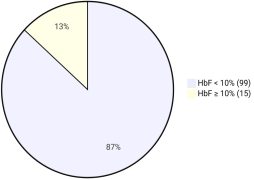
Homozygous sickle cell disease is the most common hemoglobinopathy worldwide, particularly in Africa where it remains a major cause of morbidity and mortality. Fetal hemoglobin (HbF) plays a recognized protective role by inhibiting the polymerization of hemoglobin S. The aim of this study was to evaluate the association between HbF levels and the occurrence of clinical and biological complications in homozygous sickle cell patients. This was a prospective descriptive and analytical study conducted from September 2022 to August 2023. A total of 114 patients aged between 6 and 63 years were included. Socio-demographic and clinical data were collected using a standardized survey form. Biological parameters (Complete Blood Count, urea, creatinine, transaminases, C-Reactive Protein, and hemoglobin electrophoresis) were analyzed from blood samples. Statistical analysis was performed using CSPro 7.0 and Excel software. Among the 114 patients, 57.9% were female and 42.1% male, with a mean age of 21 years. The mean HbF level was 7.04%, ranging from 0 to 11.7%. Only 13% of patients had an HbF level ≥ 10%. The mean hemoglobin concentration was 7.6 g/dL, with 28.9% of cases presenting severe anemia. Vaso-occlusive crises (VOC) were the most frequent clinical complication (72.68%). Biologically, elevated CRP (≥ 6 mg/L) was found in 94.7% of patients. The overall frequency of clinical complications (VOC, septicemia, pneumonia, malaria, acute chest syndrome, polyarthritis, osteomyelitis, stroke, priapism, epigastric pain, and osteoarticular involvement) was higher in patients with HbF < 10%. A statistically significant association was observed between elevated HbF (≥ 10%) and reduced frequency of certain clinical complications, notably polyarthritis, osteomyelitis, stroke, priapism, and osteoarticular involvement (p < 0.05). Furthermore, higher HbF levels were significantly associated with a reduction in severe anemia (p = 0.03). Regarding the biological complications studied (transaminases > 40 IU/L, CRP ≥ 6 mg/L, hyperleukocytosis > 120,000/mL, urea > 0.50 g/L, creatinine > 13 g/dL), CRP was the only abnormality more frequently observed in patients with HbF ≥ 10%. In conclusion, fetal hemoglobin persists at variable levels in homozygous sickle cell patients, regardless of age and sex. Elevated HbF levels (≥ 10%) are significantly associated with a decrease in clinical and biological complications, confirming its protective role in sickle cell disease.
| Published in | Central African Journal of Public Health (Volume 12, Issue 6) |
| DOI | 10.11648/j.cajph.20261206.12 |
| Page(s) | 333-340 |
| Creative Commons |
This is an Open Access article, distributed under the terms of the Creative Commons Attribution 4.0 International License (http://creativecommons.org/licenses/by/4.0/), which permits unrestricted use, distribution and reproduction in any medium or format, provided the original work is properly cited. |
| Copyright |
Copyright © The Author(s), 2026. Published by Science Publishing Group |
Homozygous Sickle Cell Disease, Fetal Hemoglobin, Clinico-biological Complications
Variable | Numbers (N=114) | Frequency (%) |
|---|---|---|
Sex | ||
Male | 48 | 42.1 |
Female | 66 | 57.9 |
Age group (years) | ||
[0-9] | 18 | 15.7 |
[10-19] | 36 | 31.6 |
[20-29] | 39 | 34.2 |
[30-39] | 10 | 8.8 |
[40 ≥] | 11 | 9.7 |
Occupation | ||
Students (primary and secondary) | 63 | 55,3 |
Students (unversity) | 26 | 22.8 |
Workers | 5 | 4.4 |
Unemployed | 20 | 17.5 |
Living environment | ||
Urban | 110 | 96,5 |
Rural | 4 | 3,5 |
Complication | Number | Frequency among with complications (n=84) | Frequency in the total population (N=114) |
|---|---|---|---|
VOC (Vaso-occlusive Crisis) | 83 | 98.80% | 72.68% |
Septicemia | 10 | 11.90% | 08.77% |
Pneumonia | 4 | 7.89% | 4.76% |
Malaria | 09 | 10.71% | 7.89% |
Acute Chest Syndrom (ACS) | 06 | 7.14% | 5.26% |
Polyarthritis | 02 | 2.38% | 1.75% |
Osteomyelitis | 05 | 5.95% | 4.39% |
Osteoarthritis | 01 | 1.19% | 0.87% |
Stroke | 02 | 2.38% | 1.75% |
Priapism | 01 | 1,19% | 0,87% |
Epigastric pain | 01 | 1,19% | 0,87% |
Indicator | Value |
|---|---|
Main | 7,04% |
Minimum | 0,0% |
Maximum | 11,7% |
Age group (years) | Total number | Main HbF (%) |
|---|---|---|
[0-9] | 18 | 6,8 |
[10-19] | 36 | 6,8 |
[20-29] | 39 | 7,3 |
[30-39] | 10 | 6,5 |
[40-49] | 6 | 7,4 |
[50-59] | 3 | 8,5 |
[60-69] | 2 | 5,5 |
Overall mean 7,04% | ||
Paramètres | Moyenne ± ET |
|---|---|
Hemoglobin level (g/dL) | 7,6 ± 1,4 |
MCV (fL) | 84,6 ± 10,9 |
White Blood Cell count (/mm3) | 12 328 ± 5 122 |
CRP (mg/L) | 104,8 ± 67,52 |
Urea (g/L) | 0,33 ± 0,19 |
Serum creatinine (mg/L) | 9,9 ± 3,7 |
AST (U/L) | 31,1 ± 49,0 |
ALT (U/L) | 28,8 ± 38,0 |
Parameter | Abnormal threshold | Abnormal cases | Frequency (%) |
|---|---|---|---|
CRP (C-reactive Protein) | ≥ 6 mg/L | 108 | 94.73% |
Hemoglobin (Hb) | ˂ 07 g/dL | 33 | 28.94% |
White Blood Cell (WBC) | > 12 000/mm3 | 51 | 45.94% |
Urea | > 0,50 g/L | 08 | 7.01% |
Creatinine | > 13mg/L | 19 | 16.67% |
ALT | > 40 UI/L | 03 | 2.68% |
AST | > 40 UI/L | 06 | 5.26% |
Clinical complications | Percentage in total sample | Odds Ration | 95% Confidence Interval | p-value | |
|---|---|---|---|---|---|
HbF < 10% | HbF≥10% | ||||
CVO | 72% | 11% | 1,48 | 0,61-3,58 | 0,38 |
Septicemia | 8% | 2% | 0,68 | 0,14-3,21 | 0,62 |
Pneumonia | 4% | 0% | 0,39 | 0,02-7,47 | 0,55 |
Malaria | 7% | 3% | 0,40 | 0,10-1,60 | 0,21 |
Acute Chest Syndrom | 4% | 3% | 0,21 | 0,04-1,09 | 0,07 |
Polyarthritis | 2% | 0% | 0,48 | 0.02-10,6 | < 0,05 |
Osteomyelitis | 5% | 0% | 0,30 | 0,02-5,49 | < 0,05 |
Stroke | 2% | 0% | 0,48 | 0,02-10,6 | < 0,05 |
Priapism | 1% | 0% | 0,96 | 0,03-30,5 | < 0,05 |
Epigastric pain | 1% | 0% | 0,96 | 0,03-30,5 | < 0,05 |
Osteoarthritis | 1% | 0% | 0,96 | 0,03-30,5 | < 0,05 |
Biological Complications | Percentage in the total sample | Odds Ratio | 95% Confidence Interval | p-value | |
|---|---|---|---|---|---|
HbF <10% | HbF≥10% | ||||
Severe anemia (Hb <7g/dL) | 96.97% | 3.03% | 5.5 | 0.65-46.5 | 0.03 |
CRP ≥ 6 m/dL | 88.89% | 96.97% | 1.25 | 0.58-2.70 | 0.56 |
Leukocytosis (>12000 mg/L) | 88.89% | 19.61% | 0.72 | 0.31-1.65 | 0.47 |
Creatinine > 13 mg/L | 88.89% | 11.11% | 0.85 | 0.30-2.10 | 0.68 |
Urea > 0.5 g/L | 75.00% | 25.00% | 0.60 | 0.12-2.85 | 0.52 |
AST > 40 UI/L | 83.33% | 16.67% | 0.90 | 0.10-7.80 | 0.91 |
ALT> 40 UI/L | 100% | 0% | 0.94 | 0.04-20.5 | 0.21 |
VOC | Vaso-Occlusive Crises |
CBC | Complete Blood Count |
CRP | C-Reactive Protein |
WBC | White Blood Cell |
AST | Aspartate Aminotransferase |
ALT | Alanine Aminotransferase |
HbF | Fetal Hemoglobin |
SCD | Sickle Cell Disease |
2,3-DPG | 2,3-Diphosphateglycerate |
HbS | Hemoglobin S |
CSHA | Center for Social Health Animation |
F/M | Female/Male |
ACS | Acute Chest Syndrom |
| [1] | Elion J, Laurance S, Lapouméroulie C. Physiopathology of sickle cell disease. Medecine Tropicale. 2010: 450–458. |
| [2] | Philippes Connes. Physiopathology of sickle cell disease. In: Sickle cell disease in children and adolescents. Chapter 1. Elsevier Masson SAS; 2020. Available at: |
| [3] | Bain BJ. Haemoglobinopathy diagnosis. 2nd ed. Oxford: Blackwell Publishing; 2006. p. 2. Available at: |
| [4] | Evan M. Branstein. Sickle cell disease (HbS hemoglobinopathy). Johns Hopkins University School of Medicine. Medical review. Updated June 2022. |
| [5] | Pierre Aubry, Bernard-Alex Gauzère. Tropical medicine: hemoglobinopathies. Updated April 19, 2022. Available at: |
| [6] | Genevieve Côté, and al. Transfusion particularities in pediatrics. Published February 25, 2015. Available at: |
| [7] | World Health Organization. Sickle cell disease: Report of the 59th World Health Assembly, April 24, 2006. Available at: |
| [8] | Arnaud Ntchapda. Sickle cell disease: progress in Cameroon. Written June 18, 2020; updated November 23, 2021. Available at: ALLO DOCTEURS AFRICA. |
| [9] | Drepavie: Sickle cell disease: the world’s most common genetic disorder. Available at: |
| [10] | Thabet Mohsen, and al. Influence of fetal hemoglobin persistence on the occurrence of clinico-biological complications in homozygous sickle cell disease. Published 2020. Available at: |
| [11] | MI. Kueviakoe, V. N’Zouonto, K. Agbtiafa, and al. Influence of fetal hemoglobin levels on the profile of homozygous sickle cell disease in Togo. Published 2010. |
| [12] | Njifon H. Nsangou, Scelles R. Sickle cell disease and future perspectives: lived experience of a sister of a child with sickle cell disease in Cameroon. Elsevier; 2020. Available at: |
| [13] | Minto’o Rogombé, Kuissi Kamgaing, Minko JI, Mayi MM, Nkoghe VC, Koko J, and Ategbo S. Medical follow-up and schooling of children with sickle cell disease in Gabon. Health Sci Dis. 2018; 19(1). Available at: |
| [14] | Tsilolo L, Wembonyoma S, Summa V, and Avvisati G. Hemogram of Congolese children with sickle cell disease in steady state. Published 2010. Available at: |
| [15] | Eng YCM, Nko’o Amvene M, Awana AP, and al. Fetal hemoglobin levels in homozygous sickle cell children and effect on clinical severity. Health Sci Dis. 2022; 23(3 Suppl): 34–38. Available at: |
| [16] |
Chies JA, Nardi NB. Sickle cell disease: a chronic inflammatory disorder. Med Hypotheses. 2001; 51(1): 46–50. Available at:
www.pubmed.ncbi.nlm.nih.gov (pubmed.ncbi.nlm.nih.gov in Bing) |
| [17] |
Nagel RL, Erlingsson S, Fabry MOI, and al. The Senegal DNA haplotype is associated with improved anemia in African-American sickle cell patients. Blood. 1991; 77(6): 1371–1375. Published March 15, 1991. Available at:
www.pubmed.ncbi.nlm.nih.gov (pubmed.ncbi.nlm.nih.gov in Bing) |
APA Style
Charly, M. M., Julie, M. S. M., Cedric, G., Murielle, A. N., Ines, M. N., et al. (2026). Persistence of Fetal Hemoglobin and Clinico-biological Complications in Homozygous Sickle Cell Patients. Central African Journal of Public Health, 12(6), 333-340. https://doi.org/10.11648/j.cajph.20261206.12
ACS Style
Charly, M. M.; Julie, M. S. M.; Cedric, G.; Murielle, A. N.; Ines, M. N., et al. Persistence of Fetal Hemoglobin and Clinico-biological Complications in Homozygous Sickle Cell Patients. Cent. Afr. J. Public Health 2026, 12(6), 333-340. doi: 10.11648/j.cajph.20261206.12
@article{10.11648/j.cajph.20261206.12,
  author = {Mvogo Manga Charly and Manga Sipewa Marie Julie and Gueguim Cedric and Atangana Ngono Murielle and Messina Nkama Ines and Stephane Fargeon Massin Mbouna and Bidi Abada Protais and Etame Sone Lucien},
  title = {Persistence of Fetal Hemoglobin and Clinico-biological Complications in Homozygous Sickle Cell Patients},
  journal = {Central African Journal of Public Health},
  volume = {12},
  number = {6},
  pages = {333-340},
  doi = {10.11648/j.cajph.20261206.12},
  url = {https://doi.org/10.11648/j.cajph.20261206.12},
  eprint = {https://article.sciencepublishinggroup.com/pdf/10.11648.j.cajph.20261206.12},
  abstract = {Homozygous sickle cell disease is the most common hemoglobinopathy worldwide, particularly in Africa where it remains a major cause of morbidity and mortality. Fetal hemoglobin (HbF) plays a recognized protective role by inhibiting the polymerization of hemoglobin S. The aim of this study was to evaluate the association between HbF levels and the occurrence of clinical and biological complications in homozygous sickle cell patients. This was a prospective descriptive and analytical study conducted from September 2022 to August 2023. A total of 114 patients aged between 6 and 63 years were included. Socio-demographic and clinical data were collected using a standardized survey form. Biological parameters (Complete Blood Count, urea, creatinine, transaminases, C-Reactive Protein, and hemoglobin electrophoresis) were analyzed from blood samples. Statistical analysis was performed using CSPro 7.0 and Excel software. Among the 114 patients, 57.9% were female and 42.1% male, with a mean age of 21 years. The mean HbF level was 7.04%, ranging from 0 to 11.7%. Only 13% of patients had an HbF level ≥ 10%. The mean hemoglobin concentration was 7.6 g/dL, with 28.9% of cases presenting severe anemia. Vaso-occlusive crises (VOC) were the most frequent clinical complication (72.68%). Biologically, elevated CRP (≥ 6 mg/L) was found in 94.7% of patients. The overall frequency of clinical complications (VOC, septicemia, pneumonia, malaria, acute chest syndrome, polyarthritis, osteomyelitis, stroke, priapism, epigastric pain, and osteoarticular involvement) was higher in patients with HbF  40 IU/L, CRP ≥ 6 mg/L, hyperleukocytosis > 120,000/mL, urea > 0.50 g/L, creatinine > 13 g/dL), CRP was the only abnormality more frequently observed in patients with HbF ≥ 10%. In conclusion, fetal hemoglobin persists at variable levels in homozygous sickle cell patients, regardless of age and sex. Elevated HbF levels (≥ 10%) are significantly associated with a decrease in clinical and biological complications, confirming its protective role in sickle cell disease.},
 year = {2026}
}
TY  - JOUR
T1  - Persistence of Fetal Hemoglobin and Clinico-biological Complications in Homozygous Sickle Cell Patients
AU  - Mvogo Manga Charly
AU  - Manga Sipewa Marie Julie
AU  - Gueguim Cedric
AU  - Atangana Ngono Murielle
AU  - Messina Nkama Ines
AU  - Stephane Fargeon Massin Mbouna
AU  - Bidi Abada Protais
AU  - Etame Sone Lucien
Y1  - 2026/11/26
PY  - 2026
N1  - https://doi.org/10.11648/j.cajph.20261206.12
DO  - 10.11648/j.cajph.20261206.12
T2  - Central African Journal of Public Health
JF  - Central African Journal of Public Health
JO  - Central African Journal of Public Health
SP  - 333
EP  - 340
PB  - Science Publishing Group
SN  - 2575-5781
UR  - https://doi.org/10.11648/j.cajph.20261206.12
AB  - Homozygous sickle cell disease is the most common hemoglobinopathy worldwide, particularly in Africa where it remains a major cause of morbidity and mortality. Fetal hemoglobin (HbF) plays a recognized protective role by inhibiting the polymerization of hemoglobin S. The aim of this study was to evaluate the association between HbF levels and the occurrence of clinical and biological complications in homozygous sickle cell patients. This was a prospective descriptive and analytical study conducted from September 2022 to August 2023. A total of 114 patients aged between 6 and 63 years were included. Socio-demographic and clinical data were collected using a standardized survey form. Biological parameters (Complete Blood Count, urea, creatinine, transaminases, C-Reactive Protein, and hemoglobin electrophoresis) were analyzed from blood samples. Statistical analysis was performed using CSPro 7.0 and Excel software. Among the 114 patients, 57.9% were female and 42.1% male, with a mean age of 21 years. The mean HbF level was 7.04%, ranging from 0 to 11.7%. Only 13% of patients had an HbF level ≥ 10%. The mean hemoglobin concentration was 7.6 g/dL, with 28.9% of cases presenting severe anemia. Vaso-occlusive crises (VOC) were the most frequent clinical complication (72.68%). Biologically, elevated CRP (≥ 6 mg/L) was found in 94.7% of patients. The overall frequency of clinical complications (VOC, septicemia, pneumonia, malaria, acute chest syndrome, polyarthritis, osteomyelitis, stroke, priapism, epigastric pain, and osteoarticular involvement) was higher in patients with HbF  40 IU/L, CRP ≥ 6 mg/L, hyperleukocytosis > 120,000/mL, urea > 0.50 g/L, creatinine > 13 g/dL), CRP was the only abnormality more frequently observed in patients with HbF ≥ 10%. In conclusion, fetal hemoglobin persists at variable levels in homozygous sickle cell patients, regardless of age and sex. Elevated HbF levels (≥ 10%) are significantly associated with a decrease in clinical and biological complications, confirming its protective role in sickle cell disease.
VL  - 12
IS  - 6
ER  -
Higher Institute of Medical Technology (ISTM), Department of Biomedical Sciences, Yaounde, Cameroon;Faculty of Medicine and Pharmaceutical Sciences, University of Douala (UD), Douala, Cameroon;Doctoral Training Unit, School of Health Sciences, Catholic University of Central Africa, Yaounde, Cameroon
Higher Institute of Agriculture Wood Water and Environment, University of Bertoua, Bertoua, Cameroon;Faculty of Science, University of Bertoua, Bertoua, Cameroon
Higher Institute of Medical Technology (ISTM), Department of Biomedical Sciences, Yaounde, Cameroon

Information



 Share This Article
 Twitter
 Linked In
 Facebook

 Copy
 Download