
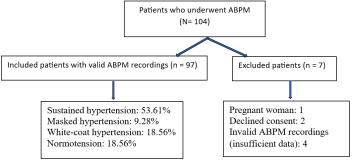
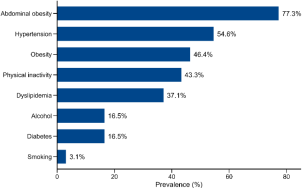
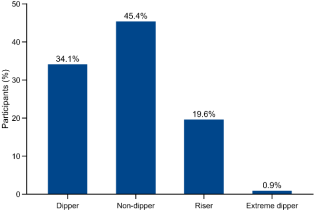
Hypertension is a major contributor to cardiovascular morbidity and mortality. Ambulatory blood pressure monitoring (ABPM) complements office blood pressure measurement by detecting white-coat hypertension, masked hypertension, and nocturnal blood pressure abnormalities, and this study aimed to assess its diagnostic value in the management of hypertension in private cardiology practice in Senegal. A prospective, descriptive, and analytical study was conducted from July to September 2024 at Clinique Urgence Cardio in Dakar, including patients aged 18 years or older with a valid 24-hour ABPM recording. Clinical, anthropometric, and treatment data, together with cardiovascular risk factors, were collected; office and ambulatory blood pressure measurements were compared; and logistic regression was used to identify factors associated with discordance between the two methods. Of the 104 patients assessed, 97 had valid ABPM recordings. The mean age was 53.2 ± 14.1 years, and women predominated. Cardiovascular risk factors included abdominal obesity (77.3%), known hypertension (54.6%), physical inactivity (43.3%), dyslipidemia (37.1%), and diabetes (16.5%). Mean office blood pressure was 145.7/91.4 mmHg, compared with 130.5/80.2 mmHg over 24 hours, 134.4/82.4 mmHg during daytime, and 125/75 mmHg during nighttime. ABPM identified sustained hypertension in 53.61% of patients, white-coat hypertension in 18.56%, masked hypertension in 9.28%, and normotension in 18.56%, with overall agreement between office and ambulatory measurements of 72.2%. Among patients with elevated office blood pressure, 25.7% had white-coat hypertension, while 33.3% of those with normal office blood pressure had masked hypertension. Non-dipping and reverse-dipping patterns were observed in 45.4% and 19.6% of patients, respectively, and discordance was independently associated with alcohol consumption (OR = 5.08; p = 0.007). ABPM improves the diagnostic classification of hypertension and reveals a high prevalence of discordant phenotypes and nocturnal blood pressure abnormalities, and wider use of ABPM may help optimize patient management in this setting.
| Published in | Cardiology and Cardiovascular Research (Volume 10, Issue 3) |
| DOI | 10.11648/j.ccr.20261003.15 |
| Page(s) | 55-62 |
| Creative Commons |
This is an Open Access article, distributed under the terms of the Creative Commons Attribution 4.0 International License (http://creativecommons.org/licenses/by/4.0/), which permits unrestricted use, distribution and reproduction in any medium or format, provided the original work is properly cited. |
| Copyright |
Copyright © The Author(s), 2026. Published by Science Publishing Group |
Ambulatory Blood Pressure Monitoring, Hypertension, White-Coat Hypertension, Masked Hypertension, Nocturnal Blood Pressure, Senegal
Circadian rhythm | Categories | Dipper | Non-dipper | Riser | Extreme dipper | Total | P-value |
|---|---|---|---|---|---|---|---|
Age | <50 years | 51.2 | 34.2 | 14.6 | 0.0 | 100 | 0.021 |
≥50 years | 21.4 | 53.6 | 23.2 | 1.8 | 100 | ||
Sex | Female | 31.3 | 48.4 | 20.3 | 0.0 | 100 | 0.422 |
Male | 39.4 | 39.4 | 18.2 | 3.0 | 100 | ||
Smoking | Yes | 0.0 | 33.3 | 66.7 | 0.0 | 100 | |
No | 32.9 | 45.9 | 20.0 | 1.2 | 100 | 0.262 | |
Former | 55.6 | 44.4 | 0.0 | 0.0 | 100 | ||
Alcohol | Yes | 18.8 | 50.0 | 3.3 | 0.0 | 100 | 0.402 |
No | 37.0 | 44.4 | 17.3 | 1.2 | 100 | ||
Physical inactivity | Yes | 42.9 | 40.5 | 14.3 | 2.4 | 100 | 0.216 |
No | 27.3 | 49.1 | 23.6 | 0.0 | 100 | ||
Diabetes | Yes | 31.25 | 50 | 18.75 | 0 | 100 | 0.953 |
No | 34.57 | 44.44 | 19.75 | 1.23 | 100 | ||
Thinness | 0 | 100 | 0 | 0 | 100 | ||
BMI | Normal | 30.43 | 43.48 | 26.09 | 0 | 100 | 0.734 |
Overweight | 42.22 | 13.33 | 2.22 | 100 | |||
Obesity | 25 | 50 | 25 | 0 | 100 | ||
Abdominal Obesity | Yes | 34.67 | 46.67 | 17.33 | 1.33 | 100 | 0.725 |
No | 31.82 | 40.91 | 27.27 | 0 | 100 |
Overall nighttime load | Categories | Diastolic hypertension | Systolic hypertension | Systolo-diastolic hypertension | Normal | Total | P-value |
|---|---|---|---|---|---|---|---|
Age | <50 years | 17.1 | 0.0 | 48.8 | 34.2 | 100 | 0.013 |
≥50 years | 7.1 | 19.6 | 48.2 | 25.0 | 100 | ||
Sex | Female | 10.9 | 10.9 | 48.4 | 29.7 | 100 | 0.992 |
Male | 12.1 | 12.1 | 48.5 | 27.3 | 100 | ||
Smoking | Yes | 0.0 | 33.3 | 66.7 | 0.0 | 100 | |
No | 9.4 | 9.4 | 50.6 | 30.6 | 100 | 0.142 | |
Former | 33.3 | 22.2 | 22.2 | 22.2 | 100 | ||
Alcohol | Yes | 0.0 | 12.5 | 75.0 | 12.5 | 100 | 0.08 |
no | 13.6 | 11.1 | 43.2 | 32.1 | 100 | ||
Physical inactivity | Yes | 11.9 | 4.8 | 57.1 | 26.2 | 100 | 0.242 |
No | 10.9 | 16.4 | 41.8 | 30.9 | 100 | ||
Diabetes | Yes | 6.25 | 25 | 50 | 18.75 | 100 | 0.233 |
No | 12.35 | 8.64 | 48.15 | 30.86 | 100 | ||
Thinness | 0 | 100 | 0 | 0 | 100 | ||
Normal | 8.7 | 17.39 | 47.83 | 26.09 | 100 | ||
BMI | 0.083 | ||||||
Overweight | 15.56 | 6.67 | 40 | 37.78 | 100 | ||
Obesity | 7.14 | 10.71 | 64.29 | 17.86 | 100 | ||
Abdominal obesity | Yes | 12 | 12 | 49.33 | 26.67 | 100 | 0.835 |
No | 9.09 | 9.09 | 45.45 | 36.36 | 100 |
Daily total load | Categories | Systolic hypertension | Diastolic hypertension | Systolic-diastolic hypertension | Normal | Total | P-value |
|---|---|---|---|---|---|---|---|
Age | <50 years | 17.1 | 2.4 | 34.2 | 46.3 | 100 | 0.047 |
≥50 years | 7.1 | 19.6 | 28.6 | 44.6 | 100 | ||
Sex | Female | 9.4 | 12.5 | 28.1 | 50.0 | 100 | 0.57 |
Male | 15.2 | 12.1 | 36.4 | 36.4 | 100 | ||
Smoking | Yes | 0.0 | 66.7 | 33.3 | 0.0 | 100 | |
No | 10.6 | 11.8 | 32.9 | 44.7 | 100 | 0.041 | |
Former | 22.2 | 0.0 | 11.1 | 66.7 | 100 | ||
Alcohol | Yes | 12.5 | 31.3 | 25.0 | 31.3 | 100 | 0.086 |
No | 11.1 | 8.6 | 32.1 | 48.2 | 100 | ||
Physical inactivity | Yes | 14.3 | 9.5 | 33.3 | 42.9 | 100 | 0.731 |
No | 9.1 | 14.6 | 29.1 | 47.3 | 100 | ||
Diabetes | Yes | 0 | 6.25 | 37.5 | 56.5 | 100 | 0.318 |
No | 13.58 | 13.58 | 29.63 | 43.1 | 100 | ||
BMI | Thinness | 0 | 0 | 0 | 100 | 100 | |
Normal | 8.7 | 8.7 | 26.09 | 56.52 | 0.398 | ||
Overweight | 13.33 | 6.67 | 31.11 | 48.89 | |||
Obesity | 10.71 | 25 | 35.71 | 28.57 | |||
Abdominal Obesity | Yes | 10.67 | 14.67 | 32 | 42.67 | 100 | 0.533 |
No | 13.64 | 4.55 | 27.27 | 54.55 | 100 |
Discordance (Clinical vs ABPM) | Coefficient | Odd-Ratio | Standard error | P>z |
|---|---|---|---|---|
Age | 0.028 | 1.03 | 0.018 | 0.124 |
Sex-Male | -0.559 | 0.57 | 0.538 | 0.299 |
Alcohol | 1.626 | 5.08 | 0.607 | 0.007 |
Dyslipidemia | -0.709 | 0.49 | 0.545 | 0.193 |
ABPM | Ambulatory Blood Pressure Monitoring |
BMI | Body Mass Index |
HTN | Hypertension |
OR | Odds Ratio |
| [1] | Vaduganathan M, Mensah GA, Turco JV, Fuster V, Roth GA. The Global Burden of Cardiovascular Diseases and Risk: A Compass for Future Health. J Am Coll Cardiol. 2022; 80(25): 2361-2371. |
| [2] | Olsen MH, Angell SY, Asma S, et al. A call to action and a lifecourse strategy to address the global burden of raised blood pressure on current and future generations: the Lancet Commission on hypertension. Lancet. 2016; 388(10060): 2665-2712. |
| [3] | NCD Risk Factor Collaboration (NCD-RisC). Worldwide trends in hypertension prevalence and progress in treatment and control from 1990 to 2019: a pooled analysis of 1201 population-representative studies with 104 million participants. Lancet. 2021; 398(10304): 957-980. |
| [4] |
World Health Organization. Hypertension: fact sheet. Geneva: World Health Organization; 2025. Available from:
https://www.who.int/news-room/fact-sheets/detail/hypertension |
| [5] | Gafane-Matemane LF, Craig A, Kruger R, et al. Hypertension in sub-Saharan Africa: the current profile, recent advances, gaps, and priorities. Journal of Human Hypertension. 2025; 39(2): 95-110. |
| [6] | Nel JH, Steyn NP. The nutrition transition and the double burden of malnutrition in sub-Saharan African countries: how do these countries compare with the recommended Lancet Commission global diet? Int J Environ Res Public Health. 2022; 19(24): 16791. |
| [7] | Jobe M, Beye SM, Gaye ND, Ka MM, Perel P, Perkins AD, et al. Hypertension in Sub-Saharan Africa: Burden, Barriers, and Priorities for Improving Treatment Outcomes. Circulation Research. 2025; 137: 106-118. |
| [8] | Price AJ, Crampin AC, Amberbir A, et al. Prevalence of obesity, hypertension, and diabetes, and cascade of care in sub-Saharan Africa: a cross-sectional, population-based study in urban and rural Malawi. Lancet Diabetes Endocrinol. 2018; 6(3): 208-222. |
| [9] | McEvoy JW, McCarthy CP, Bruno RM, et al. 2024 ESC Guidelines for the management of elevated blood pressure and hypertension. Eur Heart J. 2024; 45: 3912-4018 |
| [10] | Lee EM. When and how to use ambulatory blood pressure monitoring and home blood pressure monitoring for managing hypertension. Clin Hypertens. 2024; 30: 10. |
| [11] | Mancia G, Kreutz R, Brunström M, et al. 2023 ESH Guidelines for the management of arterial hypertension. J Hypertens. 2023; 41(12): 1874-2071. |
| [12] | Cepeda M, Pham P, Shimbo D. Status of ambulatory blood pressure monitoring and home blood pressure monitoring for the diagnosis and management of hypertension in the US: an up-to-date review. Hypertens Res. 2023; 46(3): 620-629. |
| [13] | Tang A, Yang E, Ebinger JE. Non-dipping blood pressure or nocturnal hypertension: does one matter more? Current Hypertension Reports. 2024; 26: 21-30. |
| [14] | Huart J, Persu A, Lengelé JP, et al. Pathophysiology of the nondipping blood pressure pattern. Hypertension. 2023; 80(4): 719-729. |
| [15] | Noubiap JJ, Nansseu JR, Nkeck JR, Nyaga UF, Bigna JJ. Prevalence of white coat and masked hypertension in Africa: a systematic review and meta-analysis. J Clin Hypertens. 2018; 20(8): 1165-1172. |
| [16] | Kaul U, Arambam P, Rao S, Kapoor S, Swahney JPS, Sharma K, et al. Usefulness of ambulatory blood pressure measurement for hypertension management in India: the India ABPM study. Journal of Human Hypertension. 2020; 34(6): 457-467. |
| [17] | Chuwa G, Chillo P. Ambulatory Blood Pressure Profiles and Correlation with Cardiovascular Risk Factors in a Sample of 390 University Employees in Tanzania. Integrated Blood Pressure Control. 2020; 13: 197-208. |
| [18] | Krakoff LR. Nocturnal Blood Pressure and Cardiovascular Risk. Hypertension. 2020 Aug; 76(2): 316-317. |
APA Style
Gaye, N. D., Mingou, J. S., Kaba, C., Ndiaye, M., Diouf, M. T., et al. (2026). Diagnostic Value of Ambulatory Blood Pressure Monitoring for Hypertension in Private Cardiology Practice in Senegal. Cardiology and Cardiovascular Research, 10(3), 55-62. https://doi.org/10.11648/j.ccr.20261003.15
ACS Style
Gaye, N. D.; Mingou, J. S.; Kaba, C.; Ndiaye, M.; Diouf, M. T., et al. Diagnostic Value of Ambulatory Blood Pressure Monitoring for Hypertension in Private Cardiology Practice in Senegal. Cardiol. Cardiovasc. Res. 2026, 10(3), 55-62. doi: 10.11648/j.ccr.20261003.15
AMA Style
Gaye ND, Mingou JS, Kaba C, Ndiaye M, Diouf MT, et al. Diagnostic Value of Ambulatory Blood Pressure Monitoring for Hypertension in Private Cardiology Practice in Senegal. Cardiol Cardiovasc Res. 2026;10(3):55-62. doi: 10.11648/j.ccr.20261003.15
@article{10.11648/j.ccr.20261003.15,
  author = {Ngone Diaba Gaye and Joseph Salvador Mingou and Coumba Kaba and Malick Ndiaye and Marguerite Tening Diouf and Khadim Sene and Lamine Ly and Seydina Oumar Gueye and Mamadou Adama Thiam and Constance Cabrel and Mouhamadou Bamba Ndiaye and Maboury Diao and Alassane Mbaye and Abdoul Kane and Aliou Alassane Ngaide},
  title = {Diagnostic Value of Ambulatory Blood Pressure Monitoring for Hypertension in Private Cardiology Practice in Senegal},
  journal = {Cardiology and Cardiovascular Research},
  volume = {10},
  number = {3},
  pages = {55-62},
  doi = {10.11648/j.ccr.20261003.15},
  url = {https://doi.org/10.11648/j.ccr.20261003.15},
  eprint = {https://article.sciencepublishinggroup.com/pdf/10.11648.j.ccr.20261003.15},
  abstract = {Hypertension is a major contributor to cardiovascular morbidity and mortality. Ambulatory blood pressure monitoring (ABPM) complements office blood pressure measurement by detecting white-coat hypertension, masked hypertension, and nocturnal blood pressure abnormalities, and this study aimed to assess its diagnostic value in the management of hypertension in private cardiology practice in Senegal. A prospective, descriptive, and analytical study was conducted from July to September 2024 at Clinique Urgence Cardio in Dakar, including patients aged 18 years or older with a valid 24-hour ABPM recording. Clinical, anthropometric, and treatment data, together with cardiovascular risk factors, were collected; office and ambulatory blood pressure measurements were compared; and logistic regression was used to identify factors associated with discordance between the two methods. Of the 104 patients assessed, 97 had valid ABPM recordings. The mean age was 53.2 ± 14.1 years, and women predominated. Cardiovascular risk factors included abdominal obesity (77.3%), known hypertension (54.6%), physical inactivity (43.3%), dyslipidemia (37.1%), and diabetes (16.5%). Mean office blood pressure was 145.7/91.4 mmHg, compared with 130.5/80.2 mmHg over 24 hours, 134.4/82.4 mmHg during daytime, and 125/75 mmHg during nighttime. ABPM identified sustained hypertension in 53.61% of patients, white-coat hypertension in 18.56%, masked hypertension in 9.28%, and normotension in 18.56%, with overall agreement between office and ambulatory measurements of 72.2%. Among patients with elevated office blood pressure, 25.7% had white-coat hypertension, while 33.3% of those with normal office blood pressure had masked hypertension. Non-dipping and reverse-dipping patterns were observed in 45.4% and 19.6% of patients, respectively, and discordance was independently associated with alcohol consumption (OR = 5.08; p = 0.007). ABPM improves the diagnostic classification of hypertension and reveals a high prevalence of discordant phenotypes and nocturnal blood pressure abnormalities, and wider use of ABPM may help optimize patient management in this setting.},
 year = {2026}
}
TY  - JOUR
T1  - Diagnostic Value of Ambulatory Blood Pressure Monitoring for Hypertension in Private Cardiology Practice in Senegal
AU  - Ngone Diaba Gaye
AU  - Joseph Salvador Mingou
AU  - Coumba Kaba
AU  - Malick Ndiaye
AU  - Marguerite Tening Diouf
AU  - Khadim Sene
AU  - Lamine Ly
AU  - Seydina Oumar Gueye
AU  - Mamadou Adama Thiam
AU  - Constance Cabrel
AU  - Mouhamadou Bamba Ndiaye
AU  - Maboury Diao
AU  - Alassane Mbaye
AU  - Abdoul Kane
AU  - Aliou Alassane Ngaide
Y1  - 2026/08/24
PY  - 2026
N1  - https://doi.org/10.11648/j.ccr.20261003.15
DO  - 10.11648/j.ccr.20261003.15
T2  - Cardiology and Cardiovascular Research
JF  - Cardiology and Cardiovascular Research
JO  - Cardiology and Cardiovascular Research
SP  - 55
EP  - 62
PB  - Science Publishing Group
SN  - 2578-8914
UR  - https://doi.org/10.11648/j.ccr.20261003.15
AB  - Hypertension is a major contributor to cardiovascular morbidity and mortality. Ambulatory blood pressure monitoring (ABPM) complements office blood pressure measurement by detecting white-coat hypertension, masked hypertension, and nocturnal blood pressure abnormalities, and this study aimed to assess its diagnostic value in the management of hypertension in private cardiology practice in Senegal. A prospective, descriptive, and analytical study was conducted from July to September 2024 at Clinique Urgence Cardio in Dakar, including patients aged 18 years or older with a valid 24-hour ABPM recording. Clinical, anthropometric, and treatment data, together with cardiovascular risk factors, were collected; office and ambulatory blood pressure measurements were compared; and logistic regression was used to identify factors associated with discordance between the two methods. Of the 104 patients assessed, 97 had valid ABPM recordings. The mean age was 53.2 ± 14.1 years, and women predominated. Cardiovascular risk factors included abdominal obesity (77.3%), known hypertension (54.6%), physical inactivity (43.3%), dyslipidemia (37.1%), and diabetes (16.5%). Mean office blood pressure was 145.7/91.4 mmHg, compared with 130.5/80.2 mmHg over 24 hours, 134.4/82.4 mmHg during daytime, and 125/75 mmHg during nighttime. ABPM identified sustained hypertension in 53.61% of patients, white-coat hypertension in 18.56%, masked hypertension in 9.28%, and normotension in 18.56%, with overall agreement between office and ambulatory measurements of 72.2%. Among patients with elevated office blood pressure, 25.7% had white-coat hypertension, while 33.3% of those with normal office blood pressure had masked hypertension. Non-dipping and reverse-dipping patterns were observed in 45.4% and 19.6% of patients, respectively, and discordance was independently associated with alcohol consumption (OR = 5.08; p = 0.007). ABPM improves the diagnostic classification of hypertension and reveals a high prevalence of discordant phenotypes and nocturnal blood pressure abnormalities, and wider use of ABPM may help optimize patient management in this setting.
VL  - 10
IS  - 3
ER  -
Faculty of Medicine, Cheikh Anta Diop University, Dakar, Senegal;Department of Cardiac Rehabilitation, Ibra Mamadou Wane Medical Center, Dakar, Senegal
Faculty of Medicine, Cheikh Anta Diop University, Dakar, Senegal;Cardiology Department, Dalal Jamm Hospital, Dakar, Senegal

Information



 Share This Article
 Twitter
 Linked In
 Facebook
 Copy
Copy Download