This study presents an exploratory statistical analysis of oversize (OS), slimes (SL), and heavy mineral (HM) fractions from 598 deep drilling samples collected across the Ranobe mineral sands deposit, located within the Atsimo-Andrefana region of southwestern Madagascar. Robust descriptive statistical methods and exploratory graphical analyses were employed to quantitatively characterize the spatial distributions, central tendencies, and inherent heterogeneities of these mineralized coastal formations. The structural results indicate a clear dominance of the HM fraction, which features a remarkably stable distribution centered around a high median value of 4.80%. This pattern strongly implies the persistent influence of highly efficient regional enrichment processes driven by hydraulic sorting and gravity concentration dynamics in a moderate-energy beach environment. Conversely, the fine-grained SL fraction exhibits a significantly wider dispersion and pronounced sample-to-sample variability (median of 3.33%, standard deviation of 11.64%), reflecting active hydrodynamic fluctuations and episodic inputs of suspended fine particles during deposition. The coarse OS fraction remains virtually negligible across the vast majority of analyzed samples, maintaining a median of 0%. Bivariate correlation assessments reveal a moderate positive coupling between the OS and SL phases (r ≈ 0.48), whereas their respective linear relationships with heavy minerals are remarkably weak or negative r OS-HM ≈ -0.07; r SL-HM ≈ -0.17). These statistical outputs demonstrate that heavy mineral concentration is entirely decoupled from primary grain-size metrics. Consequently, future operational campaigns must evaluate the economic potential of the Ranobe orebody using independent spatial models.
This is an Open Access article, distributed under the terms of the Creative Commons Attribution 4.0 International License (http://creativecommons.org/licenses/by/4.0/), which permits unrestricted use, distribution and reproduction in any medium or format, provided the original work is properly cited.
Heavy Minerals, Mineral Fractions, Correlation, Deposit, Ranobe
1. Introduction
Mineral sands deposits form an essential component of coastal mineral resources, particularly within geodynamic contexts associated with sedimentary basins. The Ranobe deposit, located in the Atsimo-Andrefana region of southwestern Madagascar, represents a typical example of mineralized sands, mineral-enriched sandy deposits within the Morondava Basin, a vast Mesozoic-Cenozoic sedimentary basin developed along the island’s western margin
[1]
Besairie (1972). Géologie de Madagascar I. Les terrains sédimentaires. Imprimerie Nationale.
[2]
Piqué, A., Laville, E., Rey, J., & Huchon, P. (1999). The initiation and development of the Morondava Basin, Madagascar, from the Late Carboniferous to the Middle Jurassic: sedimentary, palaeontological and structural data. Journal of African Earth Sciences, 28(4), 931-948.
Schetselaar, W., Schneider, D., Powell, J., Tari, G., Raharisolofo, H., & Ramboasalama, F. (2023). Reconstructing the thermal history of the Morondava Basin, Madagascar, after Gondwanan breakup as resolved through detrital zircon (U–Th)/He and U–Pb geochronology. Marine and Petroleum Geology, 160, 106669.
. These deposits result from complex sedimentary processes combining source-rock weathering, transport, settling, and sediment reworking in coastal environments.
Coastal zones are highly favorable sites for the formation of mineralized placers, where hydrodynamic and gravity grain sorting triggers the accumulation of heavy minerals such as ilmenite, rutile, zircon, and monazite
[4]
Van Gosen, B. S., Fey, D. L., Shah, A. K., Verplanck, P. L., & Hoefen, T. M. (2014). Deposit model for heavy-mineral sands in coastal environments (Scientific Investigations Report 2010-5070-L). U.S. Geological Survey.
. Within these coastal systems, the distribution of mineral fractions depends on the interaction between marine dynamics, aeolian processes, and the tectonic constraints that affected the Morondava Basin
[5]
Hernández-Molina, F. J., Tari, G., Scarselli, N., Raharisolofo, H., Rahajarivelo, S. F., Kirby, A., de Weger, W., & Llave, E. (2022). Evolution and morphology of a contourite depositional system based on new evidence from 3D-seismic data offshore Madagascar (Paleogene, Morondava Basin). Scientific Reports, 12, 19931.
Wu, D., Liu, J., Razoeliarimalala, M., Wang, T., Razafimbelo, R., Xu, F., Sun, W., Ralison, B., Wang, Z., Zhou, Y., Zhao, Y., & Zhao, J. (2025). Evaluation and Classification of Uranium Prospective Areas in Madagascar: A Geochemical Block-Based Approach. Minerals, 15(3), 280.
. Although regional depositional models are known, they remain poorly calibrated at the scale of detailed drilling data, which limits the quantification of the spatial and vertical variability of the primary mineral fractions-namely oversize (OS), slimes (SL), and heavy minerals (HM).
The central problem addressed by this study is: to what extent does the statistical variability of the OS, SL, and HM fractions provide insight into the sedimentary processes and internal heterogeneity of the Ranobe deposit, and how can these data contribute to building a robust geological model and assessing the site’s economic potential? This question highlights the need for a quantitative and statistical approach based on a large dataset of samples in order to identify central tendencies, characterize heterogeneity, and link these observations to regional sedimentary and tectonic processes.
The primary objective of this study is to statistically analyze the variability of OS, SL, and HM mineral fractions in the sands of the Ranobe deposit, using 598 deep drilling samples. The study also aims to quantify the statistical distributions of these fractions (medians, quartiles, interquartile range) in order to characterize their central tendency and degree of heterogeneity, and to examine the relationships between light and heavy fractions. Furthermore, it involves comparing groups using appropriate statistical tests, including non-parametric methods when normality assumptions are not met, to provide a quantitative foundation for subsequent investigations.
We hypothesize that heavy mineral distribution exhibits limited linear dependence on grain-size fractions, reflecting density-dominated sorting processes. The adopted methodology organizes the data into a long format, calculates relevant statistical metrics, and visualizes the distributions. Non-parametric tests are used to address issues arising from a lack of normality, which is common in sedimentary and coastal placer data.
The main results indicate that the HM fraction generally dominates, characterized by high medians and moderate dispersion. The SL fraction displays greater variability, whereas the OS fraction remains low or negligible across the majority of samples. This pattern corresponds to a moderate-energy coastal dynamic, where hydrodynamic sorting favors heavy mineral accumulation and the removal of coarse grains. These observations align with general models of heavy mineral sand formation in coastal environments
[4]
Van Gosen, B. S., Fey, D. L., Shah, A. K., Verplanck, P. L., & Hoefen, T. M. (2014). Deposit model for heavy-mineral sands in coastal environments (Scientific Investigations Report 2010-5070-L). U.S. Geological Survey.
. Consequently, these findings provide a preliminary quantitative framework for interpreting sedimentary processes and supporting future exploration studies.
2. Geological Setting of the Study Area
2.1. Geographic Location
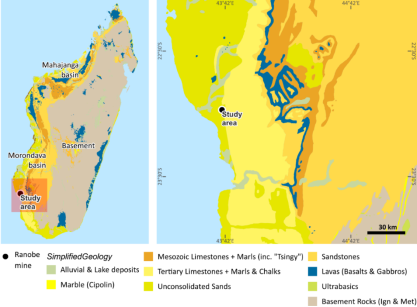
The study area corresponds to the Ranobe mineral sands deposit, located within the Atsimo-Andrefana region of southwestern Madagascar, approximately 35-45 km north of the city of Toliara, along the coast of the Mozambique Channel (Figures 1a and 1b). The area is part of the Malagasy western coastal plain, which is characterized by gently undulating topography and elevations generally below 100 m. This plain is dominated by sand ridges running parallel to the shoreline, dune systems, and Quaternary sandy deposits resulting from active marine and aeolian dynamics
[7]
Boyden, J., & Rovere, A. (2022). Revisiting Battistini: Pleistocene coastal evolution of southwestern Madagascar. Open Quaternary, 8(1), Article 2.
The regional climate is classified as hot semi-arid, characterized by low annual precipitation and high evapotranspiration. This environment favors sparse vegetation dominated by the dry spiny forest endemic to southwestern Madagascar
[8]
Randriamahefasoa, T. S. M., & Reason, C. J. C. (2016). Interannual variability of rainfall characteristics over southwestern Madagascar. Theoretical and Applied Climatology, 124(1-2), 1-17.
. It features a prolonged dry season and low annual rainfall typical of semi-arid domains, which strongly influences both the hydroclimate and surface sediment dynamics
[9]
Sourdat, M. (1969). Notes de climatologie descriptive: région sud-ouest de Madagascar (préfecture de Tuléar) (27 p.). ORSTOM. Disponible en accès libre via l’archive IRD:
. Data obtained from the boreholes drilled across the site, as illustrated in Figure 1b, were leveraged in this study to characterize the spatial distribution of sandy formations and heavy minerals. This approach enables a direct link between the regional geographic and climatic framework, the local organization of the deposit, and the dynamics of the investigated sediments.
Figure 1. Location of the study area: a) geographical setting of the Atsimo-Andrefana region; b) extent of the Ranobe mineral sands deposit and associated borehole locations for data acquisition.
2.2. Regional Geology
The Morondava sédimentary basin constitutes the largest sedimentary basin in Madagascar. It is a Mesozoic-Cenozoic structure developed along the western margin of the island within the Mozambique Channel. Extending from Cape Saint-André to Cape Sainte-Marie, it features a width ranging between 100 and 130 km and covers an estimated area of nearly 220,000 km2
[1]
Besairie (1972). Géologie de Madagascar I. Les terrains sédimentaires. Imprimerie Nationale.
[1]
.
The genesis of the basin is linked to the breakup of Gondwana through continental rifting initiated in the Late Carboniferous and continuing through the Mesozoic, in connection with the opening of adjacent oceanic basins and the progressive separation of Madagascar from Africa and subsequently from India
[2]
Piqué, A., Laville, E., Rey, J., & Huchon, P. (1999). The initiation and development of the Morondava Basin, Madagascar, from the Late Carboniferous to the Middle Jurassic: sedimentary, palaeontological and structural data. Journal of African Earth Sciences, 28(4), 931-948.
. Its tectono-sedimentary evolution includes a continental pre-rift phase, followed by active rifting associated with the deposition of the detrital series of the Karoo Supergroup, and a subsequent transition to a passive margin during the Cenozoic
[5]
Hernández-Molina, F. J., Tari, G., Scarselli, N., Raharisolofo, H., Rahajarivelo, S. F., Kirby, A., de Weger, W., & Llave, E. (2022). Evolution and morphology of a contourite depositional system based on new evidence from 3D-seismic data offshore Madagascar (Paleogene, Morondava Basin). Scientific Reports, 12, 19931.
. Recent thermochronological data suggest structural inheritance from these extensional phases and highlight a complex thermal evolution marked by episodes of subsidence and exhumation during the Jurassic-Cretaceous
[3]
Schetselaar, W., Schneider, D., Powell, J., Tari, G., Raharisolofo, H., & Ramboasalama, F. (2023). Reconstructing the thermal history of the Morondava Basin, Madagascar, after Gondwanan breakup as resolved through detrital zircon (U–Th)/He and U–Pb geochronology. Marine and Petroleum Geology, 160, 106669.
Figure 1. Morondava basin and spatial extent of the investigated area (FTM Database, SIGM).
The regional stratigraphy is dominated by the Karoo Supergroup. It comprises the Sakoa Group (Late Carboniferous - Early Permian), the Sakamena Group (Permian - Triassic), and the Isalo Group (Triassic - Jurassic). This succession reflects a progressive transition from fluvial and lacustrine environments to marine and deltaic settings
[2]
Piqué, A., Laville, E., Rey, J., & Huchon, P. (1999). The initiation and development of the Morondava Basin, Madagascar, from the Late Carboniferous to the Middle Jurassic: sedimentary, palaeontological and structural data. Journal of African Earth Sciences, 28(4), 931-948.
Wescott, W. A. (1997). Depositional history and stratigraphical evolution of the Sakoa Group (Lower Karoo Supergroup) in the southern Morondava Basin, Madagascar. Journal of African Earth Sciences, 24(4), 585-601.
Wescott, W. A. (1998). Depositional history and stratigraphical evolution of the Sakamena Group (Middle Karoo Supergroup) in the southern Morondava Basin, Madagascar. Journal of African Earth Sciences, 27(3-4), 461-479.
. Along the modern littoral margin, Quaternary sandy deposits result from the reworking of these older formations; hydrodynamic and gravity sorting processes in coastal settings lead to secondary concentrations of heavy minerals (ilmenite, rutile, zircon, monazite), in line with the genetic models of coastal placers described by
[4]
Van Gosen, B. S., Fey, D. L., Shah, A. K., Verplanck, P. L., & Hoefen, T. M. (2014). Deposit model for heavy-mineral sands in coastal environments (Scientific Investigations Report 2010-5070-L). U.S. Geological Survey.
. Thus, the structural and stratigraphic framework of the Morondava Basin appears to control sedimentary distribution patterns and conditions the localization of the heavy mineral accumulations observed in the Ranobe region.
3. Methodology
3.1. Data Description
The dataset comprises 598 sedimentary samples, each characterized by three granulometric and mineralogical parameters expressed as weight percentages (wt%). The oversize fraction (OS) corresponds to the proportion of particles retained above a defined grain-size threshold during sieving. The slimes fraction (SL) represents the proportion of fine particles, commonly referred to as slimes, which are generally smaller than 63-75 µm according to standard protocols. The heavy mineral grade (HM) corresponds to the mass proportion of high-density minerals obtained after density separation
[12]
Mange, M. A., & Maurer, H. F. W. (1992). Heavy minerals in colour. Springer.
The global statistical properties of the three variables are summarized in Table 1. The OS fraction spans from 0% to 17.49%, showing a very low mean of 0.49% and a 0% median, demonstrating that most samples feature minimal to no oversize material. Nonetheless, a small number of high values indicate a skewed distribution. The SL fraction extends from 0.32% to 69.67%, with a mean of 7.83% and a median of 3.33%. The elevated standard deviation (≈ 11.64%) underscores a high variability in contents. HM contents range from 0.41% to 29.70%, with a mean of 4.85% and a median tightly aligned with this average. The moderate standard deviation (≈ 3.43%) points to a relatively symmetrical distribution centered around the mean.
Table 1. Descriptive statistics of grain-size and mineralogical parameters for the studied samples (n = 598).
Variable
n
Min
Max
Mean
Median
SD
OS - Oversize fraction
598
0
17.48819
0.48878
0
2.025931
SL - Slime fraction
598
0.322774
69.67409
7.827003
3.332702
11.64468
HM - Heavy minerals
598
0.405175
29.70466
4.851967
4.801547
3.430447
3.2. Statistical Analysis
Statistical analyses were performed using R software to ensure the reproducibility of the data processing. Detailed descriptive statistics (sample size, minimum, maximum, mean, median, and standard deviation) were computed for each parameter to characterize their overall distribution and dispersion.
To visualize data distribution and identify extreme values, boxplots were generated. This approach aligns with the principles of exploratory data analysis (EDA) which recommend using graphical summaries to explore data structures without strict modeling assumptions
[13]
Tukey, J. W. (1977). Exploratory data analysis. Addison-Wesley.
Bivariate relationships between the OS, SL, and HM mineral fractions were explored using scatter plots. These plots allow for a visual assessment of the direction and shape of potential relationships between variables. The strength of linear associations was quantified using Pearson's correlation coefficient. The inter-variable associations in mineral fractions were compiled and visualized using a correlation matrix to diagnose of the geochemical and granulometric interactions within the deposit.
4. Results
4.1. Data Distribution and Outliers
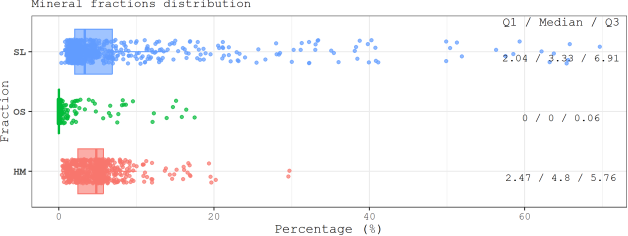
The distribution analysis of the sedimentary fraction highlights marked differences among the three mineral fractions (Figure 3). The heavy mineral (HM) fraction exhibits a median of 4.80%, with an interquartile range (IQR) spanning from 2.47% to 5.76%. This distribution indicates a moderate dispersion around a relatively high central value. The slimes (SL) fraction displays a lower median (3.33%) but a wider IQR (2.04-6.91%), a configuration that reflects more pronounced variability among the samples. The oversize (OS) fraction is virtually absent in the majority of samples, showing a median of 0% and a very low third quartile (Q3 = 0.064%), which highlights a highly asymmetrical distribution dominated by zero values. These results indicate that the mineral load is primarily controlled by the heavy and fine fractions, whereas the coarse fraction plays a marginal role.
Figure 2. Distribution of sedimentary fractions (HM, SL, OS) across 598 samples from the Ranobe deposit.
The analysis of the 598 samples from the Ranobe deposit reveals a dominance of the HM fraction (median = 4.80% and IQR = 2.47 - 5.76%), suggesting relative heavy mineral enrichment linked to hydraulic sorting and gravity concentration processes. The moderate dispersion of this fraction reflects relatively stable dynamics within the depositional environment. The slimes (SL) fraction exhibits high variability (median = 3.33%, IQR = 2.04 - 6.91%), reflecting fluctuations in hydrodynamic energy, local grain-size variations, and intermittent inputs of suspended fine particles. The virtual absence of the oversize fraction (OS, median = 0%, Q3 = 0.064%) points either to low availability of coarse particles in the source rock or to selective transport that prevents their accumulation at the study site.
From a metallogenic perspective, the stability of the HM fraction across all samples suggests a stratiform deposit potential with good lateral continuity, controlled by sedimentary processes. The variability of the SL fraction could influence ore quality and industrial recovery. The data are compatible with a reworked coastal concentration model, involving detrital inputs from the Malagasy Precambrian basement, transport toward the Morondava Basin, and deposition in a shallow coastal environment, where concentration was enhanced by wave action, longshore currents, and potential aeolian remobilization.
Table 1. Summary of trends and heterogeneity of sedimentary fractions in the Ranobe coastal deposit.
Fraction
Central tendency
Variability (IQR)
Structure and interpretation
HM
Highest (median ≈ 4.80 %)
Moderate (2.47-5.76 %)
Relatively stable distribution, reflecting heavy mineral enrichment and a stable sedimentary depositional environment
SL
Intermediate (median ≈ 3.33 %)
Highest (2.04-6,91 %)
High heterogeneity, reflecting energy fluctuations, local grain-size variations, and intermittent fine particle inputs
OS
Virtually zero (median = 0 %)
Very low (Q3 ≈ 0.064 %)
Dominated by zero values, indicating low availability of coarse particles or selective transport preventing accumulation
4.2. Inter-Variable Mineral Fraction Correlations
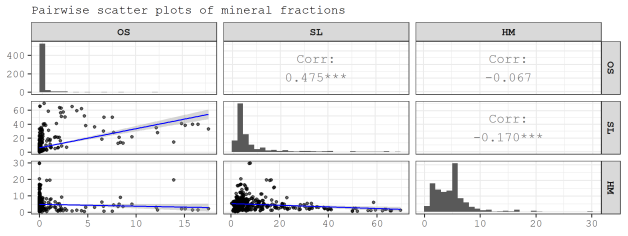
The scatter plot matrix leveraging the Ranobe deposit dataset outlines the pairwise interactions among the OS, SL, and HM mineral fractions (Figure 4). The lower bivariate panels exhibit the scatter plots overlaid with linear regression trends to visually track the overarching behavior between each variable pair. The diagonal panels display univariate distribution plots, exposing the data density and variance for each discrete fraction. The upper panels quantify these visual trends via correlation coefficients. Broadly, OS and SL demonstrate a statistical coupling, while HM remains poorly correlated, potentially indicating distinct mineralogical provenances or discrete geological sorting processes governing their spatial distribution. The OS - SL co-variation yields a moderate positive correlation (r ≈ 0.48), implying that shifts toward higher OS fractions generally scale with elevated SL values. In contrast, the OS - HM (r ≈ -0.07) and SL - HM (r ≈ -0.17) interactions are negligible and weakly negative, demonstrating that HM operates as an independent variable.
Figure 4. Pairwise scatter plot matrix depicting the interactions among OS, SL, and HM mineral fractions: the lower bivariate panels display scatter plots overlaid with linear regression trends for each variable pair; the diagonal panels exhibit univariate value histograms for each discrete fraction; the upper panels quantify the correlation coefficients between each paired fraction.
The moderate positive correlation between OS and SL (r = 0.475) demonstrates that these two mineral phases tend to co-occur. Consequently, areas characterized by higher OS fractions also feature an increased proportion of the silicate matrix. This statistical coupling likely reflects the co-deposition of both phases within distinct sedimentary facies, implying that the depositional mechanisms simultaneously promote the accumulation of these specific components.
Conversely, the correlation between OS and HM is negligible and weakly negative (-0.067), revealing that the OS mass proportion exerts no control over heavy mineral distribution. Likewise, the SL - HM correlation is weak and negative (-0.170), indicating a slight depletion of heavy minerals within highly siliceous or clay-rich sediments. These weak to non-existent statistical links underscore that heavy mineral distribution is decoupled from the main granulometric fractions, relying instead on physical sorting mechanics such as density-driven concentration or hydrodynamic segregation.
From an exploration and operational standpoint, these outcomes demonstrate that the major fractions (OS and SL) are genetically linked and highly operational for sedimentary facies mapping, whereas heavy minerals (HM) require independent evaluation. The decoupled behavior of the HM fraction relative to the other variables holds key implications for mineral exploration, establishing that heavy mineral sweet spots do not systematically overlap with zones enriched in OS or silicates.
5. Discussion
The statistical outputs demonstrate a pronounced variance regarding the SL (%) and HM (%) fractions across the investigated sample set. This spatial heterogeneity directly fulfills the primary objective of this study, namely defining the dispersion of discrete mineral fractions. The compiled metrics point to a non-uniform distribution pattern of the fractions, aligning with differential sedimentary processes or fluctuating heavy mineral grades at the deposit scale. Evaluating the statistical interplay between SL and HM addresses the second research goal, which is centered on isolating overarching trends between the light and heavy fractions. The computed correlation coefficients reveal divergent behaviors depending on the sample subsets, showing a total absence of robust or systematic linear correlations. This diagnostic implies that heavy mineral concentration is not merely a function of light fraction abundance but is governed by more complex controls, including sediment transport and depositional hydrodynamics.
Resolving outliers within specific data series underscores the internal heterogeneity of the Ranobe orebody. Rather than processing or laboratory errors, these extreme values likely denote localized sweet spots of mineral fraction concentration or dilution zones. Nevertheless, the lack of analytical duplicates, blank samples, and certified reference materials (CRMs) restricts the interpretative depth of these findings. This data limitation dictates a strictly statistical treatment of the data, discouraging any definitive genetic interpretations.
The near-total deficit of the oversize fraction, characterized by minimal OS contents and a high frequency of zero values, points to a depositional framework driven by highly efficient sorting mechanisms that selectively segregate and remove coarse clastics. This signature matches textbook observations reported in sedimentary settings where ambient energy promotes the selective transport of fine-to-medium grains
[4]
Van Gosen, B. S., Fey, D. L., Shah, A. K., Verplanck, P. L., & Hoefen, T. M. (2014). Deposit model for heavy-mineral sands in coastal environments (Scientific Investigations Report 2010-5070-L). U.S. Geological Survey.
. Evaluating the variance within the slimes (SL) fraction demonstrates pronounced sample-to-sample dispersion. This volatility maps onto heterogeneous depositional regimes, indicating localized shifts in hydro-sedimentary dynamics or sediment provenance. Prior literature underscores that the fine-grained fraction acts as a primary control on the architectural structuring of sediment assemblies and the spatial distribution of discrete mineralogical constituents
[14]
Helsel, D. R., & Hirsch, R. M. (2002). Statistical Methods in Water Resources. USGS.
[15]
Reimann, C., Filzmoser, P., Garrett, R. G., & Dutter, R. (2008). Statistical Data Analysis Explained. Wiley.
. The heavy mineral (HM) content, when analyzed alongside granulometry, displays moderate heterogeneity, dominated by low-to-intermediate grades interspersed with sporadic localized enrichments. This distribution pattern is typical of weakly to moderately enriched heavy mineral sediments lacking extreme outliers. As outlined by
[12]
Mange, M. A., & Maurer, H. F. W. (1992). Heavy minerals in colour. Springer.
, such concentrations represent the product of natural background sorting processes rather than the formation of economically viable ore concentrates.
The correlation between SL and HM is weak and slightly negative (r ≈ -0.17), indicating that heavy mineral distribution is weakly associated with the proportion of the fine fraction. This weak relationship suggests that heavy mineral enrichment is primarily controlled by physical processes of hydrodynamic sorting and gravity concentration rather than by grain size alone. This behavior aligns with the hydrodynamic models described by
[16]
Morton, A. C., & Hallsworth, C. R. (1999). Processes controlling heavy mineral distributions. Sedimentary Geology, 124, 3-29.
, which emphasize the joint role of density and grain size in the segregation of heavy minerals during transport and deposition.
Finally, the interpretation of the results falls within the methodological limitations defined by the study's initial objectives. The absence of certified reference materials, analytical duplicates, and blank samples prevents the assessment of analytical precision and systematic bias, in accordance with ISO 13528: 2015 guidelines
[17]
International Organization for Standardization. ISO 13528:2015: Statistical methods for use in proficiency testing by interlaboratory comparison. ISO. 2015.
[17]
. Supplementary analyses, such as detailed mineralogical characterization or high-resolution grain-size analysis, would allow for a deeper understanding of the identified mechanisms and strengthen the study's conclusions, consistent with the approaches proposed by
[12]
Mange, M. A., & Maurer, H. F. W. (1992). Heavy minerals in colour. Springer.
This study presents an exploratory statistical analysis of the OS, SL, and HM fractions from the Ranobe mineral sands deposit. The results demonstrate significant spatial variability across both the fine (slimes) and heavy mineral fractions, alongside remarkably weak linear relationships between granulometric parameters and heavy mineral grades.
These statistical trends are consistent with depositional environments governed by efficient hydro-sedimentary sorting, where density-driven mechanisms play a primary role in concentrating heavy minerals. However, given the absence of high-resolution mineralogical profiling and formal verification through standard quality assurance and quality control (QA/QC) workflows, these interpretations must be treated as preliminary.
From an exploration standpoint, these findings reveal that heavy mineral distribution behaves independently of grain-size metrics and should be evaluated as a decoupled variable. Consequently, future exploration campaigns must incorporate quantitative mineralogical characterization and advanced spatial modeling to accurately constrain the economic potential of the deposit.
Abbreviations
CRMs
Certified Reference Materials
OS
Oversize Fraction
SL
Slimes Fraction
HM
Heavy Mineral Grade
ISO
International Organization for Standardization
IQR
Interquartile Range
EDA
Exploratory Data Analysis
QA/QC
Quality Assurance and Quality Control
Author Contributions
Ria Raonison: Conceptualization, Investigation, Writing – original draft
Tsiorisoa Harempahasoavana: Data curation, Methodology, Visualization
Besairie (1972). Géologie de Madagascar I. Les terrains sédimentaires. Imprimerie Nationale.
[2]
Piqué, A., Laville, E., Rey, J., & Huchon, P. (1999). The initiation and development of the Morondava Basin, Madagascar, from the Late Carboniferous to the Middle Jurassic: sedimentary, palaeontological and structural data. Journal of African Earth Sciences, 28(4), 931-948.
Schetselaar, W., Schneider, D., Powell, J., Tari, G., Raharisolofo, H., & Ramboasalama, F. (2023). Reconstructing the thermal history of the Morondava Basin, Madagascar, after Gondwanan breakup as resolved through detrital zircon (U–Th)/He and U–Pb geochronology. Marine and Petroleum Geology, 160, 106669.
Van Gosen, B. S., Fey, D. L., Shah, A. K., Verplanck, P. L., & Hoefen, T. M. (2014). Deposit model for heavy-mineral sands in coastal environments (Scientific Investigations Report 2010-5070-L). U.S. Geological Survey.
Hernández-Molina, F. J., Tari, G., Scarselli, N., Raharisolofo, H., Rahajarivelo, S. F., Kirby, A., de Weger, W., & Llave, E. (2022). Evolution and morphology of a contourite depositional system based on new evidence from 3D-seismic data offshore Madagascar (Paleogene, Morondava Basin). Scientific Reports, 12, 19931.
Wu, D., Liu, J., Razoeliarimalala, M., Wang, T., Razafimbelo, R., Xu, F., Sun, W., Ralison, B., Wang, Z., Zhou, Y., Zhao, Y., & Zhao, J. (2025). Evaluation and Classification of Uranium Prospective Areas in Madagascar: A Geochemical Block-Based Approach. Minerals, 15(3), 280.
Randriamahefasoa, T. S. M., & Reason, C. J. C. (2016). Interannual variability of rainfall characteristics over southwestern Madagascar. Theoretical and Applied Climatology, 124(1-2), 1-17.
Sourdat, M. (1969). Notes de climatologie descriptive: région sud-ouest de Madagascar (préfecture de Tuléar) (27 p.). ORSTOM. Disponible en accès libre via l’archive IRD:
Wescott, W. A. (1997). Depositional history and stratigraphical evolution of the Sakoa Group (Lower Karoo Supergroup) in the southern Morondava Basin, Madagascar. Journal of African Earth Sciences, 24(4), 585-601.
Wescott, W. A. (1998). Depositional history and stratigraphical evolution of the Sakamena Group (Middle Karoo Supergroup) in the southern Morondava Basin, Madagascar. Journal of African Earth Sciences, 27(3-4), 461-479.
International Organization for Standardization. ISO 13528:2015: Statistical methods for use in proficiency testing by interlaboratory comparison. ISO. 2015.
Raonison, R., Harempahasoavana, T., Razakamanana, T. (2026). Statistical Analysis of Oversize, Slimes, and Heavy Mineral Fractions of the Ranobe Mineral Sands Deposit (Atsimo-Andrefana Region, Madagascar). Earth Sciences, 15(5), 216-223. https://doi.org/10.11648/j.earth.20261505.11
Raonison, R.; Harempahasoavana, T.; Razakamanana, T. Statistical Analysis of Oversize, Slimes, and Heavy Mineral Fractions of the Ranobe Mineral Sands Deposit (Atsimo-Andrefana Region, Madagascar). Earth Sci.2026, 15(5), 216-223. doi: 10.11648/j.earth.20261505.11
Raonison R, Harempahasoavana T, Razakamanana T. Statistical Analysis of Oversize, Slimes, and Heavy Mineral Fractions of the Ranobe Mineral Sands Deposit (Atsimo-Andrefana Region, Madagascar). Earth Sci. 2026;15(5):216-223. doi: 10.11648/j.earth.20261505.11
@article{10.11648/j.earth.20261505.11,
  author = {Ria Raonison and Tsiorisoa Harempahasoavana and Théodore Razakamanana},
  title = {Statistical Analysis of Oversize, Slimes, and Heavy Mineral Fractions of the Ranobe Mineral Sands Deposit (Atsimo-Andrefana Region, Madagascar)},
  journal = {Earth Sciences},
  volume = {15},
  number = {5},
  pages = {216-223},
  doi = {10.11648/j.earth.20261505.11},
  url = {https://doi.org/10.11648/j.earth.20261505.11},
  eprint = {https://article.sciencepublishinggroup.com/pdf/10.11648.j.earth.20261505.11},
  abstract = {This study presents an exploratory statistical analysis of oversize (OS), slimes (SL), and heavy mineral (HM) fractions from 598 deep drilling samples collected across the Ranobe mineral sands deposit, located within the Atsimo-Andrefana region of southwestern Madagascar. Robust descriptive statistical methods and exploratory graphical analyses were employed to quantitatively characterize the spatial distributions, central tendencies, and inherent heterogeneities of these mineralized coastal formations. The structural results indicate a clear dominance of the HM fraction, which features a remarkably stable distribution centered around a high median value of 4.80%. This pattern strongly implies the persistent influence of highly efficient regional enrichment processes driven by hydraulic sorting and gravity concentration dynamics in a moderate-energy beach environment. Conversely, the fine-grained SL fraction exhibits a significantly wider dispersion and pronounced sample-to-sample variability (median of 3.33%, standard deviation of 11.64%), reflecting active hydrodynamic fluctuations and episodic inputs of suspended fine particles during deposition. The coarse OS fraction remains virtually negligible across the vast majority of analyzed samples, maintaining a median of 0%. Bivariate correlation assessments reveal a moderate positive coupling between the OS and SL phases (r ≈ 0.48), whereas their respective linear relationships with heavy minerals are remarkably weak or negative r OS-HM ≈ -0.07; r SL-HM ≈ -0.17). These statistical outputs demonstrate that heavy mineral concentration is entirely decoupled from primary grain-size metrics. Consequently, future operational campaigns must evaluate the economic potential of the Ranobe orebody using independent spatial models.},
 year = {2026}
}
TY  - JOUR
T1  - Statistical Analysis of Oversize, Slimes, and Heavy Mineral Fractions of the Ranobe Mineral Sands Deposit (Atsimo-Andrefana Region, Madagascar)
AU  - Ria Raonison
AU  - Tsiorisoa Harempahasoavana
AU  - Théodore Razakamanana
Y1  - 2026/09/09
PY  - 2026
N1  - https://doi.org/10.11648/j.earth.20261505.11
DO  - 10.11648/j.earth.20261505.11
T2  - Earth Sciences
JF  - Earth Sciences
JO  - Earth Sciences
SP  - 216
EP  - 223
PB  - Science Publishing Group
SN  - 2328-5982
UR  - https://doi.org/10.11648/j.earth.20261505.11
AB  - This study presents an exploratory statistical analysis of oversize (OS), slimes (SL), and heavy mineral (HM) fractions from 598 deep drilling samples collected across the Ranobe mineral sands deposit, located within the Atsimo-Andrefana region of southwestern Madagascar. Robust descriptive statistical methods and exploratory graphical analyses were employed to quantitatively characterize the spatial distributions, central tendencies, and inherent heterogeneities of these mineralized coastal formations. The structural results indicate a clear dominance of the HM fraction, which features a remarkably stable distribution centered around a high median value of 4.80%. This pattern strongly implies the persistent influence of highly efficient regional enrichment processes driven by hydraulic sorting and gravity concentration dynamics in a moderate-energy beach environment. Conversely, the fine-grained SL fraction exhibits a significantly wider dispersion and pronounced sample-to-sample variability (median of 3.33%, standard deviation of 11.64%), reflecting active hydrodynamic fluctuations and episodic inputs of suspended fine particles during deposition. The coarse OS fraction remains virtually negligible across the vast majority of analyzed samples, maintaining a median of 0%. Bivariate correlation assessments reveal a moderate positive coupling between the OS and SL phases (r ≈ 0.48), whereas their respective linear relationships with heavy minerals are remarkably weak or negative r OS-HM ≈ -0.07; r SL-HM ≈ -0.17). These statistical outputs demonstrate that heavy mineral concentration is entirely decoupled from primary grain-size metrics. Consequently, future operational campaigns must evaluate the economic potential of the Ranobe orebody using independent spatial models.
VL  - 15
IS  - 5
ER  -
Graduate School of Geosciences (GPCEHP), University of Toliara, Toliara, Madagascar;Higher Education Institute of Anosy (IESA), University of Anosy, Taolagnaro, Madagascar
Graduate School of Geosciences (GPCEHP), University of Toliara, Toliara, Madagascar;Department of Earth Sciences (DST), University of Toliara, Toliara, Madagascar
Raonison, R., Harempahasoavana, T., Razakamanana, T. (2026). Statistical Analysis of Oversize, Slimes, and Heavy Mineral Fractions of the Ranobe Mineral Sands Deposit (Atsimo-Andrefana Region, Madagascar). Earth Sciences, 15(5), 216-223. https://doi.org/10.11648/j.earth.20261505.11
Raonison, R.; Harempahasoavana, T.; Razakamanana, T. Statistical Analysis of Oversize, Slimes, and Heavy Mineral Fractions of the Ranobe Mineral Sands Deposit (Atsimo-Andrefana Region, Madagascar). Earth Sci.2026, 15(5), 216-223. doi: 10.11648/j.earth.20261505.11
Raonison R, Harempahasoavana T, Razakamanana T. Statistical Analysis of Oversize, Slimes, and Heavy Mineral Fractions of the Ranobe Mineral Sands Deposit (Atsimo-Andrefana Region, Madagascar). Earth Sci. 2026;15(5):216-223. doi: 10.11648/j.earth.20261505.11
@article{10.11648/j.earth.20261505.11,
  author = {Ria Raonison and Tsiorisoa Harempahasoavana and Théodore Razakamanana},
  title = {Statistical Analysis of Oversize, Slimes, and Heavy Mineral Fractions of the Ranobe Mineral Sands Deposit (Atsimo-Andrefana Region, Madagascar)},
  journal = {Earth Sciences},
  volume = {15},
  number = {5},
  pages = {216-223},
  doi = {10.11648/j.earth.20261505.11},
  url = {https://doi.org/10.11648/j.earth.20261505.11},
  eprint = {https://article.sciencepublishinggroup.com/pdf/10.11648.j.earth.20261505.11},
  abstract = {This study presents an exploratory statistical analysis of oversize (OS), slimes (SL), and heavy mineral (HM) fractions from 598 deep drilling samples collected across the Ranobe mineral sands deposit, located within the Atsimo-Andrefana region of southwestern Madagascar. Robust descriptive statistical methods and exploratory graphical analyses were employed to quantitatively characterize the spatial distributions, central tendencies, and inherent heterogeneities of these mineralized coastal formations. The structural results indicate a clear dominance of the HM fraction, which features a remarkably stable distribution centered around a high median value of 4.80%. This pattern strongly implies the persistent influence of highly efficient regional enrichment processes driven by hydraulic sorting and gravity concentration dynamics in a moderate-energy beach environment. Conversely, the fine-grained SL fraction exhibits a significantly wider dispersion and pronounced sample-to-sample variability (median of 3.33%, standard deviation of 11.64%), reflecting active hydrodynamic fluctuations and episodic inputs of suspended fine particles during deposition. The coarse OS fraction remains virtually negligible across the vast majority of analyzed samples, maintaining a median of 0%. Bivariate correlation assessments reveal a moderate positive coupling between the OS and SL phases (r ≈ 0.48), whereas their respective linear relationships with heavy minerals are remarkably weak or negative r OS-HM ≈ -0.07; r SL-HM ≈ -0.17). These statistical outputs demonstrate that heavy mineral concentration is entirely decoupled from primary grain-size metrics. Consequently, future operational campaigns must evaluate the economic potential of the Ranobe orebody using independent spatial models.},
 year = {2026}
}
TY  - JOUR
T1  - Statistical Analysis of Oversize, Slimes, and Heavy Mineral Fractions of the Ranobe Mineral Sands Deposit (Atsimo-Andrefana Region, Madagascar)
AU  - Ria Raonison
AU  - Tsiorisoa Harempahasoavana
AU  - Théodore Razakamanana
Y1  - 2026/09/09
PY  - 2026
N1  - https://doi.org/10.11648/j.earth.20261505.11
DO  - 10.11648/j.earth.20261505.11
T2  - Earth Sciences
JF  - Earth Sciences
JO  - Earth Sciences
SP  - 216
EP  - 223
PB  - Science Publishing Group
SN  - 2328-5982
UR  - https://doi.org/10.11648/j.earth.20261505.11
AB  - This study presents an exploratory statistical analysis of oversize (OS), slimes (SL), and heavy mineral (HM) fractions from 598 deep drilling samples collected across the Ranobe mineral sands deposit, located within the Atsimo-Andrefana region of southwestern Madagascar. Robust descriptive statistical methods and exploratory graphical analyses were employed to quantitatively characterize the spatial distributions, central tendencies, and inherent heterogeneities of these mineralized coastal formations. The structural results indicate a clear dominance of the HM fraction, which features a remarkably stable distribution centered around a high median value of 4.80%. This pattern strongly implies the persistent influence of highly efficient regional enrichment processes driven by hydraulic sorting and gravity concentration dynamics in a moderate-energy beach environment. Conversely, the fine-grained SL fraction exhibits a significantly wider dispersion and pronounced sample-to-sample variability (median of 3.33%, standard deviation of 11.64%), reflecting active hydrodynamic fluctuations and episodic inputs of suspended fine particles during deposition. The coarse OS fraction remains virtually negligible across the vast majority of analyzed samples, maintaining a median of 0%. Bivariate correlation assessments reveal a moderate positive coupling between the OS and SL phases (r ≈ 0.48), whereas their respective linear relationships with heavy minerals are remarkably weak or negative r OS-HM ≈ -0.07; r SL-HM ≈ -0.17). These statistical outputs demonstrate that heavy mineral concentration is entirely decoupled from primary grain-size metrics. Consequently, future operational campaigns must evaluate the economic potential of the Ranobe orebody using independent spatial models.
VL  - 15
IS  - 5
ER  -





 Share This Article
 Twitter
 Linked In
 Facebook
 Copy
Copy Download