The stability of a homogeneous overburden dump depends on whether its height stays below a limiting value set by the strength of the dump material and by the bearing capacity of its foundation. This paper determines the limiting stable height of four homogeneous external dumps of the Kalmakir open pit (Almalyk MMC, Uzbekistan) for a rigid and for a weak foundation. The shear strength of the mixed-size dump rock was described as a function of the fine-fraction content, and design values were obtained with a safety factor of 1.2. For a rigid foundation the limiting height was calculated by three methods based on a circular slip surface: the G. L. Fisenko (VNIMI) method, the W. Fellenius method and the KarPTI method. For a weak foundation the limiting height was obtained from the critical load on the foundation soils and by the V. K. Tsvetkov method, for thawed (summer) and frozen (winter) soils. On a rigid foundation the limiting heights were 94.0–105.4 m, with mean values of 95.2–103.1 m, which exceed the present heights of 85–94 m by 1–21%. On a weak foundation the limiting height fell to 54 m when the soils were thawed and rose to 110 m when they were frozen. The bearing capacity of the foundation in the warm season is therefore the governing condition, and dumping on thawed soft soils should be limited to about 53–54 m.
This is an Open Access article, distributed under the terms of the Creative Commons Attribution 4.0 International License (http://creativecommons.org/licenses/by/4.0/), which permits unrestricted use, distribution and reproduction in any medium or format, provided the original work is properly cited.
As open pits deepen, the volume of overburden placed in external dumps grows faster than the volume of ore mined. In Uzbekistan, the open pits of Almalyk MMC JSC, including Kalmakir, are being developed with cyclical-and-continuous (cyclic-flow) technology, in which rock is crushed in the pit and delivered to the dumps by conveyors
[1]
Rzhevsky V. V. Open-Pit Mining. Part 2: Technology and Integrated Mechanization. Moscow: Nedra, 1985. (In Russian).
[2]
Melnikov N. N., Usynin V. I., Reshetnyak S. N. Cyclical-and-Continuous Technology with Mobile Crushing and Loading Complexes for Deep Open Pits. Apatity: Kola Science Centre RAS, 1995. (In Russian).
[1, 2]
. This technology makes it economical to build high dumps, which reduce the area of land taken for waste storage. The height of a dump, however, cannot be raised without limit: above a certain value the dump slope or its foundation loses stability
[3]
Popov I. I., Okatov R. P. Control of Landslides in Open Pits. Moscow: Nedra, 1980. 240 p. (In Russian).
[4]
Popov I. I., Shpakov P. S., Poklad G. G. Stability of Rock Dumps. Alma-Ata: Nauka, 1987. (In Russian).
[3, 4]
.
The geomechanical justification of dump parameters aims to set values that keep the dump slopes controllable: height, slope angle, width of the safety berm, loading rate, and the order and direction of dumping
[4]
Popov I. I., Shpakov P. S., Poklad G. G. Stability of Rock Dumps. Alma-Ata: Nauka, 1987. (In Russian).
[5]
Kryachko O. Yu. Dump Management in Open-Pit Mining. Moscow: Nedra, 1980. (In Russian).
[4, 5]
. Of these, the limiting height is the most important, because it determines the capacity of the dump and the land it occupies.
Two cases are usually distinguished. On a rigid foundation, whose strength exceeds that of the dump material, stability depends only on the properties of the dump rock, and failure takes place along a slip surface within the dump body. On a weak foundation, formed by soft, often water-saturated soils, the dump may fail by squeezing out the base soils or by sliding along the contact with the base, and the limiting height is usually 40–60 m
[5]
Kryachko O. Yu. Dump Management in Open-Pit Mining. Moscow: Nedra, 1980. (In Russian).
[6]
Fisenko G. L. Stability of Pit and Dump Slopes. Moscow: Nedra, 1965. 378 p. (In Russian).
[5, 6]
.
2. Literature Review
Several methods have been proposed for both cases. G. L. Fisenko's method, adopted in the VNIMI guidelines, uses the height of a vertical slope and a chart of the relative height
[6]
Fisenko G. L. Stability of Pit and Dump Slopes. Moscow: Nedra, 1965. 378 p. (In Russian).
[7]
VNIMI. Guidelines for Calculating the Stability and Bearing Capacity of Dumps. Leningrad: VNIMI, 1987. (In Russian).
[6, 7]
. W. Fellenius's circular slip surface theory
[8]
Fellenius W. Calculation of the stability of earth dams. Transactions of the 2nd Congress on Large Dams, Washington, 1936, Vol. 4, pp. 445–462.
[8]
and the KarPTI method
[9]
Shpakov P. S., Poklad G. G., Lyagina O. I., Pyatkova E. P. Determination of the physical and mechanical properties of rocks for dump stability calculations. Gornyi Zhurnal, 1979, No. 7, pp. 17–21. (In Russian).
[9]
give related solutions for a rigid base. For a weak base, the critical load on the foundation soils and the method of V. K. Tsvetkov are used
[7]
VNIMI. Guidelines for Calculating the Stability and Bearing Capacity of Dumps. Leningrad: VNIMI, 1987. (In Russian).
[10]
Tsvetkov V. K. Calculation of the Stability of Slopes. Volgograd: Nizhne-Volzhskoe Knizhnoe Izdatelstvo, 1979. (In Russian).
[7, 10]
. The methods rest on different simplifications, and their results for the same dump may differ noticeably.
The aim of this study is to determine the limiting stable height of the homogeneous external dumps of the Kalmakir open pit for rigid and weak foundations, to compare the methods, and to establish which condition governs the permissible dump height.
The objects of study are four external dumps of the Kalmakir open pit: Dump No. 2 (section I), the Central dump, Dump No. 2 (section II) and the Special dump, with present heights of 93, 93, 94 and 85 m. The dumps are formed of crushed overburden of granite, granosyenite and syenite-diorite. On the dump slopes the rock has the following size distribution: 0–100 mm – 54%, 100–200 mm – 21%, 200–300 mm – 13%, 300–400 mm – 12%; the bulking factor of the rock varies from 1.3 to 1.9 depending on the size distribution.
The dump foundations consist of alluvial and deluvial sands, sandy loams and, locally, plastic clayey soils 2–30 m thick, underlain by gravel 1.5–10 m thick and by weathered granite. The gravel is water-saturated below 9–10 m in some boreholes. In summer the foundation soils are wetted in places and their shear strength becomes very low, whereas in winter they are frozen.
Table 1. Design parameters of the dump material.
Dump
CM, kPa
φM
γ, kN/m3
Cp, kPa
φp
No. 2 (I)
25.0
35°36′
20.4
20.8
30°49′
Central
24.9
35°39′
20.5
20.8
30°52′
No. 2 (II)
25.3
34°45′
20.2
21.1
30°02′
Special
43.3
32°06′
22.4
36.1
27°36′
Following
[7]
VNIMI. Guidelines for Calculating the Stability and Bearing Capacity of Dumps. Leningrad: VNIMI, 1987. (In Russian).
[11]
Rybalkin Yu. D. Development of a Method for Assessing Dump Parameters. PhD thesis. Karaganda, 1985. 172 p. (In Russian).
[7, 11]
, the cohesion and friction of the mixed-size dump rock at relative depth hi/H depend on the content of the fine fraction:
where CM and φM are the cohesion and friction angle of the fine fraction from laboratory tests, αk is the angle of repose of the coarse fraction, and ηM is the fine-fraction content at the given depth, %. The density of the dump rock at depth hi is
where γk and γM are the densities of the coarse and fine fractions, Ai is the coarse-fraction content, %, Ki accounts for compaction under the weight of the overlying layers, and γav is the mean density of those layers. Design values were obtained with a safety factor n = 1.2:
The design parameters of the dump material are given in Table 1, and those used in the weak-foundation calculations in Table 2.
Table 2. Design parameters of the dump material and foundation soils for the weak-foundation case.
Parameter
Dump material
Foundation, thawed (summer)
Foundation, frozen (winter)
Cohesion Cp, kPa
33.6
0–18.9
up to 130
Friction angle φp
29°
up to 21°
25°
Unit weight γp, kN/m³
19.9
19.6
19.4
3. Materials and Methods
According to the theory of limit equilibrium of granular and cohesive media, elementary slip planes in a homogeneous mass form at the angle (45° − φ/2) to the direction of the major principal stress
[12]
Sokolovsky V. V. Statics of Granular Media. Oxford: Pergamon Press, 1965.
[12]
. G. L. Fisenko's (VNIMI) method uses the height of a stable vertical slope
[6]
Fisenko G. L. Stability of Pit and Dump Slopes. Moscow: Nedra, 1965. 378 p. (In Russian).
[7]
VNIMI. Guidelines for Calculating the Stability and Bearing Capacity of Dumps. Leningrad: VNIMI, 1987. (In Russian).
[6, 7]
:
where H′ is the relative dump height read from a chart as a function of the slope angle α and the friction angle φp.
W. Fellenius's method is based on a circular slip surface
[8]
Fellenius W. Calculation of the stability of earth dams. Transactions of the 2nd Congress on Large Dams, Washington, 1936, Vol. 4, pp. 445–462.
[8]
; the height of the vertical slope is
The KarPTI method follows from the balance of driving and resisting forces on a circular-cylindrical slip surface
[9]
Shpakov P. S., Poklad G. G., Lyagina O. I., Pyatkova E. P. Determination of the physical and mechanical properties of rocks for dump stability calculations. Gornyi Zhurnal, 1979, No. 7, pp. 17–21. (In Russian).
[9]
:
where a and k are coefficients read from charts as functions of α and φp.
The critical load on the foundation soils is
[7]
VNIMI. Guidelines for Calculating the Stability and Bearing Capacity of Dumps. Leningrad: VNIMI, 1987. (In Russian).
[7]
:
where Cp and φp refer to the foundation soils. With the safety factor n = 1.2, the allowable load and the limiting dump height are
where γp is the unit weight of the dump material. In V. K. Tsvetkov's method
[10]
Tsvetkov V. K. Calculation of the Stability of Slopes. Volgograd: Nizhne-Volzhskoe Knizhnoe Izdatelstvo, 1979. (In Russian).
[10]
the limiting height is
where λ is a dimensionless stability parameter taken from stability charts; λ = 0.05 for the conditions considered. Check calculations by N. N. Maslov's method were made for the thawed and frozen states of the foundation soils
[7]
VNIMI. Guidelines for Calculating the Stability and Bearing Capacity of Dumps. Leningrad: VNIMI, 1987. (In Russian).
[7]
.
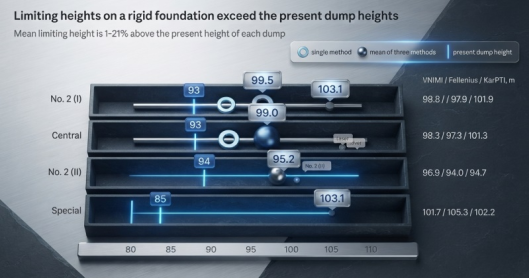
On a rigid foundation the three methods gave limiting heights of 94.0–105.4 m (Figure 1). The mean values were 99.5 m for Dump No. 2 (I), 99.0 m for the Central dump, 95.2 m for Dump No. 2 (II) and 103.1 m for the Special dump. The height of a stable vertical slope was 3.6–5.3 m by Fisenko's formula and 3.9–6.2 m by Fellenius's formula, so the relative heights H′ read from the charts were 19–28 and 17–25, respectively.
Figure 1. Limiting stable height of the Kalmakir dumps on a rigid foundation by three methods, compared with the present dump height.
The spread between the methods did not exceed 4.1 m, or about 4% of the limiting height. Fellenius's method gave the lowest value for three dumps, but the highest (105.4 m) for the Special dump, which has the highest cohesion and the lowest friction angle.
When the foundation soils are in their natural drained state, the critical load is 2.28 MPa and the allowable load with n = 1.2 is 1.90 MPa (Table 3). This load permits dump heights of 85–94 m, which coincide with the present heights of the dumps.
Table 3. Limiting height of the dumps from the bearing capacity of the foundation.
Dump
Critical load Pcr, MPa
Allowable load Pall, MPa
Unit weight γp, kN/m³
Limiting height Hlim, m
No. 2 (I)
2.28
1.90
20.4
93
Central
2.28
1.90
20.5
93
No. 2 (II)
2.28
1.90
20.2
94
Special
2.28
1.90
22.4
85
The season strongly affects the result (Table 4). For the dump body, the KarPTI, Tsvetkov and VNIMI methods gave 112, 118 and 108 m. When the foundation soils are thawed in summer, the limiting height falls to 54 m; when they are frozen in winter, it rises to 110 m. The calculations show that dumps placed on thawed soils should not exceed 53–54 m.
Table 4. Limiting height of the Kalmakir (Almalyk MMC) dumps by different methods, m.
Condition
KarPTI
Tsvetkov
VNIMI
Foundation, summer
Foundation, winter
Recommended
All dumps
112
118
108
54
110
54 (summer) / 110 (winter)
On a rigid foundation the three methods agree to within about 4%, which confirms that each of them is suitable for homogeneous dumps of crushed rock. The agreement follows from their common basis: all three relate the limiting height to the ratio Cp/γ and to the friction angle, and differ only in the shape of the assumed slip surface and in the charts used to read the coefficients. The higher value given by Fellenius's method for the Special dump reflects the larger weight that the circular-surface solution gives to cohesion, which is highest for this dump (36.1 kPa). For design, the mean of the three methods provides a balanced estimate, and the lowest value provides a conservative one.
The present heights of the dumps lie below their limiting heights, but the reserve differs between dumps. For the Special dump the mean limiting height exceeds the present height by 21%, which allows the dump to be raised. For Dump No. 2 (II) the reserve is only about 1%, and the lowest single estimate (94.0 m) equals the present height, so this dump should not be raised further without additional measures such as flattening the slope or placing a toe berm.
The weak-foundation results show that the bearing capacity of the base, not the strength of the dump body, governs the permissible height for much of the year. The limiting height of the dump body (108–118 m) is about twice the limiting height on thawed foundation soils (54 m). The difference between summer (54 m) and winter (110 m) is caused by the loss of cohesion and friction of the foundation soils when they are wetted and thawed. This agrees with the general observation that dumps on soft bases are limited to 40–60 m
[5]
Kryachko O. Yu. Dump Management in Open-Pit Mining. Moscow: Nedra, 1980. (In Russian).
[6]
Fisenko G. L. Stability of Pit and Dump Slopes. Moscow: Nedra, 1965. 378 p. (In Russian).
[5, 6]
and with the experience of dump failures on wetted foundations
[3]
Popov I. I., Okatov R. P. Control of Landslides in Open Pits. Moscow: Nedra, 1980. 240 p. (In Russian).
[4]
Popov I. I., Shpakov P. S., Poklad G. G. Stability of Rock Dumps. Alma-Ata: Nauka, 1987. (In Russian).
[3, 4]
.
In practice, this means that the dumping schedule should be linked to the season. Dump sections on soft, periodically wetted soils can be raised in winter, when the frozen base can carry up to 110 m, but their height should not exceed 53–54 m before the next thaw. Where higher dumps are needed on such soils, the base should be improved, for example by removing or draining the soft layer, or a first tier of coarse rock should be placed to consolidate the base before the dump is raised.
The study is limited by the assumption of a homogeneous dump body and by the use of chart-based coefficients, which introduce reading errors of a few percent. The effect of pore pressure in the saturated gravel layer and of seismic loading was not considered. These factors should be included in further work using numerical modelling of the stress–strain state of the dump and its foundation.
4. Conclusions
The limiting stable height of four homogeneous external dumps of the Kalmakir open pit was determined for rigid and weak foundations, with design strength parameters reduced by a safety factor of 1.2.
On a rigid foundation the Fisenko (VNIMI), Fellenius and KarPTI methods gave limiting heights of 94.0–105.4 m, with means of 95.2–103.1 m; the methods differ by no more than 4.1 m (about 4%).
The present dump heights of 85–94 m are below the limiting heights. The reserve is 21% for the Special dump but only about 1% for Dump No. 2 (II), which should not be raised further without slope flattening or a toe berm.
On a weak foundation the permissible height is governed by the bearing capacity of the base: 54 m when the foundation soils are thawed in summer and 110 m when they are frozen in winter, against 108–118 m for the dump body alone.
Dumps placed on soft, periodically wetted soils should be limited to 53–54 m before the warm season, or the foundation should be improved before the dumps are raised further.
Naimova Rano Shukurovna: Conceptualization, Data curation, Formal Analysis, Funding acquisition, Methodology, Resources, Software, Validation, Writing – original draft
Conflicts of Interest
The authors declare no conflicts of interest.
References
[1]
Rzhevsky V. V. Open-Pit Mining. Part 2: Technology and Integrated Mechanization. Moscow: Nedra, 1985. (In Russian).
[2]
Melnikov N. N., Usynin V. I., Reshetnyak S. N. Cyclical-and-Continuous Technology with Mobile Crushing and Loading Complexes for Deep Open Pits. Apatity: Kola Science Centre RAS, 1995. (In Russian).
[3]
Popov I. I., Okatov R. P. Control of Landslides in Open Pits. Moscow: Nedra, 1980. 240 p. (In Russian).
[4]
Popov I. I., Shpakov P. S., Poklad G. G. Stability of Rock Dumps. Alma-Ata: Nauka, 1987. (In Russian).
[5]
Kryachko O. Yu. Dump Management in Open-Pit Mining. Moscow: Nedra, 1980. (In Russian).
[6]
Fisenko G. L. Stability of Pit and Dump Slopes. Moscow: Nedra, 1965. 378 p. (In Russian).
[7]
VNIMI. Guidelines for Calculating the Stability and Bearing Capacity of Dumps. Leningrad: VNIMI, 1987. (In Russian).
[8]
Fellenius W. Calculation of the stability of earth dams. Transactions of the 2nd Congress on Large Dams, Washington, 1936, Vol. 4, pp. 445–462.
[9]
Shpakov P. S., Poklad G. G., Lyagina O. I., Pyatkova E. P. Determination of the physical and mechanical properties of rocks for dump stability calculations. Gornyi Zhurnal, 1979, No. 7, pp. 17–21. (In Russian).
[10]
Tsvetkov V. K. Calculation of the Stability of Slopes. Volgograd: Nizhne-Volzhskoe Knizhnoe Izdatelstvo, 1979. (In Russian).
[11]
Rybalkin Yu. D. Development of a Method for Assessing Dump Parameters. PhD thesis. Karaganda, 1985. 172 p. (In Russian).
[12]
Sokolovsky V. V. Statics of Granular Media. Oxford: Pergamon Press, 1965.
Maftuna, U., Shukurovna, N. R. (2026). Geomechanical Evaluation of the Stability of Homogeneous Overburden Dump Slopes Based on Their Limiting Height. Earth Sciences, 15(5), 247-251. https://doi.org/10.11648/j.earth.20261505.14
Maftuna, U.; Shukurovna, N. R. Geomechanical Evaluation of the Stability of Homogeneous Overburden Dump Slopes Based on Their Limiting Height. Earth Sci.2026, 15(5), 247-251. doi: 10.11648/j.earth.20261505.14
Maftuna U, Shukurovna NR. Geomechanical Evaluation of the Stability of Homogeneous Overburden Dump Slopes Based on Their Limiting Height. Earth Sci. 2026;15(5):247-251. doi: 10.11648/j.earth.20261505.14
@article{10.11648/j.earth.20261505.14,
  author = {Ulmasova Maftuna and Naimova Rano Shukurovna},
  title = {Geomechanical Evaluation of the Stability of Homogeneous Overburden Dump Slopes Based on Their Limiting Height},
  journal = {Earth Sciences},
  volume = {15},
  number = {5},
  pages = {247-251},
  doi = {10.11648/j.earth.20261505.14},
  url = {https://doi.org/10.11648/j.earth.20261505.14},
  eprint = {https://article.sciencepublishinggroup.com/pdf/10.11648.j.earth.20261505.14},
  abstract = {The stability of a homogeneous overburden dump depends on whether its height stays below a limiting value set by the strength of the dump material and by the bearing capacity of its foundation. This paper determines the limiting stable height of four homogeneous external dumps of the Kalmakir open pit (Almalyk MMC, Uzbekistan) for a rigid and for a weak foundation. The shear strength of the mixed-size dump rock was described as a function of the fine-fraction content, and design values were obtained with a safety factor of 1.2. For a rigid foundation the limiting height was calculated by three methods based on a circular slip surface: the G. L. Fisenko (VNIMI) method, the W. Fellenius method and the KarPTI method. For a weak foundation the limiting height was obtained from the critical load on the foundation soils and by the V. K. Tsvetkov method, for thawed (summer) and frozen (winter) soils. On a rigid foundation the limiting heights were 94.0–105.4 m, with mean values of 95.2–103.1 m, which exceed the present heights of 85–94 m by 1–21%. On a weak foundation the limiting height fell to 54 m when the soils were thawed and rose to 110 m when they were frozen. The bearing capacity of the foundation in the warm season is therefore the governing condition, and dumping on thawed soft soils should be limited to about 53–54 m.},
 year = {2026}
}
TY  - JOUR
T1  - Geomechanical Evaluation of the Stability of Homogeneous Overburden Dump Slopes Based on Their Limiting Height
AU  - Ulmasova Maftuna
AU  - Naimova Rano Shukurovna
Y1  - 2026/10/31
PY  - 2026
N1  - https://doi.org/10.11648/j.earth.20261505.14
DO  - 10.11648/j.earth.20261505.14
T2  - Earth Sciences
JF  - Earth Sciences
JO  - Earth Sciences
SP  - 247
EP  - 251
PB  - Science Publishing Group
SN  - 2328-5982
UR  - https://doi.org/10.11648/j.earth.20261505.14
AB  - The stability of a homogeneous overburden dump depends on whether its height stays below a limiting value set by the strength of the dump material and by the bearing capacity of its foundation. This paper determines the limiting stable height of four homogeneous external dumps of the Kalmakir open pit (Almalyk MMC, Uzbekistan) for a rigid and for a weak foundation. The shear strength of the mixed-size dump rock was described as a function of the fine-fraction content, and design values were obtained with a safety factor of 1.2. For a rigid foundation the limiting height was calculated by three methods based on a circular slip surface: the G. L. Fisenko (VNIMI) method, the W. Fellenius method and the KarPTI method. For a weak foundation the limiting height was obtained from the critical load on the foundation soils and by the V. K. Tsvetkov method, for thawed (summer) and frozen (winter) soils. On a rigid foundation the limiting heights were 94.0–105.4 m, with mean values of 95.2–103.1 m, which exceed the present heights of 85–94 m by 1–21%. On a weak foundation the limiting height fell to 54 m when the soils were thawed and rose to 110 m when they were frozen. The bearing capacity of the foundation in the warm season is therefore the governing condition, and dumping on thawed soft soils should be limited to about 53–54 m.
VL  - 15
IS  - 5
ER  -
The Department of Mining, Tashkent State Technical University named after Islam Karimov, Tashkent, Uzbekistan
Biography:
Ulmasova Maftuna is affiliated with Tashkent State Technical University named after Islam Karimov, Tashkent, Uzbekistan. Her academic interests include engineering, technical sciences, modern technologies, and scientific research related to her field of specialization.
Research Fields:
Engineering, technical sciences, modern technologies, and applied scientific research
The Department of Mining, Tashkent State Technical University named after Islam Karimov, Tashkent, Uzbekistan
Biography:
Naimova Rano Shukurovna is affiliated with Tashkent State Technical University named after Islam Karimov, Tashkent, Uzbekistan. Her academic interests include engineering sciences, technological processes, innovative technologies, and applied research.
Research Fields:
Engineering sciences, technological processes, innovative technologies, and applied research
Maftuna, U., Shukurovna, N. R. (2026). Geomechanical Evaluation of the Stability of Homogeneous Overburden Dump Slopes Based on Their Limiting Height. Earth Sciences, 15(5), 247-251. https://doi.org/10.11648/j.earth.20261505.14
Maftuna, U.; Shukurovna, N. R. Geomechanical Evaluation of the Stability of Homogeneous Overburden Dump Slopes Based on Their Limiting Height. Earth Sci.2026, 15(5), 247-251. doi: 10.11648/j.earth.20261505.14
Maftuna U, Shukurovna NR. Geomechanical Evaluation of the Stability of Homogeneous Overburden Dump Slopes Based on Their Limiting Height. Earth Sci. 2026;15(5):247-251. doi: 10.11648/j.earth.20261505.14
@article{10.11648/j.earth.20261505.14,
  author = {Ulmasova Maftuna and Naimova Rano Shukurovna},
  title = {Geomechanical Evaluation of the Stability of Homogeneous Overburden Dump Slopes Based on Their Limiting Height},
  journal = {Earth Sciences},
  volume = {15},
  number = {5},
  pages = {247-251},
  doi = {10.11648/j.earth.20261505.14},
  url = {https://doi.org/10.11648/j.earth.20261505.14},
  eprint = {https://article.sciencepublishinggroup.com/pdf/10.11648.j.earth.20261505.14},
  abstract = {The stability of a homogeneous overburden dump depends on whether its height stays below a limiting value set by the strength of the dump material and by the bearing capacity of its foundation. This paper determines the limiting stable height of four homogeneous external dumps of the Kalmakir open pit (Almalyk MMC, Uzbekistan) for a rigid and for a weak foundation. The shear strength of the mixed-size dump rock was described as a function of the fine-fraction content, and design values were obtained with a safety factor of 1.2. For a rigid foundation the limiting height was calculated by three methods based on a circular slip surface: the G. L. Fisenko (VNIMI) method, the W. Fellenius method and the KarPTI method. For a weak foundation the limiting height was obtained from the critical load on the foundation soils and by the V. K. Tsvetkov method, for thawed (summer) and frozen (winter) soils. On a rigid foundation the limiting heights were 94.0–105.4 m, with mean values of 95.2–103.1 m, which exceed the present heights of 85–94 m by 1–21%. On a weak foundation the limiting height fell to 54 m when the soils were thawed and rose to 110 m when they were frozen. The bearing capacity of the foundation in the warm season is therefore the governing condition, and dumping on thawed soft soils should be limited to about 53–54 m.},
 year = {2026}
}
TY  - JOUR
T1  - Geomechanical Evaluation of the Stability of Homogeneous Overburden Dump Slopes Based on Their Limiting Height
AU  - Ulmasova Maftuna
AU  - Naimova Rano Shukurovna
Y1  - 2026/10/31
PY  - 2026
N1  - https://doi.org/10.11648/j.earth.20261505.14
DO  - 10.11648/j.earth.20261505.14
T2  - Earth Sciences
JF  - Earth Sciences
JO  - Earth Sciences
SP  - 247
EP  - 251
PB  - Science Publishing Group
SN  - 2328-5982
UR  - https://doi.org/10.11648/j.earth.20261505.14
AB  - The stability of a homogeneous overburden dump depends on whether its height stays below a limiting value set by the strength of the dump material and by the bearing capacity of its foundation. This paper determines the limiting stable height of four homogeneous external dumps of the Kalmakir open pit (Almalyk MMC, Uzbekistan) for a rigid and for a weak foundation. The shear strength of the mixed-size dump rock was described as a function of the fine-fraction content, and design values were obtained with a safety factor of 1.2. For a rigid foundation the limiting height was calculated by three methods based on a circular slip surface: the G. L. Fisenko (VNIMI) method, the W. Fellenius method and the KarPTI method. For a weak foundation the limiting height was obtained from the critical load on the foundation soils and by the V. K. Tsvetkov method, for thawed (summer) and frozen (winter) soils. On a rigid foundation the limiting heights were 94.0–105.4 m, with mean values of 95.2–103.1 m, which exceed the present heights of 85–94 m by 1–21%. On a weak foundation the limiting height fell to 54 m when the soils were thawed and rose to 110 m when they were frozen. The bearing capacity of the foundation in the warm season is therefore the governing condition, and dumping on thawed soft soils should be limited to about 53–54 m.
VL  - 15
IS  - 5
ER  -







 Share This Article
 Twitter
 Linked In
 Facebook

 Copy
 Download