
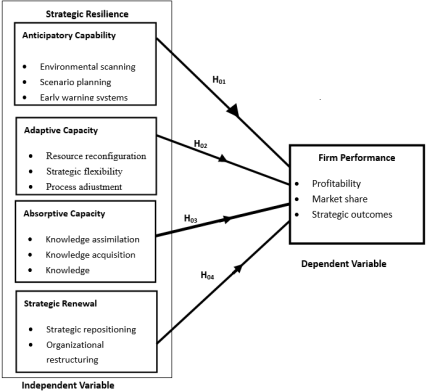
Organizations across the world continue to face increasing volatility, uncertainty, complexity, and ambiguity. These systemic forces expose firms to disruptions that make it difficult to generate and sustain competitive advantage. Consequently, organizations are required to develop strategic capabilities that enable them to sense and seize emerging opportunities and threats, as well as reconfigure resources to maximize value and strengthen strategic positioning. Strategic resilience has emerged as a critical capability that enables organizations to detect environmental turbulence and risks, absorb shocks arising from disruptions, adapt to changing conditions, and sustain long-term performance. Although scholarly interest in strategic resilience within the strategic management literature has grown, findings on its relationship with firm performance remain fragmented and inconsistent. This reflects underlying conceptual ambiguity and theoretical tension between static resource-based explanations and dynamic capability perspectives. This study adopts a literature review approach to examine conceptual, theoretical, and empirical evidence on the relationship between strategic resilience and firm performance, with the aim of identifying research gaps and developing a conceptual framework to guide future studies. The review focuses on studies published between 2000 and 2025 and draws from major academic databases to ensure methodological rigor and comprehensiveness. Strategic resilience is conceptualized as a composite construct comprising anticipatory capability, adaptive capacity, absorptive capacity, and strategic renewal, while firm performance is viewed as a multidimensional outcome encompassing both financial and non-financial indicators. The Dynamic Capabilities Theory and the Resource-Based View provide the theoretical foundation for explaining how strategic resilience influences firm performance. Accordingly, the study proposes a synthesized conceptual model linking strategic resilience and firm performance. The model uniquely integrates composite resilience capabilities with multidimensional performance metrics, which serves as a foundation for future empirical research aimed at enhancing understanding of how organizations can build and sustain competitive advantage in fast-changing and unpredictable environments.
| Published in | European Business & Management (Volume 12, Issue 2) |
| DOI | 10.11648/j.ebm.20261202.13 |
| Page(s) | 23-37 |
| Creative Commons |
This is an Open Access article, distributed under the terms of the Creative Commons Attribution 4.0 International License (http://creativecommons.org/licenses/by/4.0/), which permits unrestricted use, distribution and reproduction in any medium or format, provided the original work is properly cited. |
| Copyright |
Copyright © The Author(s), 2026. Published by Science Publishing Group |
Strategic Resilience, Firm Performance, Dynamic Capabilities, Resource-Based View, Adaptive Capacity, Strategic Renewal, VUCA Environment
RBV | Resource-Based View |
VRIN | Valuable, Rare, Inimitable and Non-Substitutable |
VRIO | Valuable, Rare, Inimitable and Organized |
VUCA | Volatility, Uncertainty, Complexity, Ambiguity |
| [1] | Ambrosini, V., & Bowman, C. (2009). What are dynamic capabilities and are they a useful construct in strategic management? International Journal of Management Reviews, 11(1), 29-49. |
| [2] | Andersén, J. (2011). Strategic resources and firm performance. Management Decision, 49(1), 87-98. |
| [3] | Andrews, K. R. (1971). The concept of corporate strategy. Dow Jones-Irwin. |
| [4] | Ansoff, H. I. (1965). Corporate strategy: An analytic approach to business policy for growth and expansion. McGraw-Hill. |
| [5] | Barney, J. B. (1986). Organizational culture: Can it be a source of sustained competitive advantage? Academy of Management Review, 11(3), 656-665. |
| [6] | Barney, J. B. (1991). Firm resources and sustained competitive advantage. Journal of Management, 17(1), 99-120. |
| [7] | Barney, J. B., & Hesterly, W. S. (2019). Strategic management and competitive advantage: Concepts (6th ed.). Pearson. |
| [8] | Barney, J. B., Ketchen, D. J., & Wright, M. (2011). The future of resource‐based theory. Journal of Management, 37(5), 1299–1315. |
| [9] | Bhamra, R., Dani, S., & Burnard, K. (2011). Resilience: The concept, a literature review and future directions. International Journal of Production Research, 49(18), 5375-5393. |
| [10] | Bititci, U., Garengo, P., Dörfler, V., & Nudurupati, S. (2012). Performance measurement: Challenges for tomorrow. International Journal of Management Reviews, 14(3), 305-327. |
| [11] | Brandon-Jones, E., Squire, B., Autry, C., & Petersen, K. J. (2014). A contingent resource-based perspective of supply chain resilience and robustness. Journal of Supply Chain Management, 50(3), 55-73. |
| [12] | Burnard, K., & Bhamra, R. (2011). Organizational resilience: Development of a conceptual framework for organizational responses. International Journal of Production Research, 49(18), 5581-5599. |
| [13] | Camisón, C., & Villar-López, A. (2014). Organizational innovation as an enabler of technological innovation capabilities and firm performance. Journal of Business Research, 67(1), 289-301. |
| [14] | Carmeli, A., & Markman, G. D. (2011). Capture, governance, and resilience: Strategy implications from the history of Rome. Strategic Management Journal, 32(3), 322-341. |
| [15] | Chandler, A. D. Jr. (1962). Strategy and structure: Chapters in the history of the industrial enterprise. MIT Press. |
| [16] | Chen, C.-J., & Huang, J.-W. (2009). Strategic human resource practices and innovation performance - The mediating role of knowledge management capacity. Journal of Business Research, 62(1), 104-114. |
| [17] | Chen, G., Nie, Q., & Zhao, H. (2023). The influence factors of organizational resilience from a CSR perspective and their impact on business growth. Sustainability, 15(22), 15712. |
| [18] | Chowdhury, M., & Quaddus, M. (2017). Supply chain resilience: Conceptualization and scale development using dynamic capability theory. International Journal of Production Economics, 188(4), 185-204. |
| [19] | Colquitt, J. A., LePine, J. A., & Wesson, M. J. (2012). Organizational behavior: Improving performance and commitment in the workplace (3rd ed.). McGraw-Hill Education. |
| [20] | Crook, T. R., Combs, J. G., & Shook, C. L. (2005). The dimensionality of organizational performance and its implications for strategic management research. Research in Social Stratification and Mobility, 2, 259-286. |
| [21] | D’Aveni, R. A. (1994) Hypercompetition: Managing the Dynamics of Strategic Maneuvering. Free Press, New York. |
| [22] | Danneels, E. (2016). Survey measures of first- and second-order competences. Strategic Management Journal, 37(10), 2174-2188. |
| [23] | Darroch, J. (2005). Knowledge management, innovation and firm performance. Journal of Knowledge Management, 9(3), 101-115. |
| [24] | Doz, Y. L., & Kosonen, M. (2010). Embedding strategic agility: A leadership agenda for accelerating business model renewal. Long Range Planning, 43(2-3), 370-382. |
| [25] | Duchek, S. (2020). Organizational resilience: A capability-based conceptualization. Business Research, 13(1), 215-246. |
| [26] | Eccles, R. G., Ioannou, I., & Serafeim, G. (2014). The impact of corporate sustainability on organizational processes and performance. Management Science, 60(11), 2835-2857. |
| [27] | Eisenhardt, K. M., & Martin, J. A. (2000). Dynamic capabilities: What are they? Strategic Management Journal, 21(10-11), 1105-1121. |
| [28] | Fiske, S. T., & Taylor, S. E. (2013). Social cognition: From brains to culture (2nd ed.). Sage Publications. |
| [29] | Freeman, R. E. (1984). Strategic Management: A Stakeholder Approach. Boston: Pitman. |
| [30] | Grant, R. M. (2019). Contemporary strategy analysis (10th ed.). Wiley. |
| [31] | Hamel, G., & Välikangas, L. (2003). The quest for resilience. Harvard Business Review, 81(9), 52–63. |
| [32] | Hartmann, S., Reymen, I., & van Oosterhout, H. (2021). How to leverage organizational culture in strategic renewal: A configurational perspective. Long Range Planning, 54(2), 102041. |
| [33] | Hartnell, C. A., Ou, A. Y., & Kinicki, A. (2011). Organizational culture and organizational effectiveness: A meta-analytic investigation of the competing values framework’s theoretical suppositions. Journal of Applied Psychology, 96(4), 677-694. |
| [34] | Helfat, C. E., & Peteraf, M. A. (2014). Managerial cognitive capabilities and the microfoundations of dynamic capabilities. Strategic Management Journal, 36(6), 831-850. |
| [35] | Herbane, B. (2019). Rethinking organizational resilience and strategic renewal in SMEs. Entrepreneurship & Regional Development, 31(5-6), 476-495. |
| [36] | Hillmann, J. (2021). Disciplines of organizational resilience: Contributions, critiques, and future research avenues. Review of Managerial Science. Advance online publication. |
| [37] | Hillmann, J., & Guenther, E. (2021). Organizational resilience: A valuable construct for management research? International Journal of Management Reviews, 23(1), 7-44. |
| [38] | Hitt, M. A., Ireland, R. D., & Hoskisson, R. E. (2013). Strategic management: Competitiveness and globalization (10th ed.). Cengage Learning. |
| [39] | Hoque, Z. (2014). 20 years of studies on the Balanced Scorecard: Trends, accomplishments, gaps and opportunities for future research. The British Accounting Review, 46(1), 33-59. |
| [40] | Ivanov, D., & Dolgui, A. (2020). OR-methods for coping with the ripple effect in supply chains during COVID-19 pandemic: Managerial insights and research implications. International Journal of Production Economics, 232, 107921. |
| [41] | Kahneman, D. (2011). Thinking, fast and slow. Farrar, Straus and Giroux. |
| [42] | Kantur, D., & İşeri-Say, A. (2012). Organizational resilience: A conceptual integrative framework. Journal of Management & Organization, 18(6), 762-773. |
| [43] | Kaplan, R. S., & Norton, D. P. (1992). The balanced scorecard: Measures that drive performance. Harvard Business Review, 70(1), 71-79. |
| [44] | Kaplan, R. S., & Norton, D. P. (1996). The balanced scorecard: Translating strategy into action. Harvard Business School Press. |
| [45] | Kaplan, R. S., & Norton, D. P. (2001). The strategy-focused organization: How balanced scorecard companies thrive in the new business environment. Harvard Business School Press. |
| [46] | Kareem, M. A., Reddy, H., & Kolloju, N. (2024). The mediating role of innovation capabilities on the relationship between dynamic capabilities and firm competitive performance. Organizacija, 57(1), 56-71. |
| [47] | Kariuki, J., Kinyua, G. & Waithaka, P. (2023). Empirical Analysis of Core Competences and Performance of Star Rated Hotels in Nairobi City County, Kenya. International Journal of Humanities Social Sciences and Education, 10(10): 46-62. |
| [48] | Kela-Kahingo, C. M., Kinyua, G. M. & Muchemi, A. (2024). Does Strategic Flexibility Influence Organisation Performance of Commercial Banks in Kenya? The Moderating Role of Environmental Dynamism. International Journal of Education and Research, 12(10). 41-60. |
| [49] | Kiarie, M. M. & Kinyua, G. M. (2025). Strategic Fit as an Antecedent of Firm Performance: Evidence from Review of Literature. International Journal of Education and research, 13(2): 221-252. |
| [50] | Kinyua, G. M. (2015). Relationship between Knowledge Management and Performance of Commercial Banks in Kenya. Doctoral Thesis, Kenyatta University; Nairobi, Kenya. |
| [51] | Koech, Z. K. & Kinyua. G. M. (2025). Is Strategic Fit an Antecedent of Service Delivery? Insights from Review of Literature. The International Journal of Humanities & Social Studies, 13(3): 13 – 25. |
| [52] | Kraaijenbrink, J., Spender, J.-C., & Groen, A. J. (2010). The resource-based view: A review and assessment of its critiques. Journal of Management, 36(1), 349-372. |
| [53] | Leiblein, M. J. (2011). What do resource- and capability-based theories propose? Journal of Management, 37(4), 909-932. |
| [54] | Lengnick-Hall, C. A., & Beck, T. E. (2005). Adaptive fit versus robust transformation: How organizations respond to environmental change. Journal of Management, 31(5), 738-757. |
| [55] | Lengnick-Hall, C. A., Beck, T. E., & Lengnick-Hall, M. L. (2011). Developing a capacity for organizational resilience through strategic human resource management. Human Resource Management Review, 21(3), 243-255. |
| [56] | Lin, Y., & Wu, L.-Y. (2014). Exploring the role of dynamic capabilities in firm performance under the resource-based view framework. Journal of Business Research, 67(3), 407-413. |
| [57] | Linnenluecke, M. K. (2017). Resilience in business and management research: A review of influential publications and a research agenda. International Journal of Management Reviews, 19(1), 4-30. |
| [58] | Lockett, A., Thompson, S., & Morgenstern, U. (2009). The development of the resource-based view of the firm: A critical appraisal. International Journal of Management Reviews, 11(1), 9-28. |
| [59] | Lumpkin, G. T., & Dess, G. G. (1996). Clarifying the entrepreneurial orientation construct and linking it to performance. Academy of Management Review, 21(1), 135-172. |
| [60] | McManus, S., Seville, E., Vargo, J., & Brunsdon, D. (2008). Facilitated process for improving organizational resilience. Natural Hazards Review, 9(2), 81-90. |
| [61] | Morgan, N. A., Vorhies, D. W., & Mason, C. H. (2009). Market orientation, marketing capabilities, and firm performance. Strategic Management Journal, 30, 909-920. |
| [62] | Murungi, N. K. & Kinyua, G. M. (2024). The Predictive Role of Organizational Vision on Performance of Medium-Sized Manufacturing Enterprises in Kenya. International Journal of Education and Research, 12(4): 11-28. |
| [63] | Naranjo-Valencia, J. C., Jiménez-Jiménez, D., & Sanz-Valle, R. (2016). Studying the links between organizational culture, innovation, and performance in Spanish companies. Revista Latinoamericana de Psicología, 48(1), 30-41. |
| [64] | Neely, A., Adams, C., & Kennerley, M. (2002). The performance prism: The scorecard for measuring and managing business success. Financial Times Prentice Hall. |
| [65] | Njuguna R. W. & Kinyua G. M. (2024). Leveraging Innovation Strategy for Firm Performance in the context of Equity Bank (K) Limited, Kenya. International Journal of Education and Research, 12(4): 29 - 48. |
| [66] | Nguya, F. N. & Kinyua, G. M. (2023). The Predictive Role of Transformational Capability on Service Delivery of Registered Water Service Providers in Nairobi City County, Kenya. International Journal of Education and Research, 11(10): 85-98. |
| [67] | O’Reilly, C. A., & Tushman, M. L. (2013). Organizational ambidexterity: Past, present and future. SSRN Electronic Journal, 27(4). |
| [68] | Penrose, E. T. (1959). The theory of the growth of the firm. Oxford University Press. |
| [69] | Pettit, T. J., Croxton, K. L., & Fiksel, J. (2019). The evolution of resilience in supply chain management: A retrospective on ensuring supply chain resilience. Journal of Business Logistics, 40(1), 56-65. |
| [70] | Piubello Orsini, L., Leardini, C., Landi, S., & Veronesi, G. (2024). Drivers of adaptive resilience of public sector organizations: An investigation into the individual characteristics of hybrid professional managers. Public Management Review, 26(12), 3577-3600. |
| [71] | Porter, M. E. (1985). Competitive advantage: Creating and sustaining superior performance. Free Press. |
| [72] | Porter, M. E. (1991). Towards a dynamic theory of strategy. Strategic Management Journal, 12(S2), 95-117. |
| [73] | Porter, M. E. (2008). The five competitive forces that shape strategy. Harvard Business Review, 86(1), 78-93. |
| [74] | Priem, R. L., & Butler, J. E. (2001). Is the resource-based “view” a useful perspective for strategic management research? Academy of Management Review, 26(1), 22-40. |
| [75] | Richard, P. J., Devinney, T. M., Yip, G. S., & Johnson, G. (2009). Measuring organizational performance: Towards methodological best practice. Journal of Management, 35(3), 718-804. |
| [76] | Saunila, M. (2014). Innovation capability for SME success: Perspectives of financial and operational performance. Journal of Advances in Management Research, 11(2), 163-175. |
| [77] | Sirmon, D. G., Hitt, M. A., Ireland, R. D., & Gilbert, B. A. (2011). Resource orchestration to create competitive advantage: Breadth, depth, and life cycle effects. Journal of Management, 37(5), 1390-1412. |
| [78] | Slack, N., Chambers, S., & Johnston, R. (2010). Operations management (6th ed.). Pearson Education. |
| [79] | Stoverink, A. C., Kirkman, B. L., Mistry, S., & Rosen, B. (2020). Bouncing back together: Toward a theoretical model of work team resilience. Academy of Management Review, 45(2), 395-422. |
| [80] | Subramaniam, M., & Youndt, M. A. (2005). The influence of intellectual capital on the types of innovative capabilities. Academy of Management Journal, 48(3), 450-463. |
| [81] | Sutcliffe, K. M., & Vogus, T. J. (2003). Organizing for resilience. In K. S. Cameron, J. E. Dutton, & R. E. Quinn (Eds.), Positive organizational scholarship: Foundations of a new discipline (pp. 94-110). Berrett-Koehler. |
| [82] | Teece, D. J. (1990). Contributions and impediments of economic analysis to the study of strategic management. In A. D. Chandler (Ed.), Advances in Strategic Management (pp. 39-80). Routledge. |
| [83] | Teece, D. J. (2007). Explicating dynamic capabilities: The nature and microfoundations of (sustainable) enterprise performance. Strategic Management Journal, 28(13), 1319-1350. |
| [84] | Teece, D. J. (2014). The foundations of enterprise performance: Dynamic and ordinary capabilities in an (economic) theory of firms. Academy of Management Perspectives, 28(4), 328-352. |
| [85] | Teece, D. J. (2018). Business models and dynamic capabilities. Long Range Planning, 51(1), 40-49. |
| [86] | Teece, D. J., & Pisano, G. (1994). The dynamic capabilities of firms: An introduction. Industrial and Corporate Change, 3(3), 537-556. |
| [87] | Teece, D. J., Peteraf, M., & Leih, S. (2016). Dynamic capabilities and organizational agility: Risk, uncertainty, and strategy in the innovation economy. California Management Review, 58(4), 13-35. |
| [88] |
Teece, D. J., Pisano, G., & Shuen, A. (1997). Dynamic capabilities and strategic management. Strategic Management Journal, 18(7), 509-533.
https://doi.org/10.1002/(SICI)1097-0266(199708)18:7<509::AID-SMJ882>3.0.CO;2-Z |
| [89] | Venkatraman, N., & Ramanujam, V. (1986). Measurement of business performance in strategy research: A comparison of approaches. Academy of Management Review, 11(4), 801-814. |
| [90] | Vogus, T. J., & Sutcliffe, K. M. (2007). Organizational resilience: Toward a theory and research agenda. In 2007 IEEE International Conference on Systems, Man and Cybernetics (pp. 3418-3422). IEEE. |
| [91] | Wernerfelt, B. (1984). A resource-based view of the firm. Strategic Management Journal, 5(2), 171–180. |
| [92] | Wheelen, T. L., & Hunger, J. D. (2018). Strategic Management and Business Policy: Globalization, Innovation and Sustainability (15th ed.). Boston: Pearson. |
| [93] | Wieland, A., & Durach, C. F. (2021). Two perspectives on supply chain resilience. Journal of Business Logistics, 42(1), 87-106. |
| [94] | Wieland, A., & Wallenburg, C. M. (2013). The influence of relational competencies on supply chain resilience: A relational view. International Journal of Physical Distribution & Logistics Management, 43(4), 300-320. |
| [95] | Wilden, R., Devinney, T. M., & Dowling, G. R. (2016). The architecture of dynamic capability research: Identifying the building blocks of a configurational approach. Academy of Management Annals, 10(1), 997–1076. |
| [96] | Williams, T. A., Gruber, D. A., Sutcliffe, K. M., Shepherd, D. A., & Zhao, E. Y. (2017). Organizational response to adversity: Fusing crisis management and resilience research streams. The Academy of Management Annals, 11(2), 733-769. |
| [97] | Winter, S. G. (2003). Understanding dynamic capabilities. Strategic Management Journal, 24(10), 991-995. |
| [98] | Wright, G., & Goodwin, P. (2009). Decision making and planning under low levels of predictability: Enhancing the scenario method. International Journal of Forecasting, 25(4), 813-825. |
| [99] | Zahra, S. A., Sapienza, H. J., & Davidsson, P. (2006). Entrepreneurship and dynamic capabilities: A review, model and research agenda. Journal of Management Studies, 43(4), 917-955. |
APA Style
Mwale, F. A., Kinyua, G. M. (2026). Strategic Resilience as a Predictor of Firm Performance: Evidence from a Systematic Literature Review. European Business & Management, 12(2), 23-37. https://doi.org/10.11648/j.ebm.20261202.13
ACS Style
Mwale, F. A.; Kinyua, G. M. Strategic Resilience as a Predictor of Firm Performance: Evidence from a Systematic Literature Review. Eur. Bus. Manag. 2026, 12(2), 23-37. doi: 10.11648/j.ebm.20261202.13
@article{10.11648/j.ebm.20261202.13,
  author = {Fredrick Ambani Mwale and Godfrey Muigai Kinyua},
  title = {Strategic Resilience as a Predictor of Firm Performance: Evidence from a Systematic Literature Review},
  journal = {European Business & Management},
  volume = {12},
  number = {2},
  pages = {23-37},
  doi = {10.11648/j.ebm.20261202.13},
  url = {https://doi.org/10.11648/j.ebm.20261202.13},
  eprint = {https://article.sciencepublishinggroup.com/pdf/10.11648.j.ebm.20261202.13},
  abstract = {Organizations across the world continue to face increasing volatility, uncertainty, complexity, and ambiguity. These systemic forces expose firms to disruptions that make it difficult to generate and sustain competitive advantage. Consequently, organizations are required to develop strategic capabilities that enable them to sense and seize emerging opportunities and threats, as well as reconfigure resources to maximize value and strengthen strategic positioning. Strategic resilience has emerged as a critical capability that enables organizations to detect environmental turbulence and risks, absorb shocks arising from disruptions, adapt to changing conditions, and sustain long-term performance. Although scholarly interest in strategic resilience within the strategic management literature has grown, findings on its relationship with firm performance remain fragmented and inconsistent. This reflects underlying conceptual ambiguity and theoretical tension between static resource-based explanations and dynamic capability perspectives. This study adopts a literature review approach to examine conceptual, theoretical, and empirical evidence on the relationship between strategic resilience and firm performance, with the aim of identifying research gaps and developing a conceptual framework to guide future studies. The review focuses on studies published between 2000 and 2025 and draws from major academic databases to ensure methodological rigor and comprehensiveness. Strategic resilience is conceptualized as a composite construct comprising anticipatory capability, adaptive capacity, absorptive capacity, and strategic renewal, while firm performance is viewed as a multidimensional outcome encompassing both financial and non-financial indicators. The Dynamic Capabilities Theory and the Resource-Based View provide the theoretical foundation for explaining how strategic resilience influences firm performance. Accordingly, the study proposes a synthesized conceptual model linking strategic resilience and firm performance. The model uniquely integrates composite resilience capabilities with multidimensional performance metrics, which serves as a foundation for future empirical research aimed at enhancing understanding of how organizations can build and sustain competitive advantage in fast-changing and unpredictable environments.},
 year = {2026}
}
TY  - JOUR
T1  - Strategic Resilience as a Predictor of Firm Performance: Evidence from a Systematic Literature Review
AU  - Fredrick Ambani Mwale
AU  - Godfrey Muigai Kinyua
Y1  - 2026/05/11
PY  - 2026
N1  - https://doi.org/10.11648/j.ebm.20261202.13
DO  - 10.11648/j.ebm.20261202.13
T2  - European Business & Management
JF  - European Business & Management
JO  - European Business & Management
SP  - 23
EP  - 37
PB  - Science Publishing Group
SN  - 2575-5811
UR  - https://doi.org/10.11648/j.ebm.20261202.13
AB  - Organizations across the world continue to face increasing volatility, uncertainty, complexity, and ambiguity. These systemic forces expose firms to disruptions that make it difficult to generate and sustain competitive advantage. Consequently, organizations are required to develop strategic capabilities that enable them to sense and seize emerging opportunities and threats, as well as reconfigure resources to maximize value and strengthen strategic positioning. Strategic resilience has emerged as a critical capability that enables organizations to detect environmental turbulence and risks, absorb shocks arising from disruptions, adapt to changing conditions, and sustain long-term performance. Although scholarly interest in strategic resilience within the strategic management literature has grown, findings on its relationship with firm performance remain fragmented and inconsistent. This reflects underlying conceptual ambiguity and theoretical tension between static resource-based explanations and dynamic capability perspectives. This study adopts a literature review approach to examine conceptual, theoretical, and empirical evidence on the relationship between strategic resilience and firm performance, with the aim of identifying research gaps and developing a conceptual framework to guide future studies. The review focuses on studies published between 2000 and 2025 and draws from major academic databases to ensure methodological rigor and comprehensiveness. Strategic resilience is conceptualized as a composite construct comprising anticipatory capability, adaptive capacity, absorptive capacity, and strategic renewal, while firm performance is viewed as a multidimensional outcome encompassing both financial and non-financial indicators. The Dynamic Capabilities Theory and the Resource-Based View provide the theoretical foundation for explaining how strategic resilience influences firm performance. Accordingly, the study proposes a synthesized conceptual model linking strategic resilience and firm performance. The model uniquely integrates composite resilience capabilities with multidimensional performance metrics, which serves as a foundation for future empirical research aimed at enhancing understanding of how organizations can build and sustain competitive advantage in fast-changing and unpredictable environments.
VL  - 12
IS  - 2
ER  -
Department of Business Administration, Kenyatta University, Nairobi, Kenya
Department of Business Administration, Kenyatta University, Nairobi, Kenya

Information



 Share This Article
 Twitter
 Linked In
 Facebook
 Copy
Copy Download