
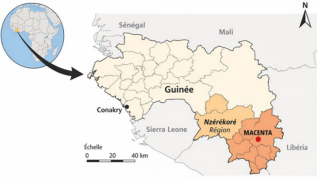
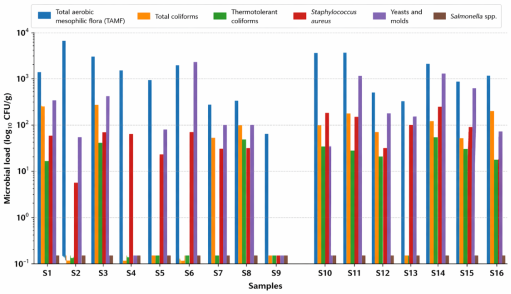
Attieke is a traditional fermented cassava-based food widely consumed in West Africa, particularly in the Republic of Guinea, where it represents an important component of the daily diet. Its microbiological quality is strongly influenced by artisanal processing methods, post-fermentation handling practices, storage conditions, and marketing environments, which may affect product safety. This study aimed to evaluate the microbiological quality of attieke sold in the urban municipality of Macenta, Guinea. Sixteen samples were randomly collected from different retail outlets and analyzed using standard microbiological methods. The parameters investigated included total aerobic mesophilic flora, total and thermotolerant coliforms, Staphylococcus aureus, yeasts and molds, and Salmonella spp. The results showed total aerobic mesophilic counts ranging from 15 to 1,000 CFU/g. Total coliforms were detected in 62.5% of samples, while thermotolerant coliforms were present in 50%, indicating inadequate hygienic conditions during processing and distribution. Staphylococcus aureus and yeasts and molds were detected in 81.3% of samples, with maximum counts of 44 CFU/g and 310 CFU/g, respectively. Salmonella spp. was not detected in any sample (absence in 25 g). Overall, microbial loads were within acceptable limits for ready-to-eat foods. However, the presence of hygiene indicator microorganisms highlights the need to strengthen good hygiene practices throughout the production and distribution chain in order to improve food safety.
| Published in | Frontiers in Environmental Microbiology (Volume 12, Issue 1) |
| DOI | 10.11648/j.fem.20261201.12 |
| Page(s) | 8-15 |
| Creative Commons |
This is an Open Access article, distributed under the terms of the Creative Commons Attribution 4.0 International License (http://creativecommons.org/licenses/by/4.0/), which permits unrestricted use, distribution and reproduction in any medium or format, provided the original work is properly cited. |
| Copyright |
Copyright © The Author(s), 2026. Published by Science Publishing Group |
Attieke, Microbiological Quality, Fermented Foods, Food Hygiene, Macenta
Microbiological parameters | Units | n | Minimum | Maximum |
|---|---|---|---|---|
Total aerobic mesophilic flora (TAMF) | CFU/g | 16 | 15 | 1,000 |
Total coliforms | CFU/g | 16 | 0 | 53 |
Thermotolerant coliforms | CFU/g | 16 | 0 | 15 |
Staphylococcus aureus | CFU/g | 16 | 0 | 44 |
Yeasts and molds | CFU/g | 16 | 0 | 310 |
Salmonella | CFU/25 g | 16 | Absence | Absence |
Microbiological parameters | Number of positive samples | (%) |
|---|---|---|
Total aerobic mesophilic flora (TAMF) | 16 | 100 |
Total coliforms | 10 | 62.5 |
Thermotolerant coliforms | 8 | 50.0 |
Staphylococcus aureus | 13 | 81.3 |
Yeasts and molds | 13 | 81.3 |
Salmonella (25 g) | 0 | 0 |
Parameters | < 10 CFU/g n (%) | 10–10² CFU/g n (%) | > 10² CFU/g n (%) |
|---|---|---|---|
Total aerobic mesophilic flora (TAMF) | 1 (6.3) | 8 (50.0) | 7 (43.7) |
Total coliforms | 6 (37.5) | 10 (62.5) | 0 (0) |
Thermotolerant coliforms | 8 (50.0) | 8 (50.0) | 0 (0) |
Staphylococcus aureus | 3 (18.7) | 11 (68.8) | 2 (12.5) |
Yeasts and molds | 3 (18.7) | 7 (43.8) | 6 (37.5) |
Parameters | Reference criteria (Codex Alimentarius) | Non-compliant samples n (%) |
|---|---|---|
Total aerobic mesophilic flora | ≤ 10⁵ CFU/g | 0 (0) |
Total coliforms | ≤ 10² CFU/g | 0 (0) |
Thermotolerant coliforms | ≤ 10 CFU/g | 4 (25.0) |
Staphylococcus aureus | ≤ 10² CFU/g | 0 (0) |
Yeasts and molds | ≤ 10³ CFU/g | 0 (0) |
Salmonella (25 g) | Absence | 0 (0) |
TAMF | Total Aerobic Mesophilic Flora |
TC | Total Coliforms |
TTC | Thermotolerant Coliforms |
Stap Aureus | Staphylococcus Aureus |
YM | Yeasts and Molds |
Sal | Salmonella |
CFU | Colony Forming Unit |
g | Gram |
e | Number of Samples |
| [1] | Krabi Ekoua, R., Assamoi, A. A., Ehon, A. F., Diawara, B., Niamke, L. S., & Thonart, P. (2015). Production of attieke (fermented cassava couscous) in the city of Abidjan. European Scientific Journal (ESJ), 11, 277–289. |
| [2] | Assanvo, J. B., Agbo, G. N., Coulin, P., et al. (2017). Influence of the microbiological and chemical quality of traditional cassava starters on attieke produced from four cassava varieties. Food Control, 78, 286–296. |
| [3] | Adaye, A. A. (2020). Production and preservation of cassava semolina (attieke) in the city of Bouake (Côte d’Ivoire). Revue Espace, Territoires, Societies et Sante, 3(5), 93–108. |
| [4] | Flibert, G., Donatien, K., Hagretou, S.-L., & Aly, S. (2016). Hygienic quality and nutritional value of attieke from local and imported cassava dough produced with different traditional starters in Burkina Faso. Food and Nutrition Sciences, 7, 555–565. |
| [5] | S. C. K., D. L., S. K., et al. (2005). Reduction of cyanide content during fermentation of cassava roots and leaves to pro-duce bikedi and ntoba mbodi, two traditional foods from Congo. African Journal of Biotechnology, 4, 689–696. |
| [6] | Nazo, E. K.-K., Benjamin, Y. N., Julien, C. K., & Ibrahim, K. (2020). Microbiological quality of attieke (steamed cassava semolina) sold in Côte d’Ivoire. Journal of Agriculture and Biology (JAB), 8, 14. |
| [7] | Dieni, I., Bagre, T. S., Traore, K. A., Zongo, O., Tapsoba, F., Bazie, B. S. R., Nikiema, M. E. M., Sawadogo, A., & Barro, N. (2022). Heavy metals and pathogenic bacteria detected in fermented cassava dough and attieke sold in Ouagadougou, Burkina Faso. International Journal of Biological and Chemical Sciences, 16(5). |
| [8] | Zhang, G., Maturin, L., & Peeler, J. T. (2001). Bacteriological Analytical Manual. U.S. Food and Drug Administration. 3-11. |
| [9] | Kouassi, K. B., Nindjin, C., Kouassi, K. N., & Amani, N. G. (2025). Quality attributes of attieke from lagoon areas selected for geographical indication labelling compared to production in a new zone in Côte d’Ivoire. Journal of Agriculture and Food Research, 21, 101954. |
| [10] | ISO, 6888-1 (2021) Microbiology of the food chain — Horizontal method for the enumeration of coagulase-positive staphylococci (Staphylococcus aureus and other species). 4–7. |
| [11] | Massamby, A., Leong, S. L., Müller, B., et al. (2025). Microbial contamination and food safety aspects of cassava roast-ed flour (“rale”) in Mozambique. Microorganisms, 13, 168. |
| [12] | ISO 6579-1. (2017/2022). Microbiology of the food chain — Horizontal method for the detection, enumeration and serotyping of Salmonella. International Organization for Standardization. |
| [13] | Anoman, A. T., Koussemon, M., Kouassi, K. I., & Ake Assi, Y. (2019). Microbiological quality of garba, a street food in Côte d’Ivoire. International Journal of Biological and Chemical Sciences, 12, 2258. |
| [14] | Koffi, L., Djedji, C., & Kamenan, A. (2009). Irreducible hydrocyanic acid content and microbiological quality of attieke produced in the Abidjan region. Agronomie Africaine, 16, 11–19. |
| [15] | Dembele, R., Konate, A., Traore, O., Kabore, W. A. D., Sarambe, L., Kabore, C. E. T., Bidiga, H., Traore, A. S., & Barro, N. (2018). Evaluation of the hygienic and sanitary quality of artisanal attieke produced in Burkina Faso: Case of “Burkina Journalier”, a local processing unit in Dedougou. International Journal of Multidisciplinary and Current Research. |
| [16] | Coulin P, Farah Z, Assanvo J, et al (2006). Characterisation of the microflora of attieke, a fermented cassava product, during traditional small-scale preparation. International Journal of Food Microbiology 106: 131–136. |
| [17] | Kouadio-Yapo CG, Dou GSP, Aka NAD, et al (2018). Identification of yeast species isolated from attieke marketed in Abidjan (Côte d’Ivoire): a preliminary study. Journal of Medical Mycology 28: 305–309. |
| [18] | Flibert G, Namwin Siourime S, Hamidou C, et al (2021). Lactic Acid Bacteria and Yeasts Associated with Cassava Fermentation to attieke in Burkina Faso and Their Technological Properties. AJFST 9: 173–184. |
| [19] | Assanvo JB, Agbo GN, Behi YEN, et al (2006). Microflora of traditional starter made from cassava for “attiéké” production in Dabou (Côte d’Ivoire). Food Control 17: 37–41. |
| [20] | Alfred, K. K., Jean Paul, B. K. M., Theodore, D. N., & Marcellin, D. K. (2019). Microbiological and chemical hazards of commercial attieke (a fermented cassava product) produced in southern Côte d’Ivoire. Food Quality and Safety, 3, 187–190. |
| [21] | Akmel DC, Aw S, Montet D, et al (2017). Quantitative assessment of the microbiological risk associated with the consumption of attieke in Côte d’Ivoire. Food Control 81: 65–73. |
APA Style
Kouyate, S., Ndiaye, N. A., Dieng, M., Soumaoro, V., Guilavogui, M. (2026). Assessment of the Microbiological Quality of Attieke Marketed in the Urban Municipality of Macenta (Republic of Guinea). Frontiers in Environmental Microbiology, 12(1), 8-15. https://doi.org/10.11648/j.fem.20261201.12
ACS Style
Kouyate, S.; Ndiaye, N. A.; Dieng, M.; Soumaoro, V.; Guilavogui, M. Assessment of the Microbiological Quality of Attieke Marketed in the Urban Municipality of Macenta (Republic of Guinea). Front. Environ. Microbiol. 2026, 12(1), 8-15. doi: 10.11648/j.fem.20261201.12
@article{10.11648/j.fem.20261201.12,
  author = {Sekou Kouyate and Ndeye Adiara Ndiaye and Modou Dieng and Vamougna Soumaoro and Mama Guilavogui},
  title = {Assessment of the Microbiological Quality of Attieke Marketed in the Urban Municipality of Macenta (Republic of Guinea)},
  journal = {Frontiers in Environmental Microbiology},
  volume = {12},
  number = {1},
  pages = {8-15},
  doi = {10.11648/j.fem.20261201.12},
  url = {https://doi.org/10.11648/j.fem.20261201.12},
  eprint = {https://article.sciencepublishinggroup.com/pdf/10.11648.j.fem.20261201.12},
  abstract = {Attieke is a traditional fermented cassava-based food widely consumed in West Africa, particularly in the Republic of Guinea, where it represents an important component of the daily diet. Its microbiological quality is strongly influenced by artisanal processing methods, post-fermentation handling practices, storage conditions, and marketing environments, which may affect product safety. This study aimed to evaluate the microbiological quality of attieke sold in the urban municipality of Macenta, Guinea. Sixteen samples were randomly collected from different retail outlets and analyzed using standard microbiological methods. The parameters investigated included total aerobic mesophilic flora, total and thermotolerant coliforms, Staphylococcus aureus, yeasts and molds, and Salmonella spp. The results showed total aerobic mesophilic counts ranging from 15 to 1,000 CFU/g. Total coliforms were detected in 62.5% of samples, while thermotolerant coliforms were present in 50%, indicating inadequate hygienic conditions during processing and distribution. Staphylococcus aureus and yeasts and molds were detected in 81.3% of samples, with maximum counts of 44 CFU/g and 310 CFU/g, respectively. Salmonella spp. was not detected in any sample (absence in 25 g). Overall, microbial loads were within acceptable limits for ready-to-eat foods. However, the presence of hygiene indicator microorganisms highlights the need to strengthen good hygiene practices throughout the production and distribution chain in order to improve food safety.},
 year = {2026}
}
TY  - JOUR
T1  - Assessment of the Microbiological Quality of Attieke Marketed in the Urban Municipality of Macenta (Republic of Guinea)
AU  - Sekou Kouyate
AU  - Ndeye Adiara Ndiaye
AU  - Modou Dieng
AU  - Vamougna Soumaoro
AU  - Mama Guilavogui
Y1  - 2026/05/11
PY  - 2026
N1  - https://doi.org/10.11648/j.fem.20261201.12
DO  - 10.11648/j.fem.20261201.12
T2  - Frontiers in Environmental Microbiology
JF  - Frontiers in Environmental Microbiology
JO  - Frontiers in Environmental Microbiology
SP  - 8
EP  - 15
PB  - Science Publishing Group
SN  - 2469-8067
UR  - https://doi.org/10.11648/j.fem.20261201.12
AB  - Attieke is a traditional fermented cassava-based food widely consumed in West Africa, particularly in the Republic of Guinea, where it represents an important component of the daily diet. Its microbiological quality is strongly influenced by artisanal processing methods, post-fermentation handling practices, storage conditions, and marketing environments, which may affect product safety. This study aimed to evaluate the microbiological quality of attieke sold in the urban municipality of Macenta, Guinea. Sixteen samples were randomly collected from different retail outlets and analyzed using standard microbiological methods. The parameters investigated included total aerobic mesophilic flora, total and thermotolerant coliforms, Staphylococcus aureus, yeasts and molds, and Salmonella spp. The results showed total aerobic mesophilic counts ranging from 15 to 1,000 CFU/g. Total coliforms were detected in 62.5% of samples, while thermotolerant coliforms were present in 50%, indicating inadequate hygienic conditions during processing and distribution. Staphylococcus aureus and yeasts and molds were detected in 81.3% of samples, with maximum counts of 44 CFU/g and 310 CFU/g, respectively. Salmonella spp. was not detected in any sample (absence in 25 g). Overall, microbial loads were within acceptable limits for ready-to-eat foods. However, the presence of hygiene indicator microorganisms highlights the need to strengthen good hygiene practices throughout the production and distribution chain in order to improve food safety.
VL  - 12
IS  - 1
ER  -
Department of Food Technology and Quality Control, Higher Institute of Science and Veterinary Medicine (ISSMV), Dalaba, Guinea
Biography: Sekou Kouyate is an Assistant Researcher in the Department of Food Technology and Product Control (TCPA) at the Higher Institute of Veterinary Science and Medicine. He obtained his Master’s degree in Quality Management in Bio-Industries from the Higher Polytechnic School (ESP), Cheikh Anta Diop University, in 2024. Recognized for his commitment, rigor, and dedication, Eng. Kouyate, currently a PhD candidate, has been appointed Head of the Physicochemical and Microbiological Laboratory of the institute. He has actively contributed to the microbiological and physicochemical analysis of food products for numerous undergraduate and graduate theses at ISSMV Dalaba, playing a key role in the practical training and scientific development of future professionals in the agri-food sector.
Research Fields: Food quality control, physico-chemical analysis of food, microbiological analysis of food, laboratory management and research, food preservation technology, bio-industrial process management, food product development

Department of Chemical Engineering and Applied Biology, Cheikh Anta Diop University, Dakar, Senegal
Biography: Ndeye Adiara Ndiaye is a Lecturer-Researcher at the Higher Polytechnic School, Cheikh Anta Diop University of Dakar (Senegal). She holds a PhD in Plant and Microbial Biotechnology, specializing in plant breeding. Her multidisciplinary background includes microbiology, biotechnology, quality management, and biological engineering. Her research focuses on applied microbiology, particularly microbiota characterization, food quality, and safety. She uses molecular and analytical techniques to study microbial dynamics in food systems. Her work aims to improve food safety, address public health issues, and promote sustainable agri-food systems. She is actively involved in teaching, research, and supervision of future engineers and researchers.
Research Fields: Microbiology and food safety

Department of Chemical Engineering and Applied Biology, Cheikh Anta Diop University, Dakar, Senegal
Biography: Modou Dieng was born in Pékesse, Thiès region (Senegal). He completed his secondary education at the Military Prytanée of Saint-Louis, obtaining a baccalaureate in natural and physical sciences with honors. He pursued higher education at ENSUT (now ESP), earning a DUT in Biological Analyses and a Technologist Engineering diploma in Sanitary Engineering. He later obtained an AEA and a DEA with honors from the Institute of Environmental Sciences. In 2009, he completed a PhD in Animal Production and Biotechnology at the Inter-State School of Veterinary Sciences and Medicine, graduating with highest honors. He is currently a Lecturer-Researcher at Cheikh Anta Diop University. His teaching includes food microbiology, general microbiology, and waste management. He also serves in key laboratory management roles and has authored around forty scientific publications.
Research Fields: Food microbiology, General microbiology, Solid waste management and recovery, Sanitary engineering and environment, Biotechnology applied to bio-industries

Department of Food Technology and Quality Control, Higher Institute of Science and Veterinary Medicine (ISSMV), Dalaba, Guinea
Biography: Vamougna Soumaoro, born on May 2, 1989, in Nzerekore (Guinea), is a food science specialist with a solid academic background in nutrition and food technology. He holds an Engineering Technologist diploma in Food Products from the Higher Institute of Veterinary Science and Medicine (ISSMV) of Dalaba, Republic of Guinea. He also earned a Master’s degree in Nutrition and Food Sciences, with a specialization in International Nutrition, from the University of Montpellier, France. His training combines expertise in food processing, nutrition, and food quality, contributing to the improvement of food systems and nutritional outcomes.
Research Fields: Food Formulation, Microbial Biotechnology, Food Fermentation, Nutrition – Health

Department of Food Technology and Quality Control, Higher Institute of Science and Veterinary Medicine (ISSMV), Dalaba, Guinea
Biography: Mama Guilavogui graduated from the Department of Food Technology and Quality Control. She has a solid background in food microbiology, quality control, and food safety. Her research interests focus on assessing the microbiological quality of food products, preventing foodborne health risks, and improving agro-food processing methods. She is particularly interested in the safety of locally marketed food products and in developing strategies to reduce contamination. Through her work, she contributes to enhancing food safety and protecting public health within communities.
Research Fields: Microbiological analysis of foods, techniques for counting microorganisms, food formulation


Information



 Share This Article
 Twitter
 Linked In
 Facebook
 Copy
Copy Download