Research Article | | Peer-Reviewed

The Bwan in Dassa: Description of a Traditional Mechanism for Reparation and Prevention of Criminal Conflicts (Burkina Faso)

Received: 11 March 2025     Accepted: 21 March 2025     Published: 14 April 2025
Views:       Downloads:
Abstract

So-called traditional communities have not always enjoyed peaceful inter-individual relations. They experience opposition and conflict, which sometimes lead to an imbalance in social cohesion. Since human relations cannot exist without the expression of power relationships and conflicts, regulatory systems are implemented and collectively adopted to guarantee the stability of social cohesion. Given the ineffectiveness of modern mechanisms and instruments for resolving community conflicts, it is necessary to examine traditional structures for preventing and resolving conflicts between individuals. Among these agrarian mechanisms is the Bwan, a traditional social institution for conflict prevention and regulation. Unable to prevent conflicts from occurring, it acts in such a way as to prevent bloody and deadly confrontations between individuals and communities. The aim of this research is to understand the Bwan mechanism through its conceptual and functional components and its temporal dynamics. This research adopts a comprehensive approach, using the qualitative method of interviewing people with experience in the office of this social fine. The results show that, through its collectively coercive nature, the Bwan is a conflict resolution mechanism. Its community impact helps regulate tensions. It is perceived by communities as a rite of collective expiation, and has a particularly religious basis. Social representations of the Bwan are, however, dynamic in terms of modernization and the precedence given to modern instruments of conflict resolution.

Published in Humanities and Social Sciences (Volume 13, Issue 2)
DOI 10.11648/j.hss.20251302.19
Page(s) 162-169
Creative Commons

This is an Open Access article, distributed under the terms of the Creative Commons Attribution 4.0 International License (http://creativecommons.org/licenses/by/4.0/), which permits unrestricted use, distribution and reproduction in any medium or format, provided the original work is properly cited.

Copyright

Copyright © The Author(s), 2025. Published by Science Publishing Group

Keywords

Bwan, Conflicts, Blood, Community, Dassa

1. Introduction
The analysis of countries' development takes into account issues of security and peace, which constitute one of the Sustainable Development Goals (Goal 16) . In the preamble to the United Nations Charter, peace is mentioned as an objective whose achievement is a common duty of all member states of the organization . Development is conceptualized as the result of the mobilization of technical knowledge and democracy. Thus, development cannot be envisioned without peace, prosperity, technological capital, and a system of governance .
The term peace implies the absence of conflict, which is a characteristic of inter-individual or community relations . Similarly, while conflicts have always existed, people have consistently mobilized initiatives to resolve them . Conflicts, whether latent or overt, signify disagreement between individuals. The causes of social conflict can transcend the individual and may be traced back to dysfunctions within societal structures . In some cases, conflict manifests in acts of extreme violence, necessitating that warring parties observe a lull or achieve peace and reconciliation .
Since conflict is inherent to communities, social norms play a cohesive role in peaceful coexistence . These social norms are often imbued with sacredness, which reinforces their coercive nature . Conflict resolution, therefore, requires the establishment of institutions to regulate deviant behavior among social actors. The judiciary is recognized as the principal organ of modern states responsible for judging those who disobey the law. However, in Africa, it is generally considered to be of colonial origin and is criticized for being ill-suited to the continent’s diverse socio-cultural contexts , limiting its effectiveness in ensuring the pacification of communities.
In the effort to safeguard social equilibrium, the revaluation of so-called traditional values remains an underutilized avenue. In this context, amid conflicts and security crises, reconciliation is increasingly encouraged through the consideration of traditional mechanisms, which have the advantage of addressing both the manifestations and causes of major crimes . Although endogenous conflict resolution mechanisms are often vaguely understood , their principles oppose revenge. They are not universal but rather pluralistic cultural practices. These mechanisms always involve at least two opposing parties and cannot be initiated by a single individual or group . They are collective in scope and commit the community to wiping the slate clean in pursuit of reconciliation.
Reconciliation is "the ideal end to a story that has been violently interrupted" . It comprises two perspectives: a minimalist and a maximalist approach. The minimalist approach advocates peaceful coexistence and the observance of a truce between parties, whereas the maximalist approach seeks to extinguish all forms of disagreement so that the reconciled parties no longer view each other as adversaries. From this perspective, reconciliation is understood as any agreement of appeasement and voluntary renunciation of a right to which opposing parties’ consent .
The quest for community peace often leads to the adoption of protection mechanisms, such as amnesty, for perpetrators of violence. Amnesty is viewed as an invitation to erase past actions, thereby removing the need for sanctions. The advantages of amnesty explain why so many perpetrators (7,000) of crimes in South Africa sought clemency from the Truth and Reconciliation Commission .
Reparations also serve as a means of achieving reconciliation. Like reconciliation itself, reparations involve some form of compensation for harm caused, including psychological reparation for victims and acknowledgment of their suffering . However, reparations do not aim to punish, assign blame, or produce revenge or financial compensation . They do not necessarily equate to the qualitative or quantitative extent of the harm done. Instead, their nature and scope depend on the severity of the injury.
The importance of reparation is secondary to the harm caused, as it serves as an expression of repentance and a public acknowledgment of wrongdoing . The diverse social experiences of communities reveal the necessity of integrating endogenous mechanisms into conflict resolution. Studies have demonstrated the inadequacy of formal crisis management structures. Colonial-era mechanisms, including judicial institutions, remain distant from citizens in multiple respects .
Furthermore, the persistence of security crises in Burkina Faso—at least regarding its endogenous aspects—demonstrates the absence of a comprehensive mechanism for preventing and addressing deviant behavior embedded in the collective consciousness, one capable of safeguarding peace. This situation calls for a reassessment of traditional mechanisms for governing social cohesion. Addressing this need aligns with the imperative of peacebuilding, which entails mobilizing local populations to build peace in post-conflict areas . From this perspective, the Bwan is an integral part of endogenous mechanisms for reparation and conflict prevention in Dassa. It is a social norm established and accepted as a governing principle of community life .
As such, the aim of this research is to identify the foundational elements of the Bwan as a mechanism for conflict prevention and resolution. By examining the Bwan as a social construct, it becomes relevant to consider it a social mechanism for conflict governance.
To this end, this research adopts a comprehensive epistemological approach, using social control theory as its theoretical framework. Social control theory originates from sociological theories of delinquency. An individual may be subject to internal control or external control, which can be formal or informal . The theory refers to the social governance of interactions and aligns with a watchdog approach to ensuring adherence to societal norms and values . Social control functions as a coercive force against deviant individuals, aiming to regulate power dynamics and maintain social cohesion. It is part of community-driven initiatives to establish social order .
The Bwan is a traditional governance mechanism within an agrarian society, operating within a specific community to punish deviant behavior. Its authority applies only to members of the community in which it holds legitimacy. This aligns with the principle of social fine enforcement, which, although diffused throughout the control system, reinforces the power of social control. Several scholars (E. Park, 1864–1944; E. A. Ross, 1866–1951; O. Spengler, 1880–1936; T. Parsons, 1902–1979; R. King Merton, 1910–2003) have contributed to this theory through the functionalist conception of social control, which describes the mechanisms enabling a society to maintain relative social cohesion (p. 18). From this perspective, the Bwan can be viewed as a form of social fine enforcement.
Following the discussion of methodology, the research findings will be presented, followed by an analysis and concluding remarks.
2. Methodology
The analysis of endogenous mechanisms for safeguarding peace and managing crises calls for a qualitative survey to identify the specific logics of action underlying traditional values and procedures. Peacemaking or peace restoration, based on endogenous practices, highlights the role of a diverse system of actors, including elders, nephews, women, holders of traditional knowledge (such as blacksmiths), wise men, and traditional chiefs.
The qualitative method was operationalized through documentary research and individual interviews. This combination of techniques was used to obtain comprehensive information. The literature review enabled an assessment of existing knowledge on the function of social fines, as well as on development and peace-related issues.
The research was conducted in the village of Dassa, in the Sanguié province of Burkina Faso. The target population consisted of people with traditional roots and customary legitimacy. These individuals are primarily elderly members of the land chief’s family, customary figures, or their representatives.
Access to these informants was obtained indirectly. A person with influence among them acted as an intermediary to facilitate interviews. Sampling was purposive, with participants selected based on specific criteria. These criteria included their status as members of families entitled to officiate in the Bwan rite and their experience with the Bwan. The final sample consisted of seven (07) individuals, all men, aged between 50 and approximately 85 years old. These participants included members of the land chief’s family, individuals from other recipient families, customary priests, griots, and those with direct experience of the Bwan.
To gather information, an interview guide was developed. This guide was structured around key themes, such as traditional types of conflict, the definition of the Bwan, the symbolic power of the Bwan, and its role in contemporary societies. The interviews were recorded with the consent of the participants to allow for full transcription.
The data was analyzed thematically. Additionally, to emphasize key concepts within the corpus, a textual analysis was conducted using Nvivo version 14 to identify their occurrence. This combination of thematic and textual analysis was carried out with due respect for argumentative rigor.
3. Results
The results of this research are presented under three main headings: social perceptions of the Bwan in Dassa, the Bwan acquittal process and, finally, what can happen if the Bwan is not paid. The results of this research are presented under three main headings: social perceptions of the Bwan in Dassa, the Bwan acquittal process, and finally, the consequences of not paying the Bwan.
3.1. Social of Perceptions of the Bwan in Dassa
Bwan can be divided into Bwan minor and Bwan major. The minor Bwan is known as the bush Bwan. It is applied in cases of minor offenses with the rank of misdemeanors. These include wounding someone with a knife, theft, witchcraft, etc. The acquittal process for this Bwan lasts just one day, and payment is made in the bush. The "major" Bwan applies in the case of offences ranking as felonies. The acquittal process in this case is more complex, and payment is made in the village. Although they are not on the same scale, their social construction is identical. In this research, we are interested in the Bwan as a regulatory entity.
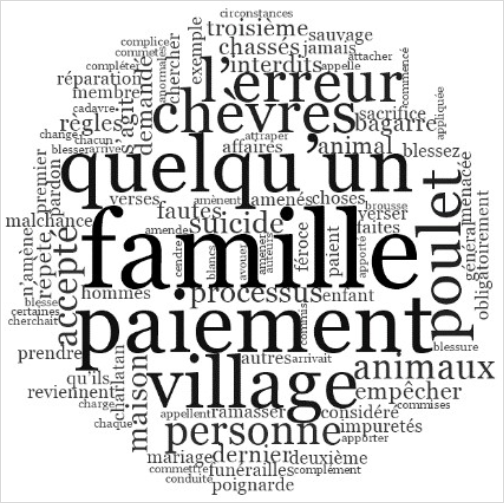
The data presents the "Bwan" using terms that refer to the community. Among the terms used to define the Bwan are: family, payment, someone, village, mistake, chicken, animals, goat, person, etc. The Bwan thus refers on the one hand to the community, and on the other to the price or means used for payment. From this point of view, refers to a social system for repairing a mistake made against another person. It is territorial, consensual and applies.
Within the limits of a territory (village). the Bwan given for the people interviewed, Bwan means "to collect the blood", according to according to respondents BH and BDO (both men from the land chief's family). B. O. (a dignitary from the 's family land chief), "it's to "wash oneself, to purify oneself, to ask forgiveness, to wash away the blood spilt, to wash away the fault", From this point of view can be likened to the social price of reparation or the social price of blood.
Figure 1. Word cloud.
The sentence to pay the Bwan follows a deviation in the application of the rules of village life.
As explains BDO (customary priest sacrificer) the rules and prohibitions were well known to all, because before settling in the village, you were told what was forbidden. For example, you must not steal, court the village wife, kill yourself or someone else, or spill blood in a fight with an iron. If you disobey any of these rules, you pay the Bwan.
It is clear from this testimony that the rules are known to everyone in the village. In this respect, the Bwan is the sanction, the reparation Bwan for non-observance of social rules. It is an act of contrition, a public confession of regret and repentance.
The Bwan is generally known as the social price of blood, and comes into play "if you shed blood on the land: kill someone, commit suicide, stab someone, when you break society's rules of good conduct, when you don't respect the village's prohibitions" (BDO, customary priest-sacrificer). Misconduct such as adultery or the abduction of a village wife is also subject to payment of the Bwan. In this way, payment of the Bwan is perceived as a condemnation, the serving of a sentence. In this sense, "payment of the Bwan was like what, in modern times, 'white men' call prison, where those who do abnormal things serve their sentences", according to DH (village griot).
It should be noted, however, that injuries are wood not subject to social fines or Bwan. This parenthesis is made by BS (85 years old, male member of the land chief's family) in these terms: "When you get into a fight, when you hit each other with wood and then injure yourself, even if blood is shed, the problem is less serious". Less serious in the sense that it doesn't involve a summons to pay the Bwan. This can happen with shepherds, who among the Nuna are generally northern considered socially immature minors.
The data show that also Bwan is paid in the event of a fatal accident.
At "Olibali ", during a rainstorm, a house collapsed while a woman and her child were sleeping inside. Unfortunately, the woman lost her life, while the child remained unharmed. A family member was sent to report the incident to the local authorities, explaining the circumstances that led to the tragedy. The chief ordered the burial of the body. Since the chief was a Bwan, the family bore the funeral expenses, as the death was considered a gura—a "red death" (violent), equivalent to suicide.
This example of a context in which the Bwan was paid reflects the idea of a fine in the event of a "red death", i.e. an unnatural one. We can then assume that by assigning families to the Bwan in these contexts, society feels that any unnatural death must be atoned for, to ward off any other similar cases.
The family of the land chief is the one that governs the cultural rite of Bwan and ensures its administration. However, they are also obliged to pay the Bwan in the event of social misconduct. As BDO () explains priest customary sacrifice, "even land chiefs, when there is a blood fault on their part too, pay the Bwan with the same rigor applied to others. That is, the same number of animals, the same payment process spread over three days". As a result, receivers Bwan are also subject to its payment, and can't get rid of it as long as a violation of the rules of peaceful coexistence is committed.
As this speech also illustrates, payment for the Bwan is made in kind. None of the interviewees mentioned any payment in cash. Instead, Bwan is paid with millet, chickens, goats, and oxen.
Paying it is seen as serving a sentence. In traditional societies, particularly in Dassa, prison sentences are not imposed in criminal cases. However, a person guilty of murder is required to leave the territory where the crime was committed.
The value of Bwan varies depending on the severity of the offense. The number and type of animals given as payment depend on the nature of the dispute between the parties. As one interviewee explained:
"The number and type of animals vary according to the offense. For a minor fight resulting in injuries, payment is made with chickens or goats. However, in cases of death, payment includes chickens, goats, and oxen." — B. A. (man, aged 70, member of a receiving family).
In the traditional system, these animals are interchangeable: four chickens are equivalent to one goat, and four goats to one ox. According to the interviewees, this conversion is applied when the price of Bwan is determined.
3.2. Bwan Acknowledgement Process
Acquittal The acquittal of the Bwan follows a three-day process. During this period, no member of the receiving families (whether man, woman, or child) may greet or offer water to any member of the guilty family. If this occurs, the Bwan is considered paid, and the obligation to make the payment shifts to the receiving families. The payment process involves various rites, as explained by B. D. O., a customary priest and sacrificer.
On the first day, the members of the family where the offence (s) were committed come to the land chief's courtyard with ashes, sit down and clap their hands. At this time, the deans of the receiving families are seated in the oldest house in the courtyard land chiefs. From there, they send a person, who comes out with a stick in hand, talks to the strangers, threatens them, insults them and tells them to get up and leave the door, they are chased away.
This rite is indicative of a ceremony of repentance, a reproduction of a scene of humility. According to the data, the land chief's family adopts a posture of sorrow, rejecting out of hand the guilty family's request for reconciliation.
On the second day, early in the morning, yesterday's hunted return with a few animals. Again, the doyens of the land chief's family sitting in "dji tcha " send someone out to see what you've brought. If you don't have all the animals, you have asked for, you are threatened again and hunted. You tie up the animals you have brought and go home.
The scene is similar to a negotiation session where the parties involved do not formally discuss prices. These sessions symbolize the pain endured by the guilty family to mobilize the price Bwan. So, even if a family is able to pay the fine systematically, it must go through the whole process to demonstrate contrition and submission to the penalty.
On the third day, in the evening, they return with the rest of the animals that the land chiefs have requested. For the first two days, it's goats and the like that are brought in; it's the third day, the last day that the ox or oxen are brought in. This day they bring a chicken. Already, the land chief has sent someone to see a charlatan who shows him how the payment Bwan should be received. On the third day, the day when everything must come to an end, the person who is to take the Bwan first the chicken collects, which is slaughtered as a sacrifice on the altar symbolizing "the earth ". If the chicken slaughtered falls on its back, the Bwan is considered to have been accepted and the fault "washed away", but if the chicken remains on its belly, the Bwan payment is not sufficient, or the family has other impurities. It is then necessary to complete the payment, bring other things and confess everything.
Acceptance of the sacrificial chicken is a sign that payment has been accepted. Some animals are immolated at this point. The payment of the Bwan is a process of purification, reparation and even prevention of other similar cases. The ceremonial preceding the acceptance of the Bwan sums up the request for forgiveness and submission and is a manifestation of regret. It also symbolizes dearness, showing that the payment required is expensive for the accused family, who consequently suffer (symbolically) to mobilize the price set.
3.3. What Happens if the Bwan Is Not Paid
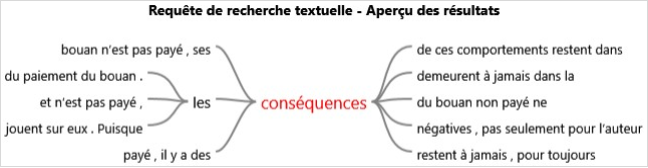
The cloud of words most frequently used to express non-payment of the Bwan shows that the words most frequent are: fault, land, consequence. The data converge to indicate that non-payment of the Bwan entails multiple consequences from the point of view of the people surveyed. The synapse of the word consequence shows that it is used to express the permanence of the fault in the family. For the interviewees, these consequences are felt by all family members and persist until the fault is "washed away".
Social representations suggest that the Bwan is paid as a means of making amends, purifying oneself, and strengthening social cohesion. The Bwan has a communal nature, and its payment is not the sole responsibility of the guilty individual. Instead, it is a punishment carried by the entire lineage of the offender.
From a religious perspective, society attributes power to the rite of Bwan payment, considering it sacred and essential for maintaining the relationship between the living and their ancestors. The function of Bwan from this viewpoint is to appease the ancestors' anger. Individuals believe that failing to pay Bwan results in negative consequences not only for the perpetrator (s) but for the entire family. Abnormal and unusual events will occur within the family, necessitating purification, reparation, and cleansing through Bwan. If it is not paid, the burden remains with the family forever. B. S (85 years old, male member of the land chief's family).
The compulsion to pay is linked to the belief that non-payment sustains the occurrence, maintenance and perpetuation of misfortunes in the family, and ensures the reproduction of similar acts.
If payment is subject to belief, then the question arises as to the survival of this practice in a modern context dominated by science and so-called revealed religions. The data reveal that the Bwan is problematic, even if a few survivals still allow this tradition to be respected. But the general observation remains that because of religions, nowadays when something happens in families, they say it's God's will. If the family hasn't reported the fault, who's going to tell them to pay the Bwan? No one will. Since it's the family of the wrongdoer who brings the information to the land chief and asks for the wrongdoing to be purified and washed away.
However, we need to put into perspective this by observing that the people who watch over the respect of traditions also have their own information network. This makes it difficult to conceal a murder in a village.
Social changes are the determining factor in the inversion of social representations about the Bwan.
In the opinion of B. O. People think it is all a fuss, that it is the chiefs of the land who want to eat the meat. People say: "I'm a Christian, I'm a Muslim, I'm..., I mustn't do these things". Imported religions mean that people are no longer interested in customs, killing tradition. Nowadays, the early deaths of several young people are due to the non-respect of these totems. Some families are dirty because the totems are trampled on. These days, it is difficult to live beyond 60 due to the disrespect of some traditions.
From this perspective, failure to uphold this tradition is believed to have serious consequences for families.
Beyond the hesitations regarding payment, those who still adhere to this tradition often fail to respect its principles. While guilty families neglect proper payment practices, the recipients of the offerings also fail to uphold their obligations, leading to complaints that the Bwan process has changed. As a result, many land chiefs and their representatives are gradually abandoning the tradition, as they no longer fully understand its implications.
Figure 2. Text search query.
4. Discussion
This research highlights several key findings, including the internalization of Bwan in the collective consciousness and the establishment of a symbolic bargaining process for reparation. The internalization and legitimization of Bwan create a form of symbolic power, which aligns with what Bourdieu (1998) calls symbolic violence:
"That paradoxical submission [...] which is exercised essentially through the purely symbolic channels of communication and knowledge or, more precisely, through misrecognition, recognition, or, at the limit, an unconscious sense of obligation" (pp. 12-13).
This symbolic power is rooted in the sacred nature of Bwan, which regulates social interactions and reinforces the link between the spiritual and the living world. The belief that the spiritual realm oversees social order legitimizes the ritual.
The Bwan payment process functions as a negotiation between parties, as it is an interactive system aimed at maintaining peace . In Dassa, the payment of Bwan is a three-day ritual, reinforcing its ceremonial significance . It is, in essence, a negotiated settlement. However, the victim—the very reason for the reparation—is absent from the process. The payment ceremony involves the opposing parties and their relationship to the conflict . In this tradition, the land chief and other cultural authorities purify the land defiled by bloodshed for the benefit of the entire community. This aligns with the findings of Bagayoko and Koné (2017), who concluded that traditional mechanisms prioritize peace and social harmony. Similarly, Séro (2022) asserts that the establishment of social norms serves to maintain stability. However, unlike the palaver tree, which fosters participatory dispute resolution , the guilty party is not present during the final purification ritual. Once the offerings are accepted, they must leave the scene.
Although Bwan has undergone social changes, remnants of the tradition persist, albeit in simplified forms. This supports discussions on the adaptability of traditional African conflict-resolution mechanisms. The case of Bwan illustrates that African traditions are not static . Social change is gradually eroding the authority of traditional leaders who once governed communities . In Dassa, land chiefs lament the perception that Bwan has been reduced to a mere feast for their benefit.
Moreover, the scope of Bwan extends to intra-family, inter-family, and community-level homicides. This finding aligns with the work of Bagayoko and Koné (2017), who identified five types of conflicts addressed by traditional mechanisms: family disputes, leadership conflicts, land disputes, intra-community conflicts, and inter-community conflicts. While Bwan applies to these local conflicts, its primary focus remains on homicide cases.
In contemporary Burkina Faso, Bwan can be considered an alternative mode of conflict resolution, challenging the modern prison system and the increasing disconnect in social prevention strategies. However, this does not imply that Bwan replaces legal trials, as Crook (2014) points out. Instead, it reflects a belief that individuals are products of their communities, and thus, the community is responsible for correcting social transgressions. The relevance of Bwan in conflict resolution is not far-fetched, as similar traditional justice mechanisms have been used to pacify communities in Somalia, Rwanda, and the Democratic Republic of Congo .
5. Conclusions
The aim of this research was to identify the fundamental elements of Bwan as a conflict prevention and resolution mechanism. The study examines the implementation of Bwan as a strategy for crime prevention and reparation in Dassa. It is a system that punishes families whose members are responsible for shedding blood. Bwan operates on two levels: a visible, material dimension—where the payment consists of animals—and a symbolic, spiritual dimension linked to purification and ancestral appeasement.
Despite its high cost, families continue to adhere to Bwan, demonstrating their belief in its sacredness and purifying power. As a traditional governance mechanism, Bwan enforces the communalization of individual transgressions. By applying Bwan, communities not only reaffirm their role in socialization but also emphasize the importance of collective solidarity. The findings of this research suggest that, due to the sacred nature of Bwan and its connection to the spiritual world, communities are able to self-regulate and prevent bloody conflicts.
Abbreviations

UN

United Nations

ECA

Commission Economique Pour l'Afrique

Author Contributions
Bacye Yisso Fidèle is the sole author. The author read and approved the final manuscript.
Conflicts of Interest
The author declares no conflicts of interest.
References
[1] UN, "Sustainable Development Goals," 2023. [Online]. Available:
[2] ECA, "Paix et développement: le point de vue africain," Addis Ababa, 1985.
[3] J. Legoas, "Peace and development in the Andes? Political imaginaries and structural violence in Ilave (Peru)," Anthropologie et sociétés, vol. 30, n 1, pp. 51-74, 2006.
[4] S. Bulle and F. Tarragoni, Sociologie du conflit, Malakoff: Armand Colin, 2021.
[5] F. Diangitukwa, "The distant origin of governance in Africa: the palaver tree," Revue Gouvernance, volume 11, n 1, pp. 1-20,
[6] P. Manirakiza, "L'Afrique et le système de justice pénale internationale," African journal of legal studies, n 3, pp. 21-52, 2009.
[7] V. Rosoux, "portée et limites du concept réconciliation: une histoire à terminer," revue d'études comparatives Est-Ouest, volume 45, n 03-04, pp. 21-47, 2015.
[8] T. Séro, "Normes sociales et sanctions sociales en Afrique noire: le cas du Dahomey de 1600 à 1894," Adilaaku, volume 2, numero 1, pp. 11-33,
[9] G. B. Gbagbo, "La fabrication du droit coutumier africain,"
[10] R. Crook, "Alternative dispute resolution and district courts in Ghana," Afrique contemporaine, volume 2, n 250, pp. 29-54, 2014.
[11] G. O. Faure, "Le traitement négocié du conflit dans les sociétés traditionnelles," Négociation, n 15, pp. 71-87, 2011.
[12] R. Vally, "Histoire, mémoire, réconciliation en Afrique du Sud: le mouvement aux voortrekkers, cinquante ans plus tard: histoire d'une auto-réconciliation," Cahiers d'études africaines, 173-174, pp. 323-341,
[13] S. Ellis and R. Bouyssou, "Vérité sans réconciliation en Afrique du Sud," Critique internationale, vol. 5, pp. 125-137, 1999.
[14] J. Cilliers, O. Dube and B. Siddiqi, "Reconciliation, conflict and development: a field experience in Sierra Leone," 2016. [Online]. Available:
[15] A. J. F. Ajayi, "La politique de Réparation dans le contexte de la mondialisation," Cahiers d'études africaines 173-174, pp. 41-63, on 02/09/2024, 2004.
[16] A. A. Kwame, "Comprendre les réparations: une reflexion préliminaire," Cahiers d'études africaines 173-174, pp. 25-40, 10.4000/etudesafricaines.4518, 2004.
[17] A. J. Sanchez, "La gestion de conflits à l'origine des conflits? "peace building" and the protection of natural resources in Casamance," Cahiers d'Etudes africaines, n 239, pp. 509-533, 2020. h
[18] A. Sene, "Les structures anthropologiques de l'imaginaire en Afrique noire traditionnelle ou vers une archétypologie des concepts de pratiques rituelles et de représentations sociales," PhD thesis, Université Pierre Mendès-France - Grenoble II, 2004.
[19] M. Ouimet, "Chapitre È les théories du contrôle social," La délinquance, Presses de l'Université Laval, pp. 121-158;
[20] B. Bouquet, "Regards sur le contrôle social," in Reconfigurations de l'État social en pratique, Villeneuve d'Ascq, Presses universitaires du Septentrion, 2012, pp. 33-45,
[21] N. Carrier, "La dépression problématique du cncept de contrôle social," deviance et société, Vol. 30(1), pp. 3-20, 2006.
[22] B. Bouquet, "Analyse critique du concept de contrôle social: intérêts, limites et risques," Vie sociale; N 1(1), pp. 15-28, 2012.
[23] P. Bourdieu, La domination masculine, Paris: Edition du Seuil, 1998.
[24] N. Bagayoko and R. F. Koné, "Traditional conflict management mechanisms in Sub-Saharan Africa," Raoul-Dandurand Chair, Montreal, 2017.
[25] interpeace, "Pour un renouveau du Pacte social au Burkina Faso: Jeter les bases d'une paix durable au Burkina Faso: Analyse participative des facteurs de conflit et de résilience,"
[26] M. Rukakiza, B. A. Cimenesa and K. C. Masonga, The African state and traditional cultural mechanisms of conflict transformation, Geneva: Globethics.net Focus 22, 2015.
[27] P. B. Kabongo-Mbaya, "Conflits et paix. Les rites de réconciliation en Afrique," Revue Esprit, pp.
[28] V. Desportes, "La stratégie en théories," politique étrangère, 2 Eté, pp. 165-178, 2014.
Cite This Article
  • APA Style

    Fidèle, B. Y. (2025). The Bwan in Dassa: Description of a Traditional Mechanism for Reparation and Prevention of Criminal Conflicts (Burkina Faso). Humanities and Social Sciences, 13(2), 162-169. https://doi.org/10.11648/j.hss.20251302.19

    Copy | Download

    ACS Style

    Fidèle, B. Y. The Bwan in Dassa: Description of a Traditional Mechanism for Reparation and Prevention of Criminal Conflicts (Burkina Faso). Humanit. Soc. Sci. 2025, 13(2), 162-169. doi: 10.11648/j.hss.20251302.19

    Copy | Download

    AMA Style

    Fidèle BY. The Bwan in Dassa: Description of a Traditional Mechanism for Reparation and Prevention of Criminal Conflicts (Burkina Faso). Humanit Soc Sci. 2025;13(2):162-169. doi: 10.11648/j.hss.20251302.19

    Copy | Download

  • @article{10.11648/j.hss.20251302.19,
      author = {Bacyé Yisso Fidèle},
      title = {The Bwan in Dassa: Description of a Traditional Mechanism for Reparation and Prevention of Criminal Conflicts (Burkina Faso)
    },
      journal = {Humanities and Social Sciences},
      volume = {13},
      number = {2},
      pages = {162-169},
      doi = {10.11648/j.hss.20251302.19},
      url = {https://doi.org/10.11648/j.hss.20251302.19},
      eprint = {https://article.sciencepublishinggroup.com/pdf/10.11648.j.hss.20251302.19},
      abstract = {So-called traditional communities have not always enjoyed peaceful inter-individual relations. They experience opposition and conflict, which sometimes lead to an imbalance in social cohesion. Since human relations cannot exist without the expression of power relationships and conflicts, regulatory systems are implemented and collectively adopted to guarantee the stability of social cohesion. Given the ineffectiveness of modern mechanisms and instruments for resolving community conflicts, it is necessary to examine traditional structures for preventing and resolving conflicts between individuals. Among these agrarian mechanisms is the Bwan, a traditional social institution for conflict prevention and regulation. Unable to prevent conflicts from occurring, it acts in such a way as to prevent bloody and deadly confrontations between individuals and communities. The aim of this research is to understand the Bwan mechanism through its conceptual and functional components and its temporal dynamics. This research adopts a comprehensive approach, using the qualitative method of interviewing people with experience in the office of this social fine. The results show that, through its collectively coercive nature, the Bwan is a conflict resolution mechanism. Its community impact helps regulate tensions. It is perceived by communities as a rite of collective expiation, and has a particularly religious basis. Social representations of the Bwan are, however, dynamic in terms of modernization and the precedence given to modern instruments of conflict resolution.
    },
     year = {2025}
    }
    

    Copy | Download

  • TY  - JOUR
    T1  - The Bwan in Dassa: Description of a Traditional Mechanism for Reparation and Prevention of Criminal Conflicts (Burkina Faso)
    
    AU  - Bacyé Yisso Fidèle
    Y1  - 2025/04/14
    PY  - 2025
    N1  - https://doi.org/10.11648/j.hss.20251302.19
    DO  - 10.11648/j.hss.20251302.19
    T2  - Humanities and Social Sciences
    JF  - Humanities and Social Sciences
    JO  - Humanities and Social Sciences
    SP  - 162
    EP  - 169
    PB  - Science Publishing Group
    SN  - 2330-8184
    UR  - https://doi.org/10.11648/j.hss.20251302.19
    AB  - So-called traditional communities have not always enjoyed peaceful inter-individual relations. They experience opposition and conflict, which sometimes lead to an imbalance in social cohesion. Since human relations cannot exist without the expression of power relationships and conflicts, regulatory systems are implemented and collectively adopted to guarantee the stability of social cohesion. Given the ineffectiveness of modern mechanisms and instruments for resolving community conflicts, it is necessary to examine traditional structures for preventing and resolving conflicts between individuals. Among these agrarian mechanisms is the Bwan, a traditional social institution for conflict prevention and regulation. Unable to prevent conflicts from occurring, it acts in such a way as to prevent bloody and deadly confrontations between individuals and communities. The aim of this research is to understand the Bwan mechanism through its conceptual and functional components and its temporal dynamics. This research adopts a comprehensive approach, using the qualitative method of interviewing people with experience in the office of this social fine. The results show that, through its collectively coercive nature, the Bwan is a conflict resolution mechanism. Its community impact helps regulate tensions. It is perceived by communities as a rite of collective expiation, and has a particularly religious basis. Social representations of the Bwan are, however, dynamic in terms of modernization and the precedence given to modern instruments of conflict resolution.
    
    VL  - 13
    IS  - 2
    ER  - 

    Copy | Download

Author Information