Abstract
We present a clump-scale observational study of magnetic-field structure and star formation efficiency (SFE) using published dust polarization observations obtained with the James Clerk Maxwell Telescope (JCMT) POL-2 instrument. The sample consists of 11 predominantly high-mass star-forming clumps associated with clustered and filamentary molecular environments. Plane-of-sky magnetic-field strengths derived from published Davis-Chandrasekhar-Fermi (DCF) analyses were examined together with magnetic-field morphology and star formation efficiency measurements compiled from the literature. The results show that the relationship between magnetic-field strength and star formation efficiency is not characterized by a simple monotonic trend. Spearman rank correlation analysis indicates a weak and statistically insignificant negative relationship between magnetic-field strength and SFE, while the observed -SFE distribution exhibits substantial scatter across the sample. Regions with comparable magnetic-field strengths therefore display significantly different star formation efficiencies, indicating that magnetic-field strength alone does not uniquely regulate star formation at clump scales. Representative JCMT POL-2 polarization maps show that the sampled regions are dominated by ordered hourglass-like and partially pinched magnetic-field morphologies. Hourglass-like structures are generally associated with intermediate to strong magnetic fields and relatively low or moderate efficiencies, whereas pinched morphologies occupy a broader range of SFE values. The results support a scale-dependent interpretation of magnetic regulation in which magnetic fields influence collapse geometry and dense gas structure, while star formation efficiency emerges from the coupled interaction of gravity, fragmentation, turbulence, filamentary accretion, and stellar feedback within dynamically evolving molecular clumps.
Keywords
Star Formation, Magnetic Fields, Polarization, Interstellar Medium, Submillimeter, Turbulence
1. Introduction
Star formation within molecular clouds is governed by the interplay between gravity, turbulence, magnetic fields, and stellar feedback. Magnetic fields, in particular, are thought to influence the evolution of dense gas by providing support against gravitational collapse, guiding mass accretion, and regulating angular momentum transport
| [5] | Crutcher, R. M. 2012, ARA&A, 50, 29.
https://doi.org/10.1146/annurev-astro-081811-125514 |
| [18] | Li, H.-B., Goodman, A., Sridharan, T. K., et al. 2014, Protostars and Planets VI, 101.
https://doi.org/10.2458/azu_uapress_9780816531240-ch005 |
[5, 18]
. At larger spatial scales, magnetic fields may also shape the formation of filamentary structures and dense clumps that serve as the sites of clustered star formation
| [1] | André, P., Di Francesco, J., Ward-Thompson, D., et al. 2014, Protostars and Planets VI, 27.
https://doi.org/10.2458/azu_uapress_9780816531240-ch002 |
| [20] | McKee, C. F., & Ostriker, E. C. 2007, ARA&A, 45, 565.
https://doi.org/10.1146/annurev.astro.45.051806.110602 |
[1, 20]
.
Observationally, the structure of magnetic fields in star-forming regions can be probed through polarized thermal emission from aligned dust grains
. Large-scale polarimetric surveys conducted with the James Clerk Maxwell Telescope, particularly the BISTRO program
| [25] | Pattle, K., Ward-Thompson, D., Kirk, J. M., et al. 2017, ApJ, 846, 122. https://doi.org/10.3847/1538-4357/aa8096 |
| [30] | Ward-Thompson, D., Pattle, K., Kirk, J. M., et al. 2017, ApJ, 842, 66. https://doi.org/10.3847/1538-4357/aa71b2 |
[25, 30]
, have provided detailed maps of magnetic-field morphology across entire molecular clouds and star-forming clumps. These observations reveal a wide range of magnetic-field configurations, including ordered hourglass morphologies associated with gravitational collapse and more complex or turbulent structures linked to feedback and dynamical interactions
| [26] | Pattle, K., Lai, S.-P., Di Francesco, J., et al. 2022, ApJ, 924, 18.
https://doi.org/10.3847/1538-4357/ac32b1 |
| [28] | Soam, A., Pattle, K., Ward-Thompson, D., et al. 2018, ApJ, 861, 65. https://doi.org/10.3847/1538-4357/aac4be |
[26, 28]
.
Star formation efficiency (SFE), defined as the fraction of gas converted into stars, provides a key diagnostic of how effectively gravitational collapse proceeds under the influence of magnetic fields and other physical processes
| [8] | Evans, N. J., II, Dunham, M. M., Jørgensen, J. K., et al. 2009, ApJS, 181, 321. https://doi.org/10.1088/0067-0049/181/2/321 |
| [17] | Krumholz, M. R., Bate, M. R., Arce, H. G., et al. 2014, Protostars and Planets VI, 243.
https://doi.org/10.2458/azu_uapress_9780816531240-ch011 |
[8, 17]
. Previous studies have suggested that strong magnetic fields can suppress star formation by supporting gas against collapse, while weaker or more disordered fields may allow more efficient star formation
| [5] | Crutcher, R. M. 2012, ARA&A, 50, 29.
https://doi.org/10.1146/annurev-astro-081811-125514 |
| [25] | Pattle, K., Ward-Thompson, D., Kirk, J. M., et al. 2017, ApJ, 846, 122. https://doi.org/10.3847/1538-4357/aa8096 |
[5, 25]
. However, the relationship between magnetic field strength and SFE remains unclear, particularly at clump scales where multiple processes act simultaneously.
In this work, we analyze a sample of 11 JCMT-observed star-forming clumps to investigate how magnetic field strength, morphology, structural environment, and feedback activity relate to star formation efficiency. By restricting the analysis to a homogeneous single-dish dataset, this study isolates clump-scale magnetic regulation and complementing previous studies that emphasize the role of density and environmental conditions in shaping star formation efficiency
| [23] | Okezuonu, P. C., & Ogwo, J. N. 2021, Int. J. Astrophys. Space Sci., 9, 45. |
[23]
.
2. Materials and Methods
2.1. Sample Selection
The sample used in this study consists of 11 star-forming regions observed with the James Clerk Maxwell Telescope (JCMT) using the POL-2 polarimeter at submillimetre wavelengths. The sources were compiled from published JCMT POL-2 and BISTRO studies
| [26] | Pattle, K., Lai, S.-P., Di Francesco, J., et al. 2022, ApJ, 924, 18.
https://doi.org/10.3847/1538-4357/ac32b1 |
| [27] | Planck Collaboration. 2016, A&A, 586, A138.
https://doi.org/10.1051/0004-6361/201525896 |
| [30] | Ward-Thompson, D., Pattle, K., Kirk, J. M., et al. 2017, ApJ, 842, 66. https://doi.org/10.3847/1538-4357/aa71b2 |
[26, 27, 30]
, in which dust polarization maps, magnetic-field morphology, and related physical quantities have been reported. The aim of the sample selection was to construct a comparative dataset of clump-scale regions for which magnetic-field structure, gas properties, and star-formation activity could be examined together.
Sources were included when they satisfied three conditions. First, each region had published JCMT POL-2 polarization observations with sufficient spatial coverage to trace the large-scale plane-of-sky magnetic-field morphology across the dominant dense gas structure
| [11] | Hildebrand, R. H., Kirby, L., Dotson, J. L., et al. 2009, ApJ, 696, 567. https://doi.org/10.1088/0004-637X/696/1/567 |
| [27] | Planck Collaboration. 2016, A&A, 586, A138.
https://doi.org/10.1051/0004-6361/201525896 |
[11, 27]
. Second, the region had available literature estimates of magnetic-field strength or the quantities required for magnetic-field estimation, including gas density, velocity dispersion, and polarization angle dispersion
| [6] | Crutcher, R. M., Hakobian, N., & Troland, T. H. 2004, ApJ, 600, 279. https://doi.org/10.1086/379705 |
| [25] | Pattle, K., Ward-Thompson, D., Kirk, J. M., et al. 2017, ApJ, 846, 122. https://doi.org/10.3847/1538-4357/aa8096 |
[6, 25]
. Third, the source had published gas mass and stellar or embedded cluster mass estimates that allowed a first-order estimate of star formation efficiency
| [8] | Evans, N. J., II, Dunham, M. M., Jørgensen, J. K., et al. 2009, ApJS, 181, 321. https://doi.org/10.1088/0067-0049/181/2/321 |
| [21] | Motte, F., Bontemps, S., & Louvet, F. 2018, Nature Astronomy, 2, 478. https://doi.org/10.1038/s41550-018-0452-x |
| [29] | Urquhart, J. S., König, C., Giannetti, A., et al. 2018, MNRAS, 473, 1059. https://doi.org/10.1093/mnras/stx2258 |
[8, 21, 29]
.
The resulting sample is dominated by high-mass and clustered star-forming environments observed at single-dish resolution. These regions include dense clumps, embedded clusters, and massive star-forming complexes in which gravity, magnetic fields, turbulence, filamentary gas structure, and feedback may act simultaneously
| [1] | André, P., Di Francesco, J., Ward-Thompson, D., et al. 2014, Protostars and Planets VI, 27.
https://doi.org/10.2458/azu_uapress_9780816531240-ch002 |
| [17] | Krumholz, M. R., Bate, M. R., Arce, H. G., et al. 2014, Protostars and Planets VI, 243.
https://doi.org/10.2458/azu_uapress_9780816531240-ch011 |
| [20] | McKee, C. F., & Ostriker, E. C. 2007, ARA&A, 45, 565.
https://doi.org/10.1146/annurev.astro.45.051806.110602 |
[1, 17, 20]
. The sources were selected from previously published JCMT POL-2 studies and are analyzed here as an observational compilation. The derived trends are therefore interpreted at the level of clump-scale comparison and not as precision measurements of individual collapse systems.
2.2. Magnetic-Field Morphology and Environmental Information
Magnetic-field morphology was characterized using the published JCMT POL-2 polarization maps and the interpretations reported in the original observational studies. The plane-of-sky magnetic-field orientation is inferred from polarized thermal dust emission produced by magnetically aligned dust grains
, with the observed polarization vectors rotated by 90° to trace the projected magnetic-field direction. Across the sample, the reported magnetic-field structures include ordered hourglass-like configurations, partially pinched structures, and more complex field geometries.
In this work, morphology is used as an observational descriptor rather than as a rigid classification system. Hourglass-like fields refer to cases where the magnetic-field pattern shows coherent inward curvature toward a dense central region, consistent with gravitationally influenced field compression
| [9] | Girart, J. M., Rao, R., & Marrone, D. P. 2006, Science, 313, 812. https://doi.org/10.1126/science.1129092 |
| [13] | Hull, C. L. H., Girart, J. M., Tychoniec, Ł., et al. 2017, ApJ, 847, 92. https://doi.org/10.3847/1538-4357/aa7fe9 |
[9, 13]
. Pinched fields describe cases where the field shows partial bending or compression but lacks the symmetry of a classical hourglass configuration
| [15] | Koch, P. M., Tang, Y.-W., & Ho, P. T. P. 2012, ApJ, 747, 79.
https://doi.org/10.1088/0004-637X/747/1/79 |
| [16] | Koch, P. M., Tang, Y.-W., Yen, H.-W., et al. 2018, ApJ, 855, 39.
https://doi.org/10.3847/1538-4357/aaab4c |
[15, 16]
. More complex magnetic patterns correspond to regions where the polarization structure is less ordered or affected by local dynamical interactions and feedback processes
.
Environmental information, including the presence of filamentary structure, embedded star formation, molecular outflows, expanding H II regions, and other feedback signatures, was taken from the literature associated with each source
| [1] | André, P., Di Francesco, J., Ward-Thompson, D., et al. 2014, Protostars and Planets VI, 27.
https://doi.org/10.2458/azu_uapress_9780816531240-ch002 |
| [2] | Arce, H. G., Shepherd, D., Gueth, F., et al. 2007, Protostars and Planets V, 245.
https://doi.org/10.48550/arXiv.astro-ph/0603071 |
| [3] | Bally, J. 2016, ARA&A, 54, 491.
https://doi.org/10.1146/annurev-astro-081915-023341 |
| [22] | Myers, P. C. 2009, ApJ, 700, 1609.
https://doi.org/10.1088/0004-637X/700/2/1609 |
[1-3, 22]
. These properties are considered when interpreting the scatter in magnetic-field strength and star formation efficiency, but they are not used here to construct formal subclasses. This approach avoids over-interpreting a relatively small sample and keeps the analysis focused on the observable relationship between magnetic-field strength, magnetic morphology, and star-formation efficiency at clump scales.
2.3. Star Formation Efficiency
The star formation efficiency (SFE), was estimated for each region using the standard expression.
where (
) is the stellar or embedded cluster mass and (
) is the molecular gas mass associated with the clump or star-forming region
| [8] | Evans, N. J., II, Dunham, M. M., Jørgensen, J. K., et al. 2009, ApJS, 181, 321. https://doi.org/10.1088/0067-0049/181/2/321 |
| [17] | Krumholz, M. R., Bate, M. R., Arce, H. G., et al. 2014, Protostars and Planets VI, 243.
https://doi.org/10.2458/azu_uapress_9780816531240-ch011 |
[8, 17]
. Gas masses were compiled from published continuum or molecular-line studies, while stellar masses were taken from literature estimates of embedded stellar populations, protostellar content, or cluster mass associated with each region
| [14] | Kauffmann, J., Bertoldi, F., Bourke, T. L., et al. 2008, A&A, 487, 993. https://doi.org/10.1051/0004-6361:200809481 |
| [21] | Motte, F., Bontemps, S., & Louvet, F. 2018, Nature Astronomy, 2, 478. https://doi.org/10.1038/s41550-018-0452-x |
| [29] | Urquhart, J. S., König, C., Giannetti, A., et al. 2018, MNRAS, 473, 1059. https://doi.org/10.1093/mnras/stx2258 |
[14, 21, 29]
.
Because the JCMT observations trace extended clump-scale environments, the resulting SFE values should be interpreted as approximate regional efficiencies rather than precise efficiencies of individual protostellar cores. The estimates may be affected by uncertainties in dust temperature, opacity, gas-to-dust ratio, source distance, aperture definition, and the adopted stellar content
| [1] | André, P., Di Francesco, J., Ward-Thompson, D., et al. 2014, Protostars and Planets VI, 27.
https://doi.org/10.2458/azu_uapress_9780816531240-ch002 |
| [10] | Hildebrand, R. H. 1983, QJRAS, 24, 267. |
[1, 10]
. In addition, sources at different evolutionary stages may have different gas reservoirs and stellar populations. For this reason, SFE is used here primarily as a comparative indicator of star-formation activity within the compiled clump-scale sample.
2.4. Magnetic-Field Strength
The plane-of-sky magnetic-field strength, (
), was estimated or compiled using values based on the Davis-Chandrasekhar-Fermi (DCF) method
| [4] | Chandrasekhar, S., & Fermi, E. 1953, ApJ, 118, 113 |
| [7] | Davis, L. 1951, Physical Review, 81, 890.
https://doi.org/10.1103/PhysRev.81.890 |
[4, 7]
. In its commonly used form, the method is written as
where (Q) is a correction factor, (
) is the gas mass density, (
) is the non-thermal velocity dispersion, and (
) is the dispersion in polarization position angle expressed in radians. A correction factor of order (Q
0.5) is commonly adopted for turbulent molecular clouds based on numerical calibrations
.
The physical quantities entering the DCF calculation were taken from the published studies associated with each source. Gas densities were obtained from reported clump masses and characteristic source sizes, velocity dispersions from molecular-line observations tracing dense gas, and polarization angle dispersions from JCMT POL-2 polarization measurements or the corresponding literature analysis
| [6] | Crutcher, R. M., Hakobian, N., & Troland, T. H. 2004, ApJ, 600, 279. https://doi.org/10.1086/379705 |
| [19] | Liu, H. B., Zhang, Q., Wright, M. C. H., et al. 2021, ApJ, 912, 92. https://doi.org/10.3847/1538-4357/abee83 |
| [28] | Soam, A., Pattle, K., Ward-Thompson, D., et al. 2018, ApJ, 861, 65. https://doi.org/10.3847/1538-4357/aac4be |
[6, 19, 28]
. Where published magnetic-field strengths were already available, those values were adopted to preserve consistency with the original observational work.
DCF-based magnetic-field estimates are subject to significant uncertainties arising from density estimates, velocity-linewidth measurements, beam averaging, projection effects, and the assumption that polarization angle dispersion is produced mainly by turbulent perturbations of the magnetic field
| [5] | Crutcher, R. M. 2012, ARA&A, 50, 29.
https://doi.org/10.1146/annurev-astro-081811-125514 |
| [11] | Hildebrand, R. H., Kirby, L., Dotson, J. L., et al. 2009, ApJ, 696, 567. https://doi.org/10.1088/0004-637X/696/1/567 |
| [12] | Houde, M., Vaillancourt, J. E., Hildebrand, R. H., et al. 2009, ApJ, 706, 1504.
https://doi.org/10.1088/0004-637X/706/2/1504 |
[5, 11, 12]
. Therefore, the magnetic-field strengths used in this study are treated as order-of-magnitude comparative estimates rather than exact measurements. The analysis emphasizes relative behaviour across the sample rather than precise absolute values for individual regions.
2.5. Treatment of Morphology in the Analysis
Magnetic-field morphology was used to guide the interpretation of the relationship between
and SFE. The morphology assigned to each source follows the dominant field pattern reported in the original JCMT POL-2/BISTRO studies
| [25] | Pattle, K., Ward-Thompson, D., Kirk, J. M., et al. 2017, ApJ, 846, 122. https://doi.org/10.3847/1538-4357/aa8096 |
| [26] | Pattle, K., Lai, S.-P., Di Francesco, J., et al. 2022, ApJ, 924, 18.
https://doi.org/10.3847/1538-4357/ac32b1 |
| [30] | Ward-Thompson, D., Pattle, K., Kirk, J. M., et al. 2017, ApJ, 842, 66. https://doi.org/10.3847/1538-4357/aa71b2 |
[25, 26, 30]
. This avoids redefining source structures independently from published maps and ensures that the present analysis remains anchored to the observational literature.
The comparison focuses on whether sources with more ordered magnetic-field structures occupy different regions of the -SFE parameter space from sources with partially pinched or more complex fields. Because the sample size is limited, the morphology analysis is interpreted qualitatively and comparatively. It is not used to claim a universal evolutionary sequence or a statistically complete classification of high-mass star-forming clumps.
3. Results
3.1. Sample Characteristics
The JCMT sample consists of 11 high-mass clump-scale star-forming regions selected from published POL-2/BISTRO polarization surveys. The sources span a range of magnetic-field strengths and evolutionary environments but are uniformly associated with dense molecular clumps traced at single-dish resolution. Most regions exhibit filamentary structure and evidence of ongoing star-formation activity, including molecular outflows, embedded heating sources, and expanding ionized gas reported in the original observational studies. The sample therefore consists of dynamically active high-mass clump environments containing dense gas, embedded star formation, and evidence of feedback activity as seen in the original studies.
Because the present study focuses on comparative magnetic-field behaviour at clump scales, the analysis emphasizes the relationship between magnetic-field strength, magnetic morphology, and star-formation efficiency across the observed JCMT regions.
3.2. Magnetic Field Strength and Star Formation Efficiency
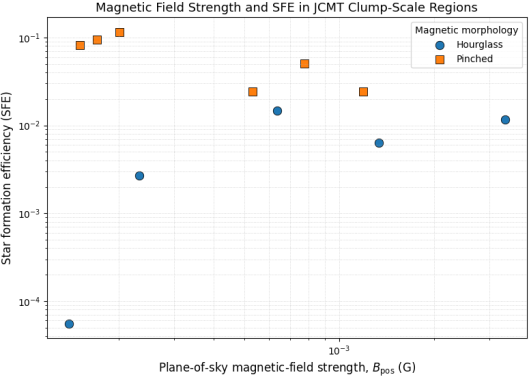
The JCMT clump-scale sample spans approximately two orders of magnitude in plane-of-sky magnetic-field strength, from (
) G to (
) G. The derived star formation efficiencies similarly cover a broad range, extending from (
) to (
). The full set of
and SFE values is presented in Appendix
Table A1 and
Figure 1 shows their relationships.
Figure 1. Star formation efficiency versus plane-of-sky magnetic-field strength for the JCMT clump-scale sample, grouped according to the dominant magnetic-field morphology reported in the literature. The distribution shows substantial scatter.
The sources are distributed across the parameter space without forming a single well-defined linear or monotonic trend. Several regions with relatively weak magnetic fields exhibit comparatively high SFE values, while some strongly magnetized regions remain associated with lower or moderate efficiencies.
The sample also shows overlap between regions with ordered hourglass-like magnetic structures and those with partially pinched morphologies. Hourglass systems are present across intermediate to strong magnetic-field strengths, whereas pinched morphologies occupy a broader range of SFE values. Despite this spread, most regions remain concentrated within the low-to-moderate efficiency regime characteristic of clump-scale star-forming environments.
Overall, the observed distribution indicates that the relationship between magnetic-field strength and star formation efficiency is not characterized by a single uniform trend across the JCMT sample.
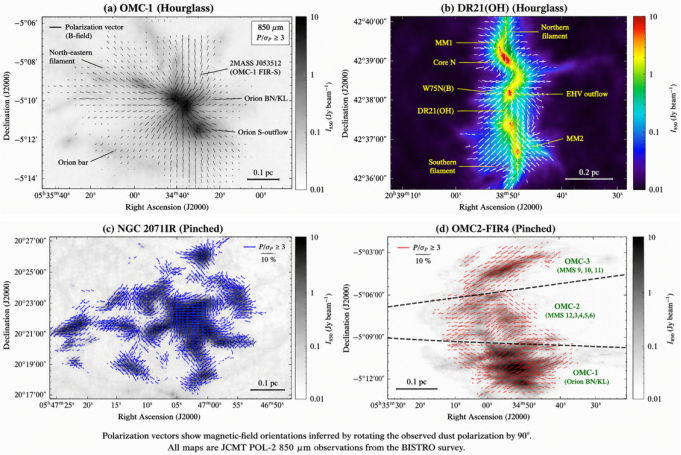
Figure 2, shows the JCMT POL-2 polarization maps.
3.3. Magnetic-Field Morphology and Representative Source Properties
The JCMT clump-scale sample exhibits predominantly hourglass-like and pinched magnetic-field morphologies, as described in Section 2.2. Representative regions together with their plane-of-sky magnetic-field strengths and star formation efficiencies are listed in
Table 1, while the complete dataset is presented in Appendix
Table A1.
Table 1. Representative JCMT clump-scale regions showing magnetic-field morphology, plane-of-sky magnetic-field strength, and star formation efficiency.
Source | Morphology-like | (G) | SFE |
W3 Main | Hourglass | 1.39E-04 | 5.57E-05 |
Orion-KL | Hourglass | 3.36E-03 | 1.17E-02 |
DR21(OH) | Hourglass | 1.34E-03 | 6.30E-03 |
G034.43+00.24 MM3 | Pinched | 1.19E-03 | 2.45E-02 |
OMC2-FIR4 | Pinched | 7.76E-04 | 5.05E-02 |
Table 1 shows that regions exhibiting hourglass-like magnetic-field structures, including W3 Main, Orion-KL, and DR21(OH), span intermediate to relatively strong magnetic-field strengths within the sample. Pinched morphologies, represented by sources such as OMC2-FIR4 and G034.43+00.24 MM3, occupy a broader range of star formation efficiencies and magnetic-field strengths.
Overall, both hourglass-like and pinched magnetic-field morphologies are present across the JCMT clump-scale sample, with pinched configurations forming the majority of the observed regions.
3.4. Statistical Characterisation of the Magnetic-Field-SFE Relation
To quantify the relationship between plane-of-sky magnetic-field strength and star formation efficiency, a Spearman rank correlation analysis was performed using logarithmic values of and SFE for the JCMT clump-scale sample. The analysis yields a weak correlation coefficient of ( = −0.21) with a corresponding p-value of (p ), indicating the absence of a statistically significant monotonic relationship between magnetic-field strength and star formation efficiency within the sample.
Figure 1 shows substantial scatter across the distribution, particularly at low and intermediate magnetic-field strengths, where regions with comparable
values exhibit markedly different star formation efficiencies. Although some strongly magnetized regions are associated with relatively lower efficiencies, the overall distribution does not follow a simple monotonic trend.
4. Discussion
4.1. Magnetic Fields and Star Formation Efficiency at Clump Scales
The JCMT clump-scale results show that the relationship between plane-of-sky magnetic-field strength and star formation efficiency is not described by a single monotonic trend. The broad scatter observed in
Figure 1, together with the weak Spearman correlation coefficient
, (p = 0.55), indicates that magnetic-field strength alone does not uniquely determine how efficiently gas is converted into stars within the sampled regions. This result is consistent with
, who showed that magnetic-field strength generally increases with gas density but does not by itself provide a complete description of star-formation activity.
The observed behaviour also agrees with previous JCMT POL-2 and BISTRO studies, which demonstrated that magnetic fields influence dense gas structure while interacting simultaneously with gravity, turbulence, and local environmental conditions
| [25] | Pattle, K., Ward-Thompson, D., Kirk, J. M., et al. 2017, ApJ, 846, 122. https://doi.org/10.3847/1538-4357/aa8096 |
| [26] | Pattle, K., Lai, S.-P., Di Francesco, J., et al. 2022, ApJ, 924, 18.
https://doi.org/10.3847/1538-4357/ac32b1 |
[25, 26]
. In the present sample, strongly magnetized regions such as Orion-KL and DR21(OH) are associated with relatively modest star formation efficiencies, whereas some regions with weaker or intermediate field strengths exhibit comparatively higher efficiencies. This distribution suggests that magnetic fields may regulate or delay collapse at clump scales, but do not completely suppress star formation once fragmentation, gravitational inflow, and clustered activity become important.
The absence of a strong monotonic relationship therefore supports a non-deterministic view of magnetic regulation, in which star formation efficiency emerges from the combined influence of magnetic support, cloud structure, gravitational collapse, turbulence, and feedback processes rather than from magnetic-field strength alone.
4.2. Magnetic-Field Morphology at Clump Scales
The polarization maps presented in
Figure 2 show that the JCMT sample is dominated by ordered hourglass-like and partially pinched magnetic-field morphologies. Such ordered configurations are commonly associated with gravitational compression of initially coherent magnetic fields within dense molecular gas
| [9] | Girart, J. M., Rao, R., & Marrone, D. P. 2006, Science, 313, 812. https://doi.org/10.1126/science.1129092 |
| [13] | Hull, C. L. H., Girart, J. M., Tychoniec, Ł., et al. 2017, ApJ, 847, 92. https://doi.org/10.3847/1538-4357/aa7fe9 |
[9, 13]
.
Hourglass-like structures observed in sources such as W3 Main, Orion-KL, and DR21(OH) generally occupy the intermediate-to-strong magnetic-field regime and are associated with relatively low or moderate star formation efficiencies. These morphologies are consistent with magnetically influenced collapse, where gravitational contraction bends the magnetic field toward the dense central region while preserving large-scale field coherence.
Pinched morphologies, represented by regions such as OMC2-FIR4, OMC3-MMS5, OMC3-MMS6, and G034.43+00.24 MM3, occupy a broader range of star formation efficiencies and magnetic-field strengths. Similar partially distorted magnetic structures have previously been interpreted as evidence of gravitational compression and dynamically evolving gas flows within dense star-forming environments
| [15] | Koch, P. M., Tang, Y.-W., & Ho, P. T. P. 2012, ApJ, 747, 79.
https://doi.org/10.1088/0004-637X/747/1/79 |
| [16] | Koch, P. M., Tang, Y.-W., Yen, H.-W., et al. 2018, ApJ, 855, 39.
https://doi.org/10.3847/1538-4357/aaab4c |
[15, 16]
. The broader distribution of the pinched sources in
Figure 1 suggests that these regions may represent environments where collapse, fragmentation, and feedback processes are already modifying the original magnetic-field configuration.
The absence of fully turbulent morphologies within the sample is also notable. Despite the presence of active star formation and feedback, the magnetic-field structures remain predominantly ordered at clump scales. This agrees with
and
, which showed that large-scale magnetic fields within molecular clouds often retain significant coherence even in dynamically active environments.
4.3. Environmental Effects: Filaments and Feedback
Most regions in the JCMT sample are associated with filamentary gas structure and evidence of ongoing feedback activity, including molecular outflows, expanding H II regions, ionized gas, and radiative heating reported in the original observational studies. Such environments are characteristic of clustered high-mass star formation and are consistent with the hub-filament framework proposed by
and
, in which dense filaments transport material into centrally condensed star-forming clumps.
The broad scatter observed in the magnetic-field strength-SFE distribution may partly reflect the influence of these environmental processes. Feedback mechanisms can reshape dense gas structure, inject turbulence, compress surrounding material, or locally disrupt collapse depending on the evolutionary state and physical conditions of the region
| [2] | Arce, H. G., Shepherd, D., Gueth, F., et al. 2007, Protostars and Planets V, 245.
https://doi.org/10.48550/arXiv.astro-ph/0603071 |
| [3] | Bally, J. 2016, ARA&A, 54, 491.
https://doi.org/10.1146/annurev-astro-081915-023341 |
| [17] | Krumholz, M. R., Bate, M. R., Arce, H. G., et al. 2014, Protostars and Planets VI, 243.
https://doi.org/10.2458/azu_uapress_9780816531240-ch011 |
[2, 3, 17]
. Consequently, regions with similar magnetic-field strengths may still evolve differently because of variations in gas accretion, fragmentation, stellar content, and local feedback intensity.
The present results therefore suggest that magnetic regulation at clump scales operates within a complex environmental context where gravity, filamentary accretion, and feedback collectively influence the efficiency of star formation.
4.4. Implications for Clump-Scale Magnetic Regulation
Taken together, the results support a scale-dependent interpretation of magnetic regulation within dense molecular clumps. The JCMT observations indicate that magnetic fields are dynamically important and contribute to shaping dense gas structure and collapse geometry, but they do not act as the sole regulator of star formation efficiency.
The combination of weak statistical correlation, broad observational scatter, and predominantly ordered magnetic-field morphologies suggests that clump-scale star formation is governed by the coupled interaction of magnetic support, gravitational inflow, turbulence, fragmentation, and feedback processes. The polarization maps presented in
Figure 2 further demonstrate that large-scale magnetic fields remain coherent across many of the sampled regions even in environments undergoing active clustered star formation.
Rather than defining a universal magnetic-field-SFE relation, the present study provides a comparative observational view of how magnetic-field structure, morphology, and environmental conditions coexist within high-mass clump-scale star-forming regions observed with JCMT POL-2. The results therefore complement previous JCMT/BISTRO studies by emphasizing the diversity of magnetic-field behaviour and star-formation outcomes across dynamically active molecular clumps.
5. Summary and Conclusions
This study presents a clump-scale investigation of magnetic-field structure and star formation efficiency using published JCMT POL-2 dust polarization observations of 11 star-forming regions associated predominantly with high-mass and clustered molecular environments. The analysis combines plane-of-sky magnetic-field strengths estimated using the Davis-Chandrasekhar-Fermi method with magnetic-field morphology and star formation efficiency measurements compiled from the literature.
The results show that the relationship between magnetic-field strength and star formation efficiency is not characterized by a simple monotonic trend. The observed distribution exhibits substantial scatter across the -SFE parameter space, and the Spearman rank correlation analysis yields a weak and statistically insignificant relationship (( -0.21), ()). Regions with similar magnetic-field strengths therefore display significantly different star formation efficiencies, indicating that magnetic-field strength alone does not uniquely regulate star formation at clump scales.
The polarization maps further show that the sampled regions are dominated by ordered hourglass-like and partially pinched magnetic-field morphologies. Hourglass-like configurations are generally associated with intermediate to strong magnetic-field strengths and relatively low or moderate star formation efficiencies, while pinched morphologies occupy a broader range of efficiencies and magnetic-field strengths. The absence of fully turbulent magnetic configurations suggests that large-scale magnetic fields within these clump environments remain relatively coherent despite ongoing star formation and feedback activity.
The results also indicate that most regions are embedded within filamentary and dynamically active environments containing molecular outflows, embedded heating sources, ionized gas, and other feedback signatures reported in the original observational studies. These environmental processes likely contribute to the broad scatter observed in the magnetic-field strength-SFE relation by modifying both gas dynamics and magnetic-field structure.
Overall, the present study supports a scale-dependent interpretation of magnetic regulation in star-forming molecular clumps. Magnetic fields are dynamically important and influence collapse geometry and gas structure, but their effect on star formation efficiency is strongly coupled to gravitational inflow, fragmentation, turbulence, and stellar feedback. The work therefore provides a comparative observational perspective on how magnetic-field structure and environmental conditions coexist within high-mass clump-scale star-forming regions observed with JCMT POL-2.
Abbreviations
JCMT | James Clerk Maxwell Telescope |
POL-2 | Polarimeter-2 |
DCF | Davis-Chandrasekhar-Fermi |
SFE | Star Formation Efficiency |
ISM | Interstellar Medium |
BISTRO | B-Fields in Star-forming Region Observations |
ALMA | Atacama Large Millimeter/Submillimeter Array |
H II | Ionized Hydrogen Region |
Acknowledgments
The authors sincerely acknowledge the use of observational polarization data and published analyses from the James Clerk Maxwell Telescope (JCMT) and the Atacama Large Millimeter/submillimeter Array (ALMA), which formed the basis of this study. We are grateful to the scientific teams and survey collaborations whose publicly available datasets made this comparative investigation possible. We also appreciate the support, academic discussions, and encouragement from colleagues in the Department of Physics, Abia State University, Uturu, throughout the course of this work.
Author Contributions
Patrick Chinedu Okezuonu: Conceptualization, Data curation, Formal analysis, Investigation, Methodology, Visualization, Writing – original draft
Jemima Ngozi Ogwo: Methodology, Supervision, Validation, Writing – review & editing
Ikechukwu Ugochukwu Chiemeka: Resources, Validation, Writing – review & editing
Data Availability Statement
The data underlying this article are available in the article and its online supplementary material. The polarization observations analysed in this work were obtained from previously published JCMT POL-2/BISTRO datasets available through the JCMT Science Archive and the referenced literature. Derived quantities and compiled source parameters used in this study are included in Appendix
Table A1. Additional compiled datasets generated during the current study are available from the corresponding author on reasonable request.
Conflicts of Interest
The authors declare no conflicts of interest.
Appendix
Table A1. Full Catalog of Star-Forming Regions.
S/N | Source | (pc) | H–F | FB | Morphology | Bpos, DCF (μG) | Bpos, (G) | | Gas Mass () | SFE |
1 | W3 Main | 1950 | Yes | Yes | Hourglass | 138.83 | 1.3883E-4 | 21.15 | 380000 | 5.57E-05 |
2 | W3(OH) | 2040 | Yes | Yes | Hourglass | 232.09 | 2.3209E-4 | 16.32 | 6000 | 2.71E-03 |
17 | Orion-KL | 415 | Yes | Yes | Hourglass | 3364.93 | 3.36493E-3 | 17.78 | 1500 | 1.17E-02 |
18 | OMC3–MMS5 | 415 | Yes | Yes | Pinched | 201.06 | 2.0106E-4 | 1.97 | 15 | 1.16E-01 |
19 | OMC3–MMS6 | 415 | Yes | Yes | Pinched | 150.66 | 1.5066E-4 | 2.24 | 25 | 8.22E-02 |
20 | OMC2–FIR4 | 415 | Yes | Yes | Pinched | 775.8 | 7.758E-4 | 2.66 | 50 | 5.05E-02 |
21 | OMC2–FIR3 | 415 | Yes | Yes | Pinched | 170.22 | 1.7022E-4 | 3.16 | 30 | 9.53E-02 |
30 | G034.43+00.24 MM1 | 1560 | Yes | Yes | Pinched | 531.6 | 5.316E-4 | 12.18 | 485 | 2.45E-02 |
31 | G034.43+00.24 MM3 | 1560 | Yes | Yes | Pinched | 1194.06 | 1.19406E-3 | 12.18 | 485 | 2.45E-02 |
33 | DR21(OH) | 1500 | Yes | Yes | Hourglass | 1339.58 | 1.33958E-3 | 11.42 | 1800 | 6.30E-03 |
37 | NGC 7538–IRS 1 | 2650 | No | Yes | Hourglass | 637.00 | 6.37E-04 | 25 | 1690 | 1.46E-02 |
NOTE: Source - Name of the star-forming region, Mass Class - Low-mass or High-mass, Hub–Filament (H-F) - Presence (Yes) or absence (No) of a hub–filament system, Feedback (FB) - Presence (Yes) or absence (No) of stellar feedback, Classification Group - Combined environmental category, - Plane-of-sky magnetic field strength in microgauss, - Stellar mass in solar masses and SFE - Star-formation efficiency. Also note that The star-formation efficiencies were computed uniformly for all sources using . This correction removed earlier spreadsheet inconsistencies and ensured that all SFE values lie within the physically meaningful interval .
References
| [1] |
André, P., Di Francesco, J., Ward-Thompson, D., et al. 2014, Protostars and Planets VI, 27.
https://doi.org/10.2458/azu_uapress_9780816531240-ch002
|
| [2] |
Arce, H. G., Shepherd, D., Gueth, F., et al. 2007, Protostars and Planets V, 245.
https://doi.org/10.48550/arXiv.astro-ph/0603071
|
| [3] |
Bally, J. 2016, ARA&A, 54, 491.
https://doi.org/10.1146/annurev-astro-081915-023341
|
| [4] |
Chandrasekhar, S., & Fermi, E. 1953, ApJ, 118, 113
|
| [5] |
Crutcher, R. M. 2012, ARA&A, 50, 29.
https://doi.org/10.1146/annurev-astro-081811-125514
|
| [6] |
Crutcher, R. M., Hakobian, N., & Troland, T. H. 2004, ApJ, 600, 279.
https://doi.org/10.1086/379705
|
| [7] |
Davis, L. 1951, Physical Review, 81, 890.
https://doi.org/10.1103/PhysRev.81.890
|
| [8] |
Evans, N. J., II, Dunham, M. M., Jørgensen, J. K., et al. 2009, ApJS, 181, 321.
https://doi.org/10.1088/0067-0049/181/2/321
|
| [9] |
Girart, J. M., Rao, R., & Marrone, D. P. 2006, Science, 313, 812.
https://doi.org/10.1126/science.1129092
|
| [10] |
Hildebrand, R. H. 1983, QJRAS, 24, 267.
|
| [11] |
Hildebrand, R. H., Kirby, L., Dotson, J. L., et al. 2009, ApJ, 696, 567.
https://doi.org/10.1088/0004-637X/696/1/567
|
| [12] |
Houde, M., Vaillancourt, J. E., Hildebrand, R. H., et al. 2009, ApJ, 706, 1504.
https://doi.org/10.1088/0004-637X/706/2/1504
|
| [13] |
Hull, C. L. H., Girart, J. M., Tychoniec, Ł., et al. 2017, ApJ, 847, 92.
https://doi.org/10.3847/1538-4357/aa7fe9
|
| [14] |
Kauffmann, J., Bertoldi, F., Bourke, T. L., et al. 2008, A&A, 487, 993.
https://doi.org/10.1051/0004-6361:200809481
|
| [15] |
Koch, P. M., Tang, Y.-W., & Ho, P. T. P. 2012, ApJ, 747, 79.
https://doi.org/10.1088/0004-637X/747/1/79
|
| [16] |
Koch, P. M., Tang, Y.-W., Yen, H.-W., et al. 2018, ApJ, 855, 39.
https://doi.org/10.3847/1538-4357/aaab4c
|
| [17] |
Krumholz, M. R., Bate, M. R., Arce, H. G., et al. 2014, Protostars and Planets VI, 243.
https://doi.org/10.2458/azu_uapress_9780816531240-ch011
|
| [18] |
Li, H.-B., Goodman, A., Sridharan, T. K., et al. 2014, Protostars and Planets VI, 101.
https://doi.org/10.2458/azu_uapress_9780816531240-ch005
|
| [19] |
Liu, H. B., Zhang, Q., Wright, M. C. H., et al. 2021, ApJ, 912, 92.
https://doi.org/10.3847/1538-4357/abee83
|
| [20] |
McKee, C. F., & Ostriker, E. C. 2007, ARA&A, 45, 565.
https://doi.org/10.1146/annurev.astro.45.051806.110602
|
| [21] |
Motte, F., Bontemps, S., & Louvet, F. 2018, Nature Astronomy, 2, 478.
https://doi.org/10.1038/s41550-018-0452-x
|
| [22] |
Myers, P. C. 2009, ApJ, 700, 1609.
https://doi.org/10.1088/0004-637X/700/2/1609
|
| [23] |
Okezuonu, P. C., & Ogwo, J. N. 2021, Int. J. Astrophys. Space Sci., 9, 45.
|
| [24] |
Ostriker, E. C., Stone, J. M., & Gammie, C. F. 2001, ApJ, 546, 980.
https://doi.org/10.1086/318290
|
| [25] |
Pattle, K., Ward-Thompson, D., Kirk, J. M., et al. 2017, ApJ, 846, 122.
https://doi.org/10.3847/1538-4357/aa8096
|
| [26] |
Pattle, K., Lai, S.-P., Di Francesco, J., et al. 2022, ApJ, 924, 18.
https://doi.org/10.3847/1538-4357/ac32b1
|
| [27] |
Planck Collaboration. 2016, A&A, 586, A138.
https://doi.org/10.1051/0004-6361/201525896
|
| [28] |
Soam, A., Pattle, K., Ward-Thompson, D., et al. 2018, ApJ, 861, 65.
https://doi.org/10.3847/1538-4357/aac4be
|
| [29] |
Urquhart, J. S., König, C., Giannetti, A., et al. 2018, MNRAS, 473, 1059.
https://doi.org/10.1093/mnras/stx2258
|
| [30] |
Ward-Thompson, D., Pattle, K., Kirk, J. M., et al. 2017, ApJ, 842, 66.
https://doi.org/10.3847/1538-4357/aa71b2
|
Cite This Article
-
APA Style
Okezuonu, P. C., Ogwo, J. N., Chiemeka, I. U. (2026). Magnetic Field Structure and Star Formation Efficiency in Clump-Scale Star-Forming Regions: A JCMT POL-2 Analysis. International Journal of Astrophysics and Space Science, 14(2), 20-28. https://doi.org/10.11648/j.ijass.20261402.11
 Copy
|
Copy
|
 Download
ACS Style
Okezuonu, P. C.; Ogwo, J. N.; Chiemeka, I. U. Magnetic Field Structure and Star Formation Efficiency in Clump-Scale Star-Forming Regions: A JCMT POL-2 Analysis. Int. J. Astrophys. Space Sci. 2026, 14(2), 20-28. doi: 10.11648/j.ijass.20261402.11
Copy
|
Download
AMA Style
Okezuonu PC, Ogwo JN, Chiemeka IU. Magnetic Field Structure and Star Formation Efficiency in Clump-Scale Star-Forming Regions: A JCMT POL-2 Analysis. Int J Astrophys Space Sci. 2026;14(2):20-28. doi: 10.11648/j.ijass.20261402.11
Copy
|
Download
-
@article{10.11648/j.ijass.20261402.11,
  author = {Patrick Chinedu Okezuonu and Jemima Ngozi Ogwo and Ikechukwu Ugochukwu Chiemeka},
  title = {Magnetic Field Structure and Star Formation Efficiency in Clump-Scale Star-Forming Regions: A JCMT POL-2 Analysis},
  journal = {International Journal of Astrophysics and Space Science},
  volume = {14},
  number = {2},
  pages = {20-28},
  doi = {10.11648/j.ijass.20261402.11},
  url = {https://doi.org/10.11648/j.ijass.20261402.11},
  eprint = {https://article.sciencepublishinggroup.com/pdf/10.11648.j.ijass.20261402.11},
  abstract = {We present a clump-scale observational study of magnetic-field structure and star formation efficiency (SFE) using published dust polarization observations obtained with the James Clerk Maxwell Telescope (JCMT) POL-2 instrument. The sample consists of 11 predominantly high-mass star-forming clumps associated with clustered and filamentary molecular environments. Plane-of-sky magnetic-field strengths derived from published Davis-Chandrasekhar-Fermi (DCF) analyses were examined together with magnetic-field morphology and star formation efficiency measurements compiled from the literature. The results show that the relationship between magnetic-field strength and star formation efficiency is not characterized by a simple monotonic trend. Spearman rank correlation analysis indicates a weak and statistically insignificant negative relationship between magnetic-field strength and SFE, while the observed -SFE distribution exhibits substantial scatter across the sample. Regions with comparable magnetic-field strengths therefore display significantly different star formation efficiencies, indicating that magnetic-field strength alone does not uniquely regulate star formation at clump scales. Representative JCMT POL-2 polarization maps show that the sampled regions are dominated by ordered hourglass-like and partially pinched magnetic-field morphologies. Hourglass-like structures are generally associated with intermediate to strong magnetic fields and relatively low or moderate efficiencies, whereas pinched morphologies occupy a broader range of SFE values. The results support a scale-dependent interpretation of magnetic regulation in which magnetic fields influence collapse geometry and dense gas structure, while star formation efficiency emerges from the coupled interaction of gravity, fragmentation, turbulence, filamentary accretion, and stellar feedback within dynamically evolving molecular clumps.},
 year = {2026}
}
Copy
|
Download
-
TY  - JOUR
T1  - Magnetic Field Structure and Star Formation Efficiency in Clump-Scale Star-Forming Regions: A JCMT POL-2 Analysis
AU  - Patrick Chinedu Okezuonu
AU  - Jemima Ngozi Ogwo
AU  - Ikechukwu Ugochukwu Chiemeka
Y1  - 2026/07/17
PY  - 2026
N1  - https://doi.org/10.11648/j.ijass.20261402.11
DO  - 10.11648/j.ijass.20261402.11
T2  - International Journal of Astrophysics and Space Science
JF  - International Journal of Astrophysics and Space Science
JO  - International Journal of Astrophysics and Space Science
SP  - 20
EP  - 28
PB  - Science Publishing Group
SN  - 2376-7022
UR  - https://doi.org/10.11648/j.ijass.20261402.11
AB  - We present a clump-scale observational study of magnetic-field structure and star formation efficiency (SFE) using published dust polarization observations obtained with the James Clerk Maxwell Telescope (JCMT) POL-2 instrument. The sample consists of 11 predominantly high-mass star-forming clumps associated with clustered and filamentary molecular environments. Plane-of-sky magnetic-field strengths derived from published Davis-Chandrasekhar-Fermi (DCF) analyses were examined together with magnetic-field morphology and star formation efficiency measurements compiled from the literature. The results show that the relationship between magnetic-field strength and star formation efficiency is not characterized by a simple monotonic trend. Spearman rank correlation analysis indicates a weak and statistically insignificant negative relationship between magnetic-field strength and SFE, while the observed -SFE distribution exhibits substantial scatter across the sample. Regions with comparable magnetic-field strengths therefore display significantly different star formation efficiencies, indicating that magnetic-field strength alone does not uniquely regulate star formation at clump scales. Representative JCMT POL-2 polarization maps show that the sampled regions are dominated by ordered hourglass-like and partially pinched magnetic-field morphologies. Hourglass-like structures are generally associated with intermediate to strong magnetic fields and relatively low or moderate efficiencies, whereas pinched morphologies occupy a broader range of SFE values. The results support a scale-dependent interpretation of magnetic regulation in which magnetic fields influence collapse geometry and dense gas structure, while star formation efficiency emerges from the coupled interaction of gravity, fragmentation, turbulence, filamentary accretion, and stellar feedback within dynamically evolving molecular clumps.
VL  - 14
IS  - 2
ER  -
Copy
|
Download





 Share This Article
 Twitter
 Linked In
 Facebook