Research Article | | Peer-Reviewed

Management Analysis of Rice Husking Residues in the City of Man (Tonkpi Region, Côte d'Ivoire)

Received: 24 August 2026     Accepted: 24 October 2026     Published: 5 November 2026
Views:       Downloads:
Abstract

This study analyzes rice husking residues management in the city of Man (Tonkpi Region, Côte d’Ivoire), through a census of husking facilities, a quantification of the residues produced, and an assessment of current management practices. To this end, field observations and a survey were conducted at active rice husking mills in the city of Man, in collaboration with the Association of Rice Husking Machine Owners of Man. A total of 31 mills were surveyed, comprising 9 large semi-industrial mills (29%) and 22 small artisanal mills (71%), spread across 16 neighborhoods. The main residues from husking are husks, bran, and a husk-bran mixture. In large mills, husks and bran are produced separately; while in small mills, an undifferentiated mixture is generated. Over seven months of operation, total byproducts amounted to approximately 1,436.23 metric tons, including 645.71 metric tons of husks and 580.89 metric tons of bran from the large mills, and 209.76 metric tons of husk bran mixture from the small mills. The main recipients of the residues are poultry farmers (47% from large mills) and pig farmers (42% from small mills), as well as crop farmers, fish farmers, and cattle farmers.

Published in International Journal of Environmental Monitoring and Analysis (Volume 14, Issue 6)
DOI 10.11648/j.ijema.20261405.12
Page(s) 190-197
Creative Commons

This is an Open Access article, distributed under the terms of the Creative Commons Attribution 4.0 International License (http://creativecommons.org/licenses/by/4.0/), which permits unrestricted use, distribution and reproduction in any medium or format, provided the original work is properly cited.

Copyright

Copyright © The Author(s), 2026. Published by Science Publishing Group

Keywords

Côte d’Ivoire, Man, Rice Bran, Rice Husks, Rice Husking Residues

1. Introduction
Rice (Oryza sativa L.) plays a strategic role in global food systems and serves as a staple food for more than half of the world’s population . It is grown in more than 110 countries, including, to varying degrees, all countries in West Africa . Global rice production is estimated at between 455 and 460 million metric tons, 90% of which comes from Asia. Africa and Latin America account for the bulk of the remaining 10% . In West Africa, and particularly in Côte d’Ivoire, rice consumption is growing steadily, driven by rapid urbanization, changing dietary habits, and population growth . In Côte d’Ivoire, rice is the primary cereal consumed, with national demand estimated at over 2 million metric tons of milled rice per year, while local production remains insufficient to meet domestic needs .
Man region, characterized by favorable climatic conditions, extensive lowlands, and an abundant agricultural workforce, is gradually emerging as a major rice-producing area . However, production and processing of rice intensification is accompanied by a significant increase in the production of agricultural byproducts, particularly residues from rice husking. In fact, paddy husking primarily generates byproducts, which account for between 20 and 25% of the total mass of processed paddy rice . Although these byproducts are rich in organic matter and lignocellulosic compounds, they are most often considered waste with no economic value in husking facilities. Their uncontrolled accumulation thus poses a major environmental problem, particularly in rural and peri-urban areas, where infrastructure for managing agricultural waste is virtually nonexistent . Numerous studies have highlighted their potential use as organic soil amendments, composting substrates, sources of renewable energy (biomass, briquettes, biogas), and as raw materials in the construction and agro-industrial sectors , in the production of biochar , or as animal bedding . Rice residues utilization is thus consistent with circular economy and sustainable development principles, promoting waste reduction, the creation of local added value, and environmental protection .
The burning of rice byproducts is generally carried out directly by farmers after the main harvest. Farmers believe that burning rice byproducts can fertilize the rice fields and prepare them for replanting . However, a study by Glushankova et al. indicates that burning rice straw can deplete soil nutrients. In addition to its negative impact on soil, burning rice straw is also a source of air pollution. According to Bodor et al. and Zorena et al. , combustion releases various pollutants such as SO2, NO2, CO, PM10, and PM2.5, which can harm environmental health. Air pollution affects humans, animals, and plants.
In Côte d'Ivoire, a study has highlighted the importance of documenting and analyzing the husk residue management chains. Messou et al. found that the Lôh-Djiboua region has an average annual rice production of over 21,000 metric tons, generating several thousand metric tons of husk residues, the management of which remains poorly documented. In the city of Man, scientific research on assessing the stockpiles of these residues and analyzing their recovery pathways remains fragmented and insufficient. Against this backdrop, the overall objective of this study is to assess the management of rice husking residues in the city of Man. More specifically, the study aims to identify the rice husking facilities in the city of Man and the different types of residues they generate; to quantify the residues produced by these mills; and to evaluate current management practices.
2. Material and Methods
2.1. Study Area
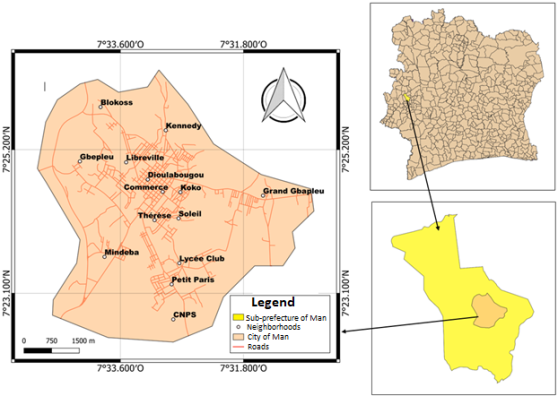
This study was conducted in the city of Man, the capital of the Tonkpi region, located in western Côte d’Ivoire (Figure 1). It covers an area of approximately 3,450 km2 and has an estimated population of over 400,000 . The region’s climate is characterized by a humid tropical mountain climate, with estimated annual rainfall ranging from 1,400 mm to 1,800 mm, distributed across two rainy seasons and two dry seasons. The vegetation is dominated by dense forest interspersed with food crops, notably rain-fed rice, upland rice, and lowland rice. The region’s rugged terrain, marked by the presence of Mount Nimba and the Dan Mountains, provides agroecological conditions that are particularly favorable for rice cultivation .
2.2. Data Collection
Data collection took place over a period of seven (7) months, from December 2025 to June 2026, and consisted of a field survey, field observations, and direct weigh-ins.
2.2.1. Identification and Geolocation of Mills and Determination of Different Types of Residues
A census of all active rice-hulling units (mills) in the city of Man was conducted in collaboration with the Association of Rice Hulling Machine Owners of Man (APMM). This preliminary work identified the mills that hull rice, and all of them were visited. During the visits, a GPS device was used to record the geographic coordinates of the sites. These coordinates were then entered into the QGIS 3.14.16 software to generate a map of the rice hulling mills in the city of Man. The different types of residues generated at the mills were determined through a survey of mill managers and employees. In addition, field observations were used to confirm the information gathered from the survey.
2.2.2. Quantification of Residues in Mills
The quantification of residues is based on data for husked paddy rice collected over a 7 month period during the study, which were provided by the managers or owners of the mills in question. To determine the various residue fractions obtained after husking paddy rice, a 100 kg bag of paddy rice was used as a reference sample. The rice was then hulled under the mills’ normal operating conditions. The various residues obtained (bran, husks, or a mixture of husks and bran) after hulling were weighed separately using a scale to determine their respective masses and to evaluate their proportions relative to the initial mass of paddy rice. Thus, the following is obtained:
1) In large mills
Mass of rice bran=Paddy rice production received×13100(1)
Mass of rice husk=Paddy rice production received×15100(2)
2) In small mills
Mass of husk+bran mixture=Paddy rice production received×34100(3)
Figure 1. Map of the City of Man.
2.2.3. Analysis of Rice Husking Residues Management Practices
The analysis of residue management practices was conducted using questionnaire surveys administered to owners, managers, and employees, followed by field observations of the methods used for collecting, storing, recycling, and disposing of residues.
2.3. Data Analysis
The collected data were grouped by neighborhood within the city of Man. The relative frequencies of each variable were calculated based on the number of mills visited, using Equation (4):
F=XY×100(4)
where:
F: Frequency; X: Number of observations in the category (number of mills per neighborhood); Y: Total number of observations.
3. Results
3.1. Map of Rice Huskers in the City of Man
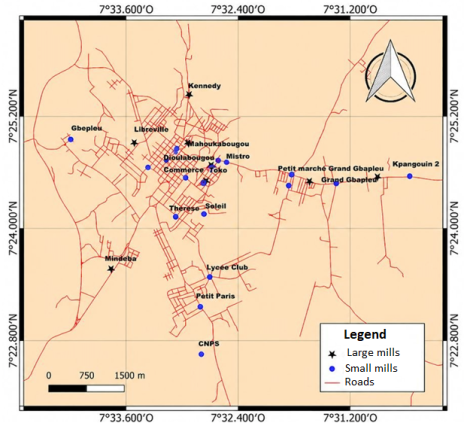
In Man city, there are 31 rice huskers (Figure 2). These mills are distributed across the neighborhoods of Mouhakadougou, Gbeupleu, Dioulabougou, Commerce, Koko, Mistro, Therese, Soleil, Lycee Club, Kennedy, Libreville, Grand Gbapleu, Petit Paris, Mindeba, CNPS, and Kpangouin 2. The mills observed in the city of Man are classified into two types: large mills (semi-industrial system) and small mills (artisanal system) (Figure 3). There are few large mills (9), and they are mainly concentrated in the neighborhoods of Koko, Mahoukadougou, Grand Gbapleu, Kpangouin 22, Kennedy, Mindeba, and Libreville. In contrast, small mills are found in the neighborhoods of Mouhakadougou, Gbeupleu, Dioulabougou, Commerce, Koko, Mistro, Therese, Soleil, Lycee Club, Grand Gbapleu, Petit Paris, CNPS, and Kpangouin 2.
Figure 2. Geolocation of rice husking mills in Man.
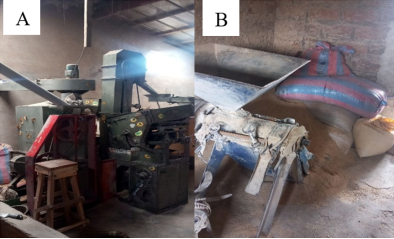
Figure 3. Different types of mills in Man; A: Large mills, B: Small mills.
3.2. Types of Rice Hulling Residues
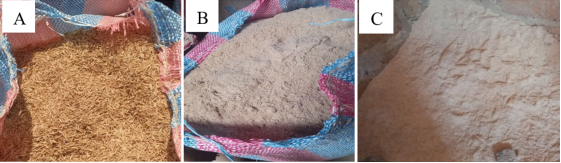
According to the survey conducted in Man, the main residues produced by rice hulling are rice husks and rice bran (Figure 4). In large mills, these two residues (rice husks and rice bran) are produced separately. There is a pipe connected to the outside of the mill through which the rice husks are discharged, while the bran is collected inside via a separate pipe. In contrast, in small mills, the two are mixed together and collected directly inside (husk bran mixture).
Figure 4. Different types of byproducts in Man; A: Rice husks, B: Rice bran, C: Rice husk bran mixture.
3.3. Amount of Byproducts Produced by Mills
3.3.1. Large Mills
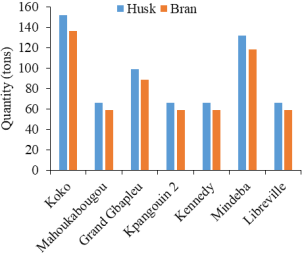
Figure 5 shows the average amount of rice by products produced by large mills. It can be seen that, in all the districts shown, rice husks quantities exceed those of rice bran. Large mills produced a total of 645.71 tons of rice husks and 580.89 tons of rice bran. The corresponding average quantities of rice husks and rice bran are 92.2 tons/month and 83 metric tons/month, respectively. Koko and Mindeba districts account for the largest share of these residues.
Figure 5. Average amount of rice byproducts (husk and bran) produced over 7 months by large mills.
3.3.2. Small Mills
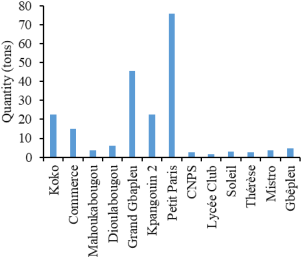
Small mills generated 209.76 tons of husk bran mixture, with an average production of 30 tons/month. Petit Paris neighborhood accounts for the largest share of these residues, with approximately 75.7 tons of husk bran mixture, while the Lycee Club neighborhood accounts for the smallest share, with approximately 1.4 tons (Figure 6).
Figure 6. Average amount of rice residues (husk-bran mixture) produced over 7 months by small mills.
3.4. Rice Husking Residues Management Practices
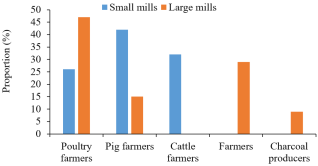
Rice husking residues produced at large and small mills in the city of Man are either dumped outdoors (near the mills or into waterways) or stored in bags before being sent to various recovery channels. Figure 7 shows the proportion of collectors of rice husking residues in Man city. Generally speaking, the residues are collected by poultry farmers, fish farmers, cattle farmers, charcoal producers (Figure 8), and crop farmers. However, at large mills, poultry farmers account for the highest proportion (47%), followed by farmers at 29%. In contrast, at small mills, pig farmers dominate (42%), followed by cattle farmers (32%).
Figure 7. Residue collection systems in mills.
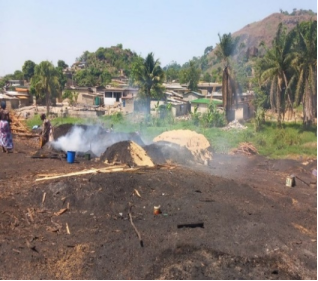
Figure 8. Residue collection systems in mills.

3.5. Economic Value of Residues
The survey reveals that rice husking residues utilization is a widespread practice in mills in Man city. In fact, 96.88% of the mills surveyed reported generating income from the sale of bran in large mills and of a husk bran mixture in small mills, confirming the existence of an active local market for these byproducts. The amount received for 100 kg of byproducts is approximately 2,500 FCFA.
4. Discussion
This study, which analyzes rice husking waste management in Man city, identified a total of 31 active mills, consisting of 22 small (artisanal) mills accounting for 71% and 9 large (semi-industrial) mills accounting for 29%. The predominance of small mills is consistent with the situation observed in Côte d’Ivoire. Indeed, Messou et al. note that in under equipped regions of Côte d’Ivoire, such as Lôh-Djiboua, artisanal systems remain more numerous than semi-industrial systems, reflecting the limited economic capacity of local producers and the lack of investment in mechanization. The main byproducts of husking in mills are husks, bran, and a mixture of husks and bran. In large mills, husks and bran are separated during husking via two distinct conveyor lines, whereas in small mills, a mixture of husks and bran is generally produced. This difference is due to the technology of the husking machines. Studies such as those by UNIDO and highlight that large mills generally use disc hullers, which allow for efficient separation of byproducts. In contrast, small mills often use older hullers, which results in a mixture. This observation is important because, according to Bhattacharya et al. , separating the husks and bran facilitates their recovery. Over a period of seven (7) months, approximately 1,436.23 metric tons of byproducts were generated at the mills in the city of Man, including 645.71 metric tons of rice husks and 580.89 metric tons of rice bran from the large mills, and 209.76 metric tons from the small mills (a mixture of rice husks and rice bran). Large mills produce the largest quantity of this rice husk residue. This predominance of rice husks over bran is consistent with the work of IRRI and Goyon et al. , which indicate that rice husks constitute the majority of husking residues. The accumulation of these residues poses a major environmental challenge, particularly in a context where agricultural waste treatment infrastructure remains limited, as highlighted by Kemausuor et al. for West Africa. Hulling residues produced in large and small mills in the city of Man are either dumped outdoors (near the mills or into waterways) or stored in bags before being sent to various recovery channels. Generally speaking, by products are collected by poultry farmers, fish farmers, cattle farmers, charcoal producers, and crop farmers. However, at large mills, poultry farmers account for the highest proportion (47%). In contrast, at small mills, swine farmers dominate (42%). The high demand for residues from large mills by poultry farmers is due to the superior quality of the separated bran, which serves as a valuable protein-rich feed supplement in poultry farming, in accordance with the recommendations of and the . At small mills, the predominance of pig farmers (42%) is due to the nature of the mixture of rice husks and bran produced. This mixture is less valuable for poultry, as it is better suited as bedding or a coarse feed supplement for pigs and cattle . The uncontrolled dumping of rice husks into waterways is a practice of particular environmental concern. Due to their low natural biodegradability resulting from their high silica content (approximately 90% of mineral compounds) and lignin content (22%) rice husks can persist for a long time in aquatic environments, degrading water quality and disrupting aquatic ecosystems . This practice is all the more problematic in the context of Man, a city crisscrossed by waterways whose ecological balance also determines local fish farming activities. The use of rice husks as a cover during wood carbonization (9%) constitutes a rudimentary but locally adapted form of energy recovery. It is similar to the indirect combustion practices documented in the literature . However, this open-air combustion, carried out without specialized equipment, generates air pollutants (SO2, CO, PM2.5 fine particles) that are harmful to public health, according to Bodor et al. and Zorena et al. . These forms of informal recovery, while positive, remain insufficient given the total volume of residues generated. A significant portion of these byproducts escapes any form of recovery and ends up in the environment. The establishment of formal collection and recovery systems such as composting, biofuel production, and bran oil extraction is a key lever for improving the management of husking residues in Man, in line with a circular economy approach .
5. Conclusions
This study analyzed rice husking residues management in Man. The results of the mill survey identified 31 active mills spread across 16 neighborhoods, including 22 small artisanal mills (71%) and 9 large semi-industrial mills (29%). Two main types of byproducts were identified: rice husks and rice bran, which are produced separately in large mills via conveyor belts and mixed together in small mills. Over the 7 month period, residues are estimated at approximately 1,436.23 metric tons, including 645.71 metric tons of husks and 580.89 metric tons of bran from the large mills, and 209.76 metric tons of a husk bran mixture from the small mills, based on a production of 4,746.7 metric tons of paddy rice received. The husking residues produced at large and small mills in the city of Man are either dumped outdoors (near the mills or into waterways) or stored in bags before being sent to various recycling channels. The residues are collected by poultry farmers, fish farmers, cattle farmers, charcoal producers, and crop farmers. However, at large mills, poultry farmers account for the highest proportion (47%), while at small mills, pig farmers predominate (42%).
Abbreviations

APMM

Association of Rice Hulling Machine Owners of Man

Acknowledgments
Thank you to the Association of Owners of Rice Huskers in Man (APMM) for their cooperation.
Author Contributions
N’Da Akoua Alice Koua-Koffi: Conceptualization, Data curation, Formal Analysis, Investigation, Methodology, Resources, Software, Visualization, Writing – original draft, Writing – review & editing
Amenan Anne Mary Kouassi-Kouadio: Data curation, Investigation, Methodology, Resources, Supervision, Visualization, Writing – review & editing
Amichale Jean Cyrille Beda: Investigation, Methodology, Project administration, Software, Supervision, Validation, Visualization, Writing - original draft, Writing – review & editing
Sandotin Lassina Coulibaly: Data curation, Methodology, Project administration, Supervision, Validation, Visualization
Sanata Kone: Formal Analysis, Investigation, Methodology, Software
Lacina Coulibaly: Conceptualization, Project administration, Resources, Supervision, Validation, Visualization
Data Availability Statement
The data supporting the outcome of this research work has been reported in this manuscript.
Conflicts of Interest
The authors declare no conflicts of interest.
References
[1] FAO. Rice value chain development in Africa. Food and Agriculture Organization of the United Nations, Rome; 2021.
[2] Lacharme, M. Memento technique de riziculture pour la vallee du fleuve Senegal [Technical Guide to Rice Cultivation for the Senegal River Valley]. Fascicule 5: La gestion de l’irrigation des rizieres. 2001, 11 p.
[3] Boutsen S., Aertsen, J. Peut-on nourrir l'Afrique de l'Ouest avec du riz ? [Can West Africa be fed with rice?] Mondial Nieuws. 2013, 74, 1‑21.
[4] Soullier, G., Demont, M., Aouna, A., Lançon, F., Mendez del Villar P. The state of rice value chain upgrading in West Africa. Global Food Security. 2020, 36, 2211-9124.
[5] CNRA. Programme du riz, Centre National de Recherche Agronomique (CNRA) [Rice Program, National Center for Agricultural Research (CNRA)]; 2021. Available from:
[6] ADERIZ. Rapport annuel sur la filiere riz en Côte d'Ivoire [Annual report on the rice sector in Côte d'Ivoire]. Agence pour le Developpement de la Filiere Riz en Côte d'Ivoire; 2019.
[7] IRRI. Rice milling, processing and by-products. International Rice Research Institute, Los Baños, Philippines; 2020.
[8] Goyon, A., Mestres, C. Le riz: benefices et risques pour la sante [Rice: health benefits and risks]. Cahiers de nutrition et de dietetique. 2017, 52(4), 202-209.
[9] Kemausuor, F., Kamp, A., Thomsen, S. T., Bensah, E. C., Østergård, H. Assessment of biomass residue availability and bioenergy yields in Ghana. Renewable and Sustainable Energy Reviews, Ghana. 2019, 101, 237‑251.
[10] Lim, J. S., Manan, Z. A., Hashim, H., Alwi, S. R. W. Towards sustainable utilization of rice husk ash. Renewable and Sustainable Energy Reviews. 2012, 16(5), 3084‑3093.
[11] Pode, R. Potential applications of rice husk ash waste from rice husk biomass power plant. Renewable and Sustainable Energy Reviews. 2016, 53, 1468‑1485.
[12] Hounyevou, K. A., Houssou, P. A. F., Dansou, V., Moreira, J., Mensah, G. A. Effet de liants et de la mouture sur la qualite des briquettes combustibles à base de balle de riz. 3e Congres AfricaRice, 21 au 24 octobre, Yaounde, Cameroun. 2014, 1 p.
[13] Lompo, D. J. P., Ye, L., Ouedraogo, S., Sori, S. I., Nacro, H. B. Caracterisation chimique d'un biocharbon de balles de riz destine à l'amendement des sols au Burkina Faso [Chemical characterization of rice husk biochar intended for soil amendment in Burkina Faso]. Afrique Science. 2021, 18(1): 216‑222.
[14] Delot, P. Balle de riz: Compilation d'elements techniques en vue de son utilisation en isolation thermique [Rice husk: Compilation of technical data regarding its use for thermal insulation]. Guide technique. 2015, 26 p.
[15] Geissdoerfer, M., Savaget, P., Bocken, N. M. P., Hultink, E. J. The circular economy — A new sustainability paradigm? Journal of Cleaner Production. 2017, 143, 757‑768.
[16] Godman, B. A. Utilization of waste straw and husks from rice production: A review. Journal of Bioresources and Bioproducts. 2020, 5(3), 143-162.
[17] Glushankova, I.; Ketov, A.; Krasnovskikh, M.; Rudakova, L.; Vaisman, I. Rice Hulls as a Renewable Complex Material Resource. Resources. 2018, 7, 31. 1-11.
[18] Bodor, K., Szep, R., & Bodor, Z. Time Series Analysis of the Air Pollution Around Ploiesti Oil Refining Complex, One of the Most Polluted Regions in Romania. Sci. Rep., 2022, 12(1): 11817.
[19] Zorena, K., Jaskulak, M., Michalska, M., Mrugacz, M., Vandenbulcke, F. Air Pollution, Oxidative Stress, and the Risk of Development of Type 1 Diabetes. Antioxidants. 2022, 11, 1908.
[20] Messou, A., Bakayoko, M. S., Ouattara, P. J. M., Coulibaly, L. Management of rice hulling residues in Côte d'Ivoire: Case of the Lôh-Djiboua region. Journal of Innovation and Applied Studies. 2022, 37(9): 693‑701.
[21] RGPH. Recensement general de la population et de l'habitat — Resultats Globaux [General Population and Housing Census — Overall Results]. Institut National de Statistiques (INS), Abidjan, Côte d'Ivoire. 2021, 12 p.
[22] PEMED-CI. Etudes monographiques et economiques des Districts de Côte d'Ivoire — District des Montagnes [Monographic and Economic Studies of the Districts of Côte d'Ivoire — Mountains District]: Note de synthese. Programme d'Etudes Monographiques et Economiques des Districts de Côte d'Ivoire, Abidjan, 2015. 85 p.
[23] UNIDO. Le son de riz: une matiere premiere sous-utilisee [Rice bran: an underutilized raw material]. United Nations Industrial Development Organization, Vienne. 1987, 287 p.
[24] Bhattacharya, S., Arul, Joe M., Kandhekar, Z., Abdul, S. P., Shrestha, R. M. Greenhouse-gas emission mitigation from the use of agricultural residues, The case of rice husk. Energy, 1999. 24(1), 43‑59.
[25] Bhattacharya, K. R. Rice quality: A guide to rice properties and analysis. Woodhead Publishing limited, Cambridge. 2011, 608p.
[26] IRRI. Postharvest management and loss reduction in rice systems. International Rice Research Institute, 2022.
[27] Halleux, E. Valorisation des cendres de balles de riz pour la production de materiaux pouzzolaniques à Madagascar [Valorization of rice husk ash for the production of pozzolanic materials in Madagascar]. Travail de fin d’etudes realise en vue de l’obtention du grade de Master Ingenieur Civil des constructions, Universite de Liege, Madagascar. 2013, 111 p.
[28] Bui, D. D. « Rice husk Ash as a Mineral Admixture for High-Performance Concrete », Pays-Bas. 2001, 122 p.
[29] Said, N. A. S., & Sulaiman F. A review on biomass combustion for heat and power generation. Renewable and Sustainable Energy Reviews. 2019, 107, 377‑390.
Cite This Article
  • APA Style

    Koua-Koffi, N. A. A., Kouassi-Kouadio, A. A. M., Beda, A. J. C., Coulibaly, S. L., Kone, S., et al. (2026). Management Analysis of Rice Husking Residues in the City of Man (Tonkpi Region, Côte d'Ivoire). International Journal of Environmental Monitoring and Analysis, 14(6), 190-197. https://doi.org/10.11648/j.ijema.20261405.12

    Copy | Download

    ACS Style

    Koua-Koffi, N. A. A.; Kouassi-Kouadio, A. A. M.; Beda, A. J. C.; Coulibaly, S. L.; Kone, S., et al. Management Analysis of Rice Husking Residues in the City of Man (Tonkpi Region, Côte d'Ivoire). Int. J. Environ. Monit. Anal. 2026, 14(6), 190-197. doi: 10.11648/j.ijema.20261405.12

    Copy | Download

    AMA Style

    Koua-Koffi NAA, Kouassi-Kouadio AAM, Beda AJC, Coulibaly SL, Kone S, et al. Management Analysis of Rice Husking Residues in the City of Man (Tonkpi Region, Côte d'Ivoire). Int J Environ Monit Anal. 2026;14(6):190-197. doi: 10.11648/j.ijema.20261405.12

    Copy | Download

  • @article{10.11648/j.ijema.20261405.12,
      author = {N’Da Akoua Alice Koua-Koffi and Amenan Anne Mary Kouassi-Kouadio and Amichale Jean Cyrille Beda and Sandotin Lassina Coulibaly and Sanata Kone and Lacina Coulibaly},
      title = {Management Analysis of Rice Husking Residues in the City of Man (Tonkpi Region, Côte d'Ivoire)},
      journal = {International Journal of Environmental Monitoring and Analysis},
      volume = {14},
      number = {6},
      pages = {190-197},
      doi = {10.11648/j.ijema.20261405.12},
      url = {https://doi.org/10.11648/j.ijema.20261405.12},
      eprint = {https://article.sciencepublishinggroup.com/pdf/10.11648.j.ijema.20261405.12},
      abstract = {This study analyzes rice husking residues management in the city of Man (Tonkpi Region, Côte d’Ivoire), through a census of husking facilities, a quantification of the residues produced, and an assessment of current management practices. To this end, field observations and a survey were conducted at active rice husking mills in the city of Man, in collaboration with the Association of Rice Husking Machine Owners of Man. A total of 31 mills were surveyed, comprising 9 large semi-industrial mills (29%) and 22 small artisanal mills (71%), spread across 16 neighborhoods. The main residues from husking are husks, bran, and a husk-bran mixture. In large mills, husks and bran are produced separately; while in small mills, an undifferentiated mixture is generated. Over seven months of operation, total byproducts amounted to approximately 1,436.23 metric tons, including 645.71 metric tons of husks and 580.89 metric tons of bran from the large mills, and 209.76 metric tons of husk bran mixture from the small mills. The main recipients of the residues are poultry farmers (47% from large mills) and pig farmers (42% from small mills), as well as crop farmers, fish farmers, and cattle farmers.},
     year = {2026}
    }
    

    Copy | Download

  • TY  - JOUR
    T1  - Management Analysis of Rice Husking Residues in the City of Man (Tonkpi Region, Côte d'Ivoire)
    AU  - N’Da Akoua Alice Koua-Koffi
    AU  - Amenan Anne Mary Kouassi-Kouadio
    AU  - Amichale Jean Cyrille Beda
    AU  - Sandotin Lassina Coulibaly
    AU  - Sanata Kone
    AU  - Lacina Coulibaly
    Y1  - 2026/11/05
    PY  - 2026
    N1  - https://doi.org/10.11648/j.ijema.20261405.12
    DO  - 10.11648/j.ijema.20261405.12
    T2  - International Journal of Environmental Monitoring and Analysis
    JF  - International Journal of Environmental Monitoring and Analysis
    JO  - International Journal of Environmental Monitoring and Analysis
    SP  - 190
    EP  - 197
    PB  - Science Publishing Group
    SN  - 2328-7667
    UR  - https://doi.org/10.11648/j.ijema.20261405.12
    AB  - This study analyzes rice husking residues management in the city of Man (Tonkpi Region, Côte d’Ivoire), through a census of husking facilities, a quantification of the residues produced, and an assessment of current management practices. To this end, field observations and a survey were conducted at active rice husking mills in the city of Man, in collaboration with the Association of Rice Husking Machine Owners of Man. A total of 31 mills were surveyed, comprising 9 large semi-industrial mills (29%) and 22 small artisanal mills (71%), spread across 16 neighborhoods. The main residues from husking are husks, bran, and a husk-bran mixture. In large mills, husks and bran are produced separately; while in small mills, an undifferentiated mixture is generated. Over seven months of operation, total byproducts amounted to approximately 1,436.23 metric tons, including 645.71 metric tons of husks and 580.89 metric tons of bran from the large mills, and 209.76 metric tons of husk bran mixture from the small mills. The main recipients of the residues are poultry farmers (47% from large mills) and pig farmers (42% from small mills), as well as crop farmers, fish farmers, and cattle farmers.
    VL  - 14
    IS  - 6
    ER  - 

    Copy | Download

Author Information
  • Faculty of Agronomic & Forestry and Environmental Engineering, University of Man, Man, Cote d’Ivoire

    Research Fields: Water purification for drinking, Domestic wastewater treatment, Environmental pollution, Urban and rural solid waste management, Waste treatment

  • Faculty of Environmental Sciences and Management, Nangui Abrogoua University, Abidjan, Cote d’Ivoire

    Research Fields: Domestic Wastewater Treatment, Environmental Pollution, Urban and Rural Solid Waste Management, Waste Recovery, Presentation and Database

  • Faculty of Agronomic & Forestry and Environmental Engineering, University of Man, Man, Cote d’Ivoire

    Research Fields: Soil Pollution, Soil Remediation, Urban and Rural Solid Waste Management, Design and Operation of Sewer Systems, Environmental Impact Assessment

  • Faculty of Agronomic & Forestry and Environmental Engineering, University of Man, Man, Cote d’Ivoire

    Research Fields: Design and Operation of Sewer Systems, Biotechnology, Environmental Pollution, Geology, Monitoring of Reactor Performance

  • Faculty of Agronomic & Forestry and Environmental Engineering, University of Man, Man, Cote d’Ivoire

    Research Fields: Solid Waste Management, Waste Recycling, Soil Pollution, Domestic Wastewater Treatment, Word Processing

  • Faculty of Environmental Sciences and Management, Nangui Abrogoua University, Abidjan, Cote d’Ivoire

    Research Fields: Bioprocess Engineering, Biotechnology, Water Treatment, Sanitation, Environmental Pollution