Research Article | | Peer-Reviewed

Characterization of Physical and Primary Processing Qualities of New Hybrid Rice (Oryza sativa L.) Lines Under Evaluation for Release in Nigeria

Received: 30 July 2025     Accepted: 2 September 2025     Published: 14 May 2026
Views:       Downloads:
Abstract

Overcoming persistent challenges such as low yield per hectare, pest pressure, and climate stress has remained a priority in rice breeding programs in Nigeria. This study evaluated four new hybrid rice lines (VSLRH-1, VSLRH-2, VSLRH-3, and VSLRH-4) alongside two improved inbred checks (FARO 44 and FARO 66) for their physical and processing qualities at 12.0±0.2% moisture content to inform postharvest handling and varietal recommendation. All hybrids were categorized as long grains based on length-width ratio (≥3.4). VSLRH-3 had the longest paddy length (9.84 mm), highest brown rice yield (86.80%), and lowest hull content (13.20%), outperforming FARO 66 and closely matching FARO 44 in grain dimensions and weight. It also recorded a high 1000-paddy weight (22.13 g) and 1000-brown rice weight (17.03 g), similar to FARO 44 (24.42 g and 18.43 g, respectively). VSLRH-1 also performed well, with long grain length (9.56 mm), high brown rice shape (3.36), and moderate hull percentage (17.49%). Geometric properties such as arithmetic (4.66 mm) and square diameter (22.89 mm) in VSLRH-1 and VSLRH-3 were comparable to the checks. Sphericity, aspect ratio, and surface area-volume ratio also indicated that these hybrids are suitable for efficient parboiling, drying, and mechanical processing. Overall, VSLRH-3 and VSLRH-1 emerged as top-performing hybrids, combining desirable physical traits with processing-friendly features. These findings provide critical information for breeders, millers, and equipment designers, supporting the advancement of these lines for varietal release and widespread adoption in Nigeria's rice value chain.

Published in International Journal of Food Engineering and Technology (Volume 10, Issue 1)
DOI 10.11648/j.ijfet.20261001.14
Page(s) 23-36
Creative Commons

This is an Open Access article, distributed under the terms of the Creative Commons Attribution 4.0 International License (http://creativecommons.org/licenses/by/4.0/), which permits unrestricted use, distribution and reproduction in any medium or format, provided the original work is properly cited.

Copyright

Copyright © The Author(s), 2026. Published by Science Publishing Group

Keywords

Rice Breeding, Hybrid Rice, Grain Quality, Physical Properties, Processing

1. Introduction
Rice (Oryza sativa L.) is one of the most important staple cereal crops in Nigeria’s food basket. Over the last decade, the country’s rice production has increased significantly, making it the leading producer of rice in Africa, producing about 5.7 million metric tons (MMT) of milled rice in 2024; however, this amount does not meet the national demand of about 7.3 MMT for food and industrial raw material; hence, the deficit of about 2.4 MMT or more is fueled through importation at a cost of about USD480 million per year. This value excludes the quantity of rice that is smuggled illegally into the country through the land borders . This practice strains the Nigerian economy of its foreign exchange reserve. The low production of rice in Nigeria has been attributed to poor farm mechanization, low utilization of improved inputs, low yield per ha of production land, and other related constraints . To meet the rice demand of growing population of Nigerian, rice productivity must increase at a rate that closes the production and consumption gap by 2030 as contained enshrined in the National Rice Development Strategy 2020-2030. Experience from other rice deficient countries of the world indicated that development of hybrid rice provide a great opportunity and effective approach to increasing yield per ha by a big margin of about 20% or more . The experience demonstrated by China indicated that increasing the adoption and expanding land under hybrid rice is a most efficient and economical way to meet the future rice demand of a growing population like Nigeria .
Over the last few decades, research and development organization across the world has been exploring modern breeding technology to develop hybrid rice varieties with high yield potential, disease resistance and acceptable grain quality . Significant number of inbred rice varieties have been developed and released to farmers for commercial production in many countries including Nigeria. A hybrid rice variety has yield potential that is 15-20% greater than inbred grown under the same conditions, mainly due to heterosis . Developing high yielding rice varieties such as hybrids therefore, have gained acceptability among rice farmers with resultant improvement of national food self-sufficiency, economic and living standards of rice farmers . The International Rice Research Institute (IRRI), Africa Rice Center (AfricaRice), Food and Agricultural Organization (FAO) and other related organizations have provided strong support and consistent investment in hybrid rice breeding . However, despite high grain yield potentials reported for hybrid rice varieties , it often suffers from poor grain quality, including low head rice yield, high degree of chalkiness and other attributes, which limit adaptation and consumer acceptability of the varieties . In Nigeria, growing good quality rice varieties has become crucial as consumers are increasingly demanding for good quality milled rice. Rice grain quality includes attributes such as physical and milling characteristics, cooking and eating, and nutritional composition . The physical appearance of rice grain is an important quality trait for consumers when selecting rice for processing and consumption and this preference vary from one group of consumer to another . Physical characteristics of rough, brown and milled rice are the first quality trait that breeders consider in developing new variety for release for commercial production . Milling quality of rice is usually evaluated by indications such as brown rice recovery from a given rough, grain weight, grain dimension etc. .
Since physical and processing qualities of rough rice are among the first criteria that crop breeders consider when developing rice for release to farmers for commercial production, and success of any newly released variety hugely depend on its ability to satisfy end-users quality perceptions including grain physical characteristics and its processing qualities, knowledge of the grain quality characteristics of new hybrid lines being developed for release to Nigerian rice farmers for commercial production are critical and should be evaluated and documented and compared with already adopted high yielding inbred varieties as a strategy to sharpen breeding progress and recommend the variety when finally released for adoption relying on evidence-based recommendations. The main objective of this study therefore, is to evaluate the grain quality characteristics of hybrid lines being evaluated in Nigeria in terms of physical appearance and technological attributes that will be applied in its classification into difference grain categories, guide consumer selection and improve it postharvest handling and processing when finally released as varieties.
2. Materials & Methods
2.1. Experimental Sites
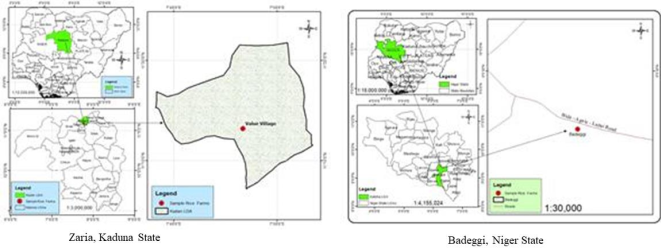
The study was conducted in two key lowland rice-growing environment of Nigeria; Zaria Local Government Aarea (LGA), Kaduna State (Lat. 11.2197517ᵒ and long. 7.778111ᵒ)., and Badeggi, Katcha LGA (Lat. 9.076847ᵒ and long. 6.046724ᵒ), Niger State, selected based on their agro-climatic significance, historical relevance to rice cultivation, and suitability for evaluating genotype-by-environment interactions, with Zaria representing rice production under rain-fed and irrigated conditions and Badeggi serving as a hub for intensive lowland rice farming.
Figure 1. Geospatial map of the hybrid and in-bred rice varieties production areas.
2.2. Field Experimental Design & Agronomic Practices
Four (4) rice hybrids lines (VSLRH-1, VSLRH-2, VSLRH-3 and VSLRH-4) and two (2) Nigeria improved commercial in-bred varieties (FARO 44 and FARO 66) were used as checks. The seven genotypes were sown in a nursery bed and transplanted 21 days after. The trials were laid out in a randomized complete block design (RCBD) with 3 replications. Each treatment was planted in 3 x 4m plot size with 20 x 20 cm intra and inter-row spacing. Before transplanting, the experimental field was ploughed, harrowed, paddled and leveled, a common practice among farmers in these locations. Fertilizer application was 120 kg nitrogen per ha at three splits of 60, 30, at (basal), 21 and 42 days after transplanting (DAT), respectively. Thereafter, 60 P2O5 and 60 kg K2O were applied at transplanting. Weeds were controlled through manual weeding throughout the experiment.
2.3. Experimental Plan
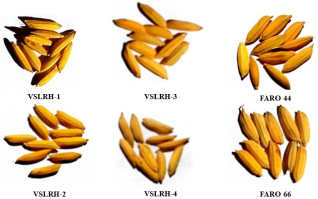
After harvest, the grains were manually threshed, winnowed and dried on the sun for 3 days (32±2°C) to reduce the moisture level to approximately 12%. The samples (1kg each) were transported to the Rice Grain Quality Laboratory (RGQL), NCRI, Badeggi, for analysis. At the laboratory, all the rough rice samples were cleaned manually and impurities such as stones, dust, straws, clay and other foreign materials were removed; samples of the 6 varieties are presented in Figure 2. The moisture content was determined using a moisture meter (MOISTEX SS-8, Satake, Japan) 3 times per sample and the average moisture content was 12.0±20% (w.b.). 200g each of the samples were de-husked to obtain brown rice using Laboratory Husker Rice Testing Machine.
Figure 2. Pictorial presentation of four (4) hybrids and two (2) in-bred varieties.
2.4. Methods of Grain Quality Evaluation
2.4.1. Moisture Content Determination
The moisture content of the paddy samples were evaluated based on official method 925.09. In this method, empty moisture test dish was weighed (W1) before the sample was added and weighed (W2) and then dried for 6 h at 60°C, cooled in a desiccator before weighing the dried sample with the dish together (W3). The moisture content in percentage was then calculated as:
Moisture content %=W2+W3W1*100(1)
2.4.2. Grain Size and Shape Determination
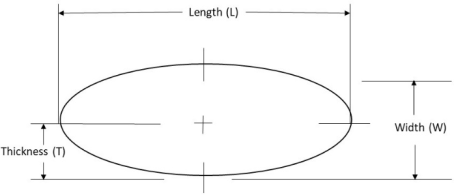
Rough and brown rice physical properties were evaluated for the following characteristics, length (the longest dimension of the maximum projected area of the rice grain), width (maximum diameter of the minimum projected area), and thickness (shortest dimension of the minimum projected area of the grain) (Figure 3) using digital veneer calipers and length/width ratio calculated. Samples were randomly selected and their principle dimensions were measured to an accuracy of 0.05 mm .
Figure 3. Triaxial ellipsoidal dimensions of rice grain.
Paddy and brown rice appearances were ranked through visual observation as described by Adeyemi and Dipti et al . Paddy samples were classified based on the principal axial dimensions into different size and shape categories .
2.4.3. Processing Characteristics Determination
Equivalent diameter (De) was estimated according to the method of Mohsenin, and Varnamkhasti, et al., .
De=L x W+T2413(2)
Arithmetic diameter (Da) and geometric diameter (Dg) were calculated from the data of the principal triaxial dimensions according to Mohsenin, and Varnamkhasti, et al., ,
Da=L+W+T3(3)
Dg=L x W x T(4)
While the square diameter (Ds) in mm was calculated using the relationship described by Danbaba et al. and Mohsenin assuming a spheroid shape for rough rice.
Ds=LW+WT+LT312(5)
The sphericity (ø) was calculated using techniques of Varnamkhasti et al. and Danbaba et al. based on the assumption that the volume of the rough rice is equal to the volume of a triaxial ellipsoid with diameters equivalent to the solid sample. The sphericity is then given as:
ø=LWT13L(6)
Rough rice volume (V) and surface area (SA) were calculated according to Jain and Bal, .
V=0.25π6 x L x W+T2(7)
SA=π.WT.L22L-WT(8)
While aspect ratio (Ra), generally defined as the ratio of the height to the width of a triaxial object was calculated according to Maduako and Faborode, .
Ra=WL(9)
Thousand-paddy weight (g) was determined according to the method of [AACC], as reported by Qadir and Wani . Briefly, 100-paddy were randomly selected from a clean sample and weighed on an electronic balance. The value was multiplied by 10 to determine the paddy 1000-grain weight.
2.5. Statistical Analysis
The results of the determinations were submitted to analysis using Analysis of Variance (ANOVA) applying the randomized complete block design approach with six (6) treatments and 30 replications for 3 major dimensions (L, W, & T). Significant mean values were compared according Duncan’s Multiple Range Test (DMRT) at 0.05 level of probability. Pearson’s correlation coefficients for the different paddy physical characteristics were evaluated using the Data Analysis ToolPak of Microsoft Excel to understand the relationship between the variables.
3. Results & Discussions
3.1. Principal Dimensions and Classification of Paddy
Measuring principal physical dimensions (length, width, and thickness) of paddy is probably the first step in quality characterization of new rice variety during its development. These values are further utilized in the estimation of other diverse dimensional traits. The mean values of the physical properties of the different hybrid and in-bred paddy specifically paddy length (size), width, thickness and length/width ratio which defines the paddy size and shape are presented in Table 1. For the paddy size, no significant difference was observed, however, for paddy width, thickness and length/width ratio, all the lines differs significantly (p≤0.05). In respect to the paddy length, both the hybrid and the controls were not significantly different from each, with the highest value of 9.84 mm and the lowest of 9.30 mm in hybrid lines VSLRH-3 and VSLRH-4 respectively. The average paddy length for both hybrid and in-bred lines was 9.52 mm. according to Varnamkhasti ; uniformity in rough rice according to size provides uniform germination and usually gives improved harvesting yield. The paddy length is closely related to the quality of the grain and consumer acceptance , hence, all the hybrid lines may command similar acceptability in terms of grain size when finally released for commercial production. The mean paddy width, thickness and length/width ratio were found to be significantly different (p≤0.05). In terms of paddy width; all the hybrids genotypes has a lower value than the two in-bred varieties. The following width values; 2.45, 2.38, 2.61 and 2.30 mm were the widths of VSLRH-1, VSLRH-1, VSLRH-1 and VSLRH-1 respectively, which are lower than 2.65 and 2.70 mm observed among the checks (Table 1).
Table 1. Tri-axial dimensional characteristics of paddy rice samples of hybrid rice.

Sample

Length (mm)*

Width (mm)

Thickness (mm)

L/W Ratio**

Paddy type

VSLRH-1

9.56±0.40a

2.45±0.10bc

1.82±0.10ab

3.91±0.12ab

Long

VSLRH-2

9.44±0.29a

2.38±0.15c

1.76±0.24ab

3.98±0.38a

Long

VSLRH-3

9.84±0.30a

2.61±0.16ab

1.82±0.08ab

3.78±0.34abc

Long

VSLRH-4

9.30±0.57a

2.30±0.09c

1.74±0.07b

4.05±0.24a

Long

FARO 44

9.60±0.53a

2.65±0.11a

1.84±0.04a

3.63±0.30bc

Long

FARO 66

9.42±0.51a

2.70±0.11a

1.74±0.08b

3.49±0.30c

Long

Mean

9.53±0.46

2.52±0.19

1.79±0.10

3.81±0.32

NA

CV (%)

4.71

5.15

5.29

6.79

NA

*Defines the size of paddy, **defines the shape of the paddy. Mean ± standard deviation in the same column followed by the same letter is not significantly different (p≤0.05) according to new Duncan’s Multiple Range Test (DMRT). NA = not applicable.
The thickness of individual paddy grain is an important factor in determining milling yield during processing. More thicker rough rice grains has a positive correlation with yield and taste of cooked rice, however, negative impact is observed during milling . In this study, the paddy thickness of the hybrid genotypes and checks were significantly different (p≤0.05). Two (2) hybrid genotypes, VSLRH – 2 and 4 recorded 1.76 and 1.74 mm thickness respectively and FARO 66 (1.74 mm) which is all lower than the mean value of 1.79 mm (Table 1). VSLRH- 1, 2 and 3 are not significantly different from FARO 44, one of the most popular high yielding lowland rice varieties in Nigeria used as check. When categorized based on the length-width ratio used to determine grain type in rice breeding program in Nigeria, all the genotypes are long grains since their mean length-width ratio is 3.4. In Nigeria, rough rice with L/W ratio of 3.4 or more, 2.3-3.3 and 2.2 or less are categorized as long, intermediate (medium) and short grain types respectively. The width and length/width ratio are important dimensional characteristics of paddy or milled rice that is crucial in determining aperture size and other adjusted parameters of sieving machine .
3.2. Tri-axial Dimensions & Classification of Paddy
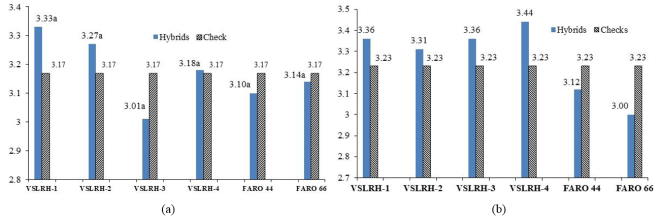
Generally, brown rice is obtained after de-husking paddy. Different rice varieties exhibit diversity in physical properties of their brown rice form especially traits such as length, breadth, thickness and length-width ratio. During paddy milling, one of the main quality attributes that determine processor’s preference is percent brown rice recovery. In this study, the principle axial properties of hybrid genotypes were studied and observed to vary between 3.01 – 3.33 mm, while the checks recorded 3.10 and 3.14 mm lengths (Figure 4a). All the hybrid genotypes except VSLRH-3 have length greater than the mean value of 3.17 mm, while both the checks are lower than mean value (Table 2). The brown rice thickness of the hybrid genotypes were found to be non-significantly different (p<0.05) from the inbred checks. The length-width ratio mean values were found to be significantly different (p<0.05) with all the hybrids having higher values than the two inbred checks (Figure 4b). Within the hybrids lines, the brown rice shape varies between 3.31 (VSLRH-2) and 3.44 (VSLRH-4) which are both greater than the average shape of 3.23 (Table 2). Based on the length-width ratio, the brown rice from the hybrid genotypes may be classified as long grain types based on length-width ratio categories used in Nigeria for rice (≥3.10 = long grain, 2.1 – 3.00 = Intermediate and ≤2.00 = short grains).
Table 2. Tri-axial dimensional characteristics of brown rice from hybrid and inbred genotypes under evaluation in Nigeria.

Sample

Brown rice Dimensional Characteristics

Grain type

Length (mm)*

Width (mm)

Thickness (mm)

L/W Ratio**

VSLRH-1

3.33±0.12a

0.99±0.07bc

0.76±0.07a

3.36±0.29ab

Long

VSLRH-2

3.27±0.16a

0.99±0.07bc

0.77±0.07a

3.31±0.31abc

Long

VSLRH-3

3.01±0.14a

0.90±0.07d

0.72±0.05a

3.36±0.33ab

Long

VSLRH-4

3.18±0.12a

0.93±0.06cd

0.76±0.06a

3.44±0.15a

Long

FARO 44

3.10±0.10a

1.07±0.07a

0.80±0.07a

3.12±0.28c

Long

FARO 66

3.14±0.14a

1.05±0.06ab

0.80±0.06a

3.00±0.22bc

Long

Mean

3.17±0.25

0.99±0.083

0.89±0.911

3.23±0.35

Long

CV (%)

7.82

5.81

1.45

9.88

NA

*Defines the size of paddy, **defines the shape of the paddy. Mean ± standard deviation in the same column followed by the same letter is not significantly different (p≤0.05) according to new Duncan’s Multiple Range Test (DMRT).
Figure 4. Variability of paddy length (a) and length-width ratio (b) among new hybrid genotypes and in-bred varieties in Nigeria.

3.3. Weight Related Characteristics of Hybrid Rice Genotypes
One thousand-paddy weight usually in grams is the weight of 1000-rice grains either in paddy, brown or milled forms which is an important physical quality indicator for rice variety. For the rice farmer, a higher 1000-paddy weight is a satisfactory indicator of good quality seed, because paddy weight is directly correlated with germination vigor, hence, resulting in good seedling establishment and overall performance of the crop (Wang et al., 2018). 1000-paddy and brown rice forms of hybrid rice genotypes and related weight traits are presented in Table 3. In this study, the thousand-grain weight of the rice paddy evaluated varied between 17.17 and 24.42 g with an average of 20.94 g (Table 3). FARO 44 was found to have higher thousand paddy mass (24.42g) than all the hybrid entries and FARO 66. However, VSLRH-3 was not significantly different (p<0.05) from FARO 44 in terms of this trait, while VSLRH-1, VSLRH-2 and VSLRH-4 were all non-significantly different (p<0.05) from FARO 66. In terms of individual paddy weight, all the hybrids and in-bred genotypes are non-significantly different (p<0.05), and same can be said of total brown rice yield and percentage hull (Table 3). When dehusked to form brown rice, the 1000-brown rice weight follow similar pattern with that of the paddy form as highest 1000-brown rice mass recorded in FARO 44 which is not significantly different (p<0.05) from VSLRH-3, while all other hybrid genotypes were non significantly different (p<0.05) from FARO 66. The results from this study are consistent with earlier study by Yehia et al. . In their study, they reported hybrid 1000-paddy weight of approximately 26.0 g. Danbaba et al. also reported 1000-paddy weight among some popular farmer’s rice cultivars in Nigeria to vary between 26.00 and 41.00g with a mean value of 38.00g. High paddy or brown rice 1000-seed or kernel weights are both indication of high yield, and therefore, promotion, adoption and utilization of these genotypes when finally released to farmers for commercial production indicates prospect for high yield/ha and milling recovery, which are both of economic and nutritional importance especially in rice deficit nation like Nigeria.
Table 3. Weight related characteristics of paddy and brown rice of hybrid genotypes & inbreed varieties in Nigeria.

Sample

Weight related characteristics

1000-Grain paddy weight (g)***

1000-Grain brown rice weight (g)**

Brown Yield (%)

*Specific paddy weight (g)

Hull (%)

Hull color

VSLRH-1

20.45±0.10b

16.00±0.25b

82.51±4.68a

0.0204±0.003a

17.49±3.33c

Straw-colored

VSLRH-2

20.92±0.92b

15.67±0.68b

80.39±7.17a

0.0210±0.005a

19.61±2.51c

Straw-colored

VSLRH-3

22.13±0.46ab

17.03±0.86ab

86.80±4.34a

0.0222±0.004a

13.20±3.07d

Straw-colored

VSLRH-4

17.17±0.27c

13.52±0.08c

79.56±6.84a

0.0195±0.001a

20.44±9.38ab

Straw-colored

FARO 44

24.42±1.02a

18.43±0.46a

85.58±3.33a

0.0230±0.009a

14.40±3.97d

Straw-colored

FARO 66

21.56±1.36ab

15.76±1.13b

76.28±4.18a

0.0240±0.003a

23.72±3.29a

Straw-colored

Mean

20.94±2.10

16.07±1.63

85.0±5.73

0.0217±0.0046

18.15±5.73

NA

CV (%)

3.91

4.12

6.95

21.93

31.35

NA

Mean ± standard deviation in the same column followed by the same letter is not significantly different (p≤0.05) according to new Duncan’s Multiple Range Test (DMRT).
*Of a fully developed mature kernels of a typical genotype within each grain sample. Defines the uniformity of the grains
**Whole grains with hull removed, but bran and germ left intact on the endosperm.
***un-hulled grains
NA = not applicable
The percentage of husk and its color in a given rice cultivar is an important quality factor that both affect the selection of rough rice for processing by processors and amount of edible rice components that will be obtained from a rough rice. In this study, the percentage hull ranges between 17.40 – 20.44% among the hybrids where the highest value (20.44%) was recorded in VSLRH-4 and the least value (17.40%) in VSLRH-1. The hull in FARO 66 seems to be significantly (p<0.05) than all the hybrid genotypes. Modern rice cultivars typically makes up about 18-22% (mean = 20%) of the total rough rice weight. This implies that for every 1000kg paddy processed, about 200kg is husk and 800 kg is the brown rice. The slightly lower husk weight seen among the hybrids in this study indicates that the varieties are of good quality and will produce significantly high amount of edible rice. Hull color is one of the most critical quality factors when describing physical appearance of rice grain. Rice husk color is considered when selecting paddy for parboiling. In Nigeria, paddy of principal cultivars produced and marketed are either straw-colored (light) or golden-colored (dark). In this study, all the hybrid rice genotypes and in-bred checks are all light colored (Table 3). Among parboiled rice producers, cultivars with light-colored hull are highly preferred than dark colored ones, this is because light-colored paddy produces lighter parboiled rice than golden colored varieties .
3.4. Geometric Properties of Hybrid Genotypes and In-bred Rice Varieties
The range of arithmetic, geometric, square and equivalent mean diameters of hybrid genotypes and in-bred checks are shown in Table 4. Arithmetic diameter ranges between 4.41 mm (VSLRH-3) – 4.66 mm (VSLRH-1 and 4) with a mean value of 4.63 mm. These values are significantly different (p<0.05) from the checks which indicated higher value of 4.68 and 4.89 mm respectively for FARO 44 and 66. The Dg was highest in VSLRH-4 (15.33 mm) and lowest (12.74 mm) in VSLRH-2 with a mean value of 14.75 mm. Dg of both checks are significantly (p<0.05) higher than the hybrids as they recorded values of 15.12 and 16.11 mm in FARO 44 and 66 respectively. There was significant difference (p<0.05) among the genotypes in terms of square mean diameter. VSLRH had the highest value (23.46 mm) and VSLRH-2 the lowest 21.10 mm with all the hybrids scoring lower Ds than FARO 44 and closely related values with FARO 66 (Table 4). The equivalent diameter higher in both checks than the hybrids as the hybrids recorded a range of value of 12.78 to 14.48 mm and the checks 14.41 and 15.28 mm respectively for FARO 44 and 66.
Table 4. Geometric properties of hybrid rice genotypes and inbred varieties.

Sample

Mean processing characteristics of paddy rice (n=30)

Arithmetic diameter, Da (mm)

Geometric diameter, Dg (mm)

Square diameter, Ds (mm)

Equivalent diameter, De (mm)

VSLRH-1

4.66±0.20ab

14.45±1.83abc

22.89±1.93ab

14.00±1.32abc

VSLRH-2

4.50±0.24b

12.74±2.28c

21.10±2.36b

12.78±1.62c

VSLRH-3

4.41±0.15b

13.66±1.32bc

21.52±1.34b

13.20±0.92bc

VSLRH-4

4.66±0.24ab

15.33±1.71ab

23.46±1.93ab

14.48±1.29ab

FARO 44

4.68±a0.19b

15.12±1.31ab

23.43±1.47ab

14.41±0.98ab

FARO 66

4.89±0.18a

16.11±1.48a

24.83±1.53a

15.28±1.05a

Mean

4.63

14.75

22.87

14.03

CV (%)

4.36

11.59

7.85

8.70

Mean ± standard deviation in the same column followed by the same letter is not significantly different (p≤0.05) according to new Duncan’s Multiple Range Test (DMRT).
Variation in the geometric dimensions of a particulate material may affect the design parameters of seed for mechanized cultivation practices . The results of this study are consistent with the study of Yehia et al., and Almasoud, et al., . The data of the geometric diameters plays a crucial role in organizing the storage structure of paddy rice and efficient postharvest handling that minimize losses .
3.5. Sphericity and Aspect Ratio
The mean values for sphericity, roundness, aspect ratio, volume, surface area and surface area-volume ratio are presented in Table 5. Sphericity and aspect ratio are two important geometric parameters that are generally used to establish the shape of solid material. Sphericity measures how closely paddy grain resembles a sphere, whereas aspect ratio the comparison in ratio between the grain’s longest dimension (length) to its shortest, which describes the paddy elongation. In this study, the sphericity significantly varies among the hybrid genotypes, ranging from 1.34% (VSLRH-2) to 1.60% 9VSLRH-4), while the checks had similar value (1.56%). The sphericity of common agricultural products is in the range of 32 to 100% . The results of this study did not agree with the position of Mohsenin as the values a lower than the suggested range. The lower sphericity may probably be due to higher paddy length . Nevertheless, the low sphericity has its advantages as it provides the paddy the ability to slide from the falling surface and frequently used when designing hopper for paddy milling machines or conveyor .
Table 5. Processing characteristics of hybrid genotypes and inbred rice varieties at 12±0.2% moisture content.

Hybrid genotypes

Processing properties

Sphericity (%)

Roundness

Aspect ratio

Volume (Vol) (mm3)

Surface area (SA) (mm2)

SA/Vol. Ratio

VSLRH-1

1.43±0.13ab

0.70±0.02bc

0.24±0.01ab

22.98±2.90abc

38.42±5.07ab

1.67±0.01b

VSLRH-2

1.34±0.20b

0.70±0.06bc

0.23±0.02b

20.24±3.40c

33.65±6.33b

1.66±0.02bc

VSLRH-3

1.53±0.14a

0.76±0.03a

0.26±0.02a

21.68±2.15bc

36.96±3.92ab

1.70±0.01a

VSLRH-4

1.60±0.11a

0.74±0.03ab

0.25±0.02ab

24.30±2.70ab

41.34±4.59a

1.70±0.02a

FARO 44

1.56±0.10a

0.72±0.02bc

0.25±0.02ab

24.09±2.13ab

40.54±3.61a

1.68±0.01a

FARO 66

1.56±0.11a

0.68±0.03c

0.24±0.02b

25.73±2.36a

42.88±4.14a

1.67±0.02b

Mean

1.51

0.72

0.25

23.17

38.97

1.68

CV (%)

9.01

4.50

1.44

11.41

12.05

1.23

Mean ± standard deviation in the same column followed by the same letter is not significantly different (p≤0.05) according to new Duncan’s Multiple Range Test (DMRT).
The aspect ratio ranges between 0.23 – 0.26 among all the genotypes with mean value of 0.25 (Table 5). The highest value (0.26) was found in VSLRH-3 while the lowest 0.23 in VSLRH-2. Generally, most rice varieties has low aspect ratio and according to Adebowale et al. it ranges from 0.26 to 1.0 which in slight agreement with the values found in this study. Lower Ra provide the paddy grain the ability to roll on hopper surface instead of sliding when need be during processing . The Ra may also be used in determination of the extent of off-types during paddy market grading, hence, impact market price of paddy .
3.6. Paddy Volume and Surface Area
The results indicate that the volume of the hybrid genotypes varied between 20.24 (VSLRH-2) and 24.30 mm3 (VSLRH-4) with an overall mean value of 23.17 mm3, while the checks indicated significant difference (p<0.05) recording higher volume of 24.09 and 25.73 mm3 respectively for FARO 44 and 66 (Table 5). Danbaba et al, in a previous study reported paddy particle volume of some popular farmer’s cultivars of rice in Nigeria to ranges between 25.43 mm3 to 31.00 mm3, which is slightly higher than the values found in the new hybrid lines, but consistent with the results of the checks. The lower particle volume observed among the hybrids may be attributed to smaller particle dimensions of the genotypes. In the rice market, paddy with large volume is more preferred by sellers because they occupy more space when exporting rice in large quantity. However, from the economic point of view, smaller particle volume as observed among the hybrids implies that they require less space during transportation than larger volume grains, which may result in reduced cost of transportation and handling.
The variation of particle surface area at 12.0±02% moisture content among the hybrid genotypes and checks are presented in Table 5. There was significant variation (p<0.05) among the paddy samples in terms SA with hybrid VSLRH-1 recording 38.42 mm2, VSLRH-2 33.65 mm2, VSLRH-3 36.96 mm2, and VSLRH-4 41.34 mm2. All the hybrids are non-<significantly different (p<0.05) from the checks, except VSLRH-2 which recorded the lowest value. These values are lower than the range of values 42.82 mm2 (FARO 57) – 47 (FARO 52) mm2 and 46.23 mm2 (Kwandala) – 46.96 (Jeep) mm2 found by Danbaba et al. . The surface area to volume ratio of the hybrid genotypes shows significant difference (Table 5). VSLRH-1 and VSLRH-2 were not significantly different; however, they were different from VSLRH-3 and VSLRH-4 and both the checks. The mean value of SA/Vol. ratio was 1.68, while the highest value 1.70 was recorded in VSLRH-3 and VSLRH-4 and the lowest 1.66 in VSLRH-2. Although, the exact value depends on the grain size and shape, it is important that the values fall within certain close range of specification. In this study, the SA/Vol. ratios fall within a close range of 1.66 and 1.70. The small values of volume of material per unit surface area are good indicators that the grains will exhibit rapid heat transfer during processing , hence, rate of heat transfer among the different hybrid genotypes can be characterized by using the surface area to volume ratio . Also, drying time and energy requirement for drying are affected the ratio of surface area to volume since the rates of heat and mass transfer are proportional to it .
3.7. Correlation Among Different Physical Characteristics of Paddy Form of Hybrid Rice Genotypes
The Pearson’s correlation coefficients for the different physical characteristics of rough rice form of hybrid genotypes studied are presented in Table 5. The paddy size depict positive correlation with brown rice yield (r = 0.84, p<0.05), however, when related with hull, the paddy length indicated negative correlation (r = -0.84, p<0.05) with percentage hull. These results implied that when the size of paddy increases, the percentage hull decreases. Paddy width indicated negative correlation with grain shape (r = -0.96, p<0.01), while it depicted positive correlation with 1000-paddy weight (r = 0.81, p<0.05) and specific (individual) paddy weight (r = 0.96, p<0.01).
Similar observation for paddy thickness indicated positive correlation between paddy thickness with thousand brown rice weight (r = 0.83, p<0.05) and brown rice yield (r = 0.89, p<0.05) when paddy is dehusked. However, negative correlation was depicted between paddy thickness and percentage hull (r = 0.90, p<0.05). Specific paddy weight was negatively correlated with paddy length-width ratio (r = 0.90, p<0.05). Arithmetic diameter indicated positive and significant correlation with geometric diameter (r = 0.88, p<0.05), square diameter (r = 0.95, p<0.01) and equivalent diameter (r = 0.93, p<0.01) (Table 5). Similar findings were reported by Bhat and Riar, and Almasoud et al, in a separate study between Da and Dg and De. Similary, positive correlation was observed in this study between Da with paddy volume (r = 0.89, p<0.05) and surface area (r = 0.82, p<0.05). Ds and De also depicted positive significant correlation with paddy volume (r = 0.99, p<0.01) and surface area (r = 0.96, p<0.01). Dg correlate positively with Ds and De respectively as r = 0.98, p<0.01 and r = 0.99, p<0.01 respectively. Sphericity indicated positive correlation with surface area (r = 0.85, p<0.05) and aspect ratio with roundness (r = 0.84, p<0.05). A strong correlation between paddy physical sizes represented by the different diameter measurements (Da, Ds, Dg and De) with the paddy volume and surface area (Table 5) according to Hoque et al., and Almasoud et al, makes it important to consider this parameters when modeling the drying, aeration, cooling and heating the hybrid rice grains during postharvest handling.
4. Conclusion & Recommendations
This study evaluated the physical and processing characteristics of four newly developed hybrid rice genotypes targeted for release in Nigeria. All hybrids were classified as long-grain types, consistent with prevailing market and consumer preferences in the country. Among the hybrids, VSLRH-3 and VSLRH-1 showed superior performance relative to the commercial inbred checks (FARO 44 and FARO 66), revealing greater grain dimensions, higher thousand-grain weights, and favorable postharvest attributes. VSLRH-3 recorded the highest brown rice yield (86.80%), lowest hull percentage (13.20%), and greatest paddy grain weight (22.13 g), indicating outstanding milling recovery and seed quality. VSLRH-1 also displayed advantageous characteristics, including increased grain length, aspect ratio, and moderate hull content. All hybrids possessed light-colored hulls, which is advantageous for parboiling and appearance. Comprehensive geometric and dimensional analyses including measures of sphericity, volume, and surface area provide essential data for the optimization of rice drying, milling, and mechanical processing systems. These traits are critical for improving postharvest efficiency and minimizing losses. Based on these promising results, particularly for VSLRH-3 and VSLRH-1, further studies are recommended to assess cooking quality, parboiling behavior, sensory attributes, and nutritional composition. Additional research on moisture-dependent physical, thermal, and mechanical properties will further inform equipment design and storage practices. The results presented herein offer valuable information to rice breeders, processors, and industry stakeholders for varietal selection, postharvest management, and commercial adoption of improved hybrids. This work thus supports efforts toward rice self-sufficiency in Nigeria by advancing the availability of high-quality hybrid varieties.
Table 6. Pearson correlation coefficients for physical properties of new hybrid rice lines in Nigeria.

Physical characteristics of hybrid lines at 12±0.2% moisture content

L

W

T

LWR

1000-PW

1000-BRW

BRY

SPW

Hull (%)

L

1.00

W

0.52

1.00

T

0.79

0.36

1.00

LWR

-0.27

-0.96**

-0.17

1.00

TPW

0.63

0.81*

0.67

-0.71

1.00

TBRW

0.73

0.73

0.82*

-0.59

0.97**

1.00

BRY

0.84*

0.19

0.89*

0.05

0.51

0.68

1.00

SPW

0.33

0.96**

0.15

-0.97**

0.77

0.64

-0.01

1.00

Hull

-0.84*

-0.19

-0.90*

-0.05

-0.51

-0.68

-1.00

0.01

1.00

Da

-0.57

0.32

-0.37

-0.55

-0.03

-0.15

-0.68

0.39

0.68

Dg

-0.37

0.37

-0.23

-0.54

-0.07

-0.13

-0.42

0.35

0.42

Ds

-0.44

0.38

-0.28

-0.57

-0.04

-0.12

-0.53

0.39

0.53

De

-0.42

0.38

-0.26

-0.56

-0.05

-0.13

-0.50

0.37

0.49

Sp

-0.04

0.34

-0.06

-0.39

-0.05

-0.04

0.00

0.26

0.00

Ro

0.48

-0.16

0.32

0.34

-0.11

0.04

0.68

-0.31

-0.68

Ra

0.57

0.29

0.42

-0.14

0.13

0.25

0.62

0.10

-0.62

Vol

-0.37

0.39

-0.23

-0.56

-0.05

-0.11

-0.43

0.37

0.43

SA

-0.33

0.37

-0.20

-0.52

-0.08

-0.12

-0.36

0.33

0.36

Continued

Physical characteristics of hybrid lines at 12±0.2% moisture content

Da

Dg

Ds

De

Sp

Ro

Ra

Vol

SA

L

W

T

LWR

TPW

TBRW

BRY

SPW

Hull

Da

1.00

Dg

0.88*

1.00

Ds

0.95**

0.98**

1.00

De

0.93**

0.99**

1.00

1.00

Sp

0.41

0.79

0.67

0.71

1.00

Ro

-0.68

-0.24

-0.42

-0.36

0.38

1.00

Ra

-0.28

0.21

0.03

0.09

0.72

0.84*

1.00

Vol

0.89*

1.00

0.99**

0.99**

0.78

-0.26

0.19

1.00

SA

0.82*

1.00

0.96**

0.97**

0.85*

-0.15

0.30

0.99**

1.00

*=correlation is significant at the 0.05 level (2-tailed); **=Correlation is significant at the 0.01 level (2-tailed); L = paddy length; W = paddy width, T = paddy grain thickness; TPW = thousand paddy weight, TBRW = thousand brown rice weight; BRY = brown rice yield; SPW = specific paddy weight; Da = arithmetic diameter; Dg = geometric diameter; Ds = square diameter; De = equivalent diameter; Sp = sphericity; Ro = roundness; Ra = aspect ratio; Vol. = volume; SA = surface area. P=0.05 = 0.811401, p=0.01= 0.917200.
Abbreviations

MMT

Million Metric Tons

USD

United State Dollar

IRRI

International Rice Research Institute

FAO

Food & Agricultural Organization

LGA

Local Government Area

FARO

Federal Agricultural Research Oryza

RCBD

Randomized Complete Block Design

DAT

Days After Transplanting

RGQL

Rice Grain Quality Laboratory

AOAC

Association of Official Agricultural Chemists

AACC

American Association of Clinical Chemists

PL

Paddy Length

PW

Paddy Width

De

Equivalent Diameter

Da

Arithmetic Diameter

Dg

Geometric Diameter

Ds

Square Diameter

Ø

Sphericity

V

Volume

Ra

Aspect Ratio

ANOVA

Analysis of Variance

DMRT

Duncan’s Multiple Range Tests

TBRW

Thousand Brown Rice Weight

BRY

Brown Rice Yield

SPW

Specific Paddy Weight

Author Contributions
Danbaba Nahemiah: Conceptualization, Writing – original draft
Muhammad Liman Muhammad: Investigation, Project Administration
Moses Terngu Igyuve: Methodology, Investigation, Funding Acquisition
Mohammed Bahir: Investigation
Alhassan Mohammed: Data curation, Formal Analysis, Methodology
Raphael Shina Vangervihi: Funding Acquisition, Validation
Muhammad Awal Yusuf: Funding Acquisition, Validation
Aliyu Ndabokun Abdulkadir: Data curation, Formal Analysis, Methodology
Alkali Fadzi Yusuf: Data curation, Formal Analysis, Methodology
Philip Audu Ibrahim: Supervision
Marcus Olaniyi Ogunbiyi: Supervision
Hauwawu Hassan: Data curation, Formal Analysis, Methodology
Conflicts of Interest
The authors declare no conflicts of interest.
References
[1] Abbas, A. M., Agada, I. G and Kolade, O. (2018). Impact of rice importation on Nigeria’s economy, Journal of Scientific Agriculture, 2184-0261.
[2] Obi-Egbedi, O., Akin-Olagunju, O. A., Oluwatayo, I. (2021). Rice trade policy and productivity: empirical evidence from Nigeria’s rice sub-sector. Global Journal of Economics and Business, 11(1): 96-106.
[3] Sarah, E. (2025). Nigeria’s rice producer at a crossroads: Between policy shift and food security challenges. Vestance,
[4] Ogunsumi, L. O., Ajayi, A., Amire, C. M. and Williams, S. (2013). Sustainability of Agricultural Transformation Agenda: The place of rice farmers in Ogun State, Nigeria. Research on Humanities and Social Sciences, 3(13): 66-78.
[5] Olumayowa, O (2024). Value addition and profitability of local rice processing in Obafemi-Owode Local Government of Area, Ogun State, Nigeria, Ethiopian Journal of Environmental Studies and Management, 17(1): 42-54,
[6] Ibrahim, M. A. (2020). Development of Hybrid Rice Technology and Sustainable Food Security in Nigeria, International Journal of Authentic Agriculture, 1(1): 42-54.
[7] Li, J., Xin, Y. and Yuan, L. (2020). Hybrid Rice Technology Development, Ensuring China’s Food Security. Millions Fed: Proven Successes in Agricultural Development Project, International Food Policy Research Institute (IFPRI),
[8] Muralidharan, K., Prasad, G. S. V., Rao, C. S., Sridhar, R., and Siddiq, E. A. (2021). Grain yield performance of hybrid rice in relation to inbred cultivars in long-term multi-environment tests in India. Crop Science, 62: 1133-1148,
[9] Igyuve, T. M and Mohammed, M. S. (2023). Advances in hybrid rice technology in Nigeria – A review. Nigeria Plant Breeders Association, Edited book of abstract of the maiden conference of the Nigerian Plant Breeders Association, 2023.
[10] Raj, A. (2024). Hybrid rice: A key to enhancing food security and agricultural productivity. Just Agriculture, a multi-disciplinary e-Newsletter, 5(4): 111-112.
[11] IRRI (2014). Hybrid rice for food security. International Year of Rice, Food and Agricultural Organization of the United Nations, Rome 00100, Italy.
[12] Kouadio, H. K., N’Cho, C. O. and Guety, T. P. (2024). Increase rice production through improved varieties cultivation in Côte d’Ivoire. World Journal of Advance Research and Review, 23(03), 2464–2473,
[13] Li, J., Luo, X. and Zhou, K. (2023). Research and development of hybrid rice in China, Plant Breeding, 143(1): 96-104,
[14] Feng, F., Li, Y., Qin, X., Liao, Y., Siddique, K. H. M. (2014). Changes in rice grain quality of Indica and japonica type varieties released in China from 2000 to 2014. Frontier in Plant Science, 8(2017): 1863.
[15] Huang, M., Cao, Jialin, C., Zhang, R., Chen, J., Cao, F., Fang, S., Zhang, M., Liu, L. (2022). Late stage vigor contributes to high grain yield in high-quality hybrid rice. Crop and Environment, 1 (2022): 115-118.
[16] Xie, J., Xiao, Z., Xing, L., Cao, F., Chen, Ali, I., Iqbal., A., Wahab, A., Huang, M. (2024). Stability differences of quality traits in high-quality hybrid rice. Journal of Agriculture and Food Research, 13: 101346,
[17] Danbaba, N., Dauda, S. M., and Anounye, J. C (2012). Some technological properties of castor seeds (Recinus communis) of importance in the design of its processing operations. Academic Research International, 2(3): 239-245.
[18] Unnevehr, L. J., Duff, B., Juliano, B. O (1992). Consumers demand for rice grain quality: introduction and major findings. L. J. Unnevehr, B. Duff, B. O Juliano (Eds.) Consumer Demand for Rice Grain Quality, IRRI, Philippines and IDRC Canada, pp. 5-20.
[19] Cruz N. D., and Khush, G. S. (2000). Rice grain quality evaluation procedures. R. K Singh, U. S Singh, G. S Khush (Eds.), Aromatic Rices, Oxford and IBH Publishing Co Pvt. Ltd, New Delhi, pp. 15-28.
[20] Hossain, Md, S., Singh, and Zama, A. K (2009). Cooking and eating characteristics of some newly identified inter sub-specific (indicia/japonica) rice hybrids. Science Asia, 35(4): 320-325.
[21] Lu, X., Wang, L., Xian, Y., Wang, F., Zhang, G., and Tang, W. (2022). Grain quality characterization of hybrid rice restorer lines with resilience to sub-optimal temperature during filling stage. Foods, 11(21): 3513,
[22] AOAC (2000). Official Methods of Analysis. 17th Edition, The Association of Official Analytical Chemists, Gaithersburg, M. D, USA. Methods 925.10, 65.17, 974.24, 992.16.
[23] Varnamkhasti, G. M.; Mobli, H.; Jafari, A.; Keyhani, A. R.; Heidari Soltanabadi, M.; Rafiee, S.; Kheiralipour, K. (2008). Some physical properties of rough rice (Oryza sativa L.) grain. Journal of Cereal Science, 47, 496–501.
[24] Adeyemi, I. A. (2006). Some Quality Factors of Raw and Processed rice. Paper presented at the NIFSTS Workshop on Rice Processing, Packaging and Marketing, Women Development Centre, Abakaliki, July 12-13.
[25] Dipti, S. S; Bari, M. N and Kabir, K. A (2003). Grain Quality Characteristics of some Beruin Rice Varieties of Bangladesh. Pakistan Journal of Nutrition, 2(4): 242-245.
[26] Alaka, I. C., Ituma, J. O. S and Ekwu, F. C (2011). Physical and Chemical Properties of Some Selected Rice Varieties in Ebonyi State. Nig J. Biotech. 22: 40- 46.
[27] Mohsenin, N. N. (1986). Physical Properties of Plant and Animal Materials, 2nd ed.; Gordon and Breach Science Publishers: New York, NY, USA.
[28] Jain, R. K and Bal, S. (1997). Properties of pearl millet. Journal of Agricultural Engineering, 66(2): 85-91.
[29] Maduako, J. N and Faborode, M. O (1990). Some physical properties of cocoa pods in relative to primary processing. Ife Journal of Technology, 2: 1-7.
[30] AACC (2000). Approved Methods of the American Association of Cereal Chemists, Methods 44.15.02, 10th Edition, St Paul.
[31] Qadir, N and Wani, I. A (2023). Physical properties of four rice cultivars grown in Indian temperate region. Applied Food Research, 3(1): 100280.
[32] Utami, I., Rusmana, R., Eris, F. R., Sjaifuddin, S. and Susiyanti, S. (2019). Physical properties on Indonesian local rice varieties, The 1st International Conference on Agriculture and Rural Development, IOP Conf. Series: Earth and Environmental Science 383: 012026,
[33] He, Bing., Li Chao., Pan, X., Wang, Z., Zhao, J., and Chen, D. (2022). Effects of grain thicknes on yield and quality of rice varieties in Jilin province, Food Science and Technology, 42, e81422.
[34] Omobuwajo, T. O., E. A. Akanda and L. A. Sanni, (1999). Selected physical, mechanical and aerodynamic properties of African breadfruit (Treculla Africana) seeds. Journal of Food Engineering, 40: 241-244.
[35] Yehia, M. E.; Ramadan, A.; Abou-Zaid, T. E.; Abdelbary, D (2016). Physical properties of new Egyptian paddy rice varieties. Misr Journal of Agricultural Engineering, 33, 933–946.
[36] Danbaba, N., Nkama, I., Manful J., Michael N., Amaka, M. O and Badau, M. H (2013). Physical and processing characteristics of some popular rice varieties in Nigeria. International Journal of Applied Research and Technology, 2(1): 64-73.
[37] Webb, B. D (1985). Criteria of rice quality in the United State. In Rice: Chemistry and Technology, American Association of Cereal Chemists, St. Paul, Minnesota, 55121, USA, pp 403-442.
[38] Chanlat, P.; Songsermpong, S. (2022). Relation between geometrical and physicochemical properties of various Thai rough rice. International Journal of Agricultural Technology, 18, 1429–1444.
[39] Almasoud, W. A.; Abdel-Sattar, M.; Abdelbary, D. A.; Sedeek, S.; Aboukarima, A. M.; Eshra, D. H.; Rihan, H. Z.; Yehia, M. E. (2024). Comparative Analysis of Physical and Engineering Properties of New Egyptian Paddy Rice (Giza 183) Adapted to Mitigate Effects of Climate Change. Agronomy 2024, 14, 2785.
[40] Venkatesan, S.; Udhaya Nandhini, D.; Senthilraja, K.; Prabha, B.; Jidhu Vaishnavi, S.; Eevera, T.; Somasundaram, E.; Balakrishnan, N.; Raveendran, M.; Geethalakshmi, V.; et al. (2023). Traditional Cultivars Influence on Physical and Engineering Properties of Rice from the Cauvery Deltaic Region of Tamil Nadu. Applied Science, 13: 5705.
[41] Patel, N.; Jagan, S. K.; Jha, S. K.; Sinha, J. P.; Kumar, A. (2013). Physical Properties of Basmati Varieties of Paddy. Journal of Agricultural Engineering, 50(4): 39–47.
[42] Adebowale, A. R.; Sanni, L. O.; Owo, H. O.; Karim, O. R. (2011). Effect of variety and moisture content on some engineering properties of paddy rice. Journal of Food Science & Technol., 48, 551–559.
[43] Shah, A., Masoadi, F. A., Gani, A., and Ashwar, B. A (2015). Geometric, functional, thermal and structural properties of oat varieties from temperate region of India. Journal of Food Science and Technology, 53: 1856-1866,
[44] Stroshine, R., and Hamann, D. D. (1994). Physical properties of agricultural materials and food products, Course Manual, Purdue University, USA.
[45] Bhat, F. M.; Riar, C. S. (2016). Cultivars effect on the physical characteristics of rice (rough and milled) (Oryza Sativa L.) of temperate region of Kashmir (India). Journal of Food Science & Technology. 53, 4258–4269.
[46] Hoque, N.; Islam, M. Z.; Rahman, F.; Mahmud, N.; Rahman, M.; Biswas, B. (2022) Grain physical properties analysis of some improved rice varieties. Asian Journal of Crop, Soil Science & Plant Nutrition, 6: 242–250.
Cite This Article
  • APA Style

    Nahemiah, D., Muhammad, M. L., Igyuve, M. T., Bahir, M., Mohammed, A., et al. (2026). Characterization of Physical and Primary Processing Qualities of New Hybrid Rice (Oryza sativa L.) Lines Under Evaluation for Release in Nigeria. International Journal of Food Engineering and Technology, 10(1), 23-36. https://doi.org/10.11648/j.ijfet.20261001.14

    Copy | Download

    ACS Style

    Nahemiah, D.; Muhammad, M. L.; Igyuve, M. T.; Bahir, M.; Mohammed, A., et al. Characterization of Physical and Primary Processing Qualities of New Hybrid Rice (Oryza sativa L.) Lines Under Evaluation for Release in Nigeria. Int. J. Food Eng. Technol. 2026, 10(1), 23-36. doi: 10.11648/j.ijfet.20261001.14

    Copy | Download

    AMA Style

    Nahemiah D, Muhammad ML, Igyuve MT, Bahir M, Mohammed A, et al. Characterization of Physical and Primary Processing Qualities of New Hybrid Rice (Oryza sativa L.) Lines Under Evaluation for Release in Nigeria. Int J Food Eng Technol. 2026;10(1):23-36. doi: 10.11648/j.ijfet.20261001.14

    Copy | Download

  • @article{10.11648/j.ijfet.20261001.14,
      author = {Danbaba Nahemiah and Muhammad Liman Muhammad and Moses Terngu Igyuve and Mohammed Bahir and Alhassan Mohammed and Raphael Shina Vangervihi and Muhammad Awal Yusuf and Aliyu Ndabokun Abdulkadir and Alkali Fadzi Yusuf and Emmanuel Ogwu and Jeremiah Atamu Akpudu and Philip Audu Ibrahim and Marcus Olaniyi Ogunbiyi and Hauwawu Hassan},
      title = {Characterization of Physical and Primary Processing Qualities of New Hybrid Rice (Oryza sativa L.) Lines Under Evaluation for Release in Nigeria},
      journal = {International Journal of Food Engineering and Technology},
      volume = {10},
      number = {1},
      pages = {23-36},
      doi = {10.11648/j.ijfet.20261001.14},
      url = {https://doi.org/10.11648/j.ijfet.20261001.14},
      eprint = {https://article.sciencepublishinggroup.com/pdf/10.11648.j.ijfet.20261001.14},
      abstract = {Overcoming persistent challenges such as low yield per hectare, pest pressure, and climate stress has remained a priority in rice breeding programs in Nigeria. This study evaluated four new hybrid rice lines (VSLRH-1, VSLRH-2, VSLRH-3, and VSLRH-4) alongside two improved inbred checks (FARO 44 and FARO 66) for their physical and processing qualities at 12.0±0.2% moisture content to inform postharvest handling and varietal recommendation. All hybrids were categorized as long grains based on length-width ratio (≥3.4). VSLRH-3 had the longest paddy length (9.84 mm), highest brown rice yield (86.80%), and lowest hull content (13.20%), outperforming FARO 66 and closely matching FARO 44 in grain dimensions and weight. It also recorded a high 1000-paddy weight (22.13 g) and 1000-brown rice weight (17.03 g), similar to FARO 44 (24.42 g and 18.43 g, respectively). VSLRH-1 also performed well, with long grain length (9.56 mm), high brown rice shape (3.36), and moderate hull percentage (17.49%). Geometric properties such as arithmetic (4.66 mm) and square diameter (22.89 mm) in VSLRH-1 and VSLRH-3 were comparable to the checks. Sphericity, aspect ratio, and surface area-volume ratio also indicated that these hybrids are suitable for efficient parboiling, drying, and mechanical processing. Overall, VSLRH-3 and VSLRH-1 emerged as top-performing hybrids, combining desirable physical traits with processing-friendly features. These findings provide critical information for breeders, millers, and equipment designers, supporting the advancement of these lines for varietal release and widespread adoption in Nigeria's rice value chain.},
     year = {2026}
    }
    

    Copy | Download

  • TY  - JOUR
    T1  - Characterization of Physical and Primary Processing Qualities of New Hybrid Rice (Oryza sativa L.) Lines Under Evaluation for Release in Nigeria
    AU  - Danbaba Nahemiah
    AU  - Muhammad Liman Muhammad
    AU  - Moses Terngu Igyuve
    AU  - Mohammed Bahir
    AU  - Alhassan Mohammed
    AU  - Raphael Shina Vangervihi
    AU  - Muhammad Awal Yusuf
    AU  - Aliyu Ndabokun Abdulkadir
    AU  - Alkali Fadzi Yusuf
    AU  - Emmanuel Ogwu
    AU  - Jeremiah Atamu Akpudu
    AU  - Philip Audu Ibrahim
    AU  - Marcus Olaniyi Ogunbiyi
    AU  - Hauwawu Hassan
    Y1  - 2026/05/14
    PY  - 2026
    N1  - https://doi.org/10.11648/j.ijfet.20261001.14
    DO  - 10.11648/j.ijfet.20261001.14
    T2  - International Journal of Food Engineering and Technology
    JF  - International Journal of Food Engineering and Technology
    JO  - International Journal of Food Engineering and Technology
    SP  - 23
    EP  - 36
    PB  - Science Publishing Group
    SN  - 2640-1584
    UR  - https://doi.org/10.11648/j.ijfet.20261001.14
    AB  - Overcoming persistent challenges such as low yield per hectare, pest pressure, and climate stress has remained a priority in rice breeding programs in Nigeria. This study evaluated four new hybrid rice lines (VSLRH-1, VSLRH-2, VSLRH-3, and VSLRH-4) alongside two improved inbred checks (FARO 44 and FARO 66) for their physical and processing qualities at 12.0±0.2% moisture content to inform postharvest handling and varietal recommendation. All hybrids were categorized as long grains based on length-width ratio (≥3.4). VSLRH-3 had the longest paddy length (9.84 mm), highest brown rice yield (86.80%), and lowest hull content (13.20%), outperforming FARO 66 and closely matching FARO 44 in grain dimensions and weight. It also recorded a high 1000-paddy weight (22.13 g) and 1000-brown rice weight (17.03 g), similar to FARO 44 (24.42 g and 18.43 g, respectively). VSLRH-1 also performed well, with long grain length (9.56 mm), high brown rice shape (3.36), and moderate hull percentage (17.49%). Geometric properties such as arithmetic (4.66 mm) and square diameter (22.89 mm) in VSLRH-1 and VSLRH-3 were comparable to the checks. Sphericity, aspect ratio, and surface area-volume ratio also indicated that these hybrids are suitable for efficient parboiling, drying, and mechanical processing. Overall, VSLRH-3 and VSLRH-1 emerged as top-performing hybrids, combining desirable physical traits with processing-friendly features. These findings provide critical information for breeders, millers, and equipment designers, supporting the advancement of these lines for varietal release and widespread adoption in Nigeria's rice value chain.
    VL  - 10
    IS  - 1
    ER  - 

    Copy | Download

Author Information
  • Abstract
  • Keywords
  • Document Sections

    1. 1. Introduction
    2. 2. Materials & Methods
    3. 3. Results & Discussions
    4. 4. Conclusion & Recommendations
    Show Full Outline
  • Abbreviations
  • Author Contributions
  • Conflicts of Interest
  • References
  • Cite This Article
  • Author Information