
Duodenal vascular ectasia (DVE) is a rare but important cause of upper gastrointestinal bleeding, particularly in patients with chronic liver disease. Gastric antral vascular ectasia (GAVE) is a more commonly recognized vascular lesion associated with cirrhosis; however, vascular ectasia involving the duodenum is infrequently reported and may pose diagnostic and therapeutic challenges. We report a case of a cirrhotic patient presenting with recurrent upper gastrointestinal bleeding manifested as melena and progressive anemia. Initial evaluation suggested variceal bleeding; however, endoscopic examination revealed the presence of GAVE along with vascular ectasia involving the duodenal bulb and extending into the third part of the duodenum. Histopathological examination of duodenal biopsies demonstrated dilated vascular channels within the lamina propria, consistent with duodenal vascular ectasia. Endoscopic management was initially directed toward GAVE using argon plasma coagulation (APC). Due to persistent anemia and recurrent bleeding, APC therapy was subsequently applied to the duodenal vascular lesions with careful technique to minimize the risk of perforation. Hemostasis was successfully achieved without complications, and the patient showed sustained clinical improvement with stabilization of hemoglobin levels and no further transfusion requirement during follow-up. This case highlights duodenal vascular ectasia as a potential source of gastrointestinal bleeding in cirrhotic patients and demonstrates that argon plasma coagulation can be a safe and effective therapeutic modality when applied cautiously.
| Published in | International Journal of Gastroenterology (Volume 10, Issue 1) |
| DOI | 10.11648/j.ijg.20261001.17 |
| Page(s) | 39-42 |
| Creative Commons |
This is an Open Access article, distributed under the terms of the Creative Commons Attribution 4.0 International License (http://creativecommons.org/licenses/by/4.0/), which permits unrestricted use, distribution and reproduction in any medium or format, provided the original work is properly cited. |
| Copyright |
Copyright © The Author(s), 2026. Published by Science Publishing Group |
Duodenal Vascular Ectasia, Cirrhosis, Gastrointestinal Hemorrhage
APC | Argon Plasma Coagulation |
DVE | Duodenal Vascular Ectasia |
GAVE | Gastric Antral Vascular Ectasia |
GI | Gastrointestinal |
PHG | Portal Hypertensive Gastropathy |
WBC | White Blood Cell Count |
| [1] | Tai DI, Chou FF, Lee TY, Lin CC. Vascular ectasia of the duodenum detected by duodenoscopy. Am J Gastroenterol. 1987; 82: 1071-1073. |
| [2] | Weaver GA, Alpern HD, Davis JS, Ramsey WH, Reichelderfer M. Gastrointestinal angiodysplasia associated with aortic valve disease: part of a spectrum of angiodysplasia of the gut. Gastroenterology. 1979; 77: 1-11. |
| [3] | Clouse RE, Costigan DJ, Mills BA, Zuckerman GR. Angiodysplasia as a cause of upper gastrointestinal bleeding. Arch Intern Med. 1985; 145: 458-461. |
| [4] | Cappell MS, Lebwohl O. Cessation of recurrent bleeding from gastrointestinal angiodysplasias after aortic valve replacement. Ann Intern Med. 1986; 105: 54-57. |
| [5] | Gallagher C, Bonar F, Dempsey J, Crowe J. Small bowel capillary dilatation in portal hypertension. Postgrad Med J. 1985; 61: 541-543. |
| [6] | Arendse MP, Jaskiewicz K, Funnell I. Massive gastrointestinal haemorrhage due to vascular ectasia of the duodenum. S Afr J Surg. 1992; 30: 111-113. |
| [7] | Calès P, Voigt JJ, Payen JL, Bloom E, Berg P, Vinel JP, et al. Diffuse vascular ectasia of the antrum, duodenum, and jejunum in a patient with nodular regenerative hyperplasia. Gut. 1993; 34: 558-561. |
| [8] | Franco D, Durandy Y, Deporte A, Bismuth H. Upper gastrointestinal haemorrhage in hepatic cirrhosis: causes and relation to hepatic failure and stress. Lancet. 1977; 1: 218-220. |
| [9] | Lecleire S, Di Fiore F, Merle V, Hervé S, Duhamel C, Rudelli A, et al. Acute upper gastrointestinal bleeding in patients with liver cirrhosis and in noncirrhotic patients: epidemiology and predictive factors of mortality. J Clin Gastroenterol. 2005; 39: 321-327. |
| [10] | Gatta A, Merkel C, Amodio P, Bellon S, Bellumat A, Bolognesi M, et al. Development and validation of a prognostic index predicting death after upper gastrointestinal bleeding in cirrhosis. Am J Gastroenterol. 1994; 89: 1528-1536. |
| [11] | D’Amico G, De Franchis R. Upper digestive bleeding in cirrhosis: outcome and prognostic indicators. Hepatology. 2003; 38: 599-612. |
| [12] | Jensen DM. Current diagnosis and treatment of severe obscure GI hemorrhage. Gastrointest Endosc. 2003; 58: 256-266. |
| [13] | Abedi M, Haber GB. Watermelon stomach. Gastroenterologist. 1997; 5: 179-184. |
| [14] | Pavey DA, Craig PI. Endoscopic therapy for upper-GI vascular ectasia. Gastrointest Endosc. 2004; 59: 233-238. |
| [15] | Moore JD, Thompson NW, Appelman HD, Foley D. Arteriovenous malformations of the gastrointestinal tract. Arch Surg. 1976; 111: 381-389. |
| [16] | Cavett CM, Selby JH, Hamilton JL, Williamson JW. Arteriovenous malformation in chronic gastrointestinal bleeding. Ann Surg. 1977; 185: 116-121. |
| [17] | Johanns W, Luis W, Janssen J, Kahl S, Greiner L. Argon plasma coagulation (APC) in gastroenterology: experimental and clinical experiences. Eur J Gastroenterol Hepatol. 1997; 9: 581-587. |
| [18] | Cipolletta L, Bianco MA, Rotondano G, Piscopo R, Prisco A, Garofano ML. Prospective comparison of argon plasma coagulator and heater probe in peptic ulcer bleeding treatment. Gastrointest Endosc. 1998; 48: 191-195. |
APA Style
Gupta, D., Patel, S., Kapadiya, M., Bhatt, P., Shah, C., et al. (2026). Duodenal Vascular Ectasia: Rare Cause of Gastrointestinal Bleeding. International Journal of Gastroenterology, 10(1), 39-42. https://doi.org/10.11648/j.ijg.20261001.17
ACS Style
Gupta, D.; Patel, S.; Kapadiya, M.; Bhatt, P.; Shah, C., et al. Duodenal Vascular Ectasia: Rare Cause of Gastrointestinal Bleeding. Int. J. Gastroenterol. 2026, 10(1), 39-42. doi: 10.11648/j.ijg.20261001.17
@article{10.11648/j.ijg.20261001.17,
  author = {Dhaval Gupta and Sachin Patel and Maulik Kapadiya and Pratin Bhatt and Chirag Shah and Vidish Sheth and Vishal Modi},
  title = {Duodenal Vascular Ectasia: Rare Cause of Gastrointestinal Bleeding},
  journal = {International Journal of Gastroenterology},
  volume = {10},
  number = {1},
  pages = {39-42},
  doi = {10.11648/j.ijg.20261001.17},
  url = {https://doi.org/10.11648/j.ijg.20261001.17},
  eprint = {https://article.sciencepublishinggroup.com/pdf/10.11648.j.ijg.20261001.17},
  abstract = {Duodenal vascular ectasia (DVE) is a rare but important cause of upper gastrointestinal bleeding, particularly in patients with chronic liver disease. Gastric antral vascular ectasia (GAVE) is a more commonly recognized vascular lesion associated with cirrhosis; however, vascular ectasia involving the duodenum is infrequently reported and may pose diagnostic and therapeutic challenges. We report a case of a cirrhotic patient presenting with recurrent upper gastrointestinal bleeding manifested as melena and progressive anemia. Initial evaluation suggested variceal bleeding; however, endoscopic examination revealed the presence of GAVE along with vascular ectasia involving the duodenal bulb and extending into the third part of the duodenum. Histopathological examination of duodenal biopsies demonstrated dilated vascular channels within the lamina propria, consistent with duodenal vascular ectasia. Endoscopic management was initially directed toward GAVE using argon plasma coagulation (APC). Due to persistent anemia and recurrent bleeding, APC therapy was subsequently applied to the duodenal vascular lesions with careful technique to minimize the risk of perforation. Hemostasis was successfully achieved without complications, and the patient showed sustained clinical improvement with stabilization of hemoglobin levels and no further transfusion requirement during follow-up. This case highlights duodenal vascular ectasia as a potential source of gastrointestinal bleeding in cirrhotic patients and demonstrates that argon plasma coagulation can be a safe and effective therapeutic modality when applied cautiously.},
 year = {2026}
}
TY  - JOUR
T1  - Duodenal Vascular Ectasia: Rare Cause of Gastrointestinal Bleeding
AU  - Dhaval Gupta
AU  - Sachin Patel
AU  - Maulik Kapadiya
AU  - Pratin Bhatt
AU  - Chirag Shah
AU  - Vidish Sheth
AU  - Vishal Modi
Y1  - 2026/05/13
PY  - 2026
N1  - https://doi.org/10.11648/j.ijg.20261001.17
DO  - 10.11648/j.ijg.20261001.17
T2  - International Journal of Gastroenterology
JF  - International Journal of Gastroenterology
JO  - International Journal of Gastroenterology
SP  - 39
EP  - 42
PB  - Science Publishing Group
SN  - 2640-169X
UR  - https://doi.org/10.11648/j.ijg.20261001.17
AB  - Duodenal vascular ectasia (DVE) is a rare but important cause of upper gastrointestinal bleeding, particularly in patients with chronic liver disease. Gastric antral vascular ectasia (GAVE) is a more commonly recognized vascular lesion associated with cirrhosis; however, vascular ectasia involving the duodenum is infrequently reported and may pose diagnostic and therapeutic challenges. We report a case of a cirrhotic patient presenting with recurrent upper gastrointestinal bleeding manifested as melena and progressive anemia. Initial evaluation suggested variceal bleeding; however, endoscopic examination revealed the presence of GAVE along with vascular ectasia involving the duodenal bulb and extending into the third part of the duodenum. Histopathological examination of duodenal biopsies demonstrated dilated vascular channels within the lamina propria, consistent with duodenal vascular ectasia. Endoscopic management was initially directed toward GAVE using argon plasma coagulation (APC). Due to persistent anemia and recurrent bleeding, APC therapy was subsequently applied to the duodenal vascular lesions with careful technique to minimize the risk of perforation. Hemostasis was successfully achieved without complications, and the patient showed sustained clinical improvement with stabilization of hemoglobin levels and no further transfusion requirement during follow-up. This case highlights duodenal vascular ectasia as a potential source of gastrointestinal bleeding in cirrhotic patients and demonstrates that argon plasma coagulation can be a safe and effective therapeutic modality when applied cautiously.
VL  - 10
IS  - 1
ER  -
Department of Gastroenterology, Gujarat Cancer Society Medical College (GCSMC), Hospital & Research Centre, Ahmedabad, India; Department of Gastroenterology, Mission Gastro Hospital, Ahmedabad, India
Department of Gastroenterology, Gujarat Cancer Society Medical College (GCSMC), Hospital & Research Centre, Ahmedabad, India
Department of Gastroenterology, Gujarat Cancer Society Medical College (GCSMC), Hospital & Research Centre, Ahmedabad, India
Department of Gastroenterology, Mission Gastro Hospital, Ahmedabad, India
Department of Gastroenterology, Mission Gastro Hospital, Ahmedabad, India
Department of Gastroenterology, Mission Gastro Hospital, Ahmedabad, India
Swasthyam Diagnostic Pathology Laboratory, Ahmedabad, India
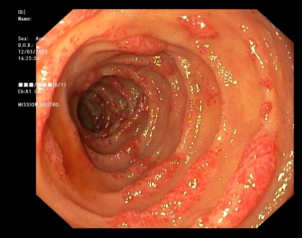
Figure 1. Endoscopic image showing vascular ectasia in the second part of duodenum.
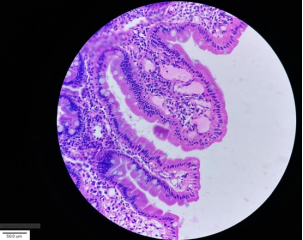
Figure 2. Histological image showing patchy mild chronic active duodenitis with patchy mild villous blunting with mild Brunner's gland hyperplasia and lamina propria shows mild fibrosis and dilated vascular channels filled with blood and few shows thrombus within suggestive of Duodenal vascular ectasia (DVE).
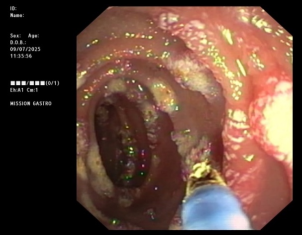
Figure 3. Endoscopic image showing Argon plasma coagulation (APC) of the duodenal vascular ectasia (DVE).

Information



 Share This Article
 Twitter
 Linked In
 Facebook
 Copy
Copy Download