Abstract
This article aims to re-examine, with the benefit of hindsight, the relevance of Butler's Tourism Area Life Cycle (TALC) model through the case of Saly (Senegal), a seaside resort on the Petite Côte. It compares the 2018 assessment, which placed the resort in a phase of consolidation and stagnation, with developments observed between 2018 and 2026. Using a longitudinal qualitative approach, the study draws on a range of documentary sources, including academic studies, institutional documents, available statistics, industry publications and press articles, given the lack of continuous and reliable local statistical series. The results confirm several observations made in 2018, notably persistent weaknesses in the hotel sector and environmental constraints, but do not establish a generalized decline. The COVID-19 pandemic further aggravated pre-existing difficulties. The weakening of international mass tourism has coincided with the development of domestic tourism, residentialisation, business tourism and the diversification of urban functions. Meanwhile, public interventions along the coastline have sought to improve the physical conditions of the seaside product, without evidence of a uniform recovery. Saly thus appears as a destination in transition, whose components evolve at different rates and cannot be assigned to a single life-cycle stage. The study concludes that the TALC remains a useful but insufficient interpretive framework and should be complemented by an evolutionary geographical perspective that accounts for public action, crises and path dependence. Given its qualitative, single-case design, the study does not support generalization to all developing countries.
Keywords
TALC, Destination Evolution, Residentialization, Saly, Developing Countries
1. Introduction
While the concept of a “tourist destination” primarily refers to a geographic area, it can also denote a social and economic system whose components evolve and interact over time. This evolution depends on several factors related to spatial, environmental, economic, social, political, and institutional dimensions. The emergence, transformation, development and even bifurcation of “tourist spaces” have long attracted academic interest
| [1] | Cooper, C., Jackson, S. Destination life cycle: The Isle of Man case study. Annals of Tourism Research. 1989, 16(3), 377–398. https://doi.org/10.1016/0160-7383(89)90051-0 |
| [2] | Butler, R. W. The concept of a tourist area cycle of evolution: Implications for resource management. The Canadian Geographer. 1980, 24(1), 5–12.
https://doi.org/10.1111/j.1541-0064.1980.tb00970.x |
| [3] | Plog, S. C. Why destination areas rise and fall in popularity. Cornell Hotel and Restaurant Administration Quarterly. 1974, 14(4), 55–58. https://doi.org/10.1177/001088047401400409 |
[1-3]
. Several studies have sought to shed light on the determining factors in the evolution of tourist destinations and, consequently, the process by which some destinations experience sustained success while others face varying fortunes over time
| [4] | Berry, E. N. An application of Butler’s (1980) tourist area life cycle theory to the Cairns region, Australia, 1876–1998. PhD thesis, James Cook University, 2000.
https://doi.org/10.25903/5bebae108228c |
[4]
.
The model of tourism destination evolution proposed by Butler
- the
Tourism Area Life Cycle (TALC) - remains one of the primary references cited in studies devoted to the dynamics of tourism destination development
| [5] | Gore, S., Borde, N., Hegde Desai, P., George, B. A structured literature review of the Tourism Area Life Cycle concept. Journal of Tourism, Sustainability and Well-being. 2022, 10(1), 1–20. https://doi.org/10.34623/7462-ma58 |
| [6] | Lagiewski, R. M. The application of the TALC model: A literature survey. In The Tourism Area Life Cycle: Vol. 1. Applications and Modifications, Butler, R. W., Ed., Channel View Publications; 2006, pp. 27–50.
https://doi.org/10.21832/9781845410278-009 |
[5, 6]
. In its original version, the
TALC describes a process consisting of several successive phases, ranging from exploration to stagnation, followed by either the decline or renewal of the destination. However, numerous applications of the model have shown that the observed trajectories do not always correspond to the linear sequence of phases described by the model. Hovinen
, Getz
, Haywood
and Lundtorp and Wanhill
| [10] | Lundtorp, S., Wanhill, S. The resort lifecycle theory: Generating processes and estimation. Annals of Tourism Research. 2001, 28(4), 947–964.
https://doi.org/10.1016/S0160-7383(00)00080-3 |
| [11] | Lundtorp, S., Wanhill, S. Time path analysis and TALC stage demarcation. In The Tourism Area Life Cycle: Vol. 2. Conceptual and Theoretical Issues, Butler, R. W., Ed., Channel View Publications; 2006, pp. 138–149. |
[10, 11]
have notably highlighted the difficulties associated with delineating these phases and the diversity of the trajectories observed.
This issue is particularly relevant in the case of tourist destinations in developing countries, whose dynamics can be strongly influenced by changes in supply and demand, government interventions, crises, and environmental constraints. From this perspective, the case of Saly in Senegal is a particularly suitable case study. Developed for tourism beginning in the late 1970s, this resort has undergone rapid development that has gradually established it as one of the country’s leading destinations. This evolution has been accompanied by significant transformations in the built environment, the tourism supply, and the destination’s functions. An analysis of its development trajectory, based on Butler’s model
, had revealed a situation of consolidation and stagnation, marked in particular by a decline in beach tourism, an increase in residentialization (the long-term settlement of expatriate residents and the construction of second homes), a shift in the profile of the clientele, and the growth of business tourism
| [12] | Ly, M. B. The theory of the life cycle of a tourist destination: An illustrative case study: Saly (Senegal). Doctoral Dissertation, University of Thiès, Thiès, Senegal, 2018. |
[12]
.
However, the assessment made at the time did not indicate with certainty which phase of the cycle the destination was experiencing. The difficulty in determining a destination’s “current” phase is, in fact, one of the main limitations of the TALC framework, in that it is often easier, with the benefit of hindsight, to identify the different stages of a trajectory than to clearly determine the phase in which a destination finds itself at a given moment
. The case of Saly now offers an opportunity to reexamine this issue with the benefit of several additional years of hindsight. Since 2018, the destination has undergone significant transformations, including coastal interventions, redevelopment projects, new investments, and a diversification of its urban functions. At the same time, certain trends identified previously persist, and tourism development continues to bring about significant spatial, environmental, and territorial transformations in the area
| [13] | Diombéra, M. Dynamique territoriale et développement touristique: quelles stratégies environnementales durables à Saly (Petite Côte, Sénégal) ? [Territorial dynamics and tourism development: What sustainable environmental strategies for Saly (Petite Côte, Senegal)?] Études caribéennes. 2020.
https://doi.org/10.4000/etudescaribeennes.19388 |
| [14] | Diouf, F. S., Fall, M. B., Sow, M. Site touristique et évolution spatiotemporelle d’un milieu géographique. Exemple de la station balnéaire de Saly Portudal au Sénégal [Tourist destination and the spatiotemporal evolution of a geographic environment: The case of the Saly Portudal seaside resort in Senegal]. Revue Internationale des Sciences Économiques et Sociales (RISES). 2024, (4), 17–30.
https://doi.org/10.17184/eac.8164 |
[13, 14]
.
This hindsight will allow us to reexamine the TALC’s ability to account for a tourism trajectory marked by the coexistence of contrasting dynamics: a decline in international tourism organized by tour operators (TOs) and hotel chains, the growth of domestic tourism, the residentialization of the site, the rise of business tourism (seminars and conferences), and persistent environmental constraints.
To what extent does Butler’s
model allow us to analyze the evolution of Saly and reassess the analysis conducted in 2018? More specifically, do the changes that occurred between 2018 and 2026 confirm or call into question the previous interpretation of the resort’s trajectory?
This article thus aims to discuss the relevance of Butler’s model for understanding the evolution of tourist destinations in developing countries, using the case of Saly, a seaside resort on Senegal’s Petite Côte. Three hypotheses guide our work:
H1: The hindsight gained between 2018 and 2026 confirms certain trends identified in the previous analysis and also highlights developments that do not follow a linear trajectory of stagnation followed by decline, as the TALC model tends to suggest.
H2: The evolution reveals the coexistence of different dynamics that correspond to several phases described in the model: stagnation, decline, and renewal. This situation calls into question any reading of the destination’s stage of evolution based on a single phase, as the model suggests.
H3: Factors related in particular to the role of the state and public authorities, dependence on international operators and chains, the rise of domestic tourism, and environmental constraints suggest that, in the context of developing countries, the model would benefit from incorporating the economic, institutional, and social conditions that influence tourism development.
2. Literature Review
2.1. Life Cycle and Tourism Destination: Ontological Questions
Life-cycle theory, applied across several disciplines, provides a framework for tracing the main stages of a phenomenon’s evolution and identifying its determining factors.
However, applying this approach, which originates in biology, to tourism destinations warrants some ontological considerations. A destination is, in fact, a complex, multifaceted, and multidimensional subject of study. It is a geographical, economic, and social entity that refers to an identifiable space equipped with infrastructure and facilities. It is also a place where practices and interactions occur among visitors, host communities, operators, and other stakeholders. Its dynamics thus depend on several factors: social behaviors, the structure of the local market, business models, and the relationships among the various actors.
This complexity raises a fundamental question: what, precisely, is the object whose cycle of evolution is being studied? In other words, what reality is evolving, and according to what dynamics? Is it the place itself, the dominant form of tourism practiced there, the tourism facilities, or the visitor segments that visit the destination? Butler
aggregates geographical, landscape, economic, and social factors to characterize the different phases of the cycle, without always clearly distinguishing the processes specific to each of these dimensions.
These questions are reflected in the numerous applications of the TALC, which have highlighted its limitations and led to adaptations or proposals for enhancement.
2.2. Butler’s TALC: Applications, Limitations, Criticisms, and Improvements
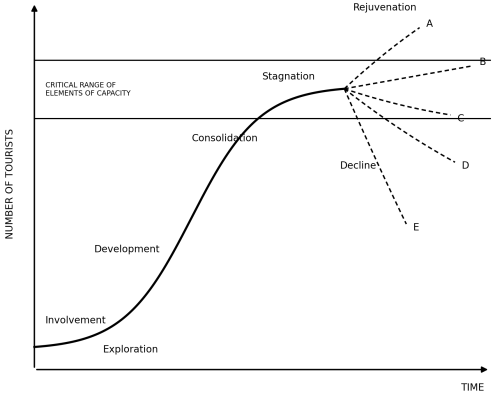
Butler’s TALC offers a theoretical representation of the evolution of a space developed for tourism, based on an S-curve whose main variables are time and the number of visitors. The model distinguishes six phases: exploration, involvement, development, consolidation, stagnation, and decline or rejuvenation.
The exploration phase corresponds to visits to the site by a limited number of visitors, in the absence of an organized tourism offering. Interaction with local residents is significant during this phase, and economic benefits remain limited. The involvement phase marks the beginning of local stakeholders’ commitment to welcoming and promoting visitors, while the first tourism infrastructure and activities take shape. During the development phase, visitor numbers increase, investments multiply, and the tourism offering becomes more formalized. This evolution is often accompanied by a transformation of the area and greater involvement from external stakeholders (notably international investors and tourists).
The consolidation phase corresponds to a slowdown in visitor growth, even as tourism plays a significant role in the local economy. Signs of losing momentum begin to appear, and stakeholders step up their promotional efforts to maintain the destination’s appeal. Stagnation then constitutes a critical stage, marked in particular by certain capacity limits being reached, the degradation of the resources that underpin the site’s appeal, and the emergence of economic and sociocultural difficulties. At this stage, the model (
Figure 1) allows for two possible outcomes: decline, when the destination gradually loses its traditional clientele and sees its facilities deteriorate or be repurposed; or rejuvenation, which involves significant changes to the tourism offering, investments, or market positioning.
Since its publication, the model has been applied in a wide range of geographical and tourism contexts. The structured literature reviews by Gore et al.
| [5] | Gore, S., Borde, N., Hegde Desai, P., George, B. A structured literature review of the Tourism Area Life Cycle concept. Journal of Tourism, Sustainability and Well-being. 2022, 10(1), 1–20. https://doi.org/10.34623/7462-ma58 |
[5]
and Lagiewski
| [6] | Lagiewski, R. M. The application of the TALC model: A literature survey. In The Tourism Area Life Cycle: Vol. 1. Applications and Modifications, Butler, R. W., Ed., Channel View Publications; 2006, pp. 27–50.
https://doi.org/10.21832/9781845410278-009 |
[6]
document around one hundred applications of the model that sought to compare the theoretical trajectory with observed developments.
Hovinen’s
study, focusing on Lancaster County in Pennsylvania, is one of the earliest landmark applications. The author observes that the early stages of development correspond relatively well to Butler’s model, but that the later phases are more difficult to delineate. In particular, he highlights the coexistence of growth, stagnation, and renewal, without it always being possible to precisely date the onset of a phase of decline. Oglethorpe
| [15] | Oglethorpe, M. K. Tourism in Malta: A crisis of dependence. Leisure Studies. 1984, 3(2), 147–161. |
[15]
, in his study of Malta, draws in particular on changes in accommodation capacity, visitor flows, and foreign investment to characterize the destination’s trajectory. Strapp
, using the case of Sauble Beach in Canada, pays particular attention to the average length of stay, arguing that this indicator allows for a clearer distinction between patterns of visitor use and changes in the destination’s tourism function. These studies show that trajectory analysis cannot rely exclusively on visitor numbers but must also take into account the nature of demand and changes in supply.
The role of public authorities also appears to be decisive in certain applications
| [12] | Ly, M. B. The theory of the life cycle of a tourist destination: An illustrative case study: Saly (Senegal). Doctoral Dissertation, University of Thiès, Thiès, Senegal, 2018. |
| [17] | Hussin, N. Z. Tracing the Malaysia tourism lifecycle and strategy assessment from the First Malaysia Plan to the Ninth Malaysia Plan. International Journal of Business and Social Science. 2014, 5(3), 161–168. |
| [18] | Ioannides, D. Tourism development agents: The Cypriot resort cycle. Annals of Tourism Research. 1992, 19(4), 711–731.
https://doi.org/10.1016/0160-7383(92)90063-U |
[12, 17, 18]
, which highlight the importance of government interventions in maintaining the attractiveness of a tourist destination. In developing countries, where the government frequently intervenes in site development, infrastructure provision, and the attraction of investment, public policy decisions can influence the trajectory followed.
The work of Lundtorp and Wanhill
on the Isle of Man and Bornholm offers a different perspective by employing a quantitative analysis of visitor numbers over a long period. Their approach distinguishes, in particular, between visitors returning to the destination and those visiting it for the first time. It highlights the importance of demand structure in identifying phases.
Researchers continue to apply the TALC framework while broadening the scope of their analysis. McKercher and Wong
, using visitor data from more than 200 national destinations over a 35-year period, identify six life-cycle patterns. The study by Lemarié and Marsac
| [20] | Lemarié, J., Marsac, A. Le modèle touristique de Butler à la lumière de la résilience hawaiienne: une analyse diachronique (1893–2025) [Butler’s tourism model in light of Hawaiian resilience: A diachronic analysis (1893–2025)]. L’Information géographique. 2026, (3), 37–57.
https://doi.org/10.3917/lig.9003.0037 |
[20]
, which examines Hawaii’s tourism trajectory over a long period (1893–2025) using time-series statistical data and a reconstruction of key events that influenced tourism development, confirms the value of the TALC for retrospective analysis. Their results suggest, however, that these trajectories cannot be reduced to a single pattern and that changes in destinations may also be interdependent.
The model’s value lies in its ability to link changes in visitor numbers to economic, spatial, and organizational transformations at the destination. It also highlights that a tourism trajectory is not necessarily irreversible. The TALC implicitly addresses the issue of destination management, particularly the ability of stakeholders to identify signs of vulnerability and to take actions likely to maintain or renew the destination’s attractiveness
| [2] | Butler, R. W. The concept of a tourist area cycle of evolution: Implications for resource management. The Canadian Geographer. 1980, 24(1), 5–12.
https://doi.org/10.1111/j.1541-0064.1980.tb00970.x |
| [9] | Haywood, K. M. Can the tourist-area life cycle be made operational? Tourism Management. 1986, 7(3), 154–167.
https://doi.org/10.1016/0261-5177(86)90002-6 |
| [21] | Agarwal, S. Coastal resort restructuring and the TALC. In The Tourism Area Life Cycle: Vol. 2. Conceptual and Theoretical Issues, Butler, R. W., Ed., Channel View Publications; 2006, pp. 201–218. |
[2, 9, 21]
.
The model thus provides a useful analytical framework, though its scope must nevertheless be assessed in light of empirical situations. Despite its influence in tourism studies, it has been criticized regarding its operationalization, its conception of the tourism trajectory, and its ability to account for the specific characteristics of destinations.
2.3. Criticisms and Limitations of the Model
2.3.1. The Difficulty of Identifying and Defining the Phases
While the S-curve offers a concise and convenient representation of tourism development, the characteristics and attributes used to determine the transition from one stage to another remain imprecise
. Haywood
thus emphasizes the need to clarify the unit of analysis, the selected indicators, and the conditions for operationalizing the model. The assessment depends, in part, on the observation period and the criteria used. To mitigate this difficulty, the identification of phases must be based on sufficiently long time series and on several convergent indicators
.
2.3.2. The Linearity of the Process
A second criticism concerns the conception of the cycle as a relatively ordered sequence of phases with little variability. However, tourism development is subject to economic, political, and social factors that can alter its course and make interpreting its trajectory much more complex. From this perspective, the model struggles to account for the bifurcations and disruptions that certain tourist destinations may experience
| [23] | Butler, R. W. COVID-19 and its potential impact on stages of tourist destination development. Current Issues in Tourism. 2022, 25(10), 1682–1695.
https://doi.org/10.1080/13683500.2021.1990223 |
| [24] | Russell, R., Faulkner, B. Entrepreneurship, chaos, and the tourism area lifecycle. Annals of Tourism Research. 2004, 31(3), 556–579. https://doi.org/10.1016/j.annals.2004.01.008 |
[23, 24]
. These factors and crises make trajectories less predictable. As a result, the model has often been criticized for its limited predictive power
| [25] | Juárez-Tárraga, F., Perles-Ribes, J. F., Ramón-Rodríguez, A. B., Cárdenas, E. Confidence intervals as a tool to determine the thresholds of the life cycle of destinations. Current Issues in Tourism. 2023, 26(24), 3923–3928.
https://doi.org/10.1080/13683500.2022.2164260 |
| [26] | Albaladejo, I. P., Martínez-García, M. P. The post-stagnation stage for mature tourism areas: A mathematical modeling process. Tourism Economics. 2017, 23(2), 387–402.
https://doi.org/10.5367/te.2015.0533 |
[25, 26]
.
2.3.3. The Diversity of Trajectories Within a Single Destination
A third limitation concerns the implicit assumption of a single trajectory common to the entire destination. Changes in visitor profiles, supply, types of accommodation, practices, and forms of tourism are not necessarily synchronous. The same applies to the physical and spatial transformations of the territory and the relationships among actors in the tourism ecosystem. These various components may follow distinct rhythms or even evolve in divergent directions. It is therefore necessary to move beyond the idea of a single cycle in order to analyze the dynamics specific to the destination’s various components and their interactions
| [5] | Gore, S., Borde, N., Hegde Desai, P., George, B. A structured literature review of the Tourism Area Life Cycle concept. Journal of Tourism, Sustainability and Well-being. 2022, 10(1), 1–20. https://doi.org/10.34623/7462-ma58 |
| [19] | McKercher, B., Wong, I. A. Do destinations have multiple lifecycles? Tourism Management. 2021, 83, Article 104232. https://doi.org/10.1016/j.tourman.2020.104232 |
[5, 19]
.
2.3.4. Insufficient Consideration of Contextual Factors and Institutional Intervention
Public policies, regulatory frameworks, the role of institutional actors, and the economic and social context also shape these trajectories, particularly in developing countries, where the government is often responsible for the development, management, and promotion of tourist sites
| [27] | Kubickova, M., Martin, D. Exploring the relationship between government and destination competitiveness: The TALC model perspective. Tourism Management. 2020, 78, Article 104040. https://doi.org/10.1016/j.tourman.2019.104040 |
| [28] | Ly, M. B. An application of Butler’s (1980) Tourist Area Life Cycle to Saly (Senegal). International Journal for Innovation Education and Research. 2018, 6(1), 47–56.
https://doi.org/10.31686/ijier.vol6.iss1.919 |
| [29] | Butler, R. W. Tourism destination development: Cycles and forces, myths and realities. Tourism Recreation Research. 2009, 34(3), 247–254.
https://doi.org/10.1080/02508281.2009.11081600 |
[27-29]
. It is therefore important to incorporate public policies and the configuration of relationships among the various stakeholders into the analysis in order to better understand the observed trajectories.
In light of the limitations and recommendations identified by researchers, the TALC should be used as a tool for interpreting destinations’ tourism trajectories rather than as a linear model whose phases can be systematically verified. Saly, whose development has been largely driven by the government, provides a relevant case study. The following section presents the case study, the sources used, and the methodological approach adopted.
3. Field of Study and Methodological Approach
3.1. The Study Area
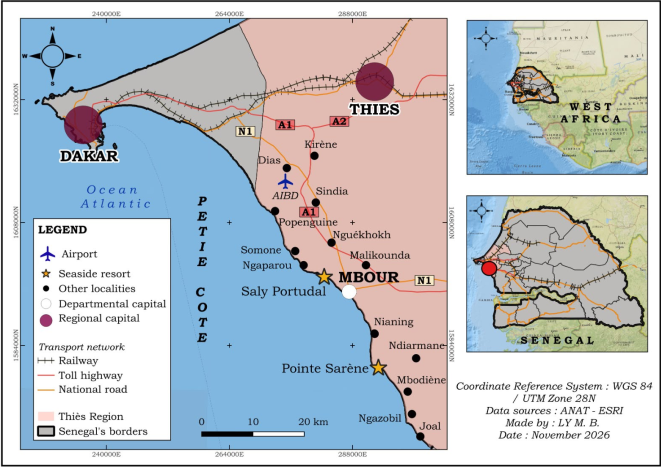
Located on Senegal’s Petite Côte, Saly (also called Saly Portudal) plays a central role in the country’s tourism economy. Its development is part of a proactive policy to promote tourism, in which the government and the Society for the Development and Promotion of Senegal’s Coasts and Tourist Areas (SAPCO-Senegal) have played a central role.
Saly’s evolution thus reflects a process of territorial transformation marked by the shift from a vacation destination, frequented primarily for short stays and second homes
| [30] | Ciss, G. Saly-Portudal, un village sénégalais face au tourisme international [Saly-Portudal: A Senegalese village facing international tourism]. Les Cahiers d’Outre-Mer. 1989, 42(165), 53–72. https://doi.org/10.3406/caoum.1989.3290 |
[30]
, to a seaside resort structured around an organized tourism offering. This transformation has been accompanied by public and private investments, changes in types of accommodation, and a gradual restructuring of the area’s functions. However, tourism development has also given rise to challenges related to coastal management, changes in the hotel sector, spatial planning, and coordination among stakeholders. Studies on Saly highlight, in particular, the environmental challenges and changes in residential land uses associated with the resort’s development
.
The choice of Saly as a case study is based on three considerations. First, its history of tourism allows us to trace a relatively long trajectory, from the earliest forms of visitor activity to the development of a seaside resort. Second, the role played by public authorities in the creation and development of the resort provides a relevant framework for examining the influence of investment and management policies on a destination’s evolution. Third, the challenges identified in the 2018 assessment, notably signs of consolidation and stagnation, the weakening of certain seaside activities, and the emergence of new functions, justify a reexamination of this trajectory in light of subsequent developments.
Figure 2. Location of Saly within Senegal and the Petite Côte.
3.2. A Longitudinal Approach to the Tourism Trajectory
This research adopts a longitudinal approach and follows a process-oriented methodology, understood as the study of phenomena through their temporal sequence, their context, and the interactions among the actors involved
.
The analysis is organized around two complementary sequences. The first consists of revisiting Saly’s historical trajectory as reconstructed in the initial study
| [12] | Ly, M. B. The theory of the life cycle of a tourist destination: An illustrative case study: Saly (Senegal). Doctoral Dissertation, University of Thiès, Thiès, Senegal, 2018. |
[12]
, distinguishing the major stages of its tourism development. This periodization is based on the model proposed by Butler
, without treating the phases as strictly delimited categories.
The second sequence covers the period 2018–2026. It compares the trends identified in the initial assessment with the developments documented over the following eight years, without mechanically applying Saly’s classification to a specific phase of the cycle.
The comparison is based on the analysis of various types of sources: scientific studies, available statistics, institutional documents, professional publications, and press articles. The information gathered is examined according to its date, origin, and scope.
In the absence of continuous and sufficiently reliable local statistical series, the analysis cannot accurately measure changes in visitor numbers, tourism revenue, or accommodation capacity over the entire period studied. It therefore favors a qualitative, documented reading of the destination’s transformations.
Finally, the identified trends are interpreted in light of the phases of Butler’s model
, while taking into account its limitations. In particular, this involves examining the possibility of simultaneous dynamics of stagnation, decline, and renewal, which may affect the various components of the destination in different ways.
4. Results and Discussion
4.1. “Stagnation” That Does Not Necessarily Lead to Decline
The assessment conducted in 2018 placed Saly in a phase in which we identified signs of both stagnation and consolidation (this phase was labeled “maturity”), while also anticipating a possible shift toward decline. The documented developments confirm the validity of these conclusions on certain points, notably the difficulties faced by part of the hotel sector, environmental constraints, and the need to renew the tourism offering. However, they do not support the conclusion that the destination is experiencing a widespread decline.
The coronavirus disease 2019 (COVID-19) pandemic represented a major disruption to this trajectory. Before the pandemic, the accommodation supply in the department of Mbour (which includes Saly, the department's main tourist destination) was still expanding: between 2018 and 2019, the number of registered tourist establishments increased from 167 to 184, while the number of rooms rose from 2,848 to 3,024
. The situation changed dramatically in 2020. At the height of the health crisis, hotel occupancy rates in Saly reportedly fell to between 5% and 12%, while 80% of the professionals surveyed by Diombera
| [34] | Diombéra, M. Les impacts socioéconomiques de la COVID-19 sur le tourisme littoral: le cas de la station de Saly Portudal (Sénégal) [The socioeconomic impacts of COVID-19 on coastal tourism: The case of the Saly Portudal resort (Senegal)]. Études caribéennes. 2021, (49).
https://doi.org/10.4000/etudescaribeennes.21099 |
[34]
reported total or partial income losses. The number of employees recorded in the author's sample also declined from 73 in 2019 to 26 in 2020, before partially recovering to 56 in 2021. These figures refer to the author's survey sample rather than the entire tourism workforce in Saly, but illustrate the scale of the economic and social disruption. In September 2020, tourism industry representatives also reported that 1,137 permanent jobs were at risk in Saly. The crisis cannot therefore be considered the sole cause of the resort’s difficulties, but rather an aggravating factor in a pre-existing situation.
This observation aligns with the limitations identified in the model’s applications. Akama
, in his analysis of the evolution of tourism in Kenya, shows that while the model allows for reconstructing the major stages of a trajectory, it proves less effective at incorporating events that abruptly alter the conditions of tourism development.
The period under study thus calls for distinguishing between the destination’s structural difficulties and external shocks that may exacerbate them. Stagnation does not necessarily constitute a stage that inevitably leads to decline
. It can be prolonged, exacerbated by a crisis, or partially mitigated by public interventions and adaptation strategies
.
4.2. The “Destination in Transition”
A key finding of the 2018 assessment was the characterization of Saly as a “destination in transition”
| [12] | Ly, M. B. The theory of the life cycle of a tourist destination: An illustrative case study: Saly (Senegal). Doctoral Dissertation, University of Thiès, Thiès, Senegal, 2018. |
[12]
. This interpretation was based on the evolution of the resort’s functions, which were no longer limited to beach vacations. The diversification of uses, the residential function, and the development of commercial and service activities suggested a gradual transformation of the resort into a space with urban functions.
Research on the spatial evolution of Saly supports the validity of this interpretation. Diouf et al.
| [14] | Diouf, F. S., Fall, M. B., Sow, M. Site touristique et évolution spatiotemporelle d’un milieu géographique. Exemple de la station balnéaire de Saly Portudal au Sénégal [Tourist destination and the spatiotemporal evolution of a geographic environment: The case of the Saly Portudal seaside resort in Senegal]. Revue Internationale des Sciences Économiques et Sociales (RISES). 2024, (4), 17–30.
https://doi.org/10.17184/eac.8164 |
[14]
analyze the spatiotemporal transformations of the resort and show how tourism development has contributed to reshaping the geographical environment. More recently, Badji et al.
| [37] | Badji, M., Sambou, H., Mbow, C., Drame, F. A. Cartographic analysis of the spatial changes in the tourist resort of Saly (Senegal) between 1988 and 2024. American Journal of Environmental Protection. 2026, 15(5), 158–168.
https://doi.org/10.11648/j.ajep.20261505.12 |
[37]
studied changes in land use between 1988 and 2024, providing cartographic evidence of the evolution of the area.
Urbanization and the renewal of tourism activity are two related but not equivalent processes. Residential development, the expansion of the resort, or commercial and real estate diversification can continue even as certain hotel-related activities stagnate. Conversely, the growth of urban functions does not automatically mean that the tourism product is being renewed.
The concept of a “destination in transition” thus allows us to move beyond the dichotomy of stagnation versus decline. It captures functional and territorial transformations that Butler’s model—which focuses on the phases of tourism development—does not always allow us to grasp directly. In the case of Saly, it is therefore important to distinguish the trajectory of tourism from that of the urban area, which includes a form of conurbation stretching from Somone to Mbour.
4.3. Factors Reshaping the Trajectory
Developments since 2018 show that Saly’s trajectory also depends on factors external to the internal dynamics of the tourist resort. Improved accessibility is a key factor. Blaise Diagne International Airport (AIBD) and the Diamniadio-AIBD highway were already operational in 2018, while the extension of the A1 highway toward Mbour opened in 2019. This extension facilitates travel between Dakar, the airport, and the Petite Côte, thereby contributing to a change in the conditions under which tourism develops in Saly. Although accessibility has improved, the effect of this improvement on Saly’s tourism performance has not been measured. Moreover, it benefits several destinations along the Petite Côte and therefore does not guarantee an exclusive competitive advantage for Saly.
Coastal restoration and protection efforts, including beach nourishment and the construction of protective structures, have restored approximately 325,000 m
2 of beaches in Saly
. These interventions show that public action can address a major constraint and preserve a resource essential to seaside tourism. However, the sources consulted document the works and the area restored but do not provide measurements of their effect on visitor numbers, occupancy or revenue. Consequently, they are insufficient, on their own, to demonstrate a sustainable revival of tourism activity. These interventions should therefore be considered as contextual factors influencing the destination's development potential.
Finally, the development of Pointe Sarène, notably with the opening of a large 1,000 bed hotel complex in 2022, has strengthened the seaside tourism offering on the Petite Côte. The emergence of this new hub is altering Saly’s competitive environment.
The case of Saly thus shows that public action can alter the conditions for tourism development without automatically determining the outcome. The effects of these changes on Saly’s trajectory, however, depend on the ability of stakeholders to define and implement effective destination management strategies and to maintain its competitiveness.
4.4. Scope and Limitations of the TALC in Analyzing Saly’s Trajectory: Lessons for Developing Countries
Our work shows that tourism trajectories must be viewed within their historical and institutional context. In the case of Saly, government intervention in the creation and development of the resort, public investments, and coastal protection policies are key elements of the analysis.
Kubickova and Li
| [39] | Kubickova, M., Li, H. Tourism competitiveness, government, and the Tourism Area Life Cycle (TALC) model: An evaluation of Costa Rica, Guatemala, and Honduras. International Journal of Tourism Research. 2017, 19(2), 223–234.
https://doi.org/10.1002/jtr.2105 |
[39]
shed additional light on the relationships between government action, competitiveness, and the life cycle. Their study of three Central American countries indicates that the government’s role varies in particular according to the level of dependence on tourism and the stage of development. A comparison of the 2018 assessment with developments documented through 2026 confirms the usefulness of Butler’s model for interpreting the major stages of Saly’s tourism development. Certain initial observations regarding the aging of the hotel supply and the failure to manage the negative externalities of tourism—both socioeconomic and environmental—have been confirmed. However, these developments do not allow us to interpret the recent trajectory as a mechanical transition from stagnation to decline or rejuvenation.
The case of Saly thus illustrates that the various components of the destination are evolving at distinct paces. The sources consulted indicate that international mass tourism is weakening
| [12] | Ly, M. B. The theory of the life cycle of a tourist destination: An illustrative case study: Saly (Senegal). Doctoral Dissertation, University of Thiès, Thiès, Senegal, 2018. |
| [31] | Fleuret, S., Lessault, D., Sakho, P. Recul du tourisme de masse: la transformation d’une station balnéaire emblématique du Sénégal [The decline of mass tourism: The transformation of an iconic Senegalese seaside resort]. The Conversation. February 6, 2023.
https://theconversation.com/recul-du-tourisme-de-masse-la-transformation-dune-station-balneaire-emblematique-du-senegal-198456 |
[12, 31]
, while domestic tourism
, residentialization
| [31] | Fleuret, S., Lessault, D., Sakho, P. Recul du tourisme de masse: la transformation d’une station balnéaire emblématique du Sénégal [The decline of mass tourism: The transformation of an iconic Senegalese seaside resort]. The Conversation. February 6, 2023.
https://theconversation.com/recul-du-tourisme-de-masse-la-transformation-dune-station-balneaire-emblematique-du-senegal-198456 |
| [40] | Samb, M. B., Samb, M. From a specialized tourist resort to a multifunctional tourist-residential territory: Residentialization and territorial transformation in Saly (Senegal). Journal of Service Science and Management. 2026, 19(5), 481–503.
https://doi.org/10.4236/jssm.2026.195022 |
[31, 40]
and the diversification of urban functions
| [14] | Diouf, F. S., Fall, M. B., Sow, M. Site touristique et évolution spatiotemporelle d’un milieu géographique. Exemple de la station balnéaire de Saly Portudal au Sénégal [Tourist destination and the spatiotemporal evolution of a geographic environment: The case of the Saly Portudal seaside resort in Senegal]. Revue Internationale des Sciences Économiques et Sociales (RISES). 2024, (4), 17–30.
https://doi.org/10.17184/eac.8164 |
| [37] | Badji, M., Sambou, H., Mbow, C., Drame, F. A. Cartographic analysis of the spatial changes in the tourist resort of Saly (Senegal) between 1988 and 2024. American Journal of Environmental Protection. 2026, 15(5), 158–168.
https://doi.org/10.11648/j.ajep.20261505.12 |
[14, 37]
are expanding. These trends are documented qualitatively, as no numerical series are available (see
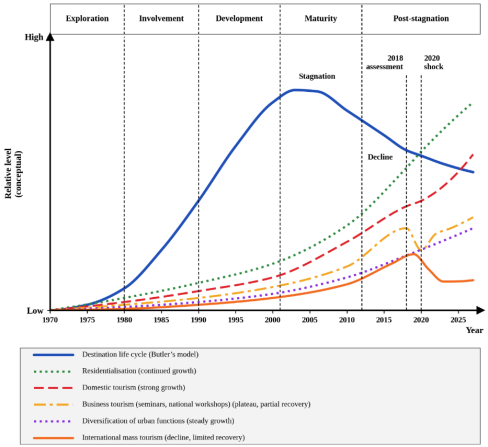
Table 2). Public interventions have also improved the physical conditions of the seaside tourism product, without leading to a uniform recovery in activity. This coexistence of differentiated dynamics—which we represent schematically and without numerical values (
Figure 3) based on a qualitative interpretation of the results—aligns with critiques of the model regarding the plurality of trajectories within a single destination
and regarding the possibility of nonlinear transformations
.
Table 1.
Qualitative trends in the dynamics represented in Figure 3 and supporting sources. Dynamic (Figure 3) | Qualitative trend | Supporting sources |
International mass tourism (tour operators, hotel chains) | Weakening | Ly | [12] | Ly, M. B. The theory of the life cycle of a tourist destination: An illustrative case study: Saly (Senegal). Doctoral Dissertation, University of Thiès, Thiès, Senegal, 2018. |
[12] |
Domestic tourism | Growth | Fleuret et al. |
Residentialization | Growth | Samb and Samb | [40] | Samb, M. B., Samb, M. From a specialized tourist resort to a multifunctional tourist-residential territory: Residentialization and territorial transformation in Saly (Senegal). Journal of Service Science and Management. 2026, 19(5), 481–503.
https://doi.org/10.4236/jssm.2026.195022 |
[40] |
Business tourism (seminars, national workshops) | Growth | Ly | [12] | Ly, M. B. The theory of the life cycle of a tourist destination: An illustrative case study: Saly (Senegal). Doctoral Dissertation, University of Thiès, Thiès, Senegal, 2018. |
[12] |
Diversification of urban functions | Growth | Diouf et al. | [14] | Diouf, F. S., Fall, M. B., Sow, M. Site touristique et évolution spatiotemporelle d’un milieu géographique. Exemple de la station balnéaire de Saly Portudal au Sénégal [Tourist destination and the spatiotemporal evolution of a geographic environment: The case of the Saly Portudal seaside resort in Senegal]. Revue Internationale des Sciences Économiques et Sociales (RISES). 2024, (4), 17–30.
https://doi.org/10.17184/eac.8164 |
[14] | [37] | Badji, M., Sambou, H., Mbow, C., Drame, F. A. Cartographic analysis of the spatial changes in the tourist resort of Saly (Senegal) between 1988 and 2024. American Journal of Environmental Protection. 2026, 15(5), 158–168.
https://doi.org/10.11648/j.ajep.20261505.12 |
[37] |
Source: Author’s elaboration based on the sources cited in the table.
To understand and interpret the complex dynamics of evolution—and even transformation—in tourist areas, the literature suggests supplementing the TALC framework with insights from evolutionary economic geography
| [41] | Boschma, R. A., Frenken, K. Why is economic geography not an evolutionary science? Towards an evolutionary economic geography. Journal of Economic Geography. 2006, 6(3), 273–302. https://doi.org/10.1093/jeg/lbi022 |
[41]
. James et al.
| [42] | James, L., Halkier, H., Sanz-Ibáñez, C., Wilson, J. Advancing evolutionary economic geographies of tourism: Trigger events, transformative moments, and destination path shaping. Tourism Geographies. 2023, 25(8), 1819–1832.
https://doi.org/10.1080/14616688.2023.2285324 |
[42]
and Romão
| [43] | Romão, J. Smart specialization and the life cycle of destinations: An evolutionary approach. In The Tourism Area Life Cycle: Review, Relevance, and Revision, Butler, R. W., Ed., Channel View Publications; 2024, pp. 171–187.
https://doi.org/10.21832/9781845419141-018 |
[43]
emphasize the role of actors and institutions, as well as the potential for creating new development trajectories, and view territorial evolution as a historical process marked by
path dependence. Butler
himself recently identified sustainability, path dependence and the link with evolutionary economic geography as trends shaping the TALC. This theoretical framework allows us to examine how historical planning choices, investments, and institutional arrangements shape subsequent transformations
| [45] | Gauna Ruiz de León, C., Anton Clavé, S., Sanz-Ibáñez, C., & Zepeda Arce, A. (2026). Agency and coevolutionary path development in tourism destinations. Tourism Geographies, 28(2), 163–190.
https://doi.org/10.1080/14616688.2025.2519327 |
[45]
. Applied to Saly, the combination of these two approaches thus provides an analytical framework for understanding the reconfiguration of the resort’s tourism and residential functions, without reducing its evolution to a linear succession of phases.
Overall, in the case of the destination studied, Butler’s
model remains useful, but it must be integrated with an analysis of public policy, crises, competition, and urbanization. This integration allows for a better understanding of destination trajectories in contexts where tourism development is closely dependent on political choices regarding tourism planning and on economic, institutional, and environmental conditions. These implications derive from a single qualitative case study; they should be read as hypotheses to be tested in comparative research rather than as findings that can be generalized to developing countries.
5. Conclusion
The objective of this article was to reexamine, with the benefit of hindsight from 2026, the relevance of Butler’s
tourist destination life cycle model using the case of Saly Portudal. More specifically, the aim was to compare the assessment made in 2018 with the changes that occurred over the following eight years.
The analysis confirms the model’s value in tracing the major stages of Saly’s tourism development and interpreting the difficulties associated with stagnation. Several observations made in 2018 remain relevant. However, the 2018–2026 period was marked by transformations that prevent the resort’s trajectory from being reduced to a mechanical transition from stagnation to decline. The COVID-19 pandemic constituted a major shock, while road accessibility, coastal protection, and the emergence of Pointe Sarène have altered the conditions for development and competition on the Petite Côte. These developments show that a destination’s trajectory also depends on external events, public policies, and changes in its territorial environment.
One of the main contributions of this research lies in the reaffirmation of Saly as a “destination in transition.” This characterization, first proposed in 2018, emphasizes that the resort’s evolution is not limited to its tourism performance. The growth of residential, commercial, and urban functions is also transforming the space and its uses. This situation thus calls for distinguishing the tourism trajectory from that of the territory that supports it.
A comparison with other applications of the model in various contexts—including Kenya, Melanesia, Central America, and Tanzania—reinforces this interpretation. The work of Akama
, Douglas
, Kubickova and Li
| [39] | Kubickova, M., Li, H. Tourism competitiveness, government, and the Tourism Area Life Cycle (TALC) model: An evaluation of Costa Rica, Guatemala, and Honduras. International Journal of Tourism Research. 2017, 19(2), 223–234.
https://doi.org/10.1002/jtr.2105 |
[39]
, and Mwongoso et al.
highlights, each within its own context, the importance of historical, institutional, and economic conditions. These studies do not allow for the identification of a common trajectory among tourist destinations in developing countries. They do, however, show that the application of the model benefits from being contextualized and linked to an analysis of public interventions, infrastructure, economic dependencies, and territorial dynamics, which appear to be key determinants of destination trajectories in these countries.
These results lead us to view Butler’s model as a useful analytical framework, but one that is insufficient on its own to explain all the transformations observed in Saly. Its main limitation lies in the risk of reducing heterogeneous dynamics to a single phase of the cycle. An analysis in terms of trajectories allows for a better understanding of this diversity by accounting for breaks, adaptation strategies, and contextual factors.
The scope of these conclusions must, however, be assessed in light of the study’s methodological limitations. The lack of official quantitative data prevents an analysis of trends in visitor numbers, consumption, and production. Future research could deepen this study through surveys of establishments, institutional actors, and residents, as well as through a comparison with other West African beach destinations.
At the end of the analysis, the research hypotheses are confirmed to varying degrees.
Table 1 presents this comparison.
Table 2. Comparison of Hypotheses (author’s own elaboration).
Hypotheses | Findings from the Analysis | Comments |
H1. The hindsight gained over 2018-2026 confirms certain trends identified in the 2018 assessment but qualifies the notion of a linear trajectory of stagnation followed by decline. | Persistent vulnerabilities COVID-19 crisis Coastal interventions; improved accessibility. | Partially confirmed. Vulnerabilities persist, but a decline has not been demonstrated. |
H2. Saly exhibits a coexistence of dynamics of stagnation, decline, and renewal, which calls into question its classification in a single phase. | Difficulties faced by certain establishments Coastal protection and redevelopment Urban transformations Changes in competition. | Partially confirmed. The coexistence is supported, but neither widespread decline nor comprehensive renewal has been established. |
H3. Institutional and political factors, dependence on operators and international chains, the growth of domestic tourism, and environmental constraints suggest that, in the context of developing countries, the model would benefit from incorporating the economic, institutional, and social conditions that influence tourism development. | Role of public authorities Planning, management, investments Vulnerability to crises Environmental constraints Evolution of urban functions | Analytically sound, but requires further exploration. The comparisons justify contextualizing the model rather than generalizing it to all developing countries. |
Abbreviations
AIBD | Blaise Diagne International Airport |
COVID-19 | Coronavirus Disease 2019 |
SAPCO, Senegal | Society for the Development and Promotion of Senegal’s Coasts and Tourist Areas |
TALC | Tourism Area Life Cycle |
TOs | Tour Operators |
Author Contributions
Mouhamadou Bamba Ly: Conceptualization, Formal Analysis, Resources, Writing – review & editing
Data Availability Statement
The data is available from the corresponding author upon reasonable request.
Conflicts of Interest
The author declares no conflicts of interest.
References
| [1] |
Cooper, C., Jackson, S. Destination life cycle: The Isle of Man case study. Annals of Tourism Research. 1989, 16(3), 377–398.
https://doi.org/10.1016/0160-7383(89)90051-0
|
| [2] |
Butler, R. W. The concept of a tourist area cycle of evolution: Implications for resource management. The Canadian Geographer. 1980, 24(1), 5–12.
https://doi.org/10.1111/j.1541-0064.1980.tb00970.x
|
| [3] |
Plog, S. C. Why destination areas rise and fall in popularity. Cornell Hotel and Restaurant Administration Quarterly. 1974, 14(4), 55–58.
https://doi.org/10.1177/001088047401400409
|
| [4] |
Berry, E. N. An application of Butler’s (1980) tourist area life cycle theory to the Cairns region, Australia, 1876–1998. PhD thesis, James Cook University, 2000.
https://doi.org/10.25903/5bebae108228c
|
| [5] |
Gore, S., Borde, N., Hegde Desai, P., George, B. A structured literature review of the Tourism Area Life Cycle concept. Journal of Tourism, Sustainability and Well-being. 2022, 10(1), 1–20.
https://doi.org/10.34623/7462-ma58
|
| [6] |
Lagiewski, R. M. The application of the TALC model: A literature survey. In The Tourism Area Life Cycle: Vol. 1. Applications and Modifications, Butler, R. W., Ed., Channel View Publications; 2006, pp. 27–50.
https://doi.org/10.21832/9781845410278-009
|
| [7] |
Hovinen, G. R. Visitor cycles: Outlook for tourism in Lancaster County. Annals of Tourism Research. 1982, 9(4), 565–583.
https://doi.org/10.1016/0160-7383(82)90073-1
|
| [8] |
Getz, D. Tourism planning and destination life cycle. Annals of Tourism Research. 1992, 19(4), 752–770.
https://doi.org/10.1016/0160-7383(92)90065-W
|
| [9] |
Haywood, K. M. Can the tourist-area life cycle be made operational? Tourism Management. 1986, 7(3), 154–167.
https://doi.org/10.1016/0261-5177(86)90002-6
|
| [10] |
Lundtorp, S., Wanhill, S. The resort lifecycle theory: Generating processes and estimation. Annals of Tourism Research. 2001, 28(4), 947–964.
https://doi.org/10.1016/S0160-7383(00)00080-3
|
| [11] |
Lundtorp, S., Wanhill, S. Time path analysis and TALC stage demarcation. In The Tourism Area Life Cycle: Vol. 2. Conceptual and Theoretical Issues, Butler, R. W., Ed., Channel View Publications; 2006, pp. 138–149.
|
| [12] |
Ly, M. B. The theory of the life cycle of a tourist destination: An illustrative case study: Saly (Senegal). Doctoral Dissertation, University of Thiès, Thiès, Senegal, 2018.
|
| [13] |
Diombéra, M. Dynamique territoriale et développement touristique: quelles stratégies environnementales durables à Saly (Petite Côte, Sénégal) ? [Territorial dynamics and tourism development: What sustainable environmental strategies for Saly (Petite Côte, Senegal)?] Études caribéennes. 2020.
https://doi.org/10.4000/etudescaribeennes.19388
|
| [14] |
Diouf, F. S., Fall, M. B., Sow, M. Site touristique et évolution spatiotemporelle d’un milieu géographique. Exemple de la station balnéaire de Saly Portudal au Sénégal [Tourist destination and the spatiotemporal evolution of a geographic environment: The case of the Saly Portudal seaside resort in Senegal]. Revue Internationale des Sciences Économiques et Sociales (RISES). 2024, (4), 17–30.
https://doi.org/10.17184/eac.8164
|
| [15] |
Oglethorpe, M. K. Tourism in Malta: A crisis of dependence. Leisure Studies. 1984, 3(2), 147–161.
|
| [16] |
Strapp, J. D. The resort cycle and second homes. Annals of Tourism Research. 1988, 15(4), 504–516.
https://doi.org/10.1016/0160-7383(88)90046-1
|
| [17] |
Hussin, N. Z. Tracing the Malaysia tourism lifecycle and strategy assessment from the First Malaysia Plan to the Ninth Malaysia Plan. International Journal of Business and Social Science. 2014, 5(3), 161–168.
|
| [18] |
Ioannides, D. Tourism development agents: The Cypriot resort cycle. Annals of Tourism Research. 1992, 19(4), 711–731.
https://doi.org/10.1016/0160-7383(92)90063-U
|
| [19] |
McKercher, B., Wong, I. A. Do destinations have multiple lifecycles? Tourism Management. 2021, 83, Article 104232.
https://doi.org/10.1016/j.tourman.2020.104232
|
| [20] |
Lemarié, J., Marsac, A. Le modèle touristique de Butler à la lumière de la résilience hawaiienne: une analyse diachronique (1893–2025) [Butler’s tourism model in light of Hawaiian resilience: A diachronic analysis (1893–2025)]. L’Information géographique. 2026, (3), 37–57.
https://doi.org/10.3917/lig.9003.0037
|
| [21] |
Agarwal, S. Coastal resort restructuring and the TALC. In The Tourism Area Life Cycle: Vol. 2. Conceptual and Theoretical Issues, Butler, R. W., Ed., Channel View Publications; 2006, pp. 201–218.
|
| [22] |
Hovinen, G. R. Revisiting the destination lifecycle model. Annals of Tourism Research. 2002, 29(1), 209–230.
https://doi.org/10.1016/S0160-7383(01)00036-6
|
| [23] |
Butler, R. W. COVID-19 and its potential impact on stages of tourist destination development. Current Issues in Tourism. 2022, 25(10), 1682–1695.
https://doi.org/10.1080/13683500.2021.1990223
|
| [24] |
Russell, R., Faulkner, B. Entrepreneurship, chaos, and the tourism area lifecycle. Annals of Tourism Research. 2004, 31(3), 556–579.
https://doi.org/10.1016/j.annals.2004.01.008
|
| [25] |
Juárez-Tárraga, F., Perles-Ribes, J. F., Ramón-Rodríguez, A. B., Cárdenas, E. Confidence intervals as a tool to determine the thresholds of the life cycle of destinations. Current Issues in Tourism. 2023, 26(24), 3923–3928.
https://doi.org/10.1080/13683500.2022.2164260
|
| [26] |
Albaladejo, I. P., Martínez-García, M. P. The post-stagnation stage for mature tourism areas: A mathematical modeling process. Tourism Economics. 2017, 23(2), 387–402.
https://doi.org/10.5367/te.2015.0533
|
| [27] |
Kubickova, M., Martin, D. Exploring the relationship between government and destination competitiveness: The TALC model perspective. Tourism Management. 2020, 78, Article 104040.
https://doi.org/10.1016/j.tourman.2019.104040
|
| [28] |
Ly, M. B. An application of Butler’s (1980) Tourist Area Life Cycle to Saly (Senegal). International Journal for Innovation Education and Research. 2018, 6(1), 47–56.
https://doi.org/10.31686/ijier.vol6.iss1.919
|
| [29] |
Butler, R. W. Tourism destination development: Cycles and forces, myths and realities. Tourism Recreation Research. 2009, 34(3), 247–254.
https://doi.org/10.1080/02508281.2009.11081600
|
| [30] |
Ciss, G. Saly-Portudal, un village sénégalais face au tourisme international [Saly-Portudal: A Senegalese village facing international tourism]. Les Cahiers d’Outre-Mer. 1989, 42(165), 53–72.
https://doi.org/10.3406/caoum.1989.3290
|
| [31] |
Fleuret, S., Lessault, D., Sakho, P. Recul du tourisme de masse: la transformation d’une station balnéaire emblématique du Sénégal [The decline of mass tourism: The transformation of an iconic Senegalese seaside resort]. The Conversation. February 6, 2023.
https://theconversation.com/recul-du-tourisme-de-masse-la-transformation-dune-station-balneaire-emblematique-du-senegal-198456
|
| [32] |
Pettigrew, A. M. What is a processual analysis? Scandinavian Journal of Management. 1997, 13(4), 337–348.
https://doi.org/10.1016/S0956-5221(97)00020-1
|
| [33] |
National Agency for Statistics and Demography. (2023). Economic and social situation of the Thies region, 2020–2021.
https://www.ansd.sn/sites/default/files/2024-01/SES-Thies_2020-2021.pdf
|
| [34] |
Diombéra, M. Les impacts socioéconomiques de la COVID-19 sur le tourisme littoral: le cas de la station de Saly Portudal (Sénégal) [The socioeconomic impacts of COVID-19 on coastal tourism: The case of the Saly Portudal resort (Senegal)]. Études caribéennes. 2021, (49).
https://doi.org/10.4000/etudescaribeennes.21099
|
| [35] |
Akama, J. S. The evolution of tourism in Kenya. Journal of Sustainable Tourism. 1999, 7(1), 6–25.
https://doi.org/10.1080/09669589908667324
|
| [36] |
Agarwal, S. Restructuring seaside tourism: The resort lifecycle. Annals of Tourism Research. 2002, 29(1), 25–55.
https://doi.org/10.1016/S0160-7383(01)00002-0
|
| [37] |
Badji, M., Sambou, H., Mbow, C., Drame, F. A. Cartographic analysis of the spatial changes in the tourist resort of Saly (Senegal) between 1988 and 2024. American Journal of Environmental Protection. 2026, 15(5), 158–168.
https://doi.org/10.11648/j.ajep.20261505.12
|
| [38] |
World Bank. Restoring beaches and protecting the coastline to revitalize tourism and fishing in Saly. Available from:
https://www.banquemondiale.org/fr/news/feature/2023/06/01/beach-restoration-and-coastal-protection-to-revive-tourism-and-fishing-in-saly
(accessed 10 july 2026).
|
| [39] |
Kubickova, M., Li, H. Tourism competitiveness, government, and the Tourism Area Life Cycle (TALC) model: An evaluation of Costa Rica, Guatemala, and Honduras. International Journal of Tourism Research. 2017, 19(2), 223–234.
https://doi.org/10.1002/jtr.2105
|
| [40] |
Samb, M. B., Samb, M. From a specialized tourist resort to a multifunctional tourist-residential territory: Residentialization and territorial transformation in Saly (Senegal). Journal of Service Science and Management. 2026, 19(5), 481–503.
https://doi.org/10.4236/jssm.2026.195022
|
| [41] |
Boschma, R. A., Frenken, K. Why is economic geography not an evolutionary science? Towards an evolutionary economic geography. Journal of Economic Geography. 2006, 6(3), 273–302.
https://doi.org/10.1093/jeg/lbi022
|
| [42] |
James, L., Halkier, H., Sanz-Ibáñez, C., Wilson, J. Advancing evolutionary economic geographies of tourism: Trigger events, transformative moments, and destination path shaping. Tourism Geographies. 2023, 25(8), 1819–1832.
https://doi.org/10.1080/14616688.2023.2285324
|
| [43] |
Romão, J. Smart specialization and the life cycle of destinations: An evolutionary approach. In The Tourism Area Life Cycle: Review, Relevance, and Revision, Butler, R. W., Ed., Channel View Publications; 2024, pp. 171–187.
https://doi.org/10.21832/9781845419141-018
|
| [44] |
Butler, R. W. Tourism destination development: The tourism area life cycle model. Tourism Geographies. 2025, 27(3–4), 599–607.
https://doi.org/10.1080/14616688.2024.2325932
|
| [45] |
Gauna Ruiz de León, C., Anton Clavé, S., Sanz-Ibáñez, C., & Zepeda Arce, A. (2026). Agency and coevolutionary path development in tourism destinations. Tourism Geographies, 28(2), 163–190.
https://doi.org/10.1080/14616688.2025.2519327
|
| [46] |
Douglas, N. Applying the life cycle model to Melanesia. Annals of Tourism Research. 1997, 24(1), 1–22.
https://doi.org/10.1016/S0160-7383(96)00011-4
|
| [47] |
Mwongoso, A., Sirima, A., Mgonja, J. Development of tourism destinations in gateway communities, Northern Tanzania. Journal of Tourism Quarterly. 2021, 3(4), 177–195.
https://htmjournals.com/jtq/index.php/jtq/article/download/41/32/
|
Cite This Article
-
APA Style
Ly, M. B. (2026). Revisiting the Life Cycle of a Tourist Destination with Hindsight: Lessons from Saly (Senegal). International Journal of Hospitality & Tourism Management, 10(2), 249-260. https://doi.org/10.11648/j.ijhtm.20261002.17
 Copy
|
 Download
ACS Style
Ly, M. B. Revisiting the Life Cycle of a Tourist Destination with Hindsight: Lessons from Saly (Senegal). Int. J. Hosp. Tour. Manag. 2026, 10(2), 249-260. doi: 10.11648/j.ijhtm.20261002.17
Copy
|
Download
AMA Style
Ly MB. Revisiting the Life Cycle of a Tourist Destination with Hindsight: Lessons from Saly (Senegal). Int J Hosp Tour Manag. 2026;10(2):249-260. doi: 10.11648/j.ijhtm.20261002.17
Copy
|
Download
-
@article{10.11648/j.ijhtm.20261002.17,
  author = {Mouhamadou Bamba Ly},
  title = {Revisiting the Life Cycle of a Tourist Destination with Hindsight: Lessons from Saly (Senegal)},
  journal = {International Journal of Hospitality & Tourism Management},
  volume = {10},
  number = {2},
  pages = {249-260},
  doi = {10.11648/j.ijhtm.20261002.17},
  url = {https://doi.org/10.11648/j.ijhtm.20261002.17},
  eprint = {https://article.sciencepublishinggroup.com/pdf/10.11648.j.ijhtm.20261002.17},
  abstract = {This article aims to re-examine, with the benefit of hindsight, the relevance of Butler's Tourism Area Life Cycle (TALC) model through the case of Saly (Senegal), a seaside resort on the Petite Côte. It compares the 2018 assessment, which placed the resort in a phase of consolidation and stagnation, with developments observed between 2018 and 2026. Using a longitudinal qualitative approach, the study draws on a range of documentary sources, including academic studies, institutional documents, available statistics, industry publications and press articles, given the lack of continuous and reliable local statistical series. The results confirm several observations made in 2018, notably persistent weaknesses in the hotel sector and environmental constraints, but do not establish a generalized decline. The COVID-19 pandemic further aggravated pre-existing difficulties. The weakening of international mass tourism has coincided with the development of domestic tourism, residentialisation, business tourism and the diversification of urban functions. Meanwhile, public interventions along the coastline have sought to improve the physical conditions of the seaside product, without evidence of a uniform recovery. Saly thus appears as a destination in transition, whose components evolve at different rates and cannot be assigned to a single life-cycle stage. The study concludes that the TALC remains a useful but insufficient interpretive framework and should be complemented by an evolutionary geographical perspective that accounts for public action, crises and path dependence. Given its qualitative, single-case design, the study does not support generalization to all developing countries.},
 year = {2026}
}
Copy
|
Download
-
TY  - JOUR
T1  - Revisiting the Life Cycle of a Tourist Destination with Hindsight: Lessons from Saly (Senegal)
AU  - Mouhamadou Bamba Ly
Y1  - 2026/11/16
PY  - 2026
N1  - https://doi.org/10.11648/j.ijhtm.20261002.17
DO  - 10.11648/j.ijhtm.20261002.17
T2  - International Journal of Hospitality & Tourism Management
JF  - International Journal of Hospitality & Tourism Management
JO  - International Journal of Hospitality & Tourism Management
SP  - 249
EP  - 260
PB  - Science Publishing Group
SN  - 2640-1800
UR  - https://doi.org/10.11648/j.ijhtm.20261002.17
AB  - This article aims to re-examine, with the benefit of hindsight, the relevance of Butler's Tourism Area Life Cycle (TALC) model through the case of Saly (Senegal), a seaside resort on the Petite Côte. It compares the 2018 assessment, which placed the resort in a phase of consolidation and stagnation, with developments observed between 2018 and 2026. Using a longitudinal qualitative approach, the study draws on a range of documentary sources, including academic studies, institutional documents, available statistics, industry publications and press articles, given the lack of continuous and reliable local statistical series. The results confirm several observations made in 2018, notably persistent weaknesses in the hotel sector and environmental constraints, but do not establish a generalized decline. The COVID-19 pandemic further aggravated pre-existing difficulties. The weakening of international mass tourism has coincided with the development of domestic tourism, residentialisation, business tourism and the diversification of urban functions. Meanwhile, public interventions along the coastline have sought to improve the physical conditions of the seaside product, without evidence of a uniform recovery. Saly thus appears as a destination in transition, whose components evolve at different rates and cannot be assigned to a single life-cycle stage. The study concludes that the TALC remains a useful but insufficient interpretive framework and should be complemented by an evolutionary geographical perspective that accounts for public action, crises and path dependence. Given its qualitative, single-case design, the study does not support generalization to all developing countries.
VL  - 10
IS  - 2
ER  -
Copy
|
Download






 Share This Article
 Twitter
 Linked In
 Facebook
