2. The Romantic Sublime and the Aesthetics of Dissolution
As the critical gaze of Rebecca Richardson puts forth in her
The Environmental Uncanny, ‘from The Walking Dead to Interstellar, that fantasize about partly or entirely wiping out human civilization—seems interested in playing out a repressed competition between humans and the natural world. I see a number of major thematic strands connecting the Romantic-era version and our own, from an interest in returning to a sustainable, pastoral existence, to imagining a knowable human community where individuals profoundly matter’ | [3] | Richardson, Rebecca. “The Environmental Uncanny: Imagining the Anthropocene in Mary Shelley’s The Last Man.” Interdisciplinary Studies in Literature and Environment, vol. 26, no. 4, 2019, pp. 1062–83. JSTOR, https://www.jstor.org/stable/26872139 Accessed 6 Nov. 2025. |
[3]
.
However, Rebecca goes on to abrogate the negligence behind the webs of dependencies between human society of anthropocentric exceptionalism and the transhuman- anthropomorphic environment. To her then the environmental prophecy of climate revenge of the post enlightenment and post revolution pantisocracy is a ‘zero-sum game between nature and humanity’ as implied in fraught power dynamic between nature and the humans that act as its “queller” and “lord”
| [3] | Richardson, Rebecca. “The Environmental Uncanny: Imagining the Anthropocene in Mary Shelley’s The Last Man.” Interdisciplinary Studies in Literature and Environment, vol. 26, no. 4, 2019, pp. 1062–83. JSTOR, https://www.jstor.org/stable/26872139 Accessed 6 Nov. 2025. |
[3]
— implicating patterns of overpopulation and overconsumption to overwhelming avalanches of natural forces and endemic-pandemic mortality.
However, Sheylleyan inversion of the Romantic Sublime subverts the transcendentalism and I will anchor textual framing of Idris’s flight through the storm
: sublime confrontation redefined through gender and fear, not transcendence. As Lionel’s later solitude documents sublime isolation as existential void rather than divine communion—echoing aesthetics of dissolution springing from the Romantic sublime, which furthermore emphasizes uncanny environmentalism. In this light, I contend moreover, Lionel’s existential dissolution is not merely psychological but symptomatic of the larger dismantling of political and epistemological order. In other phrasing, Lionel’s dissolution of the Romantic subject therefore anticipates a more comprehensive process of unmaking in which not only individual consciousness but also the political and ideological structures sustaining human exceptionalism are progressively dismantled. It is precisely this movement from sublime dissolution to the unmaking of the human world that Eileen Hunt Botting identifies in
The Last Man | [10] | Hunt, E. M. (2023). Mary Shelley’s The Last Man: Existentialism and IR meet the post-apocalyptic pandemic novel. Review of International Studies, 49(5), 832–854.
https://doi.org/10.1017/S0260210522000250 |
[10]
.
As a roman à clef– or allegorical study of the author’s life story– The Last Man is best understood as a novel ‘in ideas’ instead of a novel ‘of ideas’. The plot of Shelley’s global plague novel is driven by the political philosophies that she debated first with her father and later with her lover and husband the poet Percy Bysshe Shelley. [...] Shelley conceptualised ‘PLAGUE’ as an existential abyss: a bottomless sign for catastrophes. The introduction of the word midway through the novel marks its transition from a romantic epic, set at the exotic locations of Windsor Castle and Constantinople, into a speculative dystopian fiction about the failure of the world’s governments to contain a novel and lethal epidemic. This abrupt change in genre provokes in the mind of the reader a deconstructive philosophical process of unmaking, or breaking down, the prevailing meanings of a cascade of synonyms for disaster: war, conflict, contagion, corruption, hardship, disease, deprivation, and death. As the godlike author of the first novel to chronicle the global spread of a species-decimating pandemic, Shelley leads readers to see how the plague unmakes world leaders’ bad political ideas and policies, revealing their tragic flaws as people and governments. This unmaking of a severely defective (or dystopian) world order uncovers the need to find new (or utopian) ways of making connections and communities on Earth. [10; italics are mine].
The metaphor of the abyss is especially significant because it converts catastrophe from a discrete event into a condition of ontological uncertainty. Hunt’s emphasis on “unmaking” gives this rupture its philosophical force. The cumulative catalogue of catastrophe represents not merely physical destruction but the progressive decomposition of the conceptual and institutional structures through which human beings organize collective existence The Romantic sublime is consequently inverted: rather than allowing the human subject to experience its imaginative elevation before an overwhelming object, the plague overwhelms and dismantles the political subject itself. This dissolution extends beyond individual psychology to collective political authority, revealing that catastrophe is not simply external to civilization but exposes instability already embedded within its structures of power. Yet the logic of dissolution remains paradoxically productive. The paradox, therefore, is that dissolution becomes generative: the destruction of the existing order creates the conceptual space in which alternative forms of relationality can emerge.
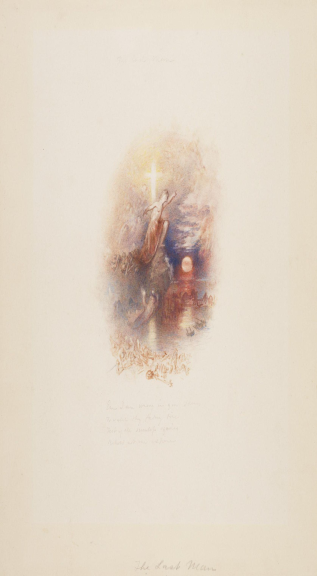
Figure 1. J. M. W. Turner, One of Twenty Vignettes – The Last Man, c. 1835, watercolour over pencil on paper, 12.5 × 9 cm, D 5164, National Galleries of Scotland, Edinburgh. The vignette was produced as one of Turner’s twenty illustrations for The Poetical Works of Thomas Campbell, published in Edward Moxon’s 1837 edition.
In revisiting the nineteenth-century visual-cultural afterlife of the “last man” motif, Turner's
The Last Man offers a revealing visual counterpoint to Shelley’s transformation of the Romantic sublime into an aesthetic of dissolution
| [11] | Turner, J. M. W. One of Twenty Vignettes—The Last Man. c. 1835. Watercolour over pencil on paper. National Galleries of Scotland, D 5164. |
[11]
. Created around 1835 as an illustration for Thomas Campbell’s
The Last Man, Turner’s vignette presents the solitary survivor within a radically diminished yet still transcendent visual universe: the human figure is isolated beneath a waning or setting sun, while a cross and heavenly host above him relocate extinction within a Christian paradigm of immortal hope. The National Galleries of Scotland notes that Turner’s cross symbolizes the last man’s immortal soul and that a spirit rises beneath the figure, while pyramids at lower left signify the antiquity of humanity. The composition consequently preserves the conventional Romantic logic in which extreme human isolation becomes an occasion for metaphysical elevation. Shelley’s
The Last Man, however, increasingly withdraws this transcendental consolation. Where Turner’s solitary figure remains oriented upward toward spiritual immortality, Lionel’s solitude is oriented toward an existential horizon emptied of guaranteed transcendence. The contrast is therefore crucial to the aesthetics of dissolution: Turner preserves the sublime by converting extinction into spiritual continuity, whereas Shelley radicalizes the last-man figure by allowing catastrophe to dismantle the political, epistemological, and anthropocentric structures through which transcendence had been imagined. The visual afterlife of the “last man” thus makes visible the very transformation Hunt identifies as “unmaking”: the Romantic sublime moves from the solitary figure’s elevation before eternity toward the survivor’s confrontation with the collapse of the human world
| [10] | Hunt, E. M. (2023). Mary Shelley’s The Last Man: Existentialism and IR meet the post-apocalyptic pandemic novel. Review of International Studies, 49(5), 832–854.
https://doi.org/10.1017/S0260210522000250 |
| [11] | Turner, J. M. W. One of Twenty Vignettes—The Last Man. c. 1835. Watercolour over pencil on paper. National Galleries of Scotland, D 5164. |
[10, 11]
. In this sense, Hunt’s formulation substantiates the central movement of the Romantic sublime in
The Last Man: transcendence gives way to dissolution, dissolution exposes the failure of human mastery, and that exposure generates the possibility of a more relational, posthuman conception of survival
| [10] | Hunt, E. M. (2023). Mary Shelley’s The Last Man: Existentialism and IR meet the post-apocalyptic pandemic novel. Review of International Studies, 49(5), 832–854.
https://doi.org/10.1017/S0260210522000250 |
[10]
.
4. War, Plague, and the Collapse of Human Exceptionalism
I will argue that war-mongering misadventure of Byronic Lord Raymond led him to estrange the association of Idris’s and Raymond’s heiress, Clara, a recurrent theme of dysfunctionalities within dystopian apocalypse as foretold in the camouflages of ‘scenes of shame,’ a close reading of this romantic dislocation will be cited thence quoted,
‘She figured to herself their life in the Greek isle he had selected for their retreat; her task of soothing him; her cares for the beauteous Clara, her rides in his company, her dedication of herself to his consolation. The picture then presented itself to her in such glowing colours, that she feared the reverse, and a life of magnificence and power in London; where Raymond would no longer be hers only, nor she the sole source of happiness to him. So far as she merely was concerned, she began to hope for defeat; and it was only on his account that her feelings vacillated, as she heard him gallop into the court-yard of the inn. That he should come to her alone, wetted by the storm, careless of every thing except speed, what else could it mean, than that, vanquished and solitary, they were to take their way from native England, the scene of shame, and hide themselves in the myrtle groves of the Grecian isles?’
.
Considering the trajectories of reversal of fortunes and futility of warfare, after all homme-fatale and femme-fatale gendered resolutions have been paralleled to the former’s [Lord Raymon’s] ‘myrtle-groves of Grecian isles’ revolutionary dystopianism and the latter’s ‘grief and famine’-stricken sway of ‘step-mother’ border[exiledom]. These gendered trajectories of war-induced displacement and social dissolution thus extend beyond individual catastrophe into the wider disintegration of the Romantic community itself, anticipating the species-wide extinction that Oliver Murphy identifies in Shelley’s apocalyptic vision:
The novel’s characters [in The Last Man] closely resemble the famous members of the Shelley-Byron circle, including Shelley’s husband, Percy Bysshe Shelley, his friend Lord Byron, and Mary’s stepsister (Byron’s sometime lover), Claire Clairmont. By the time Shelley came to write the novel, all of them – along with all but one of her children – were dead. Once part of the most significant social circle of second-generation Romantic poet-intellectuals, Shelley now found herself almost alone in the world. [...] Two catastrophically depopulating events – the horrifying bloodshed of the Revolutionary and Napoleonic Wars (1792-1815), and the rapid global cooling caused by the massive eruption of Mount Tambora in 1815 – made human extinction seem a horrifyingly imminent possibility. Meditations on ruined empires abounded [furthering down traces to Commonwealth’s cholera’s epidemic from 1818-1824]. Many writers began to imagine (or prophesy) the ruination of their own nations. Unfortunately for Shelley, by 1826 what had once seemed a shocking imaginative response to unprecedented disaster had become a cliché. [...] As they realise “the species of man must perish”, the victims of Shelley’s plague become bestial. Going against the grain of Enlightenment individualism, Shelley insists humanity is contingent on community. When the “vessel of society is wrecked” individual survivors give up all hope . The visual afterlife of this circle, retrospectively assembled around Shelley’s funeral, materialises the communal world whose dissolution haunts
The Last Man and which Murphy identifies as the autobiographical substrate of Shelley’s extinction narrative
. Murphy begins by situating
The Last Man autobiographically, observing that Shelley’s fictional characters “closely resemble” members of the Shelley–Byron circle and that, by the time Shelley composed the novel, most of those real-life figures had died. This biographical correspondence makes the novel’s extinction narrative more than an abstract fantasy of apocalypse
. The depopulation of Shelley’s fictional world becomes a literary transposition of personal bereavement. Lionel Verney’s eventual isolation therefore operates simultaneously on historical, social, and psychological levels. The Last Man is not merely the final survivor of humanity; he is the imaginative embodiment of the survivor who has outlived his community.
Murphy’s account becomes particularly significant when it connects Shelley’s imagination to the “two catastrophically depopulating events” of the Revolutionary and Napoleonic Wars and the Tambora eruption of 1815. These events transform extinction from a theological or fantastical abstraction into a historically imaginable possibility. The wars demonstrate humanity’s capacity for self-destruction, while Tambora demonstrates the vulnerability of human societies to forces beyond human control. Shelley consequently destabilises the Enlightenment confidence that reason, progress, and technological mastery can secure human futurity. The apocalypse in The Last Man is therefore both anthropogenic and ecological: humans can destroy one another, but they remain radically exposed to planetary forces that exceed human agency.
Murphy’s reference to the proliferation of narratives imagining “the ruination of their own nations” is especially important. Shelley does not present apocalypse merely as the destruction of individual bodies; she imagines the failure of political and social structures that make collective life possible. This becomes crucial to understanding the novel’s later movement from political crisis to pandemic extinction. The plague does not simply kill individuals. It progressively dismantles the institutions, relationships, rituals, and forms of collective meaning through which those individuals understand themselves as human.
The claim that extinction had become a “cliché” by 1826 is therefore paradoxical. Shelley’s originality lies precisely in transforming a familiar apocalyptic scenario into a critique of the assumptions underlying apocalypse narratives themselves
. The question is no longer simply
Will humanity survive? but
What does it mean to be human when the social conditions of humanity disappear? Murphy’s observation that Shelley’s plague victims become “bestial” as they realise that “the species of man must perish” captures this transformation. The plague produces not merely biological death but a regression of social and ethical structures.
Most importantly, Murphy identifies Shelley’s resistance to “Enlightenment individualism”
. The statement that “humanity is contingent on community” provides a particularly productive interpretive key
. Lionel’s individuality becomes meaningful only through his relations with others; once those relations disappear, individual survival itself becomes almost meaningless. Thus, the paradox of
The Last Man is that survival does not necessarily constitute futurity. Lionel remains biologically alive precisely when the collective human future has vanished.
Murphy’s phrase “the vessel of society is wrecked” intensifies this argument through metaphor. Society becomes a vessel whose destruction leaves individuals stranded rather than liberated
. The nautical image reverses the conventional Enlightenment association between individual freedom and autonomy: once the collective vessel breaks apart, isolated individuality becomes a condition of abandonment. Shelley therefore converts apocalypse into a critique of atomistic individualism. The last human being is not the triumph of the individual but the evidence of the individual’s ultimate dependence upon community.
This point also allows Murphy’s commentary to be extended beyond a straightforward COVID-19 analogy. The value of reading The Last Man alongside modern pandemic experience is not that Shelley somehow literally “predicted” COVID-19. Rather, her novel reveals a recurring structure of pandemic modernity: a biological catastrophe exposes the fragility of political institutions, social networks, human exceptionalism, and narratives of progress. Murphy’s 2020 context consequently makes Shelley’s earlier apocalypse newly legible. The pandemic becomes an interpretive lens through which the novel’s concern with isolation, contagion, mortality, social collapse, and collective dependency can be reconsidered.
Thus my argument about Shelley’s dystopian futurity crucially embeds the implication that the “last man” marks not simply the end of the human species but the collapse of the humanist subject. Murphy’s reading demonstrates that Shelley’s apocalypse dismantles the Enlightenment fantasy of the self-sufficient individual: when society is “wrecked,” survival without community becomes indistinguishable from existential desolation
. The novel therefore moves from utopian Enlightenment to futurity, pandemic catastrophe, social disintegration and ultimately posthuman isolation. In this sense, the last survivor is simultaneously the residue of humanity and the evidence of its failure.
The plague consequently becomes the ultimate equalizer and the terminal stage of this process of dissolution: humanity’s “zero-sum” struggle against nature is re-envisioned through an allegory in which the destruction of social community culminates in the erosion of human exceptionalism
. The futility of war and empire—Lord Raymond’s Greek campaign as allegory for human hubris and the Romantic “homme fatale.” The shift from civilization (Adrian’s library) to the natural world (Lionel’s rebirth after shipwreck) pinpoints a proto-posthuman condition
| [3] | Richardson, Rebecca. “The Environmental Uncanny: Imagining the Anthropocene in Mary Shelley’s The Last Man.” Interdisciplinary Studies in Literature and Environment, vol. 26, no. 4, 2019, pp. 1062–83. JSTOR, https://www.jstor.org/stable/26872139 Accessed 6 Nov. 2025. |
[3]
. I will textually anchor Evadne’s despair, indicative of humanity as a “step-mother” world; grief, famine, and disillusionment
. A further close reading will shed light on the nuances and subtleties of such instances as posited by the textual framing from the references:
The war, which about a year before the present time had broken out between Greece and Turkey, brought about many reverses of fortune. Her husband became bankrupt, and then in a tumult and threatened massacre on the part of the Turks, they were obliged to fly at midnight, and reached in an open boat an English vessel under sail, which brought them immediately to this island. The few jewels they had saved, supported them awhile. The whole strength of Evadne's mind was exerted to support the failing spirits of her husband. Loss of property, hopelessness as to his future prospects, the inoccupation to which poverty condemned him, combined to reduce him to a state bordering on insanity. Five months after their arrival in England, he committed suicide. [...] Had I a child, or any tie to bind me to existence, I might descend to this--but, as it is--the world has been to me a harsh step-mother; fain would I leave the abode she seems to grudge, and in the grave forget my pride, my struggles, my despair. The time will soon come; grief and famine have already sapped the foundations of my being; a very short time, and I shall have passed away; unstained by the crime of self destruction, unstung by the memory of degradation, my spirit will throw aside the miserable coil, and find such recompense as fortitude and resignation may deserve. This may seem madness to you, yet you also have pride and resolution; do not then wonder that my pride is tameless, my resolution unalterable . 5. Posthuman Futures and Ecological Apocalypse: Shelley’s Critique of Modernity
If Shelley’s dystopian wasteland anticipates posthuman and ecological discourses by revealing the self-sabotaging logic of Enlightenment and Romantic humanism, then the collapse of utopian futurity into dystopian finality renders The Last Man a prefiguration of the Anthropocene: a cautionary, prophylactic rendition of the intertwined ambitions of science, empire, and imagination, in which the attempted mastery of Nature ultimately exposes the material contingency of the human.
Antal’s formulation of “unhuman” nature provides a particularly useful vocabulary for this transition from anthropocentric catastrophe to posthuman possibility. The disappearance of humanity does not produce an empty world; rather, it destabilizes the assumption that the human constitutes the necessary centre of ecological meaning. The return of nature to its “original ‘dwelling place’”
consequently reverses the logic of human exceptionalism embedded in Enlightenment narratives of mastery. Shelley’s dystopia is therefore paradoxically productive: while the epidemic represents the catastrophic failure of human civilization, the retreat of human presence permits the nonhuman environment to exceed the historical and political structures that had attempted to contain it. The apocalypse consequently becomes a redistribution of ecological agency, in which humanity ceases to function as the measure of the world.
The image of Lionel and Lord Raymond is the turning point of novelistic peripeteia [Lionel being the last man and failed redeemer (victim of ecocide) and Raymond as a cultural memorial (from the engravings of a sublime landscape) tomb of overarching ambition. However, from orientalist fascination to epidemic devastation will enchain the impersonator Lord Raymond- faint portraiture of Lord Byron as evidently pointed out by the critical gaze of her arguments in
Mary Shelley’s Fascinations: The Last Man .
Yasmin Solomonescu debunks ‘Raymond’s pathological fascination with the East, this fascinated confusion between reality and ideality is exacerbated by his subsequent confrontation with Perdita over the affair: he “forgot that each word he spoke was false. He personated his assumption of innocence even to self-deception” Raymond in this regard resembles both the false Methodist prophet of volume 3, who preys on the people’s fear of plague to establish a personal cult, and the astronomer Merrival (and his forbear Victor Frankenstein), a member of Lionel’s circle whose obsession with the long-term prospect of a realignment of the Earth’s axis renders him oblivious to plague’ s threat to his household’
.
Furthermore, even no Lionel archangel figure can cast himself as St George Dragon Slayer to rescue the hubristic hamartia of Lord Raymond as underscored by the meta-narrative framework resonating intradiegetic and extradiegetic interpretations:
From this position he can be transported into the scene only figuratively, by an act of sympathy that allows him to infer from Raymond’s body language the likely purport of his speech, but to remain conscious at the same time of only infer ring it— of guessing at what is flagged in the passage as the inaudible and the seeming. Through his glass and with his naked eye, and especially through the interplay between those perspectives, Lionel, like a spectator of Greek tragedy, bears witness to the devastating consequences of the conquering hero ’ hubris. Heralding Lionel as a pastoralist and Lord Raymond as triumphant general and Lord Protector, the critic then goes on to pathologize phallic masculinity of Lionel insofar as ‘a travesty of power as it endangers the whole world . The ecological implications of this collapse become more pronounced when the epidemic is understood not merely as a mechanism of human extinction but as a displacement of humanity from its presumed position of environmental mastery. Antal argues that the epidemic is associated with the destructive structures of patriarchal modernity—including “heavy industry, hegemonic politics, advanced military technology, and wars”—while the disappearance of human society allows the natural environment to proliferate and recover its “original ‘dwelling place’”
. The significance of this reversal lies in the novel’s redistribution of agency. The plague does not simply annihilate an otherwise stable human world; it exposes the fragility of the structures through which that world has imagined itself sovereign over nature. Antal’s invocation of the Greek
oikos, the root of “ecology,” is particularly productive here because it reframes the apocalypse as a crisis of habitation: humanity’s attempt to dominate its environment ultimately results in its own expulsion from the ecological home it has treated as its possession
. The seasonal recurrence of the epidemic further intensifies this irony. Human beings, who imagine themselves masters of historical progress, become entrapped within cycles of natural temporality that they cannot control. Thus, the plague reverses the hierarchy between human culture and nonhuman nature: civilization disappears while the more-than-human world persists. Shelley’s apocalypse therefore anticipates an ecological critique in which the extinction of humanity is not necessarily synonymous with the extinction of life itself. The “last man” marks the end of human exceptionalism rather than the end of the world.
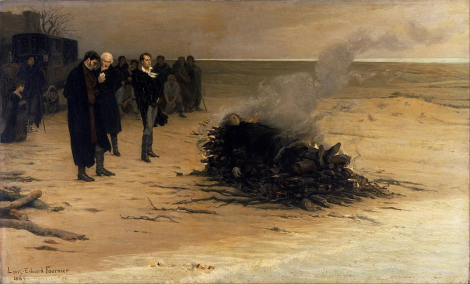
Upon lighting the funeral pyre, Trelawny records its progress in gruesome detail; as ‘the brains literally seethed, bubbled, and boiled as in a cauldron,’ Byron swam into the sea and Hunt remained in the carriage, leaving Trelawny to marvel that Shelley’s “heart remained entire.” After “snatching this relic from the fiery furnace”—burning his hand and willfully violating quarantine protocol—as the legend goes, he eventually delivered it to Mary, in whose effects a jar containing some form of human remains was indeed found after her own death. The macabre attention to detailing the brute materiality of the human in Trelawny’s account of the end of Percy Shelley resonates with Mary Shelley’s account of the end of humanity via a worldwide plague outbreak in The Last Man. [...] I then situate this reading within critical conversations about contemporary apocalyptic fiction and ecohorror in order to argue that The Last Man—and by extension, Romanticism—offers opportunities to imagine how human and nonhuman forms of agency could work together to compose different stories about life in the Anthropocene. How might The Last Man’s ambivalence between a celebration of the boundless potential of matter and the existential threat posed by the implication human life as an effect of matter’s contingency allow us to see prevailing conceptions of Nature as constructions? How might the novel’s distinct apocalyptic framework open the possibility of nonmodern forms for imagining how human and nonhuman forms of agency could work together to compose a common future, or, following Latour ‘rematerialize our belonging to the world’| [14] | Dushane, A. (2024). “This automaton of flesh”: Mary Shelley’s The Last Man, the paradox of the moderns, and Romantic ecohorror. Essays in Romanticism, 31(1), 57–73.
https://doi.org/10.3828/eir.2024.31.1.6 |
If Antal’s “unhuman” nature survives the disappearance of humanity, Allison Dushane’s materialist reading clarifies what the apocalypse reveals about the human subject itself: not mastery over matter, but its irreducible contingency. Her juxtaposition of Trelawny’s gruesome account of Percy Shelley’s cremation with Mary Shelley’s representation of humanity’s extinction foregrounds the “brute materiality of the human,” as the apparently exceptional Romantic body is reduced to flesh, bone, brain, and the resistant relic of Shelley’s heart
| [14] | Dushane, A. (2024). “This automaton of flesh”: Mary Shelley’s The Last Man, the paradox of the moderns, and Romantic ecohorror. Essays in Romanticism, 31(1), 57–73.
https://doi.org/10.3828/eir.2024.31.1.6 |
[14]
. The funeral pyre thus anticipates the material logic of
The Last Man: individual death and species extinction become parallel revelations of the human body’s dependence upon processes it cannot control. Dushane’s argument offers a particularly productive extension of the section’s movement from war, technological modernity, and human exceptionalism toward plague and material dissolution
| [14] | Dushane, A. (2024). “This automaton of flesh”: Mary Shelley’s The Last Man, the paradox of the moderns, and Romantic ecohorror. Essays in Romanticism, 31(1), 57–73.
https://doi.org/10.3828/eir.2024.31.1.6 |
[14]
.
This materialist emphasis is crucial to the novel’s challenge to human exceptionalism. Dushane’s supererogation of how
The Last Man might illuminate the possibility that “human and nonhuman forms of agency could work together” and invokes Latour’s formulation of “rematerializ[ing] our belonging to the world”
| [14] | Dushane, A. (2024). “This automaton of flesh”: Mary Shelley’s The Last Man, the paradox of the moderns, and Romantic ecohorror. Essays in Romanticism, 31(1), 57–73.
https://doi.org/10.3828/eir.2024.31.1.6 |
[14]
(pp. 57–60). The implication is that Shelley’s apocalypse does not simply remove humanity from the world; paradoxically, human extinction reveals humanity’s prior embeddedness within material processes that modernity attempts to conceal. The plague therefore becomes more than a narrative mechanism of depopulation. It exposes the contingency of the human body and undermines the conceptual distinction between autonomous human agency and the supposedly passive natural world.
The checks and balances of the modern Constitution allow for the proliferation of technologies that shape the daily lives of the Moderns and, in the Last Man, enable Adrian and Raymond to work together on a plan for the perpetual improvement of the nation as a microcosm of humanity upon Raymond’s election to the position of Lord Protector. Aided by Adrian as advisor, ‘Raymond was occupied in a thousand beneficial schemes. Canals, aqueducts, bridges, stately buildings, and various edifices for public utility, were entered upon; he was continually surrounded by projectors and projects, which were to render England one scene of fertility and magnificence; the state of poverty was to be abolished’. The technologies and resulting social improvements developed under their rule echo the catalogue included in Bacon’s New Atlantis; authorized to ‘invade the material world and freely create the social world,’ the new republican regime promises to eliminate not only poverty, but also disease, and perhaps even death itself. [...] Adrian and Raymond unite to deliver the promises of the modern Constitution, as they, following Latour’s account of its formation, ‘make Nature intervene at every point in the fabrication of their societies while they go right on attributing to Nature its radical transcendence” and believe that they are “the only actors in their political destiny, while they go right on making their society hold together by mobilizing Nature’. Under their rule, ‘the mechanism of society, once systematized according to faultless rules, would never again swerve into disorder’[14; italics are mine].
Dushane’s discussion of Adrian and Raymond's political programme foregrounding their schemes—“canals, aqueducts, bridges, stately buildings” and the promise to abolish poverty—reproduce the Baconian fantasy that technology can reorganise both nature and society according to rational human purposes
| [14] | Dushane, A. (2024). “This automaton of flesh”: Mary Shelley’s The Last Man, the paradox of the moderns, and Romantic ecohorror. Essays in Romanticism, 31(1), 57–73.
https://doi.org/10.3828/eir.2024.31.1.6 |
[14]
. The striking image of food apparently springing up “spontaneously” while machines satisfy “every want of the population” represents the technological sublime of modernity: nature becomes an apparently inexhaustible resource, while technology appears capable of converting material abundance into permanent social progress. Yet Dushane demonstrates the paradox underlying this vision. The regime seeks to master Nature while simultaneously depending upon Nature at every stage of its political and technological construction.
The phrase “the mechanism of society, once systematized according to faultless rules, would never again swerve into disorder” is consequently deeply ironic
| [14] | Dushane, A. (2024). “This automaton of flesh”: Mary Shelley’s The Last Man, the paradox of the moderns, and Romantic ecohorror. Essays in Romanticism, 31(1), 57–73.
https://doi.org/10.3828/eir.2024.31.1.6 |
[14]
. The mechanical metaphor imagines society as a controllable apparatus, but the subsequent plague exposes the impossibility of such perfect systematisation. The modern constitutional order assumes that disorder can be eliminated through rational organisation; Shelley’s pandemic demonstrates that contingency cannot be engineered away. Disease, mortality, environmental instability, and material decay remain outside the totalising ambitions of the technological state.
This point connects directly with my discussion of Raymond's military hubris. Raymond’s Greek campaign and his later political-technological schemes are not separate failures. They are manifestations of the same modern desire to impose human order upon resistant material and political worlds. War attempts to reorganise geopolitical reality through force; technology attempts to reorganise nature through mastery. Both ultimately encounter limits that cannot be absorbed into the logic of human control. Dushane therefore allows Raymond’s “homme fatale” trajectory to be interpreted not merely as a failure of personal ambition but as an allegory of modernity’s systemic overconfidence in human agency
| [14] | Dushane, A. (2024). “This automaton of flesh”: Mary Shelley’s The Last Man, the paradox of the moderns, and Romantic ecohorror. Essays in Romanticism, 31(1), 57–73.
https://doi.org/10.3828/eir.2024.31.1.6 |
[14]
.
Dushane’s treatment of the “automaton of flesh” then marks the decisive reversal. The phrase transforms the human subject from an autonomous agent into a material mechanism. The irony is profound: the modern world repeatedly imagines society as a “mechanism,” but at the end of the novel the surviving human being himself becomes an “automaton of flesh.” What modernity initially projects onto society as a controllable machine is finally revealed as the vulnerable material body. Lionel’s reduction to flesh therefore constitutes the collapse of the distinction between the human subject and the material world.
That Dushane's interpretation of Lionel’s transformation into an “automaton of flesh” is not simply the degradation of humanity. It exposes the shared materiality of human and nonhuman existence
| [14] | Dushane, A. (2024). “This automaton of flesh”: Mary Shelley’s The Last Man, the paradox of the moderns, and Romantic ecohorror. Essays in Romanticism, 31(1), 57–73.
https://doi.org/10.3828/eir.2024.31.1.6 |
[14]
. The apocalypse consequently produces a paradox: humanity is destroyed by the very material contingency that it attempted to transcend, yet this destruction simultaneously makes visible a form of ecological belonging that modern humanism had suppressed. Dissolution thus becomes epistemological as well as ontological: the destruction of the human reveals something about the human that survival within a technologically mastered world could not.
Adrian speaks with the double-edged sword of apocalyptic rhetoric: ‘if we strive with all our might to will a paradisiacal telos, we will inevitably actualize such an outcome here on earth.’ At the same time, ‘if we lack the necessary force of will we shall succumb to the grim realities of death, sickness, hatred, tyranny, and fear, thus producing a ‘daemon[ic]’ hell on earth.’ Raymond displays this Gnostic perspective as he speaks to Lionel before dying, which also echoes through Lord Byron’s remarks at Percy Shelley’s funeral: ‘Earth is to me a tomb, the firmament a vault, shrouding mere corruption … each man I meet a corse, which will soon be deserted of its animating spark, on the eve of decay and corruption [...]. The moment at which Lionel finds himself reduced to “automaton of flesh,” then, might be read as an opportunity; the novel presents the moment at which shared materiality of human and nonhuman life is revealed through the destruction of humanity as a means to identify—and then think beyond—the paradox of the Moderns. The ending of Lionel’s narrative is not, however, the end of The Last Man, or at least not the only possible end. Shelley frames the narrative as a prophecy, inscribed on Sybilline leaves and written into life by an anonymous compiler and translator. [14; emphasis added].
The connection Dushane makes between Raymond’s final apocalyptic rhetoric and Byron’s reflections on Percy Shelley’s corpse further intensifies this materialist reversal. The imagery of the Earth as “a tomb” and each human being as a future “corse” strips away the Romantic fantasy of stable spiritual transcendence and foregrounds decay as the unavoidable condition of embodied existence
| [14] | Dushane, A. (2024). “This automaton of flesh”: Mary Shelley’s The Last Man, the paradox of the moderns, and Romantic ecohorror. Essays in Romanticism, 31(1), 57–73.
https://doi.org/10.3828/eir.2024.31.1.6 |
[14]
. Death is not an interruption of the human condition; material decay is constitutive of it.
This makes Dushane especially important to my section’s argument about the “Collapse of Human Exceptionalism.” Murphy
establishes the collapse of the social human—humanity depends upon community—whereas Dushane
| [14] | Dushane, A. (2024). “This automaton of flesh”: Mary Shelley’s The Last Man, the paradox of the moderns, and Romantic ecohorror. Essays in Romanticism, 31(1), 57–73.
https://doi.org/10.3828/eir.2024.31.1.6 |
[14]
extends the collapse to the material human. Murphy demonstrates that the isolated individual cannot meaningfully survive once the “vessel of society” is wrecked; Dushane demonstrates that the surviving individual cannot maintain the ontological distinction between human agency and material contingency. Together, they produce a trajectorial progression from the warfare toward apogee of posthuman possibility through transferring between social dissolution, plague, species extinction and material dissolution. Murphy establishes why the destruction of community makes the “last man” existentially desolate; Dushane establishes why the surviving “man” is finally no longer securely separable from the material world.
Her reading therefore gives my title, The Romantic Sublime and the Aesthetics of Dissolution, a further conceptual dimension. The Romantic sublime traditionally confronts the subject with forces greater than itself, yet the subject often returns from that encounter with an intensified awareness of its own imaginative capacity. In The Last Man, Shelley radically reverses that trajectory. The subject does not master the overwhelming object; the distinction between subject and material world itself dissolves. The “automaton of flesh” is therefore the terminal figure of Shelley’s anti-exceptionalist sublime: what remains after the collapse of civilisation is not an elevated human consciousness but an embodied remainder that exposes humanity’s profound material contingency.
Finally, Dushane’s observation that Lionel’s narrative does not constitute the absolute end because Shelley frames it through the Sibylline leaves, anonymous compiler, and translator opens an important possibility for my conclusion
| [14] | Dushane, A. (2024). “This automaton of flesh”: Mary Shelley’s The Last Man, the paradox of the moderns, and Romantic ecohorror. Essays in Romanticism, 31(1), 57–73.
https://doi.org/10.3828/eir.2024.31.1.6 |
[14]
. Extinction is therefore not represented as a simple terminal point. The narrative survives its protagonist, just as matter survives the human beings who attempt to master it. The end of humanity becomes the beginning of another mode of narration and another conception of futurity. This is precisely where my argument can move from
dystopian apocalypse toward posthuman futurity: dissolution does not merely signify annihilation; it creates the epistemic conditions for imagining forms of existence no longer organised around human exceptionalism.
William D. Brewer’s trans* reading becomes particularly compelling when
The Last Man is read through the novel’s persistent destabilization of bodily, gendered, and species boundaries. The plague initially appears through an explicitly masculine imaginary: Verney dreams of a pestilence that “assume[s] the form of Raymond,” whose body expands into a “gigantic phantom” bearing “the sign of pestilence”
. The imagery is significant because the plague does not simply attack humanity from outside; it appropriates the body of the imperial masculine subject. Raymond’s enlarged phantom consequently transforms political and corporeal domination into a grotesque form of contagion. Yet the gender of the plague does not remain stable. Verney later sees the plague as feminine, declaring, “I see plague! She has invested his form, is incarnate in his flesh, has entwined herself with his being”
. The movement from “his form” to “her” presence makes gender itself appear mutable and relational rather than biologically fixed. Brewer’s choice of “them” as the most appropriate pronoun for the plague therefore emerges from the novel’s own unstable grammar of embodiment: the plague can be masculine, feminine, neuter, animal, and monstrous without finally belonging to any single category
.
This instability is intensified by Verney’s comparison of the plague to a “serpent-head” and to “a thousand packs of wolves”
. The plague consequently exceeds both human gender categories and the boundary separating human from nonhuman life. Its body is never anatomically stable because it is repeatedly imagined through metamorphic forms. Brewer’s observation that the plague “can assume multiple genders and forms” is therefore crucial to understanding the novel’s larger critique of categorical identity
. The plague becomes an agent of transformation precisely because it exposes the inadequacy of the classifications through which human beings organize bodies, species, sexuality, and social hierarchy.
Evadne provides an even more complex embodiment of this trans* logic. Rather than remaining within the stable category of the “woman scorned,” she moves through a succession of identities: princess, political intriguer, draughtsman, lover, and soldier
. Her transformation is particularly striking because Shelley associates gender transition with trauma. After Raymond rejects her, Evadne declares that she has been forced to abandon her “woman’s heart and sensibility” and to endure the “privation, labour, and pain” associated with masculine military existence
. Her body and social identity thus become sites of negotiation between femininity and masculinity. The soldier who appears before Verney is dressed as a man but still cries out “like a female,” producing a deliberately unstable conjunction between gendered appearance, voice, and emotional identity
. Shelley therefore refuses to allow gender presentation to provide a reliable index of identity.
Evadne’s final prophecy develops this instability into a form of counter-patriarchal power. She imagines herself transforming war, fire, and plague into her “servitors” and ultimately binds Raymond to herself through death
. Raymond, meanwhile, becomes increasingly inseparable from the destructive forces he embodies. His death beneath the collapsing architecture of Stamboul converts imperial masculine power into literal ruin. Brewer consequently reads Evadne as an “empowered trans* sibyl” who chains the apparently powerful Raymond to herself in a necrophiliac union
. The reversal is important: the patriarchal warrior who appears to possess military, sexual, and imperial authority becomes the passive object of Evadne’s prophecy. Gendered power is consequently redistributed through transformation rather than simply reversed.
The novel’s gender instability is equally evident in Adrian. Although he occupies a position of political authority, Adrian repeatedly occupies roles conventionally coded as feminine. His relationship with Verney is simultaneously maternal and homoerotic: Verney describes himself as a child responding to a mother under Adrian’s influence
. Adrian’s self-description as the “tainted wether of the flock” further complicates his masculinity because the phrase evokes a diseased and castrated ram
. His identification with the castrated animal metaphorically removes him from normative masculine virility while connecting him to nonhuman life. Verney subsequently conflates Adrian with Idris, his deceased wife, effectively transforming Adrian into a surrogate feminine presence
. Even Raymond, the novel’s apparently hypermasculine imperial warrior, is represented through maternal imagery when his consolation of Evadne is compared with “a mother” comforting her wounded child
. Masculinity therefore repeatedly becomes porous: paternal authority can become maternal tenderness, military strength can coexist with vulnerability, and male bodies can occupy feminized emotional positions.
Verney himself most explicitly embodies this instability. His narrative voice repeatedly oscillates between masculine and feminine registers. After reunion with Adrian, he calls himself an “effeminate” and “contemptible” being and describes his emotional response as a series of “girlish extacies”
. His inability to embrace Adrian publicly is particularly revealing because his repression is produced not by an absence of affection but by an awareness of the social surveillance surrounding masculine conduct. The statement that “on the stage of the world, a man must repress such girlish extacies” exposes gender as performance: the “man” must continually act according to a socially prescribed script
. Verney’s fear that his emotional attachment might be condemned as homosexual or transgressive demonstrates how masculinity depends upon the suppression of forms of intimacy culturally coded as feminine. Shelley thus makes gender less a stable identity than a disciplinary performance.
This destabilization also extends to species identity. Verney begins life in a condition he describes as “like that of an animal,” before Adrian “humanize[s]” him
. Yet the supposed boundary between animal and human soon becomes unstable. Verney himself acknowledges that “man is a strange animal,” replacing the supposedly sacred division between humanity and animality with a more complicated continuity
. His later post-apocalyptic existence makes this transformation literal: deprived of human society, he eats “like a wild beast,” refuses conventional shelter, and recognizes that his “Nerves, pulse, brain, joint, and flesh” are organized according to the same laws as other animals
. The language of biological continuity gradually replaces the earlier language of human exceptionalism.
The development is also ethical. Verney’s changing relationship with animals traces a movement from instrumental exploitation toward recognition. Early in the novel, animals are disposable resources: he participates in hunting, abandons a dog, and imagines killing animals to secure human refuge
. Yet his rescue of the dying robin marks a crucial interruption of this anthropocentric logic. He takes the bird into his breast, feeds it, and protects its fragile body until its “warm fluttering heart” beats against him
. The physical proximity of the bird to Verney collapses the distinction between human and nonhuman vulnerability. The breast that shelters the bird becomes an intimate ecological space in which the human body temporarily functions as another creature’s habitat.
By the end of the novel, this transformation becomes more pronounced. Verney refuses to kill animals for food and increasingly respects their right to live
. His relationship with the goats is especially important because, unlike Crusoe, he refuses to reproduce a colonial logic of domination through the killing of animals. He instead leaves “the wild scenes of nature” when his presence threatens other creatures
. His movement away from human sovereignty culminates in his departure with an unnamed dog. The absence of a name is significant because naming can imply possession and mastery; Verney’s refusal to impose such sovereignty suggests that his posthuman existence requires a different ethical relationship with other species
.
The plague consequently performs a paradoxical ecological function. It is destructive, but its destruction dismantles the hierarchies that produced violence. Brewer emphasizes that the plague eliminates not merely individuals but systems of classification—“war, classism, racism, misogyny, toxic cults, plutocracy, injustice, transphobia, homophobia, and sexual violence”
. Its indiscriminate destruction makes it “antihuman rather than exclusively misandrist”: women, men, and children alike are subject to its violence
. The plague therefore cannot comfortably be interpreted as a simple manifestation of female revenge against patriarchy. Its scope is much broader. It attacks the universalist conception of “man” itself.
The final landscape makes this critique visible. Once humanity disappears, London is no longer characterized by ruin but by animal occupation: buildings remain “undamaged,” while animals move freely through palaces, staircases, chambers, and political spaces
. The reversal is striking. Human civilization, which previously represented itself as the pinnacle of rational and moral development, produces destruction, while the posthuman environment produces relative peace. Sheep enter spaces once reserved for aristocratic and political authority; oxen and doves move through the abandoned structures of civilization
. The redistribution of space therefore becomes a redistribution of sovereignty. The palace and council chamber cease to signify human political dominance and become habitats for other species.
The ending consequently transforms the meaning of the “last man.” Verney is not simply the final representative of humanity but the surviving remainder of a category whose boundaries have already dissolved. He becomes a “species-fluid creature” whose development moves from animality to civilization and finally beyond civilization
. His survival does not restore anthropocentrism; instead, it produces an altered consciousness in which human identity exists within a larger continuum of animal life. The novel’s final posthuman world thus fulfills the logic announced by Percy Shelley’s principle that “Nought may endure but Mutability”
. What survives is not an immutable human essence but transformation itself.
Taken together, these passages suggest that The Last Man imagines apocalypse not simply as the extinction of humanity but as the collapse of the conceptual boundaries through which humanity has defined itself. Gender, sexuality, species, race, class, and political authority are repeatedly shown to be mutable categories rather than permanent ontological divisions. Brewer’s trans* reading is therefore particularly productive because it reveals that the novel’s deepest concern is not merely who survives the plague, but what kinds of bodies, identities, and relationships become possible once the structures that rigidly classified them have collapsed. Verney’s movement from “animal” to “man” and finally toward a posthuman, species-fluid existence mirrors the plague’s own movement across masculine, feminine, neuter, and animal forms. The apocalypse consequently becomes an unsettling process of reclassification: humanity dies, but in its death the novel imagines a world in which identity is no longer governed by fixed binaries.





 Share This Article
 Twitter
 Linked In
 Facebook

 Copy
 Download