This paper investigates the prevalence of anomalous coronary artery origins among working-age individuals suffering from coronary artery disease, utilizing data from percutaneous coronary interventions. The research was conducted at the Samarkand Regional Branch of the Republican Specialized Scientific and Practical Medical Center of Cardiology over a one-year period from January to December 2024. A total of 4,170 coronary angiographic examinations were performed in patients with suspected or confirmed CAD. Among these individuals, 35 patients were identified as having anomalous origins of the coronary arteries, corresponding to a prevalence of approximately 0.84% within the studied population. The study population primarily consisted of working-age individuals, highlighting the socio-economic importance of early detection and appropriate management of such anomalies. Coronary angiography was used as the primary diagnostic modality to identify and classify the anatomical variants. The analysis revealed a diverse spectrum of coronary artery anomalies. The most frequently observed anomaly was the circumflex artery (CA) originating from the right coronary artery (RCA), identified in 12 patients (34.3%). The second most common finding was the origin of the RCA from the aorta above the sinus of Valsalva, observed in 9 patients (25.7%). In 6 cases (17.1%), the RCA originated from the left sinus of Valsalva. Less frequent anomalies included the obtuse marginal (OB) artery originating from the right sinus of Valsalva in 4 patients (11.4%) and the left anterior descending artery (LAD) originating from the RCA in 3 patients (8.6%). A single rare case (2.9%) of a solitary coronary artery was also documented. In conclusion, anomalous coronary artery origins, while uncommon, are not rare among working-age patients with coronary artery disease. Awareness of their prevalence and anatomical variations is crucial for interventional cardiologists, as it facilitates accurate diagnosis, optimizes procedural strategies, and may reduce the risk of procedural complications. Further studies are warranted to evaluate the long-term clinical outcomes and prognostic significance of these anomalies in patients undergoing PCI.
This is an Open Access article, distributed under the terms of the Creative Commons Attribution 4.0 International License (http://creativecommons.org/licenses/by/4.0/), which permits unrestricted use, distribution and reproduction in any medium or format, provided the original work is properly cited.
Coronary Artery Disease, Working Age, Coronary Angiography, Anomaly Coronary Artery
1. Introduction
Cardiovascular diseases (CVD) and their complications occupy leading positions in the mortality structure of the population of economically developed countries
[1]
Bagmanova Z. A. Anomalies of the coronary arteries // Cardiology. – 2010. – Т. 50. – №. 8. – С. 48-55. (in Russ).
[6]
Belov Yu. V., Bogopolskaya O. M. Myocardial bridge - a congenital anomaly of the coronary bed // Cardiology. – 2004. – Т. 44. – №. 12. – С. 89-94. (in Russ).
[1, 6]
. In many economically developing countries, the overall mortality rate from CVD is several times higher than similar indicators in Western Europe and the USA
[3]
Bagmanova Z. A. et al. Congenital coronary anomaly: single coronary artery // Emergency physician. – 2011. – №. 7. – С. 39-43. (in Russ).
[8]
Buziashvili Yu. I., Dvinyapinova N. B., Sopromadze D. L. "Electrocardiographic characteristics of the anomalous origin of the left coronary artery from the pulmonary trunk". Cardiology, 1988, № 8, с. 59-63. (in Russ).
[3, 8]
. According to the World Health Organization, in 2023, CVD became the leading cause of death worldwide and claimed the lives of more than 17 million people
[2]
Bagmanova Z. A. et al. Congenital anomaly of the coronary artery: abnormal origin of the circumflex artery from the right aortic sinus of Valsalva (clinical case) // Creative surgery and oncology. – 2011. – №. 2. – С. 113-118. (in Russ).
[7]
Burakovsky V. I., Podzolkov V. P. "Correction of anomalous origin of the left coronary artery from the pulmonary trunk". Thoracic surgery, 1989, № 2, с. 5-11. (in Russ).
[2, 7]
. The first place among CVD is occupied by ischemic heart disease (IHD), the diagnosis of which, in the presence of pronounced clinical symptoms, does not cause difficulties
[4]
Bagmatova Z. A. Peculiarities of the clinic, diagnostics and treatment of patients with congenital coronary pathology. Abstract of a doctor of medical sciences. Moscow, 2011 (in Russ.).
[9]
Camm J., Luscher T, Serruys P., Shljahto E. V., ed. The ESC Textbook of Cardiovascular Medicine / M.: GEOTAR-Media; 2011: 2042–50 (in Russ.).
[4, 9]
. At this juncture in medical advancement, the challenges of diagnosing and treating cardiac pathology are among the most pressing issues in modern cardiology, attracting considerable attention from a diverse range of medical specialists. Ischemic heart disease (IHD) has historically been the principal contributor to mortality and disability in all economically developed nations. A less common, yet entirely possible, cause of acute and/or chronic coronary insufficiency is a developmental anomaly of the coronary arteries
[5]
Bazylev V. V., Chernogrivov A. E., Chernogrivov I. E. Anomalous origin of the right coronary artery from the pulmonary trunk // Thoracic surgery, 1987, № 5, с. 80-84. (in Russ).
[10]
Chamokova B. B., Sinitsyn V. E. CT angiography in the diagnosis of coronary artery anomalies // Radiation diagnostics and therapy. - 2013. - No. 2. – P. 10-25. (in Russ).
[5, 10]
. Up until the 1970s, abnormalities of the coronary arteries were regarded as isolated incidents, typically discovered incidentally during surgical interventions or, more often, during post-mortem examinations. The introduction of coronary angiography (CAG) and operations on the coronary vessels into everyday cardiology practice contributed to the development of the clinical aspects of this type of congenital pathology, and it became possible to perform lifetime diagnostics and obtain a complete picture of the most common anatomical variants of CA anomalies with an assessment of hemodynamics and prognosis of their natural course
[11]
Chernogrivov A. E., Chernogrivov I. E., Bazylev V. V. Anomalous origin of the left coronary artery from the right branch of the pulmonary artery // Thoracic and cardiovascular surgery. – 2016. – V. 58. – No. 5. – P. 258-267. (in Russ).
[20]
Vasiliev A., Streltsova N. Anomalies in the development of coronary arteries in clinical practice // Doctor. – 2019. – Т. 30. – №. 4. – С. 10-15. (in Russ).
[11, 20]
.
The actual prevalence of congenital coronary anomalies remains unestablished. Estimates from different studies place the occurrence of these anomalies between 0.6% and 1.8%. Nevertheless, the true frequency of coronary pathology could be considerably higher, as it frequently presents without symptoms
[12]
Dechko S. V. et al. Myocardial infarctions of coronary arteries. 10th school of cardiology: scientific papers of the Republican scientific-practical conference with international participation. Minsk, 5–6 November 2015; 77–82 (in Russ.).
[19]
Tseluiko V. I., Mishchuk N. E., Kinoschenko K. Yu. Anomalies in the structure of the coronary arteries (part 1) // Liki Ukrainy. - 2012. - No. 10. - P. 44-53. (in Russ).
[12, 19]
. A substantial majority, 80%, of detected anomalies in examined individuals do not lead to significant impairments in coronary blood flow. At the current stage of development of medical technologies, a patient with coronary heart disease can be offered various treatment options. This statement is true not only in terms of the approach to choosing the tactics for managing a patient with this pathology (conservative, endovascular or surgical correction of coronary insufficiency), but also to the choice of various techniques and modifications used in myocardial revascularization operations
[13]
Druk I. V., Nechaeva G. I., Kuznetsova V. V. The state of the coronary arteries in connective tissue dysplasia // Kazan Medical Journal. – 2007. – Т. 88. – №. S5. – С. 30-32. (in Russ).
[18]
Tashnik M. А. Variability of intramural location of coronary arteries // Clinical anatomy and operative surgery. – 2009; 2(8): 29–35 (in Russ).
[13, 18]
. In normal development, the coronary arteries (CA) originate from the aorta and after originating on the surface of the heart form a vascular plexus, shaped like a crown or a corona. Abnormal origin of the CA is quite rare and accounts for approximately 0.64% of newborns
[14]
Khasanjanova F. O., Pulatova K. S., Ruzieva A. A. Analysis of the clinical effect of simvastatin in patients with unstable angina at a young age. October 2023. Cardiology in Belarus 15(5): 644-651. (In Russ.).
[14]
. At the same time, the prevalence of origin of the left CA (LCA) from the right coronary sinus (RCS) is from 0.1 to 0.3% in the population
[17]
Ragimov F. R., Mozhina A. A. "Anomalous origin of both coronary arteries from the right sinus of Valsalva with double origin of the great vessels from the left ventricle". Thoracic surgery, 1987, No. 3, pp. 90-91. (in Russ).
[17]
. Approximately 2% of individuals have abnormal development of the CA in the form of changes in the total number of arteries, the nature of their origin or branching
[1]
Bagmanova Z. A. Anomalies of the coronary arteries // Cardiology. – 2010. – Т. 50. – №. 8. – С. 48-55. (in Russ).
[15]
Nasedkina M. A., Mozhiia A. A., Petrosyan Yu. S., Krymsky L. D. "Characteristic features of pathological anatomy and myocardial damage in case of anomalous origin of the left coronary artery from the pulmonary trunk. Clinical and anatomical comparisons". Archives of Pathology, 1988, No. 6, pp. 35-41. (in Russ).
[19]
Tseluiko V. I., Mishchuk N. E., Kinoschenko K. Yu. Anomalies in the structure of the coronary arteries (part 1) // Liki Ukrainy. - 2012. - No. 10. - P. 44-53. (in Russ).
[1, 15, 19]
.
In clinical practice, most of the anomalies of the coronary arteries have no clinical significance and do not manifest themselves in any way during a person's life, since the abnormal structure and origin of the coronary arteries is a potentially dangerous condition for people at any age and can cause sudden cardiac death, angina pectoris and acute myocardial infarction (AMI), which significantly worsens the patient's quality of life
[6]
Belov Yu. V., Bogopolskaya O. M. Myocardial bridge - a congenital anomaly of the coronary bed // Cardiology. – 2004. – Т. 44. – №. 12. – С. 89-94. (in Russ).
[12]
Dechko S. V. et al. Myocardial infarctions of coronary arteries. 10th school of cardiology: scientific papers of the Republican scientific-practical conference with international participation. Minsk, 5–6 November 2015; 77–82 (in Russ.).
[16]
Petrosyan Yu. S., Garibyan V. A., Sarkisova T., Lepikhova N., I. I. "Angiographic semiotics and pathophysiology of anomalous origin of the left coronary artery from the pulmonary trunk". Thoracic surgery, 1990, no., pp. 18-25. (in Russ).
[6, 12, 16]
. The factor responsible for these phenomena may be repeated compression of this vessel due to the expansion of the aortic root or curvature as a result of its retroaortic position with subsequent compression of the coronary orifice in the groove and the formation of an obstacle to blood flow. It is also worth mentioning recent studies that indicate that the abnormal origin of the coronary arteries can increase the risk of atherosclerotic changes due to its acute angle of inclination
[7]
Burakovsky V. I., Podzolkov V. P. "Correction of anomalous origin of the left coronary artery from the pulmonary trunk". Thoracic surgery, 1989, № 2, с. 5-11. (in Russ).
[7]
. However, at present, difficulties remain in the diagnosis, treatment of this pathology and further risk stratification due to its low and rare incidence
[17]
Ragimov F. R., Mozhina A. A. "Anomalous origin of both coronary arteries from the right sinus of Valsalva with double origin of the great vessels from the left ventricle". Thoracic surgery, 1987, No. 3, pp. 90-91. (in Russ).
[20]
Vasiliev A., Streltsova N. Anomalies in the development of coronary arteries in clinical practice // Doctor. – 2019. – Т. 30. – №. 4. – С. 10-15. (in Russ).
[17, 20]
.
There are different types of coronary artery dispositions: origin of the anterior interventricular branch (LAD) from the right coronary artery (RCA) (absence of the left trunk); an increase in the number of coronary arteries originating from the aorta (absence of the right trunk); independent origin of the circumflex branch (CB) from the 2nd or 1st aortic sinuses or from the RCA. One of such anomalies is an abnormal origin from the pulmonary artery, which carries venous blood to the lungs, in which the heart is fed by oxygen-poor blood and with low pressure in the pulmonary artery, the blood supply to the heart suffers to an even greater extent
[3]
Bagmanova Z. A. et al. Congenital coronary anomaly: single coronary artery // Emergency physician. – 2011. – №. 7. – С. 39-43. (in Russ).
[3]
.
Pathological origin of the circumflex branch (OB) is the most common anomaly of the origin of the coronary artery, which is why D. Effler recommended calling it a normal variant back in 1970
[3]
Bagmanova Z. A. et al. Congenital coronary anomaly: single coronary artery // Emergency physician. – 2011. – №. 7. – С. 39-43. (in Russ).
[4]
Bagmatova Z. A. Peculiarities of the clinic, diagnostics and treatment of patients with congenital coronary pathology. Abstract of a doctor of medical sciences. Moscow, 2011 (in Russ.).
[3, 4]
. The abnormal location of the OB is always the same: from its origin it goes back and to the left, bending around the aorta from behind, then passes between the posterior wall of the aorta and the anterior wall of the right and left atria until it reaches its location in the left part of the atrioventricular groove, where it is covered by the left atrial appendage and has a normal location
[5]
Bazylev V. V., Chernogrivov A. E., Chernogrivov I. E. Anomalous origin of the right coronary artery from the pulmonary trunk // Thoracic surgery, 1987, № 5, с. 80-84. (in Russ).
[21]
Saadh, M. J., Muhammad, F. A., Shareef, A. et al. Macrophage migration inhibitory factor (MIF): a Janus-faced cytokine in viral pathogenesis and host defense. Immunol Res 73, 160 (2025).
. Anomalous origin of the OB from the right coronary sinus with a retroaortic course is a well-studied variant that is not considered malignant, since it does not pass between two arterial structures
[8]
Buziashvili Yu. I., Dvinyapinova N. B., Sopromadze D. L. "Electrocardiographic characteristics of the anomalous origin of the left coronary artery from the pulmonary trunk". Cardiology, 1988, № 8, с. 59-63. (in Russ).
[8]
. Although the course of many congenital anomalies of the coronary artery is benign, a study of case histories of anomalous origin of the left coronary artery from the PA indicates an unfavorable outcome in the absence of treatment. Surgical correction of anomalous origin of coronary arteries is advisable in the presence of symptoms of angina pectoris or latent myocardial ischemia according to stress tests.
The objective of this investigation was to ascertain the incidence of anomalous coronary artery origins among working-age patients afflicted with coronary artery disease, as identified through percutaneous coronary interventions.
2. Materials and Methods of the Study
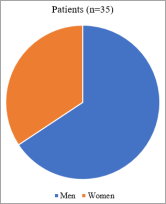
The research was executed at the Samarkand Regional Branch of the Republican Specialized Scientific and Practical Medical Center of Cardiology from January 2024 through December 2024. A total of 5170 coronary angiographic examinations were performed, from which 35 patients exhibiting abnormal coronary artery origins were identified. The mean age of the study cohort was 40 years, with an age range of 19 to 75 years. The cohort consisted of 23 male and 12 female participants (illustrated in Figure 1).
Depending on age, patients with coronary heart disease were divided into 2 groups. The 1st group included 49 (56.9%) young patients with coronary heart disease, whose average age was 32.8±12.29 years. The second group included 37 (43.1%) middle-aged patients with coronary heart disease, whose average age was 50.9±10.22 years. When distributing patients by gender, male sex prevailed in all groups of patients and occurred in the 1st group in 63.2% of cases and in the 2nd group in 56.8% of cases, respectively. The control group consisted of 80 practically healthy volunteers.
3. Results of the Study
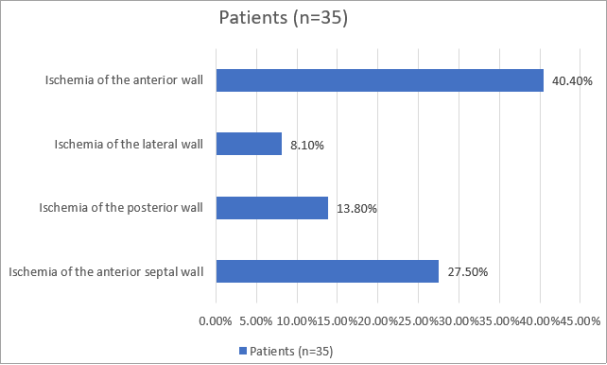
Distribution of patients depending on ischemic lesions of the left ventricle: Ischemia of the anterior septal wall 27,50%, Ischemia of the posterior wall 13,80%, Ischemia of the lateral wall 8,10%, Ischemia of the anterior wall 40,40%. (Figure 2).
Figure 2. Distribution of patients depending on ischemic lesions of the left ventricle.
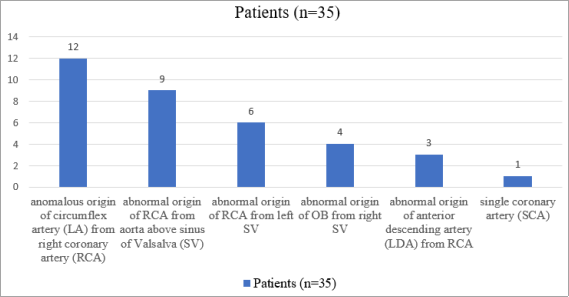
Based on coronary angiography findings, a total of 35 individuals presented with diverse forms of anomalous coronary artery origins. Specifically, the circumflex artery (CA) originated anomalously from the right coronary artery (RCA) in 12 patients. Nine patients exhibited an anomalous origin of the RCA from the aorta, superior to the sinus of Valsalva (SV). Furthermore, the RCA originated anomalously from the left SV in 6 patients. Four cases involved an anomalous origin of the obtuse marginal artery (OB) from the right SV. The anterior descending artery (LDA) was found to originate anomalously from the RCA in 3 patients. Lastly, a single coronary artery (SCA) was identified in only one patient (refer to Figure 3).
Figure 3. Distribution of patients depending on anomalous origins of coronary arteries.
Significant arterial narrowings necessitating immediate revascularization were identified in a cohort of 16 individuals. Among these, seven presented with blockages confined to a single vessel (with a Syntax Score below 22). Six patients exhibited extensive, severe multi-vessel coronary artery disease, categorized by Syntax Scores ranging from 23-32 points in four cases, and exceeding 32 points in two cases. One individual had a prior history of coronary artery bypass surgery. Coronary artery stenting procedures were carried out in nine patients. This included three instances where individuals experiencing Class III angina pectoris, as per CVD classification, underwent stenting of theus Obtusus Marginalis (OM) branch originating from the Right Coronary Artery (RCA). Stenting of the RCA, which anomalously arose from the aorta superior to the sinus of Valsalva, was performed in three patients. Additionally, a 75-year-old patient presenting with unstable angina, an anomalous OM origin from the RCA, and a narrowing in the proximal third of the Left Anterior Descending (LAD) artery, received direct stenting of the LAD. A patient with a solitary coronary artery simultaneously underwent recanalization of the Posterior Marginal Branch of the Obtuse Marginal (PMB of OM) and bifurcation stenting of the OM and RCA utilizing the culotte technique. Retrograde recanalization of the RCA, originating from the left sinus of Valsalva, was performed in one case. In every procedure, drug-eluting stents were deployed.
Favorable angiographic outcomes were achieved across all cases, with no intra- or post-procedural complications observed. Patients with multi-vessel disease and Syntax Scores exceeding 23 points were directed towards coronary artery bypass grafting. Two patients were re-hospitalized with clinical manifestations of Class III congestive heart failure after three and five years, respectively; both had previously undergone OM stenting. Subsequent control coronary angiograms revealed non-hemodynamically significant restenosis in the OM, alongside newly developed stenoses in the RCA and LAD, which were successfully treated with further stenting.
Based on the obtained data, ischemic changes were recorded on the ECG in 90% of cases. Analysis of ischemia localization in patients with coronary artery anomalies across two age groups revealed that anterior wall lesions remained most frequent - 38.8% in young patients and 45.9% in middle-aged patients (p=0.39). Damage to the anterior septal region was diagnosed in 22.4% and 21.6% of patients, respectively (p=0.88). The frequency of damage to the posterior, lateral walls, and apex was similar in both groups, with no statistically significant differences (p>0.5). The prevalence of single-walled ischemia was higher in young patients (71.4% versus 62.2%, p=0.33), and more than one-walled ischemia was higher in middle-aged patients (37.8% versus 28.6%, p=0.33), however, these differences did not reach statistical significance. Thus, the distribution of ischemia localization and volume in patients with coronary artery anomalies was similar between the two age groups (Table 1).
Table 1. Localization of ischemia and prevalence of lesions in AKA patients by age group.
Localization of ischemia
1st group (young, n=49)
%
2nd group (average age, n=37)
%
% p-value
Front wall
19
38,8%
17
45,9%
0,39
Front partition
11
22,4%
8
21,6%
0,88
Rear wall
6
12,2%
5
13,5%
0,85
Lateral wall
7
14,3%
4
10,8%
0,58
Apex
5
10,2%
3
8,1%
0,68
Ischaemia of one wall
35
71,4%
23
62,2%
0,33
Ischaemia of more than one wall
14
28,6%
14
37,8%
0,33
Table 1. Hemodynamic parameters of patients according to echocardiography data: LV end-diastolic dimension (EDD) 54,5±0,3 (mm), LV end-systolic dimension (ESD) 36,8±0,4 (mm), LV ejection fraction (EF) 59,2±0,5 (%), interventricular septum (IVS) 10,4±0,11 (mm), LV posterior wall 10,48±0,09 (mm), one hypokinesis zone 84,2%, Two or more hypokinesis zones 15,7%.
Table 1. Hemodynamic parameters of patients according to echocardiography data.
Indicators
Patient data
LV end-diastolic dimension (EDD)
54,5±0,3 (mm)
LV end-systolic dimension (ESD)
36,8±0,4 (mm)
LV ejection fraction (EF)
59,2±0,5 (%)
interventricular septum (IVS)
10,4±0,11 (mm)
LV posterior wall
10,48±0,09 (mm)
one hypokinesis zone
84,2%
Two or more hypokinesis zones
15,7%
4. Conclusion
Thus, accordingly, coronary angiography stands as a reliable modality for the diagnosis of abnormal coronary artery origins. It permits the identification of variant anatomy associated with congenital pathologies, the quantification of coronary artery damage, and the selection of the most appropriate direct myocardial revascularization strategy. Percutaneous coronary interventions are demonstrated to be an effective treatment for patients presenting with coronary heart disease in conjunction with coronary artery anomalies.
Abbreviations
CVD
Cardiovascular Diseases
IHD
Ischemic Heart Disease
CA
Coronary Arteries
RCA
Right Coronary Artery
LCA
Left Coronary Artery
LAD
Left Anterior Descending
CAG
Coronary Angiography
LV
Left Ventricul
SCA
Single Coronary Artery
SV
Sinus of Valsalva
LDA
Anterior Descending Artery
AMI
Acute Myocardial Infarction
EDD
LV End-Diastolic Dimension
ESD
LV End-Systolic Dimension
EF
Ejection Fraction
IVS
Interventricular Septum
OM
Obtusus Marginalis
PMB
Posterior Marginal Branch
Conflicts of Interest
The author declares no conflict of interest.
References
[1]
Bagmanova Z. A. Anomalies of the coronary arteries // Cardiology. – 2010. – Т. 50. – №. 8. – С. 48-55. (in Russ).
[2]
Bagmanova Z. A. et al. Congenital anomaly of the coronary artery: abnormal origin of the circumflex artery from the right aortic sinus of Valsalva (clinical case) // Creative surgery and oncology. – 2011. – №. 2. – С. 113-118. (in Russ).
[3]
Bagmanova Z. A. et al. Congenital coronary anomaly: single coronary artery // Emergency physician. – 2011. – №. 7. – С. 39-43. (in Russ).
[4]
Bagmatova Z. A. Peculiarities of the clinic, diagnostics and treatment of patients with congenital coronary pathology. Abstract of a doctor of medical sciences. Moscow, 2011 (in Russ.).
[5]
Bazylev V. V., Chernogrivov A. E., Chernogrivov I. E. Anomalous origin of the right coronary artery from the pulmonary trunk // Thoracic surgery, 1987, № 5, с. 80-84. (in Russ).
[6]
Belov Yu. V., Bogopolskaya O. M. Myocardial bridge - a congenital anomaly of the coronary bed // Cardiology. – 2004. – Т. 44. – №. 12. – С. 89-94. (in Russ).
[7]
Burakovsky V. I., Podzolkov V. P. "Correction of anomalous origin of the left coronary artery from the pulmonary trunk". Thoracic surgery, 1989, № 2, с. 5-11. (in Russ).
[8]
Buziashvili Yu. I., Dvinyapinova N. B., Sopromadze D. L. "Electrocardiographic characteristics of the anomalous origin of the left coronary artery from the pulmonary trunk". Cardiology, 1988, № 8, с. 59-63. (in Russ).
[9]
Camm J., Luscher T, Serruys P., Shljahto E. V., ed. The ESC Textbook of Cardiovascular Medicine / M.: GEOTAR-Media; 2011: 2042–50 (in Russ.).
[10]
Chamokova B. B., Sinitsyn V. E. CT angiography in the diagnosis of coronary artery anomalies // Radiation diagnostics and therapy. - 2013. - No. 2. – P. 10-25. (in Russ).
[11]
Chernogrivov A. E., Chernogrivov I. E., Bazylev V. V. Anomalous origin of the left coronary artery from the right branch of the pulmonary artery // Thoracic and cardiovascular surgery. – 2016. – V. 58. – No. 5. – P. 258-267. (in Russ).
[12]
Dechko S. V. et al. Myocardial infarctions of coronary arteries. 10th school of cardiology: scientific papers of the Republican scientific-practical conference with international participation. Minsk, 5–6 November 2015; 77–82 (in Russ.).
[13]
Druk I. V., Nechaeva G. I., Kuznetsova V. V. The state of the coronary arteries in connective tissue dysplasia // Kazan Medical Journal. – 2007. – Т. 88. – №. S5. – С. 30-32. (in Russ).
[14]
Khasanjanova F. O., Pulatova K. S., Ruzieva A. A. Analysis of the clinical effect of simvastatin in patients with unstable angina at a young age. October 2023. Cardiology in Belarus 15(5): 644-651. (In Russ.).
[15]
Nasedkina M. A., Mozhiia A. A., Petrosyan Yu. S., Krymsky L. D. "Characteristic features of pathological anatomy and myocardial damage in case of anomalous origin of the left coronary artery from the pulmonary trunk. Clinical and anatomical comparisons". Archives of Pathology, 1988, No. 6, pp. 35-41. (in Russ).
[16]
Petrosyan Yu. S., Garibyan V. A., Sarkisova T., Lepikhova N., I. I. "Angiographic semiotics and pathophysiology of anomalous origin of the left coronary artery from the pulmonary trunk". Thoracic surgery, 1990, no., pp. 18-25. (in Russ).
[17]
Ragimov F. R., Mozhina A. A. "Anomalous origin of both coronary arteries from the right sinus of Valsalva with double origin of the great vessels from the left ventricle". Thoracic surgery, 1987, No. 3, pp. 90-91. (in Russ).
[18]
Tashnik M. А. Variability of intramural location of coronary arteries // Clinical anatomy and operative surgery. – 2009; 2(8): 29–35 (in Russ).
[19]
Tseluiko V. I., Mishchuk N. E., Kinoschenko K. Yu. Anomalies in the structure of the coronary arteries (part 1) // Liki Ukrainy. - 2012. - No. 10. - P. 44-53. (in Russ).
[20]
Vasiliev A., Streltsova N. Anomalies in the development of coronary arteries in clinical practice // Doctor. – 2019. – Т. 30. – №. 4. – С. 10-15. (in Russ).
[21]
Saadh, M. J., Muhammad, F. A., Shareef, A. et al. Macrophage migration inhibitory factor (MIF): a Janus-faced cytokine in viral pathogenesis and host defense. Immunol Res 73, 160 (2025).
Odilovna, K. F. (2026). Incidence of Abnormal Coronary Artery Departures in Working-Age Patients with Ischemic Heart Disease. International Journal of Medical Research and Innovation, 2(3), 51-56. https://doi.org/10.11648/j.ijmri.20260203.12
Odilovna, K. F. Incidence of Abnormal Coronary Artery Departures in Working-Age Patients with Ischemic Heart Disease. Int. J. Med. Res. Innovation2026, 2(3), 51-56. doi: 10.11648/j.ijmri.20260203.12
Odilovna KF. Incidence of Abnormal Coronary Artery Departures in Working-Age Patients with Ischemic Heart Disease. Int J Med Res Innovation. 2026;2(3):51-56. doi: 10.11648/j.ijmri.20260203.12
@article{10.11648/j.ijmri.20260203.12,
  author = {Khasanjanova Farida Odilovna},
  title = {Incidence of Abnormal Coronary Artery Departures in Working-Age Patients with Ischemic Heart Disease},
  journal = {International Journal of Medical Research and Innovation},
  volume = {2},
  number = {3},
  pages = {51-56},
  doi = {10.11648/j.ijmri.20260203.12},
  url = {https://doi.org/10.11648/j.ijmri.20260203.12},
  eprint = {https://article.sciencepublishinggroup.com/pdf/10.11648.j.ijmri.20260203.12},
  abstract = {This paper investigates the prevalence of anomalous coronary artery origins among working-age individuals suffering from coronary artery disease, utilizing data from percutaneous coronary interventions. The research was conducted at the Samarkand Regional Branch of the Republican Specialized Scientific and Practical Medical Center of Cardiology over a one-year period from January to December 2024. A total of 4,170 coronary angiographic examinations were performed in patients with suspected or confirmed CAD. Among these individuals, 35 patients were identified as having anomalous origins of the coronary arteries, corresponding to a prevalence of approximately 0.84% within the studied population. The study population primarily consisted of working-age individuals, highlighting the socio-economic importance of early detection and appropriate management of such anomalies. Coronary angiography was used as the primary diagnostic modality to identify and classify the anatomical variants. The analysis revealed a diverse spectrum of coronary artery anomalies. The most frequently observed anomaly was the circumflex artery (CA) originating from the right coronary artery (RCA), identified in 12 patients (34.3%). The second most common finding was the origin of the RCA from the aorta above the sinus of Valsalva, observed in 9 patients (25.7%). In 6 cases (17.1%), the RCA originated from the left sinus of Valsalva. Less frequent anomalies included the obtuse marginal (OB) artery originating from the right sinus of Valsalva in 4 patients (11.4%) and the left anterior descending artery (LAD) originating from the RCA in 3 patients (8.6%). A single rare case (2.9%) of a solitary coronary artery was also documented. In conclusion, anomalous coronary artery origins, while uncommon, are not rare among working-age patients with coronary artery disease. Awareness of their prevalence and anatomical variations is crucial for interventional cardiologists, as it facilitates accurate diagnosis, optimizes procedural strategies, and may reduce the risk of procedural complications. Further studies are warranted to evaluate the long-term clinical outcomes and prognostic significance of these anomalies in patients undergoing PCI.},
 year = {2026}
}
TY  - JOUR
T1  - Incidence of Abnormal Coronary Artery Departures in Working-Age Patients with Ischemic Heart Disease
AU  - Khasanjanova Farida Odilovna
Y1  - 2026/07/27
PY  - 2026
N1  - https://doi.org/10.11648/j.ijmri.20260203.12
DO  - 10.11648/j.ijmri.20260203.12
T2  - International Journal of Medical Research and Innovation
JF  - International Journal of Medical Research and Innovation
JO  - International Journal of Medical Research and Innovation
SP  - 51
EP  - 56
PB  - Science Publishing Group
SN  - 3070-6319
UR  - https://doi.org/10.11648/j.ijmri.20260203.12
AB  - This paper investigates the prevalence of anomalous coronary artery origins among working-age individuals suffering from coronary artery disease, utilizing data from percutaneous coronary interventions. The research was conducted at the Samarkand Regional Branch of the Republican Specialized Scientific and Practical Medical Center of Cardiology over a one-year period from January to December 2024. A total of 4,170 coronary angiographic examinations were performed in patients with suspected or confirmed CAD. Among these individuals, 35 patients were identified as having anomalous origins of the coronary arteries, corresponding to a prevalence of approximately 0.84% within the studied population. The study population primarily consisted of working-age individuals, highlighting the socio-economic importance of early detection and appropriate management of such anomalies. Coronary angiography was used as the primary diagnostic modality to identify and classify the anatomical variants. The analysis revealed a diverse spectrum of coronary artery anomalies. The most frequently observed anomaly was the circumflex artery (CA) originating from the right coronary artery (RCA), identified in 12 patients (34.3%). The second most common finding was the origin of the RCA from the aorta above the sinus of Valsalva, observed in 9 patients (25.7%). In 6 cases (17.1%), the RCA originated from the left sinus of Valsalva. Less frequent anomalies included the obtuse marginal (OB) artery originating from the right sinus of Valsalva in 4 patients (11.4%) and the left anterior descending artery (LAD) originating from the RCA in 3 patients (8.6%). A single rare case (2.9%) of a solitary coronary artery was also documented. In conclusion, anomalous coronary artery origins, while uncommon, are not rare among working-age patients with coronary artery disease. Awareness of their prevalence and anatomical variations is crucial for interventional cardiologists, as it facilitates accurate diagnosis, optimizes procedural strategies, and may reduce the risk of procedural complications. Further studies are warranted to evaluate the long-term clinical outcomes and prognostic significance of these anomalies in patients undergoing PCI.
VL  - 2
IS  - 3
ER  -
Odilovna, K. F. (2026). Incidence of Abnormal Coronary Artery Departures in Working-Age Patients with Ischemic Heart Disease. International Journal of Medical Research and Innovation, 2(3), 51-56. https://doi.org/10.11648/j.ijmri.20260203.12
Odilovna, K. F. Incidence of Abnormal Coronary Artery Departures in Working-Age Patients with Ischemic Heart Disease. Int. J. Med. Res. Innovation2026, 2(3), 51-56. doi: 10.11648/j.ijmri.20260203.12
Odilovna KF. Incidence of Abnormal Coronary Artery Departures in Working-Age Patients with Ischemic Heart Disease. Int J Med Res Innovation. 2026;2(3):51-56. doi: 10.11648/j.ijmri.20260203.12
@article{10.11648/j.ijmri.20260203.12,
  author = {Khasanjanova Farida Odilovna},
  title = {Incidence of Abnormal Coronary Artery Departures in Working-Age Patients with Ischemic Heart Disease},
  journal = {International Journal of Medical Research and Innovation},
  volume = {2},
  number = {3},
  pages = {51-56},
  doi = {10.11648/j.ijmri.20260203.12},
  url = {https://doi.org/10.11648/j.ijmri.20260203.12},
  eprint = {https://article.sciencepublishinggroup.com/pdf/10.11648.j.ijmri.20260203.12},
  abstract = {This paper investigates the prevalence of anomalous coronary artery origins among working-age individuals suffering from coronary artery disease, utilizing data from percutaneous coronary interventions. The research was conducted at the Samarkand Regional Branch of the Republican Specialized Scientific and Practical Medical Center of Cardiology over a one-year period from January to December 2024. A total of 4,170 coronary angiographic examinations were performed in patients with suspected or confirmed CAD. Among these individuals, 35 patients were identified as having anomalous origins of the coronary arteries, corresponding to a prevalence of approximately 0.84% within the studied population. The study population primarily consisted of working-age individuals, highlighting the socio-economic importance of early detection and appropriate management of such anomalies. Coronary angiography was used as the primary diagnostic modality to identify and classify the anatomical variants. The analysis revealed a diverse spectrum of coronary artery anomalies. The most frequently observed anomaly was the circumflex artery (CA) originating from the right coronary artery (RCA), identified in 12 patients (34.3%). The second most common finding was the origin of the RCA from the aorta above the sinus of Valsalva, observed in 9 patients (25.7%). In 6 cases (17.1%), the RCA originated from the left sinus of Valsalva. Less frequent anomalies included the obtuse marginal (OB) artery originating from the right sinus of Valsalva in 4 patients (11.4%) and the left anterior descending artery (LAD) originating from the RCA in 3 patients (8.6%). A single rare case (2.9%) of a solitary coronary artery was also documented. In conclusion, anomalous coronary artery origins, while uncommon, are not rare among working-age patients with coronary artery disease. Awareness of their prevalence and anatomical variations is crucial for interventional cardiologists, as it facilitates accurate diagnosis, optimizes procedural strategies, and may reduce the risk of procedural complications. Further studies are warranted to evaluate the long-term clinical outcomes and prognostic significance of these anomalies in patients undergoing PCI.},
 year = {2026}
}
TY  - JOUR
T1  - Incidence of Abnormal Coronary Artery Departures in Working-Age Patients with Ischemic Heart Disease
AU  - Khasanjanova Farida Odilovna
Y1  - 2026/07/27
PY  - 2026
N1  - https://doi.org/10.11648/j.ijmri.20260203.12
DO  - 10.11648/j.ijmri.20260203.12
T2  - International Journal of Medical Research and Innovation
JF  - International Journal of Medical Research and Innovation
JO  - International Journal of Medical Research and Innovation
SP  - 51
EP  - 56
PB  - Science Publishing Group
SN  - 3070-6319
UR  - https://doi.org/10.11648/j.ijmri.20260203.12
AB  - This paper investigates the prevalence of anomalous coronary artery origins among working-age individuals suffering from coronary artery disease, utilizing data from percutaneous coronary interventions. The research was conducted at the Samarkand Regional Branch of the Republican Specialized Scientific and Practical Medical Center of Cardiology over a one-year period from January to December 2024. A total of 4,170 coronary angiographic examinations were performed in patients with suspected or confirmed CAD. Among these individuals, 35 patients were identified as having anomalous origins of the coronary arteries, corresponding to a prevalence of approximately 0.84% within the studied population. The study population primarily consisted of working-age individuals, highlighting the socio-economic importance of early detection and appropriate management of such anomalies. Coronary angiography was used as the primary diagnostic modality to identify and classify the anatomical variants. The analysis revealed a diverse spectrum of coronary artery anomalies. The most frequently observed anomaly was the circumflex artery (CA) originating from the right coronary artery (RCA), identified in 12 patients (34.3%). The second most common finding was the origin of the RCA from the aorta above the sinus of Valsalva, observed in 9 patients (25.7%). In 6 cases (17.1%), the RCA originated from the left sinus of Valsalva. Less frequent anomalies included the obtuse marginal (OB) artery originating from the right sinus of Valsalva in 4 patients (11.4%) and the left anterior descending artery (LAD) originating from the RCA in 3 patients (8.6%). A single rare case (2.9%) of a solitary coronary artery was also documented. In conclusion, anomalous coronary artery origins, while uncommon, are not rare among working-age patients with coronary artery disease. Awareness of their prevalence and anatomical variations is crucial for interventional cardiologists, as it facilitates accurate diagnosis, optimizes procedural strategies, and may reduce the risk of procedural complications. Further studies are warranted to evaluate the long-term clinical outcomes and prognostic significance of these anomalies in patients undergoing PCI.
VL  - 2
IS  - 3
ER  -





 Share This Article
 Twitter
 Linked In
 Facebook
 Copy
Copy Download