
This study is part of a circular economy approach aimed at valorizing polyethylene terephthalate (PET) waste in cementitious matrices through a materials science and engineering approach. PET waste from used containers underwent a controlled thermomechanical transformation (melting at 260°C, cooling, grinding, and sieving), yielding two distinct fractions: plastic aggregates (> 5 mm) and a fine powder. These two forms were incorporated into hydraulic concrete using two formulation strategies: (i) partial substitution of natural gravel with PET aggregates and (ii) partial substitution of sand with PET powder, at rates ranging from 0 to 18% by mass. The concrete's performance was evaluated after 7 days by measuring uniaxial compressive strength and water absorption capacity. The results show that the morphology and incorporation rate of PET significantly influence the concrete's properties. Substituting gravel with PET aggregates leads to a progressive decrease in mechanical strength and, at high concentrations, an increase in water absorption. Conversely, substituting sand with PET powder exhibits more favorable behavior at low concentrations (≤ 6–8%), characterized by a densification effect on the cementitious matrix. An optimal range of 5 to 8% PET powder is thus identified for non-structural hydraulic concrete applications.
| Published in | International Journal of Materials Science and Applications (Volume 15, Issue 3) |
| DOI | 10.11648/j.ijmsa.20261503.15 |
| Page(s) | 125-131 |
| Creative Commons |
This is an Open Access article, distributed under the terms of the Creative Commons Attribution 4.0 International License (http://creativecommons.org/licenses/by/4.0/), which permits unrestricted use, distribution and reproduction in any medium or format, provided the original work is properly cited. |
| Copyright |
Copyright © The Author(s), 2026. Published by Science Publishing Group |
Hydraulic Concrete, Waste Valorization, Recycled PET, Aggregate Substitution, Compressive Strength, Water Absorption
Case of PET as a substitute for gravel | ||
|---|---|---|
PET rate | Compressive Strength (MPa) | Water absorption capacity (%) |
0 | 13,26 | 6,7 |
6 | 12,95 | 7,2 |
9 | 11,68 | 7,3 |
12 | 9,16 | 7,4 |
15 | 7,89 | 7,5 |
18 | 7,27 | 7,5 |
Cas de substitution PET au sable | ||
|---|---|---|
PET rate | Compressive Strength (MPa) | Water absorption capacity (%) |
0 | 13,26 | 6,7 |
6 | 12,31 | 4,5 |
9 | 11,37 | 4,6 |
12 | 10,11 | 5,0 |
15 | 7,90 | 5,9 |
18 | 6,32 | 6,0 |
ITZ | Interfacial Transition Zone |
PET | Polyethylene Terephthalate |
LDPE | Low-density Polyethylene |
WAC | Water Absorption Capacity |
| [1] | OPECST (2018). Pollution plastique: une bombe à retardement ? Sénat, France. |
| [2] | Sofo, H. A. I., Mohammed, M. A., Sidick, B. (2024). Recycling of Waste Plastic PET on Asphalt Concrete (AC) by Using Application of Response Surface Methodology: Effect of PET on AC Formulated by Duriez Model. International Journal of Materials Science and Applications, 13(3), 48-60. |
| [3] | Saikia, N., & de Brito, J. (2012). Use of plastic waste as aggregate in cement mortar and concrete preparation: A review. Construction and Building Materials, 34, 385–401. |
| [4] | Shitote, S. M., Gariy, Z. C. A., & Ronoh, E. (2019). Influence of coarse aggregate on the physical and mechanical performance of paving blocks made using waste plastic. International Journal of Engineering Research & Technology, 8(6), 636-640. |
| [5] | Choi, Y. W., Moon, D. J., Chung, J. S., & Cho, S. K. (2005). Effects of waste PET bottles aggregate on the properties of concrete. Cement and Concrete Research, 35(4), 776–781. |
| [6] | Albano, C., Camacho, N., Hernández, M., Matheus, A., & Gutiérrez, A. (2009). Influence of content and particle size of waste pet bottles on concrete behavior at different w/c ratios. Waste Management, 29(10), 2707–2711. |
| [7] | THE EFFECT OF PET AND LDPE PLASTIC WASTES ON THE COMPRESSIVE STRENGTH OF PAVING BLOCKS. (2023). GEOMATE Journal, 24(101), 94-101. |
| [8] | Zakaria, R. F., & Al Jauhari, Z. (2023). The effect of pet and LDPE plastic wastes on the compressive strength of paving blocks. GEOMATE Journal, 24(101), 94-101. |
| [9] | Wicaksono, S. T., Ardhyananta, H., & Rasyida, A. (2018, April). Study on mechanical and physical properties of composite materials with recycled PET as fillers for paving block application. In AIP Conference Proceedings (Vol. 1945, No. 1, p. 020066). AIP Publishing LLC. |
| [10] | A. A. Kadir and N. A. Sarani, “An Overview of Wastes Recycling in Fired Clay Bricks,” Int. J. Integr. Eng., vol. 4, no. 2, pp. 53–69, 2012. |
| [11] | D. M. S. Mohan, J. Vignesh, P. Iyyappan, and C. Suresh, “Utilization of plastic bags in pavement blocks,” Int. J. pure Appl. Math., vol. 119, no. 15, pp. 1407–1415, 2018. |
| [12] | K. Dinesh. S, Dinesh. A, “Utilisation of Waste Plastic in Manufacturing of Bricks and Paver Blocks,” Int. J. Appl. Eng. Res. vol. 11, no. 3, pp. 364–368, 2016. |
| [13] | A. K. Jnr, D. Yunana, P. Kamsouloum, M. Webster, D. C. Wilson, and C. Cheeseman, “Recycling waste plastics in developing countries: Use of low-density polyethylene water sachets to form plastic bonded sand blocks,” Waste Manag., vol. 80, pp. 112–118, 2018. |
| [14] | B. Shanmugavalli, K. Gowtham, and P. Jeba Nalwin, “Reuse of Plastic Waste in Paver Blocks,” Int. J. Eng. Technol., vol. 6, no. 02, pp. 313–316, 2017. |
| [15] | A. Gawande, G. Zamare, V. C. Renge, S. Tayde, and G. Bharsakale, “An overview on waste plastic utilisation in asphalting of roads,” J. Eng. Res. Stud., vol. III, no. II, pp. 1–5, 2012. |
| [16] | Hamad, K., Kaseem, M., and Deri, F. (2013) Recycling of waste from polymer materials: an overview of the recent, works. Polym. Degrad. Stab., 98, 2801– 2812. |
| [17] | Goto, M. (2009) Chemical recycling of plastics using sub- and supercritical fluids. J. Supercrit. Fluids, 47, 500–507. |
| [18] | Raju Francis et. al, Recycling of Polymers Methods, Characterization and Applications, Wiley-VCH Verlag GmbH & Co, Germany, 2017. Google Scholar. |
| [19] | Tukker, A. (2002) Plastics waste – Feedstock recycling, chemical recycling and incineration. Rapra Rev. Rep., Report 148, 13 (4), 3–4. Google Scholar. |
| [20] | Jambeck, J. R., Andrady, A., Geyer, R., Narayan, R., Perryman, M., Siegler, T., Wilcox, C., Lavender Law, K., (2015). Plastic waste inputs from land into the ocean, Science, 347, p. 768–771. |
| [21] | Siddique, R., Khatib, J., & Kaur, I. (2008). Use of recycled plastic in concrete: A review. Waste Management, 28(10), 1835-1852. |
| [22] | Frigione, M. (2010). Recycling of PET bottles as fine aggregate in concrete. Waste Management, 30(6), 1101-1106. |
| [23] | De Oliveira, L. A. P., & Castro-Gomes, J. P. (2011). Physical and mechanical behaviour of recycled PET fibre reinforced mortar. Construction and Building Materials, 25(4), 1712-1717. |
| [24] | Naik, T. R., Singh, S. S., & Huber, C. O. (1996). Investigations of waste PET bottles as concrete aggregates. ACI Materials Journal, 93(2), 141-148. |
APA Style
Sofo, H. A. I., Adannou, H. A., Haroun, A. M., Djonkamla, Y., Alpha, K. D. (2026). Influence of Physical Parameters on the Mechanical Properties of a Material Produced from PET Plastic Waste into Paving Blocks. International Journal of Materials Science and Applications, 15(3), 125-131. https://doi.org/10.11648/j.ijmsa.20261503.15
ACS Style
Sofo, H. A. I.; Adannou, H. A.; Haroun, A. M.; Djonkamla, Y.; Alpha, K. D. Influence of Physical Parameters on the Mechanical Properties of a Material Produced from PET Plastic Waste into Paving Blocks. Int. J. Mater. Sci. Appl. 2026, 15(3), 125-131. doi: 10.11648/j.ijmsa.20261503.15
@article{10.11648/j.ijmsa.20261503.15,
  author = {Hassan Alaguid Ibrahim Sofo and Haroun Ali Adannou and Albayine Macki Haroun and Youdjari Djonkamla and Kilma Dieuleveut Alpha},
  title = {Influence of Physical Parameters on the Mechanical Properties of a Material Produced from PET Plastic Waste into Paving Blocks},
  journal = {International Journal of Materials Science and Applications},
  volume = {15},
  number = {3},
  pages = {125-131},
  doi = {10.11648/j.ijmsa.20261503.15},
  url = {https://doi.org/10.11648/j.ijmsa.20261503.15},
  eprint = {https://article.sciencepublishinggroup.com/pdf/10.11648.j.ijmsa.20261503.15},
  abstract = {This study is part of a circular economy approach aimed at valorizing polyethylene terephthalate (PET) waste in cementitious matrices through a materials science and engineering approach. PET waste from used containers underwent a controlled thermomechanical transformation (melting at 260°C, cooling, grinding, and sieving), yielding two distinct fractions: plastic aggregates (> 5 mm) and a fine powder. These two forms were incorporated into hydraulic concrete using two formulation strategies: (i) partial substitution of natural gravel with PET aggregates and (ii) partial substitution of sand with PET powder, at rates ranging from 0 to 18% by mass. The concrete's performance was evaluated after 7 days by measuring uniaxial compressive strength and water absorption capacity. The results show that the morphology and incorporation rate of PET significantly influence the concrete's properties. Substituting gravel with PET aggregates leads to a progressive decrease in mechanical strength and, at high concentrations, an increase in water absorption. Conversely, substituting sand with PET powder exhibits more favorable behavior at low concentrations (≤ 6–8%), characterized by a densification effect on the cementitious matrix. An optimal range of 5 to 8% PET powder is thus identified for non-structural hydraulic concrete applications.},
 year = {2026}
}
TY  - JOUR
T1  - Influence of Physical Parameters on the Mechanical Properties of a Material Produced from PET Plastic Waste into Paving Blocks
AU  - Hassan Alaguid Ibrahim Sofo
AU  - Haroun Ali Adannou
AU  - Albayine Macki Haroun
AU  - Youdjari Djonkamla
AU  - Kilma Dieuleveut Alpha
Y1  - 2026/05/27
PY  - 2026
N1  - https://doi.org/10.11648/j.ijmsa.20261503.15
DO  - 10.11648/j.ijmsa.20261503.15
T2  - International Journal of Materials Science and Applications
JF  - International Journal of Materials Science and Applications
JO  - International Journal of Materials Science and Applications
SP  - 125
EP  - 131
PB  - Science Publishing Group
SN  - 2327-2643
UR  - https://doi.org/10.11648/j.ijmsa.20261503.15
AB  - This study is part of a circular economy approach aimed at valorizing polyethylene terephthalate (PET) waste in cementitious matrices through a materials science and engineering approach. PET waste from used containers underwent a controlled thermomechanical transformation (melting at 260°C, cooling, grinding, and sieving), yielding two distinct fractions: plastic aggregates (> 5 mm) and a fine powder. These two forms were incorporated into hydraulic concrete using two formulation strategies: (i) partial substitution of natural gravel with PET aggregates and (ii) partial substitution of sand with PET powder, at rates ranging from 0 to 18% by mass. The concrete's performance was evaluated after 7 days by measuring uniaxial compressive strength and water absorption capacity. The results show that the morphology and incorporation rate of PET significantly influence the concrete's properties. Substituting gravel with PET aggregates leads to a progressive decrease in mechanical strength and, at high concentrations, an increase in water absorption. Conversely, substituting sand with PET powder exhibits more favorable behavior at low concentrations (≤ 6–8%), characterized by a densification effect on the cementitious matrix. An optimal range of 5 to 8% PET powder is thus identified for non-structural hydraulic concrete applications.
VL  - 15
IS  - 3
ER  -
Physic and Engineering Science Department, Doctoral School of Science, Technical and Environment, N’Djamena, Chad
Department of Physics and Chemistry, Higher Teacher Training College of N’Djamena, N’Djamena, Chad;Physic and Engineering Science Department, African Laboratory for Sustainable Development Research, N’Djamena, Chad
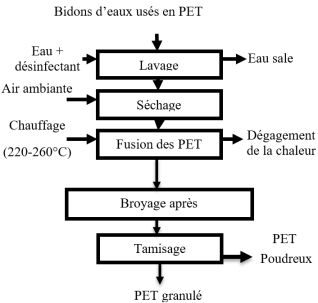
Figure 1. Concrete production diagram.
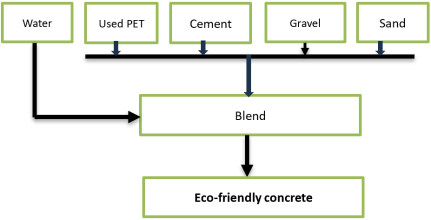
Figure 2. Hydraulic concrete production diagram.
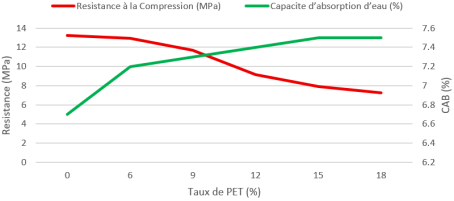
Figure 3. Influence of PET granules on the compressive strength and water absorption capacity of hydraulic concrete at 7 days.
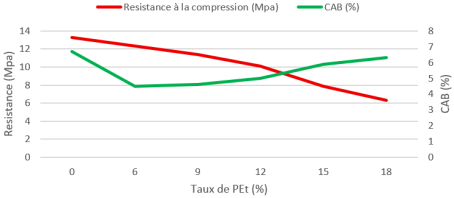
Figure 4. Influence of powdered PET on the compressive strength and water absorption capacity of hydraulic concrete at 7 days.

Information



 Share This Article
 Twitter
 Linked In
 Facebook
 Copy
Copy Download