
We study manufacture process technology using small equipments. We consider clip equipment for the first time. They are small objects. They are made of alloy. We use textile cloth membrane material. We peel the textile cloth membrane material using small clip equipment. When we peel the textile tears step by step showing the air gap with textile object in tact. The steps show polymer textile cloth process. The task of the small clip equipment are to peel towards the fibre. We continue the peel process. The air gap widens on the textile to obtain the fibre textile. The work is simple. We obtain fibre textile (FT) membrane material objects. We obtain multiple numbers. The length of the fibre textile membrane material object 1 is 7 cm. The width and height are small. The length of the fibre textile membrane material object 1 is 9 cm. The width and height are small. The work time is 4 minutes. The set up experiments are placed on wood bench. Our work can find applications in touch use, décor and seat furniture objects. The textile cloth fibre capillary inside cylinder for displays. We can use liquid with the textile cloth fibre capillary inside cylinder for displays. Textile polymer membrane material are used to show fixed vehicle. They find applications in automobiles, mini robots, vehicles and truck objects.
| Published in | International Journal of Materials Science and Applications (Volume 15, Issue 6) |
| DOI | 10.11648/j.ijmsa.20261506.11 |
| Page(s) | 181-185 |
| Creative Commons |
This is an Open Access article, distributed under the terms of the Creative Commons Attribution 4.0 International License (http://creativecommons.org/licenses/by/4.0/), which permits unrestricted use, distribution and reproduction in any medium or format, provided the original work is properly cited. |
| Copyright |
Copyright © The Author(s), 2026. Published by Science Publishing Group |
Textile, Fibre Cloth Manufacture, Polymers, Clip Equipment, Cloth Sheets
Textile cloth membrane material object | Details |
|---|---|
length | 48 cm |
width | 48 cm |
height | 3 mm |
Objects | Details |
|---|---|
Fibre textile object 1 | length = 7 cm, width and height dimensions are small |
Fibre textile object 2 | length = 9 cm, width and height dimensions are small |
FT | Fibre Textile |
2D | Two Dimensions |
3D | Three Dimensions |
| [1] | Piotr Parafiniuk, Maciej Bańda, Mateusz Stasiak, Józef Horabik, Joanna Wiącek, Marek Molenda, Effect of aspect ratio on the mechanical behavior of packings of spheroids, Physica A: Statistical Mechanics and its Applications, 501, 1-11, (2018). |
| [2] | Jayamaha, H., Park, K. & Shepherd, L. M. Ultrablack wool textiles inspired by hierarchical avian structure. Nat Commun 16, 10581 (2025). |
| [3] | Wulfsberg, J. P., Röhlig, B. Paradigm change: small machine tools for small workpieces. Prod. Eng. Res. Devel. 7, 465-468 (2013). |
| [4] | Fiorello, I., Meder, F., Mondini, A. et al. Plant-like hooked miniature machines for on-leaf sensing and delivery. Commun Mater 2, 103 (2021). |
| [5] | Ashokkumar, A., Hewitt, L., Ghezae, I. et al. Large language models can predict the results of social science experiments. Nature 656, 115-122 (2026). |
| [6] | van de Burgt, Y., Melianas, A., Keene, S. T. et al. Organic electronics for neuromorphic computing. Nat Electron 1, 386-397 (2018). |
| [7] | Roberto Venturelli et al. Hydrodynamic pressure sensing with an artificial lateral line in steady and unsteady flows, Bioinspir. Biomim. 7 036004, (2012). |
| [8] | Görtz, M. Digital twins: past, present and future. Sci Rep 16, 10510 (2026). |
| [9] | Stamm, M., Polymer surfaces and interfaces, Springer (2008). |
| [10] | Sabbatini, L., Giglio, E. D., Polymer surface characterization, De Gruyter Brill, 2nd Edition (2022). |
| [11] | Layman, B. R., Hatch, L. A., Atwood, C. R., Potter, S. M., Link, J. S., Henry, C. S., Cavinato, A. G., Implementation of laser printed paper based analytical devices for colorimetric assay of metals in the teaching laboratory, J. Chem. Educ., 102, 882-889 (2025). |
| [12] | Pogrebniak, M. F., Mathematical processing of RGB data in microfluidic paper-based analytical devices, Scientific Reports, 14, 13635 (2024). |
| [13] | Rohde, L., Anchutkin, G., Holubec, V., Cichos, F., Programmable hydrodynamics of active particles. Nat Commun. 17, 9406 (2026). |
| [14] | Fortunato, G., Pecora, A., Maiolo, L., Polysilicon thin film transistors on polymer substrates, Materials Science in Semiconductor Processing, 15, 627-641, (2012). |
| [15] | Izdebska, J., Polymers for 3D printing: methods, properties, and characteristics, William Andrew, Elsevier, (2022). |
| [16] | Melnikova, R.; Ehrmann, A.; Finsterbusch, K., 3D printing of textile-based structures by Fused Deposition Modelling (FDM) with different polymer materials, IOP Conference Series: Materials Science and Engineering, 62, (2014). |
| [17] | B. Ng, N. Quinete, P. R. Gardinali, Assessing accuracy, precision and selectivity using quality controls for non-targeted analysis, Science of The Total Environment, 713, 136568, (2020). |
| [18] | Asatekin, A., Barr, M. C., Baxamusa, S. H., Lau, K. K. S., Tehaeff, W., Xu, J., Gleason, K. K., Designing polymer surfaces via vapor deposition, Materials Today, 13, 26-33, (2010). |
| [19] | Ulf W. Gedde, Polymer Physics, Springer, 1-298, (1999). |
| [20] | Mohamed, M. H., Gu, P, Design of An Automatic Weaving Machine For 3-D Net Shapes. In: Acar, M. (eds) Mechatronic Design in Textile Engineering. NATO ASI Series, vol 279. Springer, Dordrecht (1995). |
| [21] | Harvey, C., Holtzman, E., Ko, J., Hagan, B., Wu, R., Marschner, S., Kessler D., Weaving Objects: Spatial Design and Functionality of 3D Woven Textiles, SIGGRAPH '19: ACM SIGGRAPH 2019 Art Gallery, 52, 381-388, (2019). |
| [22] | Kaldor, J. M., James, D. L., Marschner, S., Simulating Knitted Cloth at the Yarn Level, ACM Transactions on Graphics, 27, 3, 1-10, (2008). |
| [23] | Idelson, A., I., Bergsma, O., Groves, R, Quantitative Morphological Analysis of Warp and Weft Yarns in Historical Woven Structures. Studies in Conservation, 71, 136-152, (2026). |
| [24] | Böhme, N., Anders, M., Reichelt, T., Schuhmann, K., Alexandra Bridarolli, A., Chevalier, A., New treatments for canvas consolidation and conservation. Herit Sci 8, 16 (2020). |
| [25] | Idelson, A. I., Bergsma, O., Groves, R., Methodology for measures of twist and crimp in canvas paintings supports and historical textiles, Journal of Cultural Heritage, 71, 1-9, (2025). |
| [26] | Leenders, N., Moerbeek, R. M., Puijk, M. J. et al. Polycotton waste textile recycling by sequential hydrolysis and glycolysis. Nat Commun 16, 738 (2025). |
| [27] | Sanchez, V., Walsh, C. J., Wood, R. J., Textile Technology for Soft Robotic and Autonomous Garments. Adv. Funct. Mater. 31, 2008278, (2021). |
| [28] | Piccolo, C., Keller, M., Czarnecki, D. J., Austin, T., Shelver, G., Grinias, J. P., Comparison of experimental and simulated separation performance in capillary tube-in-manifold devices, Journal of Chromatography A, 1736, 465428, (2024). |
| [29] | Rodrigues, A., Figueiredo, L., Diogo, H., Bordado, J., Mechanical behavior of PET fibers and textiles for Stent-Grafts using video extensometry and image analysis. Sci. Technol. Mate. 30, 23-33, (2018). |
APA Style
Vishal, N. V. R. (2026). Manufacture Process Technology Using Small Equipment to Fabricate Fibre Textile Cloth Material Objects. International Journal of Materials Science and Applications, 15(6), 181-185. https://doi.org/10.11648/j.ijmsa.20261506.11
ACS Style
Vishal, N. V. R. Manufacture Process Technology Using Small Equipment to Fabricate Fibre Textile Cloth Material Objects. Int. J. Mater. Sci. Appl. 2026, 15(6), 181-185. doi: 10.11648/j.ijmsa.20261506.11
AMA Style
Vishal NVR. Manufacture Process Technology Using Small Equipment to Fabricate Fibre Textile Cloth Material Objects. Int J Mater Sci Appl. 2026;15(6):181-185. doi: 10.11648/j.ijmsa.20261506.11
@article{10.11648/j.ijmsa.20261506.11,
  author = {Nandigana Venkata Raghavendra Vishal},
  title = {Manufacture Process Technology Using Small Equipment to Fabricate Fibre Textile Cloth Material Objects},
  journal = {International Journal of Materials Science and Applications},
  volume = {15},
  number = {6},
  pages = {181-185},
  doi = {10.11648/j.ijmsa.20261506.11},
  url = {https://doi.org/10.11648/j.ijmsa.20261506.11},
  eprint = {https://article.sciencepublishinggroup.com/pdf/10.11648.j.ijmsa.20261506.11},
  abstract = {We study manufacture process technology using small equipments. We consider clip equipment for the first time. They are small objects. They are made of alloy. We use textile cloth membrane material. We peel the textile cloth membrane material using small clip equipment. When we peel the textile tears step by step showing the air gap with textile object in tact. The steps show polymer textile cloth process. The task of the small clip equipment are to peel towards the fibre. We continue the peel process. The air gap widens on the textile to obtain the fibre textile. The work is simple. We obtain fibre textile (FT) membrane material objects. We obtain multiple numbers. The length of the fibre textile membrane material object 1 is 7 cm. The width and height are small. The length of the fibre textile membrane material object 1 is 9 cm. The width and height are small. The work time is 4 minutes. The set up experiments are placed on wood bench. Our work can find applications in touch use, décor and seat furniture objects. The textile cloth fibre capillary inside cylinder for displays. We can use liquid with the textile cloth fibre capillary inside cylinder for displays. Textile polymer membrane material are used to show fixed vehicle. They find applications in automobiles, mini robots, vehicles and truck objects.},
 year = {2026}
}
TY  - JOUR
T1  - Manufacture Process Technology Using Small Equipment to Fabricate Fibre Textile Cloth Material Objects
AU  - Nandigana Venkata Raghavendra Vishal
Y1  - 2026/11/27
PY  - 2026
N1  - https://doi.org/10.11648/j.ijmsa.20261506.11
DO  - 10.11648/j.ijmsa.20261506.11
T2  - International Journal of Materials Science and Applications
JF  - International Journal of Materials Science and Applications
JO  - International Journal of Materials Science and Applications
SP  - 181
EP  - 185
PB  - Science Publishing Group
SN  - 2327-2643
UR  - https://doi.org/10.11648/j.ijmsa.20261506.11
AB  - We study manufacture process technology using small equipments. We consider clip equipment for the first time. They are small objects. They are made of alloy. We use textile cloth membrane material. We peel the textile cloth membrane material using small clip equipment. When we peel the textile tears step by step showing the air gap with textile object in tact. The steps show polymer textile cloth process. The task of the small clip equipment are to peel towards the fibre. We continue the peel process. The air gap widens on the textile to obtain the fibre textile. The work is simple. We obtain fibre textile (FT) membrane material objects. We obtain multiple numbers. The length of the fibre textile membrane material object 1 is 7 cm. The width and height are small. The length of the fibre textile membrane material object 1 is 9 cm. The width and height are small. The work time is 4 minutes. The set up experiments are placed on wood bench. Our work can find applications in touch use, décor and seat furniture objects. The textile cloth fibre capillary inside cylinder for displays. We can use liquid with the textile cloth fibre capillary inside cylinder for displays. Textile polymer membrane material are used to show fixed vehicle. They find applications in automobiles, mini robots, vehicles and truck objects.
VL  - 15
IS  - 6
ER  -
Department of Mechanical Engineering, Indian Institute of Technology Madras, Chennai, India
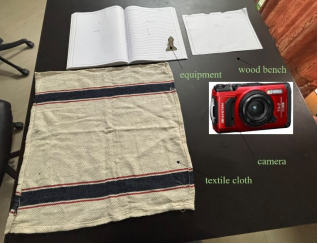
Figure 1. Experiment set up.
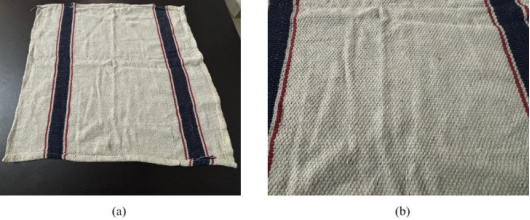
Figure 2. (a) textile cloth membrane material (b) close view.
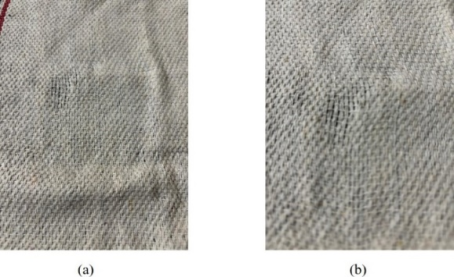
Figure 3. (a) peel region in the textile cloth (b) close view.
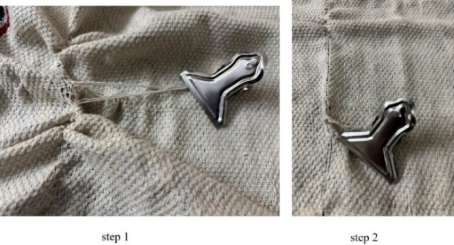
Figure 4. Fibre textile cloth membrane material object. We show steps. We show small clip equipment.
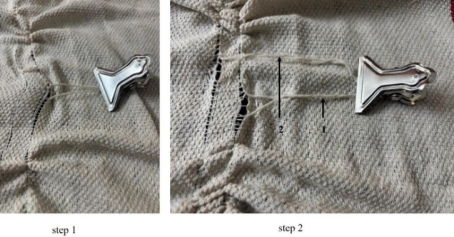
Figure 5. Two textile fibre objects. We show steps and they are flexible. We have small clip.

Information



 Share This Article
 Twitter
 Linked In
 Facebook

 Copy
 Download