Research Article | | Peer-Reviewed

Environmental Computronics: A Theoretical Study on the Fusion of Deep Learning, the Internet of Things and Environmental Management

Received: 19 October 2026     Accepted: 28 October 2026     Published: 19 November 2026
Views:       Downloads:
Abstract

Environmental management has historically depended on sparse field sampling, periodic reporting, and slow regulatory feedback, leaving decision-makers to act on incomplete, delayed, and coarse information in space and time. Two technological movements are now changing that condition. The Internet of Things (IoT) has made dense, continuous and low-cost observation of air, water, soil, climate and waste systems practicable, while deep learning has made it possible to extract structure, forecasts and anomalies from the large, heterogeneous and noisy data streams that such observation produces. This paper proposes and develops the concept of Environmental Computronics, defined as the integrated science and engineering of sensing, communicating, learning from and acting upon environmental systems through networked electronic devices and computational intelligence. Using a theoretical research design built on an integrative review of verifiable peer-reviewed literature and conceptual synthesis, the study traces the intellectual roots of the field in cybernetics, general systems theory, social-ecological systems and resilience thinking, adaptive management, estimation theory and theory-guided data science. It then advances a seven-layer Environmental Computronics Framework (ECF) spanning physical sensing, connectivity, edge intelligence, data fusion and learning, knowledge guidance, decision and actuation, and governance. The framework is expressed formally as a closed-loop, knowledge-guided state-estimation and control problem, and eight testable propositions are derived from it. Applications to air quality, water resources, weather and climate, land and biodiversity, solid waste and the oil and gas sector are examined, followed by a critical appraisal of limitations including data quality, the energy and carbon cost of computation, electronic waste, interpretability, cybersecurity, equity and institutional readiness. The paper concludes that the value of fusing deep learning and IoT for the environment lies not in the technologies themselves but in closing the loop between observation, understanding and accountable action, and it sets out a research agenda for building that loop responsibly, with particular attention to developing-country contexts such as the Niger Delta.

Published in Internet of Things and Cloud Computing (Volume 14, Issue 3)
DOI 10.11648/j.iotcc.20261403.12
Page(s) 68-88
Creative Commons

This is an Open Access article, distributed under the terms of the Creative Commons Attribution 4.0 International License (http://creativecommons.org/licenses/by/4.0/), which permits unrestricted use, distribution and reproduction in any medium or format, provided the original work is properly cited.

Copyright

Copyright © The Author(s), 2026. Published by Science Publishing Group

Keywords

Environmental Computronics, Deep Learning, Internet of Things, Environmental Management, Edge Intelligence, Knowledge-guided Machine Learning, Cybernetics, Sustainability

1. Introduction
The management of the natural environment is, at its core, a problem of information and control. To protect a river, an airshed, a forest or a coastline, managers must know the state of that system, understand how it responds to human and natural pressures, anticipate how it will change, and act in ways that keep it within acceptable limits. For most of the twentieth century each of these steps was constrained by the cost and slowness of measurement. Water quality was assessed from grab samples analysed days later in a laboratory; air pollution was measured at a handful of expensive reference stations; land cover was mapped once every few years; and environmental impact was reported to regulators in periodic, often self-declared, returns. The result was a management practice that was largely retrospective, acting on what had already happened rather than on what was happening or about to happen.
Three developments over the past two decades have begun to change this condition. The first is the emergence of environmental sensor networks, which described as a potential revolution in earth system science because they allow autonomous, continuous and spatially distributed observation of physical processes. The second is the broader Internet of Things, the vision of a world in which everyday objects are equipped with sensing, identification and communication capabilities and connected to one another and to computing infrastructure . explicitly argued that the IoT can be understood as a natural evolution of environmental sensing systems, extending them from bespoke scientific deployments towards interoperable, web-connected infrastructures. The third is the rise of deep learning, a family of representation-learning methods that build multiple levels of abstraction from raw data and that have transformed computer vision, speech recognition and sequence modelling .
Each of these developments is significant on its own. Their convergence is more significant still. IoT systems generate data streams that are large, fast, multi-modal and noisy, which are precisely the conditions in which conventional statistical methods struggle and deep learning excels . Deep learning, in turn, is hungry for data and has historically been limited in environmental science by the scarcity of labelled observations, a constraint that dense sensing begins to relax . When the two are coupled to management institutions capable of acting on what they reveal, the possibility arises of an environmental management practice that is continuous, predictive and adaptive rather than periodic, descriptive and reactive.
1.1. Statement of the Problem
Despite rapid growth in applications, the fusion of deep learning, IoT and environmental management remains theoretically fragmented. The literature is dominated by three largely separate bodies of work. Computer science and engineering research focuses on device architectures, communication protocols and model accuracy, frequently treating the environment as a source of benchmark data . Earth and environmental science research increasingly adopts deep learning but tends to evaluate it against process-based models in narrow prediction tasks . Environmental management and policy research addresses governance, sustainability and institutional change but often treats digital technology as an external input rather than as a constitutive element of the management system .
Three consequences follow. First, there is no shared vocabulary or unifying construct that names the integrated field and defines its boundaries. Second, there is no explicit theoretical account of why and under what conditions the fusion of sensing, learning and management should produce better environmental outcomes, as opposed to simply producing more data or more accurate predictions. Third, the risks and costs of the fusion itself, including the energy demand of large models, the electronic waste created by device proliferation, the opacity of deep networks and the uneven distribution of technological capacity between regions, are discussed in isolation from its benefits. Without an integrating theory, research and practice risk accumulating technically impressive but managerially inconsequential systems.
1.2. Aim and Objectives
The aim of this study is to develop a theoretical foundation for the fusion of deep learning, the Internet of Things and environmental management under the unifying construct of Environmental Computronics. The specific objectives are to:
1) define Environmental Computronics and delineate its scope relative to adjacent fields such as environmental informatics, smart environmental monitoring and AI for sustainability;
2) identify and synthesise the theoretical traditions that explain how sensing, learning and action can be integrated in the management of environmental systems;
3) propose a layered conceptual framework, with a formal representation, that describes the structure and dynamics of Environmental Computronic systems;
4) derive testable propositions from the framework to guide empirical research;
5) examine the principal application domains and the limitations, risks and ethical concerns associated with the fusion; and
6) articulate a research and practice agenda, with attention to developing-country contexts.
1.3. Research Questions
The study is guided by four research questions. 1: What conceptual boundaries and defining characteristics distinguish Environmental Computronics as an integrated field? 2: Which theoretical traditions best explain how the coupling of IoT sensing, deep learning and management action can improve environmental outcomes? 3: What architecture and formal structure can represent Environmental Computronic systems in a way that is general enough to span application domains yet specific enough to generate testable claims? 4: What are the principal limitations and risks of the fusion, and how should research and practice respond to them?
1.4. Significance of the Study
The study makes four contributions. Conceptually, it introduces and defines Environmental Computronics as a unifying construct for a field that currently lacks a common name. Theoretically, it integrates cybernetic systems, resilience and knowledge-guided learning perspectives into a single explanatory account. Methodologically, it provides a formal closed-loop representation and a set of propositions that can be operationalised in empirical studies. Practically, it offers environmental agencies, industry operators and technology developers a structured way to design, evaluate and govern data-driven environmental management systems, including in resource-constrained settings where the costs of poor design are highest.
1.5. Structure of the Paper
The remainder of the paper is organised as follows. Section 2 describes the theoretical research methodology. Section 3 establishes the conceptual foundations of the three constituent domains and defines Environmental Computronics. Section 4 synthesises the theoretical underpinnings. Section 5 presents the Environmental Computronics Framework and its formal representation. Section 6 states the propositions. Section 7 examines application domains. Section 8 offers a critical appraisal of challenges and risks. Section 9 sets out a research agenda and its implications for policy and practice, and Section 10 concludes.
2. Research Methodology
2.1. Research Design
This is a theoretical study. Its purpose is not to test hypotheses against primary data but to construct a coherent conceptual and explanatory structure from existing knowledge, a mode of inquiry appropriate where a field is emerging and fragmented and where the principal need is for integration rather than for further isolated empirical results. The design combines two complementary methods: an integrative literature review, which critically synthesises representative literature from multiple disciplines to generate new frameworks and perspectives, and conceptual synthesis, which builds definitions, frameworks and propositions through logical argument grounded in that literature.
2.2. Source Selection
Sources were selected purposively according to four criteria. First, verifiability: every source cited is a peer-reviewed journal article, a peer-reviewed conference paper from an established venue, a scholarly monograph from a recognised academic publisher, or an authoritative report from an intergovernmental or standards body, and each is traceable through a persistent identifier or a stable bibliographic record. Second, foundational or field-defining status: priority was given to works that introduced key concepts (for example, the foundational papers on cybernetics, deep learning, the IoT and planetary boundaries) or that are widely recognised syntheses in their fields. Third, disciplinary breadth: sources were drawn deliberately from computer science, electrical engineering, earth and atmospheric science, hydrology, ecology, environmental policy and information systems so that the synthesis would not privilege one disciplinary lens. Fourth, recency balanced with stability: recent landmark works on machine-learning weather prediction, knowledge-guided learning, AI and climate, and electronic waste were included alongside older theoretical foundations whose relevance is enduring.
2.3. Analytical Procedure
The analysis proceeded in four iterative stages. In the first stage, the literature of each constituent domain was examined to identify its core constructs, assumptions and open problems. In the second stage, theoretical traditions capable of explaining the integration of sensing, learning and action were identified and compared, with attention to the mechanisms each proposes. In the third stage, these mechanisms were synthesised into a layered framework and a formal representation, and propositions were derived through deductive reasoning from the framework's assumptions. In the fourth stage, the framework was examined against representative application domains and against critical literature on the limitations and harms of digital and AI systems, in order to test its scope and identify boundary conditions. Throughout, the analysis sought internal consistency (no proposition contradicts another or the framework's assumptions), parsimony (no construct is introduced that does not do explanatory work) and falsifiability (each proposition is stated in a form that empirical evidence could, in principle, contradict).
2.4. Limitations of the Method
Theoretical studies carry well-known limitations. The selection of literature, however principled, involves judgement and cannot claim the exhaustiveness of a formal systematic review. The framework and propositions have not yet been tested empirically and should be treated as structured conjectures rather than established findings. Finally, the rapid pace of change in deep learning means that specific technical examples will date more quickly than the underlying theoretical arguments, which have been framed to be robust to such change.
3. Conceptual Foundations
3.1. The Evolution of Environmental Management
Environmental management can be understood as the deliberate regulation of human interactions with environmental systems to maintain or improve their condition and the services they provide. Its institutional form has changed considerably over time. Early approaches were dominated by command-and-control regulation, in which standards were set for emissions or ambient quality and compliance was verified through periodic inspection. From the 1970s onward, ecologists argued that ecosystems do not settle into a single stable equilibrium and that management aimed at holding them constant can erode their capacity to absorb shocks . Building on this, scholars of renewable resources argued that management should be treated as an experiment from which managers learn . This argument gave rise to adaptive management, an approach in which policies are framed as hypotheses, monitoring is designed to test them, and management is adjusted as evidence accumulates.
A further shift came with the recognition that environmental problems are embedded in social-ecological systems, in which resource systems, resource units, users and governance arrangements interact across scales . At the global scale, the planetary boundaries framework proposed a set of Earth-system processes, such as climate change, biosphere integrity and biogeochemical flows, for which quantitative boundaries can define a safe operating space for humanity . The most recent update of that framework concluded that six of the nine boundaries have been transgressed . At the organisational scale, environmental management systems such as those specified in ISO 14001 institutionalise a plan-do-check-act cycle of continual improvement .
Across these developments a common thread is visible: effective environmental management increasingly depends on the timely availability of credible information about system state and on the capacity to learn from it and respond. The monitoring component of adaptive management, the feedback loops of social-ecological systems, the measurement requirements of planetary boundaries and the "check" step of the plan-do-check-act cycle all assume an information infrastructure that, historically, has been weak. This is the gap that the fusion of IoT and deep learning addresses.
3.2. The Internet of Things and Environmental Sensing
The term Internet of Things describes the extension of network connectivity to physical objects equipped with sensors, actuators and processing capabilities, enabling them to collect and exchange data and, in some cases, to act on the physical world . Influential surveys describe IoT architectures in terms of layers, typically a perception or device layer, a network layer, a middleware or processing layer and an application layer, and they identify enabling technologies including low-power wireless communication, lightweight protocols, cloud platforms and data analytics . The conceptual roots of the IoT lie in vision of ubiquitous computing, in which computation recedes into the background of everyday life.
Environmental sensing anticipated many features of the IoT. Early environmental sensor networks deployed on glaciers and in other remote settings had to solve problems of power management, intermittent communication and harsh operating conditions that later became general IoT concerns . Today, environmental IoT applications span urban air quality monitoring with low-cost sensors , in-situ water quality monitoring using wireless sensor networks , smart city infrastructure and precision agriculture. Low-cost sensors have been described as part of a changing paradigm in air pollution monitoring, shifting from sparse regulatory networks towards dense and even personal monitoring .
The literature also documents persistent limitations. Low-cost sensors often suffer from drift, cross-sensitivity, environmental interference and inconsistent performance relative to reference instruments, which raises the question of whether their less accurate data can deliver management value . Communication from remote environmental sites is constrained by energy and bandwidth, and the proliferation of devices raises concerns about security, interoperability and end-of-life disposal. Edge computing, in which computation is moved closer to the data source rather than performed entirely in the cloud, has emerged as a response to latency, bandwidth and privacy constraints .
3.3. Deep Learning and Its Environmental Applications
Deep learning refers to machine-learning methods based on artificial neural networks with multiple layers that learn hierarchical representations of data directly from examples . The theoretical justification for neural networks rests in part on universal approximation results, which show that sufficiently large feed-forward networks can approximate a broad class of functions , and in part on the observation that learning good representations is central to machine-learning performance . Practically, deep learning success has been driven by large datasets, increased computational power and architectural innovations .
Several architectural families are particularly relevant to environmental data. Convolutional neural networks (CNNs), first demonstrated at scale for document recognition and later for large-scale image classification , exploit spatial structure and underpin much of the progress in remote sensing image analysis . Encoder-decoder architectures such as U-Net, originally developed for biomedical image segmentation, are widely used for pixel-level mapping tasks . Recurrent networks, and especially long short-term memory (LSTM) networks, were designed to learn long-range temporal dependencies and have been applied successfully to rainfall-runoff modelling across many catchments . Hybrid convolutional-recurrent architectures were introduced specifically for spatio-temporal environmental problems such as precipitation nowcasting . Graph neural networks extend deep learning to data on irregular networks such as sensor graphs and river networks , and attention-based Transformer architectures have become the foundation of many large-scale models .
In environmental science, the application of deep learning has accelerated markedly. argued that deep learning offers a route to extracting spatio-temporal patterns from the Earth-system data deluge but cautioned that it must be combined with process understanding. provided a transdisciplinary review of deep learning in water resources, while surveyed its use in agriculture. Perhaps the most striking recent developments have occurred in weather and climate prediction. Deep learning has produced skilful multi-year forecasts of the El Niño-Southern Oscillation , skilful precipitation nowcasting preferred by expert forecasters , and global medium-range weather models that rival or exceed the leading operational numerical systems on many verification measures . In land monitoring, deep learning applied to Sentinel-2 imagery now supports near real-time global land use and land cover mapping at 10-metre resolution , building on cloud platforms that make planetary-scale geospatial analysis practicable .
3.4. The Convergence: Deep Learning for the Internet of Things
The coupling of deep learning and IoT has been recognised as a research area in its own right. distinguished two treatments of IoT data from a machine-learning perspective: IoT big data analytics, concerned with large stored volumes of data, and IoT streaming analytics, concerned with fast data requiring real-time or near real-time response. They argued that deep learning is well suited to both but that resource constraints on devices motivate distributed implementations across devices, fog and cloud tiers. This motivation has driven work on running neural networks directly on microcontrollers, an area known as tiny machine learning or TinyML , and on co-designing compact network architectures and inference engines to fit within kilobytes of memory . Federated learning, in which models are trained across many devices without centralising raw data, offers a further route to distributed intelligence .
A parallel line of work in industrial systems has developed the concept of the digital twin, a virtual representation of a physical asset or system that is continuously updated with sensor data and used for monitoring, simulation and optimisation . The idea of a continuously updated computational counterpart of a physical system is directly relevant to environmental management, where the "asset" may be a catchment, an airshed or an ecosystem.
3.5. Defining Environmental Computronics
The term computronics is a compound of computation and electronics. It is adopted here to emphasise a point that is easily lost when the field is described solely in terms of artificial intelligence or data: the fusion under study is irreducibly material. It depends on physical electronic devices deployed in physical environments, consuming energy, generating heat and eventually becoming waste, as well as on computational methods that transform the signals those devices produce. Environmental Computronics is therefore defined as follows.
Definition. Environmental Computronics is the integrated science and engineering of sensing, communicating, learning from and acting upon environmental systems through networked electronic devices and computational intelligence, organised as closed feedback loops that link observation to accountable management decisions.
Four characteristics distinguish the construct. First, it is closed loop: an Environmental Computronic system is defined not by its capacity to observe or predict but by its coupling of observation and learning to action, whether that action is automated actuation, a human management decision or a regulatory response. Second, it is cyber-physical: the computational and physical components are treated as a single system, so that the environmental footprint of the devices and computation is within the system boundary rather than external to it. Third, it is knowledge-guided: learning is constrained and informed by scientific understanding of the environmental processes concerned, rather than being purely data-driven. Fourth, it is governed: the system includes institutional arrangements that determine who controls data, who acts on outputs and who is accountable for outcomes.
Table 1 positions Environmental Computronics relative to adjacent fields.
Table 1. Environmental Computronics relative to adjacent fields.

Field

Primary focus

Typical output

What Environmental Computronics adds

Environmental informatics

Management and analysis of environmental data and information systems

Databases, information systems, decision support tools

Real-time sensing at the edge and deep learning as integral components; closed-loop action

Environmental sensor networks / environmental IoT

Design and deployment of networked sensing systems

Continuous observational data streams

Learning layer that converts streams into states, forecasts and anomalies; management coupling

Deep learning for Earth sciences

Pattern extraction and prediction from Earth-system data

Predictive and diagnostic models

Embedding in physical sensing infrastructure and in management feedback loops

AI for sustainability / climate

Applications of AI to sustainability goals and policy

Use cases, policy frameworks, impact assessments

Explicit cyber-physical system boundary that internalises device and compute footprints

Digital twins

Continuously updated virtual counterparts of physical assets

Simulation and optimisation of assets

Extension to open, multi-actor environmental systems with governance and knowledge guidance

4. Theoretical Underpinnings
Environmental Computronics does not require a wholly new theory. Rather, it requires the integration of several existing theoretical traditions, each of which explains part of how sensing, learning and action can be combined to manage complex systems. Six traditions are particularly relevant. They are summarised in Table 2 and discussed below.
4.1. Cybernetics: Feedback, Control and Requisite Variety
Cybernetics, founded by as the science of control and communication in the animal and the machine, provides the most fundamental lens. Its central insight is that purposeful behaviour in any system, biological or engineered, depends on feedback: the system senses the effect of its actions, compares it with a goal and adjusts its actions accordingly. An Environmental Computronic system is, in this sense, a cybernetic system in which the environment is the controlled process, sensors provide the feedback signal, learning models perform the comparison and inference, and management interventions provide the control action.
The law of requisite variety adds a second, more demanding insight: a regulator can only control a system if it has at least as much variety—meaning range of distinguishable states and responses—as the disturbances it must counter Environmental systems exhibit enormous variety in space and time. Conventional monitoring, with its sparse stations and periodic samples, has far less variety than the systems it seeks to regulate. Dense IoT sensing increases the variety of the observing system, and deep learning increases the variety of the inferential system by representing complex, non-linear relationships. Requisite variety therefore offers a principled explanation of why environmental management has often failed and why the fusion can help: it narrows the gap between the variety of the environment and the variety of the regulator. It also implies a limit, since added sensing and modelling variety is of no use unless matched by variety in the available management responses.
4.2. General Systems Theory
General systems theory, associated with , holds that systems in diverse domains share structural principles such as hierarchy, openness, emergence and the exchange of matter, energy and information across boundaries. Two implications are important here. First, systems thinking requires careful definition of the system boundary. A purely computational view of environmental AI places devices, data centres and their energy use outside the boundary; a systems view of Environmental Computronics places them inside, because they draw on and affect the same environment that the system is meant to manage. Second, systems theory emphasises that the behaviour of the whole emerges from the interaction of the parts, so that improvements in one component, such as model accuracy, do not necessarily improve system performance if other components, such as data quality or institutional response, are the binding constraint. popularised the idea that the most powerful leverage points in a system are often its information flows and feedback structures rather than its physical parameters, which directly supports the emphasis of Environmental Computronics on closing information loops.
4.3. Social-Ecological Systems and Resilience
Resilience theory, originating in Holling's work on ecological systems, distinguishes between stability, the tendency of a system to return to equilibrium, and resilience, the capacity of a system to absorb disturbance and persist while maintaining its essential functions and relationships. Resilient management therefore emphasises early warning of approaching thresholds, the maintenance of diversity and redundancy, and the capacity to adapt. The social-ecological systems framework of adds that outcomes in natural resource systems depend on interactions between ecological components and governance arrangements, including monitoring by resource users and the legitimacy of rules.
For Environmental Computronics, these perspectives imply that the purpose of sensing and learning is not merely to optimise a narrowly defined variable but to detect and respond to changes in system resilience, such as early signals of eutrophication, flood risk or ecosystem degradation. They also imply that who monitors, who sees the data and who participates in decisions are not peripheral concerns but determinants of whether the system will work.
4.4. Adaptive Management
Adaptive management, as developed by and building on the resilience perspective of , operationalises cybernetic and resilience thinking for environmental policy. It treats management actions as experiments and monitoring as the means by which managers learn about system responses, so that policy can be revised as understanding improves. Its widely acknowledged practical weakness has been the cost, slowness and inadequacy of monitoring, which often prevents the learning loop from closing within a useful timeframe. Environmental Computronics can be read as a technological infrastructure for adaptive management: dense sensing provides monitoring at the necessary resolution, deep learning provides rapid inference about system response, and digital platforms provide the means to feed results back to decision-makers. The plan-do-check-act cycle at the heart of ISO 14001 is a formalised organisational analogue of the same loop.
4.5. Estimation Theory and Data Assimilation
A further tradition, from engineering and the geosciences, concerns how to combine imperfect models with imperfect observations to estimate the state of a dynamic system. filter provided an optimal recursive solution for linear systems with Gaussian noise and became the basis of a large family of state-estimation methods. In numerical weather prediction, data assimilation, the systematic combination of observations with model forecasts, is one of the pillars of what called the quiet revolution in forecast skill. information theory provides the underlying measure of how much uncertainty an observation can resolve.
Estimation theory supplies Environmental Computronics with a rigorous language for thinking about uncertainty. Sensors are noisy, models are incomplete, and the aim is to obtain the best estimate of the environmental state together with a credible measure of its uncertainty. Deep learning can contribute to every step of this process, as a learned forecast model, a learned observation operator mapping states to sensor readings, or a learned correction to a process-based model, but it must be embedded within a framework that tracks uncertainty explicitly .
4.6. Theory-Guided and Knowledge-Guided Machine Learning
The final tradition is recent and directly addresses the integration of deep learning with environmental science. proposed theory-guided data science as a paradigm that uses scientific knowledge to improve the generalisability and physical consistency of data-driven models, arguing that black-box models trained only on data can produce results that are accurate on training conditions yet physically implausible or unreliable elsewhere. surveyed the methods by which scientific knowledge can be integrated with machine learning for engineering and environmental systems, including physics-guided loss functions, physics-guided architectures, hybrid models and physics-guided initialisation. Physics-informed neural networks embed governing differential equations directly into the training objective . similarly called for hybrid approaches coupling physical process models with the versatility of data-driven learning.
Knowledge guidance is central to Environmental Computronics for three reasons. First, environmental data are often sparse where they matter most, in extreme events and in under-monitored regions, so purely data-driven models may extrapolate poorly. Second, management decisions require explanations that are consistent with scientific understanding and defensible before regulators and the public, a requirement that aligns with arguments for interpretable rather than post-hoc-explained models in high-stakes settings . Third, conservation laws and process knowledge provide constraints that can reduce the data required for learning, which is valuable in resource-constrained contexts.
Table 2. Theoretical traditions underpinning Environmental Computronics.

Tradition

Key sources

Core mechanism

Contribution to Environmental Computronics

Cybernetics

Wiener

; Ashby

Feedback control; requisite variety

Explains why closing sensing-learning-action loops improves regulation, and the limits of doing so

General systems theory

von Bertalanffy

; Meadows

Boundaries, emergence, leverage points

Places devices and computation inside the system boundary; locates leverage in information flows

Resilience and social-ecological systems

Holling

; Ostrom

Thresholds, adaptive capacity, polycentric governance

Directs sensing and learning toward early warning and resilience; makes governance endogenous

Adaptive management

Walters

; ISO

Management as experiment; monitoring as learning

Supplies the managerial logic that Environmental Computronic infrastructure enables

Estimation theory and data assimilation

Shannon

; Kalman ; Bauer et al.

Optimal fusion of models and observations under uncertainty

Provides the formal language for state estimation and uncertainty quantification

Knowledge-guided machine learning

Karpatne et al.

; Raissi et al. ; Willard et al.

Embedding scientific knowledge in learning

Ensures physical consistency, generalisability and defensibility of learned models

5. The Environmental Computronics Framework
5.1. Overview
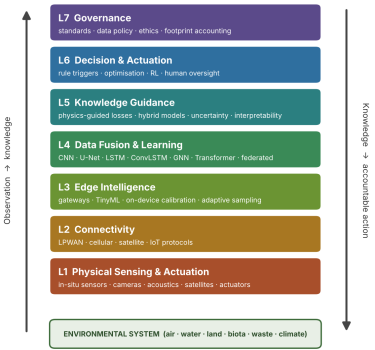
Drawing on the foundations and theories above, this section proposes the Environmental Computronics Framework (ECF). The ECF describes an Environmental Computronic system as seven interacting layers arranged in a closed loop. The lower layers deal with the physical capture and movement of signals; the middle layers transform signals into knowledge; the upper layers transform knowledge into accountable action; and the action, in turn, alters the environment that the lower layers observe. Figure 1 depicts the framework and Table 3 summarises each layer.
Figure 1. The Environmental Computronics Framework (ECF): seven layers arranged as a closed feedback loop between the environmental system and its management.
5.2. Layer 1: Physical Sensing and Actuation
The first layer comprises electronic devices that interact directly with the environment: sensors measuring physical, chemical and biological variables; cameras and acoustic recorders; satellite and airborne instruments; and actuators such as valves, pumps, sluice gates, ventilation controls and dosing systems. This layer determines what can be known and what can be done. Its key properties are coverage (spatial and temporal density), fidelity (accuracy, precision, drift and cross-sensitivity), energy autonomy and robustness. The low-cost sensor literature shows that these properties trade off against one another and that calibration and quality assurance are not optional .
5.3. Layer 2: Connectivity
The second layer moves data and commands between devices and computing resources. It includes short-range and low-power wide-area wireless technologies, cellular and satellite links, and the protocols that structure communication . In environmental settings connectivity is frequently intermittent and energy-limited, which shapes everything above it: a design that assumes continuous cloud connectivity may fail in a mangrove swamp, a remote catchment or a conflict-affected area. and documented these constraints in early environmental deployments, and they remain relevant.
5.4. Layer 3: Edge Intelligence
The third layer performs computation close to the data source, on the sensor node itself or on a nearby gateway. Edge computing reduces latency, bandwidth use and exposure of raw data , and TinyML makes it possible to run compact neural networks on microcontrollers consuming very little power. In Environmental Computronic systems edge intelligence performs tasks such as on-device calibration correction, event detection (for example, detecting a pollution spike or the acoustic signature of illegal logging), data compression and adaptive sampling, in which the device increases its sampling rate when something interesting is happening and conserves energy otherwise.
5.5. Layer 4: Data Fusion and Learning
The fourth layer integrates data from heterogeneous sources, including dense low-cost sensors, sparse reference stations, satellite imagery, model outputs and human reports, and applies deep learning to estimate states, forecast evolution and detect anomalies. Architectures are matched to data structure: CNNs and U-Net-type networks for gridded and image data , LSTMs and convolutional-recurrent networks for time series and spatio-temporal fields , graph neural networks for sensor and river networks and Transformers for long-range dependencies . Federated learning allows learning across devices or organisations without centralising sensitive data .
5.6. Layer 5: Knowledge Guidance
The fifth layer, which distinguishes the ECF from generic IoT analytics architectures, embeds scientific and domain knowledge into the learning process. It operates through the mechanisms identified by , and : physics-based loss terms that penalise violations of conservation laws, hybrid models that let neural networks learn the parts of a process that are poorly understood while retaining established process equations, and architectural constraints that respect known symmetries. It also includes uncertainty quantification, so that every estimate is accompanied by a credible measure of confidence , and interpretability mechanisms that allow domain experts to scrutinise model behaviour . This layer can be thought of as an environmental digital twin: a continuously updated, scientifically grounded computational counterpart of the managed system .
5.7. Layer 6: Decision and Actuation
The sixth layer converts knowledge into action. Actions may be automated, such as adjusting aeration in a wastewater plant or closing a sluice gate when a flood threshold is forecast; advisory, such as issuing an air quality alert or recommending an inspection; or strategic, such as informing a permitting decision or a land-use plan. Decision methods include rule-based triggers, optimisation and, increasingly, reinforcement learning, in which an agent learns policies by interacting with an environment and receiving feedback . Because environmental actions can have irreversible and distributive consequences, the ECF treats human oversight as a design requirement for any action whose consequences are significant, uncertain or contested.
5.8. Layer 7: Governance
The seventh layer encompasses the institutions, rules and values that determine how the system is designed, operated and held to account. It includes data ownership and access, standards and certification, regulatory acceptance of sensor and model outputs, privacy and security, and the ethical principles that guide AI deployment, such as beneficence, non-maleficence, autonomy, justice and explicability . Governance also includes the accounting of the system's own environmental footprint: the energy consumption and carbon emissions of computation and the electronic waste generated when devices reach end of life . O. insight that monitoring arrangements and the legitimacy of rules shape outcomes applies directly.
Table 3. Layers of the Environmental Computronics Framework.

Layer

Function

Representative technologies and methods

Key design concerns

L1 Physical sensing and actuation

Observe and act on the environment

In-situ sensors, cameras, acoustic recorders, satellites, actuators

Coverage, fidelity, calibration, drift, energy autonomy, robustness

L2 Connectivity

Move data and commands

Low-power wide-area networks, cellular, satellite links, IoT protocols

Intermittency, energy cost, latency, security

L3 Edge intelligence

Compute near the source

Edge gateways, TinyML on microcontrollers

Memory and power limits, on-device calibration, adaptive sampling

L4 Data fusion and learning

Estimate, forecast, detect

CNN, U-Net, LSTM, ConvLSTM, GNN, Transformer, federated learning

Heterogeneous data, label scarcity, distribution shift

L5 Knowledge guidance

Ground learning in science

Physics-guided losses, hybrid models, PINNs, uncertainty quantification, interpretability

Physical consistency, extrapolation, trust

L6 Decision and actuation

Convert knowledge to action

Rule triggers, optimisation, reinforcement learning, decision support

Human oversight, irreversibility, distributive effects

L7 Governance

Legitimise and account

Standards, data policy, ethics frameworks, footprint accounting

Accountability, equity, privacy, security, e-waste and energy

5.9. Formal Representation
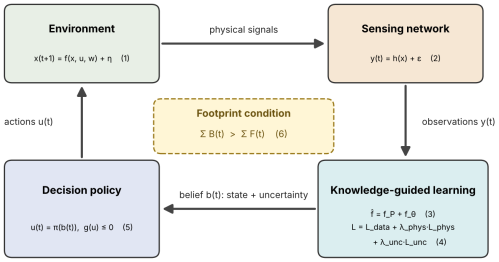
The ECF can be expressed formally as a closed-loop, knowledge-guided state-estimation and control problem. Let x_t denote the state of the environmental system at time t, for example the vector of pollutant concentrations on a spatial grid or the water levels and quality variables across a river network. The state evolves according to a dynamic process influenced by management actions u_t and external drivers w_t:
x_{t+1} = f(x_t, u_t, w_t) + η_t(1)
where f represents the true environmental dynamics and η_t represents process noise. The system is observed through a sensing network that produces observations y_t:
y_t = h(x_t) + ε_t(2)
where h is the observation operator, mapping the true state to what sensors would record, and ε_t represents measurement error, including the drift and bias of low-cost sensors. Neither f nor h is perfectly known. In conventional modelling, f is approximated by a process-based model f_P. In purely data-driven modelling, f is approximated by a neural network f_θ with parameters θ. Environmental Computronics adopts a hybrid formulation:
f̂(x_t, u_t, w_t) = f_P(x_t, u_t, w_t) + f_θ(x_t, u_t, w_t) (3)
in which the neural component learns the residual that the process model fails to capture. The parameters θ are learned by minimising a knowledge-guided objective:
L(θ) = L_data(θ) + λ_phys · L_phys(θ) +
λ_unc · L_unc(θ)(4)
where L_data measures the discrepancy between predictions and observations, L_phys penalises violations of known physical constraints such as mass or energy conservation, L_unc encourages well-calibrated uncertainty estimates, and λ_phys and λ_unc are weights that balance these objectives. This structure follows the theory-guided and physics-informed approaches of , and .
The estimated state and its uncertainty, summarised as a belief b_t over possible states, are then used to choose management according to a policy π:
u_t = π(b_t) subject to g(u_t) ≤ 0(5)
where g represents constraints imposed by law, budget, technical feasibility and ethical principles, all of which are determined at the governance layer. Finally, the ECF requires that the environmental footprint of the system itself be accounted for. If F_t denotes the resource cost of operating the sensing and computing infrastructure, including energy, emissions and embodied materials, and B_t denotes the environmental benefit attributable to improved management, then a necessary condition for an Environmental Computronic system to be justified on environmental grounds is:
Σ_t B_t > Σ_t F_t(6)
over the system's life cycle. Condition (6) formalises the cyber-physical boundary principle: a system that consumes more environmental resources than it saves is not an environmental management system in any meaningful sense, however accurate its predictions. Figure 2 illustrates the closed loop expressed by equations (1) to (6).
Figure 2. The closed-loop structure of an Environmental Computronic system expressed as knowledge-guided state estimation and control.
5.10. An Illustrative Walk-Through of the Framework
To show how the abstract layers and equations relate to practice, consider a hypothetical Environmental Computronic system for monitoring produced-water discharge and surface-water quality around an onshore and swamp oil production area. The scenario is illustrative and is not a description of any existing deployment.
At Layer 1, multiparameter water quality probes measuring temperature, pH, conductivity, turbidity and dissolved oxygen are installed at discharge points and at upstream and downstream reference locations on the receiving creeks, complemented by hydrocarbon-in-water sensors at the discharge points and by periodic satellite imagery of the surrounding surface waters. At selected locations, actuators allow a discharge valve to be closed or flow to be diverted to a holding pond. At Layer 2, because cellular coverage is patchy in the swamp, each node communicates through a low-power wide-area network to a solar-powered gateway that holds data locally when the backhaul link is unavailable. At Layer 3, a compact neural network on each gateway corrects sensor drift using recent co-located laboratory samples, flags readings that are physically implausible, and increases the sampling rate when it detects a rapid change in conductivity or hydrocarbon readings, which may indicate an upset or a spill.
At Layer 4, readings from all nodes, laboratory results, rainfall and tidal data and satellite imagery are fused to estimate water quality continuously along the creek network, represented as a graph whose nodes are monitoring points and whose edges follow the direction of flow. A graph neural network forecasts concentrations downstream over the next hours. At Layer 5, the forecast is constrained by a simple advection-dilution model so that predicted concentrations respect mass balance and flow direction, and every estimate is reported with an uncertainty band, as expressed in equations (3) and (4). At Layer 6, a rule set agreed in advance with the regulator specifies what happens when the estimated downstream concentration is likely to exceed a permit limit: below a first threshold the operator is alerted; above a second threshold the discharge valve is closed automatically and a field team is dispatched; in every case the event and the evidence are logged. At Layer 7, the data-sharing arrangement gives the regulator direct access to the monitoring dashboard, provides host communities with a summary of conditions at the reference points, specifies who is accountable for each response, and requires the operator to report the energy consumption and end-of-life plan of the monitoring equipment so that condition (6) can be assessed.
The walk-through clarifies several points that are easily missed in technology-centred designs. The value of the system depends on the existence of the agreed response rules at Layer 6, without which accurate forecasts would change nothing (Proposition 1). The usefulness of denser sensing depends on the operator having more than one response option, such as diversion as well as shutdown (Proposition 2). The physical constraint at Layer 5 is what makes downstream forecasts credible for locations without sensors (Proposition 3). Finally, the credibility of the system before regulators and communities rests on the governance arrangements at Layer 7 rather than on the sophistication of the neural network (Propositions 7 and 8).
6. Theoretical Propositions
From the framework and its theoretical foundations, eight propositions are derived. They are stated in a form intended to be testable through comparative case studies, field experiments, simulation and quasi-experimental policy evaluation.
Proposition 1 (Loop closure). The environmental benefit of an Environmental Computronic system depends more on the closure of the loop between observation and management action than on the accuracy of its predictive models. Systems that improve prediction without a corresponding decision pathway will show weaker environmental outcomes than systems with modest predictive accuracy but well-defined, timely response mechanisms. This follows from cybernetic theory and the leverage-point argument of systems thinking .
Proposition 2 (Matched variety). Improvements in sensing density and model capacity will improve environmental regulation only to the extent that they are matched by a corresponding variety of available management responses. Where response options are few or rigid, additional sensing and modelling variety will produce diminishing returns. This follows from law of requisite variety.
Proposition 3 (Knowledge guidance and generalisation). Knowledge-guided deep learning models will outperform purely data-driven models of comparable capacity when applied to conditions outside the range of their training data, such as extreme events, new locations and changed climates, while performing comparably within that range. This follows from the arguments of , and .
Proposition 4 (Fusion of dense and sparse sensing). Combining dense, lower-fidelity IoT sensing with sparse, high-fidelity reference observations through learned calibration and data fusion will yield more accurate and more spatially resolved state estimates than either source alone. This follows from estimation theory and the low-cost sensing literature .
Proposition 5 (Edge intelligence and autonomy). In environments with intermittent connectivity and limited energy, systems that place inference and adaptive sampling at the edge will achieve longer operational lifetimes and faster detection of critical events than systems that rely on transmitting raw data for central processing. This follows from the edge computing and TinyML literature .
Proposition 6 (Footprint boundary). The net environmental benefit of Environmental Computronic systems will be systematically overestimated by evaluations that exclude the energy, emissions and electronic waste of the sensing and computing infrastructure. Including these factors will change the ranking of alternative system designs, favouring smaller, more efficient and longer-lived configurations. This follows from the systems boundary argument and the literature on the footprint of AI and electronics.
Proposition 7 (Interpretability and uptake). Environmental Computronic outputs that are accompanied by credible uncertainty estimates and interpretable reasoning will be more readily adopted into regulatory and management decisions than equally accurate outputs from opaque models. This follows from arguments on interpretability in high-stakes decisions and on the role of legitimacy in environmental governance .
Proposition 8 (Governance and equity). The distribution of benefits from Environmental Computronic systems will reflect the distribution of control over sensing infrastructure, data and decision rights. Systems designed with participatory governance and open data arrangements will produce more equitable environmental outcomes and greater public trust than centrally controlled systems of equal technical capability. This follows from the social-ecological systems framework and the AI ethics literature .
7. Application Domains
The ECF is intended to be domain general. This section examines how it applies to six domains in which the fusion of IoT and deep learning is already well advanced or particularly promising. Table 4 summarises the mapping of each domain to the framework layers.
7.1. Air Quality Management
Urban air pollution management has been one of the earliest and most active areas for environmental IoT. Conventional regulatory monitoring relies on a small number of reference-grade stations that are accurate but expensive and therefore sparse, which makes them poorly suited to capturing the steep spatial and temporal gradients of urban pollution . Low-cost sensor networks promise much denser coverage but suffer from calibration drift and sensitivity to humidity and temperature, and their data quality varies considerably between devices and conditions . Within the ECF, Layer 3 and Layer 4 address this tension directly: learned calibration models, trained against co-located reference instruments, correct low-cost sensor readings, and spatio-temporal deep learning fuses corrected readings with reference stations, meteorological data and traffic information to produce high-resolution pollution maps and short-term forecasts. Layer 6 converts these into public alerts, traffic management measures or targeted inspections. Proposition 4 predicts that this fusion will outperform either source alone, while Proposition 1 predicts that its value will depend on whether a responsive management pathway exists.
7.2. Water Resources and Water Quality
Water systems present a second major domain. In-situ water quality monitoring with wireless sensor networks allows continuous measurement of parameters such as temperature, pH, dissolved oxygen, turbidity and conductivity, replacing or supplementing periodic manual sampling . On the hydrological side, LSTM networks trained on data from many catchments have been shown to model rainfall-runoff relationships with skill comparable to an established conceptual hydrological model , and machine learning more broadly has been applied extensively to flood prediction . argued that deep learning could help address long-standing hydrological challenges such as prediction in ungauged basins. Knowledge guidance is particularly important here: Willard et al. review examples in which physics-guided models of lake temperature respect energy conservation and generalise better than purely data-driven models. In management terms, an Environmental Computronic water system could detect contamination events in real time, forecast floods with sufficient lead time to operate control structures, and optimise treatment processes.
7.3. Weather, Climate and Disaster Risk
Weather and climate prediction is the domain in which deep learning has recently produced its most visible advances. Deep learning models have delivered skilful multi-year ENSO forecasts and precipitation nowcasts preferred by expert meteorologists over competing methods . Global data-driven models such as Pangu-Weather and GraphCast have achieved medium-range forecast skill rivalling or exceeding leading operational numerical weather prediction systems on many verification metrics, at a fraction of the computational cost at inference time . These models are trained on reanalysis datasets produced by decades of data assimilation, illustrating the dependence of data-driven methods on the observational and process-modelling infrastructure described by . For environmental management, the significance lies in early warning: faster and cheaper forecasts make it possible to run larger ensembles, to downscale to local conditions and to deliver warnings to communities that conventional systems serve poorly. identify disaster management and climate adaptation as high-impact areas for machine learning.
7.4. Land, Forests and Biodiversity
Land and ecosystem monitoring relies heavily on remote sensing, where deep learning has become one of the leading analytical approaches . Global forest change has been mapped at high resolution from satellite archives , and near real-time land cover mapping at 10-metre resolution is now available globally through deep learning applied to Sentinel-2 imagery , supported by cloud platforms for planetary-scale analysis . Ground-based IoT, such as camera traps and acoustic sensors with on-device inference, complements satellite observation by detecting species, poaching or illegal logging at fine scales. Within the ECF, satellite and ground sensing are fused at Layer 4, and knowledge of ecological processes informs model design at Layer 5. The management value depends on whether detection is linked to enforcement and conservation responses at Layer 6, and on whether local communities participate in governance at Layer 7.
7.5. Solid Waste and the Circular Economy
Solid waste management is an area of growing activity for Environmental Computronics, particularly in rapidly urbanising regions. Fill-level sensors in waste bins, connected through low-power networks, allow collection routes to be optimised dynamically rather than on fixed schedules, while computer vision supports automated sorting and contamination detection. Deep learning applied to these data streams can forecast waste generation, predict maintenance needs and identify illegal dumping. The ECF's footprint boundary is especially pertinent here, because the devices deployed to manage waste will themselves become electronic waste. The Global E-waste Monitor 2024 reports that a record 62 million tonnes of electronic waste was generated in 2022, that less than a quarter of it was documented as formally collected and recycled, and that generation is projected to reach 82 million tonnes by 2030 . Proposition 6 therefore applies with particular force to smart waste systems: device longevity, repairability and end-of-life recovery must be designed in from the outset.
7.6. Oil and Gas Operations and Environmental Compliance
The oil and gas sector presents both significant environmental risks and a long tradition of instrumentation and process control, making it a natural candidate for Environmental Computronics. Pipeline integrity monitoring, leak and spill detection, emissions monitoring at production facilities, produced-water quality monitoring and remediation tracking are all amenable to the fusion of IoT sensing and deep learning. In regions such as the Niger Delta, where operations take place across land, swamp and coastal environments with complex hydrology and limited communication infrastructure, the framework's emphasis on edge intelligence (Proposition 5), fusion of satellite and ground observations (Proposition 4) and participatory governance (Proposition 8) is particularly relevant. Satellite-based detection of surface changes, combined with ground sensors at critical infrastructure and community-based reporting, could shorten the time between an environmental incident and response. The credibility of such systems before regulators and affected communities will depend on transparency about data, uncertainty and responsibility, as Proposition 7 suggests.
Table 4. Mapping of application domains to the Environmental Computronics Framework.

Domain

Sensing (L1-L2)

Edge and learning (L3-L4)

Knowledge guidance (L5)

Decision and governance (L6-L7)

Air quality

Low-cost sensor networks; reference stations; satellites

On-device calibration; spatio-temporal fusion and forecasting

Dispersion and atmospheric chemistry constraints

Public alerts; traffic and emission controls; data openness

Water

In-situ water quality nodes; gauges; rain sensors

Event detection; LSTM rainfall-runoff and flood forecasting

Mass and energy balance; hydrological process models

Treatment control; flood gates; abstraction permits

Weather and climate

Station networks; radar; satellites; reanalysis

Data-driven global and nowcasting models

Physical consistency; data assimilation

Early warning; disaster risk management; adaptation planning

Land and biodiversity

Satellite imagery; camera traps; acoustic sensors

CNN and U-Net mapping; on-device species detection

Ecological process and phenology knowledge

Enforcement; conservation planning; community governance

Solid waste

Fill-level sensors; vision systems on sorting lines

Route optimisation; waste forecasting; anomaly detection

Material flow accounting

Dynamic collection; circular economy policy; device end-of-life

Oil and gas

Pipeline, emissions and water sensors; satellite imagery

Leak and spill detection at the edge; anomaly detection

Flow, pressure and transport physics

Incident response; regulatory reporting; community engagement

8. Challenges and Critical Perspectives
A theory of Environmental Computronics would be incomplete, and potentially harmful, if it presented the fusion only as a source of benefit. This section examines the principal challenges and risks, each of which the ECF locates at one or more of its layers.
8.1. Data Quality, Label Scarcity and Distribution Shift
Deep learning models are only as good as the data on which they are trained. Environmental data are frequently noisy, biased, incomplete and unevenly distributed in space and time, with the poorest coverage often in regions facing the greatest environmental risks. Low-cost sensors introduce additional errors that must be characterised and corrected . Labelled examples of rare but critical events, such as extreme floods or major spills, are scarce by definition. Moreover, environmental systems are non-stationary: climate change, land-use change and management interventions themselves alter the relationships that models learn from, so that models trained on past conditions may degrade without warning. Knowledge guidance (Layer 5) and explicit uncertainty quantification are the principal theoretical responses, but they do not eliminate the need for sustained investment in high-quality reference observations.
8.2. The Energy and Carbon Cost of Computation
The computation that underpins deep learning has a significant and growing environmental cost. drew attention to the energy and carbon emissions associated with training large natural language models, and argued for "Green AI" research that treats efficiency as an evaluation criterion alongside accuracy. provided a systematic framework distinguishing the direct effects of computation, the effects of specific applications, and broader system-level effects of AI on greenhouse gas emissions, cautioning that the net effect depends heavily on how AI is used. For Environmental Computronics, these concerns are not external but internal to the system boundary, as expressed in condition (6) of the formal model. The implication is a strong preference for efficient architecture, edge inference where appropriate, careful choice of model scale relative to the decision being supported, and transparent reporting of computational footprints.
8.3. Electronic Waste and Material Footprint
The proliferation of sensors, gateways and computing hardware contributes to the global electronic waste problem. As noted above, the latest Global E-waste Monitor reports that formal collection and recycling have not kept pace with generation . Environmental sensors deployed in harsh conditions may have short lifetimes, and devices scattered across landscapes may be difficult to recover. Design for longevity, modularity and recovery, together with procurement policies that require end-of-life responsibility from suppliers, are necessary responses. This is an area in which environmental management, procurement and supply chain practice intersect directly with technical design.
8.4. Interpretability, Trust and Accountability
Deep neural networks are often opaque, making it difficult to understand why they produce a given output. In environmental management, where decisions may be contested in courts, before regulators or by affected communities, opacity undermines legitimacy. Post-hoc explanation methods such as SHAP can help, but argued that for high-stakes decisions it is preferable to use inherently interpretable models where possible, rather than explaining black boxes after the fact. The ECF responds by making interpretability and uncertainty part of the knowledge guidance layer and by requiring human oversight for consequential actions at the decision layer.
8.5. Cybersecurity and Resilience of the Infrastructure
Environmental Computronic systems are cyber-physical systems, and their compromise can have physical consequences. Manipulated sensor data could conceal pollution events or trigger false alarms; compromised actuators could release water, chemicals or emissions. IoT devices are frequently resource-constrained and difficult to patch, which makes security a persistent challenge . Resilience thinking suggests that systems should be designed to degrade gracefully, with redundancy, anomaly detection on the data streams themselves and fallback to manual procedures when automated components fail or are compromised. Yet there are new ideas, applications, monitoring and best practices with critical control measures that will benefit the industries when deployed for these cyber physical systems .
8.6. Equity, the Digital Divide and Data Sovereignty
The capacity to build and operate Environmental Computronic systems is unevenly distributed. Many of the most significant advances depend on large datasets, computing resources and expertise concentrated in a small number of countries and companies. found that AI could act as an enabler of many Sustainable Development Goal targets but also as an inhibitor of others and highlighted the risk that AI could exacerbate inequalities between and within nations. If environmental sensing and prediction capacity is concentrated in the hands of a few actors, those most affected by environmental harm may have the least access to the information that describes it. The ECF's governance layer, informed by emphasis on local monitoring and legitimate rules and by the principle of justice in AI ethics , calls for open data, local capacity building, appropriate technology choices such as low-cost hardware and TinyML, and participatory design.
8.7. Institutional Readiness and Regulatory Acceptance
Finally, the greatest barrier to Environmental Computronics may be institutional rather than technical. Regulatory frameworks often specify approved measurement methods and reporting formats that do not accommodate low-cost sensors or model-based estimates. Agencies may lack the skills to procure, operate and interpret such systems. noted that research on AI for sustainability faces challenges including overreliance on historical data, uncertain human behavioural responses and difficulties in measuring the effects of interventions. Proposition 1 implies that unless institutions are prepared to act on what Environmental Computronic systems reveal, investment in sensing and modelling will yield limited environmental return.
Table 5. Principal challenges, their location in the framework and responses.

Challenge

ECF layers

Theoretical basis

Indicative responses

Data quality and distribution shift

L1, L4, L5

Estimation theory; knowledge-guided learning

Reference networks; learned calibration; physics constraints; uncertainty quantification; continuous validation

Energy and carbon of computation

L3, L4, L7

Systems boundary; footprint condition (6)

Efficient architectures; edge inference; right-sized models; footprint reporting

Electronic waste

L1, L7

Systems boundary; circular economy

Design for longevity and recovery; supplier take-back obligations in procurement

Interpretability and trust

L5, L6

Legitimacy in governance; interpretable ML

Interpretable models; uncertainty communication; human oversight

Cybersecurity

L1-L3, L6

Resilience; cyber-physical systems

Secure-by-design devices; anomaly detection on data streams; manual fallbacks

Equity and data sovereignty

L7

Social-ecological systems; AI ethics

Open data; local capacity; participatory governance; low-cost technology

Institutional readiness

L6, L7

Adaptive management; requisite variety

Regulatory sandboxes; method validation; skills development; defined response pathways

9. Research Agenda and Implications for Policy and Practice
The framework and propositions suggest a research agenda organised around five themes. Table 6 summarises them.
The first theme concerns empirical testing of the propositions. Comparative case studies of Environmental Computronic deployments should examine whether loop closure (Proposition 1) and matched response variety (Proposition 2) explain differences in environmental outcomes better than technical performance measures do. Field experiments can test the value of fusing dense and sparse sensing (Proposition 4) and of edge intelligence in constrained environments (Proposition 5).
The second theme concerns knowledge-guided learning under data scarcity. Research is needed on methods that perform well with few labelled examples, transfer across regions and remain reliable under climate and land-use change, with explicit benchmarking on out-of-distribution conditions as Proposition 3 requires. Under-monitored regions, including much of sub-Saharan Africa, offer both the greatest need and the most demanding test.
The third theme concerns life-cycle evaluation. Evaluations of Environmental Computronic systems should adopt life-cycle methods that account for the energy, emissions and material footprint of devices and computation alongside environmental benefits, testing Proposition 6 and operationalising condition (6). Standardised reporting of computational footprints, as advocated by and , should become routine.
The fourth theme concerns governance and institutions. Research should investigate how regulatory frameworks can validate and accept sensor and model-based evidence, how data governance arrangements affect trust and equity (Propositions 7 and 8), and how procurement and supply chain policies can embed device longevity and end-of-life responsibility.
The fifth theme concerns contextualisation in developing regions. Much of the existing literature originates in high-income countries. Research in settings such as the Niger Delta should examine how Environmental Computronic systems can be designed for intermittent power and connectivity, high humidity and temperature, security risks to infrastructure and complex stakeholder relationships among operators, regulators and host communities, and how local technical capacity can be built and sustained.
Table 6. Research agenda for Environmental Computronics.

Theme

Key questions

Related propositions

Suggested methods

Testing the framework

Does loop closure predict outcomes better than model accuracy? Does response variety limit the value of sensing?

P1, P2, P4, P5

Comparative case studies; field experiments; simulation

Knowledge-guided learning under scarcity

Which forms of knowledge guidance best support generalisation to new regions and extremes?

P3

Out-of-distribution benchmarks; transfer learning studies

Life-cycle evaluation

When do benefits exceed footprints? How do footprints change design rankings?

P6

Life-cycle assessment; footprint accounting

Governance and institutions

How can regulators accept sensor and model evidence? How does data governance affect trust and equity?

P7, P8

Policy analysis; stakeholder research; institutional case studies

Developing-region contexts

How should systems be designed for constrained power, connectivity and security conditions?

P4, P5, P8

Design science; participatory action research; pilot deployments

9.1. Implications for Environmental Regulators
Although the propositions remain to be tested, the framework already suggests several practical implications for organisations that commission, build or regulate Environmental Computronic systems.
For environmental regulators, the most important implication is that the acceptance of sensor and model-based evidence should be planned rather than improvised. Regulators can specify performance-based requirements for data quality, calibration and uncertainty reporting, rather than prescribing particular instruments, so that low-cost and model-based approaches can be accepted when they meet defined standards. They can also require that monitoring systems submitted in support of permits include defined response rules, so that the loop from detection to action is closed by design rather than left to discretion.
9.2. Implications for Industrial Operators and Technology Developers
For industry operators, including those in the oil and gas sector, the framework implies that investment in sensing and analytics should be evaluated against its contribution to environmental decisions and compliance outcomes, not against the volume of data collected or the accuracy of models in isolation. Designs should begin with the decisions that need to be taken (Layer 6) and the accountability arrangements that will govern them (Layer 7), and work downward to the sensing and computation required, rather than beginning from available technology and working upward.
For procurement and supply chain functions, the footprint boundary has concrete consequences. Specifications for environmental monitoring equipment can include requirements for expected service life, repairability, availability of spare parts, energy consumption and supplier takeback at end of life. Total cost of ownership assessments can incorporate calibration, maintenance and data-management costs, which are often larger than the purchase price of low-cost sensors. Contracts for analytics services can require disclosure of model performance under conditions outside the training data and of the computational resources used.
For technology developers and researchers, the framework argues for designing and reporting systems as wholes. A paper or product that reports high predictive accuracy should also report how outputs reach decision-makers, what uncertainty accompanies them, what energy and hardware they consume and how they perform when conditions change. Such reporting would make it far easier to compare designs and to accumulate evidence about which configurations deliver environmental benefit.
9.3. Implications for Government and Development Partners
For governments and development partners in developing regions, the framework suggests prioritising foundations that are often neglected: reference-grade monitoring that allows low-cost networks to be calibrated, open data policies, local skills in both environmental science and data science, and institutional arrangements that allow agencies to act on what monitoring reveals. Without these foundations, imported technology is likely to produce data without decisions.
10. Conclusion
This paper argued that the fusion of deep learning, the Internet of Things and environmental management constitutes an emerging field that merits a unifying construct and a theoretical foundation. It has proposed the term Environmental Computronics for this field, defined as the integrated science and engineering of sensing, communicating, learning from and acting upon environmental systems through networked electronic devices and computational intelligence, organised as closed feedback loops that link observation to accountable management decisions.
In answer to the first research question, the study has distinguished Environmental Computronics from adjacent fields by four defining characteristics: it is closed-loop, cyber-physical, knowledge-guided and governed. In answer to the second, it has shown that six theoretical traditions, namely cybernetics, general systems theory, resilience and social-ecological systems, adaptive management, estimation theory and knowledge-guided machine learning, together explain how and under what conditions the fusion can improve environmental outcomes. In answer to the third, it has proposed the seven-layer Environmental Computronics Framework, expressed it formally as a knowledge-guided state-estimation and control problem subject to a life-cycle footprint condition, and derived eight testable propositions. In answer to the fourth, it has identified data quality, the energy and material footprint of the technology, interpretability, cybersecurity, equity and institutional readiness as the principal challenges and has located each within the framework.
The central conclusion is that the value of Environmental Computronics does not lie in sensors or neural networks as such. It lies in closing the loop between observation, understanding and accountable action, in a way that respects scientific knowledge, accounts honestly for its own environmental costs and distributes its benefits fairly. A sensing network that no one acts upon, a model that cannot be trusted or explained, or a system that consumes more resources than it saves does not advance environmental management, however sophisticated it may be. Conversely, modest technology embedded in responsive institutions can deliver substantial environmental gains. For researchers, the framework offers a structure for designing studies that test these claims. For practitioners in environmental agencies, industry and technology development, it offers a checklist of the layers that must all be present, and the questions that must all be answered, if digital investment is to translate into environmental improvement.
Abbreviations

AI

Artificial Intelligence

CNN

Convolutional Neural Network

ConvLSTM

Convolutional Long Short-term Memory Network

ECF

Environmental Computronics Framework

ENSO

El Niño-Southern Oscillation

GNN

Graph Neural Network

IoT

Internet of Things

ISO

International Organization for Standardization

LPWAN

Low-power Wide-area Network

LSTM

Long Short-term Memory Network

ML

Machine Learning

PINN

Physics-informed Neural Network

RL

Reinforcement Learning

SDG

Sustainable Development Goal

SHAP

SHapley Additive exPlanations

TinyML

Tiny Machine Learning (Machine Learning on Microcontrollers)

U-Net

U-shaped Encoder-decoder Convolutional Network

Author Contributions
Dimie Nwankwe: Conceptualization, Formal Analysis, Funding acquisition, Investigation, Methodology, Resources, Visualization, Writing – original draft, Writing – review & editing
Conflicts of Interest
The author declares no conflict of interest.
References
[1] Hart, J. K., & Martinez, K. (2006). Environmental sensor networks: A revolution in the earth system science? Earth-Science Reviews, 78(3–4), 177–191.
[2] Atzori, L., Iera, A., & Morabito, G. (2010). The Internet of Things: A survey. Computer Networks, 54(15), 2787–2805.
[3] Gubbi, J., Buyya, R., Marusic, S., & Palaniswami, M. (2013). Internet of Things (IoT): A vision, architectural elements, and future directions. Future Generation Computer Systems, 29(7), 1645–1660.
[4] Hart, J. K., & Martinez, K. (2015). Toward an environmental Internet of Things. Earth and Space Science, 2, 194–200.
[5] LeCun, Y., Bengio, Y., & Hinton, G. (2015). Deep learning. Nature, 521(7553), 436–444.
[6] Goodfellow, I., Bengio, Y., & Courville, A. (2016). Deep learning. MIT Press.
[7] Mohammadi, M., Al-Fuqaha, A., Sorour, S., & Guizani, M. (2018). Deep learning for IoT big data and streaming analytics: A survey. IEEE Communications Surveys & Tutorials, 20(4), 2923–2960.
[8] Reichstein, M., Camps-Valls, G., Stevens, B., Jung, M., Denzler, J., Carvalhais, N., & Prabhat. (2019). Deep learning and process understanding for data-driven Earth system science. Nature, 566(7743), 195–204.
[9] Al-Fuqaha, A., Guizani, M., Mohammadi, M., Aledhari, M., & Ayyash, M. (2015). Internet of Things: A survey on enabling technologies, protocols, and applications. IEEE Communications Surveys & Tutorials, 17(4), 2347–2376.
[10] Shen, C. (2018). A transdisciplinary review of deep learning research and its relevance for water resources scientists. Water Resources Research, 54(11), 8558–8593.
[11] Nishant, R., Kennedy, M., & Corbett, J. (2020). Artificial intelligence for sustainability: Challenges, opportunities, and a research agenda. International Journal of Information Management, 53, Article 102104.
[12] Vinuesa, R., Azizpour, H., Leite, I., Balaam, M., Dignum, V., Domisch, S., Felländer, A., Langhans, S. D., Tegmark, M., & Fuso Nerini, F. (2020). The role of artificial intelligence in achieving the Sustainable Development Goals. Nature Communications, 11(1), Article 233.
[13] Strubell, E., Ganesh, A., & McCallum, A. (2019). Energy and policy considerations for deep learning in NLP. In Proceedings of the 57th Annual Meeting of the Association for Computational Linguistics (pp. 3645–3650).
[14] Kaack, L. H., Donti, P. L., Strubell, E., Kamiya, G., Creutzig, F., & Rolnick, D. (2022). Aligning artificial intelligence with climate change mitigation. Nature Climate Change, 12(6), 518–527.
[15] Baldé, C. P., Kuehr, R., Yamamoto, T., McDonald, R., D'Angelo, E., Althaf, S., Bel, G., Deubzer, O., Fernandez-Cubillo, E., Forti, V., Gray, V., Herat, S., Honda, S., Iattoni, G., Khetriwal, D. S., Luda di Cortemiglia, V., Lobuntsova, Y., Nnorom, I., Pralat, N., & Wagner, M. (2024). The global e-waste monitor 2024. International Telecommunication Union (ITU) and United Nations Institute for Training and Research (UNITAR).
[16] Holling, C. S. (1973). Resilience and stability of ecological systems. Annual Review of Ecology and Systematics, 4, 1–23.
[17] Walters, C. J. (1986). Adaptive management of renewable resources. Macmillan.
[18] Ostrom, E. (2009). A general framework for analyzing sustainability of social-ecological systems. Science, 325(5939), 419–422.
[19] Rockström, J., Steffen, W., Noone, K., Persson, Å., Chapin, F. S., III, Lambin, E. F., Lenton, T. M., Scheffer, M., Folke, C., Schellnhuber, H. J., Nykvist, B., de Wit, C. A., Hughes, T., van der Leeuw, S., Rodhe, H., Sörlin, S., Snyder, P. K., Costanza, R., Svedin, U., Foley, J. A. (2009). A safe operating space for humanity. Nature, 461(7263), 472–475.
[20] Steffen, W., Richardson, K., Rockström, J., Cornell, S. E., Fetzer, I., Bennett, E. M., Biggs, R., Carpenter, S. R., de Vries, W., de Wit, C. A., Folke, C., Gerten, D., Heinke, J., Mace, G. M., Persson, L. M., Ramanathan, V., Reyers, B., & Sörlin, S. (2015). Planetary boundaries: Guiding human development on a changing planet. Science, 347(6223), Article 1259855.
[21] Richardson, K., Steffen, W., Lucht, W., Bendtsen, J., Cornell, S. E., Donges, J. F., Drüke, M., Fetzer, I., Bala, G., von Bloh, W., Feulner, G., Fiedler, S., Gerten, D., Gleeson, T., Hofmann, M., Huiskamp, W., Kummu, M., Mohan, C., Nogués-Bravo, D., Rockström, J. (2023). Earth beyond six of nine planetary boundaries. Science Advances, 9(37), Article eadh2458.
[22] International Organization for Standardization. (2015). ISO 14001: 2015 Environmental management systems — Requirements with guidance for use. ISO.
[23] Weiser, M. (1991). The computer for the 21st century. Scientific American, 265(3), 94–104.
[24] Martinez, K., Hart, J. K., & Ong, R. (2004). Environmental sensor networks. Computer, 37(8), 50–56.
[25] Kumar, P., Morawska, L., Martani, C., Biskos, G., Neophytou, M., Di Sabatino, S., Bell, M., Norford, L., & Britter, R. (2015). The rise of low-cost sensing for managing air pollution in cities. Environment International, 75, 199–205.
[26] Morawska, L., Thai, P. K., Liu, X., Asumadu-Sakyi, A., Ayoko, G., Bartonova, A., Bedini, A., Chai, F., Christensen, B., Dunbabin, M., Gao, J., Hagler, G. S. W., Jayaratne, R., Kumar, P., Lau, A. K. H., Louie, P. K. K., Mazaheri, M., Ning, Z., Motta, N.,... Williams, R. (2018). Applications of low-cost sensing technologies for air quality monitoring and exposure assessment: How far have they gone? Environment International, 116, 286–299.
[27] Adu-Manu, K. S., Tapparello, C., Heinzelman, W., Katsriku, F. A., & Abdulai, J.-D. (2017). Water quality monitoring using wireless sensor networks: Current trends and future research directions. ACM Transactions on Sensor Networks, 13(1), Article 4.
[28] Zanella, A., Bui, N., Castellani, A., Vangelista, L., & Zorzi, M. (2014). Internet of Things for smart cities. IEEE Internet of Things Journal, 1(1), 22–32.
[29] Snyder, E. G., Watkins, T. H., Solomon, P. A., Thoma, E. D., Williams, R. W., Hagler, G. S. W., Shelow, D., Hindin, D. A., Kilaru, V. J., & Preuss, P. W. (2013). The changing paradigm of air pollution monitoring. Environmental Science & Technology, 47(20), 11369–11377.
[30] Castell, N., Dauge, F. R., Schneider, P., Vogt, M., Lerner, U., Fishbain, B., Broday, D., & Bartonova, A. (2017). Can commercial low-cost sensor platforms contribute to air quality monitoring and exposure estimates? Environment International, 99, 293–302.
[31] Shi, W., Cao, J., Zhang, Q., Li, Y., & Xu, L. (2016). Edge computing: Vision and challenges. IEEE Internet of Things Journal, 3(5), 637–646.
[32] Cybenko, G. (1989). Approximation by superpositions of a sigmoidal function. Mathematics of Control, Signals and Systems, 2(4), 303–314.
[33] Hornik, K., Stinchcombe, M., & White, H. (1989). Multilayer feedforward networks are universal approximators. Neural Networks, 2(5), 359–366.
[34] Bengio, Y., Courville, A., & Vincent, P. (2013). Representation learning: A review and new perspectives. IEEE Transactions on Pattern Analysis and Machine Intelligence, 35(8), 1798–1828.
[35] Schmidhuber, J. (2015). Deep learning in neural networks: An overview. Neural Networks, 61, 85–117.
[36] LeCun, Y., Bottou, L., Bengio, Y., & Haffner, P. (1998). Gradient-based learning applied to document recognition. Proceedings of the IEEE, 86(11), 2278–2324.
[37] Krizhevsky, A., Sutskever, I., & Hinton, G. E. (2012). ImageNet classification with deep convolutional neural networks. In Advances in Neural Information Processing Systems 25.
[38] He, K., Zhang, X., Ren, S., & Sun, J. (2016). Deep residual learning for image recognition. In Proceedings of the IEEE Conference on Computer Vision and Pattern Recognition (pp. 770–778).
[39] Zhu, X. X., Tuia, D., Mou, L., Xia, G.-S., Zhang, L., Xu, F., & Fraundorfer, F. (2017). Deep learning in remote sensing: A comprehensive review and list of resources. IEEE Geoscience and Remote Sensing Magazine, 5(4), 8–36.
[40] Ma, L., Liu, Y., Zhang, X., Ye, Y., Yin, G., & Johnson, B. A. (2019). Deep learning in remote sensing applications: A meta-analysis and review. ISPRS Journal of Photogrammetry and Remote Sensing, 152, 166–177.
[41] Ronneberger, O., Fischer, P., & Brox, T. (2015). U-Net: Convolutional networks for biomedical image segmentation. In Medical Image Computing and Computer-Assisted Intervention – MICCAI 2015 (Lecture Notes in Computer Science, Vol. 9351, pp. 234–241). Springer.
[42] Hochreiter, S., & Schmidhuber, J. (1997). Long short-term memory. Neural Computation, 9(8), 1735–1780.
[43] Kratzert, F., Klotz, D., Brenner, C., Schulz, K., & Herrnegger, M. (2018). Rainfall–runoff modelling using Long Short-Term Memory (LSTM) networks. Hydrology and Earth System Sciences, 22(11), 6005–6022.
[44] Shi, X., Chen, Z., Wang, H., Yeung, D.-Y., Wong, W.-K., & Woo, W.-c. (2015). Convolutional LSTM network: A machine learning approach for precipitation nowcasting. In Advances in Neural Information Processing Systems 28.
[45] Kipf, T. N., & Welling, M. (2017). Semi-supervised classification with graph convolutional networks. In Proceedings of the 5th International Conference on Learning Representations (ICLR 2017).
[46] Wu, Z., Pan, S., Chen, F., Long, G., Zhang, C., & Yu, P. S. (2021). A comprehensive survey on graph neural networks. IEEE Transactions on Neural Networks and Learning Systems, 32(1), 4–24.
[47] Vaswani, A., Shazeer, N., Parmar, N., Uszkoreit, J., Jones, L., Gomez, A. N., Kaiser, Ł., & Polosukhin, I. (2017). Attention is all you need. In Advances in Neural Information Processing Systems 30.
[48] Kamilaris, A., & Prenafeta-Boldú, F. X. (2018). Deep learning in agriculture: A survey. Computers and Electronics in Agriculture, 147, 70–90.
[49] Ham, Y.-G., Kim, J.-H., & Luo, J.-J. (2019). Deep learning for multi-year ENSO forecasts. Nature, 573(7775), 568–572.
[50] Ravuri, S., Lenc, K., Willson, M., Kangin, D., Lam, R., Mirowski, P., Fitzsimons, M., Athanassiadou, M., Kashem, S., Madge, S., Prudden, R., Mandhane, A., Clark, A., Brock, A., Simonyan, K., Hadsell, R., Robinson, N., Clancy, E., Arribas, A., & Mohamed, S. (2021). Skilful precipitation nowcasting using deep generative models of radar. Nature, 597(7878), 672–677.
[51] Bi, K., Xie, L., Zhang, H., Chen, X., Gu, X., & Tian, Q. (2023). Accurate medium-range global weather forecasting with 3D neural networks. Nature, 619(7970), 533–538.
[52] Lam, R., Sanchez-Gonzalez, A., Willson, M., Wirnsberger, P., Fortunato, M., Alet, F., Ravuri, S., Ewalds, T., Eaton-Rosen, Z., Hu, W., Merose, A., Hoyer, S., Holland, G., Vinyals, O., Stott, J., Pritzel, A., Mohamed, S., & Battaglia, P. (2023). Learning skillful medium-range global weather forecasting. Science, 382(6677), 1416–1421.
[53] Brown, C. F., Brumby, S. P., Guzder-Williams, B., Birch, T., Hyde, S. B., Mazzariello, J., Czerwinski, W., Pasquarella, V. J., Haertel, R., Ilyushchenko, S., Schwehr, K., Weisse, M., Stolle, F., Hanson, C., Guinan, O., Moore, R., & Tait, A. M. (2022). Dynamic World, near real-time global 10 m land use land cover mapping. Scientific Data, 9(1), Article 251.
[54] Gorelick, N., Hancher, M., Dixon, M., Ilyushchenko, S., Thau, D., & Moore, R. (2017). Google Earth Engine: Planetary-scale geospatial analysis for everyone. Remote Sensing of Environment, 202, 18–27.
[55] Warden, P., & Situnayake, D. (2019). TinyML: Machine learning with TensorFlow Lite on Arduino and ultra-low-power microcontrollers. O'Reilly Media.
[56] Sanchez-Iborra, R., & Skarmeta, A. F. (2020). TinyML-enabled frugal smart objects: Challenges and opportunities. IEEE Circuits and Systems Magazine, 20(3), 4–18.
[57] Lin, J., Chen, W.-M., Lin, Y., Cohn, J., Gan, C., & Han, S. (2020). MCUNet: Tiny deep learning on IoT devices. In Advances in Neural Information Processing Systems 33.
[58] McMahan, B., Moore, E., Ramage, D., Hampson, S., & Agüera y Arcas, B. (2017). Communication-efficient learning of deep networks from decentralized data. In Proceedings of the 20th International Conference on Artificial Intelligence and Statistics (Proceedings of Machine Learning Research, Vol. 54, pp. 1273–1282).
[59] Tao, F., Zhang, H., Liu, A., & Nee, A. Y. C. (2019). Digital twin in industry: State-of-the-art. IEEE Transactions on Industrial Informatics, 15(4), 2405–2415.
[60] Wiener, N. (1948). Cybernetics: Or control and communication in the animal and the machine. Technology Press; John Wiley & Sons.
[61] Ashby, W. R. (1956). An introduction to cybernetics. Chapman & Hall.
[62] von Bertalanffy, L. (1968). General system theory: Foundations, development, applications. George Braziller.
[63] Meadows, D. H. (2008). Thinking in systems: A primer. Chelsea Green Publishing.
[64] Kalman, R. E. (1960). A new approach to linear filtering and prediction problems. Journal of Basic Engineering, 82(1), 35–45.
[65] Bauer, P., Thorpe, A., & Brunet, G. (2015). The quiet revolution of numerical weather prediction. Nature, 525(7567), 47–55.
[66] Shannon, C. E. (1948). A mathematical theory of communication. Bell System Technical Journal, 27(3), 379–423.
[67] Gal, Y., & Ghahramani, Z. (2016). Dropout as a Bayesian approximation: Representing model uncertainty in deep learning. In Proceedings of the 33rd International Conference on Machine Learning (Proceedings of Machine Learning Research, Vol. 48, pp. 1050–1059).
[68] Karpatne, A., Atluri, G., Faghmous, J. H., Steinbach, M., Banerjee, A., Ganguly, A., Shekhar, S., Samatova, N., & Kumar, V. (2017). Theory-guided data science: A new paradigm for scientific discovery from data. IEEE Transactions on Knowledge and Data Engineering, 29(10), 2318–2331.
[69] Willard, J., Jia, X., Xu, S., Steinbach, M., & Kumar, V. (2023). Integrating scientific knowledge with machine learning for engineering and environmental systems. ACM Computing Surveys, 55(4), 1–37.
[70] Raissi, M., Perdikaris, P., & Karniadakis, G. E. (2019). Physics-informed neural networks: A deep learning framework for solving forward and inverse problems involving nonlinear partial differential equations. Journal of Computational Physics, 378, 686–707.
[71] Rudin, C. (2019). Stop explaining black box machine learning models for high stakes decisions and use interpretable models instead. Nature Machine Intelligence, 1(5), 206–215.
[72] Lundberg, S. M., & Lee, S.-I. (2017). A unified approach to interpreting model predictions. In Advances in Neural Information Processing Systems 30.
[73] Sutton, R. S., & Barto, A. G. (2018). Reinforcement learning: An introduction (2nd ed.). MIT Press.
[74] Floridi, L., Cowls, J., Beltrametti, M., Chatila, R., Chazerand, P., Dignum, V., Luetge, C., Madelin, R., Pagallo, U., Rossi, F., Schafer, B., Valcke, P., & Vayena, E. (2018). AI4People—An ethical framework for a good AI society: Opportunities, risks, principles, and recommendations. Minds and Machines, 28(4), 689–707.
[75] Jobin, A., Ienca, M., & Vayena, E. (2019). The global landscape of AI ethics guidelines. Nature Machine Intelligence, 1(9), 389–399.
[76] Schwartz, R., Dodge, J., Smith, N. A., & Etzioni, O. (2020). Green AI. Communications of the ACM, 63(12), 54–63.
[77] Mosavi, A., Ozturk, P., & Chau, K.-w. (2018). Flood prediction using machine learning models: Literature review. Water, 10(11), Article 1536.
[78] Rolnick, D., Donti, P. L., Kaack, L. H., Kochanski, K., Lacoste, A., Sankaran, K., Ross, A. S., Milojevic-Dupont, N., Jaques, N., Waldman-Brown, A., Luccioni, A. S., Maharaj, T., Sherwin, E. D., Mukkavilli, S. K., Kording, K. P., Gomes, C. P., Ng, A. Y., Hassabis, D., Platt, J. C., Bengio, Y. (2022). Tackling climate change with machine learning. ACM Computing Surveys, 55(2), Article 42.
[79] Hansen, M. C., Potapov, P. V., Moore, R., Hancher, M., Turubanova, S. A., Tyukavina, A., Thau, D., Stehman, S. V., Goetz, S. J., Loveland, T. R., Kommareddy, A., Egorov, A., Chini, L., Justice, C. O., & Townshend, J. R. G. (2013). High-resolution global maps of 21st-century forest cover change. Science, 342(6160), 850–853.
[80] Frederick, B. A., & Taylor, O. E. (2023). Analysis on cybersecurity control and monitoring techniques in industrial IoT: Industrial control systems. Internet of Things and Cloud Computing, 11(1), 1–17.
Cite This Article
  • APA Style

    Nwankwe, D. (2026). Environmental Computronics: A Theoretical Study on the Fusion of Deep Learning, the Internet of Things and Environmental Management. Internet of Things and Cloud Computing, 14(3), 68-88. https://doi.org/10.11648/j.iotcc.20261403.12

    Copy | Download

    ACS Style

    Nwankwe, D. Environmental Computronics: A Theoretical Study on the Fusion of Deep Learning, the Internet of Things and Environmental Management. Internet Things Cloud Comput. 2026, 14(3), 68-88. doi: 10.11648/j.iotcc.20261403.12

    Copy | Download

    AMA Style

    Nwankwe D. Environmental Computronics: A Theoretical Study on the Fusion of Deep Learning, the Internet of Things and Environmental Management. Internet Things Cloud Comput. 2026;14(3):68-88. doi: 10.11648/j.iotcc.20261403.12

    Copy | Download

  • @article{10.11648/j.iotcc.20261403.12,
      author = {Dimie Nwankwe},
      title = {Environmental Computronics: A Theoretical Study on the Fusion of Deep Learning, the Internet of Things and Environmental Management},
      journal = {Internet of Things and Cloud Computing},
      volume = {14},
      number = {3},
      pages = {68-88},
      doi = {10.11648/j.iotcc.20261403.12},
      url = {https://doi.org/10.11648/j.iotcc.20261403.12},
      eprint = {https://article.sciencepublishinggroup.com/pdf/10.11648.j.iotcc.20261403.12},
      abstract = {Environmental management has historically depended on sparse field sampling, periodic reporting, and slow regulatory feedback, leaving decision-makers to act on incomplete, delayed, and coarse information in space and time. Two technological movements are now changing that condition. The Internet of Things (IoT) has made dense, continuous and low-cost observation of air, water, soil, climate and waste systems practicable, while deep learning has made it possible to extract structure, forecasts and anomalies from the large, heterogeneous and noisy data streams that such observation produces. This paper proposes and develops the concept of Environmental Computronics, defined as the integrated science and engineering of sensing, communicating, learning from and acting upon environmental systems through networked electronic devices and computational intelligence. Using a theoretical research design built on an integrative review of verifiable peer-reviewed literature and conceptual synthesis, the study traces the intellectual roots of the field in cybernetics, general systems theory, social-ecological systems and resilience thinking, adaptive management, estimation theory and theory-guided data science. It then advances a seven-layer Environmental Computronics Framework (ECF) spanning physical sensing, connectivity, edge intelligence, data fusion and learning, knowledge guidance, decision and actuation, and governance. The framework is expressed formally as a closed-loop, knowledge-guided state-estimation and control problem, and eight testable propositions are derived from it. Applications to air quality, water resources, weather and climate, land and biodiversity, solid waste and the oil and gas sector are examined, followed by a critical appraisal of limitations including data quality, the energy and carbon cost of computation, electronic waste, interpretability, cybersecurity, equity and institutional readiness. The paper concludes that the value of fusing deep learning and IoT for the environment lies not in the technologies themselves but in closing the loop between observation, understanding and accountable action, and it sets out a research agenda for building that loop responsibly, with particular attention to developing-country contexts such as the Niger Delta.},
     year = {2026}
    }
    

    Copy | Download

  • TY  - JOUR
    T1  - Environmental Computronics: A Theoretical Study on the Fusion of Deep Learning, the Internet of Things and Environmental Management
    AU  - Dimie Nwankwe
    Y1  - 2026/11/19
    PY  - 2026
    N1  - https://doi.org/10.11648/j.iotcc.20261403.12
    DO  - 10.11648/j.iotcc.20261403.12
    T2  - Internet of Things and Cloud Computing
    JF  - Internet of Things and Cloud Computing
    JO  - Internet of Things and Cloud Computing
    SP  - 68
    EP  - 88
    PB  - Science Publishing Group
    SN  - 2376-7731
    UR  - https://doi.org/10.11648/j.iotcc.20261403.12
    AB  - Environmental management has historically depended on sparse field sampling, periodic reporting, and slow regulatory feedback, leaving decision-makers to act on incomplete, delayed, and coarse information in space and time. Two technological movements are now changing that condition. The Internet of Things (IoT) has made dense, continuous and low-cost observation of air, water, soil, climate and waste systems practicable, while deep learning has made it possible to extract structure, forecasts and anomalies from the large, heterogeneous and noisy data streams that such observation produces. This paper proposes and develops the concept of Environmental Computronics, defined as the integrated science and engineering of sensing, communicating, learning from and acting upon environmental systems through networked electronic devices and computational intelligence. Using a theoretical research design built on an integrative review of verifiable peer-reviewed literature and conceptual synthesis, the study traces the intellectual roots of the field in cybernetics, general systems theory, social-ecological systems and resilience thinking, adaptive management, estimation theory and theory-guided data science. It then advances a seven-layer Environmental Computronics Framework (ECF) spanning physical sensing, connectivity, edge intelligence, data fusion and learning, knowledge guidance, decision and actuation, and governance. The framework is expressed formally as a closed-loop, knowledge-guided state-estimation and control problem, and eight testable propositions are derived from it. Applications to air quality, water resources, weather and climate, land and biodiversity, solid waste and the oil and gas sector are examined, followed by a critical appraisal of limitations including data quality, the energy and carbon cost of computation, electronic waste, interpretability, cybersecurity, equity and institutional readiness. The paper concludes that the value of fusing deep learning and IoT for the environment lies not in the technologies themselves but in closing the loop between observation, understanding and accountable action, and it sets out a research agenda for building that loop responsibly, with particular attention to developing-country contexts such as the Niger Delta.
    VL  - 14
    IS  - 3
    ER  - 

    Copy | Download

Author Information
  • Abstract
  • Keywords
  • Document Sections

    1. 1. Introduction
    2. 2. Research Methodology
    3. 3. Conceptual Foundations
    4. 4. Theoretical Underpinnings
    5. 5. The Environmental Computronics Framework
    6. 6. Theoretical Propositions
    7. 7. Application Domains
    8. 8. Challenges and Critical Perspectives
    9. 9. Research Agenda and Implications for Policy and Practice
    10. 10. Conclusion
    Show Full Outline
  • Abbreviations
  • Author Contributions
  • Conflicts of Interest
  • References
  • Cite This Article
  • Author Information