Abstract
BookTok, a reading-focused sub-community on TikTok that surged during the COVID-19 pandemic, is revolutionizing the publishing industry and reshaping how consumers approach book purchases. Through user-generated content, including book reviews, recommendations, and literary discussions, the platform has transformed how readers discover and purchase books, attracting increasing academic attention worldwide. However, despite the growing body of international research, empirical evidence on BookTok's influence on consumer purchasing behavior in the Algerian context remains limited. This study aimed to investigate the influence of BookTok on Algerian readers' purchasing behavior across four key dimensions: purchase frequency, English-language book purchases, romance genre purchases, and backlist title purchases. To achieve this objective, a quantitative research approach was employed using an online survey distributed via Shakespeare Bookstore’s social media platforms to Algerian BookTok users. A total of 274 valid responses were collected and analyzed. Results revealed that exposure to BookTok significantly influenced all four dimensions of purchasing behavior examined in this study. The strongest influence was observed on readers’ purchase frequency and purchases of English-language books, while its effect on romance and backlist title purchases was comparatively less pronounced. Overall, these results provide empirical evidence that BookTok is becoming an influential component of the Algerian book market. The relatively low to moderate effects observed may reflect the platform's recent emergence in Algeria, suggesting that its influence on readers' purchasing behavior could continue to expand as its adoption grows. These findings offer valuable insights for publishers and booksellers seeking to engage readers, better understand their preferences, and promote book sales through digital platforms.
Keywords
BookTok, TikTok, Consumer Behavior, Purchasing Behavior, Algerian Readers, Social Media Marketing
1. Introduction
In recent years, the COVID-19 pandemic and the lockdowns have transformed the way consumers discover and purchase products, including books. Social media usage increased dramatically during this period, and TikTok emerged as one of the most used platforms
| [17] | Klug, D., Evans, M., & Kaufman, G. (2023). How TikTok served as a platform for young people to share and cope with lived COVID-19 experiences. MedieKultur: Journal of Media and Communication Research, 38(73), 152–170.
https://doi.org/10.7146/mk.v38i73.128463 |
[17]
. One of the most popular sub-communities that has risen on the platform is BookTok, a community where users share different book recommendations, reviews, and many more book-related content
| [31] | Van Schaik, O. (2024). BookTok: From turning pages to turning tides – Examining the promotion of bibliodiversity on BookTok (master’s thesis). Erasmus University Rotterdam, Netherlands. |
[31]
.
Even though different book communities existed before BookTok, what made it different is its short-format videos, where people can quickly watch content without losing interest or getting bored. This has allowed BookTok to capture the attention of a wide audience from all over the world, and what started as a form of escape way turned into a community that continued to exist after the end of the pandemic. BookTok has turned into a strong phenomenon in the publishing industry. Many titles that were featured on BookTok gained popularity, including books that were published years ago. This phenomenon has attracted the attention of researchers, publishers, and marketers, who have leveraged it by adapting their marketing strategies according to it, creating BookTok tables and collaborating with creators from BookTok
| [5] | Coleman, T. (2022). #BookTok: Is TikTok changing the publishing industry? The Week. |
| [14] | Hue, A. (2021, September 18). TikTok's inspiring a reading renaissance — and it's turning decade-old books into first-time bestsellers. Business Insider. |
[5, 14]
.
Its impact has been widely recognized in Western countries. Much research dived into this new phenomenon and examined its effect, whether in the United States, or across Europe, like France, Finland, Sweden, Germany, the Netherlands, and Malta. Or other non-Western countries, such as Indonesia, Vietnam, and Malaysia. However, no prior studies have been conducted to examine its influence in Algeria. This study seeks to examine the influence of BookTok on readers’ purchasing behavior in Algeria, a country which contains its own linguistic, social, and cultural specificities that may affect how digital trends like BookTok are received.
2. Literature Review
2.1. The Evolution of Book Marketing
Book marketing has evolved alongside digital platforms and shifting reader preferences, transforming traditional promotion strategies
| [16] | Kirk, T. (2023). From traditional to trending: How book marketing techniques have evolved. Book Marketing Pro. |
[16]
.
2.1.1. Traditional Marketing
In the past, traditional book marketing heavily depended on print media and physical distribution. Authors frequently employed publicists to gain reviews in multiple publications and relied on book tours and signings to engage with readers and generate excitement about their work
| [16] | Kirk, T. (2023). From traditional to trending: How book marketing techniques have evolved. Book Marketing Pro. |
[16]
. Publishers and authors used to place advertisements in newspapers, magazines, and literary journals to promote new releases and upcoming titles. These Advertisements targeted specific demographics and were a primary means of reaching potential readers.
2.1.2. Social Media Marketing
“Within the past ten years, social media has taken the world by storm. Users of platforms such as Instagram, YouTube, and TikTok can find communities that have similar interests as them, while interacting with one another”
| [10] | Foster, C. (2023). The impact of social media on the publishing industry: A case study of author Colleen Hoover (Unpublished honors thesis). East Tennessee State University, USA. |
[10]
.
Multiple studies explored how social media in general, and BookTok precisely have transformed book marketing and sales, highlighting that readers rely on social media for book reviews, promotions, and recommendations
| [10] | Foster, C. (2023). The impact of social media on the publishing industry: A case study of author Colleen Hoover (Unpublished honors thesis). East Tennessee State University, USA. |
| [20] | Nguyen, H. V., Huy, L. V., Nguyen, T. N., Dinh, V. S., & Tran, V. T. (2019). The role of social media in the purchase of books: Empirical evidence from Vietnam’s publishing industry. Publishing Research Quarterly, 36(1), 52–64.
https://doi.org/10.1007/s12109-019-09682-4 |
[10, 20]
.
2.2. Emergence of BookTok
A study in the United States analyzed the platform’s growth during the COVID-19 pandemic. Using quantitative research, the study found that TikTok's popularity surged by 180% among users aged 15–25. One of the app's most popular subgroups is BookTok, which has gained a large following within the platform
| [2] | Ceci, L. (n.d.). *TikTok usage during COVID-19 in the United States 2020*. Statista. |
| [12] | Greenfield, A., Zarco, M., & Lorenzo, X. (2021). The rise of BookTok and its impact on the reading community. Medium. |
[2, 12]
.
BookTok is a niche community within TikTok where creators share book recommendations, updates on new releases, and other literary discussions. The platform's video format, ranging from 15 seconds to 10 minutes, allows for both brief and detailed reviews to circulate widely
. The combination of the pandemic and the rise of BookTok have significantly contributed to the recent surge in book sales. TikTok has evolved from a novelty to a crucial part of the market
| [5] | Coleman, T. (2022). #BookTok: Is TikTok changing the publishing industry? The Week. |
[5]
.
Most studies suggest that Generation Z (Gen Z) is the most engaged demographic with BookTok, making them a key audience shaping book trends on the platform. Low, Ehret, and Hagh noted that TikTok is closely linked to Gen Z (ages 10 25), who account for a significant and growing share (60%) of its user base. Additionally, it was reported that 63% of U.S. teenagers use TikTok, with 16% engaging with the platform almost constantly
| [18] | Low, B., Ehret, C., & Hagh, A. (2023). Algorithmic imaginings and critical digital literacy on #BookTok. New Media & Society, 25(12), 1–18. https://doi.org/10.1177/14614448231206466 |
| [21] | Ortutay, B. (2024). Nearly half of US teens are online ‘constantly,’ Pew report finds. Associated Press. |
[18, 21]
.
While TikTok is accessible to everyone, studies found that BookTok is overwhelmingly female dominated, with women comprising 92.0% of creators
| [31] | Van Schaik, O. (2024). BookTok: From turning pages to turning tides – Examining the promotion of bibliodiversity on BookTok (master’s thesis). Erasmus University Rotterdam, Netherlands. |
[31]
. Furthermore, the majority of BookTok users are women aged 25 to 34, closely followed by the 18 to 24 age group. This demographic insight highlights the significant presence of Generation Z within the BookTok community, demonstrating their strong engagement with literary content on TikTok
| [28] | Townend, K. (n.d.). BookTok trends: Exploring seasonal reading habits in the UK and USA. YouScan. |
[28]
.
2.3. BookTok’s Influence on Readers’ Behavior
TikTok has not only revolutionized the publishing industry but also significantly shaped the reading habits of the younger generation, particularly those aged 16-34
| [13] | Hill, D. (2024). Is BookTok killing the publishing industry? Palatinate. |
[13]
.
2.3.1. Influence on Reading Preferences
The Publishers Association study, The BookTok Generation: How social media is Transforming Gen Z Reading Habits, surveyed 2,001 UK respondents aged 16-25. Findings show that 59% credited BookTok for reviving their love of reading, 55% used it for recommendations, and 68% read books they wouldn’t have considered otherwise. Additionally, 49% visited bookstores to buy books seen on BookTok, highlighting its growing influence on reading habits
| [25] | Savanta. (2022). The BookTok generation: How social media is transforming Gen Z reading habits. The Publishers Association. |
[25]
.
BookTok has been shown to significantly influence readers’ behavior, including expanding To Be Read (TBR) lists and increasing engagement with book consumption patterns. A survey conducted by Statista in early 2021 found that BookTok significantly impacted reading habits in the United States. Among individuals aged 18 to 29, book readership increased by 2%, from 81% to 83%. Additionally, a poll from May 2023 revealed that 48% of TikTok users reported reading more books due to BookTok’s influence, while 62% of users stated they had read books recommended on the platform, contributing to a 60% rise in their overall reading activities
| [23] | Ridzuan, M., & Ahmadrashidi, N. (2023). The phenomenon of BookTok and its impact on the transformation of literary culture and the publishing industry. Forum Komunikasi, 18(2), 74-83. https://doi.org/10.24191/FK.V18i2.2023_06 |
[23]
.
2.3.2. Influence on Literary Trends
BookTok's rise as a vibrant TikTok community has transformed the publishing industry and contributed to the expansion of literary culture
| [23] | Ridzuan, M., & Ahmadrashidi, N. (2023). The phenomenon of BookTok and its impact on the transformation of literary culture and the publishing industry. Forum Komunikasi, 18(2), 74-83. https://doi.org/10.24191/FK.V18i2.2023_06 |
[23]
.
Genre
According to a study that analyzed 600,000 books from Goodreads, romance is the largest and most distinct genre in contemporary literature. The study highlighted its dominance in popularity and the diversity of its subgenres
| [22] | Porter, J. D., Eimannsberger, A., English, J., Hathaway, M., & Yakoob, A. (n.d.). Genre juggernaut: Measuring ‘romance’. Public Books. |
[22]
.
A structured interview analysis with two BookTok influencers was conducted to examine the platform’s influence on literary trends and the publishing industry. The findings revealed a strong preference for romance novels among both informants, aligning with the broader trend on BookTok
| [23] | Ridzuan, M., & Ahmadrashidi, N. (2023). The phenomenon of BookTok and its impact on the transformation of literary culture and the publishing industry. Forum Komunikasi, 18(2), 74-83. https://doi.org/10.24191/FK.V18i2.2023_06 |
[23]
. Similarly, Van Schaik conducted a quantitative content analysis of 164 BookTok videos and semi-structured interviews with five content creators. The study found that romance was the most featured genre (28.5%), followed by young adult (13.1%) and fantasy (11.7%), highlighting BookTok’s influence on genre popularity and book promotion dynamics
| [31] | Van Schaik, O. (2024). BookTok: From turning pages to turning tides – Examining the promotion of bibliodiversity on BookTok (master’s thesis). Erasmus University Rotterdam, Netherlands. |
[31]
.
Language
BookTok has been shown to significantly shape reading habits in Finland, where English-language books dominate trends in bookstores and libraries. Consequently, book retailers have adjusted their selections to respond to increasing demand for English-language titles, based on qualitative interview data from industry professionals
| [29] | Tukia, H. (2022). The role of book content and influencers on TikTok in marketing of books (bachelor’s thesis). Lappeenranta-Lahti University of Technology, Finland. |
[29]
.
A study conducted a narrative review to assess academic research on BookTok. Scholars found that Swedish youth predominantly engage with English-language books on BookTok, reflecting a broader linguistic shift observed across Western Europe
| [1] | Asplund, S.-B., Ljung Egeland, B., & Olin-Scheller, C. (2024). Sharing is caring: Young people’s narratives about BookTok and volitional reading. Language and Education, 38(2).
https://doi.org/10.1080/09500782.2024.2324947 |
| [8] | Dera, J. (2024). BookTok: A narrative review of current literature and directions for future research. Literature Compass, 21(10–12). https://doi.org/10.1111/lic3.70012 |
[1, 8]
.
Van Schaik explored how BookTok contributes to bibliodiversity through a mixed method approach. The study revealed that English is the predominant language on BookTok
| [31] | Van Schaik, O. (2024). BookTok: From turning pages to turning tides – Examining the promotion of bibliodiversity on BookTok (master’s thesis). Erasmus University Rotterdam, Netherlands. |
[31]
. A comparable trend has been noted across other Western European countries, supported by both anecdotal and empirical evidence. For instance, Weber discusses this shift in Germany, while Dera and Van Doeselaar examine its presence in the Netherlands, and Snaije explores its impact in France. This transformation is largely attributed to BookTok, along with other digital literary trends, such as Goodreads reading challenges
| [8] | Dera, J. (2024). BookTok: A narrative review of current literature and directions for future research. Literature Compass, 21(10–12). https://doi.org/10.1111/lic3.70012 |
[8]
.
Backlist Titles Resurgence
BookTok has been shown to revive interest in backlist titles, driving them to bestseller status. Colleen Hoover’s
It Ends with Us is a notable example, having experienced a significant sales surge years after its initial release due to BookTok’s influence
| [27] | Stewart, S. (2021). How TikTok makes backlist books into bestsellers. Publishers Weekly. |
[27]
.
Studies have shown that BookTok significantly influences backlist book sales, with reported increases reaching 1,047% overall and a peak rise of 2,166% in December 2021 compared to September 2019. Individual titles saw monthly sales growth between 146% and 235,600%, confirming BookTok’s significant impact on reviving older books
| [33] | Zara, A. (2022). The real impact of #BookTok on book sales. BookNet Canada. |
[33]
.
TikTok’s impact on book sales has been particularly evident for backlist and previously published young adult titles. The Publishers Association in the UK reported a rise in young readers purchasing books they discovered on BookTok, contributing to a 5% increase in total sales. National Public Radio (NPR) also noted that many viral BookTok books were backlist titles, such as They Both Die at the End (2017) and We Were Liars (2014), which became top sellers in the UK in 2021
| [26] | Segal, C. (2022). #BookTok is selling a ton of books, especially backlist titles for young adults. Literary Hub. |
[26]
.
2.4. Influence on Purchasing Behavior
Savanta in her research
| [25] | Savanta. (2022). The BookTok generation: How social media is transforming Gen Z reading habits. The Publishers Association. |
[25]
, used a quantitative method to analyze BookTok’s impact on purchasing habits. She found that 49% of Gen Z readers (16–25) bought books they discovered on BookTok, highlighting the platform’s role as a powerful marketing tool for publishers and retailers. Similarly, another study was conducted to examine TikTok’s impact on book purchases among Generation Z students in Malta. Using a questionnaire distributed to 362 students, the study found that TikTok, particularly BookTok, significantly influences book-buying behavior
| [3] | Chetcuti, M. (2024). The influence of TikTok on the consumer buying behaviour of books (master’s thesis). University of Malta, Malta. |
[3]
. Another quantitative study surveyed 380 U.S. readers and found that 72.89% were likely to buy a book after seeing it on social media, with 19.47% being "very likely". The study confirms BookTok’s strong influence on book purchases. Research indicates that BookTok has pushed people to buy more books, contributing to the sale of more than 20 million books in 2021
| [6] | Culberson, D. (2024). BookTok: The cultural phenomenon introducing a stagnated industry to a new generation (Honors thesis). University of Tennessee at Chattanooga, USA. |
[6]
.
3. Conceptual Framework
The conceptual framework defines key concepts related to the study, providing a theoretical foundation for this research.
Exposure is defined as “the extent to which an audience member has encountered specific messages or classes of messages/media content”
| [19] | Neijens, P., Araujo, T., Möller, J., & de Vreese, C. H. (2024). Measuring exposure and attention to media and communication: Solutions to wicked problems. Amsterdam University Press. https://doi.org/10.5117/9789463723176 |
[19]
. Social media exposure is the duration an individual spends on social media platforms and the content they encounter while using these platforms
| [9] | Fiveable. (n.d.). Social media exposure. |
[9]
. New media exposure, such as social media, is multidirectional, provides diverse content formats, and active audience feedback, amplifying the potential for mass reach. These platforms facilitate exchanging information, resulting in heightened user engagement and increased time spent on social media
| [32] | Yahya, R. M., Ciftci, D., & İşman, A. (2023). The relationship between social media exposure and social comparison level: Instagram as a model. TOJET: The Turkish Online Journal of Educational Technology, 22(2), 131–149. |
[32]
.
Exposure levels related to content consumption are measured by duration (time spent interacting with content) and frequency (how often users access content). Social media usage intensity, defined as the regularity of platform use, further shapes these dynamics
| [32] | Yahya, R. M., Ciftci, D., & İşman, A. (2023). The relationship between social media exposure and social comparison level: Instagram as a model. TOJET: The Turkish Online Journal of Educational Technology, 22(2), 131–149. |
[32]
.
Purchase frequency refers to how often consumers make purchases within a defined timeframe, typically measured as the average number of purchases per consumer over a given period
| [30] | Ulaikere, S. A., Okhai, A., Asikhia, O. U., Adefulu, A. D., & Ajike, E. O. (2020). Consumer shopping behaviour affectors and purchase frequency of selected online student buyers in Lagos State, Nigeria. International Journal of Advanced Studies in Economics and Public Sector Management (IJASEPSM), 8(1), 95–114. |
[30]
.
Studies show that exposure to BookTok content through its algorithm driven For You Page (FYP), and recommendations influence readers to buy books more frequently
| [6] | Culberson, D. (2024). BookTok: The cultural phenomenon introducing a stagnated industry to a new generation (Honors thesis). University of Tennessee at Chattanooga, USA. |
| [33] | Zara, A. (2022). The real impact of #BookTok on book sales. BookNet Canada. |
[6, 33]
.
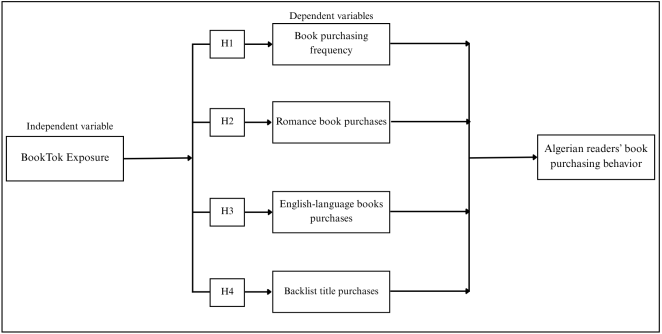
H1: Exposure to BookTok positively and significantly influences Algerian readers to purchase books more frequently.
Recent studies highlight a shift in BookTok trends, with romance emerging as the dominant genre since the platform’s rise in 2020, while the share of young adult literature has declined
| [8] | Dera, J. (2024). BookTok: A narrative review of current literature and directions for future research. Literature Compass, 21(10–12). https://doi.org/10.1111/lic3.70012 |
| [11] | Gonzales, J. (2025). Romance revival: How 'BookTok' has shifted romance in literature, for better or worse. The State Press. |
| [31] | Van Schaik, O. (2024). BookTok: From turning pages to turning tides – Examining the promotion of bibliodiversity on BookTok (master’s thesis). Erasmus University Rotterdam, Netherlands. |
[8, 11, 31]
.
H2: Exposure to BookTok positively and significantly influences Algerian readers to purchase romance books.
BookTok has contributed to a linguistic shift and an increase in English-language book purchases among young readers across Western Europe
| [8] | Dera, J. (2024). BookTok: A narrative review of current literature and directions for future research. Literature Compass, 21(10–12). https://doi.org/10.1111/lic3.70012 |
[8]
.
H3: Exposure to BookTok positively and significantly influences Algerian readers to purchase English-language books.
BookTok has reignited interest in backlist titles, with older books returning to bestseller lists and gaining renewed popularity.
H4: Exposure to BookTok positively and significantly influences Algerian readers to purchase backlist titles.
Figure 1. Conceptual Model.
4. Methodology
The primary objective of this study is to examine the extent to which exposure to BookTok influences Algerian readers’ book purchasing behavior, focusing on four key aspects.
This study adopted a mono-method quantitative approach using a survey. The quantitative method was chosen after identifying both the gap in literature, and the nature of the research objectives. Most existing studies on BookTok’s influence have employed either qualitative methods or content analysis, with limited use of quantitative surveys specifically targeting BookTok users
| [8] | Dera, J. (2024). BookTok: A narrative review of current literature and directions for future research. Literature Compass, 21(10–12). https://doi.org/10.1111/lic3.70012 |
[8]
. Therefore, this research seeks to contribute to the literature by offering empirical, measurable data collected directly from BookTok users, more precisely, within the Algerian context where no study about BookTok has been conducted to date.
The structured survey targeted Algerian readers who are exposed to BookTok. Individuals of all ages, genders, and socio-professional backgrounds were included. The sample was selected using a convenience sampling method, making it a non-probability sampling approach, as the exact population size of the study is unknown. An infinite population assumption was adopted to calculate the sample size for this study. To ensure a high level of precision, a 95% confidence level and a 5% margin of error were chosen. By assuming maximum variability (p=0.5), the required sample size was determined to be 385 respondents. A pre-test of the survey was conducted with a small sample of participants to evaluate the clarity of the questions. Minor wording adjustments were made to enhance comprehension. To assess internal consistency, Cronbach's alpha was calculated for all constructs. The results were all above the acceptable threshold of 0.7, indicating good reliability, with several reaching as high as 0.9.
The survey was created using Google Forms and administered through the social media accounts of Shakespeare Bookstore, targeting Algerian readers exposed to BookTok. Participation was voluntary and anonymous, and all responses were treated with strict confidentiality and were used solely for research purposes. A total of 408 responses were collected, however, due to the screening process, only 274 responses were retained for analysis. Following the administration of the survey and collection process, the responses were processed and analyzed using IBM SPSS Statistics 27 and EXCEL.
Simple linear regressions were used to test the influence of exposure to BookTok on the four aspects of the book purchasing behavior defined in this study. The validity of the analysis was confirmed by the ANOVA significance coefficient, which was less than 0.05, indicating statistical significance. The interpretation of results was based on R2 values, standardized beta coefficients (β), F-statistics and p-values.
5. Data Analysis and Results
The collected data were analyzed using simple linear regression to test the four hypotheses, which examined the influence of exposure to BookTok on purchasing frequency, romance genre book purchases, English-language book purchases, and backlist title purchases.
5.1. Hypothesis 01: Exposure to BookTok and Purchasing Frequency
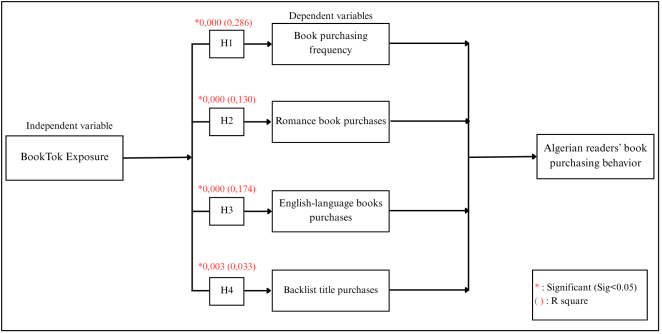
The first hypothesis assumed that exposure to BookTok has a positive and significant impact on purchasing frequency. The results supported this assumption, revealing a statistically significant positive relationship between the two variables (R = 0.532, R2 = 0.283, F = 107.145, p < 0.001), indicating that exposure to BookTok explains 28.3% of the variance in purchasing frequency. The standardized beta coefficient (β=0.532) suggests a moderate positive relationship between the variables.
5.2. Hypothesis 02: Exposure to BookTok and Romance Genre Book Purchases
The second hypothesis proposed that exposure to BookTok has a positive and significant influence on romance genre book purchases. The results supported this assumption, revealing a statistically significant positive relationship between the two variables (R = 0.360, R2 = 0.130, F = 40.549, p < 0.001), indicating that exposure to BookTok explains 13% of the variance in romance book purchases. However, the standardized beta coefficient (β = 0.360) suggests a weak positive relationship between the variables.
5.3. Hypothesis 03: Exposure to BookTok and English-language Book Purchases
The third hypothesis examined whether exposure to BookTok positively and significantly influences Algerian readers to purchase books in English. The regression results revealed a statistically significant positive relationship (R = 0.417, R2 = 0.174, F = 57.147, p < 0.001), indicating that exposure to BookTok explains 17.4% of the variance in English-language book purchases, with a standardized beta coefficient (β = 0.417) indicating a moderate positive relationship.
5.4. Hypothesis 04: Exposure to BookTok and Backlist Title Purchases
The fourth hypothesis proposed that exposure to BookTok has a positive and significant effect on backlist title purchases. The regression analysis confirmed this relationship, showing a statistically significant positive relationship (R = 0.181, R2 = 0.033, F = 9.227, p < 0.003). The independent variable explains only 3.33% of the variance in backlist title purchases, with a standardized beta coefficient (β = 0.181) indicating a very weak positive relationship between the variables, suggesting a limited effect among Algerian readers.
While the findings indicated a positive significant impact, the R square values were relatively low, indicating that exposure to BookTok, as the only predictor in this study, does not explain a large portion of the variance in book purchasing behavior. This result is not unusual in behavioral science. Low R
2 values (e.g., 1–10% variance explained) are common and can still be meaningful due to the complex nature of human behavior, and that effect sizes should be judged by their contextual relevance
.
In this case, BookTok’s moderate but meaningful effect could lead to substantial changes over time, especially given the context in Algeria, where BookTok may still be emerging as a new phenomenon, and has not yet been fully adopted by readers. According to Rogers' Diffusion of innovation theory, innovations spread through a population in stages, from early adopters to the larger majority
| [24] | Rogers, E. M. (1983). Diffusion of innovations (3rd ed.). The Free Press. |
[24]
. In Algeria, BookTok could be in the initial stages of diffusion, where only a small segment of the population is embracing it.
The low and moderate impact observed in this study could be due to absence of moderators in the study. Demographic factors play a significant role in affecting the buying behavior of consumers
| [15] | Khan, S. M. F. A., & Chawla, C. (2014). Impact of income on purchase decision from organized and unorganized retail in India. International Journal of Management (IJM), 5(11), 76–85. |
[15]
. For instance, younger readers may be more exposed to BookTok but lack the financial independence to make frequent purchases, while limited financial resources in general could also restrict book buying despite exposure. Gender could play a role as well, given that BookTok is predominantly female oriented. Personal factors such as reading frequency and format preference may also moderate behavior, as avid readers might be more influenced by BookTok than occasional readers, while some individuals may prefer free digital content instead of buying physical books.
Figure 2. Validated conceptual model.
6. Conclusion
The study set out to explore the influence of BookTok on Algerian readers' book purchasing behavior. To address it, a quantitative study was conducted, and data was collected through a survey, gathering responses from 274 participants on the five variables of this study. The results obtained confirm that exposure to BookTok has a positive and significant influence on the four aspects of book purchasing behavior explored in this study.
The findings offered a significant contribution by being one of the first to explore the new phenomenon of BookTok and its impact on Algerian readers. It shed light on how exposure to this community may affect purchasing behavior, offering insights to publishers and the book industry in Algeria on the importance of this phenomenon. The study highlighted how leveraging this platform could be beneficial to understand the current trends in the market, and to better understand customers’ preferences and needs, therefore, increasing book sales. Furthermore, this research provided a starting point for future studies exploring the impact of BookTok or similar digital communities on book purchasing behavior, offering a deeper understanding of how these platforms influence readers' choices and preferences. It also opened the door for further investigations into the evolving relationship between digital platforms and consumer behavior.
7. Research Limitations and Recommendations
While this study provided valuable insights, it is important to recognize its limitations to better guide future research. The sample size of 274 participants, though suitable for analysis, may not fully represent Algerian readers. The use of self-reported and cross-sectional data also introduces potential biases and limits the ability to assess changes in behavior over time. Moreover, the study did not account for moderating variables such as age, income, or reading habits, nor did it differentiate between types of BookTok content, which could influence purchasing behavior differently. The absence of a standardized tool to measure exposure to TikTok further restricted precision. Additionally, the scarcity of prior research on BookTok in the Algerian context limited theoretical grounding. Future studies could adopt a longitudinal or experimental design to assess BookTok’s long-term and direct effects on purchasing behavior. Moreover, Including control and moderating variables such as age, income, and reading habits would provide a clearer understanding of influencing factors. Finally, future research may examine changes in reading preferences and engagement patterns to capture BookTok’s broader cultural and behavioral impact.
Abbreviations
FYP | For You Page |
NPR | National Public Radio |
Gen Z | Generation Z |
SPSS | Statistical Package for Social Sciences |
TBR | To Be Read |
Author Contributions
Yousra Mebarek: Conceptualization, Data curation, Formal Analysis, Writing – original draft
Lamia El Mokretar: Supervision, Validation
Abdelaziz Barkat: Supervision, Validation
Conflicts of Interests
The authors declare no conflicts of interest.
References
| [1] |
Asplund, S.-B., Ljung Egeland, B., & Olin-Scheller, C. (2024). Sharing is caring: Young people’s narratives about BookTok and volitional reading. Language and Education, 38(2).
https://doi.org/10.1080/09500782.2024.2324947
|
| [2] |
Ceci, L. (n.d.). *TikTok usage during COVID-19 in the United States 2020*. Statista.
|
| [3] |
Chetcuti, M. (2024). The influence of TikTok on the consumer buying behaviour of books (master’s thesis). University of Malta, Malta.
|
| [4] |
Cohen, J. (1988). Statistical power analysis for the behavioral sciences (2nd ed.). Lawrence Erlbaum Associates.
https://doi.org/10.4324/9780203771587
|
| [5] |
Coleman, T. (2022). #BookTok: Is TikTok changing the publishing industry? The Week.
|
| [6] |
Culberson, D. (2024). BookTok: The cultural phenomenon introducing a stagnated industry to a new generation (Honors thesis). University of Tennessee at Chattanooga, USA.
|
| [7] |
De Melo, A. (2024). The influence of BookTok on literary criticisms and diversity. Social Media & Society.
https://doi.org/10.1177/20563051241286700
|
| [8] |
Dera, J. (2024). BookTok: A narrative review of current literature and directions for future research. Literature Compass, 21(10–12).
https://doi.org/10.1111/lic3.70012
|
| [9] |
Fiveable. (n.d.). Social media exposure.
|
| [10] |
Foster, C. (2023). The impact of social media on the publishing industry: A case study of author Colleen Hoover (Unpublished honors thesis). East Tennessee State University, USA.
|
| [11] |
Gonzales, J. (2025). Romance revival: How 'BookTok' has shifted romance in literature, for better or worse. The State Press.
|
| [12] |
Greenfield, A., Zarco, M., & Lorenzo, X. (2021). The rise of BookTok and its impact on the reading community. Medium.
|
| [13] |
Hill, D. (2024). Is BookTok killing the publishing industry? Palatinate.
|
| [14] |
Hue, A. (2021, September 18). TikTok's inspiring a reading renaissance — and it's turning decade-old books into first-time bestsellers. Business Insider.
|
| [15] |
Khan, S. M. F. A., & Chawla, C. (2014). Impact of income on purchase decision from organized and unorganized retail in India. International Journal of Management (IJM), 5(11), 76–85.
|
| [16] |
Kirk, T. (2023). From traditional to trending: How book marketing techniques have evolved. Book Marketing Pro.
|
| [17] |
Klug, D., Evans, M., & Kaufman, G. (2023). How TikTok served as a platform for young people to share and cope with lived COVID-19 experiences. MedieKultur: Journal of Media and Communication Research, 38(73), 152–170.
https://doi.org/10.7146/mk.v38i73.128463
|
| [18] |
Low, B., Ehret, C., & Hagh, A. (2023). Algorithmic imaginings and critical digital literacy on #BookTok. New Media & Society, 25(12), 1–18.
https://doi.org/10.1177/14614448231206466
|
| [19] |
Neijens, P., Araujo, T., Möller, J., & de Vreese, C. H. (2024). Measuring exposure and attention to media and communication: Solutions to wicked problems. Amsterdam University Press.
https://doi.org/10.5117/9789463723176
|
| [20] |
Nguyen, H. V., Huy, L. V., Nguyen, T. N., Dinh, V. S., & Tran, V. T. (2019). The role of social media in the purchase of books: Empirical evidence from Vietnam’s publishing industry. Publishing Research Quarterly, 36(1), 52–64.
https://doi.org/10.1007/s12109-019-09682-4
|
| [21] |
Ortutay, B. (2024). Nearly half of US teens are online ‘constantly,’ Pew report finds. Associated Press.
|
| [22] |
Porter, J. D., Eimannsberger, A., English, J., Hathaway, M., & Yakoob, A. (n.d.). Genre juggernaut: Measuring ‘romance’. Public Books.
|
| [23] |
Ridzuan, M., & Ahmadrashidi, N. (2023). The phenomenon of BookTok and its impact on the transformation of literary culture and the publishing industry. Forum Komunikasi, 18(2), 74-83.
https://doi.org/10.24191/FK.V18i2.2023_06
|
| [24] |
Rogers, E. M. (1983). Diffusion of innovations (3rd ed.). The Free Press.
|
| [25] |
Savanta. (2022). The BookTok generation: How social media is transforming Gen Z reading habits. The Publishers Association.
|
| [26] |
Segal, C. (2022). #BookTok is selling a ton of books, especially backlist titles for young adults. Literary Hub.
|
| [27] |
Stewart, S. (2021). How TikTok makes backlist books into bestsellers. Publishers Weekly.
|
| [28] |
Townend, K. (n.d.). BookTok trends: Exploring seasonal reading habits in the UK and USA. YouScan.
|
| [29] |
Tukia, H. (2022). The role of book content and influencers on TikTok in marketing of books (bachelor’s thesis). Lappeenranta-Lahti University of Technology, Finland.
|
| [30] |
Ulaikere, S. A., Okhai, A., Asikhia, O. U., Adefulu, A. D., & Ajike, E. O. (2020). Consumer shopping behaviour affectors and purchase frequency of selected online student buyers in Lagos State, Nigeria. International Journal of Advanced Studies in Economics and Public Sector Management (IJASEPSM), 8(1), 95–114.
|
| [31] |
Van Schaik, O. (2024). BookTok: From turning pages to turning tides – Examining the promotion of bibliodiversity on BookTok (master’s thesis). Erasmus University Rotterdam, Netherlands.
|
| [32] |
Yahya, R. M., Ciftci, D., & İşman, A. (2023). The relationship between social media exposure and social comparison level: Instagram as a model. TOJET: The Turkish Online Journal of Educational Technology, 22(2), 131–149.
|
| [33] |
Zara, A. (2022). The real impact of #BookTok on book sales. BookNet Canada.
|
Cite This Article
-
APA Style
Mebarek, Y., Mokretar, L. E., Barkat, A. (2026). The Influence of BookTok on Algerian Readers’ Purchasing Behavior: A Case Study of Shakespeare Bookstore. Journal of Business and Economic Development, 11(3), 89-96. https://doi.org/10.11648/j.jbed.20261103.13
 Copy
|
Copy
|
 Download
ACS Style
Mebarek, Y.; Mokretar, L. E.; Barkat, A. The Influence of BookTok on Algerian Readers’ Purchasing Behavior: A Case Study of Shakespeare Bookstore. J. Bus. Econ. Dev. 2026, 11(3), 89-96. doi: 10.11648/j.jbed.20261103.13
Copy
|
Download
AMA Style
Mebarek Y, Mokretar LE, Barkat A. The Influence of BookTok on Algerian Readers’ Purchasing Behavior: A Case Study of Shakespeare Bookstore. J Bus Econ Dev. 2026;11(3):89-96. doi: 10.11648/j.jbed.20261103.13
Copy
|
Download
-
@article{10.11648/j.jbed.20261103.13,
  author = {Yousra Mebarek and Lamia El Mokretar and Abdelaziz Barkat},
  title = {The Influence of BookTok on Algerian Readers’ Purchasing Behavior: A Case Study of Shakespeare Bookstore},
  journal = {Journal of Business and Economic Development},
  volume = {11},
  number = {3},
  pages = {89-96},
  doi = {10.11648/j.jbed.20261103.13},
  url = {https://doi.org/10.11648/j.jbed.20261103.13},
  eprint = {https://article.sciencepublishinggroup.com/pdf/10.11648.j.jbed.20261103.13},
  abstract = {BookTok, a reading-focused sub-community on TikTok that surged during the COVID-19 pandemic, is revolutionizing the publishing industry and reshaping how consumers approach book purchases. Through user-generated content, including book reviews, recommendations, and literary discussions, the platform has transformed how readers discover and purchase books, attracting increasing academic attention worldwide. However, despite the growing body of international research, empirical evidence on BookTok's influence on consumer purchasing behavior in the Algerian context remains limited. This study aimed to investigate the influence of BookTok on Algerian readers' purchasing behavior across four key dimensions: purchase frequency, English-language book purchases, romance genre purchases, and backlist title purchases. To achieve this objective, a quantitative research approach was employed using an online survey distributed via Shakespeare Bookstore’s social media platforms to Algerian BookTok users. A total of 274 valid responses were collected and analyzed. Results revealed that exposure to BookTok significantly influenced all four dimensions of purchasing behavior examined in this study. The strongest influence was observed on readers’ purchase frequency and purchases of English-language books, while its effect on romance and backlist title purchases was comparatively less pronounced. Overall, these results provide empirical evidence that BookTok is becoming an influential component of the Algerian book market. The relatively low to moderate effects observed may reflect the platform's recent emergence in Algeria, suggesting that its influence on readers' purchasing behavior could continue to expand as its adoption grows. These findings offer valuable insights for publishers and booksellers seeking to engage readers, better understand their preferences, and promote book sales through digital platforms.},
 year = {2026}
}
Copy
|
Download
-
TY  - JOUR
T1  - The Influence of BookTok on Algerian Readers’ Purchasing Behavior: A Case Study of Shakespeare Bookstore
AU  - Yousra Mebarek
AU  - Lamia El Mokretar
AU  - Abdelaziz Barkat
Y1  - 2026/07/24
PY  - 2026
N1  - https://doi.org/10.11648/j.jbed.20261103.13
DO  - 10.11648/j.jbed.20261103.13
T2  - Journal of Business and Economic Development
JF  - Journal of Business and Economic Development
JO  - Journal of Business and Economic Development
SP  - 89
EP  - 96
PB  - Science Publishing Group
SN  - 2637-3874
UR  - https://doi.org/10.11648/j.jbed.20261103.13
AB  - BookTok, a reading-focused sub-community on TikTok that surged during the COVID-19 pandemic, is revolutionizing the publishing industry and reshaping how consumers approach book purchases. Through user-generated content, including book reviews, recommendations, and literary discussions, the platform has transformed how readers discover and purchase books, attracting increasing academic attention worldwide. However, despite the growing body of international research, empirical evidence on BookTok's influence on consumer purchasing behavior in the Algerian context remains limited. This study aimed to investigate the influence of BookTok on Algerian readers' purchasing behavior across four key dimensions: purchase frequency, English-language book purchases, romance genre purchases, and backlist title purchases. To achieve this objective, a quantitative research approach was employed using an online survey distributed via Shakespeare Bookstore’s social media platforms to Algerian BookTok users. A total of 274 valid responses were collected and analyzed. Results revealed that exposure to BookTok significantly influenced all four dimensions of purchasing behavior examined in this study. The strongest influence was observed on readers’ purchase frequency and purchases of English-language books, while its effect on romance and backlist title purchases was comparatively less pronounced. Overall, these results provide empirical evidence that BookTok is becoming an influential component of the Algerian book market. The relatively low to moderate effects observed may reflect the platform's recent emergence in Algeria, suggesting that its influence on readers' purchasing behavior could continue to expand as its adoption grows. These findings offer valuable insights for publishers and booksellers seeking to engage readers, better understand their preferences, and promote book sales through digital platforms.
VL  - 11
IS  - 3
ER  -
Copy
|
Download





 Share This Article
 Twitter
 Linked In
 Facebook