1. Introduction
Anaerobic digestion, a biochemical technological process for the treatment of organic wastes such as animal manures, industrial effluents and agricultural residues, has received increasing attention in recent years and highly used for animal wastes anaerobic digestion. The process involves degradation and stabilization of complex organic matter by microorganisms leading to the production of biogas and digestate including solid and liquid as a consequence of energy and fertilizers recovery respectively. The process distinguishes small-scale digesters, medium scale and industrial scale digesters. Small-scale digesters or domestic/residential digesters have a power supply capacity less than 25 kW or a volume going from 3 to 30 m
3 and are meant to supply energy for cooking, lighting or sanitation in rural residential areas. Medium scale or commercial digesters with a capacity between 25 and 250 kW or a volume going from 50 to 500 m
3 and meant for heating or electricity generation and large-scale installations with a capacity greater than 250 kW or a volume of more than 500 m
3 | [1] | Mutungwazi, A., Mukumba, P., Makaka, G. (2018). Biogas digester types installed in South Africa: A review. Renewable and Sustainable Energy Reviews; 81 (1): 172-180. |
[1]
. They process the organic substrates into digestate and biogas which is composed in majority by 40 to 70% of methane and 30 to 60% of carbon dioxide
| [2] | Bond, T, Templeton, M. R. (2011). History and future of domestic biogas plants in the developing world. Energy Sustain Dev; 15: 347–54. http://dx.doi.org/10.1016/j.esd.2011.09.003 |
| [3] | Ononogbo, C. Nwufo, O. C., Nwaiwu C. F., Igbokwe, J. O. (2015). An innovative approach to construction and operation of biodigesters: a consderation of floating drum biogas plant. TLEP International Journal of Mechanical Engineering Research, 1 (3): 1 – 13. |
| [4] | Obileke, K., Mamphweli, S., Edson, L., Meyer, E. L., Makaka, G. and Nwabunwanne Nwokolo, N. (2020). Design and Fabrication of a Plastic Biogas Digester for the Production of Biogas from Cow Dung. Hindawi Journal of Engineering; pp1 -11. |
| [5] | Ojo, O. M., Babatola, J. O. (2021). Appraisal of Cumulative Volume of Biogas Produced from Water Hyacinth and Selected Animal Dungs Co-Digestion Mixes. Journal of Civil Engineering and Urbanism; 11 (5): 58-64. |
| [6] | Safley, Jr L. M., Westerman, P. W. (1992). Performance of a low temperature lagoon digester. Bioresource Technology; 41(2): 167–75. |
[2-6]
. Depending on the technology, they can be implemented in various types of climates and consists of thermophilic (45 - 60°C), mesophilic (20 - 45°C), or psychrophilic (< 20°C) digestion
| [7] | Boers, W., Workneh, K., Esthete, G. (2008). National biogas programme - Ethiopia programme implementation document. |
[7]
. Available small-scale biodigesters consist of fixed dome, floating dome, bag digester, portable digester. But the most developed domestic biodigester technology in Africa is the fixed-dome digester running in mesophilic conditions
| [7] | Boers, W., Workneh, K., Esthete, G. (2008). National biogas programme - Ethiopia programme implementation document. |
| [8] | Pincam T., Liu T-Q., Short M., Guo B., Sadhukhan J., Bywater A. (2026). Challenging conventional temperature ranges in anaerobic digestion: intermediate (45°C) as general optimum with feedstock-dependent performance differences from mesophilic (35°C) and thermophilic (55°C) conditions. Bioresource technology; 441: 133609. |
[7, 8]
. The main characteristics of most of these small-scale biodigesters models are their small size, heating and substrate mixing are very limited and operate in wet-conditions. Structurally, they are composed of the substrate feeding/extraction pits, the digester core, and the biogas storage unit, usually integrated into the digester. The volumetric production of the different domestic digesters ranges from 0.1 to 0.4 m
3 biogas/m
3 digester/day for fixed dome digesters (Chinese, Camartec), 0.4 to 0.8 m
3 biogas/m
3 digester/day for floating dome digesters (Indian Gobbar, Puxin), and 0.25 to 0.6 m
3 biogas/m
3 digester/day for bag digesters and plug flow digesters. Among these biodigesters, the Puxin digester model has a high and stable pressure production of biogas and used for livestock effluents, human excrement, wastewater, straw, and food waste. The model was developed by the Shenzhen company, established in 2001 in China. It consists of domestic-sized (6 and 10 m
3) and semi-industrial-sized (> 50 m
3) units characterized by cylindrical, vertical reactors in a single cross-section, generally constructed of concrete using pre-designed molds. The integration of this model of biodigester in Togo’s republic need to analyze its integration. Thus, the objective of this work is to study the reaction environment of Puxin model anaerobic digestion reactors in mesophilic conditions under a tropical climate. Four biodigesters were therefore implemented in a sheep and goats slaughterhouses for the anaerobic digestion of the produced wastes. The process of implementation was analyzed and stability, inhibitors, organic and mineral load were monitored to ensure the performance of the reactor.
2. Materials and Methods
2.1. Area of Construction
The site for the implementation of the biodigesters was chosen taking into account the constant and sufficient availability of biodegradable substrates, the energy needs to be met, and the availability and strong motivation of the beneficiary to ensure the operation of the installation. The safety distance between trees and the installation site is greater than 50 m, eliminating any suspicion of weakening or collapse of the biodigesters due to established root development. Furthermore, the piezometric level, the avoidance of construction in flood zones, the 30 m safety distance from wells and surface water, and the downstream location of the biodigesters in relation to groundwater flow were not considered critical factors during the installation process. Thus, three 10 m3 Puxin digesters were installed in Agoe sheep and goat slaughterhouse.
2.2. Design and Construction
The system design considered two major parameters: retention time (RT) and daily slaughterhouse waste production, based on a digester installation with a capacity of 10 m
3. Retention time is determined by the digestion temperature (25-30°C) and the substrate dry matter content (16% of dry matter). The daily organic load (ORL) was determined and the number of biodigester to build was estimated to 02. Two biodigesters of 10 m
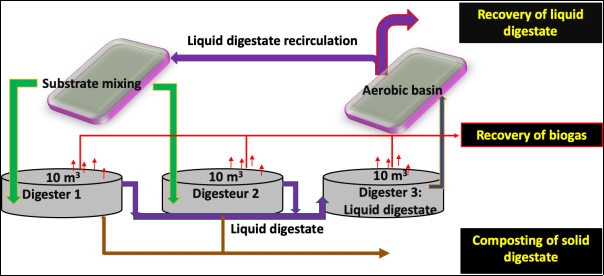
3 were therefore built for solid wastes anaerobic digestion, with an additional biodigester to ensure the maturation of the liquid digestate (
Table 1).
Table 1. Calculation method for sizing biodigesters.
Retention time: RT (jr) | Daily waste production: Pj (kg MB) | ORL = Biodigester volume/RT | Number of digester (N) N=Pj/ORL |
RT= 66 | Pj = 208 | Volume of biodigester = 10 m3 = 10 000 dm3 ORL = 10000/66 = 151 kg.day-1 | N= Pj/ORL = 1,4≈2 |
The installation is characterized by the site preparation phase followed by construction. Site preparation consisted of precisely locating and marking out the construction area for the biodigesters. Excavation of a pit of 3 meters depths and 4 meters in diameter was realized. The subsoil was prepared by laying a 10 cm thick layer of sand to prevent any potential cracks on the back face of the digester bases.
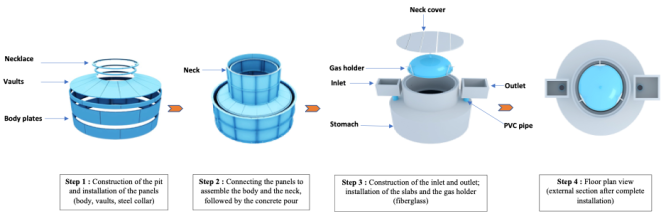
The biodigesters were constructed by assembling the molds (body, arches, collar, pins) in the pre-existing pit as designed by Puxin company (
Figure 1). Concrete, made from a mixture of 50 kg of cement, 60 L of sand, 130 L of gravel, and 25 L of water, was poured into the base on which the mold assembly rested and between the plates. The extraction and feeding pits are constructed using concrete blocks through which 1.25 m long of 160 mm Polyvinnyl chloride (PVC) pipes pass, forming the channel through which the substrates were introduced. The 160 mm PVC pipes was inclined at 45° and their lower edge was located 50 cm from the base of the digester. The bell was then placed in position, and protective concrete slabs protect it from potential external hazards or from being blown off its base due to the pressure generated by the biogas.
Figure 1. Process of Puxin biodigester construction.
Polyethylene pipes (d= 9 mm) connect the bell to the source of biogas consumption. The pipes were equipped with manometers with a maximum pressure of 16 kPa, which helped to detect leaks following untimely drops in pressure. The pressure gauges were followed by a water trap with a volume of 0.5 L to retain the water produced during the cooling of the biogas preventing any obstruction of the passage of the biogas. Sulfur filters containing iron filings purify biogas from sulfur. Water and air tightness tests were carried out to respectively check the tightness of the digester and the piping/bell. Watertightness tests were carried out by filling water into the digester and measuring losses after 24 hours, 48 hours, 72 hours and 96 hours. Airtightness tests were carried out using biogas and water. Biogas is filled through all the piping which is then immersed in water. Leaks are identified by the formation of air bubbles.
2.3. Solid Substrates Characterization and Reactor Start-Up
A 10 kg mass of slaughterhouse waste was sampled and then transferred to the laboratory at room temperature (25°C). The samples were characterized in terms of pH, dry matter, and volatile matter in triplicate. The pH was determined according to standard NF ISO 10390 (1994) using an Inolab-IDS-WTW Multi 9430 pH meter with a Sentix 980 electrode. The dry matter content was determined according to standard NF ISO 11465 (1994) using a Firlabo oven by drying at 105 ± 2°C. The organic matter content was evaluated by loss on ignition at 550°C for 4 hours using the SNOL 4011200 oven. The start-up of biodigesters was subdivided into three main stages, including the determination of the dry matter and volatile matter content of the substrates; the introduction of 10 m3 of water in which 1 m3 of inoculum, representing 1/10 of the biodigester's volume; and the monitoring and observation of the initial biogas production from the inoculum, which serves to initiate daily feeding.
The initial organic load was estimated at 16.5 kgDM/m3. The daily feeding of the biodigesters with raw substrates fluctuated between 100 and 150 kg, corresponding to an average organic load of 2.1 kgDM/m3. Slaughterhouse substrates were used in this study as both inoculum and digestion substrates because their high microbial load and readily biodegradable.
2.4. Physico-chemical Monitoring in the Reactor
The pH, the redox potential, and the conductivity within the biodigester were monitored using the PHT-027 multiparameter meter, with a pH probe (Ag/AgCl electrode), an ORP probe, and a conductivity probe. The pH meter was calibrated using three buffer solutions: 4.01, 6.86, and 9.18. The accuracy is 0.1 pH unit for the pH probe and 0.1% for the ORP probe. The temperature within the biodigester was determined using the Vici TM803 thermometer probe. The temperature measurement range was -50°C to +70°C with an accuracy of ±1°C. The pH, redox potential, and conductivity within the biodigester were measured through the extraction and feed pits, and at various depths, including 1 m, 2 m, and 2.75 m allowing the calculation of the daily average values.
2.5. Evaluation of Organic Load and Inhibition Parameters
Chemical Oxycgen Demand (COD) and Biological Oxygen Demand (BOD5) were measured by potassium dichromate digestion and respirometry using the SELECTA Digest Block 6 and the Aqua-Lytic AL606 BOD system, respectively. Total Kjeldhal Nitrogen (TKN) was determined by mineralization with H2SO4 in the presence of a catalyst (K2SO4 + Se) using the SELECTA Digest Block 6, followed by distillation with the Kjeltec Tecator 2200 distiller and titration with 0.1M NaOH. Volatile fatty acids (VFA) and total alkalimetry (TAC) content were determined by titration with H2SO4 and NaOH (1N and 0.1N).
2.6. Evaluation of Biogas Flow Rate, and Quality
The biogas flow rate was measured using the Argon type Gas Flow Meter Tester from two different biogas outlets, first at the outlet of the biodigester (during 30 days) and second at the outlet of the biogas storage tank.
The methane content was determined by sampling the biogas using a syringe and measuring it volumetrically by moving the liquid. The first liquid is a solution of distilled water acidified to pH 2 using HCl and measures the total volume of biogas and the second is a KOH solution of pH 11 and measures the volume of methane in the biogas.
3. Results and Discussion
3.1. Biodigesters Construction and Leak Test Realization
The construction of the biodigester, the pipe installation and 24 hours system verification for leaks were completed in 5 days with a workforce of four and a concrete mixer including. Indian Gobarr, and Chinese biodigesters models require significantly longer construction times, ranging from 10 to 20 days, with a similar workforce. The quantities of materials used for the treatment of the subsoil and the construction are indicated
Table 2.
Table 2. Volumes of materials used for the construction of a Puxin biodigester 10 m3.
Materials | Unit | Quantity per digester |
Cement | kg | 1600-1800 |
Sand | m3 | 4-4,5 |
Gravel | m3 | 6 |
Iron bar of 6/8, length 12m | unit | 4-5 |
Pipes PVC 160 | m | 1,25 x 2 |
Bricks | unit | 100 |
Wire coil | unit | 01 |
Plaster | unit | 01 |
Used oil for mol lubrification | L | 3 |
Water tightness testing of the digesters revealed an average water loss of 1.2 cm (0.3 m
3), 1.8 cm (0.5 m
3), and 1.2 cm (0.3 m
3) after 24 hours respectively for Digester 1, Digester 2 and Digester 3. These losses were attributed to absorption by the concrete and evaporation. This water loss stabilized at 0.5 cm after 72, 96, and 120 hours, indicating that the systems are watertight. The low water losses was attributed to evaporation. The water tightness testing technique was similar to that defined by
| [9] | Chanakya, H. N., Bhogle, S., Arun, R. S. (2005). Field experience with leaf litter-based biogas plants. Energy for Sustainable Development; 9(2), 49-62. |
[9]
, who suggested gradually filling the digester with water and assessing the losses over 2 to 4 days. Lacour
| [10] | Lacour, J. (2012). Valorization of agricultural organic residues and associated wastes towards anaerobic biological treatments. University of Lyon; PhD Thesis; 218p. |
[10]
emphasizes that leak tests are recommended for three main reasons: i) the eradication of groundwater pollution, ii) the reduction of water losses from digesters, and iii) the reduction of gas leaks that hinder pressurization of the biodigester.
The gas leak test was performed on both the fiberglass chamber storing the biogas within the biodigester and the piping used to deliver the gas to the point of consumption. Excess water was added to the upper limit of the chamber. The absence of air bubbles indicated a perfect seal on the chamber. For the piping, the biogas flows under pressure through the piping. Immersing the piping in water confirmed the absence of leaks due to the lack of air bubbles. The technique developed by Chanakya
| [9] | Chanakya, H. N., Bhogle, S., Arun, R. S. (2005). Field experience with leaf litter-based biogas plants. Energy for Sustainable Development; 9(2), 49-62. |
[9]
for verifying gas tightness requires injecting air into the system at a differential pressure of 50 mbar and checking its stability after 2 hours. The design of the complete installation is shown in
Figure 2.
Figure 2. Design of the installation.
3.2. Inoculation of the Biodigester by the Substrates
Substrates from the rumen of slaughtered small ruminants were used simultaneously as inoculum and subsequently as substrates for methanation, given their high concentration of bacterial flora and known high buffering capacity. The volatile matter of the inoculum was 98 ± 2%
DM and the dry matter was 17 ± 3%
DM | [11] | Tcha-Thom, M., Baba, G., Feuillade-Cathalifaud, G., Pallier, V., Gnanvossou, D., Toko, M., Koledzi, E. K. (2018a). Comprehensive study of organic and inorganic compounds released by animal and pineapple fruits wastes. Journal of Scientific and Engineering Research; 5 (11): 32-42. |
[11]
. The pH (7.1 ± 0.5) was suitable for anaerobic digestion, and the mineral load, reflected by the conductivity, is approximately 3317 ± 210 µS.cm
-¹.
Compared to conventional digesters characterized by two- or three-stage inoculation
| [9] | Chanakya, H. N., Bhogle, S., Arun, R. S. (2005). Field experience with leaf litter-based biogas plants. Energy for Sustainable Development; 9(2), 49-62. |
[9]
, the inoculation of the digesters in this study using slaughterhouse wastes was carried out in a single stage by introducing 1 m
3 of inoculum into a liquid phase of 10 m
3 of water. This unique inoculation method, used in Puxin technology, eliminates any immediate inhibition and allows for gradual colonization of the digestion medium. Biogas production (> 1 m
3) was achieved in less than 12 hours. Flammability tests were positive, with a blue flame indicating effective methanogenic activity.
3.3. Studying Stability Parameters of the Biodigester in Situ
A sudden change in temperature can cause a functional imbalance in the microbial population
. Gerardi
| [13] | Gerardi, M.H. (2003). The microbiology of anaerobic digesters, wastewater microbiology series Hoboken, New Jersey: John Wiley & Sons, Inc. |
[13]
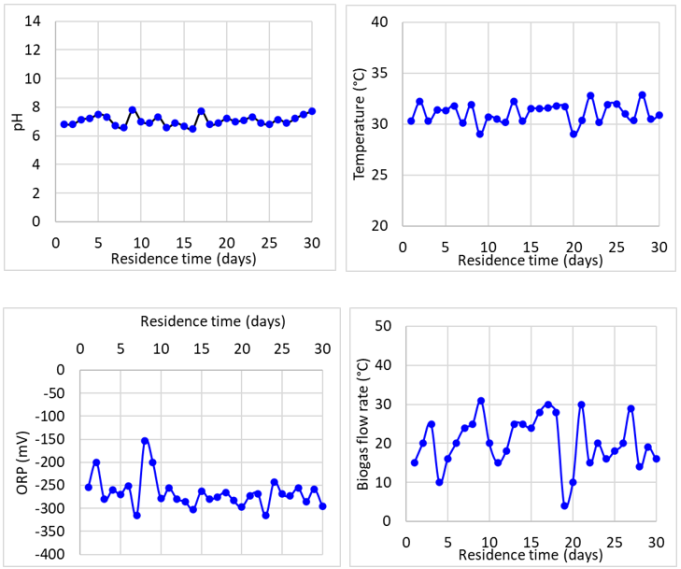
recommends a fluctuation between 2 and 3°C in temperature to ensure the stability of the process in mesophilic conditions. Temperature in the biodigester varied between 29 and 33°C with an average of 31 ± 1°C, a deficit of around 4°C compared to the optimal temperature in mesophilic digestion which is 35 ± 2°C (
Figure 3). The external temperature varied between 28 and 40°C during the experiment phase, therefore the temperature measured within the biodigester was not a function of the external temperature in mesophilic conditions and in tropical regions. In contrary, it should be a function of the intensity of degradation of the organic load and therefore of bacterial activity. This analysis was confirmed by Pincam et
al.,
| [8] | Pincam T., Liu T-Q., Short M., Guo B., Sadhukhan J., Bywater A. (2026). Challenging conventional temperature ranges in anaerobic digestion: intermediate (45°C) as general optimum with feedstock-dependent performance differences from mesophilic (35°C) and thermophilic (55°C) conditions. Bioresource technology; 441: 133609. |
[8]
who showed that, feedstock composition significantly influenced anaerobic digestion sensitivity to temperature change, readily degradable feedstock displaying greater sensitivity to temperature changes. The low digestion temperatures within biodigesters compared to the optimal digestion temperature in mesophilic digestion could reduce the performance of anaerobic digestion with the consequence of a reduction in the level of degradation and the qualitative production of methane and a low level of sanitation of the digestates. The temperature variations reported within biodigesters in Togo are higher than those measured in Haïti which oscillate between 24 and 31°C, with an average of 27.4°C, and environmental temperature conditions varying between 4 and 13°C
| [10] | Lacour, J. (2012). Valorization of agricultural organic residues and associated wastes towards anaerobic biological treatments. University of Lyon; PhD Thesis; 218p. |
[10]
while in Senegal
| [14] | Ebeya, C., C., Mahmoud, M., Sidibba, A., Yetilmezsoy, K., Kiyan, E., Kane, C., S., E., Bilal, B., Jedou, E;, Youm, I., Ndongo, M. (2022). Influence of the construction materials properties of the biodigester on the biogas production and electricity generated by the slaughterhouse waste. International Journal of Design & Nature and Ecodynamics; 17 (4), 513-520. |
[14]
reported a variation between 29.1 and 36.6°C with an ambient temperature of 26.8 to 31.6°C. Studies revealed that, the temperatures and the average daily biogas productions were higher for the steel biodigester (1.5 ± 0.12 m
3.day
-1 at 36 ± 2℃) than those produced from the PVC (1.3 ± 0.1 m
3.day
-1 at 31 ± 1.5℃) and concrete (1.2 ± 0.05 m
3.day
-1 at 27 ± 2℃) biodigesters. So, the low temperature of the studied biodigester compared to the optimal values appropriate anaerobic digestion may be influenced by its state, built with cement
| [15] | Mansaly, J.B., Diouf, D., Piriou, B., Ndiaye, D. and Maïga, A.S. (2021) Study of the limit of the technological transition in the field of methanisation in Senegal (from Laboratory Scale to in-Situ Bi- odigester). Journal of Sustainable Bioenergy Systems; 11, 215-226. https://doi.org/10.4236/jsbs.2021.114014 |
[15]
. Therefore, the external temperature might have a very slight impact on the internal temperature of the reaction medium of the digesters.
The pH varied between 6.5 and 7.8 with an average of 7.1 ± 0.3, adequate range for optimal anaerobic digestion (
Figure 3). The high pH values were measured on the side of the substrate extraction pit while the low values were obtained on the side of the feeding pit. Lacour
| [10] | Lacour, J. (2012). Valorization of agricultural organic residues and associated wastes towards anaerobic biological treatments. University of Lyon; PhD Thesis; 218p. |
[10]
highlights changes in pH in biodigesters of between 6.3 and 8.7 on a plug flow biodigester and
| [13] | Gerardi, M.H. (2003). The microbiology of anaerobic digesters, wastewater microbiology series Hoboken, New Jersey: John Wiley & Sons, Inc. |
| [14] | Ebeya, C., C., Mahmoud, M., Sidibba, A., Yetilmezsoy, K., Kiyan, E., Kane, C., S., E., Bilal, B., Jedou, E;, Youm, I., Ndongo, M. (2022). Influence of the construction materials properties of the biodigester on the biogas production and electricity generated by the slaughterhouse waste. International Journal of Design & Nature and Ecodynamics; 17 (4), 513-520. |
[13, 14]
reported a fluctuation between 6.8 and 7.7 for Puxin model biodigester very closed to the results of this study. Optimal activity of methanogens is favored by a pH between 6.8 and 7.2
| [14] | Ebeya, C., C., Mahmoud, M., Sidibba, A., Yetilmezsoy, K., Kiyan, E., Kane, C., S., E., Bilal, B., Jedou, E;, Youm, I., Ndongo, M. (2022). Influence of the construction materials properties of the biodigester on the biogas production and electricity generated by the slaughterhouse waste. International Journal of Design & Nature and Ecodynamics; 17 (4), 513-520. |
| [16] | Dana, R. (2010). Macro-Scale biogas production: A beginners guide. The national sustainable agriculture information service, ATTRA.
https://www.ncat.org/publication/micro-scale-biogas-production-a-beginners-guide/ |
[14, 16]
.
The optimum range of ORP for CH4 reducing bacteria is below -230 mV
| [17] | Hungate, R.E. (1969). Chapter IV a roll tube method for cultivation of strict anaerobes. In: Norris, J.R., Ribbons, D.W. (Eds.), Methods in Microbiology, Part B, Academic Press; 3: 117–132. |
| [18] | Vongvichiankul, C., Deebao, J., Khongnakorn, W. (2017). Relationship between pH, oxidation reduction potential and biogas production in mesophilic screw anaerobic digester. Energy Procedia; 138: 877-882. |
| [19] | Sukphun, P., Sittijunda, S., Reungsang, A., Atta-Obeng, E. (2021). Volatile fatty acid production from organic waste with the emphasis on membrane-based recovery. Fermentation; 7, 159. |
[17-19]
. The redox potential quickly reached the optimum for anaerobic digestion within 10 h after feeding and then stabilized between -250 and -315 mV (
Figure 3). Considering the convenience, economic factor and reliability of industrial biogas plants of chicken manure, an ORP higher than -540 mV is an indicator of inhibition while a severe inhibition occur for an ORP higher than -520 mV
| [20] | Ao, T., Chen, L., Zhou, P., Lui, X., Li, D. (2021). The role of oxidation-reduction potential as an early warning indicator, and a microbial instability merchanism in a pilot-scale anaerobic digestion of chicken manure. Rewable Energy; 179: 223- 232. |
[20]
.
Figure 3. Physical and physico-chemical parameters evolution in biodigesteur.
3.4. Evaluation of the Organic Load and Inhibitors Parameters in Liquid Digestate
The mineral load, expressed as conductivity, the organic load, expressed as COD and VFAs, and the buffering capacity, characterized by TAC, were determined during the first two months of digester operation. These parameters were measured on the liquid phase, which is transferred daily from the biodigesters receiving the solid substrates to the biodigester responsible for digesting the effluent. The mineral load increased from 500 to 5500 µ
S.cm
-1. The TKN, COD, and VFAs changed from 50 to 400 mg.L
-1, 250 to 4150 mg.L
-1, and from 0.08 to 0.99 g.L
-1, respectively. BOD
5 accounted for 54% to 89% of the COD, demonstrating high biodegradability of the liquid abattoir digestates. The TAC quickly reached the minimum desired value of 3 g.L
-1. The VFA/TAC ratio varied between 0.09 and 0.4 and did not exceed the limit ratio of 0.8. Some studies underlined TAC values slightly above 5 g.L
-1 ensuring a stabilization of the anaerobic digestion process, ammonium values in mesophilic conditions were under 1.5 g.L
-1 and soluble COD were approximately 900 mg.L
-1 at 37°C up to 3500 mg.L
-1 at 53°C
| [21] | Steiniger, B., Hupfauf, S., Insam, H., Schaum, C. (2023). Exploring anaerobic digestion from mesophilic to thermophilic temperatures—operational and microbial aspects. Fermentation; 9(9): 798; https://doi.org/10.3390/fermentation9090798 |
[21]
.
3.5. Biodigesteur Performance: Flow Rate and Biogaz Quality
The biogas flow rate generated by the biodigester varied between 3 and 33 L
biogas.min
-1 (
Figure 3- biogas flow rate), the equivalent of 3 to 8 kPa. Low flow rates and pressure are observed with biogas use. The average biogas flow rate was 20 L
biogaz.min
-1. This pressure is similar to 0 to 6 kPa and 0.9 to 10.8 measured respectively by Tcha-Thom et
al.
| [22] | Tcha-Thom, M., Baba, G., Koledzi, K. E. (2018b). Waste recovery into biogas: promotion and suitability of bio-digesters in industrial units. Technological Innovation and Management for Sustainable Development (For Greener, Safer and Smarter World); Gwalior, India. pp. 376-386. |
[22]
and Ebeya et
al.,
| [14] | Ebeya, C., C., Mahmoud, M., Sidibba, A., Yetilmezsoy, K., Kiyan, E., Kane, C., S., E., Bilal, B., Jedou, E;, Youm, I., Ndongo, M. (2022). Influence of the construction materials properties of the biodigester on the biogas production and electricity generated by the slaughterhouse waste. International Journal of Design & Nature and Ecodynamics; 17 (4), 513-520. |
[14]
on Puxin model biodigester. A 10 m
3 digester in normal operation can reach a value of 12 kPa
| [14] | Ebeya, C., C., Mahmoud, M., Sidibba, A., Yetilmezsoy, K., Kiyan, E., Kane, C., S., E., Bilal, B., Jedou, E;, Youm, I., Ndongo, M. (2022). Influence of the construction materials properties of the biodigester on the biogas production and electricity generated by the slaughterhouse waste. International Journal of Design & Nature and Ecodynamics; 17 (4), 513-520. |
[14]
.
However, due to overproduction, transferring the biogas into 10 m3 tanks was considered. The biogas stored in these 10 m3 tanks exits at a flow rate of < 0.5 Lbiogaz.min-1 hindering its use. Therefore, tests are being conducted to determine a suitable flow rate.
Table 3. Performance parameters of the biodigesteur.
| Pressure (kPa) | Biogas flow rate (L/min) | Methane content (%) |
Biogas exiting directly from biodigester | 3 - 8 | 0 - 33 | |
Biogas exiting from balloon | < 0.1 | < 0.5 | |
Biogas exiting from balloon supporting load of 50 - 500 kg | 0.5 | < 0.5 | 45 - 64.5 |
Biogas exiting from balloon connected to boster pump | 0 - 50 | 0 - 60 | |
Adding weights ranging from 50 to 500 kg to the biogas storage tank resulted in flow rate < 0.5 Lbiogaz.min-1. This technique did not appear promising for optimal biogas utilization. Using the biogas directly from the biodigester provided better flow rate. The use of an electrically powered pressure regulator generated adjustable pressure, ranging from 0 to 60 Lbiogaz.min-1, depending on the application. This flow rate allowed the use of generator for electricity production, and cooking.
The measured methane content ranges from 45% to 64.5%. On-site concentrations varying from 40 to 62.95% were reported on plug-flow digester in Haïti and Puxin biodigester in Senegal
| [10] | Lacour, J. (2012). Valorization of agricultural organic residues and associated wastes towards anaerobic biological treatments. University of Lyon; PhD Thesis; 218p. |
| [14] | Ebeya, C., C., Mahmoud, M., Sidibba, A., Yetilmezsoy, K., Kiyan, E., Kane, C., S., E., Bilal, B., Jedou, E;, Youm, I., Ndongo, M. (2022). Influence of the construction materials properties of the biodigester on the biogas production and electricity generated by the slaughterhouse waste. International Journal of Design & Nature and Ecodynamics; 17 (4), 513-520. |
[10, 14]
, while some authors reported very low concentrations of methane (29 to 47%) and high concentrations of 80 to 91% of fish wastes anaerobic digestion in mesophilic conditions
| [23] | Fall, M. (2018). Physicochemical characterization and energy recovery of solid waste in the Dakar region. Doctoral thesis, Cheikh Anta Diop University of Dakar. |
| [24] | Kebe, N.N., Fall, P.A., Ndiaye, D. and Diouf, D. (2019). Residues of the transformation of halieutics products: an alternative substrate for energy valorization of wastes by methanisation for a local sustainable development (preliminary results). African Journal of Environmental Science and Technology; 13, 291-295. https://doi.org/10.5897/AJEST2018.2549 |
[23, 24]
. The methane percentages obtained by Faye
| [25] | Faye, O.K., Ndiaye, L.G., Sarr, B. (2020). Comparative Study of Anaerobic Digestion Between Cashew Apple Pulp, Cow Dung and Their Codigestion. Soaphys Journal of Physics 2(2630-0958): 1. |
[25]
were 58.52% on cow dung, 62.95% on cashew apple and 61.3% in co-digestion of 50% on cashew pulp and 50% cow.
3.6. Structural Optimization: Automatic Water Drainage by Sloping the Pipes
During the operation of the biodigesters, the absence of biogas at the point of consumption was reported three times in six months. This was due to failure to adhere to the monthly drainage schedule for water droplets formed during gas cooling in the piping, preventing the biogas from reaching the point of consumption. Tests to drain the water from the piping determined that the emptying time was one hour by two people for three biodigesters. However, the operators found this operation very tedious. Previously, the piping was horizontal and at the same level as the top of the tank. Raising the piping and placing it at an angle resolved the problem. This allows the water to return to the biodigester by gravity without external intervention, thus ensuring the regular presence of biogas at the point of consumption.
Author Contributions
Maglwa Tcha-Thom: Conceptualization, Data curation, Formal Analysis, Funding acquisition, Investigation, Methodology, Software, Visualization, Writing – review & editing
Edem Komi Koledzi: Data curation, Funding acquisition, Investigation, Project administration, Supervision, Validation, Writing – review & editing
Gnon Baba: Data curation, Funding acquisition, Investigation, Project administration, Supervision, Validation, Writing – review & editing