Abstract
This article examines a methodical analysis for optimizing the wavelength selection used for the two channels of a bichromatic pyrometer. Temperature measurement via pyrometry relies on analyzing the radiation emitted by a body at various wavelengths, enabling non-contact thermal assessment. Several laws mathematically characterize this thermal radiation: Lambert’s law, which states that radiance is independent of the emission direction, and Planck’s law, which allows for the calculation of the body's radiation energy density. The bichromatic pyrometer utilizes distinct wavelengths; it consists of two separate spectral filter channels and two detectors with different spectral sensitivities, each followed by its own analog processing electronics. The two signals representing the thermal radiation undergo this analog processing before being combined through digital processing. A crucial step is selecting the wavelengths for the two spectral filters. Depending on the approach, calculations for a bichromatic pyrometer can be based either on the flux ratio combined with Wien’s approximation or on the flux ratio combined with Planck’s law, with each approach offering a different level of compensation for emissivity variations. In our case, the second method, that is to say the flux ratio using Planck's law will be used. This method applies Planck’s law to a real body by modeling emissivity as a second-degree polynomial. By varying the ratio value, we can calculate pairs of wavelengths based on their difference; this difference is then evaluated against relative errors to determine how to optimize the selected wavelengths. Optimizing wavelength selection in the bispectral system, by using two wavelengths simultaneously, improves the accuracy of temperature estimation and enables more reliable modeling of the materials' spectral behavior.
Keywords
Wavelength, Two-Color Pyrometer, Temperature, Emissivity, Luminance, Planck's Law
1. Introduction
Precise temperature measurement is crucial for high-temperature industrial processes such as steelmaking and foundry operations. Optical pyrometry, which measures temperature without contact by analyzing thermal radiation, offers speed and safety. However, its accuracy is limited by complex variations in the material's emissivity. This radiative property depends on the wavelength, surface condition, and composition of the material
| [1] | P. E Ratianarivo, T. Ra. zafindratsira, E. Rastefano. Efficiency of Multispectral Pyrometer Technology in the Infrared Spectral Band According to Planck's Law on the Real Body in the Case of Oxidized Steels. Journal of Electrical and Electronic Engineering. 2026, 14(3), 129–134.
https://doi.org/10.11648/j.jeee.20261403.11 |
| [2] | P. E. RATIANARIVO, Optimization of wavelength selection for a quadraspectral pyrometer for the austenitization of steels, Ph.D. Thesis, University of Antananarivo, 2018. |
| [3] | Th. Duvaut, Comparison between multiwavelength infrared and visible pyrometry: Application to metals, Infrared Physics & Technology, 2008, 51, 292–299
https://www.sciencedirect.com/science/article/pii/S1350449507001375 |
[1-3]
. A two-color pyrometer employs two optical filters for two different wavelength ranges. The selection of these two wavelengths plays a significant role in minimizing measurement errors.
2. Methodology
2.1. Physical Modeling of Thermal Radiation According to Planck's Law
According to Planck's law, the spectral radiance of a black body depends only on its temperature and wavelength
| [4] | Sama Badr Aljohani, Ibrahim A. Alshunaifi, Naif B. Alqahtani, and Bader A. Alfarraj, Comparison of a two-wavelength pyrometer system and spectral pyrometry for high-temperature measurements. Applied Optics. 2024, 63(13), 3648-3657.
https://doi.org/10.1364/AO.522898 |
[4]
:
(1)
where h =6,6255×10⁻³⁴Js: constant of Planck,
k =1,38×10⁻²³ JK-1: constant of Boltzmann,
c =2,996×10
8 ms
-1: Speed of electromagnetic waves in a vacuum
| [5] | Tairan Fu, Jiangfan Liu, and Anzhou Zong. Radiation temperature measurement method for semitransparent materials using one-channel infrared pyrometer. Applied Optics. 2014, 53(29), 6830-6839.
https://doi.org/10.1364/AO.53.006830 |
[5]
.
A real material is characterized by emission that depends on the spectral emissivity ε(λ, T). In this case, Planck's law thus becomes the product of the blackbody radiance and the emissivity:
Kirchhoff described a relationship between emissivity and absorptivity. This relationship holds for opaque bodies
| [5] | Tairan Fu, Jiangfan Liu, and Anzhou Zong. Radiation temperature measurement method for semitransparent materials using one-channel infrared pyrometer. Applied Optics. 2014, 53(29), 6830-6839.
https://doi.org/10.1364/AO.53.006830 |
| [6] | Yunwei Huang, Jianyu Long, Dengfu Chen, Mujun Long, Zhe Yang, and Chuan Li. Temperature errors in two-color pyrometry simultaneously considering reflection and combustion gas radiation. Applied Optics. 2021, 29(16), 25084-25099. https://doi.org/10.1364/OE.433942 |
| [7] | P. E Ratianarivo, E. Rastefano, Characteristics of Optimal Wavelength Selection for the Quadrispectral Pyrometer in the NearInfrared Spectral Range Made for Austenization of Steels. International Journal of Advanced Research in Electrical, Electronics and Instrumentation Engineering. 2025, 14(11), 3751-3763.
https://doi.org/10.15662/ijareeie.2025.1411006 |
[5-7]
.
With is the spectral reflectivity.
2.2. Theoretical Foundations of Thermal Radiation
A blackbody serves as the reference for all emitting bodies; it absorbs all incident light and perfectly emits the full spectrum of radiation
| [3] | Th. Duvaut, Comparison between multiwavelength infrared and visible pyrometry: Application to metals, Infrared Physics & Technology, 2008, 51, 292–299
https://www.sciencedirect.com/science/article/pii/S1350449507001375 |
| [4] | Sama Badr Aljohani, Ibrahim A. Alshunaifi, Naif B. Alqahtani, and Bader A. Alfarraj, Comparison of a two-wavelength pyrometer system and spectral pyrometry for high-temperature measurements. Applied Optics. 2024, 63(13), 3648-3657.
https://doi.org/10.1364/AO.522898 |
| [5] | Tairan Fu, Jiangfan Liu, and Anzhou Zong. Radiation temperature measurement method for semitransparent materials using one-channel infrared pyrometer. Applied Optics. 2014, 53(29), 6830-6839.
https://doi.org/10.1364/AO.53.006830 |
| [6] | Yunwei Huang, Jianyu Long, Dengfu Chen, Mujun Long, Zhe Yang, and Chuan Li. Temperature errors in two-color pyrometry simultaneously considering reflection and combustion gas radiation. Applied Optics. 2021, 29(16), 25084-25099. https://doi.org/10.1364/OE.433942 |
[3-6]
.
Depending on the emissivity model, which may be monochromatic or total, as well as directional or hemispherical. its value is between 0 and 1. The emission of a real body depends entirely on its emissivity, as described by Equation (
2). A heated body emits radiation in the ultraviolet and infrared ranges; these represent the thermal radiation utilized in pyrometry to detect the body's temperature.
2.3. Analysis of Heat Transfer Modes
The study distinguishes between the three modes of heat transfer: conduction, convection, and radiation. At high temperatures, radiation becomes the dominant mode, justifying the use of optical techniques for thermal measurement. Interactions between the radiation emitted by the object, the environment, and the intervening atmosphere are taken into account to assess their impact on the measurement
| [5] | Tairan Fu, Jiangfan Liu, and Anzhou Zong. Radiation temperature measurement method for semitransparent materials using one-channel infrared pyrometer. Applied Optics. 2014, 53(29), 6830-6839.
https://doi.org/10.1364/AO.53.006830 |
[5]
.
2.4. Infrared Detection Technologies
In the field of detection technology, there are two main categories: photonic detectors and thermal detectors. The choice of detector determines the measurable temperature range and the overall accuracy of the system
| [6] | Yunwei Huang, Jianyu Long, Dengfu Chen, Mujun Long, Zhe Yang, and Chuan Li. Temperature errors in two-color pyrometry simultaneously considering reflection and combustion gas radiation. Applied Optics. 2021, 29(16), 25084-25099. https://doi.org/10.1364/OE.433942 |
[6]
.
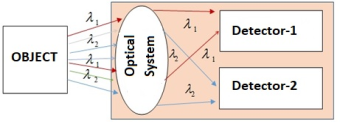
The radiation from the object is detected by two detection systems that each other has their specification in term of spectral sensitivity. The flux cannot detect directly by those detectors but an optical filter system allows two different spectra to pass through and converge them respectively towards the detector system
| [6] | Yunwei Huang, Jianyu Long, Dengfu Chen, Mujun Long, Zhe Yang, and Chuan Li. Temperature errors in two-color pyrometry simultaneously considering reflection and combustion gas radiation. Applied Optics. 2021, 29(16), 25084-25099. https://doi.org/10.1364/OE.433942 |
| [7] | P. E Ratianarivo, E. Rastefano, Characteristics of Optimal Wavelength Selection for the Quadrispectral Pyrometer in the NearInfrared Spectral Range Made for Austenization of Steels. International Journal of Advanced Research in Electrical, Electronics and Instrumentation Engineering. 2025, 14(11), 3751-3763.
https://doi.org/10.15662/ijareeie.2025.1411006 |
[6, 7]
.
3. Various Bichromatic Estimation Models
Three models will be presented and compared. Each model accounts for a polynomial representation up to the second order of the spectral variations in the measurement chain's overall transfer function (including emissivity). The first model is based on the flux ratio using the Wien approximation; it is thus inspired by the model used in dual-wavelength (bi-spectral) thermometry. The second model relies solely on the flux ratio, assuming Planckian emission
| [8] | P. E Ratianarivo, E. Rastefano, Limit of the Bichromatic Pyrometer for Determining the Temperature of a Metal. International Journal of Advanced Research in Electrical, Electronics and Instrumentation Engineering. 2025, 14(10), 3386-3391. https://doi.org/10.15662/ijareeie.2025.1410001 |
| [9] | Tairan Fu, Minghao Duan, Jiaqi Tang, Cong ling Shi, Measurements of the directional spectral emissivity based on a radiation heating source with alternating spectral distributions. International Journal of Heat and Mass Transfer. 90 (2015) 1207–1213.
https://www.sciencedirect.com/science/article/pii/S001793101500784X |
| [10] | M. Boivineau, G. Pottlacher, Thermophysical properties of metals at very high temperatures obtained by dynamic heating techniques: recent advances,
https://www.inderscienceonline.com/doi/pdf/10.1504/IJMPT.2006.009468 |
| [11] | A Barlier-Salsi, Stray light correction on array spectroradiometers for optical radiation risk assessment in the workplace, Journal of Radiological Protection. 34 (2014): 915–930. https://doi.org/10.1088/0952-4746/34/4/915 |
| [12] | Tairan Fu, Jiangfan Liu, Minghao Duan, Anzhou Zong, Temperature measurements using multicolor pyrometry in thermal radiation heating environments. Review of Scientific Instruments. 85, 044901 (2014).
https://doi.org/10.1063/1.4870252 |
[8-12]
.
3.1. Multispectral Method Based on the Flux Ratio and the Wien Approximation
The Temperature via Non-Linear model (TNL) is the model and the suffix TXY indicates the parameters to be estimated. This method will be referred to as the TNL.TXY method
| [11] | A Barlier-Salsi, Stray light correction on array spectroradiometers for optical radiation risk assessment in the workplace, Journal of Radiological Protection. 34 (2014): 915–930. https://doi.org/10.1088/0952-4746/34/4/915 |
| [12] | Tairan Fu, Jiangfan Liu, Minghao Duan, Anzhou Zong, Temperature measurements using multicolor pyrometry in thermal radiation heating environments. Review of Scientific Instruments. 85, 044901 (2014).
https://doi.org/10.1063/1.4870252 |
| [13] | Christophe Rodiet, Benjamin Rémy, Alain Degiovanni, Franck Demeurie, – Optimisation of wavelengths selection used for the multi-spectral temperature measurement by ordinary least squares method of surfaces exhibiting non-uniform emissivity. Quantitative InfraRed Thermography. 2013, 10(2), 222–236.
https://www.tandfonline.com/doi/abs/10.1080/17686733.2013.812816 |
| [14] | Antonio Araujo, Dual-band pyrometry for emissivity and temperature measurements of gray surfaces at ambient temperature: The effect of pyrometer and background temperature uncertainties. Measurement. 94 (2016), 316–325.
https://www.sciencedirect.com/science/article/pii/S0263224116304687 |
[11-14]
. The same naming convention will be used for the other methods.
Letting (𝜆) denote the overall transfer function of the measurement chain, the flux (𝜆
𝑖) received by the detector at wavelength 𝜆
𝑖, under the Wien approximation
| [1] | P. E Ratianarivo, T. Ra. zafindratsira, E. Rastefano. Efficiency of Multispectral Pyrometer Technology in the Infrared Spectral Band According to Planck's Law on the Real Body in the Case of Oxidized Steels. Journal of Electrical and Electronic Engineering. 2026, 14(3), 129–134.
https://doi.org/10.11648/j.jeee.20261403.11 |
| [15] | Philippe Herve, Julie Cedelle, Ionut Negreanu, Infrared technique for simultaneous determination of temperature and emissivity. Infrared Physics & Technology. 55 (2012), 1–10.
https://www.sciencedirect.com/science/article/pii/S1350449510000721 |
| [16] | Christophe Rodiet, Benjamin Remy, Alain Degiovanni, Optimal wavelengths obtained from laws analogous to the Wien’s law for monospectral and bispectral methods, and general methodology for multispectral temperature measurements taking into account global transfer function including non-uniform emissivity of surfaces. Infrared Physics & Technology. 76 (2016), 444–454.
https://www.sciencedirect.com/science/article/pii/S1350449516300147 |
[1, 15, 16]
, is expressed as:
,(4)
with and
3.2. Multispectral Method Based on the Flux Ratio and Planck's Law
The approach is analogous to that developed in the first method, except that Planck's law is used instead of the Wien approximation; consequently, we cannot express the temperature R𝑖𝑗 as a function of the flux ratio
. Thus, the proposed model is written as:
R(,)=(6)
3.3. Multispectral Method Based on Planck's Law
The multispectral method based on Planck's law for real bodies is a technique for determining an object's temperature by analyzing its electromagnetic radiation at multiple wavelengths
| [16] | Christophe Rodiet, Benjamin Remy, Alain Degiovanni, Optimal wavelengths obtained from laws analogous to the Wien’s law for monospectral and bispectral methods, and general methodology for multispectral temperature measurements taking into account global transfer function including non-uniform emissivity of surfaces. Infrared Physics & Technology. 76 (2016), 444–454.
https://www.sciencedirect.com/science/article/pii/S1350449516300147 |
| [17] | Jinlong Chen, Yongcai Guo, Dongying Wang, Shaoqian Xue, Min Jiao, Chao Gao, A data processing method for two-Color pyrometers in accurate temperature measurement of high-temperature flow fields. 2025, 243, 116431.
https://www.sciencedirect.com/science/article/pii/S0263224124023169 |
[16, 17]
. Planck's law describes the intensity of radiation emitted by a black body as a function of temperature T and wavelength λ:
where h is Planck's constant,
c is the speed of light,
k is Boltzmann's constant.
By measuring the spectral intensity at different wavelengths, λ1 and λ2, one can establish a flux ratio:
(8)
This ratio is then used to solve the equation for T, thereby making it possible to determine the object's temperature. This method is effective in contexts requiring high precision, such as infrared thermography and astrophysics
.
4. Results of the Various Presentations of the Calculations
The spectral flux radiated by the steel at T = 1373.15 K is calculated using Planck's law using Equation (
2). By measuring the spectral intensity at different wavelengths, λ
1 and λ
2, a flux ratio represented in Equation (
6) can be established.
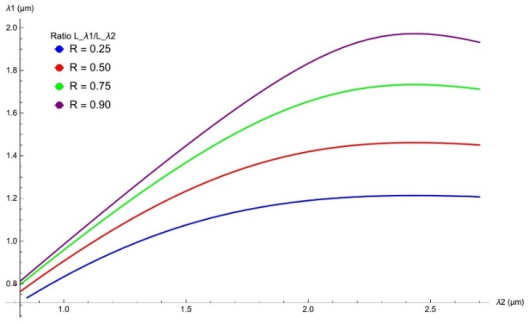
For each value of λ2 ranging from 0.7 to 2.5 µm, that is the near-infrared band, the corresponding wavelength λ1 is determined numerically by solving this ratio. Calculations show that λ1 is always less than λ2.
4.1. Selection of the Two Wavelengths Based on the Ratio of the Two Fluxes
The analysis of wavelength selection optimization for the bichromatic pyrometer focuses on determining the optimal separation between the two wavelengths used to measure the temperature of molten steel at 1373.15 K. The principle relies on measuring the ratio of radiant fluxes at two closely spaced wavelengths (λ1 and λ2). The objective is to identify wavelength pairs that minimize measurement error while remaining within the technologically feasible range of 0.7 µm to 3 µm. The wavelength differences are illustrated in the figure below for flux ratios of 0.25, 0.50, 0.75, and 0.90.
4.2. Flux Ratio Versus the Difference Between the Two Wavelengths
The figure below is derived using the results from Section 4.1 regarding the selection of the two wavelengths based on the flux ratio and Equation (
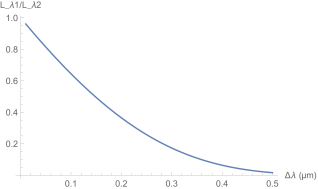
6). The ratio of the two spectral radiances (based on Planck's law applied to a real body) is expressed as a function of the separation between the two wavelengths, λ
1 and λ
2.
Figure 2. Optimal pairs (λ1, λ2) for different values of the ratio of the two fluxes.
Figure 3. Ratio of the two fluxes as a function of Δλ, with λ2 fixed at 1.2 µm.
4.3. Measurement Sensitivity
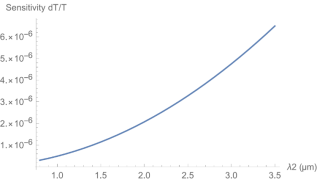
Figure 4. Ratio relative error dT/T as a function of λ2.
The amplification factor for measurement errors in the luminance ratio is plotted as a function of the choice of λ
2, since the value of the first wavelength depends on the second. Understanding the characteristics of this error is important for determining the optimal values for both wavelengths
| [17] | Jinlong Chen, Yongcai Guo, Dongying Wang, Shaoqian Xue, Min Jiao, Chao Gao, A data processing method for two-Color pyrometers in accurate temperature measurement of high-temperature flow fields. 2025, 243, 116431.
https://www.sciencedirect.com/science/article/pii/S0263224124023169 |
| [18] | Zongju Yang, Bo Wang, Jingmin Dai, Zhijian Hu, Development of multi-spectral pyrometer for measuring cathode surface temperature of pulsed vacuum arc discharge.
https://www.sciencedirect.com/science/article/pii/S2211379723008070 |
[17, 18]
.
5. Discussion of the Results
For each λ2, the corresponding λ1 is determined such that the flux ratio L_λ1/L_λ2 equals 0.25, 0.50, 0.75, or 0.90. The closer the ratio of the two fluxes generated at wavelengths λ1 and λ2, respectively is to the upper limit (i.e., close to 1), the more linear the curve of the difference λ2 – λ1 becomes for λ2 values below 2.5 µm. Within this λ2 range, lower ratios exhibit less linearity in the difference between the two wavelengths compared to ratios close to 1.
The ratio decreases almost exponentially with Δλ:
1) For Δλ = 0.01 µm, the ratio is 0.95, very close to 1; the risk of error is high, as the two signals are nearly equal.
2) For Δλ = 0.18 µm, R = 0.45; this allows for an optimal value regarding the two wavelengths.
3) For Δλ = 0.5 µm, R = 0.05; noise immunity reaches its lower limit because the ratio of the two fluxes from the two wavelengths is too low.
At wavelengths below 2 µm, the sensitivity follows a non-linear polynomial curve with very low relative error. Preferably, the second wavelength λ2 lies within the near-infrared band, and λ1 is calculated and based on its value. The goal is to achieve a configuration that offers the best compromise between thermal sensitivity (significant variation of luminance with the temperature T), emissivity stability (λ1 and λ2 being close), low sensitivity to measurement errors, and, above all, the availability of detectors in the relevant spectral band.
6. Conclusions
The method achieves a theoretical temperature accuracy of around 0.1%, which is sufficient for the industrial control of steelmaking processes.
It follows that the higher the flux ratio, the more one error term can be disregarded relative to the other, thereby reducing the error in the temperature measurement.
While the two-color pyrometer is not the most theoretically accurate method for real bodies, it represents the optimal solution from a techno-economic standpoint. It offers the best balance between measurement speed, implementation cost, and partial robustness against signal disturbances (provided these are non-selective). It is therefore the preferred choice for industrial process control, where speed and simplicity are paramount.
Optimizing the selection of wavelengths minimizes measurement errors while addressing the requirements of the various criteria.
Abbreviations
TNL | Temperature via Non-Linear Model |
TXY | Parameters T, X, et Y to Be Estimated |
Acknowledgments
We express sincere gratitude to the electronic engineering department teams at the Polytechnical High School of Antsirabe at the University of Vakinankaratra, and the team of Polytechnical High School of Antananarivo leaded by Doctor Guy Danielson, and Doctoral School of Science ond Technology of Engineering and Innovation, University of Antananarivo leaded by Professor Rivo Mahandrisoa Randriamaroson.
Author Contributions
Ratianarivo Paul Ezekel: Conceptualization, Investigation, Methodology, Resources, Visualization, Writing – original draft, Writing – review & editing
Andrianjanahary Olinirina Theophile: Data curation, Resources, Software
Rastefano Elisee: Project administration, Supervision, Validation
Data Availability Statement
The data is available from the corresponding author upon reasonable request.
Conflicts of Interest
The authors declare no conflicts of interest.
References
| [1] |
P. E Ratianarivo, T. Ra. zafindratsira, E. Rastefano. Efficiency of Multispectral Pyrometer Technology in the Infrared Spectral Band According to Planck's Law on the Real Body in the Case of Oxidized Steels. Journal of Electrical and Electronic Engineering. 2026, 14(3), 129–134.
https://doi.org/10.11648/j.jeee.20261403.11
|
| [2] |
P. E. RATIANARIVO, Optimization of wavelength selection for a quadraspectral pyrometer for the austenitization of steels, Ph.D. Thesis, University of Antananarivo, 2018.
|
| [3] |
Th. Duvaut, Comparison between multiwavelength infrared and visible pyrometry: Application to metals, Infrared Physics & Technology, 2008, 51, 292–299
https://www.sciencedirect.com/science/article/pii/S1350449507001375
|
| [4] |
Sama Badr Aljohani, Ibrahim A. Alshunaifi, Naif B. Alqahtani, and Bader A. Alfarraj, Comparison of a two-wavelength pyrometer system and spectral pyrometry for high-temperature measurements. Applied Optics. 2024, 63(13), 3648-3657.
https://doi.org/10.1364/AO.522898
|
| [5] |
Tairan Fu, Jiangfan Liu, and Anzhou Zong. Radiation temperature measurement method for semitransparent materials using one-channel infrared pyrometer. Applied Optics. 2014, 53(29), 6830-6839.
https://doi.org/10.1364/AO.53.006830
|
| [6] |
Yunwei Huang, Jianyu Long, Dengfu Chen, Mujun Long, Zhe Yang, and Chuan Li. Temperature errors in two-color pyrometry simultaneously considering reflection and combustion gas radiation. Applied Optics. 2021, 29(16), 25084-25099.
https://doi.org/10.1364/OE.433942
|
| [7] |
P. E Ratianarivo, E. Rastefano, Characteristics of Optimal Wavelength Selection for the Quadrispectral Pyrometer in the NearInfrared Spectral Range Made for Austenization of Steels. International Journal of Advanced Research in Electrical, Electronics and Instrumentation Engineering. 2025, 14(11), 3751-3763.
https://doi.org/10.15662/ijareeie.2025.1411006
|
| [8] |
P. E Ratianarivo, E. Rastefano, Limit of the Bichromatic Pyrometer for Determining the Temperature of a Metal. International Journal of Advanced Research in Electrical, Electronics and Instrumentation Engineering. 2025, 14(10), 3386-3391.
https://doi.org/10.15662/ijareeie.2025.1410001
|
| [9] |
Tairan Fu, Minghao Duan, Jiaqi Tang, Cong ling Shi, Measurements of the directional spectral emissivity based on a radiation heating source with alternating spectral distributions. International Journal of Heat and Mass Transfer. 90 (2015) 1207–1213.
https://www.sciencedirect.com/science/article/pii/S001793101500784X
|
| [10] |
M. Boivineau, G. Pottlacher, Thermophysical properties of metals at very high temperatures obtained by dynamic heating techniques: recent advances,
https://www.inderscienceonline.com/doi/pdf/10.1504/IJMPT.2006.009468
|
| [11] |
A Barlier-Salsi, Stray light correction on array spectroradiometers for optical radiation risk assessment in the workplace, Journal of Radiological Protection. 34 (2014): 915–930.
https://doi.org/10.1088/0952-4746/34/4/915
|
| [12] |
Tairan Fu, Jiangfan Liu, Minghao Duan, Anzhou Zong, Temperature measurements using multicolor pyrometry in thermal radiation heating environments. Review of Scientific Instruments. 85, 044901 (2014).
https://doi.org/10.1063/1.4870252
|
| [13] |
Christophe Rodiet, Benjamin Rémy, Alain Degiovanni, Franck Demeurie, – Optimisation of wavelengths selection used for the multi-spectral temperature measurement by ordinary least squares method of surfaces exhibiting non-uniform emissivity. Quantitative InfraRed Thermography. 2013, 10(2), 222–236.
https://www.tandfonline.com/doi/abs/10.1080/17686733.2013.812816
|
| [14] |
Antonio Araujo, Dual-band pyrometry for emissivity and temperature measurements of gray surfaces at ambient temperature: The effect of pyrometer and background temperature uncertainties. Measurement. 94 (2016), 316–325.
https://www.sciencedirect.com/science/article/pii/S0263224116304687
|
| [15] |
Philippe Herve, Julie Cedelle, Ionut Negreanu, Infrared technique for simultaneous determination of temperature and emissivity. Infrared Physics & Technology. 55 (2012), 1–10.
https://www.sciencedirect.com/science/article/pii/S1350449510000721
|
| [16] |
Christophe Rodiet, Benjamin Remy, Alain Degiovanni, Optimal wavelengths obtained from laws analogous to the Wien’s law for monospectral and bispectral methods, and general methodology for multispectral temperature measurements taking into account global transfer function including non-uniform emissivity of surfaces. Infrared Physics & Technology. 76 (2016), 444–454.
https://www.sciencedirect.com/science/article/pii/S1350449516300147
|
| [17] |
Jinlong Chen, Yongcai Guo, Dongying Wang, Shaoqian Xue, Min Jiao, Chao Gao, A data processing method for two-Color pyrometers in accurate temperature measurement of high-temperature flow fields. 2025, 243, 116431.
https://www.sciencedirect.com/science/article/pii/S0263224124023169
|
| [18] |
Zongju Yang, Bo Wang, Jingmin Dai, Zhijian Hu, Development of multi-spectral pyrometer for measuring cathode surface temperature of pulsed vacuum arc discharge.
https://www.sciencedirect.com/science/article/pii/S2211379723008070
|
Cite This Article
-
APA Style
Ezekel, R. P., Theophile, A. O., Elisee, R. (2026). Optimization of Wavelength Selection for a Two-Color Pyrometer Based on the Flux Ratio and Planck's Law on Real Body. Journal of Electrical and Electronic Engineering, 14(4), 190-195. https://doi.org/10.11648/j.jeee.20261404.11
 Copy
|
Copy
|
 Download
ACS Style
Ezekel, R. P.; Theophile, A. O.; Elisee, R. Optimization of Wavelength Selection for a Two-Color Pyrometer Based on the Flux Ratio and Planck's Law on Real Body. J. Electr. Electron. Eng. 2026, 14(4), 190-195. doi: 10.11648/j.jeee.20261404.11
Copy
|
Download
AMA Style
Ezekel RP, Theophile AO, Elisee R. Optimization of Wavelength Selection for a Two-Color Pyrometer Based on the Flux Ratio and Planck's Law on Real Body. J Electr Electron Eng. 2026;14(4):190-195. doi: 10.11648/j.jeee.20261404.11
Copy
|
Download
-
@article{10.11648/j.jeee.20261404.11,
  author = {Ratianarivo Paul Ezekel and Andrianjanahary Olinirina Theophile and Rastefano Elisee},
  title = {Optimization of Wavelength Selection for a Two-Color Pyrometer Based on the Flux Ratio and Planck's Law on Real Body},
  journal = {Journal of Electrical and Electronic Engineering},
  volume = {14},
  number = {4},
  pages = {190-195},
  doi = {10.11648/j.jeee.20261404.11},
  url = {https://doi.org/10.11648/j.jeee.20261404.11},
  eprint = {https://article.sciencepublishinggroup.com/pdf/10.11648.j.jeee.20261404.11},
  abstract = {This article examines a methodical analysis for optimizing the wavelength selection used for the two channels of a bichromatic pyrometer. Temperature measurement via pyrometry relies on analyzing the radiation emitted by a body at various wavelengths, enabling non-contact thermal assessment. Several laws mathematically characterize this thermal radiation: Lambert’s law, which states that radiance is independent of the emission direction, and Planck’s law, which allows for the calculation of the body's radiation energy density. The bichromatic pyrometer utilizes distinct wavelengths; it consists of two separate spectral filter channels and two detectors with different spectral sensitivities, each followed by its own analog processing electronics. The two signals representing the thermal radiation undergo this analog processing before being combined through digital processing. A crucial step is selecting the wavelengths for the two spectral filters. Depending on the approach, calculations for a bichromatic pyrometer can be based either on the flux ratio combined with Wien’s approximation or on the flux ratio combined with Planck’s law, with each approach offering a different level of compensation for emissivity variations. In our case, the second method, that is to say the flux ratio using Planck's law will be used. This method applies Planck’s law to a real body by modeling emissivity as a second-degree polynomial. By varying the ratio value, we can calculate pairs of wavelengths based on their difference; this difference is then evaluated against relative errors to determine how to optimize the selected wavelengths. Optimizing wavelength selection in the bispectral system, by using two wavelengths simultaneously, improves the accuracy of temperature estimation and enables more reliable modeling of the materials' spectral behavior.},
 year = {2026}
}
Copy
|
Download
-
TY  - JOUR
T1  - Optimization of Wavelength Selection for a Two-Color Pyrometer Based on the Flux Ratio and Planck's Law on Real Body
AU  - Ratianarivo Paul Ezekel
AU  - Andrianjanahary Olinirina Theophile
AU  - Rastefano Elisee
Y1  - 2026/08/10
PY  - 2026
N1  - https://doi.org/10.11648/j.jeee.20261404.11
DO  - 10.11648/j.jeee.20261404.11
T2  - Journal of Electrical and Electronic Engineering
JF  - Journal of Electrical and Electronic Engineering
JO  - Journal of Electrical and Electronic Engineering
SP  - 190
EP  - 195
PB  - Science Publishing Group
SN  - 2329-1605
UR  - https://doi.org/10.11648/j.jeee.20261404.11
AB  - This article examines a methodical analysis for optimizing the wavelength selection used for the two channels of a bichromatic pyrometer. Temperature measurement via pyrometry relies on analyzing the radiation emitted by a body at various wavelengths, enabling non-contact thermal assessment. Several laws mathematically characterize this thermal radiation: Lambert’s law, which states that radiance is independent of the emission direction, and Planck’s law, which allows for the calculation of the body's radiation energy density. The bichromatic pyrometer utilizes distinct wavelengths; it consists of two separate spectral filter channels and two detectors with different spectral sensitivities, each followed by its own analog processing electronics. The two signals representing the thermal radiation undergo this analog processing before being combined through digital processing. A crucial step is selecting the wavelengths for the two spectral filters. Depending on the approach, calculations for a bichromatic pyrometer can be based either on the flux ratio combined with Wien’s approximation or on the flux ratio combined with Planck’s law, with each approach offering a different level of compensation for emissivity variations. In our case, the second method, that is to say the flux ratio using Planck's law will be used. This method applies Planck’s law to a real body by modeling emissivity as a second-degree polynomial. By varying the ratio value, we can calculate pairs of wavelengths based on their difference; this difference is then evaluated against relative errors to determine how to optimize the selected wavelengths. Optimizing wavelength selection in the bispectral system, by using two wavelengths simultaneously, improves the accuracy of temperature estimation and enables more reliable modeling of the materials' spectral behavior.
VL  - 14
IS  - 4
ER  -
Copy
|
Download








 Share This Article
 Twitter
 Linked In
 Facebook