Abstract
Ethiopia hosts substantial bentonite resources totaling over 141.5 million tonnes, distributed across the Cenozoic Afar Depression and the Main Ethiopian Rift. This comprehensive review systematically synthesizes the geological occurrence, mineralogical and chemical characteristics, physical properties, industrial application suitability, and development potential of Ethiopian bentonite deposits. Major deposits include Gewane (77.03 Mm3 / ~70 Mt), Warseiso (7.01 Mm3), Ledi (1.78 Mm3), Hadar Basin (Kada Hadar & Ounda Hadar, 0.93 Mm3), and Gidicho Island (>9.4 Mt / 3.46 Mm3), all formed through the low-temperature alteration and diagenesis of Cenozoic volcanic ash and vitric tuff in alkaline lacustrine environments. Mineralogically, X-ray diffraction (XRD) demonstrates that Ethiopian bentonites are predominantly calcium montmorillonite (Ca-montmorillonite) accompanied by minor kaolinite, quartz, albite, and trace zeolites. Complete major oxide geochemistry by XRF reveals SiO2 contents ranging from 48.78% to 61.93% and Al2O3 from 11.06% to 16.40%, with distinct Na2O/CaO zonation reflecting alkaline depositional water chemistry. Physicochemical testing indicates exceptionally high cation exchange capacity (CEC) values ranging from 77.0 meq/100g (Gidicho) to 82.1 meq/100g (Warseiso), exceeding standard commercial calcium bentonites. Natural swelling indices reach 17.1 mL/2g for Gidicho bentonite, which competes closely with international drilling-mud benchmarks. Beneficiation and chemical activation pathways including sodium carbonate activation for API 13A drilling muds, acid activation (0.8M HCl) for bleaching earth and catalysis, and thermal activation (300°C) for surface area expansion (increasing from 57.6 to 81.74 m2/g) substantially upgrade industrial performance. Systematic evaluation against international standards (API 13A/ISO 13500, UNIDO, JB/T 9227) confirms high suitability for drilling fluids, foundry sands, iron-ore pelletizing, civil engineering sealants, and environmental sorbents. Strategic domestic exploitation can completely replace expensive imports, conserve foreign currency, foster regional industrial growth, and drive value-added mineral export development in East Africa.
|
Published in
|
Journal of Energy and Natural Resources (Volume 15, Issue 4)
|
|
DOI
|
10.11648/j.jenr.20261504.11
|
|
Page(s)
|
81-93 |
|
Creative Commons
|

This is an Open Access article, distributed under the terms of the Creative Commons Attribution 4.0 International License (http://creativecommons.org/licenses/by/4.0/), which permits unrestricted use, distribution and reproduction in any medium or format, provided the original work is properly cited.
|
|
Copyright
|
Copyright © The Author(s), 2026. Published by Science Publishing Group
|
Keywords
Bentonite, Montmorillonite, Afar Depression, Industrial Minerals, Acid Activation
1. Introduction
Bentonite is a versatile industrial clay mineral composed predominantly of smectite-group minerals, primarily montmorillonite
| [1] | Murray, H. Applied Clay Mineralogy: Occurrences, Processing and Application of Kaolins, Bentonites, Palygorskite-Sepiolite, and Common Clays. Elsevier, 2007.
https://doi.org/10.1007/BF03406033 |
| [2] | Grim, R. E. Clay Mineralogy, 2nd ed. McGraw-Hill, 1968. |
[1, 2]
. Its unique physicochemical properties including a high specific surface area, permanent layer charge, significant cation exchange capacity (CEC), thixotropic rheology, and remarkable hydration and swelling capacity make it an indispensable raw material in oil and gas drilling, foundry sand binding, iron-ore pelletizing, edible oil refining (bleaching earth), civil engineering barriers, agriculture, and wastewater remediation
| [1] | Murray, H. Applied Clay Mineralogy: Occurrences, Processing and Application of Kaolins, Bentonites, Palygorskite-Sepiolite, and Common Clays. Elsevier, 2007.
https://doi.org/10.1007/BF03406033 |
| [2] | Grim, R. E. Clay Mineralogy, 2nd ed. McGraw-Hill, 1968. |
| [3] | Berhe, M. T., Berhe, G. G., Cheru, M. S., Weldehans, M. G., Bhoi, N. K. Characterization of Acid Activation of Bentonite Clay of Hadar, Afar, Ethiopia. Advances in Applied Sciences. 2024, 9(2), 34-45. https://doi.org/10.1155/2024/6413786 |
| [4] | Christidis, G. E. Formation of Smectites in Bentonites from the Eastern Mediterranean: A Review. Clay Minerals. 2001, 36(3), 387-405. https://doi.org/10.2113/gselements.5.2.93 |
[1-4]
. The fundamental performance of bentonite in these diverse industrial applications is governed by the structural characteristics of its smectite constituent, particularly the nature of the dominant exchangeable interlayer cation (Na
+ vs. Ca
2+) and the degree of layer charge substitution
| [1] | Murray, H. Applied Clay Mineralogy: Occurrences, Processing and Application of Kaolins, Bentonites, Palygorskite-Sepiolite, and Common Clays. Elsevier, 2007.
https://doi.org/10.1007/BF03406033 |
| [5] | Xu, Y. F., Matsuoka, H. Swelling Characteristics of Fractal-Textured Bentonite and Its Mixtures. Applied Clay Science. 2003, 22(4), 197-209.
https://doi.org/10.1016/S0169-1317(02)00159-X |
[1, 5]
.
In Ethiopia, extensive Cenozoic volcanism associated with the evolution of the East African Rift System (EARS) created ideal conditions for the formation of substantial bentonite deposits
| [6] | Tadesse, S., Milesi, J.-P., Deschamps, Y. Geology and Mineral Potential of Ethiopia: A Note on Geology and Mineral Map of Ethiopia. Journal of African Earth Sciences. 2003, 36, 273-313. https://doi.org/10.1016/S0899-5362(03)00048-4 |
| [7] | Mesfin, T. The Occurrence of Bentonite in Ethiopia: Bentonite Promotion Document. Ethiopian Geological Survey, Addis Ababa, Ethiopia, 2012.
https://doi.org/10.31080/ASAG.2019.03.0652 |
| [8] | Mekonnen, E., Meshesha, D., Chekol, T., et al. Mineralogical and Physicochemical Characterization of Bentonite Deposit of Gidicho Island in Lake Abaya, Southern Main Ethiopian Rift. Applied Earth Science. 2025, 134(2), 83-98.
https://doi.org/10.1177/25726838251335897 |
[6-8]
. Explosive pyroclastic eruptions deposited vast blankets of vitric volcanic ash and tuff into alkaline lacustrine and fluvio-lacustrine basins throughout the Afar Depression and the Main Ethiopian Rift (MER)
| [6] | Tadesse, S., Milesi, J.-P., Deschamps, Y. Geology and Mineral Potential of Ethiopia: A Note on Geology and Mineral Map of Ethiopia. Journal of African Earth Sciences. 2003, 36, 273-313. https://doi.org/10.1016/S0899-5362(03)00048-4 |
| [9] | Bekele, E., Ayenew, T., Kebede, S. Mineral Resources of the Afar Depression, Ethiopia. Journal of African Earth Sciences. 2014, 99, 1-15. |
[6, 9]
. Subsequent diagenetic and low-temperature hydrothermal alteration converted these volcanic glass precursor materials into extensive smectite-rich clay horizons
| [3] | Berhe, M. T., Berhe, G. G., Cheru, M. S., Weldehans, M. G., Bhoi, N. K. Characterization of Acid Activation of Bentonite Clay of Hadar, Afar, Ethiopia. Advances in Applied Sciences. 2024, 9(2), 34-45. https://doi.org/10.1155/2024/6413786 |
| [7] | Mesfin, T. The Occurrence of Bentonite in Ethiopia: Bentonite Promotion Document. Ethiopian Geological Survey, Addis Ababa, Ethiopia, 2012.
https://doi.org/10.31080/ASAG.2019.03.0652 |
[3, 7]
. Historical exploration by the Geological Survey of Ethiopia (GSE) and the United Nations Industrial Development Organization (UNIDO) established a combined calculated reserve of over 86 million m
3 (~140 million tonnes) across major deposits including Gewane, Warseiso, Ledi, Hadar, and Gidicho Island
| [7] | Mesfin, T. The Occurrence of Bentonite in Ethiopia: Bentonite Promotion Document. Ethiopian Geological Survey, Addis Ababa, Ethiopia, 2012.
https://doi.org/10.31080/ASAG.2019.03.0652 |
| [9] | Bekele, E., Ayenew, T., Kebede, S. Mineral Resources of the Afar Depression, Ethiopia. Journal of African Earth Sciences. 2014, 99, 1-15. |
| [10] | UNIDO. Technical Report on Bentonite for Bleaching Earth Production. United Nations Industrial Development Organization (Document IP/ET/86/002), 1986. |
[7, 9, 10]
. Recent field mapping and laboratory characterizations have further expanded this resource base with new discoveries in Chacha (Amhara Region), Burji (Southern Ethiopia), and Degele Ruso (Wolayta/Arba Minch)
| [11] | Misgana, A. Application of Montmorillonite Type Bentonite Clay from Chacha Area as Alternative for Local Construction Material. Unpublished Research Thesis, Addis Ababa University, 2023. |
| [12] | Tibebu, M., Fantaw, H. M. Industrial Minerals and Rocks Resource Potential of Ethiopia. Geological Survey of Ethiopia, Addis Ababa, 2002. |
| [13] | Yonas Hordofa, Yohaness Belechewu. Reconnaissance Survey for Industrial Mineral Exploration in Wolliata and Arba Minch Area. Geological Institute of Ethiopia (GIE), Unpublished Report, 2025. |
[11-13]
.
Despite hosting these massive industrial mineral reserves, Ethiopia historically imported thousands of tonnes of processed bentonite and activated bleaching earth annually to meet the growing demands of its domestic petroleum exploration, edible oil refining, steel casting, and construction sectors
| [7] | Mesfin, T. The Occurrence of Bentonite in Ethiopia: Bentonite Promotion Document. Ethiopian Geological Survey, Addis Ababa, Ethiopia, 2012.
https://doi.org/10.31080/ASAG.2019.03.0652 |
| [14] | UNIDO. Mineral Resources of Ethiopia: An Assessment of the Industrial Mineral Potential. United Nations Industrial Development Organization (Document IP/ET/83/001), 1983. |
[7, 14]
. This reliance on imported bentonite represents a substantial drain on foreign currency reserves. Unlocking the full economic potential of Ethiopian bentonite requires a rigorous, integrated understanding of deposit geology, spatial distribution, smectite mineralogy, complete major-oxide geochemistry, and physical performance metrics, coupled with targeted beneficiation and chemical activation technologies
| [3] | Berhe, M. T., Berhe, G. G., Cheru, M. S., Weldehans, M. G., Bhoi, N. K. Characterization of Acid Activation of Bentonite Clay of Hadar, Afar, Ethiopia. Advances in Applied Sciences. 2024, 9(2), 34-45. https://doi.org/10.1155/2024/6413786 |
| [8] | Mekonnen, E., Meshesha, D., Chekol, T., et al. Mineralogical and Physicochemical Characterization of Bentonite Deposit of Gidicho Island in Lake Abaya, Southern Main Ethiopian Rift. Applied Earth Science. 2025, 134(2), 83-98.
https://doi.org/10.1177/25726838251335897 |
| [15] | Musie, W., Gonfa, G. Thermal Activation, Characterization and Performance Evaluation of Ethiopian Bentonite for Sodium Removal. Water Science and Technology. 2023, 87(4), 998-1008. https://doi.org/10.2166/wst.2023.031 |
[3, 8, 15]
.
This review systematically synthesizes available geological, mineralogical, chemical, and technological datasets for Ethiopian bentonite deposits. The principal objectives are to: (1) evaluate the regional geological framework and deposit genesis; (2) detail the spatial distribution and resource tonnage of major and emerging deposits; (3) characterize smectite mineralogy, major oxide geochemistry, CEC, and swelling behavior; (4) evaluate raw and activated bentonites against international industrial standards (API 13A, ISO 13500, UNIDO, JB/T 9227); (5) outline optimal beneficiation and activation pathways (sodium, acid, and thermal processing); and (6) analyze market dynamics, import substitution opportunities, and strategic development recommendations.
2. Regional Geological Framework and Deposit Genesis
2.1. Tectonic Architecture and Rift Volcanism
The geological architecture of Ethiopia is defined by Precambrian basement rocks overlain locally by Mesozoic sedimentary successions and extensive Cenozoic volcanic and sedimentary sequences associated with the East African Rift System
| [6] | Tadesse, S., Milesi, J.-P., Deschamps, Y. Geology and Mineral Potential of Ethiopia: A Note on Geology and Mineral Map of Ethiopia. Journal of African Earth Sciences. 2003, 36, 273-313. https://doi.org/10.1016/S0899-5362(03)00048-4 |
| [8] | Mekonnen, E., Meshesha, D., Chekol, T., et al. Mineralogical and Physicochemical Characterization of Bentonite Deposit of Gidicho Island in Lake Abaya, Southern Main Ethiopian Rift. Applied Earth Science. 2025, 134(2), 83-98.
https://doi.org/10.1177/25726838251335897 |
[6, 8]
. The evolution of the Ethiopian Rift involved major phases of plume-related continental rifting and intense volcanism. According to Kazmin (1975), significant volcanic episodes occurred during the Oligocene (~30–31 Ma), the Miocene (~16–20 Ma), and the Pliocene to Quaternary
| [16] | Kazmin, V. The Geology of Ethiopia. In Eritrea and Ethiopia: A Bibliographic Guide. Geological Survey of Ethiopia, 1975. |
[16]
. These volcanic pulses generated enormous volumes of rhyolitic, dacitic, and basaltic lavas, pyroclastic flows, vitric tuffs, and volcanic ash
| [6] | Tadesse, S., Milesi, J.-P., Deschamps, Y. Geology and Mineral Potential of Ethiopia: A Note on Geology and Mineral Map of Ethiopia. Journal of African Earth Sciences. 2003, 36, 273-313. https://doi.org/10.1016/S0899-5362(03)00048-4 |
| [16] | Kazmin, V. The Geology of Ethiopia. In Eritrea and Ethiopia: A Bibliographic Guide. Geological Survey of Ethiopia, 1975. |
[6, 16]
. Tectonic extension created NNE-trending normal faults and asymmetric grabens that trapped thick volcano-sedimentary sequences
| [7] | Mesfin, T. The Occurrence of Bentonite in Ethiopia: Bentonite Promotion Document. Ethiopian Geological Survey, Addis Ababa, Ethiopia, 2012.
https://doi.org/10.31080/ASAG.2019.03.0652 |
| [8] | Mekonnen, E., Meshesha, D., Chekol, T., et al. Mineralogical and Physicochemical Characterization of Bentonite Deposit of Gidicho Island in Lake Abaya, Southern Main Ethiopian Rift. Applied Earth Science. 2025, 134(2), 83-98.
https://doi.org/10.1177/25726838251335897 |
[7, 8]
.
2.2. Depositional Environments and Hydrothermal Alteration
Ethiopian bentonites formed primarily through the diagenetic transformation and low-temperature alteration of glassy volcanic ash and tuff deposited in closed, alkaline lacustrine to fluvio-lacustrine environments
| [3] | Berhe, M. T., Berhe, G. G., Cheru, M. S., Weldehans, M. G., Bhoi, N. K. Characterization of Acid Activation of Bentonite Clay of Hadar, Afar, Ethiopia. Advances in Applied Sciences. 2024, 9(2), 34-45. https://doi.org/10.1155/2024/6413786 |
| [7] | Mesfin, T. The Occurrence of Bentonite in Ethiopia: Bentonite Promotion Document. Ethiopian Geological Survey, Addis Ababa, Ethiopia, 2012.
https://doi.org/10.31080/ASAG.2019.03.0652 |
| [9] | Bekele, E., Ayenew, T., Kebede, S. Mineral Resources of the Afar Depression, Ethiopia. Journal of African Earth Sciences. 2014, 99, 1-15. |
[3, 7, 9]
. In the Afar Depression and Main Ethiopian Rift, volcanic ash falling into alkaline, silica-saturated lake waters underwent glass hydrolysis and hydration reactions
| [8] | Mekonnen, E., Meshesha, D., Chekol, T., et al. Mineralogical and Physicochemical Characterization of Bentonite Deposit of Gidicho Island in Lake Abaya, Southern Main Ethiopian Rift. Applied Earth Science. 2025, 134(2), 83-98.
https://doi.org/10.1177/25726838251335897 |
| [15] | Musie, W., Gonfa, G. Thermal Activation, Characterization and Performance Evaluation of Ethiopian Bentonite for Sodium Removal. Water Science and Technology. 2023, 87(4), 998-1008. https://doi.org/10.2166/wst.2023.031 |
[8, 15]
. The dissolution of volcanic glass released Si⁴
+, Al
3+, Na
+, K
+, Ca
2+, and Mg
2+ into pore waters. Under alkaline conditions (pH 8.5–10) with restricted drainage and high Mg
2+/Ca
2+ activity, smectite minerals (dioctahedral montmorillonite) precipitated rapidly as the primary stable phase
| [1] | Murray, H. Applied Clay Mineralogy: Occurrences, Processing and Application of Kaolins, Bentonites, Palygorskite-Sepiolite, and Common Clays. Elsevier, 2007.
https://doi.org/10.1007/BF03406033 |
| [3] | Berhe, M. T., Berhe, G. G., Cheru, M. S., Weldehans, M. G., Bhoi, N. K. Characterization of Acid Activation of Bentonite Clay of Hadar, Afar, Ethiopia. Advances in Applied Sciences. 2024, 9(2), 34-45. https://doi.org/10.1155/2024/6413786 |
| [5] | Xu, Y. F., Matsuoka, H. Swelling Characteristics of Fractal-Textured Bentonite and Its Mixtures. Applied Clay Science. 2003, 22(4), 197-209.
https://doi.org/10.1016/S0169-1317(02)00159-X |
[1, 3, 5]
. Local low-temperature hydrothermal activity associated with active rift faulting further promoted smectite crystallization and pore-space alteration
| [7] | Mesfin, T. The Occurrence of Bentonite in Ethiopia: Bentonite Promotion Document. Ethiopian Geological Survey, Addis Ababa, Ethiopia, 2012.
https://doi.org/10.31080/ASAG.2019.03.0652 |
| [8] | Mekonnen, E., Meshesha, D., Chekol, T., et al. Mineralogical and Physicochemical Characterization of Bentonite Deposit of Gidicho Island in Lake Abaya, Southern Main Ethiopian Rift. Applied Earth Science. 2025, 134(2), 83-98.
https://doi.org/10.1177/25726838251335897 |
[7, 8]
.
3. Geological Characteristics and Deposit Distribution
Ethiopian bentonite deposits are primarily concentrated in two major rift provinces: the Afar Depression in northeastern Ethiopia and the Main Ethiopian Rift (MER) in the south-central part of the country
| [7] | Mesfin, T. The Occurrence of Bentonite in Ethiopia: Bentonite Promotion Document. Ethiopian Geological Survey, Addis Ababa, Ethiopia, 2012.
https://doi.org/10.31080/ASAG.2019.03.0652 |
| [8] | Mekonnen, E., Meshesha, D., Chekol, T., et al. Mineralogical and Physicochemical Characterization of Bentonite Deposit of Gidicho Island in Lake Abaya, Southern Main Ethiopian Rift. Applied Earth Science. 2025, 134(2), 83-98.
https://doi.org/10.1177/25726838251335897 |
[7, 8]
. In addition, recent geological reconnaissance has identified active commercial deposits in the Amhara Region, along with emerging prospects in Southern Ethiopia
| [11] | Misgana, A. Application of Montmorillonite Type Bentonite Clay from Chacha Area as Alternative for Local Construction Material. Unpublished Research Thesis, Addis Ababa University, 2023. |
| [12] | Tibebu, M., Fantaw, H. M. Industrial Minerals and Rocks Resource Potential of Ethiopia. Geological Survey of Ethiopia, Addis Ababa, 2002. |
[11, 12]
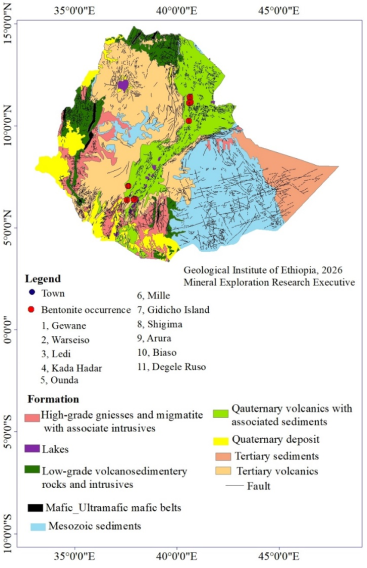
, as illustrated in
Table 1 and
Figure 1.
3.1. Gewane Deposit
The Gewane deposit, located in the Afar Regional State, represents the largest single bentonite resource documented in Ethiopia
| [7] | Mesfin, T. The Occurrence of Bentonite in Ethiopia: Bentonite Promotion Document. Ethiopian Geological Survey, Addis Ababa, Ethiopia, 2012.
https://doi.org/10.31080/ASAG.2019.03.0652 |
| [9] | Bekele, E., Ayenew, T., Kebede, S. Mineral Resources of the Afar Depression, Ethiopia. Journal of African Earth Sciences. 2014, 99, 1-15. |
| [10] | UNIDO. Technical Report on Bentonite for Bleaching Earth Production. United Nations Industrial Development Organization (Document IP/ET/86/002), 1986. |
[7, 9, 10]
. Bentonite beds are exposed over an extensive area along the Ambule, Kalhaitu, Aburagarsa, and Tathamatu river valleys
. The Ambule River section displays the most prominent bentonite horizon, reaching thicknesses between 10 and 22 m
| [7] | Mesfin, T. The Occurrence of Bentonite in Ethiopia: Bentonite Promotion Document. Ethiopian Geological Survey, Addis Ababa, Ethiopia, 2012.
https://doi.org/10.31080/ASAG.2019.03.0652 |
| [9] | Bekele, E., Ayenew, T., Kebede, S. Mineral Resources of the Afar Depression, Ethiopia. Journal of African Earth Sciences. 2014, 99, 1-15. |
[7, 9]
. Historical reserve evaluations by UNIDO (1986) established a proven volume of 77.0346 million m
3 (~70 million tonnes), with an average bed thickness of 11.83 m covering a surface area of approximately 6.51 million m
2 | [7] | Mesfin, T. The Occurrence of Bentonite in Ethiopia: Bentonite Promotion Document. Ethiopian Geological Survey, Addis Ababa, Ethiopia, 2012.
https://doi.org/10.31080/ASAG.2019.03.0652 |
| [10] | UNIDO. Technical Report on Bentonite for Bleaching Earth Production. United Nations Industrial Development Organization (Document IP/ET/86/002), 1986. |
[7, 10]
. The overburden averages 14.35 million m
3 (14,354,313 m
3), consisting of stratovolcanics, gravel, and fluvio-lacustrine sediments
. Gewane bentonite exhibits a light grey to cream color and high silica content (61.93% SiO
2)
| [7] | Mesfin, T. The Occurrence of Bentonite in Ethiopia: Bentonite Promotion Document. Ethiopian Geological Survey, Addis Ababa, Ethiopia, 2012.
https://doi.org/10.31080/ASAG.2019.03.0652 |
| [14] | UNIDO. Mineral Resources of Ethiopia: An Assessment of the Industrial Mineral Potential. United Nations Industrial Development Organization (Document IP/ET/83/001), 1983. |
[7, 14]
.
3.2. Warseiso Deposit
The Warseiso deposit is situated 1–3 km north of the Dessie–Assab highway between the Badona River and Warseiso in Afar
. The deposit occurs within a fluvio-lacustrine sedimentary sequence intercalated with rhyolite, basalt, volcanic ash, and gravel
. Five distinct bentonite blocks have been delineated, comprising grey to greenish-grey clay with low sand content
| [7] | Mesfin, T. The Occurrence of Bentonite in Ethiopia: Bentonite Promotion Document. Ethiopian Geological Survey, Addis Ababa, Ethiopia, 2012.
https://doi.org/10.31080/ASAG.2019.03.0652 |
| [15] | Musie, W., Gonfa, G. Thermal Activation, Characterization and Performance Evaluation of Ethiopian Bentonite for Sodium Removal. Water Science and Technology. 2023, 87(4), 998-1008. https://doi.org/10.2166/wst.2023.031 |
[7, 15]
. Total historical reserves are estimated at 7.00666 million m
3, with an average bed thickness of 5.58 m over a surface area of 1.26 million m
2, and 2.45 million m
3 of overburden
| [7] | Mesfin, T. The Occurrence of Bentonite in Ethiopia: Bentonite Promotion Document. Ethiopian Geological Survey, Addis Ababa, Ethiopia, 2012.
https://doi.org/10.31080/ASAG.2019.03.0652 |
| [10] | UNIDO. Technical Report on Bentonite for Bleaching Earth Production. United Nations Industrial Development Organization (Document IP/ET/86/002), 1986. |
[7, 10]
. Raw Warseiso bentonite possesses an exceptionally high CEC of 82.1 meq/100g
| [15] | Musie, W., Gonfa, G. Thermal Activation, Characterization and Performance Evaluation of Ethiopian Bentonite for Sodium Removal. Water Science and Technology. 2023, 87(4), 998-1008. https://doi.org/10.2166/wst.2023.031 |
[15]
.
3.3. Ledi Deposit
The Ledi occurrence lies ~20 km south of the Dessie junction near the Ledi River in Afar
. Four main occurrences are recognized, consisting of grey-green compact clay to brownish saline bentonitic beds
. An outcrop on the northern bank reaches 8.5 m in thickness with zero overburden, while the Huana River exposure averages 7.5 m
. The overall reserve is evaluated at 1.784 million m
3, with an average bed thickness of 3.20 m and 1.20 million m
3 of overburden
| [7] | Mesfin, T. The Occurrence of Bentonite in Ethiopia: Bentonite Promotion Document. Ethiopian Geological Survey, Addis Ababa, Ethiopia, 2012.
https://doi.org/10.31080/ASAG.2019.03.0652 |
| [10] | UNIDO. Technical Report on Bentonite for Bleaching Earth Production. United Nations Industrial Development Organization (Document IP/ET/86/002), 1986. |
[7, 10]
. Ledi bentonite contains elevated Na
2O (1.85%), reflecting a strong sodium-smectite tendency
.
3.4. Hadar Basin Deposits (Kada Hadar & Ounda Hadar)
The Hadar bentonite deposit occurs along the Kada Hadar and Ounda Hadar river valleys in the Hadar sedimentary basin (famous for the 'Lucy' hominin discovery), approximately 7 km from the Dessie–Assab highway via Ascoma village
| [3] | Berhe, M. T., Berhe, G. G., Cheru, M. S., Weldehans, M. G., Bhoi, N. K. Characterization of Acid Activation of Bentonite Clay of Hadar, Afar, Ethiopia. Advances in Applied Sciences. 2024, 9(2), 34-45. https://doi.org/10.1155/2024/6413786 |
| [7] | Mesfin, T. The Occurrence of Bentonite in Ethiopia: Bentonite Promotion Document. Ethiopian Geological Survey, Addis Ababa, Ethiopia, 2012.
https://doi.org/10.31080/ASAG.2019.03.0652 |
[3, 7]
. Bentonite beds (1.8–2.5 m thick, averaging 4.2 m) occur within Pliocene–Pleistocene lacustrine clays, silts, tuffs, and limestones
| [3] | Berhe, M. T., Berhe, G. G., Cheru, M. S., Weldehans, M. G., Bhoi, N. K. Characterization of Acid Activation of Bentonite Clay of Hadar, Afar, Ethiopia. Advances in Applied Sciences. 2024, 9(2), 34-45. https://doi.org/10.1155/2024/6413786 |
| [7] | Mesfin, T. The Occurrence of Bentonite in Ethiopia: Bentonite Promotion Document. Ethiopian Geological Survey, Addis Ababa, Ethiopia, 2012.
https://doi.org/10.31080/ASAG.2019.03.0652 |
[3, 7]
. The combined proven reserve is 0.92545 million m
3 (925,450 m
3), with ~0.925 million m
3 of overburden
| [7] | Mesfin, T. The Occurrence of Bentonite in Ethiopia: Bentonite Promotion Document. Ethiopian Geological Survey, Addis Ababa, Ethiopia, 2012.
https://doi.org/10.31080/ASAG.2019.03.0652 |
| [10] | UNIDO. Technical Report on Bentonite for Bleaching Earth Production. United Nations Industrial Development Organization (Document IP/ET/86/002), 1986. |
[7, 10]
. Hadar bentonite is characterized by Na
2O exceeding CaO (sodium bentonite tendency) and contains intermixed zeolites that enhance catalytic properties
| [3] | Berhe, M. T., Berhe, G. G., Cheru, M. S., Weldehans, M. G., Bhoi, N. K. Characterization of Acid Activation of Bentonite Clay of Hadar, Afar, Ethiopia. Advances in Applied Sciences. 2024, 9(2), 34-45. https://doi.org/10.1155/2024/6413786 |
[3]
.
3.5. Gidicho Island Deposit (Main Ethiopian Rift)
Located on Gidicho Island in Lake Abaya (Southern Main Ethiopian Rift), this deposit occurs within a Pleistocene lacustrine succession containing diatomite, silt, and diatomaceous earth
| [8] | Mekonnen, E., Meshesha, D., Chekol, T., et al. Mineralogical and Physicochemical Characterization of Bentonite Deposit of Gidicho Island in Lake Abaya, Southern Main Ethiopian Rift. Applied Earth Science. 2025, 134(2), 83-98.
https://doi.org/10.1177/25726838251335897 |
| [17] | Knoth, W., Abera, S. Report on Diatomite and Bentonite Clay on Gidicho Island, Lake Abaya. Ethiopian Institute of Geological Surveys (EIGS), Unpublished Report, 1983. |
[8, 17]
. Proven reserves total 9.41236 million tonnes (3.46286 million m
3)
| [7] | Mesfin, T. The Occurrence of Bentonite in Ethiopia: Bentonite Promotion Document. Ethiopian Geological Survey, Addis Ababa, Ethiopia, 2012.
https://doi.org/10.31080/ASAG.2019.03.0652 |
| [8] | Mekonnen, E., Meshesha, D., Chekol, T., et al. Mineralogical and Physicochemical Characterization of Bentonite Deposit of Gidicho Island in Lake Abaya, Southern Main Ethiopian Rift. Applied Earth Science. 2025, 134(2), 83-98.
https://doi.org/10.1177/25726838251335897 |
| [17] | Knoth, W., Abera, S. Report on Diatomite and Bentonite Clay on Gidicho Island, Lake Abaya. Ethiopian Institute of Geological Surveys (EIGS), Unpublished Report, 1983. |
[7, 8, 17]
. The complex includes three major sub-deposits: Shigima (5.700712 Mt), Biaso (3.298368 Mt), and Arura (0.413280 Mt)
| [7] | Mesfin, T. The Occurrence of Bentonite in Ethiopia: Bentonite Promotion Document. Ethiopian Geological Survey, Addis Ababa, Ethiopia, 2012.
https://doi.org/10.31080/ASAG.2019.03.0652 |
| [8] | Mekonnen, E., Meshesha, D., Chekol, T., et al. Mineralogical and Physicochemical Characterization of Bentonite Deposit of Gidicho Island in Lake Abaya, Southern Main Ethiopian Rift. Applied Earth Science. 2025, 134(2), 83-98.
https://doi.org/10.1177/25726838251335897 |
[7, 8]
. Gidicho bentonite is predominantly Ca-montmorillonite with a CEC of 77.0 meq/100g, a natural swelling index of 17.1 mL/2g, a bulk density of 1.64–1.67 g/cm
3, and specific gravity of 2.23–2.40
| [8] | Mekonnen, E., Meshesha, D., Chekol, T., et al. Mineralogical and Physicochemical Characterization of Bentonite Deposit of Gidicho Island in Lake Abaya, Southern Main Ethiopian Rift. Applied Earth Science. 2025, 134(2), 83-98.
https://doi.org/10.1177/25726838251335897 |
[8]
. It represents the highest-grade raw drilling-mud clay in Ethiopia, competing closely with Russian commercial bentonite
| [7] | Mesfin, T. The Occurrence of Bentonite in Ethiopia: Bentonite Promotion Document. Ethiopian Geological Survey, Addis Ababa, Ethiopia, 2012.
https://doi.org/10.31080/ASAG.2019.03.0652 |
| [8] | Mekonnen, E., Meshesha, D., Chekol, T., et al. Mineralogical and Physicochemical Characterization of Bentonite Deposit of Gidicho Island in Lake Abaya, Southern Main Ethiopian Rift. Applied Earth Science. 2025, 134(2), 83-98.
https://doi.org/10.1177/25726838251335897 |
[7, 8]
.
3.6. Emerging Discoveries: Burji, Chacha, Degele Ruso, and Biaso
Recent mineral exploration has revealed major new bentonite occurrences across Ethiopia. In Chacha (Amhara Region), a high-grade montmorillonite deposit (SiO
2 63.03–78.4%, Na
2O/CaO ratio ~1.5) attracted commercial mining by Arerti Ceramics Manufacturing under an 870,000-tonne extraction concession
| [11] | Misgana, A. Application of Montmorillonite Type Bentonite Clay from Chacha Area as Alternative for Local Construction Material. Unpublished Research Thesis, Addis Ababa University, 2023. |
[11]
. In Burji Woreda (Southern Ethiopia), geological mapping delineated a significant calcium bentonite deposit of 5.22 million tonnes
. Reconnaissance surveys by the Geological Institute of Ethiopia (2025) identified lacustrine bentonites in Degele Ruso (Wolayta/Arba Minch)
| [13] | Yonas Hordofa, Yohaness Belechewu. Reconnaissance Survey for Industrial Mineral Exploration in Wolliata and Arba Minch Area. Geological Institute of Ethiopia (GIE), Unpublished Report, 2025. |
[13]
. In the Mille area, historical bentonite beds serve as reference foundry material
| [7] | Mesfin, T. The Occurrence of Bentonite in Ethiopia: Bentonite Promotion Document. Ethiopian Geological Survey, Addis Ababa, Ethiopia, 2012.
https://doi.org/10.31080/ASAG.2019.03.0652 |
| [9] | Bekele, E., Ayenew, T., Kebede, S. Mineral Resources of the Afar Depression, Ethiopia. Journal of African Earth Sciences. 2014, 99, 1-15. |
[7, 9]
.
Figure 1. Map of Ethiopian Bentonite Occurrences.
Table 1. Summary of Major Ethiopian Bentonite Deposits and Geological Characteristics.
Deposit / Occurrence | Region | Resource / Reserve Tonnage | Status | Geological Setting & Characteristics | Source |
Gewane | Afar | 77.0346 Mm3 (~70 Mt) | Proven / Major Deposit | Lacustrine beds exposed along Ambule, Kalhaitu, Aburagarsa, Tathamatu. Avg thickness 11.83 m (10–22 m max); overburden 14.35 Mm3. | | [7] | Mesfin, T. The Occurrence of Bentonite in Ethiopia: Bentonite Promotion Document. Ethiopian Geological Survey, Addis Ababa, Ethiopia, 2012.
https://doi.org/10.31080/ASAG.2019.03.0652 | | [9] | Bekele, E., Ayenew, T., Kebede, S. Mineral Resources of the Afar Depression, Ethiopia. Journal of African Earth Sciences. 2014, 99, 1-15. | | [10] | UNIDO. Technical Report on Bentonite for Bleaching Earth Production. United Nations Industrial Development Organization (Document IP/ET/86/002), 1986. | | [14] | UNIDO. Mineral Resources of Ethiopia: An Assessment of the Industrial Mineral Potential. United Nations Industrial Development Organization (Document IP/ET/83/001), 1983. |
[7, 9, 10, 14] |
Warseiso | Afar | 7.00666 Mm3 | Proven / Exploitable | Fluvio-lacustrine beds between Badona River & Warseiso. 5 blocks; grey to green clay. Avg thickness 5.58 m; overburden 2.45 Mm3. Raw CEC 82.1 meq/100g. | | [7] | Mesfin, T. The Occurrence of Bentonite in Ethiopia: Bentonite Promotion Document. Ethiopian Geological Survey, Addis Ababa, Ethiopia, 2012.
https://doi.org/10.31080/ASAG.2019.03.0652 | | [15] | Musie, W., Gonfa, G. Thermal Activation, Characterization and Performance Evaluation of Ethiopian Bentonite for Sodium Removal. Water Science and Technology. 2023, 87(4), 998-1008. https://doi.org/10.2166/wst.2023.031 | | [24] | Saba Hadis, Zelalem, A., Sisay, D. Characterization and Beneficiation of Bentonite Deposit, Warseisso, Ethiopia. EIGS, Unpublished Report, 2002. |
[7, 15, 24] |
Ledi | Afar | 1.784 Mm3 | Proven Deposit | Lacustrine bentonitic clay near Ledi River. 4 occurrences; outcrop 8.5 m without overburden; Huana River avg 7.5 m. Avg thickness 3.2 m; overburden 1.2 Mm3. | | [6] | Tadesse, S., Milesi, J.-P., Deschamps, Y. Geology and Mineral Potential of Ethiopia: A Note on Geology and Mineral Map of Ethiopia. Journal of African Earth Sciences. 2003, 36, 273-313. https://doi.org/10.1016/S0899-5362(03)00048-4 | | [7] | Mesfin, T. The Occurrence of Bentonite in Ethiopia: Bentonite Promotion Document. Ethiopian Geological Survey, Addis Ababa, Ethiopia, 2012.
https://doi.org/10.31080/ASAG.2019.03.0652 | | [14] | UNIDO. Mineral Resources of Ethiopia: An Assessment of the Industrial Mineral Potential. United Nations Industrial Development Organization (Document IP/ET/83/001), 1983. |
[6, 7, 14] |
Kada Hadar & Ounda Hadar | Afar | 0.92545 Mm3 (combined) | Proven Deposit | Pliocene–Pleistocene Hadar lacustrine sequence ('Lucy' site). Beds 1.8–2.5 m thick (avg 4.2 m). Zeolite present; Na2O > CaO. | | [3] | Berhe, M. T., Berhe, G. G., Cheru, M. S., Weldehans, M. G., Bhoi, N. K. Characterization of Acid Activation of Bentonite Clay of Hadar, Afar, Ethiopia. Advances in Applied Sciences. 2024, 9(2), 34-45. https://doi.org/10.1155/2024/6413786 |
[3, |
Gidicho Island | SNNPR (Main MER) | 9.41236 Mt (3.46286 Mm3) | Proven / Major Deposit | Pleistocene lacustrine bentonite with diatomite & silt in Lake Abaya. Sub-deposits: Shigima (5.70 Mt), Biaso (3.30 Mt), Arura (0.41 Mt). CEC 77 meq/100g, swelling 17.1 ml/2g. | | [7] | Mesfin, T. The Occurrence of Bentonite in Ethiopia: Bentonite Promotion Document. Ethiopian Geological Survey, Addis Ababa, Ethiopia, 2012.
https://doi.org/10.31080/ASAG.2019.03.0652 | | [8] | Mekonnen, E., Meshesha, D., Chekol, T., et al. Mineralogical and Physicochemical Characterization of Bentonite Deposit of Gidicho Island in Lake Abaya, Southern Main Ethiopian Rift. Applied Earth Science. 2025, 134(2), 83-98.
https://doi.org/10.1177/25726838251335897 | | [17] | Knoth, W., Abera, S. Report on Diatomite and Bentonite Clay on Gidicho Island, Lake Abaya. Ethiopian Institute of Geological Surveys (EIGS), Unpublished Report, 1983. | | [26] | Million, H., Elfios, T. Bentonite Deposits of Gidicho Island, Sidamo Administrative Region. EIGS, Unpublished Report, 1991. |
[7, 8, 17, 26] |
Mille | Afar | Not established | Reconnaissance | Lacustrine/volcaniclastic materials near Mille. Reference material in foundry binder testing. | | [7] | Mesfin, T. The Occurrence of Bentonite in Ethiopia: Bentonite Promotion Document. Ethiopian Geological Survey, Addis Ababa, Ethiopia, 2012.
https://doi.org/10.31080/ASAG.2019.03.0652 | | [25] | Malis, E., Mengistu, T. Bentonite around Mille and Gewane, Wollo and Hararghe Administrative Region. EIGS Note 204, 1983. | | [27] | Mengistu, T. Exploration on Bentonitic Clays in Hararghe and Wollo Administrative Regions. EIGS, Unpublished Report, 1987. |
[7, 25, 27] |
Chacha | Amhara | 870,000 t (mining agreement) | Active Mining License | Montmorillonite clay with Na2O/CaO ~1.5; SiO2 63.03–78.4%. Arerti Ceramics commercial mining concession. | | [11] | Misgana, A. Application of Montmorillonite Type Bentonite Clay from Chacha Area as Alternative for Local Construction Material. Unpublished Research Thesis, Addis Ababa University, 2023. |
[11] |
Burji Woreda | Southern Ethiopia | 5.22 Mt | Emerging Prospect | Calcium bentonite deposit delineated through regional geological and geochemical mapping. | |
Degele Ruso | SNNPR (Wolayta/Arba Minch) | Not quantified | Reconnaissance | Lacustrine bentonite identified during Wolayta–Arba Minch industrial mineral exploration. | | [13] | Yonas Hordofa, Yohaness Belechewu. Reconnaissance Survey for Industrial Mineral Exploration in Wolliata and Arba Minch Area. Geological Institute of Ethiopia (GIE), Unpublished Report, 2025. |
[13] |
4. Mineralogical, Chemical, and Physical Characteristics
4.1. Smectite Mineralogy and Structural Properties
Quantitative X-ray diffraction (XRD) combined with FTIR and SEM-EDS analysis confirms that Ethiopian bentonites are predominantly composed of dioctahedral calcium montmorillonite (Ca-montmorillonite)
| [3] | Berhe, M. T., Berhe, G. G., Cheru, M. S., Weldehans, M. G., Bhoi, N. K. Characterization of Acid Activation of Bentonite Clay of Hadar, Afar, Ethiopia. Advances in Applied Sciences. 2024, 9(2), 34-45. https://doi.org/10.1155/2024/6413786 |
| [8] | Mekonnen, E., Meshesha, D., Chekol, T., et al. Mineralogical and Physicochemical Characterization of Bentonite Deposit of Gidicho Island in Lake Abaya, Southern Main Ethiopian Rift. Applied Earth Science. 2025, 134(2), 83-98.
https://doi.org/10.1177/25726838251335897 |
| [15] | Musie, W., Gonfa, G. Thermal Activation, Characterization and Performance Evaluation of Ethiopian Bentonite for Sodium Removal. Water Science and Technology. 2023, 87(4), 998-1008. https://doi.org/10.2166/wst.2023.031 |
[3, 8, 15]
. The montmorillonite crystal structure consists of 2:1 layer units (two tetrahedral silica sheets sandwiching an octahedral alumina sheet)
| [1] | Murray, H. Applied Clay Mineralogy: Occurrences, Processing and Application of Kaolins, Bentonites, Palygorskite-Sepiolite, and Common Clays. Elsevier, 2007.
https://doi.org/10.1007/BF03406033 |
| [5] | Xu, Y. F., Matsuoka, H. Swelling Characteristics of Fractal-Textured Bentonite and Its Mixtures. Applied Clay Science. 2003, 22(4), 197-209.
https://doi.org/10.1016/S0169-1317(02)00159-X |
[1, 5]
. Isomorphous substitution of Mg
2+ for Al
3+ in the octahedral layer and minor Al
3+ for Si⁴
+ in the tetrahedral layer creates a net negative layer charge (~0.33 per formula unit), balanced by exchangeable interlayer Ca
2+ and Na
+ ions
| [1] | Murray, H. Applied Clay Mineralogy: Occurrences, Processing and Application of Kaolins, Bentonites, Palygorskite-Sepiolite, and Common Clays. Elsevier, 2007.
https://doi.org/10.1007/BF03406033 |
| [8] | Mekonnen, E., Meshesha, D., Chekol, T., et al. Mineralogical and Physicochemical Characterization of Bentonite Deposit of Gidicho Island in Lake Abaya, Southern Main Ethiopian Rift. Applied Earth Science. 2025, 134(2), 83-98.
https://doi.org/10.1177/25726838251335897 |
[1, 8]
. Associated non-clay and secondary clay minerals include minor kaolinite, quartz, albite (plagioclase feldspar), and trace zeolites
| [3] | Berhe, M. T., Berhe, G. G., Cheru, M. S., Weldehans, M. G., Bhoi, N. K. Characterization of Acid Activation of Bentonite Clay of Hadar, Afar, Ethiopia. Advances in Applied Sciences. 2024, 9(2), 34-45. https://doi.org/10.1155/2024/6413786 |
| [8] | Mekonnen, E., Meshesha, D., Chekol, T., et al. Mineralogical and Physicochemical Characterization of Bentonite Deposit of Gidicho Island in Lake Abaya, Southern Main Ethiopian Rift. Applied Earth Science. 2025, 134(2), 83-98.
https://doi.org/10.1177/25726838251335897 |
[3, 8]
.
Table 2. XRD Mineralogical Composition and Phase Identification of Ethiopian Bentonites.
Mineral Phase | Relative Abundance | Ideal Chemical Formula | Structural & Performance Role | Source |
Ca-montmorillonite | Major (>75–85%) | (Na,Ca)0.33(Al,Mg)2(Si4O10)(OH)2·nH2O | Primary smectite phase; governs CEC, interlayer hydration, and swelling behavior. | | [3] | Berhe, M. T., Berhe, G. G., Cheru, M. S., Weldehans, M. G., Bhoi, N. K. Characterization of Acid Activation of Bentonite Clay of Hadar, Afar, Ethiopia. Advances in Applied Sciences. 2024, 9(2), 34-45. https://doi.org/10.1155/2024/6413786 | | [8] | Mekonnen, E., Meshesha, D., Chekol, T., et al. Mineralogical and Physicochemical Characterization of Bentonite Deposit of Gidicho Island in Lake Abaya, Southern Main Ethiopian Rift. Applied Earth Science. 2025, 134(2), 83-98.
https://doi.org/10.1177/25726838251335897 |
[3, 8] |
Kaolinite | Minor (5–12%) | Al2Si2O5(OH)4 | Non-swelling 1:1 layer clay impurity; slightly dilutes total expansion capacity. | | [8] | Mekonnen, E., Meshesha, D., Chekol, T., et al. Mineralogical and Physicochemical Characterization of Bentonite Deposit of Gidicho Island in Lake Abaya, Southern Main Ethiopian Rift. Applied Earth Science. 2025, 134(2), 83-98.
https://doi.org/10.1177/25726838251335897 |
[8] |
Quartz | Minor (3–10%) | SiO2 | Crystalline free-silica contaminant; affects grit content and slurry abrasiveness. | | [3] | Berhe, M. T., Berhe, G. G., Cheru, M. S., Weldehans, M. G., Bhoi, N. K. Characterization of Acid Activation of Bentonite Clay of Hadar, Afar, Ethiopia. Advances in Applied Sciences. 2024, 9(2), 34-45. https://doi.org/10.1155/2024/6413786 | | [8] | Mekonnen, E., Meshesha, D., Chekol, T., et al. Mineralogical and Physicochemical Characterization of Bentonite Deposit of Gidicho Island in Lake Abaya, Southern Main Ethiopian Rift. Applied Earth Science. 2025, 134(2), 83-98.
https://doi.org/10.1177/25726838251335897 |
[3, 8] |
Albite (Feldspar) | Minor (2–8%) | NaAlSi3O8 | Plagioclase feldspar remnant from primary volcanic ash precursor. | | [3] | Berhe, M. T., Berhe, G. G., Cheru, M. S., Weldehans, M. G., Bhoi, N. K. Characterization of Acid Activation of Bentonite Clay of Hadar, Afar, Ethiopia. Advances in Applied Sciences. 2024, 9(2), 34-45. https://doi.org/10.1155/2024/6413786 |
[3] |
Zeolite | Trace to Minor (0–5%) | Variable aluminosilicate (e.g., Clinoptilolite) | Porous framework silicate phase in Hadar deposit; enhances catalytic/adsorptive surface area. | | [3] | Berhe, M. T., Berhe, G. G., Cheru, M. S., Weldehans, M. G., Bhoi, N. K. Characterization of Acid Activation of Bentonite Clay of Hadar, Afar, Ethiopia. Advances in Applied Sciences. 2024, 9(2), 34-45. https://doi.org/10.1155/2024/6413786 |
[3] |
Calcite / Gypsum | Trace (< 2%) | CaCO3 / CaSO4·2H2O | Impurities formed during volcanic ash alteration; Structurally, dilute active smectite content and impair functional properties like swelling and rheology, making mineral beneficiation or chemical activation necessary to meet industrial performance standards. | | [17] | Knoth, W., Abera, S. Report on Diatomite and Bentonite Clay on Gidicho Island, Lake Abaya. Ethiopian Institute of Geological Surveys (EIGS), Unpublished Report, 1983. |
[17] |
4.2. Complete Major Oxide Geochemistry
Whole-rock major oxide geochemistry (determined by X-ray fluorescence, XRF) demonstrates that Ethiopian bentonites are aluminum-rich silicates with systematic chemical variations between deposits
| [3] | Berhe, M. T., Berhe, G. G., Cheru, M. S., Weldehans, M. G., Bhoi, N. K. Characterization of Acid Activation of Bentonite Clay of Hadar, Afar, Ethiopia. Advances in Applied Sciences. 2024, 9(2), 34-45. https://doi.org/10.1155/2024/6413786 |
| [7] | Mesfin, T. The Occurrence of Bentonite in Ethiopia: Bentonite Promotion Document. Ethiopian Geological Survey, Addis Ababa, Ethiopia, 2012.
https://doi.org/10.31080/ASAG.2019.03.0652 |
| [8] | Mekonnen, E., Meshesha, D., Chekol, T., et al. Mineralogical and Physicochemical Characterization of Bentonite Deposit of Gidicho Island in Lake Abaya, Southern Main Ethiopian Rift. Applied Earth Science. 2025, 134(2), 83-98.
https://doi.org/10.1177/25726838251335897 |
[3, 7, 8]
. Silica (SiO
2) ranges from 48.78% (Kada Hadar) to 61.93% (Gewane), while Al
2O
3 ranges from 10.90% (Gidicho Arura) to 16.40% (Gidicho Biaso)
| [7] | Mesfin, T. The Occurrence of Bentonite in Ethiopia: Bentonite Promotion Document. Ethiopian Geological Survey, Addis Ababa, Ethiopia, 2012.
https://doi.org/10.31080/ASAG.2019.03.0652 |
| [8] | Mekonnen, E., Meshesha, D., Chekol, T., et al. Mineralogical and Physicochemical Characterization of Bentonite Deposit of Gidicho Island in Lake Abaya, Southern Main Ethiopian Rift. Applied Earth Science. 2025, 134(2), 83-98.
https://doi.org/10.1177/25726838251335897 |
[7, 8]
. The alkali and alkaline-earth oxide ratio (Na
2O/CaO) serves as a key geochemical indicator for distinguishing swelling (Na-dominant) from low-swelling (Ca-dominant) bentonites
| [1] | Murray, H. Applied Clay Mineralogy: Occurrences, Processing and Application of Kaolins, Bentonites, Palygorskite-Sepiolite, and Common Clays. Elsevier, 2007.
https://doi.org/10.1007/BF03406033 |
| [3] | Berhe, M. T., Berhe, G. G., Cheru, M. S., Weldehans, M. G., Bhoi, N. K. Characterization of Acid Activation of Bentonite Clay of Hadar, Afar, Ethiopia. Advances in Applied Sciences. 2024, 9(2), 34-45. https://doi.org/10.1155/2024/6413786 |
| [7] | Mesfin, T. The Occurrence of Bentonite in Ethiopia: Bentonite Promotion Document. Ethiopian Geological Survey, Addis Ababa, Ethiopia, 2012.
https://doi.org/10.31080/ASAG.2019.03.0652 |
[1, 3, 7]
. Afar deposits such as Hadar (Native) exhibit higher Na
2O (2.15%) relative to CaO (~1.52%), displaying a sodium bentonite tendency
| [3] | Berhe, M. T., Berhe, G. G., Cheru, M. S., Weldehans, M. G., Bhoi, N. K. Characterization of Acid Activation of Bentonite Clay of Hadar, Afar, Ethiopia. Advances in Applied Sciences. 2024, 9(2), 34-45. https://doi.org/10.1155/2024/6413786 |
[3]
. In contrast, Gidicho Island deposits contain higher CaO (1.05–2.00%) and MgO (0.90–2.00%), reflecting calcium-montmorillonite characteristics
| [8] | Mekonnen, E., Meshesha, D., Chekol, T., et al. Mineralogical and Physicochemical Characterization of Bentonite Deposit of Gidicho Island in Lake Abaya, Southern Main Ethiopian Rift. Applied Earth Science. 2025, 134(2), 83-98.
https://doi.org/10.1177/25726838251335897 |
[8]
. Gidicho Arura exhibits elevated Fe
2O
3 (13.50%), requiring magnetic or gravity separation
| [7] | Mesfin, T. The Occurrence of Bentonite in Ethiopia: Bentonite Promotion Document. Ethiopian Geological Survey, Addis Ababa, Ethiopia, 2012.
https://doi.org/10.31080/ASAG.2019.03.0652 |
| [8] | Mekonnen, E., Meshesha, D., Chekol, T., et al. Mineralogical and Physicochemical Characterization of Bentonite Deposit of Gidicho Island in Lake Abaya, Southern Main Ethiopian Rift. Applied Earth Science. 2025, 134(2), 83-98.
https://doi.org/10.1177/25726838251335897 |
[7, 8]
.
Table 3. Complete Major Oxide Geochemistry (wt.% oxides) and Geochemical Classification of Ethiopian Bentonites.
Deposit / Location | SiO2 | Al2O3 | Fe2O3 | TiO2 | CaO | MgO | Na2O | K2O | MnO | Source |
Gewane (Afar) | 61.93 | 11.06 | 6.76 | 1.06 | 1.03 | 2.56 | 1.68 | 1.27 | 0.10 | |
Warseiso (Afar) | 49.00 | 13.40 | 8.71 | 1.61 | 3.81 | 2.79 | 1.10 | 1.31 | 0.10 | |
Kada Hadar (Afar) | 48.78 | 13.42 | 8.78 | 1.50 | 4.12 | 2.80 | 1.32 | 1.40 | 1.10 | |
Ounda Hadar (Afar) | 54.23 | 12.90 | 9.10 | 1.40 | 1.90 | 2.50 | 1.76 | 1.10 | 0.10 | |
Hadar Native (Afar) | 58.18 | 14.28 | 6.24 | — | <CaO | — | 2.15 | — | — | | [3] | Berhe, M. T., Berhe, G. G., Cheru, M. S., Weldehans, M. G., Bhoi, N. K. Characterization of Acid Activation of Bentonite Clay of Hadar, Afar, Ethiopia. Advances in Applied Sciences. 2024, 9(2), 34-45. https://doi.org/10.1155/2024/6413786 |
[3] |
Ledi (Afar) | 54.23 | 12.65 | 7.75 | 1.35 | 3.15 | 2.80 | 1.85 | 1.35 | 0.10 | |
Gidicho Shigima (SNNPR) | 56.40 | 14.40 | 8.30 | 1.05 | 2.00 | 1.60 | 3.00 | 1.60 | 0.19 | |
Gidicho Arura (SNNPR) | 60.80 | 10.90 | 13.50 | 1.09 | 0.90 | 1.30 | 2.20 | 1.10 | 0.16 | |
Gidicho Biaso (SNNPR) | 59.40 | 16.40 | 8.70 | 1.04 | 0.90 | 1.40 | 2.40 | 1.50 | 0.16 | |
Chacha (Amhara) | 63.03–78.4 | 10.9–16.4 | 6.0–9.0 | — | 0–3.75 | 0.98–2.89 | Na2O/CaO ~1.5 | — | — | | [11] | Misgana, A. Application of Montmorillonite Type Bentonite Clay from Chacha Area as Alternative for Local Construction Material. Unpublished Research Thesis, Addis Ababa University, 2023. |
[11] |
4.3. Cation Exchange Capacity, Swelling, and Physical Properties
Cation exchange capacity (CEC) measures the density of exchangeable cations that balance the negative layer charge, serving as a primary determinant of adsorption efficiency and chemical reactivity
| [1] | Murray, H. Applied Clay Mineralogy: Occurrences, Processing and Application of Kaolins, Bentonites, Palygorskite-Sepiolite, and Common Clays. Elsevier, 2007.
https://doi.org/10.1007/BF03406033 |
| [15] | Musie, W., Gonfa, G. Thermal Activation, Characterization and Performance Evaluation of Ethiopian Bentonite for Sodium Removal. Water Science and Technology. 2023, 87(4), 998-1008. https://doi.org/10.2166/wst.2023.031 |
[1, 15]
. Raw Ethiopian bentonites exhibit remarkably high CEC values, ranging from 77.0 meq/100g for Gidicho Island bentonite to 82.1 meq/100g for raw Warseiso bentonite
| [8] | Mekonnen, E., Meshesha, D., Chekol, T., et al. Mineralogical and Physicochemical Characterization of Bentonite Deposit of Gidicho Island in Lake Abaya, Southern Main Ethiopian Rift. Applied Earth Science. 2025, 134(2), 83-98.
https://doi.org/10.1177/25726838251335897 |
| [15] | Musie, W., Gonfa, G. Thermal Activation, Characterization and Performance Evaluation of Ethiopian Bentonite for Sodium Removal. Water Science and Technology. 2023, 87(4), 998-1008. https://doi.org/10.2166/wst.2023.031 |
[8, 15]
. These values match or exceed international commercial benchmarks for calcium bentonites (60–100 meq/100g)
| [1] | Murray, H. Applied Clay Mineralogy: Occurrences, Processing and Application of Kaolins, Bentonites, Palygorskite-Sepiolite, and Common Clays. Elsevier, 2007.
https://doi.org/10.1007/BF03406033 |
| [8] | Mekonnen, E., Meshesha, D., Chekol, T., et al. Mineralogical and Physicochemical Characterization of Bentonite Deposit of Gidicho Island in Lake Abaya, Southern Main Ethiopian Rift. Applied Earth Science. 2025, 134(2), 83-98.
https://doi.org/10.1177/25726838251335897 |
[1, 8]
. Notably,
| [15] | Musie, W., Gonfa, G. Thermal Activation, Characterization and Performance Evaluation of Ethiopian Bentonite for Sodium Removal. Water Science and Technology. 2023, 87(4), 998-1008. https://doi.org/10.2166/wst.2023.031 |
[15]
demonstrated that thermal activation at 300°C for 6 hours reduces the CEC of Warseiso bentonite from 82.1 to 67.2 meq/100g, while simultaneously increasing its specific surface area from 57.6 m
2/g to 81.74 m
2/g
| [15] | Musie, W., Gonfa, G. Thermal Activation, Characterization and Performance Evaluation of Ethiopian Bentonite for Sodium Removal. Water Science and Technology. 2023, 87(4), 998-1008. https://doi.org/10.2166/wst.2023.031 |
[15]
. In its raw form, Gidicho bentonite exhibits a natural swelling index of 17.1 mL/2g, an optimum moisture content of 30.1%, a bulk density of 1.64–1.67 g/cm
3, and a specific gravity of 2.23–2.40
| [8] | Mekonnen, E., Meshesha, D., Chekol, T., et al. Mineralogical and Physicochemical Characterization of Bentonite Deposit of Gidicho Island in Lake Abaya, Southern Main Ethiopian Rift. Applied Earth Science. 2025, 134(2), 83-98.
https://doi.org/10.1177/25726838251335897 |
[8]
, as illustrated in
Table 4.
Table 4. Physical Properties, Swelling Index, and Surface Area Characteristics of Ethiopian Bentonites.
Deposit / State | CEC (meq/100g) | Swelling Index (mL/2g) | Specific Surface Area (m2/g) | Optimum Moisture (%) | Bulk Density (g/cm3) | Specific Gravity | Source |
Gidicho Island (Raw) | 77.0 | 17.1 | N/A | 30.1% | 1.64 – 1.67 | 2.23 – 2.40 | | [8] | Mekonnen, E., Meshesha, D., Chekol, T., et al. Mineralogical and Physicochemical Characterization of Bentonite Deposit of Gidicho Island in Lake Abaya, Southern Main Ethiopian Rift. Applied Earth Science. 2025, 134(2), 83-98.
https://doi.org/10.1177/25726838251335897 |
[8] |
Warseiso (Raw) | 82.1 | 6.5 | 57.6rface | 28.5% | 1.58 – 1.62 | 2.31 – 2.35 | | [15] | Musie, W., Gonfa, G. Thermal Activation, Characterization and Performance Evaluation of Ethiopian Bentonite for Sodium Removal. Water Science and Technology. 2023, 87(4), 998-1008. https://doi.org/10.2166/wst.2023.031 |
[15] |
Warseiso (300°C Activated) | 67.2 | 8.0 | 81.74 | 22.0% | 1.52 – 1.55 | 2.30 | | [15] | Musie, W., Gonfa, G. Thermal Activation, Characterization and Performance Evaluation of Ethiopian Bentonite for Sodium Removal. Water Science and Technology. 2023, 87(4), 998-1008. https://doi.org/10.2166/wst.2023.031 |
[15] |
Ledi River (Raw) | 78.5 | 11.0 | SN/A Area (m2/g) | 29.0% | 1.60 | 2.32 | | [14] | UNIDO. Mineral Resources of Ethiopia: An Assessment of the Industrial Mineral Potential. United Nations Industrial Development Organization (Document IP/ET/83/001), 1983. |
[14] |
Gewane Deposit (Raw) | 74.2 | 5.5 | N/A | 31.0% | 1.65 | 2.38 | |
Hadar Native Clay | 79.0 | 12.5 | Significantly Expanded Surface Area (m2/g) | 27.8% | 1.59 | 2.34 | | [3] | Berhe, M. T., Berhe, G. G., Cheru, M. S., Weldehans, M. G., Bhoi, N. K. Characterization of Acid Activation of Bentonite Clay of Hadar, Afar, Ethiopia. Advances in Applied Sciences. 2024, 9(2), 34-45. https://doi.org/10.1155/2024/6413786 |
[3] |
Commercial Benchmark (Ca-Bentonite) | 60–100 | 5–15 | 40–80 | 10–15% | 0.80–1.20 | 2.00–2.40 | | [1] | Murray, H. Applied Clay Mineralogy: Occurrences, Processing and Application of Kaolins, Bentonites, Palygorskite-Sepiolite, and Common Clays. Elsevier, 2007.
https://doi.org/10.1007/BF03406033 |
[1] |
Commercial Benchmark (Na-Bentonite / API) | 80–120 | ≥ 24 | 60-120pecific Surface Area (m2/g) | 10–12% | 0.70–1.10 | 2.20–2.60 | | [18] | API Specification 13A. Specification for Drilling Fluids Materials, 19th ed. American Petroleum Institute, Washington, D. C., 2010. |
[18] |
5. Industrial Specifications, Beneficiation, and Upgrading Pathways
5.1. Evaluation against International Industrial Standards
To determine the commercial viability of Ethiopian bentonites, raw and activated clays must be evaluated against sector-specific international standards
| [1] | Murray, H. Applied Clay Mineralogy: Occurrences, Processing and Application of Kaolins, Bentonites, Palygorskite-Sepiolite, and Common Clays. Elsevier, 2007.
https://doi.org/10.1007/BF03406033 |
| [4] | Christidis, G. E. Formation of Smectites in Bentonites from the Eastern Mediterranean: A Review. Clay Minerals. 2001, 36(3), 387-405. https://doi.org/10.2113/gselements.5.2.93 |
| [18] | API Specification 13A. Specification for Drilling Fluids Materials, 19th ed. American Petroleum Institute, Washington, D. C., 2010. |
| [19] | ISO. ISO 13500: 2008: Petroleum and Natural Gas Industries—Drilling Fluid Materials—Specifications and Tests. International Organization for Standardization, 2008. |
[1, 4, 18, 19]
.
For drilling fluid applications, the primary technical benchmarks are defined by API Specification 13A and ISO 13500, which require a viscometer dial reading at 600 rpm of at least 30, a yield point to plastic viscosity ratio of 3 or less, an API filtrate fluid loss of no more than 15.0 mL, and a wet residue retention (>75 µm) of ≤ 4.0%. Raw bentonite from Gidicho competes closely with international drilling mud benchmarks, whereas calcium bentonites from Gewane and Warseiso require sodium activation via the addition of 3–5 wt.% soda ash to achieve required API yield points
| [7] | Mesfin, T. The Occurrence of Bentonite in Ethiopia: Bentonite Promotion Document. Ethiopian Geological Survey, Addis Ababa, Ethiopia, 2012.
https://doi.org/10.31080/ASAG.2019.03.0652 |
| [8] | Mekonnen, E., Meshesha, D., Chekol, T., et al. Mineralogical and Physicochemical Characterization of Bentonite Deposit of Gidicho Island in Lake Abaya, Southern Main Ethiopian Rift. Applied Earth Science. 2025, 134(2), 83-98.
https://doi.org/10.1177/25726838251335897 |
[7, 8]
.
In bleaching earth production, suitability is evaluated against the UNIDO (1986) standard, which mandates a specific surface area of 250–300 m
2/g, a cation exchange capacity (CEC) of 50–55 meq/100g, a free acidity of ≤0.4 mg KOH/g, a pH of 3.4–3.5, and a filtered oil retention of 40–60%. Clays from Hadar and Warseiso meet or exceed these thresholds following acid activation with 0.8M HCl
| [3] | Berhe, M. T., Berhe, G. G., Cheru, M. S., Weldehans, M. G., Bhoi, N. K. Characterization of Acid Activation of Bentonite Clay of Hadar, Afar, Ethiopia. Advances in Applied Sciences. 2024, 9(2), 34-45. https://doi.org/10.1155/2024/6413786 |
| [15] | Musie, W., Gonfa, G. Thermal Activation, Characterization and Performance Evaluation of Ethiopian Bentonite for Sodium Removal. Water Science and Technology. 2023, 87(4), 998-1008. https://doi.org/10.2166/wst.2023.031 |
[3, 15]
.
Similarly, for foundry sand binders, standards including JB/T 9227-2013 and IS 12446 specify a green compression strength of ≥12.5 psi, a swelling index of 32–35 mL/2g, and fine grinding with ≥85% passing a 75 µm mesh
| [20] | JB/T 9227-2013. Bentonite for Foundry. Chinese Industrial Standard, 2013. |
| [21] | UNI 6716: 1970. Foundry Bentonite - Characteristics and Test Methods. Italian Standard, 1970. |
[20, 21]
. Unactivated Warseiso and Gewane clays demonstrate high performance as green sand binders under these foundry requirements.
For iron-ore pelletizing, industrial specifications require a methylene blue absorption of ≥350 mg/g, a plate water absorption of ≥600%, and a moisture content of ≤15%
. Gewane and Ledi clays possess the high binding strength required to meet these pelletizing standards. Lastly, for civil engineering and environmental sorbent applications, the naturally high CEC of Ethiopian bentonites (77–82.1 meq/100g) provides effective sealing and contaminant retention for geosynthetic clay liners (GCLs), landfill capping, and heavy metal wastewater adsorption
| [8] | Mekonnen, E., Meshesha, D., Chekol, T., et al. Mineralogical and Physicochemical Characterization of Bentonite Deposit of Gidicho Island in Lake Abaya, Southern Main Ethiopian Rift. Applied Earth Science. 2025, 134(2), 83-98.
https://doi.org/10.1177/25726838251335897 |
| [15] | Musie, W., Gonfa, G. Thermal Activation, Characterization and Performance Evaluation of Ethiopian Bentonite for Sodium Removal. Water Science and Technology. 2023, 87(4), 998-1008. https://doi.org/10.2166/wst.2023.031 |
| [22] | UNIDO. Technical Report on Non-Metallic Sorbents for Soil Reclamation in Ethiopia. United Nations Industrial Development Organization, 1987. |
[8, 15, 22]
, as illustrated in
Table 5.
5.2. Beneficiation and Chemical Activation Pathways
Because the majority of Ethiopian bentonite deposits are calcium-dominated, appropriate industrial upgrading pathways are essential to optimize product quality and suit target commercial applications
| [3] | Berhe, M. T., Berhe, G. G., Cheru, M. S., Weldehans, M. G., Bhoi, N. K. Characterization of Acid Activation of Bentonite Clay of Hadar, Afar, Ethiopia. Advances in Applied Sciences. 2024, 9(2), 34-45. https://doi.org/10.1155/2024/6413786 |
| [8] | Mekonnen, E., Meshesha, D., Chekol, T., et al. Mineralogical and Physicochemical Characterization of Bentonite Deposit of Gidicho Island in Lake Abaya, Southern Main Ethiopian Rift. Applied Earth Science. 2025, 134(2), 83-98.
https://doi.org/10.1177/25726838251335897 |
| [15] | Musie, W., Gonfa, G. Thermal Activation, Characterization and Performance Evaluation of Ethiopian Bentonite for Sodium Removal. Water Science and Technology. 2023, 87(4), 998-1008. https://doi.org/10.2166/wst.2023.031 |
[3, 8, 15]
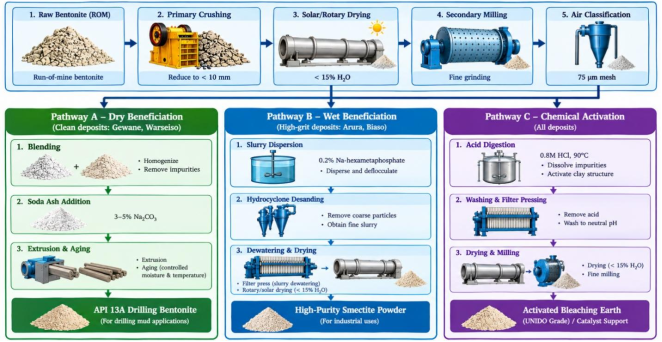
. Primary processing begins with crushing run-of-mine clay, solar or rotary drying to achieve a moisture content of <15%, secondary pulverization, and air classification to obtain a fine powder passing a 75 µm (200 mesh) sieve
| [14] | UNIDO. Mineral Resources of Ethiopia: An Assessment of the Industrial Mineral Potential. United Nations Industrial Development Organization (Document IP/ET/83/001), 1983. |
| [15] | Musie, W., Gonfa, G. Thermal Activation, Characterization and Performance Evaluation of Ethiopian Bentonite for Sodium Removal. Water Science and Technology. 2023, 87(4), 998-1008. https://doi.org/10.2166/wst.2023.031 |
[14, 15]
. The choice between dry and wet beneficiation is governed by deposit purity and operational economics. Dry processing is recommended for clean, high-grade deposits such as those at Gewane, Warseiso, and the main Gidicho beds to minimize water usage and energy costs
| [7] | Mesfin, T. The Occurrence of Bentonite in Ethiopia: Bentonite Promotion Document. Ethiopian Geological Survey, Addis Ababa, Ethiopia, 2012.
https://doi.org/10.31080/ASAG.2019.03.0652 |
| [10] | UNIDO. Technical Report on Bentonite for Bleaching Earth Production. United Nations Industrial Development Organization (Document IP/ET/86/002), 1986. |
[7, 10]
. Conversely, wet processing—comprising dispersion with 0.2 wt.% sodium hexametaphosphate, hydrocyclone desanding, sedimentation, and dewatering is required for impurity-rich beds, such as Gidicho Arura containing 13.5 wt.% Fe
2O
3, to remove gangue minerals and achieve the required purity
| [8] | Mekonnen, E., Meshesha, D., Chekol, T., et al. Mineralogical and Physicochemical Characterization of Bentonite Deposit of Gidicho Island in Lake Abaya, Southern Main Ethiopian Rift. Applied Earth Science. 2025, 134(2), 83-98.
https://doi.org/10.1177/25726838251335897 |
[8]
.
Chemical activation pathways provide the primary mechanism for upgrading low-swelling Ca-bentonites into high-value functional materials. Sodium activation (soda ash treatment) involves adding 3–5 wt.% sodium carbonate (Na
2CO
3) during extrusion or wet mixing to promote Ca
2+ ↔ Na
+ ion exchange. This transformation converts calcium bentonite into a high-swelling sodium bentonite capable of meeting API specifications for drilling fluids
| [7] | Mesfin, T. The Occurrence of Bentonite in Ethiopia: Bentonite Promotion Document. Ethiopian Geological Survey, Addis Ababa, Ethiopia, 2012.
https://doi.org/10.31080/ASAG.2019.03.0652 |
| [8] | Mekonnen, E., Meshesha, D., Chekol, T., et al. Mineralogical and Physicochemical Characterization of Bentonite Deposit of Gidicho Island in Lake Abaya, Southern Main Ethiopian Rift. Applied Earth Science. 2025, 134(2), 83-98.
https://doi.org/10.1177/25726838251335897 |
[7, 8]
. For adsorbent and catalytic applications, acid activation is employed by digesting the raw clay with 0.8M HCl or H
2SO
4 at 90–95°C for 2–4 hours. This treatment selectively leaches octahedral cations (Al
3+, Fe
3+, and Mg
2+), opening micropores, expanding pore volume, and boosting the specific surface area to >250 m
2/g for edible oil bleaching and catalysis
| [3] | Berhe, M. T., Berhe, G. G., Cheru, M. S., Weldehans, M. G., Bhoi, N. K. Characterization of Acid Activation of Bentonite Clay of Hadar, Afar, Ethiopia. Advances in Applied Sciences. 2024, 9(2), 34-45. https://doi.org/10.1155/2024/6413786 |
[3]
.
Thermal activation offers an alternative physical modification route. Controlled calcination at 300°C for 6 hours increases the specific surface area from 57.6 to 81.74 m
2/g without destroying the underlying smectite layer structure, thereby enhancing adsorption performance for wastewater treatment and environmental remediation
| [28] | Vimonses, V., Lei, S., Jin, B., Chow, C. W. K., Saint, C. Enhancing Removal Efficiency of Anionic Dye by Combination and Calcination of Clay Materials. Journal of Hazardous Materials. 2009, 171(1-3), 50-62.
https://doi.org/10.1016/j.cej.2008.09.009 |
[28]
. Together, these primary processing, beneficiation, and chemical activation strategies provide a complete technical framework for converting raw Ethiopian bentonite resources into commercial-grade products
| [15] | Musie, W., Gonfa, G. Thermal Activation, Characterization and Performance Evaluation of Ethiopian Bentonite for Sodium Removal. Water Science and Technology. 2023, 87(4), 998-1008. https://doi.org/10.2166/wst.2023.031 |
[15]
, as illustrated in
Figure 2.
Table 5. Industrial Application Suitability Summary of Ethiopian Bentonite Deposits.
Deposit | Drilling Fluids (API 13A) | Foundry Sand | Iron-Ore Pelletizing | Bleaching Earth | Civil Eng. & Barrier | Agriculture (CEC ≥ 70) | Specialty / Catalysis | Activation & Beneficiation Pathway | Source |
Gewane | High (with Na activation) | High | High | High (with acid activation) | High | High | Moderate | Na-activation for drilling; acid activation for bleaching earth | | [7] | Mesfin, T. The Occurrence of Bentonite in Ethiopia: Bentonite Promotion Document. Ethiopian Geological Survey, Addis Ababa, Ethiopia, 2012.
https://doi.org/10.31080/ASAG.2019.03.0652 | | [9] | Bekele, E., Ayenew, T., Kebede, S. Mineral Resources of the Afar Depression, Ethiopia. Journal of African Earth Sciences. 2014, 99, 1-15. |
[7, 9] |
Warseiso | High (with Na activation) | High | High | High (acid activated) | High | High (82.1 CEC) | High | Highest CEC (82.1); thermal or acid activation | | [15] | Musie, W., Gonfa, G. Thermal Activation, Characterization and Performance Evaluation of Ethiopian Bentonite for Sodium Removal. Water Science and Technology. 2023, 87(4), 998-1008. https://doi.org/10.2166/wst.2023.031 | | [24] | Saba Hadis, Zelalem, A., Sisay, D. Characterization and Beneficiation of Bentonite Deposit, Warseisso, Ethiopia. EIGS, Unpublished Report, 2002. |
[15, 24] |
Ledi | High | High | High | High (with activation) | High | High | High | High natural Na2O (1.85%); Na or acid activation | | [6] | Tadesse, S., Milesi, J.-P., Deschamps, Y. Geology and Mineral Potential of Ethiopia: A Note on Geology and Mineral Map of Ethiopia. Journal of African Earth Sciences. 2003, 36, 273-313. https://doi.org/10.1016/S0899-5362(03)00048-4 | | [14] | UNIDO. Mineral Resources of Ethiopia: An Assessment of the Industrial Mineral Potential. United Nations Industrial Development Organization (Document IP/ET/83/001), 1983. |
[6, 14] |
Kada Hadar | High (Na-bentonite) | High | High | High (acid activated) | High | High | High | Zeolite presence enhances catalysis; acid activation | | [3] | Berhe, M. T., Berhe, G. G., Cheru, M. S., Weldehans, M. G., Bhoi, N. K. Characterization of Acid Activation of Bentonite Clay of Hadar, Afar, Ethiopia. Advances in Applied Sciences. 2024, 9(2), 34-45. https://doi.org/10.1155/2024/6413786 | | [7] | Mesfin, T. The Occurrence of Bentonite in Ethiopia: Bentonite Promotion Document. Ethiopian Geological Survey, Addis Ababa, Ethiopia, 2012.
https://doi.org/10.31080/ASAG.2019.03.0652 |
[3, 7] |
Ounda Hadar | High | High | High | High (with activation) | High | High | Moderate | Na2O > CaO; combined resource with Kada Hadar | | [7] | Mesfin, T. The Occurrence of Bentonite in Ethiopia: Bentonite Promotion Document. Ethiopian Geological Survey, Addis Ababa, Ethiopia, 2012.
https://doi.org/10.31080/ASAG.2019.03.0652 | | [14] | UNIDO. Mineral Resources of Ethiopia: An Assessment of the Industrial Mineral Potential. United Nations Industrial Development Organization (Document IP/ET/83/001), 1983. |
[7, 14] |
Gidicho Island | High (meets API) | High | High | High | High | High (77 CEC) | High | Best overall quality; natural swelling 17.1 ml/2g; Na-activation | | [8] | Mekonnen, E., Meshesha, D., Chekol, T., et al. Mineralogical and Physicochemical Characterization of Bentonite Deposit of Gidicho Island in Lake Abaya, Southern Main Ethiopian Rift. Applied Earth Science. 2025, 134(2), 83-98.
https://doi.org/10.1177/25726838251335897 | | [17] | Knoth, W., Abera, S. Report on Diatomite and Bentonite Clay on Gidicho Island, Lake Abaya. Ethiopian Institute of Geological Surveys (EIGS), Unpublished Report, 1983. |
[8, 17] |
Shigima | High | High | High | High | High | High | Moderate | Part of Gidicho complex; CEC ~77 meq/100g; Na/acid activation | | [7] | Mesfin, T. The Occurrence of Bentonite in Ethiopia: Bentonite Promotion Document. Ethiopian Geological Survey, Addis Ababa, Ethiopia, 2012.
https://doi.org/10.31080/ASAG.2019.03.0652 | | [8] | Mekonnen, E., Meshesha, D., Chekol, T., et al. Mineralogical and Physicochemical Characterization of Bentonite Deposit of Gidicho Island in Lake Abaya, Southern Main Ethiopian Rift. Applied Earth Science. 2025, 134(2), 83-98.
https://doi.org/10.1177/25726838251335897 |
[7, 8] |
Arura | High (beneficiated) | High (beneficiated) | High (beneficiated) | High (beneficiated) | High | High | Moderate | Highest Fe2O3 (13.50%); requires magnetic/gravity desanding | | [7] | Mesfin, T. The Occurrence of Bentonite in Ethiopia: Bentonite Promotion Document. Ethiopian Geological Survey, Addis Ababa, Ethiopia, 2012.
https://doi.org/10.31080/ASAG.2019.03.0652 | | [8] | Mekonnen, E., Meshesha, D., Chekol, T., et al. Mineralogical and Physicochemical Characterization of Bentonite Deposit of Gidicho Island in Lake Abaya, Southern Main Ethiopian Rift. Applied Earth Science. 2025, 134(2), 83-98.
https://doi.org/10.1177/25726838251335897 |
[7, 8] |
Biaso | High (beneficiated) | High (beneficiated) | High (beneficiated) | High (beneficiated) | High | High | Moderate | Highest Al2O3 (16.40%); requires beneficiation | | [7] | Mesfin, T. The Occurrence of Bentonite in Ethiopia: Bentonite Promotion Document. Ethiopian Geological Survey, Addis Ababa, Ethiopia, 2012.
https://doi.org/10.31080/ASAG.2019.03.0652 | | [8] | Mekonnen, E., Meshesha, D., Chekol, T., et al. Mineralogical and Physicochemical Characterization of Bentonite Deposit of Gidicho Island in Lake Abaya, Southern Main Ethiopian Rift. Applied Earth Science. 2025, 134(2), 83-98.
https://doi.org/10.1177/25726838251335897 |
[7, 8] |
Chacha | High (with activation) | High | High | High (with activation) | High | High | High | Na2O/CaO ratio ~1.5; active commercial mining agreement | | [11] | Misgana, A. Application of Montmorillonite Type Bentonite Clay from Chacha Area as Alternative for Local Construction Material. Unpublished Research Thesis, Addis Ababa University, 2023. |
[11] |
Burji Woreda | High (with activation) | High | High | High (with activation) | High | High | Moderate | Calcium bentonite (~5.22 Mt); requires systematic exploration | |
Figure 2. Bentonite beneficiation flow sheet and processing pathways.
6. Domestic Market Dynamics, Import Substitution, and Economic Potential
6.1. Domestic Industrial Demand and Growth Drivers
The domestic market for bentonite in Ethiopia is experiencing robust expansion, driven by rapid industrialization, infrastructure development, and agricultural modernization
| [7] | Mesfin, T. The Occurrence of Bentonite in Ethiopia: Bentonite Promotion Document. Ethiopian Geological Survey, Addis Ababa, Ethiopia, 2012.
https://doi.org/10.31080/ASAG.2019.03.0652 |
| [14] | UNIDO. Mineral Resources of Ethiopia: An Assessment of the Industrial Mineral Potential. United Nations Industrial Development Organization (Document IP/ET/83/001), 1983. |
| [23] | 6Wresearch. Ethiopia Bentonite Market (2025-2031): Trends & Companies. Product Code ETC4817426, 2025. |
[7, 14, 23]
. The national edible oil refining industry requires thousands of tonnes of activated bleaching earth annually for pigment decolorization and contaminant removal
| [10] | UNIDO. Technical Report on Bentonite for Bleaching Earth Production. United Nations Industrial Development Organization (Document IP/ET/86/002), 1986. |
| [14] | UNIDO. Mineral Resources of Ethiopia: An Assessment of the Industrial Mineral Potential. United Nations Industrial Development Organization (Document IP/ET/83/001), 1983. |
[10, 14]
. Expanding geothermal, groundwater, and oil/gas exploration drilling generates steady demand for API-grade drilling bentonite
| [7] | Mesfin, T. The Occurrence of Bentonite in Ethiopia: Bentonite Promotion Document. Ethiopian Geological Survey, Addis Ababa, Ethiopia, 2012.
https://doi.org/10.31080/ASAG.2019.03.0652 |
| [18] | API Specification 13A. Specification for Drilling Fluids Materials, 19th ed. American Petroleum Institute, Washington, D. C., 2010. |
[7, 18]
. Additionally, local foundries, iron/steel manufacturing plants, civil construction projects, and agricultural soil reclamation programs represent growing domestic end-markets
| [4] | Christidis, G. E. Formation of Smectites in Bentonites from the Eastern Mediterranean: A Review. Clay Minerals. 2001, 36(3), 387-405. https://doi.org/10.2113/gselements.5.2.93 |
| [7] | Mesfin, T. The Occurrence of Bentonite in Ethiopia: Bentonite Promotion Document. Ethiopian Geological Survey, Addis Ababa, Ethiopia, 2012.
https://doi.org/10.31080/ASAG.2019.03.0652 |
| [15] | Musie, W., Gonfa, G. Thermal Activation, Characterization and Performance Evaluation of Ethiopian Bentonite for Sodium Removal. Water Science and Technology. 2023, 87(4), 998-1008. https://doi.org/10.2166/wst.2023.031 |
| [22] | UNIDO. Technical Report on Non-Metallic Sorbents for Soil Reclamation in Ethiopia. United Nations Industrial Development Organization, 1987. |
[4, 7, 15, 22]
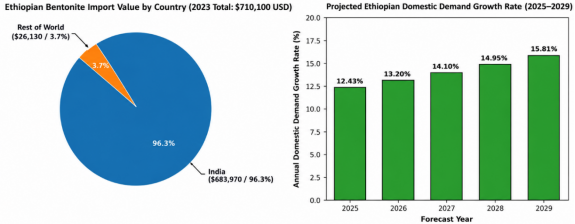
. Quantitative market projections indicate that domestic demand for bentonite will expand substantially, with annual compound growth rates accelerating from 12.43% in 2025 to 15.81% by 2029
| [23] | 6Wresearch. Ethiopia Bentonite Market (2025-2031): Trends & Companies. Product Code ETC4817426, 2025. |
[23]
.
6.2. Import Reliance and Import Substitution Analysis
Despite hosting vast natural resources estimated at 141.5 million tonnes, Ethiopia remains heavily reliant on foreign imports to fulfill its refined bentonite requirements. Official trade statistics reveal that in 2023, Ethiopia imported 1,871,870 kg (1,872 tonnes) of processed bentonite with a cumulative value of $710,100 USD
| [7] | Mesfin, T. The Occurrence of Bentonite in Ethiopia: Bentonite Promotion Document. Ethiopian Geological Survey, Addis Ababa, Ethiopia, 2012.
https://doi.org/10.31080/ASAG.2019.03.0652 |
| [23] | 6Wresearch. Ethiopia Bentonite Market (2025-2031): Trends & Companies. Product Code ETC4817426, 2025. |
[7, 23]
. India represents the overwhelming primary foreign supplier, contributing 1,825,650 kg valued at $683,970 USD, supplemented by minor imports from Italy (26,274 kg; $17,040 USD), China (19,200 kg; $6,410 USD), France (661 kg; $2,480 USD), and the United Arab Emirates (84 kg; $200 USD)
| [7] | Mesfin, T. The Occurrence of Bentonite in Ethiopia: Bentonite Promotion Document. Ethiopian Geological Survey, Addis Ababa, Ethiopia, 2012.
https://doi.org/10.31080/ASAG.2019.03.0652 |
| [23] | 6Wresearch. Ethiopia Bentonite Market (2025-2031): Trends & Companies. Product Code ETC4817426, 2025. |
[7, 23]
. Establishing domestic beneficiation facilities for drying, grinding, and chemical activation (sodium and acid treatment) presents an immediate opportunity for full import substitution, curbing foreign exchange expenditure while enhancing national supply-chain security.
6.3. Value Addition, Employment, and Commercial Investments
Transitioning from raw clay extraction to domestic value-added processing yields significantly higher economic margins and socio-economic benefits
| [10] | UNIDO. Technical Report on Bentonite for Bleaching Earth Production. United Nations Industrial Development Organization (Document IP/ET/86/002), 1986. |
[10]
. Downstream processing pathways including sodium activation for API-grade drilling muds, acid activation for edible oil bleaching earth, thermal calcination for environmental sorbents, and organo-modification for specialty applications create strong domestic industrial linkages
| [10] | UNIDO. Technical Report on Bentonite for Bleaching Earth Production. United Nations Industrial Development Organization (Document IP/ET/86/002), 1986. |
| [15] | Musie, W., Gonfa, G. Thermal Activation, Characterization and Performance Evaluation of Ethiopian Bentonite for Sodium Removal. Water Science and Technology. 2023, 87(4), 998-1008. https://doi.org/10.2166/wst.2023.031 |
[10, 15]
. Commercial investment in domestic deposits is already under way; notably, Arerti Ceramics Manufacturing signed a 10-year mining agreement with the Ministry of Mines to invest 41 million ETB in extracting 870,000 tonnes of bentonite at the Chacha deposit, a venture projected to create approximately 3,000 jobs upon full operation
| [11] | Misgana, A. Application of Montmorillonite Type Bentonite Clay from Chacha Area as Alternative for Local Construction Material. Unpublished Research Thesis, Addis Ababa University, 2023. |
[11]
. Nevertheless, economic viability requires balancing processing overheads such as transportation, energy, chemical additives, packaging, and quality testing against landed foreign import prices.
6.4. Regional Export Prospects and Strategic Investment Roadmap
Beyond domestic import substitution, Ethiopia’s geographical location positions it strategically to serve expanding regional markets across East Africa and the Middle East. Value-added bentonite products specifically drilling-grade sodium bentonite, activated bleaching earth, and foundry sand binders possess competitive regional export potential, supported by lower transport costs relative to intercontinental suppliers despite Ethiopia's landlocked logistics
| [7] | Mesfin, T. The Occurrence of Bentonite in Ethiopia: Bentonite Promotion Document. Ethiopian Geological Survey, Addis Ababa, Ethiopia, 2012.
https://doi.org/10.31080/ASAG.2019.03.0652 |
| [8] | Mekonnen, E., Meshesha, D., Chekol, T., et al. Mineralogical and Physicochemical Characterization of Bentonite Deposit of Gidicho Island in Lake Abaya, Southern Main Ethiopian Rift. Applied Earth Science. 2025, 134(2), 83-98.
https://doi.org/10.1177/25726838251335897 |
| [14] | UNIDO. Mineral Resources of Ethiopia: An Assessment of the Industrial Mineral Potential. United Nations Industrial Development Organization (Document IP/ET/83/001), 1983. |
[7, 8, 14]
. To capture this economic potential, strategic development priorities must focus on: (1) detailed reserve delineation of priority deposits (Gewane, Gidicho, Warseiso, Hadar), (2) establishment of commercial beneficiation and activation processing plants, (3) development of accredited national quality control laboratories, (4) implementation of supportive import substitution policies and tariff incentives, and (5) integration of Environmental, Social, and Governance (ESG) frameworks into mining operations.
7. Conclusions and Recommendations
7.1. Conclusions
Ethiopia hosts extensive bentonite reserves exceeding 141.5 million tonnes across the Main Ethiopian Rift and Afar Depression, predominantly composed of calcium montmorillonite derived from the weathering, devitrification, and diagenetic alteration of volcanic ash and tuff in alkaline lacustrine settings. The resource base is dominated by the Gewane deposit (~70 million tonnes), supplemented by substantial reserves at Warseiso (7.01 million m3), Gidicho Island (>9.4 million tonnes), Ledi (1.78 million m3), Kada Hadar (0.93 million m3), Burji (5.22 million tonnes), and the commercial Chacha deposit (870,000 tonnes). Geochemically, these bentonites exhibit high cation exchange capacities (77–82.1 meq/100g), matching or surpassing global commercial benchmarks.
Although raw Ethiopian bentonites naturally display low to moderate swelling capacity due to their Ca-dominant interlayer chemistry, targeted chemical and thermal activation pathways successfully unlock high industrial utility. Sodium activation via soda ash treatment (3–5 wt.% Na2CO3) exchanges interlayer Ca2+ for Na+, elevating rheological performance and swelling capacity to meet API Specification 13A / ISO 13500 drilling fluid standards. Acid activation using 0.8M HCl leaches octahedral cations, expanding micropores and increasing specific surface area to >250 m2/g, thereby fulfilling UNIDO activated bleaching earth thresholds for edible oil refining. Thermal calcination at 300°C increases surface area from 57.6 to 81.74 m2/g for environmental wastewater remediation, while unactivated raw clays from Gewane and Warseiso demonstrate high binding performance as foundry sand binders and iron-ore pelletizing agents.
Realizing domestic beneficiation and activation presents an immediate import substitution pathway eliminating significant foreign currency outlays such as the $710,100 USD spent importing 1,871,870 kg of processed bentonite in 2023 (primarily from India at $683,970 USD for 1,825,650 kg)—while unlocking high-margin export potential across East Africa.
7.2. Recommendations
To transition Ethiopia's bentonite sector from raw geological potential into a sustainable industrial driver, the following policy and strategic measures are recommended. First, systematic core drilling and resource validation should be undertaken to upgrade historical reconnaissance data to international reporting standards (such as JORC or NI 43-101) through systematic core drilling, trenching, 3D block modeling, and detailed geochemical mapping across priority deposits (Gewane, Gidicho, Warseiso, Hadar, Burji, and Chacha). Second, integrated beneficiation and activation facilities should be established by directing capital investment toward modern commercial processing plants equipped for primary crushing, solar or rotary drying (<15% moisture), fine grinding to 75 µm (200 mesh), extrusion-based sodium activation, acid digestion, and thermal calcination to supply uniform, certified industrial grades. Third, accredited quality control testing infrastructure should be developed by establishing accredited national testing laboratories and mandatory technical standards for drilling muds, bleaching earths, and foundry sand binders, ensuring strict batch-to-batch quality assurance and user confidence among domestic industrial consumers. Fourth, supportive import substitution and tariff policies should be enacted through fiscal incentives and protective trade measures, including targeted import tariffs on foreign processed clays, tax relief for local mining operations, and local-content mandates compelling domestic edible oil refiners and drilling contractors to utilize certified Ethiopian bentonite products. Finally, environmental, social, and governance (ESG) frameworks should be implemented through rigorous environmental protection standards requiring progressive mine land rehabilitation, waste management protocols, and equitable community benefit-sharing to guarantee socio-economically sustainable resource extraction.
Abbreviations
API | American Petroleum Institute |
CEC | Cation Exchange Capacity |
EARS | East African Rift System |
GSE | Geological Survey of Ethiopia |
ISO | International Organization for Standardization |
MER | Main Ethiopian Rift |
UNIDO | United Nations Industrial Development Organization |
XRD | X-Ray Diffraction |
XRF | X-Ray Fluorescence |
Acknowledgments
The authors gratefully acknowledge the Geological Institute of Ethiopia and the Ministry of Mines for granting access to geological data and technical resources. We also extend our sincere thanks to the Mineral Exploration and Research Lead Executive Professionals for their support, and to the experts and researchers of the Geological Survey of Ethiopia, whose earlier contributions formed the basis of this work.
Author Contributions
Kisa Workineh: Conceptualization, Data curation, Formal Analysis, Investigation, Methodology, Software, Visualization, Writing – original draft, Writing – review & editing
Getnet Belachew: Data curation, Formal Analysis, Investigation, Writing – review & editing
Abinet Markos: Data curation, Formal Analysis, Investigation, Writing – review & editing
Data Availability Statement
The data supporting the findings of this research have been compiled from published and unpublished reports of the Geological Survey of Ethiopia, Ministry of Mines, and academic literature. The data is available from the corresponding author upon reasonable request.
Conflicts of Interest
The authors declare no conflicts of interest.
References
| [1] |
Murray, H. Applied Clay Mineralogy: Occurrences, Processing and Application of Kaolins, Bentonites, Palygorskite-Sepiolite, and Common Clays. Elsevier, 2007.
https://doi.org/10.1007/BF03406033
|
| [2] |
Grim, R. E. Clay Mineralogy, 2nd ed. McGraw-Hill, 1968.
|
| [3] |
Berhe, M. T., Berhe, G. G., Cheru, M. S., Weldehans, M. G., Bhoi, N. K. Characterization of Acid Activation of Bentonite Clay of Hadar, Afar, Ethiopia. Advances in Applied Sciences. 2024, 9(2), 34-45.
https://doi.org/10.1155/2024/6413786
|
| [4] |
Christidis, G. E. Formation of Smectites in Bentonites from the Eastern Mediterranean: A Review. Clay Minerals. 2001, 36(3), 387-405.
https://doi.org/10.2113/gselements.5.2.93
|
| [5] |
Xu, Y. F., Matsuoka, H. Swelling Characteristics of Fractal-Textured Bentonite and Its Mixtures. Applied Clay Science. 2003, 22(4), 197-209.
https://doi.org/10.1016/S0169-1317(02)00159-X
|
| [6] |
Tadesse, S., Milesi, J.-P., Deschamps, Y. Geology and Mineral Potential of Ethiopia: A Note on Geology and Mineral Map of Ethiopia. Journal of African Earth Sciences. 2003, 36, 273-313.
https://doi.org/10.1016/S0899-5362(03)00048-4
|
| [7] |
Mesfin, T. The Occurrence of Bentonite in Ethiopia: Bentonite Promotion Document. Ethiopian Geological Survey, Addis Ababa, Ethiopia, 2012.
https://doi.org/10.31080/ASAG.2019.03.0652
|
| [8] |
Mekonnen, E., Meshesha, D., Chekol, T., et al. Mineralogical and Physicochemical Characterization of Bentonite Deposit of Gidicho Island in Lake Abaya, Southern Main Ethiopian Rift. Applied Earth Science. 2025, 134(2), 83-98.
https://doi.org/10.1177/25726838251335897
|
| [9] |
Bekele, E., Ayenew, T., Kebede, S. Mineral Resources of the Afar Depression, Ethiopia. Journal of African Earth Sciences. 2014, 99, 1-15.
|
| [10] |
UNIDO. Technical Report on Bentonite for Bleaching Earth Production. United Nations Industrial Development Organization (Document IP/ET/86/002), 1986.
|
| [11] |
Misgana, A. Application of Montmorillonite Type Bentonite Clay from Chacha Area as Alternative for Local Construction Material. Unpublished Research Thesis, Addis Ababa University, 2023.
|
| [12] |
Tibebu, M., Fantaw, H. M. Industrial Minerals and Rocks Resource Potential of Ethiopia. Geological Survey of Ethiopia, Addis Ababa, 2002.
|
| [13] |
Yonas Hordofa, Yohaness Belechewu. Reconnaissance Survey for Industrial Mineral Exploration in Wolliata and Arba Minch Area. Geological Institute of Ethiopia (GIE), Unpublished Report, 2025.
|
| [14] |
UNIDO. Mineral Resources of Ethiopia: An Assessment of the Industrial Mineral Potential. United Nations Industrial Development Organization (Document IP/ET/83/001), 1983.
|
| [15] |
Musie, W., Gonfa, G. Thermal Activation, Characterization and Performance Evaluation of Ethiopian Bentonite for Sodium Removal. Water Science and Technology. 2023, 87(4), 998-1008.
https://doi.org/10.2166/wst.2023.031
|
| [16] |
Kazmin, V. The Geology of Ethiopia. In Eritrea and Ethiopia: A Bibliographic Guide. Geological Survey of Ethiopia, 1975.
|
| [17] |
Knoth, W., Abera, S. Report on Diatomite and Bentonite Clay on Gidicho Island, Lake Abaya. Ethiopian Institute of Geological Surveys (EIGS), Unpublished Report, 1983.
|
| [18] |
API Specification 13A. Specification for Drilling Fluids Materials, 19th ed. American Petroleum Institute, Washington, D. C., 2010.
|
| [19] |
ISO. ISO 13500: 2008: Petroleum and Natural Gas Industries—Drilling Fluid Materials—Specifications and Tests. International Organization for Standardization, 2008.
|
| [20] |
JB/T 9227-2013. Bentonite for Foundry. Chinese Industrial Standard, 2013.
|
| [21] |
UNI 6716: 1970. Foundry Bentonite - Characteristics and Test Methods. Italian Standard, 1970.
|
| [22] |
UNIDO. Technical Report on Non-Metallic Sorbents for Soil Reclamation in Ethiopia. United Nations Industrial Development Organization, 1987.
|
| [23] |
6Wresearch. Ethiopia Bentonite Market (2025-2031): Trends & Companies. Product Code ETC4817426, 2025.
|
| [24] |
Saba Hadis, Zelalem, A., Sisay, D. Characterization and Beneficiation of Bentonite Deposit, Warseisso, Ethiopia. EIGS, Unpublished Report, 2002.
|
| [25] |
Malis, E., Mengistu, T. Bentonite around Mille and Gewane, Wollo and Hararghe Administrative Region. EIGS Note 204, 1983.
|
| [26] |
Million, H., Elfios, T. Bentonite Deposits of Gidicho Island, Sidamo Administrative Region. EIGS, Unpublished Report, 1991.
|
| [27] |
Mengistu, T. Exploration on Bentonitic Clays in Hararghe and Wollo Administrative Regions. EIGS, Unpublished Report, 1987.
|
| [28] |
Vimonses, V., Lei, S., Jin, B., Chow, C. W. K., Saint, C. Enhancing Removal Efficiency of Anionic Dye by Combination and Calcination of Clay Materials. Journal of Hazardous Materials. 2009, 171(1-3), 50-62.
https://doi.org/10.1016/j.cej.2008.09.009
|
| [29] |
World Bank. Ethiopia - Trade Statistics & Industrial Clay Import Dynamics. World Bank Open Data, 2024.
|
Cite This Article
-
APA Style
Workineh, K., Belachew, G., Markos, A. (2026). Geological Occurrence, Mineralogical Characteristics, Industrial Applications, and Development Potential of Ethiopian Bentonite Deposits: A Review. Journal of Energy and Natural Resources, 15(4), 81-93. https://doi.org/10.11648/j.jenr.20261504.11
 Copy
|
 Download
ACS Style
Workineh, K.; Belachew, G.; Markos, A. Geological Occurrence, Mineralogical Characteristics, Industrial Applications, and Development Potential of Ethiopian Bentonite Deposits: A Review. J. Energy Nat. Resour. 2026, 15(4), 81-93. doi: 10.11648/j.jenr.20261504.11
Copy
|
Download
AMA Style
Workineh K, Belachew G, Markos A. Geological Occurrence, Mineralogical Characteristics, Industrial Applications, and Development Potential of Ethiopian Bentonite Deposits: A Review. J Energy Nat Resour. 2026;15(4):81-93. doi: 10.11648/j.jenr.20261504.11
Copy
|
Download
-
@article{10.11648/j.jenr.20261504.11,
  author = {Kisa Workineh and Getnet Belachew and Abinet Markos},
  title = {Geological Occurrence, Mineralogical Characteristics, Industrial Applications, and Development Potential of Ethiopian Bentonite Deposits: A Review},
  journal = {Journal of Energy and Natural Resources},
  volume = {15},
  number = {4},
  pages = {81-93},
  doi = {10.11648/j.jenr.20261504.11},
  url = {https://doi.org/10.11648/j.jenr.20261504.11},
  eprint = {https://article.sciencepublishinggroup.com/pdf/10.11648.j.jenr.20261504.11},
  abstract = {Ethiopia hosts substantial bentonite resources totaling over 141.5 million tonnes, distributed across the Cenozoic Afar Depression and the Main Ethiopian Rift. This comprehensive review systematically synthesizes the geological occurrence, mineralogical and chemical characteristics, physical properties, industrial application suitability, and development potential of Ethiopian bentonite deposits. Major deposits include Gewane (77.03 Mm3 / ~70 Mt), Warseiso (7.01 Mm3), Ledi (1.78 Mm3), Hadar Basin (Kada Hadar & Ounda Hadar, 0.93 Mm3), and Gidicho Island (>9.4 Mt / 3.46 Mm3), all formed through the low-temperature alteration and diagenesis of Cenozoic volcanic ash and vitric tuff in alkaline lacustrine environments. Mineralogically, X-ray diffraction (XRD) demonstrates that Ethiopian bentonites are predominantly calcium montmorillonite (Ca-montmorillonite) accompanied by minor kaolinite, quartz, albite, and trace zeolites. Complete major oxide geochemistry by XRF reveals SiO2 contents ranging from 48.78% to 61.93% and Al2O3 from 11.06% to 16.40%, with distinct Na2O/CaO zonation reflecting alkaline depositional water chemistry. Physicochemical testing indicates exceptionally high cation exchange capacity (CEC) values ranging from 77.0 meq/100g (Gidicho) to 82.1 meq/100g (Warseiso), exceeding standard commercial calcium bentonites. Natural swelling indices reach 17.1 mL/2g for Gidicho bentonite, which competes closely with international drilling-mud benchmarks. Beneficiation and chemical activation pathways including sodium carbonate activation for API 13A drilling muds, acid activation (0.8M HCl) for bleaching earth and catalysis, and thermal activation (300°C) for surface area expansion (increasing from 57.6 to 81.74 m2/g) substantially upgrade industrial performance. Systematic evaluation against international standards (API 13A/ISO 13500, UNIDO, JB/T 9227) confirms high suitability for drilling fluids, foundry sands, iron-ore pelletizing, civil engineering sealants, and environmental sorbents. Strategic domestic exploitation can completely replace expensive imports, conserve foreign currency, foster regional industrial growth, and drive value-added mineral export development in East Africa.},
 year = {2026}
}
Copy
|
Download
-
TY  - JOUR
T1  - Geological Occurrence, Mineralogical Characteristics, Industrial Applications, and Development Potential of Ethiopian Bentonite Deposits: A Review
AU  - Kisa Workineh
AU  - Getnet Belachew
AU  - Abinet Markos
Y1  - 2026/11/06
PY  - 2026
N1  - https://doi.org/10.11648/j.jenr.20261504.11
DO  - 10.11648/j.jenr.20261504.11
T2  - Journal of Energy and Natural Resources
JF  - Journal of Energy and Natural Resources
JO  - Journal of Energy and Natural Resources
SP  - 81
EP  - 93
PB  - Science Publishing Group
SN  - 2330-7404
UR  - https://doi.org/10.11648/j.jenr.20261504.11
AB  - Ethiopia hosts substantial bentonite resources totaling over 141.5 million tonnes, distributed across the Cenozoic Afar Depression and the Main Ethiopian Rift. This comprehensive review systematically synthesizes the geological occurrence, mineralogical and chemical characteristics, physical properties, industrial application suitability, and development potential of Ethiopian bentonite deposits. Major deposits include Gewane (77.03 Mm3 / ~70 Mt), Warseiso (7.01 Mm3), Ledi (1.78 Mm3), Hadar Basin (Kada Hadar & Ounda Hadar, 0.93 Mm3), and Gidicho Island (>9.4 Mt / 3.46 Mm3), all formed through the low-temperature alteration and diagenesis of Cenozoic volcanic ash and vitric tuff in alkaline lacustrine environments. Mineralogically, X-ray diffraction (XRD) demonstrates that Ethiopian bentonites are predominantly calcium montmorillonite (Ca-montmorillonite) accompanied by minor kaolinite, quartz, albite, and trace zeolites. Complete major oxide geochemistry by XRF reveals SiO2 contents ranging from 48.78% to 61.93% and Al2O3 from 11.06% to 16.40%, with distinct Na2O/CaO zonation reflecting alkaline depositional water chemistry. Physicochemical testing indicates exceptionally high cation exchange capacity (CEC) values ranging from 77.0 meq/100g (Gidicho) to 82.1 meq/100g (Warseiso), exceeding standard commercial calcium bentonites. Natural swelling indices reach 17.1 mL/2g for Gidicho bentonite, which competes closely with international drilling-mud benchmarks. Beneficiation and chemical activation pathways including sodium carbonate activation for API 13A drilling muds, acid activation (0.8M HCl) for bleaching earth and catalysis, and thermal activation (300°C) for surface area expansion (increasing from 57.6 to 81.74 m2/g) substantially upgrade industrial performance. Systematic evaluation against international standards (API 13A/ISO 13500, UNIDO, JB/T 9227) confirms high suitability for drilling fluids, foundry sands, iron-ore pelletizing, civil engineering sealants, and environmental sorbents. Strategic domestic exploitation can completely replace expensive imports, conserve foreign currency, foster regional industrial growth, and drive value-added mineral export development in East Africa.
VL  - 15
IS  - 4
ER  -
Copy
|
Download





 Share This Article
 Twitter
 Linked In
 Facebook