Abstract
Toddlerhood is a critical period of neurodevelopment characterized by rapid maturation of language, memory, attention, executive function, motor coordination, emotional regulation, and social cognition, supported by coordinated processes including neuronal differentiation, dendritic arborization, axonal growth, synaptogenesis, myelination, neurotransmission, and activity-dependent synaptic plasticity. Docosahexaenoic acid (DHA; 22:6 n-3), a long-chain omega-3 polyunsaturated fatty acid highly enriched in neuronal and retinal membranes, plays essential structural, metabolic, and signaling roles in the developing brain. Although brain DHA accumulation is greatest during late gestation and the first two years of life, membrane remodeling and cognitive maturation continue throughout toddlerhood, making adequate DHA intake an ongoing nutritional priority. Brain DHA status depends on dietary intake, lipid transport, genetic factors, developmental stage, and overall nutritional status because endogenous synthesis from alpha-linolenic acid is limited. Mechanistically, DHA enhances neuronal membrane fluidity, receptor function, neurotransmission, neurite extension, dendritic development, synaptic protein expression, and long-term potentiation, while increasing phosphatidylserine-mediated activation of neuronal survival pathways. DHA is also converted into bioactive mediators, including synaptamide, protectins, and resolvins, which promote neurogenesis, synaptogenesis, and regulation of neuroinflammation. Efficient transport across the blood–brain barrier via the MFSD2A transporter further underscores the importance of adequate DHA availability for optimal brain function. Collectively, these mechanisms provide strong biological plausibility for DHA involvement in synapse formation, neural maturation, learning, memory, attention, and cognitive development. However, evidence from human intervention studies remains inconsistent. While some studies have reported associations between higher DHA status and improved vocabulary, reading, learning, or cognitive performance, several randomized controlled trials in toddlers and preschool children have found no significant improvements in standardized developmental outcomes following DHA supplementation, particularly among adequately nourished populations. These discrepancies likely reflect differences in baseline DHA status, dietary quality, dosage, intervention duration, developmental timing, prematurity, genetic variation, socioeconomic factors, and outcome measures. This narrative review synthesizes current evidence regarding the physiological significance, molecular mechanisms, and functional effects of DHA during toddlerhood, highlighting the contrast between robust mechanistic evidence and mixed clinical findings. Overall, ensuring adequate dietary DHA should be considered an important component of balanced toddler nutrition, particularly in populations at risk of insufficient intake or developmental vulnerability, while recognizing that optimal neurodevelopment also depends on adequate energy, protein, iron, iodine, choline, sleep, responsive caregiving, language stimulation, physical activity, and enriched learning environments. Further well-designed toddler-specific trials are needed to identify the populations most likely to benefit and to establish the optimal dose, duration, and cognitive outcomes of DHA supplementation.
|
Published in
|
Journal of Food and Nutrition Sciences (Volume 14, Issue 4)
|
|
DOI
|
10.11648/j.jfns.20261404.15
|
|
Page(s)
|
258-270 |
|
Creative Commons
|

This is an Open Access article, distributed under the terms of the Creative Commons Attribution 4.0 International License (http://creativecommons.org/licenses/by/4.0/), which permits unrestricted use, distribution and reproduction in any medium or format, provided the original work is properly cited.
|
|
Copyright
|
Copyright © The Author(s), 2026. Published by Science Publishing Group
|
Keywords
Docosahexaenoic Acid -DHA, Toddlerhood, Brain Development, Neural Development, Learning, Memory, Cognition, Neuroplasticity
1. Introduction
Toddlerhood, commonly defined as the developmental period from approximately 12 to 36 months, is characterized by rapid gains in language, mobility, social interaction, attention, memory, problem-solving, and emotional regulation. Although total brain growth is especially rapid during fetal life and infancy, the toddler brain remains biologically active and highly plastic. Neural circuits are being strengthened, reorganized, and selectively refined in response to nutrition, sensory stimulation, movement, relationships, sleep, stress, and learning experiences.
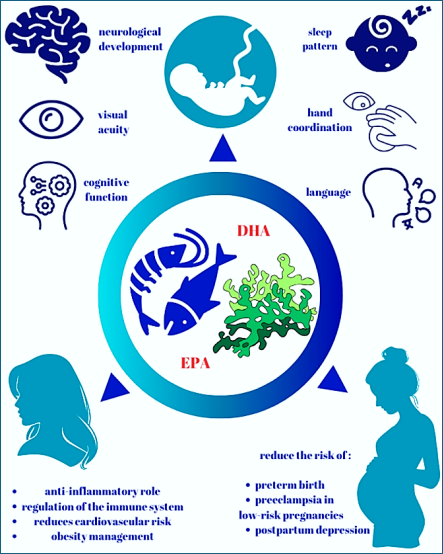
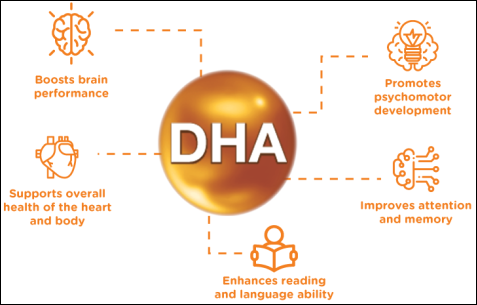
Figure 1. Synergistic Role of DHA.
During this period, synaptic density and connectivity change extensively. New connections continue to form, while less frequently used connections may be weakened or removed through synaptic pruning. Dendrites become more complex, axons become increasingly myelinated, and communication among cortical and subcortical networks becomes more efficient. These processes provide the biological foundation for increasingly sophisticated abilities, including word learning, recognition memory, imitation, working memory, behavioral control, and goal-directed activity.
Lipids are fundamental components of the developing brain. Unlike many other organs, the brain contains a high proportion of lipid-rich membranes. DHA is one of the most abundant omega-3 fatty acids within neuronal phospholipids, particularly in synaptic membranes, photoreceptors, mitochondria, and regions associated with learning and memory. Its six double bonds create a highly flexible molecular structure that influences membrane organization, protein activity, receptor mobility, and cell signaling
| [1] | Lauritzen L, Brambilla P, Mazzocchi A, Harsløf LBS, Ciappolino V, Agostoni C. DHA effects in brain development and function. Nutrients. 2016; 8 (1): 6.
https://doi.org/10.3390/nu8010006 |
[1]
.
DHA is derived either directly from dietary sources or through limited conversion of alpha-linolenic acid. The conversion pathway requires several elongation and desaturation steps and may not reliably provide sufficient DHA under all dietary and physiological conditions. Consequently, direct dietary intake can be important, especially during periods of rapid neural development. DHA is available from fatty fish, seafood, fish oils, algal oils, breast milk, fortified foods, and selected young-child formulas
.
The brain does not synthesize substantial quantities of DHA de novo. Circulating DHA must therefore be transported into the central nervous system. A major discovery was the identification of major facilitator superfamily domain-containing protein 2A, or MFSD2A, as an important transporter carrying DHA across the blood–brain barrier predominantly in the form of lysophosphatidylcholine-DHA. Experimental deletion of MFSD2A results in markedly reduced cerebral DHA, impaired brain growth, neuronal loss, and cognitive abnormalities. Rare human mutations that impair MFSD2A transport have also been linked to severe microcephaly, providing strong evidence that effective lipid transport is necessary for normal human brain development
.
Nevertheless, the statement that DHA is biologically important should not be confused with the stronger claim that supplementation will improve intelligence or development in every child. A nutrient can be necessary for normal physiology while providing little additional benefit when existing intake and tissue status are already sufficient. This distinction is essential when interpreting DHA research.
The purpose of this narrative review is to examine the role of DHA during toddlerhood, focusing on brain development, synaptic formation, neural maturation, learning, memory, and cognitive function. It also discusses the principal mechanisms through which DHA may affect neural development and critically evaluates clinical evidence from toddlers, preschool children, and related developmental populations.
2. DHA and the Developing Toddler Brain
2.1. DHA as a Structural Component of Neural Membranes
Neurons depend on specialized membranes for receiving, processing, and transmitting information. DHA is incorporated into phospholipids such as phosphatidylethanolamine, phosphatidylserine, and phosphatidylcholine. These phospholipids form neuronal cell membranes, synaptic vesicles, dendritic spines, growth cones, mitochondria, and photoreceptor membranes.
The physical characteristics of DHA contribute to membrane flexibility and dynamic organization. This flexibility may influence the movement and clustering of receptors, transporters, ion channels, and signaling proteins. Because neuronal communication requires rapid changes in membrane shape—including vesicle fusion, neurotransmitter release, receptor trafficking, and dendritic-spine remodeling—DHA-rich phospholipids are particularly relevant to synaptic function.
DHA is highly enriched in the cerebral cortex, retina, and synaptic membranes. Brain accumulation increases greatly during late gestation and infancy and remains functionally relevant beyond the second year as neural circuits continue to mature. Research involving cellular and animal models indicates that reduced brain DHA alters neuronal signaling, neurotransmitter metabolism, neurogenesis, visual function, and learning behavior
| [4] | Nguyen LN, Ma D, Shui G, et al. Mfsd2a is a transporter for the essential omega-3 fatty acid docosahexaenoic acid. Nature. 2014; 509: 503–506. https://doi.org/10.1038/nature13241 |
[4]
.
2.2. Continued Neurodevelopment During Toddlerhood
Toddler brain development includes several overlapping processes:
1) continued dendritic growth and branching;
2) formation and refinement of synaptic connections;
3) increasing myelination;
4) maturation of hippocampal and cortical networks;
5) development of receptive and expressive language;
6) improvement in sustained attention and working memory;
7) development of inhibitory control and flexible behavior;
8) integration of sensory, motor, emotional, and cognitive functions.
These processes do not depend on DHA alone. They require adequate total nutrition and appropriate stimulation. However, DHA may support the cellular environment in which development occurs by maintaining membrane properties, promoting neural signaling, and generating bioactive metabolites
| [5] | Ben-Zvi A, Lacoste B, Kur E, et al. Mfsd2a is critical for the formation and function of the blood–brain barrier. Nature. 2014; 509: 507–511. https://doi.org/10.1038/nature13324 |
[5]
.
2.3. DHA Availability and Brain Uptake
Dietary DHA circulates in several lipid forms. Evidence indicates that the brain preferentially obtains an important proportion of DHA as lysophosphatidylcholine-DHA through MFSD2A. MFSD2A is expressed in endothelial cells of the blood–brain barrier and transports lysophospholipids in a sodium-dependent manner. It also contributes to the integrity of the blood–brain barrier by limiting excessive endothelial transcytosis
| [6] | Guemez-Gamboa A, Nguyen LN, Yang H, et al. Inactivating mutations in MFSD2A, required for omega-3 fatty-acid transport in brain, cause a lethal microcephaly syndrome. Nat Genet. 2015; 47: 809–813. |
[6]
.
This mechanism has several implications. First, dietary intake alone does not fully define cerebral DHA status. Digestion, absorption, hepatic lipid metabolism, circulating lipid form, transport across the blood–brain barrier, and incorporation into brain phospholipids all influence availability. Second, plasma DHA and brain DHA are related but are not identical biological measures. Third, genetic and metabolic variation may partly explain why children respond differently to supplementation.
Table 1.
Major developmental functions of DHA during toddlerhood | [7] | Cater RJ, Chua GL, Erramilli SK, et al. Structural basis of omega-3 fatty-acid transport across the blood–brain barrier. Nature. 2021; 595: 315–319. |
Functional area | Proposed contribution of DHA | Potential developmental relevance | Strength of evidence |
Neuronal membranes | Maintains membrane flexibility, phospholipid organization and receptor mobility | Efficient neuronal signaling and membrane remodeling | Strong biochemical and experimental evidence |
Neurite development | Supports axonal and dendritic extension and branching | Expansion of neural connectivity | Strong cellular and animal evidence |
Synapse formation | Increases synapsin puncta, synaptic proteins and glutamate-receptor expression | Formation and maturation of communication between neurons | Strong experimental evidence |
Neurotransmission | Modulates vesicular release, receptor function and glutamatergic activity | Attention, learning and information processing | Moderate-to-strong experimental evidence |
Long-term potentiation | Supports hippocampal synaptic plasticity | Learning and memory consolidation | Strong animal evidence |
Neuronal survival | Enhances phosphatidylserine-dependent Akt signaling | Resistance to apoptosis and support of developing neurons | Strong mechanistic evidence |
Neurogenesis | DHA-derived synaptamide activates GPR110–cAMP–PKA–CREB pathways | Generation and maturation of neural cells | Strong cellular and animal evidence |
Inflammation resolution | Produces protectins, resolvins and related mediators | Protection from excessive neuroinflammation | Strong preclinical evidence; limited toddler-specific evidence |
Cognition and language | May support vocabulary, memory, attention and executive processing | Early learning and school readiness | Mixed human intervention evidence |
Visual development | Supports retinal membrane structure and photoreceptor function | Visual attention and visually guided learning | Moderate clinical and strong biological evidence |
3. DHA and Synapse Formation
3.1. Synaptogenesis During Early Development | [8] | Wong BH, Chan JP, Cazenave-Gassiot A, et al. The lysolipid transporter Mfsd2a regulates lipogenesis in the developing brain. PLoS Biol. 2018; 16: e2006443. |
[8]
Synaptogenesis refers to the formation of functional connections between neurons. It involves axonal growth toward target cells, development of presynaptic terminals, clustering of neurotransmitter-containing vesicles, formation of postsynaptic densities, receptor insertion, and activity-dependent stabilization.
During toddlerhood, synaptic networks are not simply expanding. They are also being refined according to experience. Language exposure, play, movement, social interaction, emotional security, and problem-solving repeatedly activate specific neural pathways. Frequently activated synapses may be strengthened, whereas weaker or less relevant connections may be eliminated.
DHA may support synaptogenesis through both structural and signaling pathways. In cultured hippocampal neurons, DHA has been shown to increase neurite growth, branching, synapsin-positive puncta, glutamate-receptor expression, and spontaneous synaptic activity. Conversely, developmental omega-3 deficiency reduces neurite development, synaptic proteins, glutamate-receptor subunits, and long-term potentiation
| [9] | Akbar M, Calderon F, Wen Z, Kim HY. Docosahexaenoic acid: a positive modulator of Akt signaling in neuronal survival. Proc Natl Acad Sci USA. 2005; 102: 10858–10863.
https://doi.org/10.1073/pnas.0502903102 |
[9]
.
3.2. Presynaptic Effects
The presynaptic terminal stores neurotransmitters in vesicles and releases them when an electrical impulse reaches the terminal. This process depends on membrane curvature, vesicle docking, fusion proteins, calcium signaling, and efficient recycling of vesicle membranes.
Because DHA is highly flexible, its incorporation into membrane phospholipids may facilitate the membrane deformation required for synaptic-vesicle fusion and recycling. Experimental observations of increased synapsin expression and synaptic puncta following DHA exposure support a role in presynaptic maturation.
Synapsins are proteins associated with synaptic vesicles. They contribute to vesicle organization, reserve-pool maintenance, neurotransmitter release, and synaptic development. Reduced synapsin expression in DHA-deficient developmental models provides one possible connection between low DHA status and weaker synaptic function
.
3.3. Postsynaptic Effects
Postsynaptic membranes contain neurotransmitter receptors, ion channels, scaffolding proteins, and enzymes that translate chemical signals into cellular responses. DHA can affect the lipid environment surrounding these proteins and may therefore alter receptor mobility, receptor conformation, signal amplification, and internalization.
Experimental studies have reported that DHA supports the expression of glutamate-receptor subunits. Glutamate is the principal excitatory neurotransmitter in the brain and plays an important role in learning and memory. Appropriate glutamatergic signaling is required for synaptic strengthening, but excessive activation can be harmful. DHA may contribute to maintaining effective signaling while also supporting anti-inflammatory and neuroprotective mechanisms
.
3.4. Synaptic Plasticity and Long-term Potentiation
Synaptic plasticity is the ability of synaptic strength to change in response to activity. Long-term potentiation is a sustained increase in synaptic transmission following repeated stimulation and is widely considered a cellular model of learning and memory.
Developmental omega-3 deprivation has been associated with impaired hippocampal long-term potentiation, while restoration or supplementation of DHA in animal models has improved certain measures of spatial learning and memory. DHA-related changes in membrane composition, glutamate-receptor expression, BDNF-associated pathways, CREB activation, and dendritic development may all contribute to these effects
| [13] | Lee JW, Huang BX, Kwon H, et al. Orphan GPR110 targeted by N-docosahexaenoylethanolamine in development of neurons and cognitive function. Nat Commun. 2016; 7: 13123. https://doi.org/10.1038/ncomms13123 |
[13]
.
4. DHA in Early Neural Development
4.1. Neuronal Differentiation and Neurite Extension
Neural development requires immature neural cells to differentiate, extend axons and dendrites, locate appropriate targets, and become incorporated into functional networks. DHA has demonstrated specific neuritogenic effects in experimental hippocampal neurons. Compared with several other fatty acids, DHA increased both neurite length and branching, suggesting that its actions cannot be explained solely by the provision of nonspecific lipid energy
| [14] | Kim HY, Spector AA. Molecular and signaling mechanisms for docosahexaenoic-acid-derived neurodevelopment and neuroprotection. Int J Mol Sci. 2022; 23. |
[14]
.
Neurites form the structural framework through which neurons communicate. Greater dendritic branching provides more potential sites for receiving synaptic input, while axonal growth enables signals to reach other cells. During toddlerhood, such structural maturation supports increasingly integrated networks required for language, memory, attention, and coordinated behavior.
4.2. Neurogenesis
Neurogenesis is most extensive before birth but continues after birth in selected brain regions. DHA can influence neural progenitor proliferation, differentiation, and survival indirectly through membrane signaling and directly through DHA-derived metabolites.
One important mediator is N-docosahexaenoylethanolamine, commonly called synaptamide. Synaptamide is produced from DHA in neural tissues and promotes neurogenesis, neurite growth, and synapse formation. It binds to the adhesion G-protein-coupled receptor GPR110, also known as ADGRF1, and increases intracellular cyclic AMP. This activates protein kinase A and CREB-dependent gene expression. Experimental deletion of GPR110 abolishes several synaptamide-related effects and produces deficits in object recognition and spatial memory in animals
| [16] | Keim SA, Boone KM, Klebanoff MA, et al. Effect of docosahexaenoic-acid supplementation versus placebo on developmental outcomes of toddlers born preterm: a randomized clinical trial. JAMA Pediatr. 2018; 172: 1126–1134. https://doi.org/10.1001/jamapediatrics.2018.3082 |
[16]
.
4.3. Neuronal Survival
Developing neurons undergo both growth and programmed cell death. Survival depends partly on trophic signals and intracellular pathways that suppress apoptosis. DHA increases phosphatidylserine content in neuronal membranes. Phosphatidylserine facilitates the recruitment and activation of Akt, a kinase involved in cell survival.
In experimental models, DHA-enhanced phosphatidylserine promoted Akt activation and reduced neuronal susceptibility to apoptosis. Omega-3 deficiency reduced hippocampal phosphatidylserine and increased neuronal vulnerability. This pathway suggests that DHA functions not only as a passive membrane component but also as an active regulator of signaling
| [17] | Colombo J, Jill Shaddy D, Kerling EH, Gustafson KM, Carlson SE. Developmental outcomes at 24 months of age in toddlers supplemented with arachidonic acid and docosahexaenoic acid: results of a double-blind randomized controlled trial. Nutrients. 2017; 9: 975. |
[17]
.
4.4. Myelination and Network Efficiency
Myelin enables rapid electrical conduction along axons. Although DHA is not the sole lipid required for myelin, adequate long-chain polyunsaturated-fatty-acid status contributes to the overall lipid environment needed for neural maturation. Toddlerhood is an important period for the ongoing myelination of pathways involved in motor control, language, attention, and higher cognitive processing.
Clinical studies do not yet establish that DHA supplementation alone accelerates toddler myelination or produces clinically meaningful changes in white-matter development. Nevertheless, maintaining adequate DHA status is biologically consistent with supporting overall membrane development.
5. DHA, Learning Ability and Attention
Learning ability is not a single process. It includes attention to relevant information, encoding of experience, language comprehension, working memory, consolidation, retrieval, motivation, and behavioral regulation. DHA could potentially affect several of these domains through its actions on synaptic function and neural communication.
5.1. Attention and Information Processing
Attention allows the child to select important information and maintain engagement long enough to learn. Neural networks involving the prefrontal cortex, parietal cortex, basal ganglia, and thalamus contribute to attentional processing. These networks continue to mature throughout early childhood.
DHA-rich membranes may support efficient neurotransmission in these networks. However, intervention evidence is inconsistent. In a randomized study of healthy four-year-old children receiving 400 mg DHA daily for four months, overall changes in multiple cognitive tests were not significantly different from placebo. Nevertheless, higher blood DHA concentrations were positively associated with performance on a vocabulary-related measure
| [18] | Minns LM, Kerling EH, Neely MR, et al. Toddler formula supplemented with DHA improves DHA status and respiratory health in a randomized, double-blind controlled trial of US children younger than three years. Prostaglandins Leukot Essent Fatty Acids. 2010; 82: 287–293.
https://doi.org/10.1016/j.plefa.2010.02.009 |
[18]
.
This finding illustrates an important research issue: assignment to supplementation may not predict outcomes as accurately as achieved biological status. Adherence, absorption, baseline levels, metabolism, and individual variation can cause substantial differences in blood DHA even among children given the same dose.
5.2. Language Learning
Toddlerhood is a period of rapid vocabulary expansion and grammatical development. Language learning requires auditory discrimination, sustained attention, working memory, symbolic association, and repeated social interaction.
DHA may help provide a neural environment that supports these functions, but it cannot substitute for responsive communication and language exposure. A child requires adults who speak, listen, read, respond, and engage in reciprocal interaction. Nutrition creates biological capacity; experience organizes and applies that capacity.
The positive relationship between blood DHA and vocabulary performance in preschool children is noteworthy but does not prove that supplementation alone caused improvement. It may reflect broader dietary quality, biological responsiveness, or an exposure–response effect that was not sufficiently captured by group comparison
| [19] | Richardson AJ, Burton JR, Sewell RP, Spreckelsen TF, Montgomery P. Docosahexaenoic acid for reading, cognition and behavior in children aged 7–9 years: the DOLAB study. PLoS One. 2012; 7: e43909. |
[19]
.
5.3. Reading and Later Learning
Evidence from older children may provide indirect insight into mechanisms relevant to toddlerhood, although it should not be directly generalized. In the DOLAB trial, healthy schoolchildren aged seven to nine years with below-average reading performance received 600 mg DHA daily or placebo. The study assessed reading, working memory, and behavior and reported potential benefits in selected subgroups, particularly children with poorer baseline reading
| [20] | Birch EE, Hoffman DR, Uauy R, Birch DG, Prestidge C. Visual acuity and the essentiality of docosahexaenoic acid and arachidonic acid in the diet of term infants. Pediatr Res. 1998; 44: 201–209. https://doi.org/10.1203/00006450-199808000-00011 |
[20]
.
Such findings raise the possibility that children with low baseline status or identifiable developmental vulnerability may respond more strongly than well-nourished children. This hypothesis remains to be tested rigorously in toddlers.
6. DHA and Memory
Memory includes multiple interacting systems. Recognition memory allows a child to identify familiar people or objects. Working memory temporarily holds information for immediate use. Episodic memory relates to events, while semantic memory stores meanings and concepts. Procedural memory supports learned actions and motor sequences.
6.1. The Hippocampus and Memory Development
The hippocampus plays a central role in learning and memory. DHA is enriched in hippocampal neuronal membranes, and experimental DHA deficiency alters hippocampal development and function. DHA supplementation has been associated with enhanced neurite growth, increased synaptic protein expression, stronger glutamatergic activity, and improved long-term potentiation in developmental models
| [21] | Birch EE, Garfield S, Hoffman DR, Uauy R, Birch DG. A randomized controlled trial of early dietary supply of long-chain polyunsaturated fatty acids and mental development in term infants. Dev Med Child Neurol. 2000; 42: 174–181. |
[21]
.
Animal studies have reported fewer working- and reference-memory errors after DHA administration, accompanied by increased activity-related Fos expression in the hippocampal CA1 region. Although such results support biological plausibility, animal performance cannot be equated directly with human toddler intelligence or memory
| [22] | Makrides M, Neumann MA, Simmer K, Gibson RA. A critical appraisal of the role of dietary long-chain polyunsaturated fatty acids on neural indices of term infants: a randomized controlled trial. Pediatrics. 2000; 105: 32–38.
https://doi.org/10.1542/peds.105.1.32 |
[22]
.
6.2. Encoding and Consolidation
Effective memory requires information to be encoded, stabilized, and retrieved. Synaptic plasticity and protein synthesis are central to consolidation. CREB is a transcription factor involved in gene expression necessary for long-term memory. DHA-derived synaptamide activates cAMP–PKA–CREB signaling through GPR110, linking DHA metabolism with pathways relevant to neuronal differentiation and memory-related plasticity
| [23] | O’Connor DL, Hall R, Adamkin D, et al. Growth and development in preterm infants fed long-chain polyunsaturated fatty acids: a prospective randomized controlled trial. Pediatrics. 2001; 108: 359–371. |
[23]
.
DHA may also interact with neurotrophic pathways. BDNF and its TrkB receptor regulate dendritic growth, synaptic maturation, protein trafficking, and long-term potentiation. Although DHA and BDNF are distinct biological factors, experimental studies suggest that omega-3 status can influence neurotrophic signaling, providing another potential connection between nutrition and memory-related synaptic adaptation. BDNF–TrkB signaling activates MAPK, PI3K and PLC pathways involved in synaptic protein synthesis and plasticity
| [24] | Smithers LG, Gibson RA, McPhee A, Makrides M. Higher-dose docosahexaenoic acid in the neonatal period improves visual acuity of preterm infants. Am J Clin Nutr. 2008; 88: 1049–1056. https://doi.org/10.1093/ajcn/88.4.1049 |
[24]
.
6.3. Human Evidence
Human studies of DHA and memory in toddlers remain limited. Standardized developmental assessments may not isolate memory sufficiently, and brief testing sessions may fail to detect subtle changes in neural efficiency. Furthermore, gains in memory may appear indirectly through vocabulary acquisition, problem-solving, imitation, or adaptive behavior rather than as an independent score.
Existing toddler trials have generally not demonstrated large improvements in broad developmental composites. This should not be interpreted as evidence that DHA has no role in memory. Rather, it indicates that additional supplementation above existing intake has not consistently produced measurable population-level benefits within the studied durations and conditions.
7. DHA and Cognitive Function
Cognitive function during toddlerhood includes language, perception, attention, memory, problem-solving, inhibitory control, cognitive flexibility, and early executive function. These abilities emerge through interactions among genetic potential, nutrition, caregiving, health, sleep, education, and social environment.
7.1. Evidence from Toddler Trials
A double-blind controlled trial enrolled 133 toddlers at an average age of approximately 13 months. Participants received 200 mg DHA plus 200 mg arachidonic acid daily or a corn-oil control until 24 months. Supplementation significantly increased plasma and red-cell DHA and arachidonic-acid levels. However, no significant overall benefit was observed in Bayley cognitive and language composites or visual-motor integration. A subgroup relationship between red-cell arachidonic acid and cognition was observed in supplemented boys, but such subgroup findings require cautious interpretation
| [25] | Carlson SE, Ford AJ, Werkman SH, Peeples JM, Koo WW. Visual acuity and fatty-acid status of term infants fed human milk and formulas with and without docosahexaenoate and arachidonate. Pediatr Res. 1996; 39: 882–888. |
[25]
.
Another randomized trial evaluated 200 mg DHA plus 200 mg arachidonic acid daily for six months in toddlers born before 35 weeks’ gestation. The intervention did not significantly improve the primary Bayley cognitive outcome or overall language and motor outcomes. The study nevertheless remains important because preterm children are biologically vulnerable and may have altered fatty-acid accretion and developmental trajectories
.
These trials suggest that increasing circulating DHA does not automatically translate into detectable changes in broad developmental scores. Several explanations are possible:
1) participants may not have been sufficiently deficient at baseline;
2) developmental tests may not detect specific neural changes;
3) intervention duration may have been inadequate;
4) developmental outcomes may emerge later;
5) DHA may require interaction with other nutrients;
6) benefits may be limited to particular subgroups;
7) concurrent arachidonic acid may influence responses;
8) environmental influences may outweigh modest nutritional effects.
7.2. Evidence from Preschool Children
The preschool trial by Ryan and Nelson provided 400 mg DHA daily for four months to healthy four-year-old children. No significant group-level differences were found across the primary cognitive measures, although blood DHA was positively associated with receptive vocabulary performance
| [27] | Yoshii A, Constantine-Paton M. Postsynaptic BDNF–TrkB signaling in synapse maturation, plasticity and disease. Dev Neurobiol. 2010; 70: 304–322.
https://doi.org/10.1002/dneu.20765 |
[27]
.
This result demonstrates why both intention-to-treat and biomarker analyses are useful. The group comparison answers whether offering DHA under the study conditions improved outcomes. The biomarker analysis examines whether greater achieved DHA status was related to performance. These are related but distinct questions.
7.3. Evidence from Infancy and Older Childhood
Studies during infancy have reported mixed findings. Some trials found improved visual acuity or mental-development measures after DHA-containing formulas, whereas others found no significant effect. In one early randomized trial, DHA plus arachidonic acid supplementation was associated with a seven-point increase in the Bayley Mental Development Index at 18 months. Other trials found visual benefits without consistent cognitive improvement, and some reported no meaningful differences
| [28] | Sasi M, Vignoli B, Canossa M, Blum R. Neurobiology of local and intercellular BDNF signaling. Pflugers Arch. 2017; 469: 593–610. |
[28]
.
A recent systematic review and meta-analysis of early-life supplementation reported no statistically significant overall improvement in the Mental Development Index. Such pooled results emphasize the heterogeneity of study populations, supplementation timing, dosage, formulations, developmental assessments, and baseline nutrition
| [29] | Orr SK, Palumbo S, Bosetti F, et al. Unesterified docosahexaenoic acid is protective in neuroinflammation. J Neurochem. 2013; 127: 378–393.
https://doi.org/10.1111/jnc.12392 |
[29]
.
Therefore, the current evidence supports biological necessity more strongly than universal cognitive enhancement through supplementation.
Table 2.
Selected human studies relevant to DHA and neurodevelopment | [30] | Layé S, Nadjar A, Joffre C, Bazinet RP. Anti-inflammatory effects of omega-3 fatty acids in the brain. J Neuroinflammation. 2018; 15: 239. |
Study population and intervention | Main outcomes | Principal finding | Interpretation |
Toddlers, approximately 13–24 months; 200 mg DHA + 200 mg ARA daily | Bayley cognition and language; visual-motor integration | Increased blood DHA and ARA but no significant overall developmental improvement | Biomarker response confirmed; broad cognitive benefit not demonstrated |
Preterm-born toddlers; six months of 200 mg DHA + 200 mg ARA daily | Bayley cognitive, language and motor scores; behavior | No significant improvement in primary cognitive outcome | Higher-risk status did not ensure treatment response |
Healthy four-year-olds; 400 mg DHA daily for four months | Attention, vocabulary and executive measures | No significant overall group effect; blood DHA associated with vocabulary score | Achieved status may matter more than assignment alone |
Underperforming schoolchildren aged 7–9 years; 600 mg DHA daily | Reading, working memory and behavior | Potential benefits in children with poorer baseline reading | Benefits may be greatest in selected lower-performing groups |
Term infants given DHA-containing formula | Visual and developmental measures | Mixed results across trials; some visual or developmental advantages | Timing, composition and baseline status influence outcomes |
Preterm infants receiving higher DHA intake | Visual acuity and development | Some studies found improved early visual outcomes | Preterm infants may have distinct requirements |
Early-life DHA trials included in meta-analysis | Mental and psychomotor development | No significant pooled improvement in mental-development index | Evidence is heterogeneous and does not support universal supplementation effects |
8. Mechanisms of Action of DHA
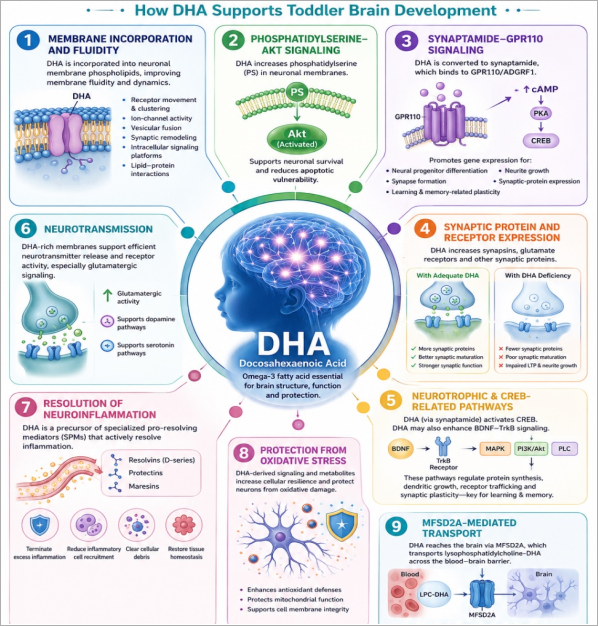
DHA supports brain development through several interconnected mechanisms. After entering the brain, it is incorporated into neuronal membrane phospholipids, where its flexible structure improves membrane fluidity, curvature, receptor organization, ion-channel activity, vesicle fusion, synaptic remodeling, and intracellular signaling. DHA also increases phosphatidylserine in neuronal membranes, facilitating Akt activation and supporting neuronal survival while reducing susceptibility to apoptosis. It can be converted into synaptamide, which binds GPR110/ADGRF1 and activates the cAMP–protein kinase A–CREB pathway, promoting neural differentiation, neurite growth, synapse formation, synaptic-protein expression, and memory-related plasticity. Experimental evidence further indicates that DHA increases synapsins, glutamate receptors, and other proteins required for synaptic maturation and long-term potentiation, while deficiency produces reduced neurite growth and impaired synaptic function. DHA may also interact with BDNF–TrkB signaling through MAPK, PI3K/Akt, and PLC pathways, thereby supporting dendritic development, receptor trafficking, and synaptic plasticity. By maintaining DHA-rich membranes, it contributes to efficient neurotransmitter release and receptor activity, particularly within glutamatergic systems, and may also influence dopamine and serotonin pathways. In addition, DHA serves as a precursor of specialized pro-resolving mediators, including resolvins, protectins, and maresin-related compounds, which help resolve excessive neuroinflammation and protect neural tissue. Although DHA is vulnerable to oxidation, its metabolites and signaling pathways may strengthen cellular resilience, making product quality, antioxidant protection, and proper storage important. Finally, DHA reaches the brain mainly as lysophosphatidylcholine-bound DHA through the MFSD2A transporter at the blood–brain barrier; disruption of this transport reduces cerebral DHA and is associated with impaired brain growth and cognitive abnormalities. Overall, these mechanisms provide strong biological support for DHA’s role in early neural development, although some pathways remain more clearly demonstrated in experimental models.
Table 3.
Principal mechanisms linking DHA with toddler neurodevelopment | [31] | Serhan CN. Pro-resolving lipid mediators are leads for resolution physiology. Nature. 2014; 510: 92–101. |
Mechanism | Molecular or cellular process | Possible functional outcome |
MFSD2A-mediated brain uptake | Transports lysophosphatidylcholine-DHA across the blood–brain barrier | Supplies developing brain tissue with DHA |
Membrane phospholipid incorporation | DHA enters phosphatidylethanolamine, phosphatidylserine and other lipids | Supports membrane flexibility, receptor mobility and synaptic remodeling |
Phosphatidylserine–Akt pathway | DHA increases phosphatidylserine and facilitates Akt activation | Promotes neuronal survival and resistance to apoptosis |
Synaptamide–GPR110 pathway | Activates cAMP, protein kinase A and CREB | Promotes neurogenesis, neuritogenesis and synaptogenesis |
Synaptic-protein regulation | Increases synapsins, glutamate receptors and related proteins | Supports synaptic maturation and neurotransmission |
Long-term potentiation | Enhances mechanisms of activity-dependent synaptic strengthening | Supports learning and memory consolidation |
Neurotrophic signaling | Converges with CREB-, Akt- and BDNF-associated pathways | Supports dendritic development and synaptic plasticity |
Specialized pro-resolving mediators | Generates resolvins, protectins and related metabolites | Limits excessive neuroinflammation and supports tissue homeostasis |
Neurotransmitter modulation | Influences glutamatergic and other signaling systems | May affect attention, learning, motivation and behavior |
Mitochondrial and cellular protection | Supports membrane integrity and survival signaling | Helps maintain neuronal energy function and resilience |
9. Discussion
9.1. Biological Importance and Mixed Clinical Outcomes | [32] | Hooijmans CR, Pasker-de Jong PCM, de Vries RBM, Ritskes-Hoitinga M. The effects of long-chain polyunsaturated fatty acids on cognition and development. Neurosci Biobehav Rev. 2012; 36: 191–203. |
[32]
Available evidence shows that DHA is essential for neural development, supporting neurite growth, synapse formation, membrane function, neuronal survival, and hippocampal plasticity. However, supplementation does not consistently improve cognitive outcomes in all toddlers.
Benefits may be greater when DHA status is low. In children who already have adequate DHA, factors such as iron deficiency, poor sleep, illness, limited language exposure, and psychosocial conditions may have a stronger influence on development. This supports a threshold model in which correcting deficiency may help, while intake above adequate levels may offer limited additional benefit.
9.2. Baseline Status
DHA status varies with breastfeeding history, seafood intake, fortified foods, maternal diet, socioeconomic conditions, genetics, and metabolism. Trials involving children with adequate baseline levels may underestimate benefits in low-intake populations.
Future studies should measure DHA biomarkers before and after supplementation and analyze children according to baseline status.
9.3. Dose, Duration, and Timing
Toddler studies commonly use about 200 mg DHA daily, while studies in older children often use 300–600 mg. However, no universally accepted dose for improving cognition in healthy toddlers has been established.
Higher doses do not always produce better outcomes because tissue incorporation may plateau. Duration, formulation, adherence, and developmental timing are also important. DHA exposure during pregnancy and infancy may influence later outcomes, although adequate intake during toddlerhood remains relevant because synaptic development continues.
9.4. Dha and Arachidonic Acid Balance
Some studies provide DHA together with arachidonic acid, another important long-chain fatty acid involved in brain structure and signaling. Therefore, DHA-only and DHA-plus-arachidonic-acid studies should be interpreted separately. The optimal balance between the two during toddlerhood remains uncertain.
9.5. Measuring Developmental Outcomes
Broad developmental scores may overlook smaller changes in attention, memory, language, processing speed, or neural efficiency. Future research should combine developmental tests with language assessments, attention and memory tasks, eye tracking, electrophysiology, biomarkers, and long-term follow-up.
Repeated assessments may be more useful than a single measurement because development changes rapidly during toddlerhood.
9.6. Population Differences
Preterm children, selective eaters, children with low seafood intake, food insecurity, or malabsorption may have a greater risk of inadequate DHA status. However, these children often face several nutritional, medical, and environmental challenges, so DHA alone may not produce measurable improvement.
Supplementation should therefore be integrated with broader nutritional and developmental support.
9.7. Dha Within Overall Nutrition
Brain development depends on several nutrients, including iron, iodine, choline, zinc, protein, and essential fatty acids. DHA works within this wider nutritional network and should not be promoted as an isolated “brain booster.”
Adequate diet, responsive caregiving, sleep, language exposure, and opportunities for learning remain equally important.
9.8. Dietary Intake and Supplementation
Low-mercury fish, seafood, fortified foods, and algal DHA can help meet dietary needs. Supplements may be considered when intake is consistently low, but quality, dose, oxidation, and professional guidance should be considered.
Current evidence does not support claims that DHA supplementation alone guarantees higher intelligence, better memory, or prevention of developmental disorders
| [33] | Zhang X, et al. Early-life DHA supplementation and neurodevelopment: systematic review and meta-analysis. 2024. PMID: 38645744. |
[33]
.
9.9. Immunomodulation and Cognition
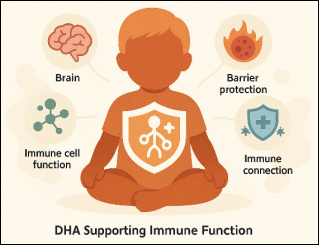
DHA-derived pro-resolving mediators may help regulate inflammation, which can otherwise affect synaptic function, neurogenesis, and neuronal survival. This provides a possible indirect pathway through which DHA may support cognitive development.
However, most evidence comes from laboratory and animal research. Toddler studies have not yet confirmed that improved cognition results specifically from DHA-related immunomodulation.
10. Conclusion
DHA is an important structural and functional component of the developing nervous system. During toddlerhood, it contributes to the lipid architecture of neuronal and synaptic membranes and participates in pathways involved in neuronal differentiation, neurite extension, synapse formation, neurotransmission, neuronal survival and inflammatory resolution.
Mechanistic evidence indicates that DHA supports synaptic development by increasing neurite growth, synaptic-protein expression and glutamatergic function. Through phosphatidylserine-dependent Akt activation, DHA promotes neuronal-survival signaling. Its metabolite synaptamide activates GPR110–cAMP–PKA–CREB pathways that stimulate neurogenesis, neuritogenesis and synaptogenesis. DHA-derived resolvins and protectins may further protect neural tissue by supporting the resolution of inflammation.
These mechanisms provide a credible biological foundation for DHA involvement in learning, memory, attention and cognitive development. Nevertheless, clinical evidence in toddlers and preschool children remains mixed. Supplementation reliably increases circulating DHA but has not consistently improved broad cognitive, language or motor scores. The absence of a universal supplementation effect does not negate DHA’s physiological importance. It suggests that benefit depends on baseline status, developmental timing, dose, duration, vulnerability, nutrient interactions and the sensitivity of assessment methods.
The most defensible conclusion is that adequate DHA intake should be supported as part of balanced toddler nutrition, particularly where dietary intake may be low. DHA should not be promoted as an independent guarantee of greater intelligence or superior development. Optimal neurodevelopment requires the combined influence of good nutrition, responsive caregiving, language exposure, adequate sleep, physical activity, emotional security and access to healthcare and learning opportunities.
Author Contributions
Abu Zafar Muhammad Khairul Anam: Conceptualization, Formal Analysis, Investigation, Methodology, Project administration, Supervision, Validation, Writing – original draft, Writing – review & editing
Mohsin Tareq: Conceptualization, Data curation, Formal Analysis, Investigation, Methodology, Visualization, Writing – original draft
Saiful Islam: Conceptualization, Data curation, Formal Analysis, Investigation, Methodology, Project administration, Visualization
Aziz Ahmed: Conceptualization, Data curation, Formal Analysis, Investigation, Validation, Visualization, Writing – original draft
Monir Hossain: Conceptualization, Data curation, Formal Analysis, Investigation, Methodology, Project administration, Supervision, Validation, Visualization, Writing – original draft, Writing – review & editing
Conflicts of Interest
The authors declare no conflicts of interest.
References
| [1] |
Lauritzen L, Brambilla P, Mazzocchi A, Harsløf LBS, Ciappolino V, Agostoni C. DHA effects in brain development and function. Nutrients. 2016; 8 (1): 6.
https://doi.org/10.3390/nu8010006
|
| [2] |
Horrocks LA, Yeo YK. Health benefits of docosahexaenoic acid. Pharmacol Res. 1999; 40(3): 211–225.
https://doi.org/10.1006/phrs.1999.0495
|
| [3] |
Innis SM. Dietary omega-3 fatty acids and the developing brain. Brain Res. 2008; 1237: 35–43.
https://doi.org/10.1016/j.brainres.2008.08.078
|
| [4] |
Nguyen LN, Ma D, Shui G, et al. Mfsd2a is a transporter for the essential omega-3 fatty acid docosahexaenoic acid. Nature. 2014; 509: 503–506.
https://doi.org/10.1038/nature13241
|
| [5] |
Ben-Zvi A, Lacoste B, Kur E, et al. Mfsd2a is critical for the formation and function of the blood–brain barrier. Nature. 2014; 509: 507–511.
https://doi.org/10.1038/nature13324
|
| [6] |
Guemez-Gamboa A, Nguyen LN, Yang H, et al. Inactivating mutations in MFSD2A, required for omega-3 fatty-acid transport in brain, cause a lethal microcephaly syndrome. Nat Genet. 2015; 47: 809–813.
|
| [7] |
Cater RJ, Chua GL, Erramilli SK, et al. Structural basis of omega-3 fatty-acid transport across the blood–brain barrier. Nature. 2021; 595: 315–319.
|
| [8] |
Wong BH, Chan JP, Cazenave-Gassiot A, et al. The lysolipid transporter Mfsd2a regulates lipogenesis in the developing brain. PLoS Biol. 2018; 16: e2006443.
|
| [9] |
Akbar M, Calderon F, Wen Z, Kim HY. Docosahexaenoic acid: a positive modulator of Akt signaling in neuronal survival. Proc Natl Acad Sci USA. 2005; 102: 10858–10863.
https://doi.org/10.1073/pnas.0502903102
|
| [10] |
Cao D, Kevala K, Kim J, et al. Docosahexaenoic acid promotes hippocampal neuronal development and synaptic function. J Neurochem. 2009; 111: 510–521.
https://doi.org/10.1111/j.1471-4159.2009.06335.x
|
| [11] |
Calderon F, Kim HY. Docosahexaenoic acid promotes neurite growth in hippocampal neurons. J Neurochem. 2004; 90: 979–988.
https://doi.org/10.1111/j.1471-4159.2004.02520.x
|
| [12] |
Kim HY, Moon HS, Cao D, et al. N-Docosahexaenoylethanolamide promotes development of hippocampal neurons. Biochem J. 2011; 435: 327–336.
https://doi.org/10.1042/BJ20102118
|
| [13] |
Lee JW, Huang BX, Kwon H, et al. Orphan GPR110 targeted by N-docosahexaenoylethanolamine in development of neurons and cognitive function. Nat Commun. 2016; 7: 13123.
https://doi.org/10.1038/ncomms13123
|
| [14] |
Kim HY, Spector AA. Molecular and signaling mechanisms for docosahexaenoic-acid-derived neurodevelopment and neuroprotection. Int J Mol Sci. 2022; 23.
|
| [15] |
Ryan AS, Nelson EB. Assessing the effect of docosahexaenoic acid on cognitive functions in healthy preschool children: a randomized, placebo-controlled, double-blind study. Clin Pediatr. 2008; 47: 355–362.
https://doi.org/10.1177/0009922807311730
|
| [16] |
Keim SA, Boone KM, Klebanoff MA, et al. Effect of docosahexaenoic-acid supplementation versus placebo on developmental outcomes of toddlers born preterm: a randomized clinical trial. JAMA Pediatr. 2018; 172: 1126–1134.
https://doi.org/10.1001/jamapediatrics.2018.3082
|
| [17] |
Colombo J, Jill Shaddy D, Kerling EH, Gustafson KM, Carlson SE. Developmental outcomes at 24 months of age in toddlers supplemented with arachidonic acid and docosahexaenoic acid: results of a double-blind randomized controlled trial. Nutrients. 2017; 9: 975.
|
| [18] |
Minns LM, Kerling EH, Neely MR, et al. Toddler formula supplemented with DHA improves DHA status and respiratory health in a randomized, double-blind controlled trial of US children younger than three years. Prostaglandins Leukot Essent Fatty Acids. 2010; 82: 287–293.
https://doi.org/10.1016/j.plefa.2010.02.009
|
| [19] |
Richardson AJ, Burton JR, Sewell RP, Spreckelsen TF, Montgomery P. Docosahexaenoic acid for reading, cognition and behavior in children aged 7–9 years: the DOLAB study. PLoS One. 2012; 7: e43909.
|
| [20] |
Birch EE, Hoffman DR, Uauy R, Birch DG, Prestidge C. Visual acuity and the essentiality of docosahexaenoic acid and arachidonic acid in the diet of term infants. Pediatr Res. 1998; 44: 201–209.
https://doi.org/10.1203/00006450-199808000-00011
|
| [21] |
Birch EE, Garfield S, Hoffman DR, Uauy R, Birch DG. A randomized controlled trial of early dietary supply of long-chain polyunsaturated fatty acids and mental development in term infants. Dev Med Child Neurol. 2000; 42: 174–181.
|
| [22] |
Makrides M, Neumann MA, Simmer K, Gibson RA. A critical appraisal of the role of dietary long-chain polyunsaturated fatty acids on neural indices of term infants: a randomized controlled trial. Pediatrics. 2000; 105: 32–38.
https://doi.org/10.1542/peds.105.1.32
|
| [23] |
O’Connor DL, Hall R, Adamkin D, et al. Growth and development in preterm infants fed long-chain polyunsaturated fatty acids: a prospective randomized controlled trial. Pediatrics. 2001; 108: 359–371.
|
| [24] |
Smithers LG, Gibson RA, McPhee A, Makrides M. Higher-dose docosahexaenoic acid in the neonatal period improves visual acuity of preterm infants. Am J Clin Nutr. 2008; 88: 1049–1056.
https://doi.org/10.1093/ajcn/88.4.1049
|
| [25] |
Carlson SE, Ford AJ, Werkman SH, Peeples JM, Koo WW. Visual acuity and fatty-acid status of term infants fed human milk and formulas with and without docosahexaenoate and arachidonate. Pediatr Res. 1996; 39: 882–888.
|
| [26] |
Santos AR, Comprido D, Duarte CB. Regulation of local translation at the synapse by BDNF. Prog Neurobiol. 2010; 92: 505–516.
https://doi.org/10.1016/j.pneurobio.2010.08.004
|
| [27] |
Yoshii A, Constantine-Paton M. Postsynaptic BDNF–TrkB signaling in synapse maturation, plasticity and disease. Dev Neurobiol. 2010; 70: 304–322.
https://doi.org/10.1002/dneu.20765
|
| [28] |
Sasi M, Vignoli B, Canossa M, Blum R. Neurobiology of local and intercellular BDNF signaling. Pflugers Arch. 2017; 469: 593–610.
|
| [29] |
Orr SK, Palumbo S, Bosetti F, et al. Unesterified docosahexaenoic acid is protective in neuroinflammation. J Neurochem. 2013; 127: 378–393.
https://doi.org/10.1111/jnc.12392
|
| [30] |
Layé S, Nadjar A, Joffre C, Bazinet RP. Anti-inflammatory effects of omega-3 fatty acids in the brain. J Neuroinflammation. 2018; 15: 239.
|
| [31] |
Serhan CN. Pro-resolving lipid mediators are leads for resolution physiology. Nature. 2014; 510: 92–101.
|
| [32] |
Hooijmans CR, Pasker-de Jong PCM, de Vries RBM, Ritskes-Hoitinga M. The effects of long-chain polyunsaturated fatty acids on cognition and development. Neurosci Biobehav Rev. 2012; 36: 191–203.
|
| [33] |
Zhang X, et al. Early-life DHA supplementation and neurodevelopment: systematic review and meta-analysis. 2024. PMID: 38645744.
|
| [34] |
He C, Qu X, Cui L, Wang J, Kang JX. Improved spatial learning performance of fat-1 mice is associated with enhanced neurogenesis and neuritogenesis. Proc Natl Acad Sci USA. 2009; 106: 11370–11375.
|
| [35] |
Gamoh S, Hashimoto M, Sugioka K, et al. Chronic administration of docosahexaenoic acid improves reference-memory-related learning in young rats. Neuroscience. 1999; 93: 237–241.
|
Cite This Article
-
APA Style
Anam, A. Z. M. K., Tareq, M., Islam, S., Ahmed, A., Hossain, M. (2026). The Multifaceted Role of DHA During Toddlerhood: Supporting Synapse Formation, Early Neural Development, Learning Ability, Memory, and Cognitive Function. Journal of Food and Nutrition Sciences, 14(4), 258-270. https://doi.org/10.11648/j.jfns.20261404.15
 Copy
|
Copy
|
 Download
ACS Style
Anam, A. Z. M. K.; Tareq, M.; Islam, S.; Ahmed, A.; Hossain, M. The Multifaceted Role of DHA During Toddlerhood: Supporting Synapse Formation, Early Neural Development, Learning Ability, Memory, and Cognitive Function. J. Food Nutr. Sci. 2026, 14(4), 258-270. doi: 10.11648/j.jfns.20261404.15
Copy
|
Download
AMA Style
Anam AZMK, Tareq M, Islam S, Ahmed A, Hossain M. The Multifaceted Role of DHA During Toddlerhood: Supporting Synapse Formation, Early Neural Development, Learning Ability, Memory, and Cognitive Function. J Food Nutr Sci. 2026;14(4):258-270. doi: 10.11648/j.jfns.20261404.15
Copy
|
Download
-
@article{10.11648/j.jfns.20261404.15,
  author = {Abu Zafar Muhammad Khairul Anam and Mohsin Tareq and Saiful Islam and Aziz Ahmed and Monir Hossain},
  title = {The Multifaceted Role of DHA During Toddlerhood: Supporting Synapse Formation, Early Neural Development, Learning Ability, Memory, and Cognitive Function},
  journal = {Journal of Food and Nutrition Sciences},
  volume = {14},
  number = {4},
  pages = {258-270},
  doi = {10.11648/j.jfns.20261404.15},
  url = {https://doi.org/10.11648/j.jfns.20261404.15},
  eprint = {https://article.sciencepublishinggroup.com/pdf/10.11648.j.jfns.20261404.15},
  abstract = {Toddlerhood is a critical period of neurodevelopment characterized by rapid maturation of language, memory, attention, executive function, motor coordination, emotional regulation, and social cognition, supported by coordinated processes including neuronal differentiation, dendritic arborization, axonal growth, synaptogenesis, myelination, neurotransmission, and activity-dependent synaptic plasticity. Docosahexaenoic acid (DHA; 22:6 n-3), a long-chain omega-3 polyunsaturated fatty acid highly enriched in neuronal and retinal membranes, plays essential structural, metabolic, and signaling roles in the developing brain. Although brain DHA accumulation is greatest during late gestation and the first two years of life, membrane remodeling and cognitive maturation continue throughout toddlerhood, making adequate DHA intake an ongoing nutritional priority. Brain DHA status depends on dietary intake, lipid transport, genetic factors, developmental stage, and overall nutritional status because endogenous synthesis from alpha-linolenic acid is limited. Mechanistically, DHA enhances neuronal membrane fluidity, receptor function, neurotransmission, neurite extension, dendritic development, synaptic protein expression, and long-term potentiation, while increasing phosphatidylserine-mediated activation of neuronal survival pathways. DHA is also converted into bioactive mediators, including synaptamide, protectins, and resolvins, which promote neurogenesis, synaptogenesis, and regulation of neuroinflammation. Efficient transport across the blood–brain barrier via the MFSD2A transporter further underscores the importance of adequate DHA availability for optimal brain function. Collectively, these mechanisms provide strong biological plausibility for DHA involvement in synapse formation, neural maturation, learning, memory, attention, and cognitive development. However, evidence from human intervention studies remains inconsistent. While some studies have reported associations between higher DHA status and improved vocabulary, reading, learning, or cognitive performance, several randomized controlled trials in toddlers and preschool children have found no significant improvements in standardized developmental outcomes following DHA supplementation, particularly among adequately nourished populations. These discrepancies likely reflect differences in baseline DHA status, dietary quality, dosage, intervention duration, developmental timing, prematurity, genetic variation, socioeconomic factors, and outcome measures. This narrative review synthesizes current evidence regarding the physiological significance, molecular mechanisms, and functional effects of DHA during toddlerhood, highlighting the contrast between robust mechanistic evidence and mixed clinical findings. Overall, ensuring adequate dietary DHA should be considered an important component of balanced toddler nutrition, particularly in populations at risk of insufficient intake or developmental vulnerability, while recognizing that optimal neurodevelopment also depends on adequate energy, protein, iron, iodine, choline, sleep, responsive caregiving, language stimulation, physical activity, and enriched learning environments. Further well-designed toddler-specific trials are needed to identify the populations most likely to benefit and to establish the optimal dose, duration, and cognitive outcomes of DHA supplementation.},
 year = {2026}
}
Copy
|
Download
-
TY  - JOUR
T1  - The Multifaceted Role of DHA During Toddlerhood: Supporting Synapse Formation, Early Neural Development, Learning Ability, Memory, and Cognitive Function
AU  - Abu Zafar Muhammad Khairul Anam
AU  - Mohsin Tareq
AU  - Saiful Islam
AU  - Aziz Ahmed
AU  - Monir Hossain
Y1  - 2026/08/24
PY  - 2026
N1  - https://doi.org/10.11648/j.jfns.20261404.15
DO  - 10.11648/j.jfns.20261404.15
T2  - Journal of Food and Nutrition Sciences
JF  - Journal of Food and Nutrition Sciences
JO  - Journal of Food and Nutrition Sciences
SP  - 258
EP  - 270
PB  - Science Publishing Group
SN  - 2330-7293
UR  - https://doi.org/10.11648/j.jfns.20261404.15
AB  - Toddlerhood is a critical period of neurodevelopment characterized by rapid maturation of language, memory, attention, executive function, motor coordination, emotional regulation, and social cognition, supported by coordinated processes including neuronal differentiation, dendritic arborization, axonal growth, synaptogenesis, myelination, neurotransmission, and activity-dependent synaptic plasticity. Docosahexaenoic acid (DHA; 22:6 n-3), a long-chain omega-3 polyunsaturated fatty acid highly enriched in neuronal and retinal membranes, plays essential structural, metabolic, and signaling roles in the developing brain. Although brain DHA accumulation is greatest during late gestation and the first two years of life, membrane remodeling and cognitive maturation continue throughout toddlerhood, making adequate DHA intake an ongoing nutritional priority. Brain DHA status depends on dietary intake, lipid transport, genetic factors, developmental stage, and overall nutritional status because endogenous synthesis from alpha-linolenic acid is limited. Mechanistically, DHA enhances neuronal membrane fluidity, receptor function, neurotransmission, neurite extension, dendritic development, synaptic protein expression, and long-term potentiation, while increasing phosphatidylserine-mediated activation of neuronal survival pathways. DHA is also converted into bioactive mediators, including synaptamide, protectins, and resolvins, which promote neurogenesis, synaptogenesis, and regulation of neuroinflammation. Efficient transport across the blood–brain barrier via the MFSD2A transporter further underscores the importance of adequate DHA availability for optimal brain function. Collectively, these mechanisms provide strong biological plausibility for DHA involvement in synapse formation, neural maturation, learning, memory, attention, and cognitive development. However, evidence from human intervention studies remains inconsistent. While some studies have reported associations between higher DHA status and improved vocabulary, reading, learning, or cognitive performance, several randomized controlled trials in toddlers and preschool children have found no significant improvements in standardized developmental outcomes following DHA supplementation, particularly among adequately nourished populations. These discrepancies likely reflect differences in baseline DHA status, dietary quality, dosage, intervention duration, developmental timing, prematurity, genetic variation, socioeconomic factors, and outcome measures. This narrative review synthesizes current evidence regarding the physiological significance, molecular mechanisms, and functional effects of DHA during toddlerhood, highlighting the contrast between robust mechanistic evidence and mixed clinical findings. Overall, ensuring adequate dietary DHA should be considered an important component of balanced toddler nutrition, particularly in populations at risk of insufficient intake or developmental vulnerability, while recognizing that optimal neurodevelopment also depends on adequate energy, protein, iron, iodine, choline, sleep, responsive caregiving, language stimulation, physical activity, and enriched learning environments. Further well-designed toddler-specific trials are needed to identify the populations most likely to benefit and to establish the optimal dose, duration, and cognitive outcomes of DHA supplementation.
VL  - 14
IS  - 4
ER  -
Copy
|
Download





 Share This Article
 Twitter
 Linked In
 Facebook