Case Report | | Peer-Reviewed

Uterine Scar Dehiscence Found During Emergency Caesarean Section: A Case Report

Received: 14 May 2026     Accepted: 28 May 2026     Published: 12 June 2026
Views:       Downloads:
Abstract

Background: We are presenting a 27 years old female with her second pregnancy at 42 weeks of gestation who was admitted because she was post date with one previous uterine scar and planned for emergency caesarean section due to aforementioned reasons. She was prepared and sent to theatre where uterine scar dehiscence was found but she got a live fetus male baby weighed 3.2kg and scored 9 and 10 at 1st and 5th minutes respectively. The patient received all necessary post operative cares, she progress well while in the ward and was discharged in good health after 3 days and came again in the 7th day for suture remove and then continued with post natal visits as per protocol until was discharged from the clinic. Conclusion: Uterine scar dehiscence without notable complications to the mother and her fetus is rare condition which necessitates serious attention to most women with previous caesarean delivery. In preconception period around 3 to 6 months post previous c/section, transvaginal ultrasound is ideal to measure the lower uterine segment thickness and during pregnancy is better at 32 to 36 weeks using trans-abdominal ultrasound. Whenever an ultrasound is not conclusive, MRI can be used. This case is presented to emphasize on importance of scheduled caesarean section at 37 completed weeks.

Published in Journal of Gynecology and Obstetrics (Volume 14, Issue 3)
DOI 10.11648/j.jgo.20261403.11
Page(s) 71-74
Creative Commons

This is an Open Access article, distributed under the terms of the Creative Commons Attribution 4.0 International License (http://creativecommons.org/licenses/by/4.0/), which permits unrestricted use, distribution and reproduction in any medium or format, provided the original work is properly cited.

Copyright

Copyright © The Author(s), 2026. Published by Science Publishing Group

Keywords

Caesarean Section, Uterine Scar Dehiscence, Live Fetus

1. Introduction
Caesarean section is one of the most important mode of delivery when the need arise, as in most circumstances it is a life saving procedures for the mother and wellbeing of the fetus . In recent years there is increase in the number of caesarean sections worldwide and WHO reports increase between 10% to 15% for these caesarean section delivery . Increase in the number of these procedures carries risks, including uterine scar dehiscence. Factors associated with increase in uterine scar dehiscence among women undergoing caesarean section includes prior classical or low vertical cesarean incision, short inter-pregnancy interval (<18 months), multiple prior cesarean sections, technical suturing, suture material, emergency situations and puerperal infections . Uterine scar dehiscence is the incomplete separation of uterine wall froma previous caesarean delivery without rupture of fetal membranes and/or uterine bleeding, in most cases is silent and often asymptomatic . Uterine scar dehiscence poses a challenge in the field of obstetrics because it may lead to severe maternal morbidity and/or mortality together with poor fetal outcomes . Despite of being reported with low incidence rates which ranges from 0.2% to 3.4%, it can be catastrophic, so early detection and management is necessary to prevent further complications . Uterine scar dehiscence can complicate to peritonitis, and its treatment varies depending on the severityof infection, and in some cases, uterine scar dehiscence if not diagnosed and treated early may lead to peripartum hysterectomy .
This is a case of incidental findings of uterine scar dehiscence found during caesarean section of a woman who presented to the facility at 42 weeks of gestational age not in labourpain. This was considered late presentation for a woman with previous caesarean scar. A case is presented to show how delay to attend to the facility at recommended time of 37 completed weeks is very important because iflabor had started could end up with ruptured uterus and other catastrophic events.
2. Case Report
A 27 years old female G2P1L0 at 42weeks of gestational age with one previous scar not in labour. She was assessed and diagnosis of one previous scar with post term pregnancy was made and decision of doing emergency caesarean section was mandatory. Intraoperatively there was uterine scar dehiscence. A live male baby of 3.2kg was extracted and uterus repaired in double layers. On 3rdday patient was discharged home in good health wither baby. On 7th day sutures were removed and no complication reported. A case is presented and discussed on uterine scar dehiscence.
2.1. History of Presenting Illness
The patient was well with her pregnancy throughout antenatal period and reached her expected date of delivery with no any symptoms of labour. At completed 42 weeks of gestation she decided to seek a medical care at our centre. She had no history of vaginal bleeding, vaginal discharge or vaginal leakage of fluid reported. There were nohistory of headache, blurred vision, epigastric pain, dizziness or any lower limb swelling. Fetal movements were perceived normally.
She booked antenatal clinic at 18 weeks of gestational age, had 5 visits, fundal height was 18/40 corresponding to her gestational age. She was tested for HIVand VDRL was negative. She was given tetanus toxoid injection, hematenics, mebendazole and sulphadoxine-pyrimethamine for malaria. She was not counselled on mode of delivery for the index pregnancy.
2.2. General and Systemic Examination
2.2.1. General Examination
She was fully conscious, oriented to people, place and time, not pale, not jaundiced, no lower limb oedema.
Vital signs: Temperature 36.6 Celsius, pulse rate 78 beats per minute regular with normal volume, respiratory rate 18c ycles per minute, Blood pressure 117/78mmHg, no lower limb oedema.
2.2.2. Chest Examination
She had normal chest contours, moves with respiration, trachea centrally located, and resonant percussion note.
Vesicular breathing sounds heard on both lungs. Normal precordial activities, located in the 5th intercostals space along mid-clavicular line. Normal heart sounds sound 1 and sound 2 heard with no murmurs.
2.2.3. Abdominal Examination
Distended abdomen, moves with respiration, pfannenstiel scar seen, fundal height 36/40, longitudinal lie cephalic presentation, engagement 4/5.
No tenderness, no contraction perceived on palpation, fetal heart rate 138 beats per minute.
2.2.4. Pelvicexamination
Normal vulva and vagina on inspection, cervix was closed and no blood in the gloved finger.
2.3. Provisional Diagnosis
1. Post term pregnancy
2. One previous caesarean delivery
2.4. Management Plan
2.4.1. Investigations Done
Her haemoglobin level was 10.6gm/dl
She was blood group O positive
2.4.2. Treatment
Patient was counselled about emergency caesarean delivery, since she had previous caesarean delivery with postterm pregnancy, so induction of labour was not possible due to fear of uterine rupture. Patient accepted the plan and was prepared for the procedure. She was catheterized, intravenous antibiotics were given, metronidazole 500mg intravenous, ceftriaxone 1 gram intravenous stat and ringer’s lactate one litre was given. Patient was given informed consent and signed, then was taken to theatre for emergency caesarean section.
(i). Operative Procedure
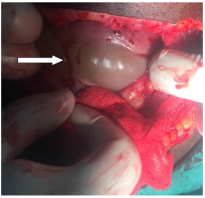
Under subarachnoid blockage she was kept on supine position. Abdomen cleaned with spirit and povidone iodineand vagina was cleansed with povidone. Abdomen was opened through pfannenstiel incision; findings were adhesions of the uterine fundus to anterior abdominal wall. There was complete separation of lower uterine segment with bulging of foetal membranes as seen in the picture below.
Figure 1. Showing Uterine Scar Dehiscence with intact amniotic membrane.
Just a blunt separation of amniotic membrane was done. A male baby weighing 3.2kg with apgar score of 9 at first minute and 10 at fifth minute was extracted. Placenta and membrane were completely removed. Uterus was then repaired in double layers using vicryl suture number two, peritoneal layer was repaired followed by whole abdomen closed in layers using vicryl suture number two and skin layer was closed with nylon number two-zero. Haemostasis was achieved with estimated blood loss of 400mls. Patient was kept on post-operative orders and admitted to postnatal wards.
(ii). Progress in the Ward
She continued with intravenous fluids and analgesics. She received pethidine 100mg intramuscular six hourly for 24 hours and then continued with diclofenac 50mg orally 8hourly for 5 days. After 12 hours she started ambulation and oral sips. Catheter was removed after 24 hours. She had stable vitals sign. In the 3rd day she was reviewed and she had good progress, no fever, headache, no wound discharge and no foul smelling vaginal discharge. She was discharged home in good health and in the 7th day she came back for suture removal. She was given follow up to gynaecology clinic for 2 weeks. She was reviewed later on 28th day post caesarean section at gynaecology clinic shehad no any complain, her haemoglobin level was 11g/dl and was breast feedingher baby normally. Plan was to continue with puerperal sessions as per protocol.
3. Discussion
Uterine scar dehiscence and ruptured uterus are serious complications that has catastrophic outcomes to both mother and fetus . Uterine scar dehiscence is classically defined as separation of the uterine musculature without extravasation of intraamniotic contents and fetal parts into the peritoneal cavity or Uterine dehiscence refers to an incomplete uterine scar separation with intact serosa . In our case there was uterine separation except amniotic membrane only.
Uterine rupture or dehiscence occurs in approximately 0.3-1.9% of cases of previous cesarean section . A study done at Bugando Medical Centre in 2019 showed that risk factors associated with uterine rupture include prolonged obstructed labor, previous caesarian delivery and augmentation of labor with oxytocin in a multiparous women . Our patient had one previous caesarian delivery so she was at risk of uterine scar dehiscence or uterine rupture although she was not yet started labor pain. Studies has shown that caesarian delivery is the most risk factor for uterine rupture or uterine scar dehiscence, hence, it is not surprising to witness a surge of both conditions that paralleled the recent increase in cesarean section rates. The incidence of cesarean section (C-sections) deliveries has steadily increased worldwide .
In different studies there is no difference seen in suturing technique, where single layer versus double layer closure in terms of infections and uterine scar dehiscence . In our case we don’t know the suture material or technique used in previous caesarean delivery since it was not done in our setting so no any documentation.
In one study concluded that patients with a history of CS should under-go transvaginal sonographic of the scar region in order to detect latent scar dehiscence in combination with uterine wall thinning prior to planning furtherpregnancy. In suspected cases, a combined laparoscopic–vaginal approach can be employed to repair the defect . Another study revealed that sonographic appearance of uterine scar dehiscence during pregnancy has been previously described as an anechoic space interrupting the myometrium of the lower uterine segment, resulting in direct continuity of the endometrial cavity with the outside of the uterus . Several studies have demonstrated that less than 50% of uterine scars dehiscence are identified during pregnancy .
So it is possible to diagnose uterine scar dehiscence during pregnancy or pre pregnancy state by using ultrasound and laparoscopic procedure in non-pregnant women. In preconception period around 3 to 6 months post previous c/section, transvaginal ultrasound is ideal to measure the lower uterine segment thickness and during pregnancy is better at 32 to 36 weeks using transabdominal ultrasound . Whenever an ultrasound is not conclusive, MRI can be used. In this case patient had no any ultrasound prior conception or during pregnancy to predict the scar dehiscence. Screening women with prior caesarian delivery during subsequent pregnancy or prior conception can help to prevent complications related to uterine scar dehiscence or uterine rupture. However screening by ultrasound ormagnetic resonance imaging (MRI) can help to determine mode of delivery in a woman with previous caesarian delivery.
4. Conclusion
Uterine scar dehiscence without notable complications to the mother and her fetus israre condition which necessitate serious attention in most women with previous caesarean delivery. This case is presented to emphasize on importance scheduled caesarean delivery at 37 completed weeks.
Abbreviations

C/S

Caesarean Section

HIV

Human Immunodeficiency Virus

Kg

Kilogram

MRI

Magnetic Resonance Imaging

VDRL

Venerial Disease Research Laboratory

WHO

World Health Organisation

Acknowledgments
The authors would like to thank Cosmas Mbulwa for financial support in preparing this manuscript.
Author Contributions
Emiliana Dismas Mvungi: Validation, Writing – original draft, Writing – review & editing
Innocent Lutakyamilwa Kaiza: Supervision, Validation, Writing – original draft, Writing – review & editing
Ndakibae Gabriel Mabega: Supervision, Writing – review & editing
Conflicts of Interest
The authors declare that they have no conflicts of interest.
References
[1] Simran A et al. Examining the role and relevance of the critical analysis and comparison of cesarean section rates in a changing world.
[2] Saifon Chawanpaiboon et al. Severe Complications of Uterine Dehiscence Post-Lower Segment Cesarean Section: A Case Report Emphasizing the Importance of Timely Diagnosis and Intervention.
[3] Bashiri A, Burstein E, Rosen S, et al. Clinical significance of uterine scar dehiscence in women with previous cesarean delivery: Prevalence and independent risk factors.
[4] Mohamad K. Ramadana et at. Incidence and Risk Factors of Uterine Scar Dehiscence Identified at Elective Repeat Cesarean Delivery: A Case-Control Study. J Clin Gynecol Obstet. 2018; 7(2): 37-42.
[5] Zeb L. Frequency of scar dehiscence in patients with previous one caesarean section having scar tenderness. J Khyber Coll Dentist. 2023; 13(3): 45-8.
[6] Tyagi N, Prabhakar M, Tyagi S. Retrospective study to find predictive factors of scar dehiscence in previous caesarean section to prevent maternal and perinatal morbidity and mortality. Int J Reproduct Contracept Obstetr Gynecol. 2019; 8(2): 531-6.
[7] Kaplanoglu M, Bulbul M, Kaplanoglu D, Bakacak SM. Effect of multiple repeat cesarean sections on maternal morbidity: data from southeast Turkey. I nt MedJ Experiment Clin Res. 2015; 21: 1447.
[8] Chen SH, Du XP. Silent spontaneous posterior uterine rupture of a prior caesarean delivery at 36weeks of gestation. BMC Pregnancy Childbirth. 2019; 19(1): 4–6.
[9] Hamar BD, Levine D, Katz NL, Lim KH. Expectant management of uterine dehiscence in the second trimester of pregnancy. Obstet Gynecol. 2003; 102 (5SUPPL.): 1139–42.
[10] Fox NS, Gerber RS, Mourad M, Saltzman DH, Klauser CK, Gupta S, et al. Pregnancy outcomes in patients with prior uterine rupture or dehiscence. ObstetGynecol. 2014; 123(4): 785–9.
[11] Hofmeyr GJ, Say L, Gülmezoglu AM. WHO systematic review of maternal mortality and morbidity: The prevalence of uterine rupture. BJOG An IntJ Obstet Gynaecol. 2005; 112(9): 1221–8.
[12] Mrema S, Massinde A, Matovelo D, Kihunrwa A, Rumanyika R, Kidenya B. Fetomaternal outcomes in patients with Uterine Rupture managed at Bugando Medical Centre, Tanzania: 5-year review of cases. 2019; 1–23.
[13] Sawada M, Matsuzaki S, Nakae R, Iwamiya T, Kakigano A, Kumasawa K, et al. Treatment and repair of uterine scar dehiscence during cesarean section. Clin Case Reports. 2017; 5(2): 145–9.
[14] Chapman SJ, Owen J, Hauth JC. One-versus two-layer closure of a low transverse cesarean: The next pregnancy. Obstet Gynecol. 1997; 89(1): 16–8.
[15] Klemm P, Koehler C, Mangler M, Schneider U, Schneider A. Laparoscopic and vaginal repair of uterine scar dehiscence following cesarean section as detected by ultrasound. J PerinatMed. 2005; 33(4): 324–31.
[16] Bromley B, Pitcher BL, Klapholz H, Lichter E, Benacerraf BR. Sonographic appearance of uterine scar dehiscence. IntJ Gynecol Obstet. 1995; 51(1): 53–6.
[17] Ishan Kumar, Ashish Verma et al. Utility of multiparametric MRI in c/section scar characterization and preoperative prediction of scar dehiscence: a prospective study.
Cite This Article
  • APA Style

    Mvungi, E. D., Kaiza, I. L., Mabega, N. G. (2026). Uterine Scar Dehiscence Found During Emergency Caesarean Section: A Case Report. Journal of Gynecology and Obstetrics, 14(3), 71-74. https://doi.org/10.11648/j.jgo.20261403.11

    Copy | Download

    ACS Style

    Mvungi, E. D.; Kaiza, I. L.; Mabega, N. G. Uterine Scar Dehiscence Found During Emergency Caesarean Section: A Case Report. J. Gynecol. Obstet. 2026, 14(3), 71-74. doi: 10.11648/j.jgo.20261403.11

    Copy | Download

    AMA Style

    Mvungi ED, Kaiza IL, Mabega NG. Uterine Scar Dehiscence Found During Emergency Caesarean Section: A Case Report. J Gynecol Obstet. 2026;14(3):71-74. doi: 10.11648/j.jgo.20261403.11

    Copy | Download

  • @article{10.11648/j.jgo.20261403.11,
      author = {Emiliana Dismas Mvungi and Innocent Lutakyamilwa Kaiza and Ndakibae Gabriel Mabega},
      title = {Uterine Scar Dehiscence Found During Emergency Caesarean Section: A Case Report},
      journal = {Journal of Gynecology and Obstetrics},
      volume = {14},
      number = {3},
      pages = {71-74},
      doi = {10.11648/j.jgo.20261403.11},
      url = {https://doi.org/10.11648/j.jgo.20261403.11},
      eprint = {https://article.sciencepublishinggroup.com/pdf/10.11648.j.jgo.20261403.11},
      abstract = {Background: We are presenting a 27 years old female with her second pregnancy at 42 weeks of gestation who was admitted because she was post date with one previous uterine scar and planned for emergency caesarean section due to aforementioned reasons. She was prepared and sent to theatre where uterine scar dehiscence was found but she got a live fetus male baby weighed 3.2kg and scored 9 and 10 at 1st and 5th minutes respectively. The patient received all necessary post operative cares, she progress well while in the ward and was discharged in good health after 3 days and came again in the 7th day for suture remove and then continued with post natal visits as per protocol until was discharged from the clinic. Conclusion: Uterine scar dehiscence without notable complications to the mother and her fetus is rare condition which necessitates serious attention to most women with previous caesarean delivery. In preconception period around 3 to 6 months post previous c/section, transvaginal ultrasound is ideal to measure the lower uterine segment thickness and during pregnancy is better at 32 to 36 weeks using trans-abdominal ultrasound. Whenever an ultrasound is not conclusive, MRI can be used. This case is presented to emphasize on importance of scheduled caesarean section at 37 completed weeks.},
     year = {2026}
    }
    

    Copy | Download

  • TY  - JOUR
    T1  - Uterine Scar Dehiscence Found During Emergency Caesarean Section: A Case Report
    AU  - Emiliana Dismas Mvungi
    AU  - Innocent Lutakyamilwa Kaiza
    AU  - Ndakibae Gabriel Mabega
    Y1  - 2026/06/12
    PY  - 2026
    N1  - https://doi.org/10.11648/j.jgo.20261403.11
    DO  - 10.11648/j.jgo.20261403.11
    T2  - Journal of Gynecology and Obstetrics
    JF  - Journal of Gynecology and Obstetrics
    JO  - Journal of Gynecology and Obstetrics
    SP  - 71
    EP  - 74
    PB  - Science Publishing Group
    SN  - 2376-7820
    UR  - https://doi.org/10.11648/j.jgo.20261403.11
    AB  - Background: We are presenting a 27 years old female with her second pregnancy at 42 weeks of gestation who was admitted because she was post date with one previous uterine scar and planned for emergency caesarean section due to aforementioned reasons. She was prepared and sent to theatre where uterine scar dehiscence was found but she got a live fetus male baby weighed 3.2kg and scored 9 and 10 at 1st and 5th minutes respectively. The patient received all necessary post operative cares, she progress well while in the ward and was discharged in good health after 3 days and came again in the 7th day for suture remove and then continued with post natal visits as per protocol until was discharged from the clinic. Conclusion: Uterine scar dehiscence without notable complications to the mother and her fetus is rare condition which necessitates serious attention to most women with previous caesarean delivery. In preconception period around 3 to 6 months post previous c/section, transvaginal ultrasound is ideal to measure the lower uterine segment thickness and during pregnancy is better at 32 to 36 weeks using trans-abdominal ultrasound. Whenever an ultrasound is not conclusive, MRI can be used. This case is presented to emphasize on importance of scheduled caesarean section at 37 completed weeks.
    VL  - 14
    IS  - 3
    ER  - 

    Copy | Download

Author Information
  • Department of Obstetrics and Gynecology, Sekou Toure Regional Referral Hospital, Mwanza, United Republic of Tanzania

  • Department of Obstetrics and Gynecology, Sekou Toure Regional Referral Hospital, Mwanza, United Republic of Tanzania

  • Department of Clinical Research, National Institute for Medical Research, Mwanza, United Republic of Tanzania