Research Article | | Peer-Reviewed

Effects of Cash Transfer Program Attributes on the Wellbeing of the Elderly

Received: 8 July 2026     Accepted: 24 July 2026     Published: 10 August 2026
Views:       Downloads:
Abstract

This study examined the effect of cash transfer programme accessibility on the wellbeing of elderly beneficiaries in Kawangware informal settlement, Nairobi County, Kenya. Despite the implementation of the Older Persons Cash Transfer (OPCT) programme under the Inua Jamii initiative, many elderly beneficiaries continue to experience barriers in accessing cash transfer services, limiting the programme's potential to improve their wellbeing. The study adopted a descriptive research design guided by the pragmatist research philosophy and employed a mixed-methods approach. The target population comprised 989 OPCT beneficiaries aged 60 years and above. A sample of 285 respondents was selected using stratified random sampling for the quantitative survey, while 25 key informants were purposively selected for qualitative interviews, of which 17 participated. A total of 224 questionnaires were successfully completed, representing a response rate of 80.6%. Quantitative data were collected using structured questionnaires and analysed using descriptive statistics, chi-square tests, correlation analysis, and multiple linear regression, while qualitative data were collected through interview guides and analysed thematically. The findings revealed that accessibility to cash transfer services had a statistically significant positive relationship with elderly wellbeing (p <.001). Easy access to payment points, manageable travel time, reasonable travel distance, affordable transport costs, convenient payment methods, and the ability to collect cash independently were associated with better wellbeing among beneficiaries. Qualitative findings further revealed that long travel distances, congestion at payment centres, high transport costs, and technological challenges reduced the effectiveness of the programme despite its contribution to beneficiaries' livelihoods. The study concludes that improving accessibility to cash transfer services is essential for enhancing the wellbeing of older persons living in urban informal settlements. The study recommends decentralizing payment points, expanding elderly-friendly digital payment systems, strengthening digital literacy support, and reducing transport and administrative barriers to improve the effectiveness of the OPCT programme.

Published in Journal of Public Policy and Administration (Volume 10, Issue 3)
DOI 10.11648/j.jppa.20261003.12
Page(s) 190-198
Creative Commons

This is an Open Access article, distributed under the terms of the Creative Commons Attribution 4.0 International License (http://creativecommons.org/licenses/by/4.0/), which permits unrestricted use, distribution and reproduction in any medium or format, provided the original work is properly cited.

Copyright

Copyright © The Author(s), 2026. Published by Science Publishing Group

Keywords

Cash Transfer Accessibility, Elderly Wellbeing, Older Persons Cash Transfer, Social Protection, Urban Informal Settlements

1. Introduction
The wellbeing of older persons in urban informal settlements remains a major global social protection concern, especially in low- and middle-income countries where poverty, inadequate healthcare, social exclusion, and weak support systems increase vulnerability. With the global population aged 60 years and above projected to exceed 2 billion by 2050, the need for effective social protection interventions is growing . Cash transfer programmes are widely used to improve the wellbeing of vulnerable older persons by increasing household income, improving access to healthcare, reducing poverty, and promoting social inclusion . Evidence also shows that cash transfers improve health-seeking behaviour, reduce financial stress, and enhance older adults’ quality of life . However, these benefits depend largely on beneficiaries’ ability to access transfers easily and consistently.
Across Africa, social cash transfer programmes have significantly contributed to reducing poverty among vulnerable populations, including older persons. Nevertheless, accessibility challenges continue to limit programme effectiveness. Long distances to payment points, limited digital literacy, inadequate transport, bureaucratic procedures, and weak payment infrastructure reduce beneficiaries' ability to receive transfers promptly . During the COVID-19 pandemic, countries with accessible and shock-responsive payment systems protected vulnerable households more effectively than those with fragmented delivery systems. However, older persons, especially women and those living in informal settlements, continue to face exclusion resulting from administrative barriers, physical mobility limitations, and technological challenges . These findings highlight that accessibility remains a critical determinant of the success of social protection programmes across Africa.
In Kenya, the Older Persons Cash Transfer (OPCT) programme under the Inua Jamii initiative was introduced to improve the wellbeing of older persons through regular financial assistance. Studies have shown that the programme contributes positively to financial security, healthcare utilization, and social inclusion among beneficiaries . However, several studies report that elderly beneficiaries continue to experience accessibility challenges, including long travel distances to payment centres, congestion, transport costs, delayed payments, limited digital literacy, and dependence on third parties when accessing benefits . These barriers reduce the effectiveness of the programme and limit its contribution to improving the wellbeing of elderly beneficiaries despite continued government investment.
Kawangware informal settlement presents a particularly important context for examining programme accessibility. The settlement is characterized by high poverty levels, overcrowding, inadequate infrastructure, insecurity, and limited access to essential public services. Many elderly residents depend almost entirely on the Inua Jamii programme as their primary source of income. More than 45% of older persons living in urban informal settlements remain below the poverty line . Although cash transfer programmes are intended to improve their wellbeing, accessibility barriers such as long distances to payment points, transport costs, technological challenges, and administrative procedures may reduce programme effectiveness. Understanding how accessibility influences the wellbeing of elderly beneficiaries is therefore essential for strengthening social protection programmes and informing policies aimed at improving the quality of life of older persons living in urban informal settlements.
The Government of Kenya has invested substantially in social protection through the Older Persons Cash Transfer (OPCT) programme under the Inua Jamii initiative to improve the wellbeing of vulnerable older persons. Despite these efforts, many elderly beneficiaries living in urban informal settlements such as Kawangware continue to experience poor wellbeing characterized by financial insecurity, limited access to healthcare, social exclusion, and poor quality of life. These challenges are compounded by poverty, chronic illness, inadequate infrastructure, and weak social support systems, which disproportionately affect older persons living in informal settlements . Consequently, the intended benefits of the programme are not fully realized among many beneficiaries.
A major factor limiting programme effectiveness is poor accessibility to cash transfer services. Elderly beneficiaries frequently experience long travel distances to payment points, high transport costs, and overcrowding, technological barriers associated with digital payment systems, and administrative procedures that delay or complicate access to benefits . These barriers increase physical and financial burdens, discourage timely collection of transfers, and reduce the programme's capacity to improve beneficiaries' wellbeing. Although the Inua Jamii programme has expanded its coverage, accessibility challenges continue to undermine its effectiveness, particularly among older persons with limited mobility and low digital literacy.
Previous studies have largely examined the overall effectiveness of cash transfer programmes or focused on payment adequacy and targeting mechanisms, while giving limited attention to accessibility as a determinant of elderly wellbeing. Most existing studies have employed quantitative approaches that provide limited understanding of beneficiaries' lived experiences in accessing cash transfer services, particularly within densely populated urban informal settlements such as Kawangware . Consequently, there remains inadequate empirical evidence on how physical, financial, administrative, and technological accessibility influences the wellbeing of elderly beneficiaries in these settings.
This study addressed this knowledge gap by examining the effect of cash transfer programme accessibility on the wellbeing of elderly beneficiaries in Kawangware informal settlement using a mixed-methods approach. Specifically, the study investigated how accessibility factors, including distance to payment points, transport costs, convenience of payment methods, independence in accessing benefits, and administrative procedures, influence the physical, economic, psychological, and social wellbeing of elderly beneficiaries. The findings provide evidence to support policy reforms aimed at improving accessibility to cash transfer services and strengthening social protection programmes for older persons living in urban informal settlements.
2. Literature Review
Accessibility to cash transfer programmes significantly influences the wellbeing of elderly beneficiaries because it determines how easily beneficiaries obtain financial support, healthcare, and other essential services. Globally, physical barriers, discriminatory attitudes, and strict documentation requirements limit access to cash assistance among vulnerable populations, while mobile money systems improved accessibility although infrastructural and environmental barriers continued to affect vulnerable groups . Similarly, digital delivery systems improve outreach but may disadvantage elderly persons with low digital literacy, whereas formal identification requirements are significant institutional barriers within African cash transfer systems . These studies collectively demonstrate that accessibility is multidimensional, involving physical, administrative, and technological factors. However, most global studies focus on disability inclusion, humanitarian contexts, or general vulnerable populations rather than elderly persons living in urban informal settlements such as Kawangware.
African studies similarly reveal that accessibility challenges continue to affect the effectiveness of social protection programmes among vulnerable populations. Found that older persons in Sub-Saharan Africa often rely on fragile informal support systems when access to formal social protection programmes is limited, while observed that weak urban governance systems increased exclusion among vulnerable populations during the COVID-19 period in Nigeria. further argued that bureaucratic procedures and documentation requirements disproportionately exclude vulnerable elderly populations from accessing social protection services. In Tanzania, emphasized the importance of verification systems to prevent exclusion arising from digital identification procedures. These studies agree that administrative and institutional barriers weaken programme accessibility and negatively affect wellbeing outcomes. Nevertheless, the studies provide limited evidence on how accessibility barriers specifically affect elderly persons residing in densely populated urban informal settlements with unique infrastructural and social challenges.
In Kenya, several studies have linked accessibility challenges with reduced effectiveness of cash transfer programmes among elderly beneficiaries. established that although the Older Age Cash Transfer Programme improved healthcare access in Isiolo County, long distances to payment points remain a major challenge for elderly beneficiaries. Similarly, found that mobile money, bank cheques, and counter payment systems enhanced programme accessibility, although long distances, poor health, transport costs, and weak communication systems limited elderly participation in Kiambu County. further revealed that low literacy levels, inadequate awareness of programme procedures, and reliance on informal information channels hindered access to unconditional cash transfers among older persons in Tharaka Nithi County. also identified poor coordination, weak technical infrastructure, and administrative inefficiencies within the OPCT programme. These findings demonstrate persistent accessibility challenges within Kenya’s social protection programmes.
Institutional and community-related factors also influence accessibility and wellbeing among elderly beneficiaries. observed that discriminatory attitudes and inflexible programme procedures reduced programme uptake among vulnerable beneficiaries, while established that weak formal systems force elderly persons to rely on unstable kinship networks for survival. Similarly, reported that community-based beneficiary identification processes in Kenya sometimes introduce bias and exclusion errors that prevent deserving beneficiaries from accessing support. further found that low awareness levels and complicated registration procedures reduce uptake of unconditional cash transfer programmes. These studies reveal a pattern where institutional rigidity, weak communication systems, and social biases negatively affect accessibility among vulnerable populations. However, there remains limited empirical evidence on how community dynamics and administrative procedures affect elderly beneficiaries living in highly populated and socially diverse informal settlements such as Kawangware.
Technological and security-related dimensions of accessibility have also emerged as important concerns affecting elderly wellbeing. noted that digital cash transfer systems improve efficiency and outreach but may create exclusion among elderly beneficiaries with low digital literacy. Similarly, emphasized the need for dedicated verification mechanisms to ensure elderly beneficiaries are not excluded from digital systems. In Kenya, mobile payment systems such as M-Pesa have improved convenience and reduced travel requirements, although many elderly beneficiaries continue to rely on third parties to access their funds, increasing the risk of exploitation. further argued that safe and localized disbursement systems are essential for protecting elderly beneficiaries, while identified physical safety concerns during benefit collection as a major challenge affecting elderly wellbeing in Ghana. Despite increasing digitization of cash transfer systems, there remains inadequate evidence on how digital literacy, insecurity, and urban crime environments influence accessibility and wellbeing among elderly beneficiaries in Kawangware informal settlement.
3. Methodology
The study adopted a mixed-methods research design combining quantitative and qualitative approaches to examine the effect of cash transfer programme accessibility on the wellbeing of elderly beneficiaries in Kawangware informal settlement, Nairobi County, Kenya. The target population comprised 989 elderly beneficiaries of the Older Persons Cash Transfer (OPCT) programme aged 60 years and above. A sample of 285 respondents was determined using Cochran's formula, while 25 purposively selected key informants participated in qualitative interviews, of which 17 were successfully interviewed. Stratified random sampling was used to select survey respondents, while purposive sampling identified participants with relevant programme experience. Quantitative data were collected using structured questionnaires, whereas qualitative data were gathered through semi-structured interview guides. Instrument validity was established through expert review and pilot testing, while reliability was assessed using Cronbach's Alpha. Quantitative data were analysed using descriptive statistics, chi-square tests, correlation analysis, and multiple linear regressions to determine the influence of accessibility on elderly wellbeing. Qualitative data were analysed thematically using NVivo, with triangulation employed to enhance the credibility of the findings. Ethical approval was obtained from St. Paul's University Ethics Review Committee and a research permit was secured from the National Commission for Science, Technology and Innovation (NACOSTI). Informed consent, confidentiality, voluntary participation, anonymity, and secure data management were maintained throughout the study.
4. Results and Discussion
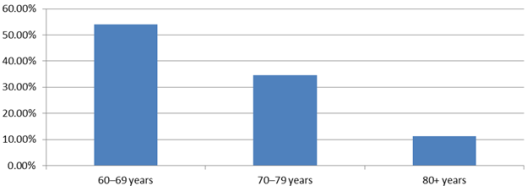
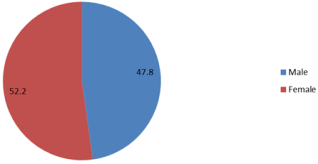
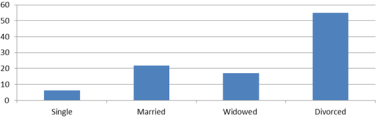
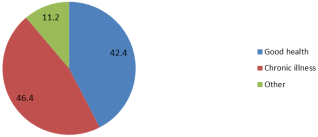
This section presents the demographics of the respondents, providing the context for interpreting the survey results. The collected data included age bracket, gender, marital status, and health status of the elderly participants in the cash transfer program. This information is essential for understanding the influence of individual and social resources on the effectiveness of cash transfers in enhancing wellbeing outcomes. Majority of respondents were aged 60 to 79 years, with a balanced representation of both genders. The marital and health status highlighted the vulnerability of the elderly, enhancing the comprehension of their socio-economic and wellness conditions.
4.1. Age Bracket of Elderly OPCT Beneficiaries in Kawangware Informal Settlement, Nairobi County, Kenya
This section provides a description of respondents according to their age categories. It examines the distribution of elderly participants across different age brackets to understand the demographic composition of the study sample. Analyzing age distribution helps determine whether the cash transfer program reaches various segments of the elderly population and provides context for interpreting wellbeing outcomes across age groups.
Table 1. Age Distribution of Elderly OPCT Beneficiaries in Kawangware Informal Settlement, Nairobi County, Kenya.
Age Bracket

Frequency

Percent

60-69 years

112

54.1%

70-79 years

71

34.6%

80+ years

24

11.3%

Total

224

100.0%

Figure 1. Age Distribution of Elderly OPCT Beneficiaries in Kawangware Informal Settlement, Nairobi County, Kenya.
4.2. Gender Distribution of Elderly OPCT Beneficiaries in Kawangware Informal Settlement, Nairobi County, Kenya
This section provides an analysis of respondents based on gender. It examines the distribution of male and female participants in the study to establish gender representation among elderly beneficiaries. Understanding gender composition is important in assessing whether the cash transfer program is equitably accessed and whether wellbeing outcomes may differ between male and female respondents.
Table 2. Gender Distribution of Elderly OPCT Beneficiaries in Kawangware Informal Settlement, Nairobi County, Kenya.
Gender

Frequency

Percent

Male

107

47.8

Female

117

52.2

Total

224

100.0

Figure 2. Gender Distribution of Elderly OPCT Beneficiaries in Kawangware Informal Settlement, Nairobi County, Kenya.
4.3. Marital Status of Elderly OPCT Beneficiaries in Kawangware Informal Settlement, Nairobi County, Kenya
This section provides a description of respondents according to their marital status. It examines the distribution of elderly beneficiaries as single, married, widowed, or separated to understand their social and family support structures. Marital status is important in interpreting wellbeing outcomes, as it may influence financial stability, caregiving support, and overall living conditions among the elderly.
Table 3. Marital Status of Elderly OPCT Beneficiaries in Kawangware Informal Settlement, Nairobi County, Kenya.

Marital Status

Frequency

Percent

Single

14

6.3

Married

49

21.9

Widowed

38

17.0

Divorced

123

54.9

Total

224

100.0

Figure 3. Marital Status Distribution of Elderly OPCT Beneficiaries in Kawangware Informal Settlement, Nairobi County, Kenya.
4.4. Health Status of Elderly OPCT Beneficiaries in Kawangware Informal Settlement, Nairobi County, Kenya
This section provides an analysis of respondents’ health status. It examines the prevalence of health conditions and access to medical care among the elderly beneficiaries. Assessing health status is important in understanding wellbeing outcomes, since poor health can increase dependency and financial burden, thereby influencing the effectiveness of cash transfer support in improving elderly living conditions.
Table 4. Health Status of Elderly OPCT Beneficiaries in Kawangware Informal Settlement, Nairobi County, Kenya.

Health Status

Frequency

Percent

Good health

95

42.4

Chronic illness

104

46.4

Other

25

11.2

Total

224

100.0

Figure 4. Health Status of Elderly OPCT Beneficiaries in Kawangware Informal Settlement, Nairobi County, Kenya.
4.5. Analysis of the Study Variables of Elderly OPCT Beneficiaries in Kawangware Informal Settlement, Nairobi County, Kenya
Table 5. Cross-tabulation of Accessibility to Cash Transfer Programme and Wellbeing of Elderly Beneficiaries in Kawangware Informal Settlement, Nairobi County, Kenya.

Variable

Response

Good Wellbeing (Frequency,%)

Poor Wellbeing (Frequency,%)

χ2

df

p-value

Is it easy for you to access the cash transfer location?

Yes

159 (71.0%)

65 (29.0%)

39.45

1

<.001

No

65 (29.0%)

159 (71.0%)

Is the time it takes to reach the payment point manageable?

Yes

158 (70.5%)

66 (29.5%)

37.79

1

<.001

No

66 (29.5%)

158 (70.5%)

Is the distance to the cash disbursement point reasonable?

Yes

161 (71.9%)

63 (28.1%)

42.88

1

<.001

No

63 (28.1%)

161 (71.9%)

Are you able to collect your cash without needing assistance?

Yes

158 (70.5%)

66 (29.5%)

37.79

1

<.001

No

66 (29.5%)

158 (70.5%)

Do you feel independent when collecting your cash transfer?

Yes

150 (67.0%)

74 (33.0%)

25.79

1

<.001

No

74 (33.0%)

150 (67.0%)

Do you rely on others for help when accessing the cash?

Yes

154 (68.8%)

70 (31.2%)

31.50

1

<.001

No

70 (31.2%)

154 (68.8%)

Is the cost of transport to the payment point affordable?

Yes

158 (70.5%)

66 (29.5%)

37.79

1

<.001

No

66 (29.5%)

158 (70.5%)

Do you spend a lot of money to access the cash transfer?

Yes

159 (71.0%)

65 (29.0%)

39.45

1

<.001

No

65 (29.0%)

159 (71.0%)

Do poor delivery methods make it harder for you to access your cash? (reverse scored)

Yes

154 (68.8%)

70 (31.2%)

31.50

1

<.001

No

70 (31.2%)

154 (68.8%)

Is the current payment method convenient and reliable for your needs?

Yes

161 (71.9%)

63 (28.1%)

42.88

1

<.001

No

63 (28.1%)

161 (71.9%)

Table 5 presents the relationship between accessibility to cash transfer programmes and elderly wellbeing using chi-square analysis because the wellbeing indicators under this objective were measured as categorical variables. Table 5 shows that accessibility to the cash transfer program is strongly and significantly associated with elderly wellbeing, as all p-values are <.001, meaning the relationships are statistically significant. Respondents who found access easy reported better wellbeing, for example 159 (71.0%) had good wellbeing compared to 65 (29.0%) poor wellbeing (χ2=39.45). Similarly, manageable travel time had 158 (70.5%) reporting good wellbeing versus 66 (29.5%) poor wellbeing (χ2=37.79). Reasonable distance recorded 161 (71.9%) good wellbeing and 63 (28.1%) poor wellbeing (χ2=42.88). Independence in collecting cash also showed strong association (158; 70.5%). Transport affordability was significant (158; 70.5%), while high transport costs reduced wellbeing (159; 71.0%). Convenient payment methods showed 161 (71.9%) good wellbeing (χ2=42.88). These results imply that improving accessibility reduces barriers, enhances independence, and strengthens wellbeing among elderly beneficiaries in Kawangware informal settlement.
Kawangware interviewees stressed how accessibility affected their well-being, undermining monetary transfers. One interviewee noted that “I walk approximately two kilometers to collect my points,” which was expensive and time-consuming. Others said transit costs ate up their tiny funds (interviewee 4, interviewee 16). Long lines were another theme, with interviewee 1 waiting in the rain with hurting knees and interviewee 5 remembering fainting in a long line. Interviewee 3 was frustrated by biometric system failures that caused repeated trips. Some suggested using mobile money to reduce such expenses (interviewee 2, interviewee 9, and interviewee 14). Interviewees agreed that the program gave them dignity and independence, but inaccessibility often hindered efficacy; therefore predictable and easier delivery techniques were needed. The qualitative findings therefore reinforce the quantitative results by showing that transport barriers, congestion, and technological challenges negatively affect elderly wellbeing and programme effectiveness.
The study found that cash transfer accessibility significantly predict elderly wellbeing, suggesting that these factors are more important than the amount itself. Interviewee 1 reported, “Walking long distances to collect the money are exhausting because of my age.” Interviewee 5 explained, “Long queues and overcrowding affect elderly people with health problems.” Interviewee 14 recommended, “Mobile money payments would reduce transport costs and make access easier for older people. “This supports Social Protection Theory, which emphasizes stability and predictability in vulnerability mitigation. Regular payments provide beneficiaries security to spend wisely and receive essential services without feeling deprived. Through the Life Course Theory, constant transfers can address senior persons' lifelong vulnerabilities and provide a consistent flow of resources to address economic and health difficulties. The observation shows that in informal urban locations like Kawangware, transfer timing and reliability are more theoretically significant than monetary value because they develop long-term resilience and dignity in older adults.
These findings are consistent with who found that Kenya Old Age Cash Transfer Programme improved food security, healthcare, and education with regular payment disbursements, and who noted that accessibility depends on payment regularity and delivery channels. found that regular payments increased senior happiness. The results contradict , who stated that accessibility constraints, not frequency, are the biggest difficulty for marginalized populations including people with disabilities. This paradox may be due to contextual differences: while accessibility difficulties are important, regular payments are the most important factor in elderly wellbeing in Kawangware. Frequency is statistically important, but theoretically, it shows how social protection should assure inclusion and regularity in delivery to preserve old welfare over time. The findings therefore suggest that improving accessibility mechanisms such as mobile payment systems, reduced travel distances, and elderly-friendly delivery systems would significantly enhance elderly wellbeing.
5. Conclusion
The study concludes that accessibility to cash transfer services is a significant determinant of the wellbeing of elderly beneficiaries in Kawangware informal settlement. Easy access to payment points, affordable transport, convenient payment methods, and the ability to collect benefits independently significantly enhanced beneficiaries' financial security, healthcare access, dignity, and overall quality of life. Conversely, long travel distances, transport costs, congestion at payment centres, and technological barriers reduced the effectiveness of the Older Persons Cash Transfer (OPCT) programme. The findings demonstrate that improving accessibility is essential for maximizing the social protection benefits of cash transfer programmes and promoting the wellbeing of older persons living in urban informal settlements.
6. Recommendations
The Government of Kenya, through the Ministry of Labour and Social Protection, should improve the accessibility of the Older Persons Cash Transfer programme by decentralizing payment points and expanding secure mobile payment systems to reduce travel distances and transport costs for elderly beneficiaries. Programme administrators should simplify payment procedures and provide continuous support and digital literacy training to enable older persons to access benefits independently. Financial institutions and mobile service providers should develop elderly-friendly payment platforms that are simple, reliable, and secure. County governments should strengthen collaboration with local community leaders to identify and address accessibility barriers, while future studies should examine the long-term effects of digital payment systems and accessibility interventions on elderly wellbeing in different urban and rural settings.
Abbreviations

OPCT

Older Persons Cash Transfer

KNBS

Kenya National Bureau of Statistics

SPSS

Statistical Package for Social Sciences

NACOSTI

National Commission for Science, Technology and Innovation

WHO

World Health Organization

IMF

International Monetary Fund

Author Contributions
Kelly Lunani: Conceptualization, Data Curation, Investigation, Writing – original draft
Anthony Wando Odek: Supervision, Methodology, Writing – review & editing
Peter Koome: Validation, Writing – review & editing
Conflicts of Interest
The authors declare no conflicts of interest.
References
[1] Aboderin, I., Kano, M., & Owii, H. A. (2017). Toward “age-friendly slums”? Health challenges of older slum dwellers in Nairobi and the applicability of the age-friendly city approach. International Journal of Environmental Research and Public Health, 14(10), 1259.
[2] Age International. (2024). Age-inclusive social protection in fragile settings. Age International.
[3] Bosch, M., Melguizo, Á., & Pagés, C. (2023). Aging in Latin America and the Caribbean: Social protection and quality of life of older persons. Inter-American Development Bank.
[4] Chepngeno-Langat, G., van der Wielen, N., Evandrou, M., & Falkingham, J. (2019). Unravelling the wider benefits of social pensions: Secondary beneficiaries of the Older Persons Cash Transfer Program in the slums of Nairobi. Journal of Aging Studies, 51, 100818.
[5] Chepngeno-Langat, G., van der Wielen, N., Falkingham, J., & Evandrou, M. (2021). Targeting cash transfers on the "poorest of the poor" in the slums: How well did Kenya's Older Persons Cash Transfer Programme perform? Journal of Aging & Social Policy, 35(1), 107-124.
[6] Dhemba, J. (2024). Challenges faced by older persons in Eastern and Southern Africa and implications for social work practice. Social Work & Society, 21(2).
[7] Ethics and Anti-Corruption Commission. (2024). Annual report and financial statements for the financial year 2023/2024. Ethics and Anti-Corruption Commission.
[8] Hassan, A. M., & Sakwa, M. (2018). Effect of cash transfer programme on older persons' wellbeing in Garissa County, Kenya. Jomo Kenyatta University of Agriculture and Technology.
[9] HelpAge International. (2025). Improving access to social protection for older persons in Africa.
[10] International Labour Organization. (2024). World Social Protection Report 2024-26: Universal social protection for climate action and a just transition. International Labour Office.
[11] International Monetary Fund. (2025). Digital payment innovations in Sub-Saharan Africa (Departmental Paper No. 2025/004). International Monetary Fund.
[12] Kenya Ministry of Public Service, Gender, Senior Citizens Affairs and Special Programmes. (2022). Midline impact evaluation of Kenya's Inua Jamii 70 Years and Above Cash Transfer Programme. Government of Kenya.
[13] Kenya National Bureau of Statistics. (2024). Kenya Economic Survey 2024. Kenya National Bureau of Statistics.
[14] Kiburu, M., & Oino, P. G. (2021). Level of awareness among elderly persons and hindrances to unconditional cash transfer accessibility: A case study of Tharaka Nithi County in Kenya. Global Journal of Human-Social Science, 21(C7), 41-51.
[15] Mbugua, L. N. (2015). Challenges in management of older person's cash transfer programme in Kenya. Strategic Journal of Business & Change Management, 2(1).
[16] Mohamed, H. (2023). Influence of old age cash transfer programme on human development in Isiolo County. International Journal of Scientific and Research Publications, 13(10), 300.
[17] Olajide, O., Lawanson, T., Odekunle, D., Akinola, O., Agunbiade, M., Alabi, M., & Watson, V. (2023). Urban governance and COVID-19 response in Nigeria: Who is left behind? In COVID-19 in Africa: Governance and Containment (pp. 81-117). Palgrave Macmillan.
[18] Otieno, A. A., Khasakhala, A., Makena, L., Bwire, R., & Szabo, S. (2025). Exploring barriers and facilitators to accessing social protection and influencing wider wellbeing of older people in rural Kenya. HelpAge International.
[19] Oware, P. M., Zembe, Y., & Zembe-Mkabile, W. (2025). Reconfiguration of informal social protection systems of older adults in Sub-Saharan Africa amid the COVID-19 pandemic: A narrative review. Social Sciences, 14(4), 200.
[20] Richterman, A., Bùi, T.-M. N., Bair, E. F., Jerome, G., Millien, C., Suffrin, J. C. D., Behrman, J. R., & Thirumurthy, H. (2025). The effects of government-led cash transfer programmes on behavioural and health determinants of mortality: A difference-in-differences study. The Lancet. Advance online publication.
[21] Rothe, M., Bodgener, P., & Brown, D. (2021). Disability inclusive cash assistance: Learnings from practice in humanitarian response. CBM Global Disability Inclusion.
[22] Thuo, J., Okari, H., & Okuk, M. T. (2017). Impediments facing elderly persons in accessing cash transfer programs in Kiambu Sub County, Kenya. International Journal of Scientific and Research Publications, 7(10), 647.
[23] United Republic of Tanzania, Prime Minister's Office. (2025). National humanitarian cash transfer guideline. Prime Minister's Office, Disaster Management Department.
[24] World Bank. (2022). Financial inclusion in Sub-Saharan Africa: Overview. World Bank.
[25] World Health Organization. (2023). Decade of Healthy Ageing: Progress report. World Health Organization.
[26] World Health Organization. (2024). Ageing and health.
Cite This Article
  • APA Style

    Lunani, K., Odek, A. W., Koome, P. (2026). Effects of Cash Transfer Program Attributes on the Wellbeing of the Elderly. Journal of Public Policy and Administration, 10(3), 190-198. https://doi.org/10.11648/j.jppa.20261003.12

    Copy | Download

    ACS Style

    Lunani, K.; Odek, A. W.; Koome, P. Effects of Cash Transfer Program Attributes on the Wellbeing of the Elderly. J. Public Policy Adm. 2026, 10(3), 190-198. doi: 10.11648/j.jppa.20261003.12

    Copy | Download

    AMA Style

    Lunani K, Odek AW, Koome P. Effects of Cash Transfer Program Attributes on the Wellbeing of the Elderly. J Public Policy Adm. 2026;10(3):190-198. doi: 10.11648/j.jppa.20261003.12

    Copy | Download

  • @article{10.11648/j.jppa.20261003.12,
      author = {Kelly Lunani and Anthony Wando Odek and Peter Koome},
      title = {Effects of Cash Transfer Program Attributes on the Wellbeing of the Elderly},
      journal = {Journal of Public Policy and Administration},
      volume = {10},
      number = {3},
      pages = {190-198},
      doi = {10.11648/j.jppa.20261003.12},
      url = {https://doi.org/10.11648/j.jppa.20261003.12},
      eprint = {https://article.sciencepublishinggroup.com/pdf/10.11648.j.jppa.20261003.12},
      abstract = {This study examined the effect of cash transfer programme accessibility on the wellbeing of elderly beneficiaries in Kawangware informal settlement, Nairobi County, Kenya. Despite the implementation of the Older Persons Cash Transfer (OPCT) programme under the Inua Jamii initiative, many elderly beneficiaries continue to experience barriers in accessing cash transfer services, limiting the programme's potential to improve their wellbeing. The study adopted a descriptive research design guided by the pragmatist research philosophy and employed a mixed-methods approach. The target population comprised 989 OPCT beneficiaries aged 60 years and above. A sample of 285 respondents was selected using stratified random sampling for the quantitative survey, while 25 key informants were purposively selected for qualitative interviews, of which 17 participated. A total of 224 questionnaires were successfully completed, representing a response rate of 80.6%. Quantitative data were collected using structured questionnaires and analysed using descriptive statistics, chi-square tests, correlation analysis, and multiple linear regression, while qualitative data were collected through interview guides and analysed thematically. The findings revealed that accessibility to cash transfer services had a statistically significant positive relationship with elderly wellbeing (p <.001). Easy access to payment points, manageable travel time, reasonable travel distance, affordable transport costs, convenient payment methods, and the ability to collect cash independently were associated with better wellbeing among beneficiaries. Qualitative findings further revealed that long travel distances, congestion at payment centres, high transport costs, and technological challenges reduced the effectiveness of the programme despite its contribution to beneficiaries' livelihoods. The study concludes that improving accessibility to cash transfer services is essential for enhancing the wellbeing of older persons living in urban informal settlements. The study recommends decentralizing payment points, expanding elderly-friendly digital payment systems, strengthening digital literacy support, and reducing transport and administrative barriers to improve the effectiveness of the OPCT programme.},
     year = {2026}
    }
    

    Copy | Download

  • TY  - JOUR
    T1  - Effects of Cash Transfer Program Attributes on the Wellbeing of the Elderly
    AU  - Kelly Lunani
    AU  - Anthony Wando Odek
    AU  - Peter Koome
    Y1  - 2026/08/10
    PY  - 2026
    N1  - https://doi.org/10.11648/j.jppa.20261003.12
    DO  - 10.11648/j.jppa.20261003.12
    T2  - Journal of Public Policy and Administration
    JF  - Journal of Public Policy and Administration
    JO  - Journal of Public Policy and Administration
    SP  - 190
    EP  - 198
    PB  - Science Publishing Group
    SN  - 2640-2696
    UR  - https://doi.org/10.11648/j.jppa.20261003.12
    AB  - This study examined the effect of cash transfer programme accessibility on the wellbeing of elderly beneficiaries in Kawangware informal settlement, Nairobi County, Kenya. Despite the implementation of the Older Persons Cash Transfer (OPCT) programme under the Inua Jamii initiative, many elderly beneficiaries continue to experience barriers in accessing cash transfer services, limiting the programme's potential to improve their wellbeing. The study adopted a descriptive research design guided by the pragmatist research philosophy and employed a mixed-methods approach. The target population comprised 989 OPCT beneficiaries aged 60 years and above. A sample of 285 respondents was selected using stratified random sampling for the quantitative survey, while 25 key informants were purposively selected for qualitative interviews, of which 17 participated. A total of 224 questionnaires were successfully completed, representing a response rate of 80.6%. Quantitative data were collected using structured questionnaires and analysed using descriptive statistics, chi-square tests, correlation analysis, and multiple linear regression, while qualitative data were collected through interview guides and analysed thematically. The findings revealed that accessibility to cash transfer services had a statistically significant positive relationship with elderly wellbeing (p <.001). Easy access to payment points, manageable travel time, reasonable travel distance, affordable transport costs, convenient payment methods, and the ability to collect cash independently were associated with better wellbeing among beneficiaries. Qualitative findings further revealed that long travel distances, congestion at payment centres, high transport costs, and technological challenges reduced the effectiveness of the programme despite its contribution to beneficiaries' livelihoods. The study concludes that improving accessibility to cash transfer services is essential for enhancing the wellbeing of older persons living in urban informal settlements. The study recommends decentralizing payment points, expanding elderly-friendly digital payment systems, strengthening digital literacy support, and reducing transport and administrative barriers to improve the effectiveness of the OPCT programme.
    VL  - 10
    IS  - 3
    ER  - 

    Copy | Download

Author Information
  • Abstract
  • Keywords
  • Document Sections

    1. 1. Introduction
    2. 2. Literature Review
    3. 3. Methodology
    4. 4. Results and Discussion
    5. 5. Conclusion
    6. 6. Recommendations
    Show Full Outline
  • Abbreviations
  • Author Contributions
  • Conflicts of Interest
  • References
  • Cite This Article
  • Author Information