
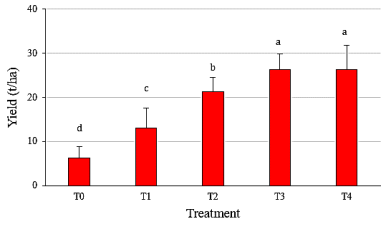
The consumption of market garden products contributes to the food and nutritional security of the world's populations. Among these products, tomato occupies a prominent place. Meanwhile, the excessive use of synthetic fertilizers to produce tomatoes reduces the productive potential of soils. Due to this problem, the present study was conducted in West Cameroon, aiming to reduce the use of chemical inputs for sustainable tomato production through the use of organic input. Thus, five treatments (: T0 = control; T1 = 100% NET EDEN organic fertilizer; T2 = 100% poultry manure; T3 = 50% NET EDEN organic fertilizer + 50% poultry manure; T4 = 100% mineral fertilizer) were arranged in a completely randomized block design (RCBD) with three replications. The study was carried out from March 1 to June 26, 2024. The results revealed that the treatment with mineral fertilizer and the treatment with Net Eden organic fertilizer + chickens manure led to 26.28±5.50 t ha-1 and 26.10±3.51 t ha-1 respectively. These yields T4; T3 are significantly different (P<0.05) from the yields obtained with the other treatments. The economic analysis of fertilization using the value-cost ratio (VCR) showed that only the treatment based on mineral fertilizer T4 and the treatment with Net Eden+manure T3 should be popularized among farmers/producers. Thus, the use of organic fertilizers for tomato production has agronomic, ecological, and economic advantages. However, similar studies in other agroecological zones are needed.
| Published in | Journal of Plant Sciences (Volume 14, Issue 4) |
| DOI | 10.11648/j.jps.20261404.11 |
| Page(s) | 133-142 |
| Creative Commons |
This is an Open Access article, distributed under the terms of the Creative Commons Attribution 4.0 International License (http://creativecommons.org/licenses/by/4.0/), which permits unrestricted use, distribution and reproduction in any medium or format, provided the original work is properly cited. |
| Copyright |
Copyright © The Author(s), 2026. Published by Science Publishing Group |
Tomato, Organic Fertilizer, Organic Input, Chemical Fertilizer, Yield, Profitability
Elements | Content |
|---|---|
pHwater | 6,80 |
pHKCl | 6,6 |
CO (%) | 15,93 |
MO (%) | 27,47 |
N (%) | 1,36 |
C/N | 11,72 |
Ca (meq/100g) | 1,14 |
Mg (meq/100g) | 2,80 |
K (%) | 1,71 |
Na (%) | 0,11 |
S (meq/100g) | 5,77 |
Ptotal (%) | 1,01 |
CE (Ms/cm) | 8,47 |
Band | Setting | Content |
|---|---|---|
Texture (%) | Clay | 21 |
Silt | 04 | |
Sand | 75 | |
Soil reaction | pH-water | 6.1 |
pH-KCl | 5.4 | |
Δ pH | -0.7 | |
Organic matter (%) | CO | 5.89 |
MO | 10.16 | |
N | 0.12 | |
C/N | 50 | |
Exchangeable cations (meq / 100g) | That | 4.52 |
Mg | 3.08 | |
K | 0.14 | |
N / A | 0.24 | |
SB | 8 | |
CEC | 20 | |
S (%) | 40 | |
Phosphorus (mg kg-1) | P Bray II | 19.38 |
Samples | Before seeding | After seeding |
|---|---|---|
Soil texture | ||
Clay | 21% | 26% |
Silt | 4% | 18% |
Sand | 75% | 56% |
Texture class | Sandy clay loam | Sandy clay loam |
Soil reaction | ||
pH (water) | 6.1 | 6.3 |
pH (KCl) | 5.4 | 5.4 |
pH | -0.7 | -0.9 |
Organic matter | ||
CO (%) | 5.89 | 6.32 |
OM (%) | 10.16 | 10.89 |
Total N (%) | 0.12 | 0.11 |
C/N | 50 | 58 |
Exchangeable cations (meq/100g) | ||
Calcium | 4.52 | 5.96 |
Magnesium | 3.08 | 3.96 |
Potassium | 0.14 | 0.19 |
Sodium | 0.24 | 0.34 |
Total bases | 8 | 10 |
Cation Exchange Capacity (meq/100g) | ||
CEC at pH7 | 20 | 22 |
Saturation (%) | 40 | 47 |
Available phosphorus | ||
Bray II (mg/kg) | 19.38 | 17.33 |
Treatments | Plant height | Number of leaves | Number of branches | Diameter at the collar |
|---|---|---|---|---|
T0 | 30,31±9,34b | 28,29±6,19b | 7,458±0,996c | 5,783±1,649c |
T1 | 31,20±9,44b | 31,33±6,42b | 7,583±1,389c | 6,075 ±1,820c |
T2 | 67,56±7,02a | 86,63±15,33a | 23,792±1,269a | 12,375±1,802ab |
T3 | 66,53±6,85a | 79,13±15,76a | 19,625±1,718b | 11,725±1,113b |
T4 | 66,17±8,46a | 88,33±25,94a | 20,625±1,183b | 13,138±1,517a |
P | 0,000 | 0,000 | 0,000 | 0,000 |
Treatment | Number of fruits per plant | Weight of fruits (g/plant) | Fruity Yield (t/ha) -1 |
|---|---|---|---|
T0 | 1,771± 0,881c | 192,2± 123,0d | 6,505± 4,098 |
T1 | 3,500± 0,984b | 407,0 ±122,4c | 13, 568 ± 4,079 |
T2 | 7,063± 1,286a | 637,4± 125,6b | 21,247 ±4,188 |
T3 | 7,885± 1,032a | 783,1± 116,6a | 26,107 ±3,886 |
T4 | 7,990 ±1,503a | 788,3 ±151,3a | 26,28 ±5,04 |
P | 0.000 | 0,000 |
SV | DF | SS | MS | F value | P > F |
|---|---|---|---|---|---|
Block | 2 | 144.93 | 72.467 | 36.847 | 9.19-5 *** |
Treatment | 4 | 926.67 | 231.667 | 117.797 | 3.83x10⁻⁷ *** |
Error | 8 | 15.73 | 1.967 | / | / |
Total | 14 | 1087.33 | / | / | / |
T0 | T1 | T2 | T3 | T4 | |
|---|---|---|---|---|---|
Yield | 6,505 | 13,568 | 21,247 | 26,107 | 26,28 |
AY | / | 7,505 | 14,722 | 19,602 | 19,775 |
CPAY | / | 3731200 | 5842925 | 7179425 | 7227000 |
CT1 | / | 3012779 | 3379319 | 3565201,2 | 3615491 |
I.I | / | 27458,37 | 30755,11 | 32380,05 | 32974,47 |
CT2 | / | 3040237,37 | 3410074.11 | 3547581.25 | 3608465.47 |
VCR | / | 1,227 | 1,713 | 2,023 | 2,0002 |
EP % | / | 22.7 | 71.3 | 102.3 | 100.2 |
ANOVA | Analysis of Variance |
CEC | Cation Exchange Capacity |
CFT | Cost of Fertilizer Treatment |
FAO | Food Agricultural Organization |
OM | Organic Matter |
RVC | Rainfall Value Cost |
TOC | Total Organic Carbon |
V/C | Value-on- Cost |
VAP | Value of Additional Production |
VCR | Value-cost Ratio |
| [1] | Soma A. Vegetable farming near the Kossodo industrial estate in Ouagadougou: practices, marketing channels and health risks for city residents 2020; 3: 67–78. |
| [2] | Dube J, Ddamulira G, Maphosa M. Tomato breeding in sub-Saharan Africa-Challenges and opportunities. A Review, African Crop Science Journal 2020; 28: 131–40. |
| [3] | Van Breemen RB, Pajkovic N. Multitargeted therapy of cancer by lycopene. Cancer Letters 2008; 269: 339–51. |
| [4] |
FAOSTAT n. d.
https://www.fao.org/faostat/fr/#data/QCL (accessed May 8, 2025). |
| [5] | Tarla D, Manu I, Tamedjouong Z, Kamga A, Fontem D. Plight of pesticide applicators in Cameroon: case of tomato (Lycopersicon esculentum mill.) farmers in Foumbot. Journal of Agriculture and Environmental Sciences 2015; 4: 87–98. |
| [6] | Djoukeng HG, Tangka JK, Ndaji NT, Wafo CKT, Assoumou WRA, Peyoumeya NL. Improving Handling Systems of Tomato (Solanum lycopersicum) in Cameroon. Asian Journal of Advances in Agricultural Research 2023; 21: 14–22. |
| [7] | Tabe-Ojong MP, Molua EL, Nzie JRM, Fuh GL. Production and supply of tomato in Cameroon: Examination of the comparative effect of price and non-price factors. Scientific African 2020; 10. |
| [8] | Titti RW, Etoga AS, Ntsoli PG, Etame GMK, Chotangui AH, Bikomo RM, et al. Typology of Tomato Cropping Systems and Determinants of Preharvest Losses in Western Cameroon. Scientifica 2024; 2024. |
| [9] | Tsala R, Mounkéné ZB, Amia GD, Abba M, Tchuenteu LT, Megueni C. Study of tomato growers’ cultural practices and risks associated with the unreasoned use of chemical inputs in the Adamawa Region, Cameroon. African and Mediterranean Agricultural Journal - Al Awamia 2024: 243–53. |
| [10] | Tchaniley L, Kwasi Dzola A, Kodjo Akonta DK. Effect of Combining Organic and Inorganic Fertilisers (NPK 15-15-15 and Urea) on Lettuce (Lactuca sativa L.) Yield in Southern Togo. Journal of Applied Biosciences 2020; 151: 15540–9. |
| [11] | Vâtcă S, Vidican R, Gâdea Ștefania, Horvat M, Vâtcă A, Stoian VA, et al. Blackcurrant Variety Specific Growth and Yield Formation as a Response to Foliar Fertilizers. Agronomy 2020; 10: 2014. |
| [12] | Mataffo A, Scognamiglio P, Dente A, Strollo D, Colla G, Rouphael Y, et al. Foliar Application of an Amino Acid-Enriched Urea Fertilizer on ‘Greco’ Grapevines at Full Veraison Increases Berry Yeast-Assimilable Nitrogen Content. Plants 2020; 9: 619. |
| [13] | Quintarelli V, Borgatti D, Baretta M, Stazi SR, Allevato E, Pancaldi S, et al. Microbial biofertilizers and algae‐based biostimulant affect fruit yield characteristics of organic processing tomato. J Sci Food Agric 2025; 105: 530–9. |
| [14] | Mounirou MM, Nassourou LM, Tidjani AD, Kadri DIA. Comparitive study of the effects of organic and mineral fertilisation on the physico-chemical properties of the soil, and on the yield and quality of the F1 hybrid tomato (Mongol) grown in winter at the Faculty of Agronomy, Abdou Moumouni University, Niamey, Niger. ESI Preprints 2024. |
| [15] | Muzola B, Nsilulu B, Lukombo L, Bunga L. Comparative study of organic fertilisers on tomato production under the ecological conditions of the rural community of Luozi. International Journal for Multidisciplinary Research 2025; 7: 1–21. |
| [16] | ADEID. Dschang Municipal Development Programme. Mairie de Dschang; 2011. |
| [17] | Kalra Y, Maynard D. Methods manual for forest soil and plant analysis. Northwest Region. Tech. Rep: Information Report NOR-X319; 1991. |
| [18] | Walkley A, Black IA. An examination of the degtjareff method for determining soil organic matter, and a proposed modification of the chromic acid titration method. Soil Science 1934; 37: 29–38. |
| [19] | Bremner JM, Mulvaney CS. Nitrogen—Total. 1st ed. Wiley; 1982. |
| [20] | Jones Jr. Laboratory Guide for Conducting Soil Tests and Plant Analysis. 0 ed. CRC Press; 2001. |
| [21] | Kelly VA, Murekezi A. Fertilizer Response and Profitability in Rwanda: A Synthesis of Findings from MINAGRI Studies Conducted by The Food Security Research Project (FSRP) and The FAO Soil Fertility Initiative. AgEcon Search 2000. |
| [22] |
R Core Team. R: A Language and Environment for Statistical Computing 2025.
https://www.r-project.org/ (accessed May 23, 2025). |
| [23] | Temgoua E, Tsafack HN, Ngnikam E, Gouana RT, Dongmo GRZ. Fertilisation of maize (Zea mays L.) using sanitised human urine in an oxisol in western Cameroon. International Journal of Biological and Chemical Sciences 2018; 11: 2071. |
| [24] | Beyegue DH, Bedıne Boat MA, Egoume Guissana A, Kueptoudji EVE, Mvondo-Awono JP, Tankou C. Response of Congo Grass (Brachiaria ruziziensis L. Germain and Evard) to Nitrogen Fertilization on an Oxisol in Western Highlands Agro-ecological Zone of Cameroon. International Journal of Innovative Approaches in Agricultural Research 2023; 7: 325–35. |
| [25] | Sawadogo J, Bassole SD, Savadogo CA, Legma JB. Effects of organic fertilisers on tomato productivity in the semi-arid region of Burkina Faso. Journal of Applied Biosciences 2021; 167: 17375–90. |
| [26] | Kakabouki I, Roussis I, Krokida M, Mavroeidis A, Stavropoulos P, Karydogianni S, et al. Comparative Study Effect of Different Urea Fertilizers and Tomato Pomace Composts on the Performance and Quality Traits of Processing Tomato (Lycopersicon esculentum Mill.). Plants 2024; 13: 1852. |
| [27] | Li Y, Zhang R, Zhang C, Li Q, Nie L, Wang C, et al. Integrative approaches to nutrient management in tomato cultivation for improved sustainability and productivity. Front Plant Sci 2025; 16: 1626136. |
| [28] | Disciglio G, Tarantino A, Frabboni L. Yield and Fruit Characteristics of Tomato Crops Grown with Mineral Macronutrients: Impact of Organo-Mineral Fertilizers through Foliar or Soil Applications. Plants 2024; 13: 1458. |
| [29] | Maffia A, Marra F, Canino F, Oliva M, Mallamaci C, Celano G, et al. Comparative Study of Fertilizers in Tomato-Grown Soils: Soil Quality, Sustainability, and Carbon/Water Footprints. Soil Systems 2023; 7: 109. |
| [30] | Nzuki BF, Kinkwono EK, Sekle BG. Use of guano as a substitute for diammonium phosphate (DAP) in the fertilisation of soybeans and tomatoes in the Democratic Republic of the Congo. Tropicultura 2011; 29: 114–20. |
| [31] | Upite JT, Kitabala Misonga A, Kasongo Mukonzo Lenge E, Nyembo Kimuni L. Effects of domestic compost on soil properties and vegetable crop productivity: The case of tomatoes (Lycopersicon esculentum Mill). International Journal of Biological and Chemical Sciences 2020; 13: 3411–28. |
| [32] | Alla TK, Bomisso LE, Seydou T, Dick E. Effects of organic fertilisation using plantain peel and chicken manure on the agronomic parameters and financial profitability of the N’drowa aubergine (Solanum aethiopicum L.) in Cote d’Ivoire. Afrique Science 2021; 18: 25–38. |
| [33] | Brady, N. C. and Weil, R. R. (2008) The nature and properties of soil, 14 ed. Prentice-Hall, Upper Saddle River, New Jersey. |
| [34] | Lal, R. (2006) Enhancing Crop Yields in the Developing Countries through Restoration of the Soil Organic Carbon Pool in Agricultural Lands. Land Degradation & Development, 17, 197-209. |
| [35] | Sumner, M. E. and Miller, W. P. (1996) Cation Exchange Capacity and Exchange Coefficients. In: Sparks, D. L., Ed., Methods of Soil Analysis Part 3: Chemical Methods, SSSA Book Series 5, Soil Science Society of America, Madison, Wisconsin, 1201-1230. |
| [36] | Havlin, J. L., Tisdale, S. L., Nelson, W. L., & Beaton, J. D. (2014). Soil Fertility and Fertilization: An Introduction to Nutrient Management (8th ed., p. 516). |
| [37] | F. Kaho, M. Yemefack, P. Teguefouet, J. C. Tchantchaouang. (2011). Combined Effect of Tithonia diversifolia leaves and Inorganic Fertilizers on Maize Grain Yield and Soil Properties of a Central Cameroon Acrisol. 29(1): 39-45. |
APA Style
Gertrude, K., Xavier, Z. M., Paul, K. M. J., Antoine, E. G., Fabrice, L. T. (2026). Assessment of Some Organic and a Mineral Fertilizer on the Yield and Profitability of Tomato (Lycopersicum esculentum Mill.) in an Oxysol of West Cameroon. Journal of Plant Sciences, 14(4), 133-142. https://doi.org/10.11648/j.jps.20261404.11
ACS Style
Gertrude, K.; Xavier, Z. M.; Paul, K. M. J.; Antoine, E. G.; Fabrice, L. T. Assessment of Some Organic and a Mineral Fertilizer on the Yield and Profitability of Tomato (Lycopersicum esculentum Mill.) in an Oxysol of West Cameroon. J. Plant Sci. 2026, 14(4), 133-142. doi: 10.11648/j.jps.20261404.11
AMA Style
Gertrude K, Xavier ZM, Paul KMJ, Antoine EG, Fabrice LT. Assessment of Some Organic and a Mineral Fertilizer on the Yield and Profitability of Tomato (Lycopersicum esculentum Mill.) in an Oxysol of West Cameroon. J Plant Sci. 2026;14(4):133-142. doi: 10.11648/j.jps.20261404.11
@article{10.11648/j.jps.20261404.11,
  author = {Keegoui Gertrude and Zingui Messomo Xavier and Kamseu Mogo Jean Paul and Egoume Guissana Antoine and Lessa Tchohou Fabrice},
  title = {Assessment of Some Organic and a Mineral Fertilizer on the Yield and Profitability of Tomato (Lycopersicum esculentum Mill.) in an Oxysol of West Cameroon},
  journal = {Journal of Plant Sciences},
  volume = {14},
  number = {4},
  pages = {133-142},
  doi = {10.11648/j.jps.20261404.11},
  url = {https://doi.org/10.11648/j.jps.20261404.11},
  eprint = {https://article.sciencepublishinggroup.com/pdf/10.11648.j.jps.20261404.11},
  abstract = {The consumption of market garden products contributes to the food and nutritional security of the world's populations. Among these products, tomato occupies a prominent place. Meanwhile, the excessive use of synthetic fertilizers to produce tomatoes reduces the productive potential of soils. Due to this problem, the present study was conducted in West Cameroon, aiming to reduce the use of chemical inputs for sustainable tomato production through the use of organic input. Thus, five treatments (: T0 = control; T1 = 100% NET EDEN organic fertilizer; T2 = 100% poultry manure; T3 = 50% NET EDEN organic fertilizer + 50% poultry manure; T4 = 100% mineral fertilizer) were arranged in a completely randomized block design (RCBD) with three replications. The study was carried out from March 1 to June 26, 2024. The results revealed that the treatment with mineral fertilizer and the treatment with Net Eden organic fertilizer + chickens manure led to 26.28±5.50 t ha-1 and 26.10±3.51 t ha-1 respectively. These yields T4; T3 are significantly different (P<0.05) from the yields obtained with the other treatments. The economic analysis of fertilization using the value-cost ratio (VCR) showed that only the treatment based on mineral fertilizer T4 and the treatment with Net Eden+manure T3 should be popularized among farmers/producers. Thus, the use of organic fertilizers for tomato production has agronomic, ecological, and economic advantages. However, similar studies in other agroecological zones are needed.},
 year = {2026}
}
TY  - JOUR
T1  - Assessment of Some Organic and a Mineral Fertilizer on the Yield and Profitability of Tomato (Lycopersicum esculentum Mill.) in an Oxysol of West Cameroon
AU  - Keegoui Gertrude
AU  - Zingui Messomo Xavier
AU  - Kamseu Mogo Jean Paul
AU  - Egoume Guissana Antoine
AU  - Lessa Tchohou Fabrice
Y1  - 2026/07/11
PY  - 2026
N1  - https://doi.org/10.11648/j.jps.20261404.11
DO  - 10.11648/j.jps.20261404.11
T2  - Journal of Plant Sciences
JF  - Journal of Plant Sciences
JO  - Journal of Plant Sciences
SP  - 133
EP  - 142
PB  - Science Publishing Group
SN  - 2331-0731
UR  - https://doi.org/10.11648/j.jps.20261404.11
AB  - The consumption of market garden products contributes to the food and nutritional security of the world's populations. Among these products, tomato occupies a prominent place. Meanwhile, the excessive use of synthetic fertilizers to produce tomatoes reduces the productive potential of soils. Due to this problem, the present study was conducted in West Cameroon, aiming to reduce the use of chemical inputs for sustainable tomato production through the use of organic input. Thus, five treatments (: T0 = control; T1 = 100% NET EDEN organic fertilizer; T2 = 100% poultry manure; T3 = 50% NET EDEN organic fertilizer + 50% poultry manure; T4 = 100% mineral fertilizer) were arranged in a completely randomized block design (RCBD) with three replications. The study was carried out from March 1 to June 26, 2024. The results revealed that the treatment with mineral fertilizer and the treatment with Net Eden organic fertilizer + chickens manure led to 26.28±5.50 t ha-1 and 26.10±3.51 t ha-1 respectively. These yields T4; T3 are significantly different (P<0.05) from the yields obtained with the other treatments. The economic analysis of fertilization using the value-cost ratio (VCR) showed that only the treatment based on mineral fertilizer T4 and the treatment with Net Eden+manure T3 should be popularized among farmers/producers. Thus, the use of organic fertilizers for tomato production has agronomic, ecological, and economic advantages. However, similar studies in other agroecological zones are needed.
VL  - 14
IS  - 4
ER  -
Department of Agriculture, University of Dschang, Dschang, Cameroon
Multiple Purpose Station, Institute of Agricultural Research for Development (IRAD), Dschang, Cameroun

Information



 Share This Article
 Twitter
 Linked In
 Facebook
 Copy
Copy Download