Abstract
Despite the widespread adoption of Quality Management (QM) frameworks, many organizations in developing economies continue to implement them primarily as compliance mechanisms rather than strategic drivers of competitive performance, profitability, and sustainable growth. This study examines the underlying reasons for this persistent gap and argues that the problem lies not in the existing frameworks themselves, but in the way quality is perceived, positioned, and governed within organizations. Using a qualitative multi-method approach, the research combines an extensive literature review, Root Cause Analysis (RCA), semi-structured interviews with senior managers, comparative case analysis, and a pilot survey involving organizations from Azerbaijan, Georgia, Kazakhstan, and Turkey. The findings reveal three interrelated root causes: the widespread perception of quality as a standalone support function rather than an inherent characteristic of every business process, the rigid implementation of quality frameworks without considering organizational context, and limited executive-level understanding of quality as a strategic business capability. These factors weaken process ownership, reduce integration with financial and strategic decision-making, and limit the contribution of quality systems to operational effectiveness and business performance. To address these challenges, the study introduces the concept of Business Assurance (BA) and proposes the Business Assurance Model of Excellence (BAME), which redefines quality as the measurable degree to which each process achieves its intended business objectives and embeds assurance within the responsibility of process owners rather than centralized quality functions. By integrating quality into governance, financial management, operational performance, and leadership accountability, BAME provides a scalable framework that enables organizations to move beyond certification-focused systems towards measurable business value, improved profitability, greater organizational resilience, and sustainable competitive advantage. The study contributes to Quality Management theory by repositioning quality as a strategic business capability and offers a practical framework for organizations seeking to transform compliance-oriented management systems into drivers of long-term economic performance and sustainable growth.
|
Published in
|
Journal of World Economic Research (Volume 15, Issue 2)
|
|
DOI
|
10.11648/j.jwer.20261502.12
|
|
Page(s)
|
80-88 |
|
Creative Commons
|

This is an Open Access article, distributed under the terms of the Creative Commons Attribution 4.0 International License (http://creativecommons.org/licenses/by/4.0/), which permits unrestricted use, distribution and reproduction in any medium or format, provided the original work is properly cited.
|
|
Copyright
|
Copyright © The Author(s), 2026. Published by Science Publishing Group
|
Keywords
Business Assurance, Competitive Performance, Quality Management, Profitability, Sustainable Growth, Strategic Governance
1. Introduction
Quality Management (QM) is globally recognized as a foundational enabler of competitiveness, customer satisfaction, and sustainable performance. However, in many developing economies, its practical application remains largely compliance-driven and strategically underleveraged. Rather than functioning as a driver of competitive performance and profitability, QM is frequently reduced to a formal requirement, most commonly through ISO 9001
| [7] | ISO. (2015). ISO 9001: 2015 Quality management systems - Requirements. International Organization for Standardization. |
[7]
certification to secure tender eligibility or satisfy audit expectations. This transactional orientation constrains the strategic potential of quality systems and weakens their contribution to broader business outcomes such as financial performance, innovation capacity, operational resilience, and sustainable growth.
Despite widespread ISO 9001
| [7] | ISO. (2015). ISO 9001: 2015 Quality management systems - Requirements. International Organization for Standardization. |
[7]
adoption, implementation often reflects external validation more than internal performance transformation. Organizations may hold valid certificates while continuing to experience systemic inefficiencies, inconsistent service or product delivery, limited cross-functional alignment, and weakened stakeholder confidence. Such misalignment generates rework, customer dissatisfaction, operational waste, and hidden costs of non-quality, ultimately eroding profitability and competitive positioning while undermining sustainability objectives including resource efficiency and long-term resilience.
At the core of this challenge lies a fundamental misperception: quality is frequently treated as a standalone function, delegated to a department, managed externally, or applied retrospectively after processes are completed. This interpretation originates from its historical association with Quality Control (QC), where inspection defined conformance. However, in contemporary, complex business environments, inspection-based thinking is insufficient to support strategic performance and market competitiveness.
This research challenges that assumption. Quality is not a department; it is the degree to which any process meets its defined requirements. It is an adjective describing how effectively procurement, finance, logistics, training, or operations achieve business-aligned outcomes. Each process possesses its own quality, determined by its ability to meet strategic and operational expectations. Therefore, quality must be embedded within the process itself, not applied externally as an after-the-fact verification mechanism.
This misperception is further reinforced by the rigid or mechanical application of traditional frameworks. Many organizations adopt structured systems without calibrating them to their scale, maturity, or competitive context. SMEs in particular may over-engineer systems by replicating large-corporation models or, conversely, reduce them to documentation-driven audit checklists. In both cases, the result is limited performance improvement and minimal contribution to strategic differentiation or financial return, particularly where organizations adopt frameworks without sufficient adaptation to their size, maturity, and strategic objectives
| [9] | Malikov, A. (2025). Bridging the gap: Adapting quality frameworks to fit every business. CQI, World Quality Journal. |
| [10] | Malikov, A. (2025). How to choose the right quality framework for your business. CQI, World Quality Journal. |
[9, 10]
.
A further barrier is the limited integration of quality education within business, management, and engineering curricula. Consequently, executives and process owners often assume leadership roles without a clear understanding of how quality influences financial results, operational risk, or competitive positioning. This reinforces the perception that quality is the responsibility of a technical function rather than a governance-level performance driver.
This paper argues that the root cause of underperforming quality systems lies in how quality is defined, positioned, and governed within organizations. To address this gap, it proposes a strategic shift from traditional Quality Assurance (QA) toward Business Assurance (BA), a model that embeds quality directly into the purpose, governance, and performance management of every process. The Business Assurance Model of Excellence (BAME) is introduced as a practical framework enabling organizations to move beyond compliance and toward integrated, process-owned quality that strengthens strategic alignment, operational efficiency, profitability, and sustainable growth.
Within the BAME framework, quality ceases to be a certification milestone or external requirement. Instead, it becomes the measurable outcome of internal ownership, strategic clarity, and process effectiveness. This repositioning transforms quality from a support function into a core driver of competitive performance, distributed across all functions and directly contributing to long-term business success in developing economies.
2. Literature Review/theoretical Background
The evolution of Quality Management (QM) reveals the structural foundations of many current implementation challenges, particularly in developing economies. Foundational thinkers
| [2] | Crosby, P. B. (1979). Quality is free: The art of making quality certain. McGraw-Hill. |
| [4] | Deming, W. E. (1986). Out of the crisis. MIT Press. |
| [8] | Juran, J. M., & Godfrey, A. B. (1999). Juran's quality handbook (5th ed.). McGraw-Hill. |
| [14] | Shewhart, W. A. (1931). Economic control of quality of manufactured product. D. Van Nostrand Company. |
[2, 4, 8, 14]
shifted quality from post-production inspection toward process orientation, systemic thinking, and continuous improvement. Subsequent models, including including TQM
, Six Sigma, Lean, and sector-specific standards, and sector-specific standards such as API Q1/Q2 and ISO 9001
| [7] | ISO. (2015). ISO 9001: 2015 Quality management systems - Requirements. International Organization for Standardization. |
[7]
equipped organizations with structured tools to reduce variation, improve reliability, and institutionalize learning.
However, despite these theoretical and methodological advancements, the perception of quality as a departmental or audit-driven function persists. This enduring separation between quality and core business performance limits the strategic impact of otherwise robust frameworks.
Established models including ISO 9001
| [7] | ISO. (2015). ISO 9001: 2015 Quality management systems - Requirements. International Organization for Standardization. |
[7]
, the European Foundation for Quality Management (EFQM)
, and the Baldrige Performance Excellence Program have strengthened organizational discipline and process documentation. Yet empirical evidence suggests that in many developing economies these frameworks are implemented symbolically, with certification prioritized over performance outcomes. Previous studies also highlight that organizational culture, leadership commitment, and internal capabilities significantly influence successful Quality Management implementation
| [1] | Nasim, K. (2018). Role of internal and external organizational factors in TQM implementation: A systematic literature review and theoretical framework. International Journal of Quality & Reliability Management, 35(5), 1014-1033.
https://doi.org/10.1108/IJQRM-03-2017-0036 |
[1]
.
Identify weak top-management commitment, limited quality education, and fragile organizational culture as major impediments to effective TQM implementation in construction sectors of developing countries. Similarly, professional reports from certifcation bodies demonstrate that ISO 9001
| [7] | ISO. (2015). ISO 9001: 2015 Quality management systems - Requirements. International Organization for Standardization. |
[7]
contributes to sustainable performance in Indian MSMEs only when leadership engagement and process ownership are embedded into daily operations.
Recent scholarship further signals a paradigm shift from audit-control mechanisms toward process-embedded assurance and internal ownership.
| [17] | Durak Uşar, D. (2024). Impact of ISO certifications on corporate financial performance and competitive potential of European companies. Sustainability, 16(16), 7021.
https://doi.org/10.3390/su16167021 |
[17]
This shift recognizes that certification alone does not generate competitive advantage; performance improvement requires integration into governance, decision-making, and operational accountability.
Collectively, these findings suggest that the core issue is not the absence of frameworks, but their misalignment with organizational maturity, leadership capability, and competitive context in developing economies. This supports critical reflections that the quality profession may follow an ineffective direction when established approaches are applied without reconsidering their strategic purpose and organizational relevance
| [15] | Van Kemenade, E. (2020). Getting on the wrong bus: A critical reflection on the quality journey. International Journal of Quality and Service Sciences, 12(4), 467-475. |
[15]
. The persistent gap between certification and measurable business performance manifested in inefficiencies, cost overruns, and weak strategic integration, provides the foundation for rethinking how quality is positioned within organizations.
This research advances that argument by redefining quality not as a standalone function, but as the degree to which each process meets its defined requirements. Quality is an operational characteristic describing how effectively procurement, logistics, HR, finance, or training deliver business-aligned outcomes, reflecting the broader view of quality as a multidimensional basis for competition rather than only conformance to specifications
| [6] | Garvin, D. A. (1987). Competing on the eight dimensions of quality. Harvard Business Review, 65(6), 101-109. |
[6]
. Every function possesses its own quality, determined by its contribution to strategic and financial objectives. That quality must be assured by the process owner not managed by a parallel administrative unit. When organizations overlook this principle, frameworks are implemented mechanically, producing compliance without competitive performance.
Even advanced excellence models retain structural language that can unintentionally reinforce this separation. Evidence from leading journals, including the International Journal of Quality & Reliability Management and the Journal of Operations Management, indicates that in developing economies quality systems are frequently maintained formally but underperform operationally. Audit cycles dominate managerial attention, while integration into KPIs, executive dashboards, and financial planning remains limited. The result is reactive systems characterized by excessive documentation, diffused accountability, and weak strategic impact.
The consequences extend beyond operational inefficiency. When quality is treated as external to business processes, duplication, waste, and disengagement increase. The cost of non-quality rework, lost opportunities, reputational damage, and inefficient resource allocation directly affects profitability and long-term competitiveness. Without process-level ownership and strategic alignment, quality efforts fail to translate into measurable business value.
Organizational learning theory, systems thinking, and innovation diffusion literature
| [12] | Rogers, E. M. (2002). Diffusion of preventive innovations. Addictive Behaviors, 27(6), 989-993.
https://doi.org/10.1016/S0306-4603(02)00300-3 |
| [13] | Senge, P. M. (1990). The fifth discipline: The art and practice of the learning organization. Doubleday. |
[12, 13]
emphasize that sustainable performance improvement depends on integrated, feedback-driven systems. Yet even integrated management systems often position quality as one pillar among many, rather than as the unifying principle connecting strategic objectives, operational execution, and stakeholder value.
The Business Assurance Model of Excellence (BAME) diverges from conventional interpretations by recognizing that quality already exists within every process. It does not require addition; it requires assurance where work is performed. Each process defines business-aligned criteria and assumes accountability for its own outcomes. In doing so, assurance becomes embedded rather than externally verified.
This reframing shifts quality from a technical support responsibility to a strategic operational capability. BAME enables leadership to define performance expectations and equips process owners to assure results within their domains. It is built not on external validation alone, but on internal alignment, visibility, and governance addressing the foundational misconception that quality is separate from competitive performance.
3. Methods
This study adopts a qualitative, multi-method approach to examine how quality is perceived, interpreted, and operationalized across business environments in developing economies, and to understand why existing Quality Management Systems (QMS) often underperform as drivers of competitive performance and sustainable growth. The methodology was designed to identify the root causes behind the disconnect between certification and measurable business outcomes, and to validate the need for a governance-oriented model grounded in process ownership and strategic alignment.
The research combines four key elements:
3.1. Root Cause Analysis (RCA)
A structured RCA was conducted using case data from organizations in Azerbaijan, Georgia, Kazakhstan, and Turkey, representing sectors including manufacturing, logistics, training, and public services. The analysis categorized findings into three interrelated levels:
1) Immediate causes:
Quality is primarily viewed as a compliance requirement, centered on documentation and audit readiness. ISO 9001
| [7] | ISO. (2015). ISO 9001: 2015 Quality management systems - Requirements. International Organization for Standardization. |
[7]
certification is frequently pursued to satisfy external demands (e.g., client or tender requirements), with limited connection to operational effectiveness, financial performance, or strategic improvement.
2) Underlying causes:
Quality is perceived as a technical or support function, detached from leadership, financial governance, and decision-making. The structure and terminology of traditional frameworks reinforce the perception that quality is administered externally by auditors or centralized departments rather than owned by those accountable for operational outcomes.
3) Foundational causes:
The core misperception lies in treating quality as a standalone function. In practice, quality represents the degree to which each process meets its defined requirements. When this understanding is absent, systems become fragmented, accountability is diffused, and quality efforts yield limited impact on productivity, cost efficiency, or competitive positioning.
These findings directly informed the development of the Business Assurance Model of Excellence (BAME), which seeks to address these root causes by embedding assurance within each process and aligning quality with strategic and financial objectives.
3.2. Interviews
Fifteen semi-structured interviews were conducted with senior professionals from the same four countries. Participants included directors, senior managers, and heads of operations or compliance across manufacturing, logistics, and education sectors. The interviews explored:
1) How quality is defined and communicated across functions
2) Who holds responsibility for quality within operational processes
3) The degree of integration between quality and strategic planning
4) Perceptions of ISO 9001’s value beyond certification
5) Barriers to long-term performance and sustainable competitiveness
Table 1. Interview Results.
Theme Explored | Key Insight from Participants |
Definition of quality | Often seen as compliance-focused rather than business-integrated |
Responsibility for quality | Generally perceived as the task of a specific team, not owned across functions |
Integration with strategic planning | Rarely embedded in board-level discussions or KPIs |
Perception of ISO 9001 | Seen more as a certification tool than a driver of operational improvement |
Barriers to sustainability and long-term performance | Lack of leadership engagement, poor communication, resource constraints |
A recurring theme was that quality was perceived as something applied to processes rather than built into them. Participants emphasized that quality functions were often under-resourced, disconnected from financial governance, and positioned as compliance checkpoints instead of contributors to competitive performance.
These insights shaped key elements of BAME, particularly the emphasis on executive accountability, process-level ownership, and integration into strategic performance management systems.
3.3. Survey
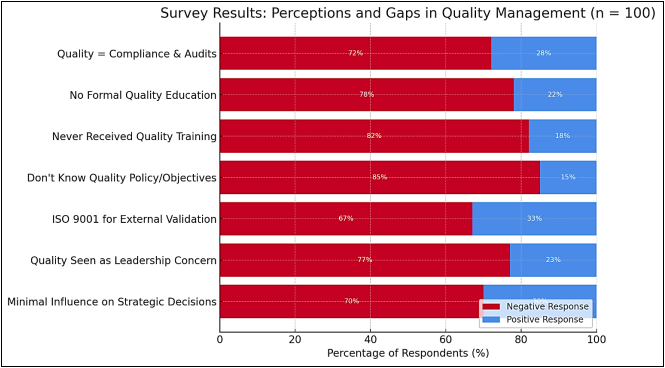
To complement qualitative findings, a pilot survey was conducted involving 100 mid-to-senior-level managers across Azerbaijan, Georgia, Kazakhstan, and Turkey. Participants represented diverse sectors, including manufacturing, logistics, education, and public services. The survey assessed perceptions of quality, leadership engagement, and integration into operational and strategic decision-making.
Key findings included:
1) 72% associated quality with compliance and audits.
2) 78% lacked formal education in quality management; many had attended only short courses (e.g., ISO 9001 awareness, Lead Auditor, API standards), which were viewed as useful foundations but insufficient for building a quality mindset or process assurance capabilities.
3) 82% of employees had never received any quality training, reflecting widespread organizational gaps.
4) 85% of employees did not know their organization’s quality policy or objectives. Poor internal communication of quality systems was seen as a major barrier to engagement.
5) 67% reported ISO 9001 was implemented primarily for external validation.
6) Only 23% of respondents viewed quality as a leadership concern.
7) Over 70% stated that quality had a minimal influence on decision-making, KPIs, or strategic planning.
Figure 1. Survey Results.
These results confirm a systemic gap between certification status and embedded performance practice. The limited integration of quality into executive governance, KPI systems, and financial management explains why many certified organizations fail to realize measurable competitive advantage.
Interview transcripts and RCA summaries were manually reviewed and coded thematically following the six-phase framework of
. Codes were organized into analytical categories to identify recurring patterns. Findings were triangulated with survey data to enhance reliability and analytical coherence.
3.4. Literature Integration
Findings from the RCA, interviews, and survey were compared with academic literature discussed in Section 2. A consistent pattern emerged: quality systems in developing economies are constrained not by the absence of frameworks, but by weak ownership, limited leadership integration, and misalignment with competitive strategy.
While ISO 9001 and related models provide structural discipline, their impact on profitability and sustainable growth remains conditional on governance integration and process accountability. Existing literature frequently documents implementation challenges yet rarely addresses the structural misconception that quality is externally managed rather than operationally owned.
BAME addresses this gap by redefining quality as an operational characteristic embedded within each process. By integrating assurance into daily performance management and strategic governance, the model enables a transition from symbolic compliance to measurable value creation and competitive performance enhancement.
4. Results and Discussion
4.1. Quality as a Strategic Performance Driver
Survey and interview data confirm that quality is still widely perceived as a compliance-driven activity, owned by a specialized department and validated primarily through audits. This mindset significantly limits its role as a strategic performance driver and reduces quality to a reactive function rather than a source of competitive advantage and operational value creation.
Language plays a reinforcing role. Terms such as “Quality Assurance” and “Quality Control” implicitly position quality as an activity performed by specialists, separate from core business operations. As a result, process owners do not fully recognize their responsibility for quality outcomes, and executives rarely connect quality with financial performance, cost efficiency, or strategic decision-making. This disconnect weakens the potential of quality systems to influence profitability and long-term competitiveness.
This research redefines quality as the degree to which each process meets its defined requirements. It is not an external function but an internal characteristic of effective operations. Quality is reflected in how procurement delivers value, how finance ensures accuracy and control, and how logistics maintains consistency and reliability. Each process possesses its own quality, which must be defined, maintained, and assured by those responsible for its execution.
This perspective does not reject existing frameworks but reframes their purpose. Organizations already possess quality structures; however, BAME enables a transition from compliance-oriented systems toward business-integrated mechanisms that actively contribute to performance, efficiency, and value creation.
4.2. Limitations of Traditional Approaches
Frameworks such as ISO 9001 have played an important role in establishing structure, consistency, and documentation discipline. However, in many cases, implementation remains limited to certification outcomes rather than performance improvement. Quality becomes an administrative objective rather than a strategic lever for competitiveness and profitability.
In practice, QMS is often developed and maintained by quality departments, reviewed during audit cycles, and only marginally integrated into operational KPIs or executive dashboards. Consequently, quality remains detached from process ownership and business performance management.
This disconnect has direct business consequences: missed efficiency gains, duplication of effort, diffused accountability, and a low return on quality investment. Over time, organizations may sustain certification while continuing to experience hidden costs of non-quality, including rework, delays, customer dissatisfaction, and lost market opportunities.
Importantly, the limitation does not lie in the frameworks themselves, but in how they are interpreted and applied. When quality is positioned outside the business, it cannot effectively influence or lead business performance.
4.3. Introducing Business Assurance (BA)
To address these limitations, this research introduces Business Assurance (BA), a concept that repositions quality as a strategic, performance-oriented characteristic embedded across all business processes.
BA does not replace traditional systems; rather, it reframes them around ownership, alignment, and measurable value. Under BA:
Each process defines and assures its own quality in alignment with business objectives.
Quality is directly linked to strategic goals, financial performance, and sustainability outcomes.
Assurance becomes a continuous operational practice rather than a periodic audit activity.
Executives interpret quality as a performance indicator influencing profitability, risk, and competitiveness.
This approach reflects a fundamental reality: business success is determined by process effectiveness. Therefore, quality must evolve into a shared, cross-functional responsibility integrated into daily decision-making and governance structures.
4.4. The Business Assurance Model of Excellence (BAME)
The Business Assurance Model of Excellence (BAME) operationalizes the BA concept by redefining how quality is structured, governed, and delivered across the organization. Rather than treating quality as a separate system, BAME positions it as the measurable degree to which every process achieves its intended purpose in alignment with strategic and financial objectives.
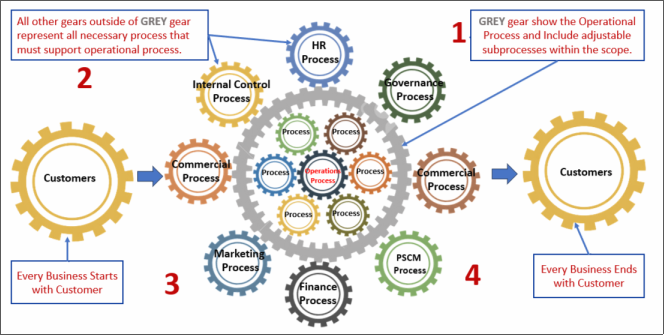
The model structure (
Figure 2) illustrates the interaction between the central operational process and the supporting functional processes that collectively assure performance. The central gear represents the core operational system and its subprocesses, while surrounding gears represent enabling functions; Finance, HR, Procurement (PSCM), Marketing, Governance, and Internal Control, that interact dynamically to sustain effectiveness. Customer interfaces at both ends emphasize that all processes ultimately serve value creation and delivery.
Together, these interconnected elements position quality as a system-wide characteristic linking operational execution, strategic alignment, and sustainable performance.
BAME does not replace established frameworks such as ISO 9001, EFQM
, or sector-specific standards. Instead, it enhances their effectiveness by embedding quality into daily operations, governance mechanisms, and performance management systems moving beyond audit cycles toward continuous value delivery.
Figure 2. Business Assurance Model of Excellence (BAME).
1. Strategic Alignment
Quality objectives are directly derived from business strategy and translated into measurable process-level outcomes, ensuring alignment between operational execution and organizational goals.
2. Integrated Processes
Quality is embedded within core functions including procurement, HR, operations, logistics, and finance, eliminating parallel systems and ensuring assurance is part of routine management.
3. Leadership Accountability
Senior leadership assumes ownership of quality outcomes, aligning resources, monitoring performance indicators, and ensuring visibility across the organization.
4. Process-Based Assurance
Each process defines its own performance criteria and internally assures results, strengthening accountability and reducing reliance on external verification mechanisms.
5. Scalability and Simplicity
BAME is adaptable across organizational sizes and maturity levels, focusing on outcomes rather than excessive documentation, making it suitable for both SMEs and complex enterprises.
6. Sustainability Enablement
Through improved transparency, accountability, and efficiency, BAME supports resource optimization, stakeholder trust, and long-term value creation.
With BAME, quality becomes visible, measurable, and owned across all functions. This creates alignment between departments, enhances decision-making, and strengthens accountability. Organizations move from certificate-driven activity toward outcome-driven performance, where quality directly contributes to profitability, resilience, and competitive positioning.
In this context, quality is no longer a support function, it becomes a central mechanism through which business performance is defined, managed, and sustained.
BAME does not replace frameworks like ISO 9001, EFQM
, or sector-specific models. Instead, it enhances them by embedding quality into the way each function operates daily, not just during audit cycles.
The model is built on six foundational pillars, each representing a key benefit of this approach:
1. Strategic Alignment
2. Quality objectives are derived directly from business goals and made visible across departments. This ensures every process contributes to the organization’s strategic direction.
3. Integrated Processes
4. There is no parallel quality system. Instead, quality is embedded into procurement, HR, operations, logistics, and finance making assurance part of routine management, not an afterthought.
5. Leadership Accountability
6. Executives and senior leaders own quality outcomes. They are responsible for aligning resources, monitoring KPIs, and ensuring visibility across the organization.
7. Process-Based Assurance
8. Each process defines its own quality criteria and assures outcomes internally. This distributes ownership and reduces dependency on external audits or central quality departments.
9. Scalability and Simplicity
10. BAME is adaptable to businesses of any size or complexity. It avoids unnecessary documentation and focuses on real outcomes, making it ideal for both SMEs and large enterprises.
11. Sustainability Enablement
12. By promoting accountability and transparency, BAME supports resource efficiency, stakeholder trust, and long-term value creation. It helps quality evolve from compliance to contribution.
With BAME, every process and every person can see their impact on the quality of others. This creates transparency, alignment, and shared responsibility. Departments are no longer isolated in pursuit of internal targets; instead, they work together to deliver consistent, customer-aligned value. Organizations shift from certificate-driven activity to outcome-driven quality, where business interest is centralized and sustained through operational excellence.
4.5. Comparative Case Study: Manufacturing Sector
Building on the conceptual structure presented in
Figure 2, the following comparative case study demonstrates how the BAME model translates into practical organizational outcomes.
To illustrate the contrast, two mid-sized manufacturing companies operating in similar markets were examined:
Company A (Traditional QA): ISO 9001-certified for 7+ years. Quality was managed by a central team focused on audits. Process teams had little engagement with quality objectives. Improvements were reactive, and certification was viewed as a necessity, not a tool.
Company B (BAME-Aligned): Rebuilt its quality system around BAME. Each department defined process-specific goals tied to business strategy. KPIs reflected internal assurance, not audit readiness. After 12 months, the company saw a 25% drop in nonconformities, improved interdepartmental collaboration, and greater engagement. Quality became part of performance discussions at the executive level.
This case comparison reinforces the core message: having a quality system is not enough. It is how quality is understood, owned, and aligned that determines impact. When quality is assured by those who execute the process, it becomes real.
These cases validate the practical relevance of the BAME framework, showing that its process-ownership principles can be applied effectively in real industrial contexts and measured through tangible performance improvements.
5. Conclusion
This study contributes to redefining Quality Management in developing economies by confronting the persistent gap between compliance-driven systems and strategic business performance. While frameworks like ISO 9001 and EFQM have supported procedural structure and external accountability
, their potential remains underutilized not because of their design, but due to how quality is positioned, interpreted, and implemented.
The findings reveal that quality is still perceived as a technical or support function detached from leadership, strategy, and process ownership. This misperception prevents organizations from leveraging quality as a source of value, innovation, or sustainability. The issue is not poor documentation or ineffective tools, but the failure to see quality as a characteristic of business success.
In response, this paper introduces the Business Assurance Model of Excellence (BAME) a practical and conceptual shift that redefines quality as the degree to which every process meets its own requirements. BAME challenges the idea of quality as a department or certificate. It positions quality as an outcome of strategic alignment, internal assurance, and process effectiveness.
By embedding quality within each process and distributing responsibility across functions, BAME transforms quality from a symbolic practice into a driver of performance, trust, and sustainable growth. It provides a scalable framework for organizations to evolve from audit readiness to business readiness enabling long-term resilience.
Quality is no longer something we inspect; it is something we enable. And with BAME, every process and person contribute to that enablement, creating a shared platform for excellence in business and sustainability.
Abbreviations
BA | Business Assurance |
BAME | Business Assurance Model of Excellence |
CQI | Chartered Quality Institute |
EFQM | European Foundation for Quality Management |
HR | Human Resources |
ISO | International Organization for Standardization |
KPI | Key Performance Indicator |
MSME | Micro, Small and Medium-sized Enterprise |
QA | Quality Assurance |
QC | Quality Control |
QM | Quality Management |
QMS | Quality Management System |
RCA | Root Cause Analysis |
SME | Small and Medium-sized Enterprise |
TQM | Total Quality Management |
PSCM | Procurement and Supply Chain Management |
Author Contributions
Anar Malikov Karim: Conceptualization, Formal Analysis, Investigation, Methodology, Validation, Visualization, Writing – original draft, Writing – review & editing
Conflicts of Interest
The author declares no conflicts of interest.
References
| [1] |
Nasim, K. (2018). Role of internal and external organizational factors in TQM implementation: A systematic literature review and theoretical framework. International Journal of Quality & Reliability Management, 35(5), 1014-1033.
https://doi.org/10.1108/IJQRM-03-2017-0036
|
| [2] |
Crosby, P. B. (1979). Quality is free: The art of making quality certain. McGraw-Hill.
|
| [3] |
Dean, J. W., Jr., & Bowen, D. E. (1994). Management theory and total quality: Improving research and practice through theory development. Academy of Management Review, 19(3), 392-418.
https://doi.org/10.5465/amr.1994.9412271803
|
| [4] |
Deming, W. E. (1986). Out of the crisis. MIT Press.
|
| [5] |
EFQM. (2020). The EFQM model. European Foundation for Quality Management.
https://efqm.org/the-efqm-model/
|
| [6] |
Garvin, D. A. (1987). Competing on the eight dimensions of quality. Harvard Business Review, 65(6), 101-109.
|
| [7] |
ISO. (2015). ISO 9001: 2015 Quality management systems - Requirements. International Organization for Standardization.
|
| [8] |
Juran, J. M., & Godfrey, A. B. (1999). Juran's quality handbook (5th ed.). McGraw-Hill.
|
| [9] |
Malikov, A. (2025). Bridging the gap: Adapting quality frameworks to fit every business. CQI, World Quality Journal.
|
| [10] |
Malikov, A. (2025). How to choose the right quality framework for your business. CQI, World Quality Journal.
|
| [11] |
Oakland, J. S. (2014). Total quality management and operational excellence: Text with cases (4th ed.). Routledge.
https://doi.org/10.4324/9781315815725
|
| [12] |
Rogers, E. M. (2002). Diffusion of preventive innovations. Addictive Behaviors, 27(6), 989-993.
https://doi.org/10.1016/S0306-4603(02)00300-3
|
| [13] |
Senge, P. M. (1990). The fifth discipline: The art and practice of the learning organization. Doubleday.
|
| [14] |
Shewhart, W. A. (1931). Economic control of quality of manufactured product. D. Van Nostrand Company.
|
| [15] |
Van Kemenade, E. (2020). Getting on the wrong bus: A critical reflection on the quality journey. International Journal of Quality and Service Sciences, 12(4), 467-475.
|
| [16] |
Riaz et al. (2023) Key factors for implementation of total quality management in construction Sector: A system dynamics approach:
https://doi.org/10.1016/j.asej.2022.101903
|
| [17] |
Durak Uşar, D. (2024). Impact of ISO certifications on corporate financial performance and competitive potential of European companies. Sustainability, 16(16), 7021.
https://doi.org/10.3390/su16167021
|
| [18] |
Braun, V., & Clarke, V. (2006). Using thematic analysis in psychology. Qualitative Research in Psychology, 3(2), 77-101.
https://doi.org/10.1191/1478088706qp063oa
|
Cite This Article
-
APA Style
Karim, A. M. (2026). From Compliance to Competitive Performance: Business Assurance as a Strategic Driver of Profitability and Sustainable Growth in Developing Economies. Journal of World Economic Research, 15(2), 80-88. https://doi.org/10.11648/j.jwer.20261502.12
 Copy
|
Copy
|
 Download
ACS Style
Karim, A. M. From Compliance to Competitive Performance: Business Assurance as a Strategic Driver of Profitability and Sustainable Growth in Developing Economies. J. World Econ. Res. 2026, 15(2), 80-88. doi: 10.11648/j.jwer.20261502.12
Copy
|
Download
AMA Style
Karim AM. From Compliance to Competitive Performance: Business Assurance as a Strategic Driver of Profitability and Sustainable Growth in Developing Economies. J World Econ Res. 2026;15(2):80-88. doi: 10.11648/j.jwer.20261502.12
Copy
|
Download
-
@article{10.11648/j.jwer.20261502.12,
  author = {Anar Malikov Karim},
  title = {From Compliance to Competitive Performance: Business Assurance as a Strategic Driver of Profitability and Sustainable Growth in Developing Economies},
  journal = {Journal of World Economic Research},
  volume = {15},
  number = {2},
  pages = {80-88},
  doi = {10.11648/j.jwer.20261502.12},
  url = {https://doi.org/10.11648/j.jwer.20261502.12},
  eprint = {https://article.sciencepublishinggroup.com/pdf/10.11648.j.jwer.20261502.12},
  abstract = {Despite the widespread adoption of Quality Management (QM) frameworks, many organizations in developing economies continue to implement them primarily as compliance mechanisms rather than strategic drivers of competitive performance, profitability, and sustainable growth. This study examines the underlying reasons for this persistent gap and argues that the problem lies not in the existing frameworks themselves, but in the way quality is perceived, positioned, and governed within organizations. Using a qualitative multi-method approach, the research combines an extensive literature review, Root Cause Analysis (RCA), semi-structured interviews with senior managers, comparative case analysis, and a pilot survey involving organizations from Azerbaijan, Georgia, Kazakhstan, and Turkey. The findings reveal three interrelated root causes: the widespread perception of quality as a standalone support function rather than an inherent characteristic of every business process, the rigid implementation of quality frameworks without considering organizational context, and limited executive-level understanding of quality as a strategic business capability. These factors weaken process ownership, reduce integration with financial and strategic decision-making, and limit the contribution of quality systems to operational effectiveness and business performance. To address these challenges, the study introduces the concept of Business Assurance (BA) and proposes the Business Assurance Model of Excellence (BAME), which redefines quality as the measurable degree to which each process achieves its intended business objectives and embeds assurance within the responsibility of process owners rather than centralized quality functions. By integrating quality into governance, financial management, operational performance, and leadership accountability, BAME provides a scalable framework that enables organizations to move beyond certification-focused systems towards measurable business value, improved profitability, greater organizational resilience, and sustainable competitive advantage. The study contributes to Quality Management theory by repositioning quality as a strategic business capability and offers a practical framework for organizations seeking to transform compliance-oriented management systems into drivers of long-term economic performance and sustainable growth.},
 year = {2026}
}
Copy
|
Download
-
TY  - JOUR
T1  - From Compliance to Competitive Performance: Business Assurance as a Strategic Driver of Profitability and Sustainable Growth in Developing Economies
AU  - Anar Malikov Karim
Y1  - 2026/08/10
PY  - 2026
N1  - https://doi.org/10.11648/j.jwer.20261502.12
DO  - 10.11648/j.jwer.20261502.12
T2  - Journal of World Economic Research
JF  - Journal of World Economic Research
JO  - Journal of World Economic Research
SP  - 80
EP  - 88
PB  - Science Publishing Group
SN  - 2328-7748
UR  - https://doi.org/10.11648/j.jwer.20261502.12
AB  - Despite the widespread adoption of Quality Management (QM) frameworks, many organizations in developing economies continue to implement them primarily as compliance mechanisms rather than strategic drivers of competitive performance, profitability, and sustainable growth. This study examines the underlying reasons for this persistent gap and argues that the problem lies not in the existing frameworks themselves, but in the way quality is perceived, positioned, and governed within organizations. Using a qualitative multi-method approach, the research combines an extensive literature review, Root Cause Analysis (RCA), semi-structured interviews with senior managers, comparative case analysis, and a pilot survey involving organizations from Azerbaijan, Georgia, Kazakhstan, and Turkey. The findings reveal three interrelated root causes: the widespread perception of quality as a standalone support function rather than an inherent characteristic of every business process, the rigid implementation of quality frameworks without considering organizational context, and limited executive-level understanding of quality as a strategic business capability. These factors weaken process ownership, reduce integration with financial and strategic decision-making, and limit the contribution of quality systems to operational effectiveness and business performance. To address these challenges, the study introduces the concept of Business Assurance (BA) and proposes the Business Assurance Model of Excellence (BAME), which redefines quality as the measurable degree to which each process achieves its intended business objectives and embeds assurance within the responsibility of process owners rather than centralized quality functions. By integrating quality into governance, financial management, operational performance, and leadership accountability, BAME provides a scalable framework that enables organizations to move beyond certification-focused systems towards measurable business value, improved profitability, greater organizational resilience, and sustainable competitive advantage. The study contributes to Quality Management theory by repositioning quality as a strategic business capability and offers a practical framework for organizations seeking to transform compliance-oriented management systems into drivers of long-term economic performance and sustainable growth.
VL  - 15
IS  - 2
ER  -
Copy
|
Download





 Share This Article
 Twitter
 Linked In
 Facebook