
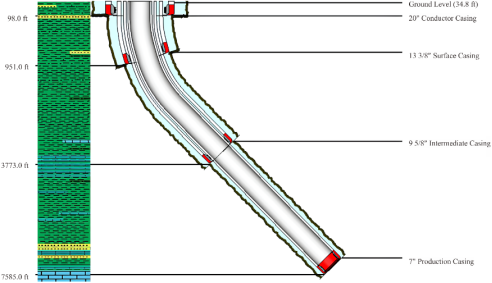
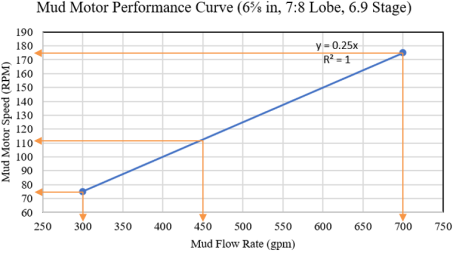
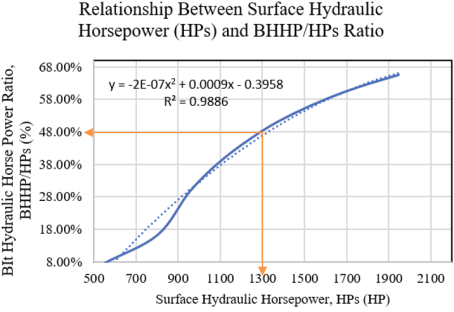
The “ARD-01” well is a directional well with a final depth of 7,585 ftMD, penetrating the limestone Tuban Formation. At the 8 ½” section, a drilling issue arose in the form of a suboptimal hydraulic program due to insufficient bit power, as indicated by a BHHP/HPs ratio of 7.63%. Under these conditions, the downhole mud motor operated at 112.5 rpm with a Rate of Penetration (ROP) of 75 ft/hr, which could potentially lead to bit balling and cutting regrinding due to cuttings buildup in the borehole, thereby reducing rock fragmentation efficiency and increasing the risk of non-productive time (NPT). The hydraulic evaluation and optimization conducted in this study utilized the Bit Hydraulic Horsepower (BHHP) method, which is considered effective because it focuses on the total hydraulic energy that aids in cuttings removal. BHHP accounts for the combination of pressure and flow rate, with a target BHHP/HPs ratio of approximately 48%, since a portion of the hydraulic horsepower, around 18% is used to operate the downhole mud motor. This relationship determines the desired drilling rate, particularly in the design of the downhole mud motor, to ensure adequate rotational speed (RPM) as a mechanical factor. The results of drilling hydraulics optimization achieved by changing the actual flow rate from 450 gpm to an optimized flow rate of 530 gpm and the actual pressure from 2100 to an optimized pressure of 4200 psi using a series connected triplex pump yielded an increase in the BHHP/HPs ratio of 48.20% which meets the recommended hydraulic parameters for directional drilling with a downhole mud motor. Under these conditions, the downhole mud motor speed increased to 132 rpm, resulting in a Rate of Penetration (ROP) increase from 75 ft/hr to 90 ft/hr under average conditions and reaching 105 ft/hr under optimal conditions. These results indicate that optimizing pressure and flow rate using the BHHP method can increase the hydraulic energy available at the bit, thereby improving drilling efficiency.
| Published in | Science Discovery (Volume 14, Issue 4) |
| DOI | 10.11648/j.sd.20261404.25 |
| Page(s) | 297-306 |
| Creative Commons |
This is an Open Access article, distributed under the terms of the Creative Commons Attribution 4.0 International License (http://creativecommons.org/licenses/by/4.0/), which permits unrestricted use, distribution and reproduction in any medium or format, provided the original work is properly cited. |
| Copyright |
Copyright © The Author(s), 2026. Published by Science Publishing Group |
Drilling Optimization, Bit Hydraulic Horsepower, Downhole Mud Motor, Directional Drilling
Parameter | Conductor Section | Surface Section | Intermediate Section | Production Section |
|---|---|---|---|---|
Bit Size, in | 26 | 17 ½ | 12 ¼ | 8 ½ |
Casing Size, in | 20 | 13 3/8 | 9 5/8 | 7 |
Length Casing, ft | 98 | 951 MD/ 940.4 TVD | 3773 MD/ 3152.9 TVD | 7585 MD/ 5612.2 TVD |
Inclination ° | 0 | 15.11 | 44.45 | 44.45 |
BUR, °/100 ft | 0 | 2.02 | 0 | 0 |
Tools | ID (in) | OD (in) | Length (in) |
|---|---|---|---|
Drill Pipe | 5.00 | 4.276 | 6653.78 |
HWDP 1 | 5.50 | 3.625 | 218.8 |
Jar | 6.50 | 2.75 | 31.00 |
HWDP 2 | 5.50 | 3.625 | 498.69 |
Drill Collar | 6.50 | 3.00 | 94.50 |
Crossover Sub | 6.00 | 2.76 | 3.00 |
MWD | 6.75 | 3.00 | 30.00 |
LWD | 6.75 | 2.76 | 30.00 |
Float Sub | 6.75 | 2.76 | 3.00 |
DHMM | 6.625 | 5.50 | 21.85 |
Parameter | Data |
|---|---|
PV, Cp | 28 |
YP, lb/100ft2 | 39 |
µ, cp | 65 |
ρ Cutting, ppg | 22 |
D Cutting, in | 1 |
P Pump, psi | 2100 |
Q Pump, gpm | 450 |
ROP, ft/d | 75 |
RPM | 112 |
WOB, klbs | 20 |
Number of Nozzles | 3 |
TFA, in2 | 0.59 |
Mud Pump Specification | 6 ¾” In Liner | 6 ½” In Liner | 6 ¼” In Liner | 6” In Liner | 5 ¾ In Liner |
|---|---|---|---|---|---|
Max Power, HP | 1000 | 1000 | 1000 | 1000 | 1000 |
Pump Speed, Spm | 140 | 140 | 140 | 140 | 140 |
Pressure, Psi | 2370 | 2558 | 2770 | 3010 | 3270 |
Flow Rate, gpm | 651 | 603 | 558 | 514 | 472 |
Surface Equipment Type | Stand Pipe | Rotary Hose | Swivel | Kelly | ||||
|---|---|---|---|---|---|---|---|---|
Length (ft) | ID (in) | Length (ft) | ID (in) | Length (ft) | ID (in) | Length (ft) | ID (in) | |
1 | 40 | 3.0 | 40 | 2.0 | 4 | 2.0 | 40 | 2.25 |
2 | 40 | 3.5 | 55 | 2.5 | 5 | 2.5 | 40 | 3.25 |
3 | 45 | 4.0 | 55 | 3.0 | 5 | 2.5 | 40 | 3.25 |
4 | 45 | 4.0 | 55 | 3.0 | 6 | 3.0 | 40 | 4.00 |
Surface Equipment Type | Value of E | |
|---|---|---|
Imperial Units | Metric Units | |
1 | 2.5 x 10⁻⁴ | 8.8 x 10⁻⁶ |
2 | 9.6 x 10⁻⁵ | 3.3 x 10⁻⁶ |
3 | 5.3 x 10⁻⁵ | 1.8 x 10⁻⁶ |
4 | 4.2 x 10⁻⁵ | 1.4 x 10⁻⁶ |
OD (in) | Lobes | Flow Rate (gpm) | Pressure Drop (psi) | Speed Range (RPM) | RPG |
|---|---|---|---|---|---|
6 ¾ | 4:5 | 300-600 | 875 | 149-300 | 0.50 |
6 ¾ | 7:8 | 300-600 | 415 | 42-84 | 0.15 |
6 ¾ | 7:8 | 300-600 | 1000 | 150-300 | 0.28 |
6 5/8 | 5:6 | 450-750 | 1330 | 155-258 | 0.34 |
6 5/8 | 4:6 | 350-700 | 1350 | 1220-280 | 0.40 |
6 5/8 | 5:6 | 350-700 | 1250 | 123-245 | 0.35 |
6 5/8 | 7:8 | 300-700 | 1050 | 75-175 | 0.25 |
Parameters | Result |
|---|---|
Hp Max, Hp | 2000 |
Q Max, gpm | 585.9 |
P Max, Psi | 4266 |
Parameters | Pressure Loss (Psi) |
|---|---|
Surface Connection | 43.45 |
Drill Pipe | 366.84 |
HWDP | 147.357 |
Drill Collar | 64.39 |
DHMM | 1050 |
Annulus Drill Pipe | 203.17 |
Annulus HWDP | 39.34 |
Annulus Drill Collar | 25.51 |
Parameters | Result |
|---|---|
Pressure Loss Bit, Psi | 160.278 |
BHHP/HPs, % | 7.63 |
P (Psi) | Q (gpm) | RPM | (P x Q)/1714 (HP) | BHHP (HP) | HPs (HP) | BHHP/HPs (%) |
|---|---|---|---|---|---|---|
2100 | 450 | 112 | 551.342 | 42.08 | 551.34 | 7.63 |
2600 | 530 | 132 | 803.967 | 131.21 | 803.96 | 16.32 |
3100 | 530 | 132 | 958.576 | 285.82 | 958.57 | 29.82 |
3600 | 530 | 132 | 1113.19 | 440.42 | 113.19 | 39.56 |
4200 | 530 | 132 | 1298.72 | 625.96 | 1298.71 | 48.20 |
4700 | 530 | 132 | 1453.33 | 780.56 | 1453.33 | 53.71 |
5200 | 530 | 132 | 1607.93 | 935.17 | 1607.93 | 58.16 |
5700 | 530 | 132 | 1762.54 | 1089.78 | 1762.54 | 61.83 |
6300 | 530 | 132 | 1948.07 | 1275.31 | 1275.31 | 65.47 |
BHHP | Bit Hydraulics Horsepower |
HPs | Horsepower Surface |
RPM | Revolution Per Minute |
BUR | Build Up Rate |
DHMM | Downhole Mud Motor |
MD | Measure Depth |
TVD | True Vertical Depth |
P | Pressure |
Q | Flow Rate |
n | Flow Index |
K | Consistency Index |
PV | Plastic Viscosity |
YP | Yield Point |
| [1] | Khudhair, S.; Al-Mahdawi, F. H. M. Optimization of Drilling Well Design: A Review. Iraqi Journal of Chemical and Petroleum Engineering 2022, 23(4), 91–99. |
| [2] | S. K. Al-Hlaichi and F. H. M. Al-Mahdawi, “Drilling optimization by using high drilling techniques: A review,” AIP Conf. Proc., vol. 2839, no. 1, p. 20029, Sep. 2023, |
| [3] | J. Skenderija, A. Koulidis, D. L. Sanchez, and S. Ahmed, “Advanced Hole Cleaning in Horizontal Wells: Experimental Investigation Supported by a Downhole Clamp-On Tool,” Feb. 19, 2023. |
| [4] | Y. Wang and S. Salehi, “Application of Real-Time Field Data to Optimize Drilling Hydraulics Using Neural Network Approach,” J. Energy Resour. Technol., vol. 137, no. 6, Nov. 2015, |
| [5] | G. Gjelstad, G. Hareland, K. N. Nikolaisen, and R. K. Bratli, “The Method of Reducing Drilling Costs More Than 50 Percent,” Jul. 08, 1998. |
| [6] | M. Alinejad Mofrad, Drilling Hydraulics Simulation Analysis and Comparison to a Field Case. 2006. |
| [7] | R. Ashena, A. A. Hekmatinia, A. Ghalambor, B. Aadnoy, C. Enget, and V. Rasouli, “Improving drilling hydraulics estimations-a case study,” J. Pet. Explor. Prod. Technol., vol. 11, no. 6, pp. 2763–2776, 2021, |
| [8] | T. C. Nguyen, E. Al-Safran, and V. Nguyen, “Theoretical modeling of Positive Displacement Motors performance,” J. Pet. Sci. Eng., vol. 166, no. December 2017, pp. 188–197, 2018, |
| [9] | A. Y. Prawira and E. P. Rini, “Size and configuration of mud motor drilling affects the optimum power outputs,” Eng. Solid Mech., vol. 5, no. 2, pp. 93–102, 2017, |
| [10] | D. Belov et al., “Hybrid Approach for Health Monitoring of Mud Motor Fleet,” PHM Soc. Eur. Conf., vol. 6, no. 1, p. 10, Jun. 2021, |
| [11] | S. Irawan, A. M. Abd Rahman, and S. Q. Tunio, “Optimization of weight on bit during drilling operation based on rate of penetration model,” Res. J. Appl. Sci. Eng. Technol., vol. 4, no. 12, pp. 1690–1695, 2012, |
| [12] | M. M. Al Rubaii, “A new robust approach for hole cleaning to improve rate of penetration,” Soc. Pet. Eng. - SPE Kingdom Saudi Arab. Annu. Tech. Symp. Exhib. 2018, SATS 2018, 2018, |
| [13] | A. Kiyani, P. Moarefvand, M. Dehvedar, and M. K. Moraveji, “Computational Fluid Dynamic application on Bit Hydraulic Performance,” Int. Conf. Recent Innov. n Chem. Chem. Eng., vol. 4, no. July 2017, pp. 1–16, 2017. |
| [14] | S. BA, D. Belov, D. Nobre, L. L. Yin, and E. Johnson, “Combined Data Analytics and Physics-Based Simulation for Optimum Bit, Motor, BHA Combination,” Oct. 29, 2019. |
| [15] | Shamsuddin, M. N.; Busahmin, B. Drilling Optimization through Rig Hydraulics Using a Mathematical Model. Improved Oil and Gas Recovery 2025, 9, 1–10. |
| [16] | Al-Rubaii, M. M. Real-Time Models of Rig and Drill Bit Hydraulics Optimizes Drilling Efficiency. In Offshore Technology Conference Asia; Kuala Lumpur, Malaysia, 2026. |
| [17] | H. Widiyatni, A. Rizkina, and W. I. Dirastri, “Evaluation of drilling hydraulic calculation to the ability of bottom hole cleaning,” J. Phys. Conf. Ser., vol. 1402, no. 5, pp. 0–6, 2019, |
| [18] | Herianto, “Optimization of Hydraulic Horsepower to Predict the Rate of Penetration,” Am. J. Phys. Appl., vol. 6, no. 3, p. 63, 2018, |
| [19] | Herianto, “Optimization Rate Of Penetration In Directional Drilling With Adjustable Bit Rotating and Hydraulic Hole Cleaning,” Adv. Image Video Process., vol. 9, no. 5, 2021, |
| [20] | H. Rabia, Oilwell drilling engineering : principles and practice / by H. Rabia. London: London: Graham & Trotman, 1985. |
| [21] | J. Bourgoyne, K. K. Millheim, M. E. Chenevert, and J. Young F S, Applied drilling engineering. United States: Richardson, TX (United States); Society of Petroleum Engineers, 1986. [Online]. Available: |
APA Style
Herianto, Adiguna, R. A. (2026). Integrated Drill Bit Hydraulic Optimization and Mechanical Factor for Directional Drilling. Science Discovery, 14(4), 297-306. https://doi.org/10.11648/j.sd.20261404.25
ACS Style
Herianto; Adiguna, R. A. Integrated Drill Bit Hydraulic Optimization and Mechanical Factor for Directional Drilling. Sci. Discov. 2026, 14(4), 297-306. doi: 10.11648/j.sd.20261404.25
AMA Style
Herianto, Adiguna RA. Integrated Drill Bit Hydraulic Optimization and Mechanical Factor for Directional Drilling. Sci Discov. 2026;14(4):297-306. doi: 10.11648/j.sd.20261404.25
@article{10.11648/j.sd.20261404.25,
  author = {Herianto and Rivandi Ardanda Adiguna},
  title = {Integrated Drill Bit Hydraulic Optimization and Mechanical Factor for Directional Drilling},
  journal = {Science Discovery},
  volume = {14},
  number = {4},
  pages = {297-306},
  doi = {10.11648/j.sd.20261404.25},
  url = {https://doi.org/10.11648/j.sd.20261404.25},
  eprint = {https://article.sciencepublishinggroup.com/pdf/10.11648.j.sd.20261404.25},
  abstract = {The “ARD-01” well is a directional well with a final depth of 7,585 ftMD, penetrating the limestone Tuban Formation. At the 8 ½” section, a drilling issue arose in the form of a suboptimal hydraulic program due to insufficient bit power, as indicated by a BHHP/HPs ratio of 7.63%. Under these conditions, the downhole mud motor operated at 112.5 rpm with a Rate of Penetration (ROP) of 75 ft/hr, which could potentially lead to bit balling and cutting regrinding due to cuttings buildup in the borehole, thereby reducing rock fragmentation efficiency and increasing the risk of non-productive time (NPT). The hydraulic evaluation and optimization conducted in this study utilized the Bit Hydraulic Horsepower (BHHP) method, which is considered effective because it focuses on the total hydraulic energy that aids in cuttings removal. BHHP accounts for the combination of pressure and flow rate, with a target BHHP/HPs ratio of approximately 48%, since a portion of the hydraulic horsepower, around 18% is used to operate the downhole mud motor. This relationship determines the desired drilling rate, particularly in the design of the downhole mud motor, to ensure adequate rotational speed (RPM) as a mechanical factor. The results of drilling hydraulics optimization achieved by changing the actual flow rate from 450 gpm to an optimized flow rate of 530 gpm and the actual pressure from 2100 to an optimized pressure of 4200 psi using a series connected triplex pump yielded an increase in the BHHP/HPs ratio of 48.20% which meets the recommended hydraulic parameters for directional drilling with a downhole mud motor. Under these conditions, the downhole mud motor speed increased to 132 rpm, resulting in a Rate of Penetration (ROP) increase from 75 ft/hr to 90 ft/hr under average conditions and reaching 105 ft/hr under optimal conditions. These results indicate that optimizing pressure and flow rate using the BHHP method can increase the hydraulic energy available at the bit, thereby improving drilling efficiency.},
 year = {2026}
}
TY  - JOUR
T1  - Integrated Drill Bit Hydraulic Optimization and Mechanical Factor for Directional Drilling
AU  - Herianto
AU  - Rivandi Ardanda Adiguna
Y1  - 2026/08/18
PY  - 2026
N1  - https://doi.org/10.11648/j.sd.20261404.25
DO  - 10.11648/j.sd.20261404.25
T2  - Science Discovery
JF  - Science Discovery
JO  - Science Discovery
SP  - 297
EP  - 306
PB  - Science Publishing Group
SN  - 2331-0650
UR  - https://doi.org/10.11648/j.sd.20261404.25
AB  - The “ARD-01” well is a directional well with a final depth of 7,585 ftMD, penetrating the limestone Tuban Formation. At the 8 ½” section, a drilling issue arose in the form of a suboptimal hydraulic program due to insufficient bit power, as indicated by a BHHP/HPs ratio of 7.63%. Under these conditions, the downhole mud motor operated at 112.5 rpm with a Rate of Penetration (ROP) of 75 ft/hr, which could potentially lead to bit balling and cutting regrinding due to cuttings buildup in the borehole, thereby reducing rock fragmentation efficiency and increasing the risk of non-productive time (NPT). The hydraulic evaluation and optimization conducted in this study utilized the Bit Hydraulic Horsepower (BHHP) method, which is considered effective because it focuses on the total hydraulic energy that aids in cuttings removal. BHHP accounts for the combination of pressure and flow rate, with a target BHHP/HPs ratio of approximately 48%, since a portion of the hydraulic horsepower, around 18% is used to operate the downhole mud motor. This relationship determines the desired drilling rate, particularly in the design of the downhole mud motor, to ensure adequate rotational speed (RPM) as a mechanical factor. The results of drilling hydraulics optimization achieved by changing the actual flow rate from 450 gpm to an optimized flow rate of 530 gpm and the actual pressure from 2100 to an optimized pressure of 4200 psi using a series connected triplex pump yielded an increase in the BHHP/HPs ratio of 48.20% which meets the recommended hydraulic parameters for directional drilling with a downhole mud motor. Under these conditions, the downhole mud motor speed increased to 132 rpm, resulting in a Rate of Penetration (ROP) increase from 75 ft/hr to 90 ft/hr under average conditions and reaching 105 ft/hr under optimal conditions. These results indicate that optimizing pressure and flow rate using the BHHP method can increase the hydraulic energy available at the bit, thereby improving drilling efficiency.
VL  - 14
IS  - 4
ER  -
Department of Petroleum Engineering, UPN "Veteran" Yogyakarta, Yogyakarta, Indonesia
Biography: Herianto is a Professor of Petroleum Engineering at Universitas Pembangunan Nasional "Veteran" Yogyakarta, Indonesia. He received his B.Eng. in Petroleum Engineering from UPN "Veteran" Yogyakarta, an M.Sc. in Petroleum Engineering from Institut Teknologi Bandung (ITB), and a Ph.D. in Petroleum Engineering from Universiti Teknologi Malaysia (UTM). His research interests include drilling engineering, geothermal engineering, petroleum field management, energy economics, and drilling management. He has served as an international instructor and senior consultant for major oil and gas companies and government institutions, including Pertamina, Chevron, PetroChina, Repsol, ConocoPhillips, and the Directorate General of Oil and Gas. He is also actively involved in national energy and geothermal development projects and holds the Insinyur Profesional Utama (IPU) certification awarded by the Institution of Engineers Indonesia (PII)
Research Fields: M.Sc., IPU: Petroleum drilling engineering, Geothermal engineering, Petroleum field management, Energy economics, Drilling management, Well control engineering, Reservoir engineering, Oil and gas production, Petroleum engineering education, National energy policy

Department of Petroleum Engineering, UPN "Veteran" Yogyakarta, Yogyakarta, Indonesia
Biography: Rivandi Ardanda Adiguna is an undergraduate student in the Department of Petroleum Engineering at Universitas Pembangunan Nasional "Veteran" Yogyakarta, Indonesia. His research interests include drilling engineering, drilling hydraulics, and directional drilling. He has served as a Teaching Assistant in the Drilling Laboratory and completed an industrial internship at Pertamina EP Zona 11 Cepu Field, where he gained practical experience through the review of the Acid Gas Removal Unit (AGRU) at the Central Processing Plant (CPP) Gundih. His current research focuses on hydraulic optimization based on Bit Hydraulic Horsepower (BHHP) analysis to improve drilling performance in directional wells.
Research Fields: Drilling engineering, Drilling hydraulics, Directional drilling, Drilling optimization


Information



 Share This Article
 Twitter
 Linked In
 Facebook
 Copy
Copy Download