
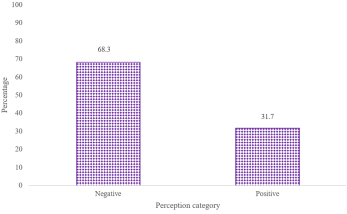
This study was conducted to assess perception and adaptation strategies to climate change-related water risks among residents of Afijio Local Government Area (LGA), Oyo state, Nigeria. This is a cross-sectional study that utilized random sampling technique to select 230 respondents. Interview was conducted using a validated interviewer administered questionnaire. Data were analyzed using descriptive statistics and Chi-square test at p=0.05. Respondents’ mean age was 37.0±17.2years, 57.8% were female while 72.6% had attained secodary education. Majority (73.5%) of the respondents agreed that changing rainfall patterns could increase flood risk, 72.6% agreed that climate change could cause irregular water supply during the dry season while 70.4% believed that communities in the area are vulnerable to water scarcity. The mean perception score was 10.1±2.9, 68.3% had negative perception about climate change-related water risks. Fifteen (15.0%) percent of the respondents reported that water scarcity had affected household health while 10.9% reported that children’s schooling was affected due to poor hygiene-related challenges. Significantly, 52.0% of respondents who reported that climate change-related water risk affected children schooling had negative perception compared to 48.0% who had positive perception (χ2=3.423, p-value=0.034). The three major adaptation strategies to water scarcity mentioned by the respondents were digging of wells (21.7%), storage of rainwater (20.0%) and drilled boreholes (10.9%). Only 36.5% reported changing their farming practices in response to water challenges while 18.7% ever received any support to cope with climate-related water challenges. Respondents had negative perception and had experienced several impacts of climate change-related water risk. Very few respondents had ever received any support to cope with climate-related water challenges. There is need for a public health interventions focusing on more systematic support to transform awareness into broad resilience on climate change-related water risks at community level.
| Published in | Science Discovery (Volume 14, Issue 5) |
| DOI | 10.11648/j.sd.20261405.12 |
| Page(s) | 311-321 |
| Creative Commons |
This is an Open Access article, distributed under the terms of the Creative Commons Attribution 4.0 International License (http://creativecommons.org/licenses/by/4.0/), which permits unrestricted use, distribution and reproduction in any medium or format, provided the original work is properly cited. |
| Copyright |
Copyright © The Author(s), 2026. Published by Science Publishing Group |
Climate Change, Adaptation Strategies, Water Risks, Poor Hygiene
Characteristics | Frequency | % |
|---|---|---|
Gender | ||
Male | 97 | 42.2 |
Female | 133 | 57.8 |
Marital status | ||
Single | 106 | 46.1 |
Married | 111 | 48.3 |
Widowed | 11 | 4.8 |
Divorced or separated | 2 | 0.9 |
Highest Educational Level Attained | ||
No Formal Education | 5 | 2.2 |
Primary | 30 | 13.0 |
Secondary Education | 167 | 72.6 |
Tertiary Education | 28 | 12.2 |
Primary Occupation | ||
Civil Service | 35 | 15.2 |
Artisanship | 45 | 19.6 |
Farming | 77 | 33.5 |
Trading | 73 | 31.7 |
Residence Period at the Community | ||
1-5years | 109 | 47.4 |
>5years | 121 | 52.6 |
Household Size | ||
1-5people | 178 | 77.4 |
>5people | 52 | 22.6 |
Statement | A (%) | NAND (%) | D (%) |
|---|---|---|---|
Changes in rainfall patterns could increase the risk of flooding in my area | 169 (73.5) | 19 (8.3) | 42 (18.3) |
Flooding has become more frequent in my community in recent years | 124 (53.9) | 25 (10.9) | 81 (35.2) |
My community is vulnerable to the risk of erosion into water sources | 156 (67.8) | 28 (12.2) | 46 (20.0) |
Drinking water sources in my area are vulnerable to water pollution | 111 (48.3) | 28 (12.2) | 91 (39.6) |
Climate change could lead to an irregular water supply during the dry season | 167 (72.6) | 31 (13.5) | 32 (13.9) |
Most communities in my area are vulnerable to water scarcity during the dry season | 162 (70.4) | 38 (16.5) | 30 (13.0) |
Heavy rainfall now causes more damage to properties than in the past | 153 (66.5) | 29 (12.6) | 48 (20.9) |
The water I use for household purposes is often affected by flooding | 100 (43.5) | 38 (16.5) | 92 (40.0) |
Water-related problems pose a serious threat to people's health | 169 (73.5) | 32 (13.9) | 29 (12.6) |
Flooding poses a serious threat to people's livelihoods | 162 (70.5) | 31 (13.5) | 37 (16.1) |
Human activities such as improper waste disposal worsen the impact of flooding in my area | 164 (71.3) | 31 (13.5) | 35 (15.2) |
Community members understand the causes and impacts of climate-related water risks | 148 (64.3) | 38 (16.5) | 44 (19.1) |
Climate-related water risks can be reduced through collective community action | 187 (81.3) | 23 (10.0) | 20 (8.7) |
Access to accurate climate information helps people prepare better for water-related risks. | 169 (73.5) | 32 (13.9) | 29 (12.6) |
Education on climate change can reduce water-related problems in my community | 179 (77.8) | 24 (10.4) | 27 (11.7) |
Experiences about the impact | Frequency | % |
|---|---|---|
Ever experienced damage to any of the following due to flooding | ||
Property | 99 | 43.0 |
Farmland | 111 | 48.3 |
Livestock | 96 | 41.7 |
Stored food | 82 | 35.7 |
Building | 3 | 1.3 |
Ever experienced any of the following losses due to water scarcity | ||
Income | 109 | 47.4 |
Crops | 131 | 57.0 |
Livestock | 98 | 42.6 |
Water scarcity has affected the health of your household | 34 | 15.0 |
Some water scarcity effect on your households’ health | ||
Typhoid | 2 | 0.9 |
Lack of quality water | 22 | 9.5 |
Inflation | 1 | 0.4 |
Water-borne disease | 4 | 1.7 |
Erosion in well water | 1 | 0.4 |
Drinking polluted/bad water | 1 | 0.4 |
Drying of flower | 1 | 0.4 |
Agricultural produce are affected | 2 | 0.8 |
Skin infection | 1 | 0.4 |
Water-related challenges have affected children’s schooling in your household | 25 | 10.9 |
Water scarcity effects on your children’s schooling | ||
Poor attendance | 9 | 3.9 |
Poor hygiene | 9 | 3.8 |
Lateness to school | 5 | 2.2 |
Risk of crossing bridge | 3 | 1.3 |
Destruction of roads and school properties | 4 | 1.7 |
Characteristics | Frequency | % |
|---|---|---|
Ever taken action to reduce the impact of climate-related water problems in your neighborhood | 97 | 42.2 |
Steps taken to deal with water scarcity | ||
Storage of rainwater | 46 | 20.0 |
Digging of wells | 50 | 21.7 |
Drilling of boreholes | 25 | 10.9 |
Rationing of water use | 16 | 7.0 |
Reliance on water vendors | 13 | 5.7 |
Ever changed farming practices due to water challenges | 84 | 36.5 |
Ever received support to cope with climate-related water challenges | 43 | 18.7 |
Source of the support | ||
Government | 23 | 10.0 |
Individuals | 22 | 9.6 |
Community groups | 17 | 7.4 |
Faith-based organisation | 9 | 3.9 |
Non-government Organisations (NGOs) | 9 | 3.9 |
Things community should do to reduce vulnerability to climate change water-related risks | ||
Strengthen community drainage systems | 123 | 53.5 |
Encourage water conservation practices | 44 | 19.1 |
Form cooperative groups for support | 36 | 15.7 |
Variables | Perception category | Total (%) | 2 (p-value) | |
|---|---|---|---|---|
Negative (%) | Positive (%) | |||
Ever experienced damage to livestock | ||||
Yes | 63 (65.6) | 33 (34.4) | 96 (100) | 0.528 (0.467) |
No | 94 (70.1) | 40 (29.9) | 134 (100) | |
Water scarcity affects the health of my household | ||||
Yes | 18 (52.9) | 16 (47.1) | 34 (100) | 4.322 (0.038) |
No | 139 (70.9) | 57 (29.1) | 196 (100) | |
Climate-related water risk ever affected children schooling | ||||
Yes | 13 (52.0) | 12 (48.0) | 25 (100) | 3.423 (0.034) |
No | 144 (70.2) | 61 (29.8) | 205 (100) | |
Ever taken action to reduce the impact of flooding in neighborhood | ||||
Yes | 60 (65.9) | 31 (34.1) | 91 (100) | 0.376 (0.540) |
No | 97 (69.8) | 42 (30.2) | 139 (100) | |
Ever changed farming practices due to water risk | ||||
Yes | 60 (71.4) | 24 (28.6) | 84 (100) | 0.613 (0.434) |
No | 97 (66.4) | 47 (33.6) | 146 (100) | |
Ever received support to cope with climate-related water challenges | ||||
Yes | 33 (76.7) | 10 (23.3) | 43 (100) | 1.757 (0.188) |
No | 124 (66.3) | 63 (33.7) | 187 (100) | |
LGA | Local Government Area |
NGOs | Non-governmental Organizations |
IPCC | Intergovernmental Panel on Climate Change |
| [1] | Intergovernmental Panel on Climate Change [IPCC]. (2022). Climate Change 2022: Impacts, Adaptation and Vulnerability. Contribution of Working Group II to the Sixth Assessment Report of the Intergovernmental Panel on Climate Change (H.-O. Pörtner et al., Eds.). Cambridge University Press. |
| [2] | Konapala, G., Mishra, A. K., Wada, Y. and Mann, M. E. (2020). Climate change will affect global water availability through compounding changes in seasonal precipitation and evaporation. Nat Commun 11, 3044. |
| [3] | van Vliet, M. T. H., Thorslund, J., Strokal, M., Hofstra, N., Flörke, M., Macedo, H. E., Nkwasa, A., Tang, T., Kaushal, S. S., Kumar, R., van Griensven, A., Bouwman, L. and Mosley, L. M. (2023). Global river water quality under climate change and hydroclimatic extremes. Nat Rev Earth Environ 4, 687-702. |
| [4] |
World Health Organization. (2022). Review of IPCC evidence 2022: Climate change, health and well-being.
https://www.who.int/publications/m/item/review-of-ipcc-evidence-2022--climate-change--health--and-well-being (Assessed on July 16, 2026). |
| [5] | United Nations Office for Disaster Risk Reduction [UNDRR]. (2025). Global Assessment Report on Disaster Risk Reduction: Resilience Pays: Financing and Investing for our Future. Geneva. |
| [6] | World Meteorological Organization. (2021). Atlas of Mortality and Economic Losses from Weather, Climate and Water-related Hazards (1970-2021). WMO. |
| [7] | Speybroeck, N., Noy, I., Kettner, A., Below, R., Messori, G., Thiery, W., Wathelet, V., Jézéquel, A., Delforge, D. and Van Niekerk, D. (2026). The emergency events database, EM-DAT, must be preserved as a global public good. Int. J. Public Health 71: 1609990. |
| [8] |
UNDRR. (2023). UNDRR. Closing Climate and Disaster Data Gaps: New Challenges, New Thinking. United Nations Office for Disaster Risk Reduction.
https://www.undrr.org/publication/closing-climate-and-disaster-data-gaps-newchallenges-new-thinking |
| [9] | Cotti, D., Harb, M., Hadri, A., Aboufirass, M., Chaham, K. R., Libertino, A., Campo, L., Trasforini, E., Krätzschmar, E., Bellert, F. and Hagenlocher, M. (2022). An integrated multi-risk assessment for floods and drought in the Marrakech-Safi region (Morocco). Frontiers in Water, 4, 886648. |
| [10] | Gil-Guirado, S., Espín-Sánchez, J.-A. and Del Rosario Prieto, M. (2016). Can we learn from the past? Four hundred years of changes in adaptation to floods and droughts. Measuring the vulnerability in two Hispanic cities. Climatic Change, 139(2), 183-200. |
| [11] | Imaz-Lamadrid, M. A., Ivanova-Boncheva, A., Flores-López, M. Z., and Cortés-Martínez, M. Y. (2023). Participative policy design to manage droughts and floods in an arid region under changing climate scenarios: The case of Baja California Sur, Mexico. Sustainability, 15(18), Article 13547. |
| [12] | Odiyo, J., Mathivha, F. I., Nkuna, T. R. and Makungo, R. (2019). Hydrological hazards in Vhembe district in Limpopo Province, South Africa. Jamba: J Disaster Risk Stud, 11 (2), |
| [13] | Markantonis, V., Farinosi, F., Dondeynaz, C., Ameztoy Aramendi, I., Pastori, M., Marletta, L., Ali, A. and Carmona Moreno, C. (2018). Assessing floods and droughts in the Mékrou River Basin (West Africa): A combined household survey and climatic trends analysis approach, Natural Hazards andnd Earth System Sciences, ISSN 1561-8633, 18 (4): 1279-1296. |
| [14] | UNEP. (2019). Water Resources in Africa: Key Issues and Sustainable Solutions. |
| [15] | Kithiia, J. and Majambo, G. (2020). Motion but no speed: Colonial to post-colonial status of water and sanitation service provision in Mombasa city. Cities, 107, 102867. |
| [16] | African Development Bank. (2018). The Water Scarcity Challenge in Africa: Policy and Strategy Review. |
| [17] |
UN OCHA. (2024). Nigeria: Floods - Situation Report No. 1 (as of 25 September 2024). 2024. Accessed September 28, 2024.
https://reliefweb.int/report/nigeria/nigeria-floods-situation-report-no-1-25-september-2024 |
| [18] | Ibebuchi, C. C. and Abu, I.-O. (2023). Rainfall variability patterns in Nigeria during the rainy season. Scientific Reports, 13, 7888. |
| [19] | Salami, A. A., and Togo, M. (2026). Meteorological drought dynamics across Nigeria: Multi-scale SPI insights for climate adaptation. Theoretical and Applied Climatology. |
| [20] | Abaje, I. B., Abdullahi, N. and Jeje, O. G. (2016). Climate change and infectious diseases in Funtua local government area of Katsina state, Nigeria. Int J Sci Technol. 5(1): 47-58. |
| [21] | Onwe, F., Agu, A., Umezuruike, D. and Ogbonna, C. (2020). Factors responsible for the 2015 cholera outbreak and spread in Ebonyi state, Nigeria. J Epidemiol Soc Niger. 2(2): 53-8. |
| [22] | Ngwa, M. C., Ihekweazu, C., Okwor, T., Yennan, S., Williams, N., Elimian, K., Karaye, N. Y., Bello, I. W. and Sack, D. A. (2021). The cholera risk assessment in Kano state, Nigeria: a historical review, mapping of hotspots, and evaluation of contextual factors. PLoS Negl Trop Dis. 15(1): e0009046. |
| [23] | Whaley L. and Cleaver F. (2017). Can ‘functionality'save the community management model of rural water supply? Water Resources and Rural Development 9, 56-66. |
| [24] | Prüss-Ustün, A., Wolf, J., Bartram, J., Clasen, T., Cumming, O., Freeman, M. C., Gordon, B., Hunter, P. R., Medlicott, K. and Johnston, R. (2019). Burden of disease from inadequate water, sanitation and hygiene for selected adverse health outcomes: An updated analysis with a focus on low-and middle-income countries. International Journal of Hygiene and Environmental Health 222 (5), 765 -777. |
| [25] | National Population Commission (NPC). (2006). Population and housing census of the Federal Republic of Nigeria. |
| [26] | National Bureau of Statistics (NBS). (2021). Demographic statistics bulletin. |
| [27] | Oyelami, A. A., Ogunbode, T. O. and Owoeye, M. O. (2026). Dynamics of household water use determinants in selected Local Government Areas in Oyo Zone of Oyo State Nigeria. Sci Rep 16, 9613 |
| [28] | Cochran, W. G. (1977). Sampling techniques (3rd ed.). John Wiley & Sons. New York. Pp 428. ISBN 978-0-471-16240-7. |
| [29] | Mudombi, S. and Muchie, M. (2013). Perceptions of Water Access in the Context of Climate Change by Rural Households in the Seke and Murewa Districts, Zimbabwe. Jàmbá: Journal of Disaster Risk Studies, 5: 1-8. |
| [30] | Anjum, G. and Aziz, M. (2025). Climate change and gendered vulnerability: A systematic review of women's health. Womens Health (Lond). Volume 21: 1 -22 |
| [31] | Graham, J. P., Hirai, M. and Kim, S. S. (2016). An Analysis of Water Collection Labor among Women and Children in 24 Sub-Saharan African Countries. PLoS One. 1; 11(6): e0155981. |
| [32] | Bello, N., Garba, H. and Ako, A. A. (2022). Perception of residents on the impacts of climate change on water resources in Kaduna North Local Government Area. Science World Journal. 20 (1), 252-260. |
| [33] | Aldawsari, N. D., Nemt-allah, M. A. and Abdellatif, M. S. (2025). Environmental Education Awareness in Light of Sustainable Development Goals and Its Relationship with Environmental Responsibility among University Students. Sustainability, 17(21), 9393. |
| [34] | McNamara, K. E. and Buggy, L. (2017). Community-based climate change adaptation: a review of academic literature. Local Environment, 22(4), 443-460. |
| [35] | Aborode, A. T., Otorkpa, O. J., Abdullateef, A. O., Oluwaseun, O. S., Adegoye, G. A., Aondongu, N. J., Oyetunji, I. O., Akingbola, A., Scott, G. Y., Kolawole, B. O. and Komakech, J. J. (2025). Impact of Climate Change-Induced Flooding Water Related Diseases and Malnutrition in Borno State, Nigeria. Environmental Health Insights Volume 19, 1-11. |
| [36] | Bako, H., Haruna, A. P. and Adamu, B. S. (2022). Smallholders Farmers' Perceptions on the Impacts of Climate Change on Their Livelihoods in Kuje Area Councils. European Journal of Agriculture and Food Sciences. 4 (1), 72-75 |
| [37] | Odelola, R., Matthew, O. and Aniramu, O. (2025). Assessing the impact of climate change and farmers’ adaptation strategies on agricultural crop production at a community level in Southwestern Nigeria. Agriculture & Food Security, 14, 35. |
| [38] | Anunobi, A. I. (2013). Housing vulnerability, resilience and adaptation strategies to flood hazard: A study of Shiroro Town in Niger State, North Central Nigeria. Developing Country Studies, 3(12), 72-82. |
| [39] | Wahab B, and Falola, O. (2022). Vulnerable Households in Flood-prone Communities in Ibadan: Measures to improve their Status within the Inclusive Ibadan City Framework. Conference Proceedings for International Symposium on Inclusive-Cities: Achieving Inclusive Cities through A Multidisciplinary Approach, 2021 28-30 June. Journal of Inclusive cities and Built environment. 2 (1), 21-27. |
| [40] | Obeta, M. C. (2019). Private for-profit rural water supply in Nigeria: Policy constraints and options for improved performance. Journal of Water and Land Development, 41 (IV-VI), 101-110. |
| [41] | Deressa, T. T., Hassan, R. M., Ringler, C., Alemu, T. and Yesuf, M. (2009). Determinants of farmers’ choice of adaptation methods to climate change in the Nile Basin of Ethiopia. Global Environmental Change, 19(2), 248-255. |
| [42] | Ayanlade, A., Radeny, M. and Akin-Onigbinde, A. I. (2018). Climate variability/change and attitude to adaptation technologies: A pilot study among selected rural farmers' communities in Nigeria. GeoJournal, 83(2), 319-331. |
| [43] | Ojo, S., Mensah, H., Albrecht, E. and Ibrahim, B. (2020). Adaptation to climate change effects on water resources: Understanding institutional barriers in Nigeria. Climate, 8(11), 134. |
| [44] | Madaki, M. Y., Muench, S., Kaechele, H. and Bavorova, M. (2023). Climate change knowledge and perception among farming households in Nigeria. Climate, 11(6), 115. |
APA Style
Bamidele, R. J., Awolumate, T. A., Adejumo, M. (2026). Perception and Adaptation Strategies to Climate Change-Related Water Risks Among Residents of Afijio Local Government Area, Oyo State, Nigeria. Science Discovery, 14(5), 311-321. https://doi.org/10.11648/j.sd.20261405.12
ACS Style
Bamidele, R. J.; Awolumate, T. A.; Adejumo, M. Perception and Adaptation Strategies to Climate Change-Related Water Risks Among Residents of Afijio Local Government Area, Oyo State, Nigeria. Sci. Discov. 2026, 14(5), 311-321. doi: 10.11648/j.sd.20261405.12
@article{10.11648/j.sd.20261405.12,
  author = {Rereloluwa John Bamidele and Taiwo Abel Awolumate and Mumuni Adejumo},
  title = {Perception and Adaptation Strategies to Climate Change-Related Water Risks Among Residents of Afijio Local Government Area, Oyo State, Nigeria},
  journal = {Science Discovery},
  volume = {14},
  number = {5},
  pages = {311-321},
  doi = {10.11648/j.sd.20261405.12},
  url = {https://doi.org/10.11648/j.sd.20261405.12},
  eprint = {https://article.sciencepublishinggroup.com/pdf/10.11648.j.sd.20261405.12},
  abstract = {This study was conducted to assess perception and adaptation strategies to climate change-related water risks among residents of Afijio Local Government Area (LGA), Oyo state, Nigeria. This is a cross-sectional study that utilized random sampling technique to select 230 respondents. Interview was conducted using a validated interviewer administered questionnaire. Data were analyzed using descriptive statistics and Chi-square test at p=0.05. Respondents’ mean age was 37.0±17.2years, 57.8% were female while 72.6% had attained secodary education. Majority (73.5%) of the respondents agreed that changing rainfall patterns could increase flood risk, 72.6% agreed that climate change could cause irregular water supply during the dry season while 70.4% believed that communities in the area are vulnerable to water scarcity. The mean perception score was 10.1±2.9, 68.3% had negative perception about climate change-related water risks. Fifteen (15.0%) percent of the respondents reported that water scarcity had affected household health while 10.9% reported that children’s schooling was affected due to poor hygiene-related challenges. Significantly, 52.0% of respondents who reported that climate change-related water risk affected children schooling had negative perception compared to 48.0% who had positive perception (χ2=3.423, p-value=0.034). The three major adaptation strategies to water scarcity mentioned by the respondents were digging of wells (21.7%), storage of rainwater (20.0%) and drilled boreholes (10.9%). Only 36.5% reported changing their farming practices in response to water challenges while 18.7% ever received any support to cope with climate-related water challenges. Respondents had negative perception and had experienced several impacts of climate change-related water risk. Very few respondents had ever received any support to cope with climate-related water challenges. There is need for a public health interventions focusing on more systematic support to transform awareness into broad resilience on climate change-related water risks at community level.},
 year = {2026}
}
TY  - JOUR
T1  - Perception and Adaptation Strategies to Climate Change-Related Water Risks Among Residents of Afijio Local Government Area, Oyo State, Nigeria
AU  - Rereloluwa John Bamidele
AU  - Taiwo Abel Awolumate
AU  - Mumuni Adejumo
Y1  - 2026/10/09
PY  - 2026
N1  - https://doi.org/10.11648/j.sd.20261405.12
DO  - 10.11648/j.sd.20261405.12
T2  - Science Discovery
JF  - Science Discovery
JO  - Science Discovery
SP  - 311
EP  - 321
PB  - Science Publishing Group
SN  - 2331-0650
UR  - https://doi.org/10.11648/j.sd.20261405.12
AB  - This study was conducted to assess perception and adaptation strategies to climate change-related water risks among residents of Afijio Local Government Area (LGA), Oyo state, Nigeria. This is a cross-sectional study that utilized random sampling technique to select 230 respondents. Interview was conducted using a validated interviewer administered questionnaire. Data were analyzed using descriptive statistics and Chi-square test at p=0.05. Respondents’ mean age was 37.0±17.2years, 57.8% were female while 72.6% had attained secodary education. Majority (73.5%) of the respondents agreed that changing rainfall patterns could increase flood risk, 72.6% agreed that climate change could cause irregular water supply during the dry season while 70.4% believed that communities in the area are vulnerable to water scarcity. The mean perception score was 10.1±2.9, 68.3% had negative perception about climate change-related water risks. Fifteen (15.0%) percent of the respondents reported that water scarcity had affected household health while 10.9% reported that children’s schooling was affected due to poor hygiene-related challenges. Significantly, 52.0% of respondents who reported that climate change-related water risk affected children schooling had negative perception compared to 48.0% who had positive perception (χ2=3.423, p-value=0.034). The three major adaptation strategies to water scarcity mentioned by the respondents were digging of wells (21.7%), storage of rainwater (20.0%) and drilled boreholes (10.9%). Only 36.5% reported changing their farming practices in response to water challenges while 18.7% ever received any support to cope with climate-related water challenges. Respondents had negative perception and had experienced several impacts of climate change-related water risk. Very few respondents had ever received any support to cope with climate-related water challenges. There is need for a public health interventions focusing on more systematic support to transform awareness into broad resilience on climate change-related water risks at community level.
VL  - 14
IS  - 5
ER  -
Department of Environmenal Health Sciences, University of Ibadan, Ibadan, Nigeria
Department of Environmenal Health Sciences, University of Ibadan, Ibadan, Nigeria
Department of Environmenal Health Sciences, University of Ibadan, Ibadan, Nigeria

Information



 Share This Article
 Twitter
 Linked In
 Facebook
 Copy
Copy Download