
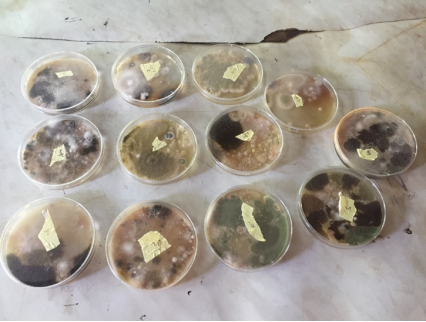
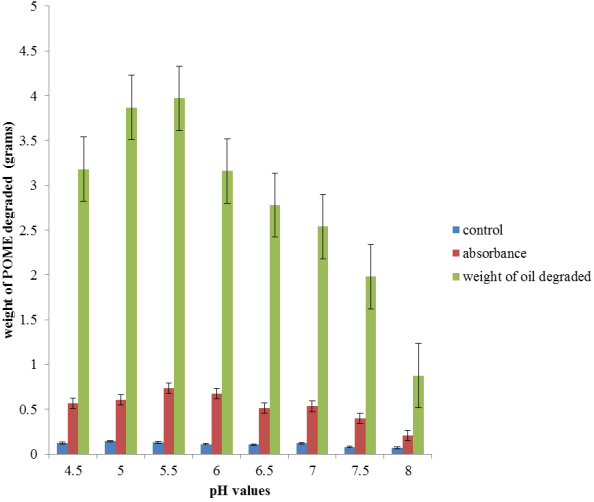
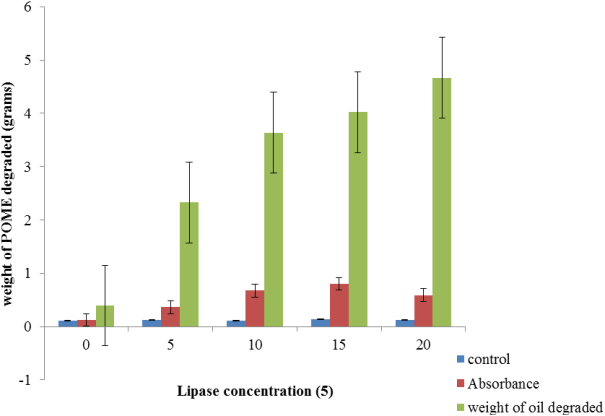
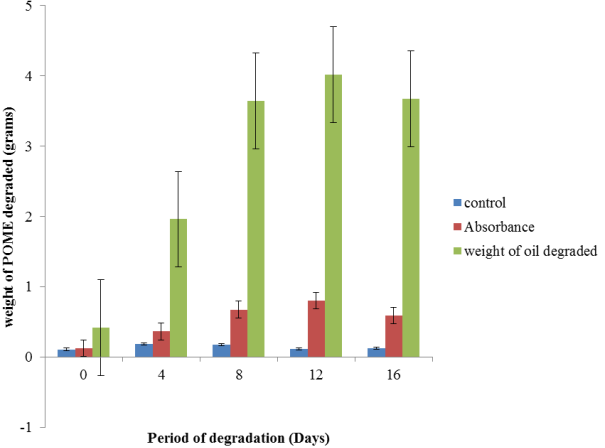
POME a bye product in palm oil processing industry is a contaminant with a high organic chemistry implication. POME is a highly polluting product, consisting of 0.7% (w/v) protein, 5% (w/v) total organic carbon, 20% total organic matter contents, 93% (w/v) water and salts the present study was carried out at a local palm oil milling center located at Umunneochi present day Abia state, Nigeria. Aspergillus sp was isolated from palm oil mill effluent impacted soil using culture dependent techniques. The organism was confirmed Aspergillus was identified using standard microbiology and biochemical techniques respectively. Lipase producing capability of the organisms was screened in an optimized culture broth in the presence of p-NPP. Yellow coloration of the broth confirms the exo-lipase secretory of the bacteria. Lipase production peaked on day 5 of the fermentation. Physicochemical properties of the palm oil mill effluent were: pH (6.0), conductivity (617 Ω-1cm-1), DO (6.21 mg/ml), BOD5 (4.89 mg/ml), TOC (102.34 mg/ml), TOM (125.87 mg/ml), Ca and Mg (34.15 mg/ml; 9.87 mg/ml). Lipase impact on the POME peaked at pH 5.0 after 168 hour with TOC/TOM contents of 56.2/68.15 mg/ml. DO/BOD5 at the respective conditions were 4.52 and 2.89. Decrease in the organic matter contents were seen in tangent with increase in lipase concentration. The present study showed the kinetic properties of lipase from Aspergillus sp. in remediation effluents such as POME as it was evident in the significant reduction in the organic matter contents of the POME.
| Published in | Science Discovery Chemistry (Volume 1, Issue 3) |
| DOI | 10.11648/j.sdc.20260103.12 |
| Page(s) | 101-108 |
| Creative Commons |
This is an Open Access article, distributed under the terms of the Creative Commons Attribution 4.0 International License (http://creativecommons.org/licenses/by/4.0/), which permits unrestricted use, distribution and reproduction in any medium or format, provided the original work is properly cited. |
| Copyright |
Copyright © The Author(s), 2026. Published by Science Publishing Group |
Pome, Aspergillus, Lipase, Organic Matter
PHYSIOCHEMICALFACTORS | CONTROL | POME(BEFORE REMEDIATION) |
|---|---|---|
pH | 7.78 | 5.67 |
CONDUCTANCE | 423 | 610 |
Magnesium(Mg)(Mg/ml) | 5.28 | 6.82 |
Dissolved oxygen content (mg/ml) | 7.21 | 6.31 |
BOD5 (mg.ml) | 2.10 | 4.87 |
Potassium (K)(Mg/ml) | 8.30 | 14.52 |
Total dissolved solid content (TDS) | 258.03 | 372.1 |
Total suspended solid content(TSS) | 396.07 | 539.55 |
Total solid contents (TS) | 654.1 | 911.6 |
Total organic matter content (TOM)(Mg/ml) | 24.88 | 100.7 |
Total organic carbon contents (Mg/ml) | 20.33 | 81.87 |
PHYSICOCHEMICALTEST | POME1 | POME2 |
|---|---|---|
pH | 5.67 | 6.5 |
Conductivity (Ω-1cm-1) | 610 | 721 |
TOM (mg/ml) | 100.7 | 68.15 |
TOC (mg/ml) | 81.87 | 56.2 |
BOD5 | 4.87 | 2.89 |
p-NPP | Para Nitrophenyl Palmitate |
POME | Palm Oil Mill Effluent |
BOD | Biochemical Oxygen Demand |
TOM | Total Organic Matter |
Toc | Total Oxidizable Carbon |
| [1] | Abigor, R., Uadia, P., Foglia, T.,Haas, M., Scott, K. and Savary, B. (2003). Partial purification and properties of lipase from germinating seeds of Jatrophacucas. J. Am. Oil Chem. Sc, 79(11):1123-1128. |
| [2] | Abolemonaen, M., Hatem, B. and Jeannette, B. (2011). Three dimensional structure of Aradposis Thaliana lipase predicted by homology modeling method. Evolutionary Bioinformatics, 7: 99-105. |
| [3] | Allam, R., Aly, M., El-zhrany, K. and Shafei, M. (2016). Production of β-Galactosidase enzyme from Lactobacillus sp. RK isolated from different sources of milk and dairy products. International Journal of ChemTech Research, 9(10): 218-231. |
| [4] | Alonso, F., Oliveira, E., Dellamora-Ortiz, G. and Pereira-Meirelles, F. (2015). Improvement of lipase production at different stirring speeds and oxygen levels, Journal of the Brazilian Sciences of Chemical Engineering, 22(1): 9–18. |
| [5] | Anosike, E. (2001). Basic enzymology, UNIPORT press, Portharcourt, Nigeria.1-120. |
| [6] | Agency of Toxic Substances and Disease Registry (ATSDR) (2009). Public Health Statements: Used mineral based crankcase oil. ATSDR. Atlanta Georgia. |
| [7] | Benjamin and S. Pandey, L. (2017). Enhancement of lipase production during repeated batch culture using immobilized Candida rugosa”, Process Biochemistry, 32(5): 437–440. |
| [8] | Berrios, M., Siles, J., Martn, M. A and Martn, A. (2007). A kinetic study of the esterification of free fatty acids (FFA) in sunflower oil. Fuel, 86: 2383-2388. |
| [9] | Boareto, A., Souza, M., Valero, F. and Valdman,B. (2007). A hybrid neural model (HNM) for the on-line monitoring of lipase production by Candida rugosa. Journal of Chemical Technology and Biotechnology, 82: 319–327. |
| [10] | Borgston, B. and Brockman, H. (2014). Lipases. Amsterdam, Elsevier. 312-322. |
| [11] | Bornscheuer, U., Bessler, C., Srinivas, R. and Krishna,S. (2012). Optimizing lipases and related enzymes for efficient application. Trends in Biotechnology, 20: 433–437. |
| [12] | Bornscheuer, U. (2012). Microbial carboxyl esterases: classification, properties and application in biocatalysis,”FEMS MicrobiologyReviews, 26(1): 73–81. |
| [13] | Cavalcanti, E., Gutarra, M., Freire, D., Castilho, L. and Sant’Anna Jr., G. (2015). Lipase production by solid state fermentation in fixed-bed bioreactors”, Brazilian Archives of Biology and Technology, 48: 79–84. |
| [14] | Chang, B., Tai, M. and Cheng, F. (2011). Kinetics and products of the degradation of chitosan byhydrogenperoxide. Journal of Agricultural and Food, 49(10): 4845-4851. |
| [15] | Chen, W., Chen, H., Xia, Y., Zhao, J., Tian, F. and Zhang, H. (2008). Production, purification and characterization of a potential thermostable galactosidase for milk lactose hydrolysis from Bacillus stearothermophilus. Journal of Dairy Science, 91:1751–1758. |
| [16] | Hansen, S. (2007) Feasibility study of performing a life cycle assessment on crude palm oil production in Malaysia (9 pp). The International Journal of Life Cycle Assessment, 12(1),50-58. |
| [17] | Kutty, S., Ngatenah, S., Isa, M. andMalakahmad, A. (2009). A nutrients removal from municipal wastewater treatment plant effluent using Eichhornia crassipes. World Academy of Science, Engineering and Technology, 36: 828-833. |
| [18] | Kuwahara, K., Angkawidjaja, C., Matsumura, H., Koga, Y., Takano, K. and Kanaya, S. (2008). Importance of the Ca2+-binding sites in the N-catalytic domain of a family 13 lipase for activity and stability. Protein Engineering, Design and Selection, 21(12), 737–744. |
| [19] | Lazarova V. and Jacques M. (2010). Innovative biofilm treatment technologies for water and wastewater treatment. ChemInform, 31-40. |
| [20] | Liese, A.,Seelbach, K. and Wandrey, C. (2000). IndustrialBiotransformations Weinheim: Wiley-VCH. |
| [21] | Lin, E.,Wang, C. andSung,S. (2008). Cultivating conditions influence lipase production by the edible basidiomycete Antrodiacinnamomea in submerged culture”, Enzyme and Microbial Technology, 39. 98–102. |
| [22] | Mbachu, E., chukwurah, O. and Mbach, I. (2016). Isolation and characterization of hydrocarbon degrading fungi from used (spent) engine oil polluted soil and their use for polycyclic aromatic hydrocarbons (PAHs) degradation. Universal Journal of Microbiology Research, 4(1): 31-37. |
| [23] | Mahanta, N.,Gupta, A. and Khare,S. (2008). Production of protease and lipase by solvent tolerant Pseudomonas aeruginosa PseA in solid-state fermentation using Jatropha curcas seed cake as substrate. Bioresource Technology, 99: 1729–1735. |
| [24] | Mosunmola, A. and Olatunde, S. (2020). Palm oil mill effluents (pome) and its pollution potentials: A biodegradable prevalence. Journal of Pollution Effects and Control, 8(5): 258-267. |
| [25] | Mozhaev, V., Melik-Nubarov, N., Sergeeva, M., Sikrnis, V. and Martinek, K. (2010). Strategy for stabilizing enzymes. Increasing stability of enzymes via the irmulti point interaction with a support. Biocatalysis,3: 179–187. |
| [26] | Sajjad, A., Teow, Y. and Wahab, A. (2018). Sustainable approach of recycling palm oil mill effluent (pome) using integrated biofilm/membrane filtration system for internal plant usage. JurnalTeknologi (Sciences & Engineering, 80(4), 165-172. |
| [27] | Shafiqah, N. and Nasir, M. (2013). Development of membrane anaerobic system (MAS) for palm oil mill effluent (POME) treatment. Universiti Malaysia Pahang. |
| [28] | Shariff, F.,Leow, C., Mukred, A., Salleh, M., Basri, R. and Rahman,Z. (2007). Production of L2 lipase by Bacillus sp. strain L2: Nutritional and physical factors”, Journal of Microbiology and Biotechnology, 47, 406–412. |
| [29] | Sohn, J., Kwon, K., Kang, J., Jung, H. and Kim, S. (2014). Novosphingo biumpenta romativorans sp. nov., a high-molecular-mass polycyclic aromatic hydrocarbon-degrading bacterium isolated from estuarine sediment. International Journal of Systematic and Evolutionary Microbiology, 54(5), 1483-1487. |
APA Style
Kenneth, B. C., Emenike, A. B., Ujunwa, A. E., Maryjane, I. M., Jane, N. M., et al. (2026). Assessment of Activity of Fungal Lipase on Certain Established Parameters of Palm Oil Mill Effluent. Science Discovery Chemistry, 1(3), 101-108. https://doi.org/10.11648/j.sdc.20260103.12
ACS Style
Kenneth, B. C.; Emenike, A. B.; Ujunwa, A. E.; Maryjane, I. M.; Jane, N. M., et al. Assessment of Activity of Fungal Lipase on Certain Established Parameters of Palm Oil Mill Effluent. Sci. Discov. Chem. 2026, 1(3), 101-108. doi: 10.11648/j.sdc.20260103.12
AMA Style
Kenneth BC, Emenike AB, Ujunwa AE, Maryjane IM, Jane NM, et al. Assessment of Activity of Fungal Lipase on Certain Established Parameters of Palm Oil Mill Effluent. Sci Discov Chem. 2026;1(3):101-108. doi: 10.11648/j.sdc.20260103.12
@article{10.11648/j.sdc.20260103.12,
  author = {Brendan Chibuike Kenneth and Amadi Benjamin Emenike and Agbo Esther Ujunwa and Iloeje Mmesomma Maryjane and Njoku Mary Jane and Obi Anasthesia Chinwendu and Oparaji Henry Emeka},
  title = {Assessment of Activity of Fungal Lipase on Certain Established Parameters of Palm Oil Mill Effluent},
  journal = {Science Discovery Chemistry},
  volume = {1},
  number = {3},
  pages = {101-108},
  doi = {10.11648/j.sdc.20260103.12},
  url = {https://doi.org/10.11648/j.sdc.20260103.12},
  eprint = {https://article.sciencepublishinggroup.com/pdf/10.11648.j.sdc.20260103.12},
  abstract = {POME a bye product in palm oil processing industry is a contaminant with a high organic chemistry implication. POME is a highly polluting product, consisting of 0.7% (w/v) protein, 5% (w/v) total organic carbon, 20% total organic matter contents, 93% (w/v) water and salts the present study was carried out at a local palm oil milling center located at Umunneochi present day Abia state, Nigeria. Aspergillus sp was isolated from palm oil mill effluent impacted soil using culture dependent techniques. The organism was confirmed Aspergillus was identified using standard microbiology and biochemical techniques respectively. Lipase producing capability of the organisms was screened in an optimized culture broth in the presence of p-NPP. Yellow coloration of the broth confirms the exo-lipase secretory of the bacteria. Lipase production peaked on day 5 of the fermentation. Physicochemical properties of the palm oil mill effluent were: pH (6.0), conductivity (617 Ω-1cm-1), DO (6.21 mg/ml), BOD5 (4.89 mg/ml), TOC (102.34 mg/ml), TOM (125.87 mg/ml), Ca and Mg (34.15 mg/ml; 9.87 mg/ml). Lipase impact on the POME peaked at pH 5.0 after 168 hour with TOC/TOM contents of 56.2/68.15 mg/ml. DO/BOD5 at the respective conditions were 4.52 and 2.89. Decrease in the organic matter contents were seen in tangent with increase in lipase concentration. The present study showed the kinetic properties of lipase from Aspergillus sp. in remediation effluents such as POME as it was evident in the significant reduction in the organic matter contents of the POME.},
 year = {2026}
}
TY  - JOUR
T1  - Assessment of Activity of Fungal Lipase on Certain Established Parameters of Palm Oil Mill Effluent
AU  - Brendan Chibuike Kenneth
AU  - Amadi Benjamin Emenike
AU  - Agbo Esther Ujunwa
AU  - Iloeje Mmesomma Maryjane
AU  - Njoku Mary Jane
AU  - Obi Anasthesia Chinwendu
AU  - Oparaji Henry Emeka
Y1  - 2026/09/02
PY  - 2026
N1  - https://doi.org/10.11648/j.sdc.20260103.12
DO  - 10.11648/j.sdc.20260103.12
T2  - Science Discovery Chemistry
JF  - Science Discovery Chemistry
JO  - Science Discovery Chemistry
SP  - 101
EP  - 108
PB  - Science Publishing Group
SN  - 3143-0597
UR  - https://doi.org/10.11648/j.sdc.20260103.12
AB  - POME a bye product in palm oil processing industry is a contaminant with a high organic chemistry implication. POME is a highly polluting product, consisting of 0.7% (w/v) protein, 5% (w/v) total organic carbon, 20% total organic matter contents, 93% (w/v) water and salts the present study was carried out at a local palm oil milling center located at Umunneochi present day Abia state, Nigeria. Aspergillus sp was isolated from palm oil mill effluent impacted soil using culture dependent techniques. The organism was confirmed Aspergillus was identified using standard microbiology and biochemical techniques respectively. Lipase producing capability of the organisms was screened in an optimized culture broth in the presence of p-NPP. Yellow coloration of the broth confirms the exo-lipase secretory of the bacteria. Lipase production peaked on day 5 of the fermentation. Physicochemical properties of the palm oil mill effluent were: pH (6.0), conductivity (617 Ω-1cm-1), DO (6.21 mg/ml), BOD5 (4.89 mg/ml), TOC (102.34 mg/ml), TOM (125.87 mg/ml), Ca and Mg (34.15 mg/ml; 9.87 mg/ml). Lipase impact on the POME peaked at pH 5.0 after 168 hour with TOC/TOM contents of 56.2/68.15 mg/ml. DO/BOD5 at the respective conditions were 4.52 and 2.89. Decrease in the organic matter contents were seen in tangent with increase in lipase concentration. The present study showed the kinetic properties of lipase from Aspergillus sp. in remediation effluents such as POME as it was evident in the significant reduction in the organic matter contents of the POME.
VL  - 1
IS  - 3
ER  -
Department of Chemical Sciences, Spiritan University, Nneochi, Nigeria

Information


 Share This Article
 Twitter
 Linked In
 Facebook
 Copy
Copy Download