Research Article | | Peer-Reviewed

Applications of Replacement Model Approach in Management of God- Is-Good Transportation Company

Received: 4 June 2024     Accepted: 28 June 2024     Published: 26 September 2024
Views:       Downloads:
Abstract

When it comes to replacing the cars in their fleets, transportation companies have a lot of factors to take into account. The age of the cars is one of the most crucial variables because older models typically need more upkeep and repairs, and if possibly replace, which may be expensive both financially and in terms of time. Using God is Good Motors as a case study, the research applied replacement theory in a transportation company to predict when to replace a vehicle using Replacement Policy when Value of Money does not change over time. The study looked at the creation, application, and assessment of a replacement model specifically designed to meet the requirements of God is Good (GIGM) Transport Company, one of Nigeria's top providers of intercity transportation services. The study commenced with an extensive examination of previous research, including current approaches, variables impacting replacement choices, and consequences for both operational and environmental results. On the basis of this framework, a methodical approach is created for creating and executing the replacement model, which includes data gathering, model creation, simulation methods, and validation procedures. The replacement model's practical use within GIGM Transport Company offered insightful information about how to apply abstract ideas to actual situations. The result showed that the average total cost A(n) is minimum at the end of the 6th year and from the next year, that is the 7th year onwards, the value of A(n) increases. Thus, a decision of replacement of the vehicle, would be right to be taken on the 6th year.

Published in Science Journal of Applied Mathematics and Statistics (Volume 12, Issue 4)
DOI 10.11648/j.sjams.20241204.12
Page(s) 64-71
Creative Commons

This is an Open Access article, distributed under the terms of the Creative Commons Attribution 4.0 International License (http://creativecommons.org/licenses/by/4.0/), which permits unrestricted use, distribution and reproduction in any medium or format, provided the original work is properly cited.

Copyright

Copyright © The Author(s), 2024. Published by Science Publishing Group

Keywords

Transportation, Replacement Model, Maintenance, Repair, The Salvage Value, Running Cost of the Equipment

1. Introduction
Managing a transport company's fleet is essential to its success, as the transport sector is essential to the global economy. Vehicles lose fuel efficiency, are more prone to malfunctions, and require more frequent maintenance as they get older. As a result, it is crucial to develop an effective replacement model that establishes the ideal interval between fleet vehicle replacements. This keeps the business operating smoothly and gives it a competitive edge. Transportation businesses confront the challenging issue of maintaining and optimizing their fleets of vehicles while keeping up with the rapid improvements in technology and the growing worries about the environment in today's rapidly changing business landscape.
Transport businesses can minimize maintenance and repair expenses while maintaining an ideal fleet size with the support of a well-planned replacement model. To choose the best time for replacement, it entails evaluating a number of variables, including the age, mileage, fuel economy, safety features, and general performance of the car. This decision-making process needs to be carefully weighed against other considerations, such the state of the market and financial limitations.
However, because old cars are more likely to have expensive breakdowns and have lower fuel efficiency, it can be difficult to discover the best way to replace them. In order to properly address this issue, businesses need to create a thorough plan that takes into account all pertinent variables, including market conditions, vehicle usage patterns, and maintenance histories.
When it comes to replacing the cars in their fleets, transportation companies have a lot of issues to take into account. The age of the cars is one of the most crucial variables because older models typically need more upkeep and repairs, which may be expensive both financially and in terms of time. Furthermore, fuel economy is a crucial factor to take into account because cars with higher fuel efficiency can lower their gasoline-related expenses.
Technological developments are another important factor for transportation businesses who are looking to replace their fleets. Modern cars are frequently outfitted with cutting-edge safety features and other technical innovations that can raise overall operational efficiency and driver safety.
Over the years, a large number of scholars have examined the difficulties associated with equipment replacement as a crucial topic in operation research and management techniques. According to this principle, a machine should be changed when a specific amount (component) of the product that the machine produces stops working. It is necessary to replace such an unserviceable element as soon as it is discovered in order to restore the product's functionality.
Offiong et al. investigated how to create a program for road transport companies to replace their vehicles. In their article, they proposed a workable replacement strategy for a transportation firm. To establish an appropriate replacement interval for different vehicle classes, annual maintenance expenses, depreciation costs, and a replacement model accounting for the value of money were developed. To establish fair prices that support both a profitable program and a successful vehicle replacement program, a fee model was developed.
In 1982, Russel worked on the replacement of vehicles. The study focused on British Gas vehicle replacement. The project modified the conventional method of replacing vehicles.
Optimal Fleet Replacement: A Case Study on a Spanish Urban Transport Fleet was completed by Riechi et al. . The primary goal of the study was to create a combined asset management support model based on the relationship between the Life Cycle Cost tool and the Monte Carlo simulation math model. This was accomplished by conducting a stochastic analysis that took into account both age and average annual mileage to determine the best time to replace a vehicle.
Boudart examined the effects of market fluctuations, budget constraints, fleet cost variability, and bus replacement modeling on fleet costs and the optimal age of replacement in King County, Washington State. The objective was to assist fleet managers in calculating the expenses associated with either an early or delayed replacement of a bus, as well as the effects of market variability on fleet costs and the ideal replacement age.
A comprehensive list of minimal repair models for the efficient planning of minimal repair and maintenance actions was provided by Jadi and Ojo study of replacement models with minimal repair, which involved a review of a number of works by renowned experts on the topic of minimal repair in replacement policies.
The problem model of machinery replacement was examined by Ekeocha et al. . The study looked at how deterioration affected resale value. The Monte Carlo simulation was used in the study to produce values of degradation as random numbers under the uniform probability distribution. The method of solution, the dynamic programming enumeration process, was chosen. Field data from several industries was used to validate the model's calibration and outcomes. Lastly, a comparison was made between the model's output and that of other models. In essence, the findings indicated that the best intervals for replacement were between 4 and 6 years for construction equipment, 16 and 20 years for pharmaceutical equipment, 13 and 17 years for plastic machinery, and 6 and 9 years for transport vehicles, provided that regular and timely corrective maintenance was performed. The outcomes additionally demonstrated the model's dependability, functionality, and ease of use.
Kparib et al. developed a bus replacement model for Ghana's state-run transportation firm, Kumasi. Their task was to come up with a plan for the destruction and replacement of the higher bus that would minimize the overall cost while accounting for salvage values, operating costs, and money earned. Information regarding the revenue produced, operating costs, and salvage values of the bus over time was gathered from the State Transport Company Office located in Kumasi. Dynamic programming proved to be the solution to the problem. It was discovered that the bus company ought to discard its vehicles whenever they reach the age of two.
Enogwe et al. used knowledge of both the variable replacement cost and the probability distribution of failure times to study the Modified Replacement Model for Items that Fail Suddenly. Modified cost functions were derived for the implementation of both individual and group replacements. The age at which item replacement would be appropriate was determined by applying the principle of classical optimization to the modified cost functions. The criteria that should be used to implement the individual and group replacement policies were determined. The theoretical assertions of this work were validated using two real data sets on LED bulb failure times and replacement prices. Essentially, for data sets I and II, the goodness-of-fit test was performed to determine the proper probability distribution of failure times and replacement prices, respectively. According to the goodness-of-fit analysis, LED bulb failure rates for data sets I and II, respectively, follow the Laplace and Smallest Extreme Value distributions. Individual replacement costs were also found to follow the two-parameter Largest Extreme Value and Gamma distributions for data sets I and II, respectively.
Additionally, it was discovered that, for data sets I and II, respectively, the group replacement cost followed the two-parameter Weibull distribution and the log-normal distribution. They found that, for both the present model and the suggested model, individual replacement policy minimizes costs more effectively than group replacement policy, based on the empirical study. The suggested replacement policy was advised above the current one in light of the results since it produced lower replacement costs than the current replacement model.
In his work , modeled replacement problem as a finite, irreducible, homogeneous Markov Chain using a Markov decision process and then, the instance was optimized using dynamic programming. Their model includes a reward functional, that could be more useful in processing industries because it considered incomes, maintenance costs, fixed costs to replace equipment, purchase price and salvage values.
Using system dynamics methodology studied the International Humanitarian Organizations dual mission of relief and development in stochastic operations with different levels of earmarked funding. Focusing on metrics of equity and efficiency they discovered that earmarked funding and relief programs affect operations in counter-intuitive ways. Due to the interaction of dual mission and earmarked funding, a system with local procurement and a short lead time consistently took longer to supply transportation for disaster response (relief) than a system with global procurement and high lead time.
A lot of works have been done on fleet management and transportation planning. Such works are who worked on optimization model for bus fleet replacement with budgetary and environmental constraints, the study carried out research on Driver management practices of motor carriers with high compliance and safety performance, the study researched on the administrative factor in the development of transportation companies.
The study used Dynamic programming approach to handle bus replacement policy for Metro-Mass Transit Limited-Kumasi Depot. The study developed and demonstrated a simulation model for patrol-vehicle replacement and maintenance analysis. The model was developed in the form of a Q-Gert network, and, demonstrated via a case example of an urban patrol fleet of 100 vehicles.
With God is Good Motors as a case study, the researchers want to apply replacement theory in a transportation company. Their goals are to: identify the important factors impacting vehicle replacement decisions in a transport company. Create a thorough replacement model that incorporates these elements and offers a methodical approach to car replacement; assess the suggested replacement model using data analysis and case studies; and decide when the business will replace its fleet of vehicles.
2. Scope of the Study
The study examined the Replacement model in Transport company, using the GIG Motors, Port Harcourt Terminal, in Obio/Akpor Local Government Area, Rivers State.
3. Methodology
3.1. Replacement Model
The issue of replacement arises when work-performing units—such as people, machinery, equipment, parts, etc.—degrade or break down suddenly or gradually, rendering them less useful or effective. It is possible to lower maintenance and other overhead costs by frequently replacing them with fresh ones. But, these substitutions would necessitate higher capital expenditures for new ones.
3.2. Types of Failure
The term ‘failure’ here will be discussed in the context of replacement decisions.
There are two types of failures:
1) Gradual failure, and
2) Sudden failure.
Gradual Failure
Gradual failure is progressive in nature. That is, as the life of an item increases, its operational efficiency also deteriorates. This results in:
1) increased running (maintenance and operating) costs
2) decrease in its productivity
3) decrease in the resale or salvage value Mechanical items like pistons, rings, bearings, etc., and automobile tyres fall under this category.
Sudden Failure: This type of failure occurs in items after some period of desired service rather than deterioration while in service. The period of desired service is not constant but follows some frequency distribution which may be progressive, retrogressive or random in nature.
1) Progressive failure: If the probability of failure of an item increases with the increase in its life, then such a failure is called a progressive failure. For example, light bulbs and tubes fail progressively
2) Retrogressive failure: If the probability of failure in the beginning of the life of an item is more but as time passes the chances of its failure become less, then such failure is said to be retrogressive.
3) Random failure: In this type of failure, the constant probability of failure is associated with items that fail from random causes such as physical shocks, not related to age. For example, vacuum tubes in air-born equipment have been found to fail at a rate independent of the age of the tube.
3.3. Types of Replacement Problem
Replacement problems to study include:
1) Replacement of items that deteriorate with time.
2) Replacement of items that break down completely,
3.3.1. Replacement of Items That Fail Completely
Throughout actual life, we are constantly faced with circumstances where an object fails suddenly rather than gradually (such as an electric lightbulb breaking down). The system might completely collapse if the component fails. Preventive replacement is frequently the best course of action if the failure's timing can be determined. It might not always be feasible to precisely estimate the failure time, though. In these situations, we'll suppose that, using historical data, the failure time probability distribution may be found. In this case, it is assumed that the failure only happens at the end of a predetermined amount of time, say till time (t). The challenge is figuring out the ideal value.
We shall consider the following two types of replacement policies:
Individual replacement policy: Under this policy, an item is replaced immediately after its failure.
Group replacement policy: Under this policy, we take decision as to when all the items must be replaced, irrespective of the fact that items have failed or have not failed, with a provision that if any item fails before the optimal time, it may be individually replaced.
3.3.2. Replacement of Items that Deteriorate with Time
Generally, the maintenance cost of certain items, e.g., machine, always increases gradually with time and a stage comes when the maintenance cost becomes so large that it is better and economical to replace the item with a new one. There may be a number of alternative choices and in each choice, we make a comparison between various alternatives by considering and safety risks, etc.
Case – 1: Replacement Policy when Value of Money does not change with time
Replacement Policy: The cost of maintenance of a machine is given as a function increasing with time, whose scrap value is constant.
1) If time is measured continuously then the average annual cost will be minimized by replacing the machine when the average cost to date becomes equal to the current maintenance cost.
2) If time is measured in discrete units, then the average annual cost will be minimized by replacing the machine when the next period’s maintenance cost becomes greater than the current average cost.
Here, the goal is to ascertain the ideal age for replacement for a piece of machinery or other item whose operating and maintenance costs rise over time while the value of money stays constant. Items that break down over time become more expensive to operate and maintain as their salvage value decreases. This would compute the equipment's average cost using a basic replacement model.
Given that time is quantified in discrete units, the equipment's average cost consists of the following components.
1) The purchase price of the equipment
2) The salvage value of the equipment
3) The running cost of the equipment.
Thus, the total cost of the equipment= purchase price -salve value +maintenance cost.
Using,
C=purchase price
S= salvage value
R (n)= total Running cost for n period
Total cost after n years
T(n) = C-S+ΣR(n)
And the average cost for each nth year is given by
A(n) =T(n)n
The decision to replace would be the nth year with minimum A(n).
Case 2. Replacement Policy when Value of Money does change with time
Replacement Policy for Items Where Money Changes Constantly Throughout a Period but Running Cost Increases with Time Money's worth criterion: A replacement decision must be based on a comparable annual cost if the time-value of money is to be taken into account. For instance, if Rs 100 has an interest rate of 10% annually, the amount that needs to be spent after a year will be Rs 110. Another name for this is worth of money. Furthermore, the depreciation ratio, often called the discounted factor, is the value of money that declines at a steady rate.
The amount needed to accumulate funds at compound interest large enough to cover the necessary expense when it becomes due is known as the discounted value. For instance, if the interest rate on Rs 100 is r percent annually, then
d =1100+rn
will be the present value, or worth, of Rs 100 that needs to be spent after n years.
Where d is the discount rate or depreciation value. After calculating depreciation value, we need to determine the critical age at which an item should be replaced so that the sum of all discounted costs is minimum.
Present worth factor criterion:
In this case the optimal value of replacement age of an equipment can be determined under the following two situations:
(i) The running cost of an equipment that deteriorates over a period of time increases and the value of the money decreases with a constant rate. If r is the interest rate, then:
Pwf = (1+ r)–n
is called the present worth factor (Pwf) or present value of one rupee spent in n years from time now onwards. But if n = 1 the Pwf is given by:
d = (1+ r)-1
where d is called the discount rate or depreciation value.
(ii) The money to be spent is taken on loan for a certain period at a given rate under the condition of repayment in installments.
The replacement of items on the basis of present worth factor (Pwf) includes the present worth of all future expenditure and revenues for each replacement alternatives. An item for which the present worth factor is less, is preferred. Let:
C = purchase cost of an item,
R = annual running cost
n = life of the item in years,
r = annual interest rate
S = scrap (or salvage) value of the item at the end of its life
Then the present worth of the total cost during n years is given by:
Total cost = C + R (Pwf for r% interest rate for n years) – S (Pwf for r% interest rate for n years)
If the running cost of the item is different for its different operational life, then the present worth of the
total cost during n years is given by:
Total cost = C + R (Pwf for r% interest rate for i years) – S (Pwf for r% interest rate for i years)
where i = 1, 2,..., n.
Replacement Policy:
If the maintenance cost increases with time and the money value decreases with constant rate, i.e. its depreciation value is given, its replacement policy would then be based on the following:
(a) Replace if the running cost of next period is greater than the weighted average of previous cost.
(b) Do not replace if the running cost of the next period is less than the weighted average of the previous costs.
3.3.3. Replacement of Items That Fail Completely
In this, the predicting the exact failure time may not be feasible. Thus, probabilities of the time of failure is calculated using previous experience with the items. Numerical based upon Replacement Problem of items that fails suddenly. It is usually very difficult to predict the time when particular equipment will fail suddenly. This problem can be overcome by determining the probability distribution of failures. Also, it is presumed that the failure occurs only at the end of the period say t. Thus the objective is to find the value of t which minimizes the total cost involved for the replacement. In such situation, there are two types of replacement policies are being followed:
Individual Replacement:
Policy Under this policy, an item (machine or equipment) is replaced individually as when it failed. This ensures smooth running of the system.
Group Replacement Policy:
It can occasionally be expensive to replace an item or items right away when they break. A group replacement policy is recommended in these situations. According to this policy, items are replaced without waiting for their failure until the end of an appropriate amount of time. However, if any item fails before the time stated, it may also be replaced separately.
In group replacement policy, we need to notice the following:
1) the rate of individual replacement during the specified time period
2) the total cost incurred for individual as well as group replacement during the specified time Obviously, a time period shall be considered optimal time for replacement when the total cost of replacement is minimum. In order to calculate optimal time period for replacement, the data on
a. probability of failure,
b. loss incurred due to these failures,
c. cost of individual replacement, and
d. cost of group replacement, are required.
Remark: The group replacement policy is suitable for a large number of identical low cost items that are likely to fail with age and for which it is difficult as well as not justified to keep the record of their individual ages.
Group Replacement Policies:
1) Group replacement should be made at the end of the period, t, if the cost of individual replacements for the period t is greater than the average cost per period through the end of period t.
2) Group replacement is not advisable at the end of period t if the cost of individual replacements at the end of period t – 1 is less than the average cost per period through the end of period t.
Let
M(t) = number of items surviving at time t
M(t-1) = number of items that will survive at time (t-1)
N = total number of items failing in the system
The probability of the items failing during the t and t-1 intervals is given by
Pj=Mt-1-M(t)N
And the conditional probability that any item will survive upon age (t-1) and will fail in thr next period is given by
Pi=Mt-1-M(t)M(t-1)
The total number of items to be replaced at a period t
i=0nNiPjwhere i+j =n
Let Cind be cost of individual replacement
Cgroup be cost of group replacement.
Total cost of replacement
TC =i=0nNiPjXCind+N0Cgroup
Where N0 is the total items in the system
Total Average Cost = TCt for tth time
The decision is taken at the tth time with minimum ATC.
In this work, the Replacement Policy when Value of Money does not change with time was applied.
4. Data Analysis
4.1. Presentation of Data
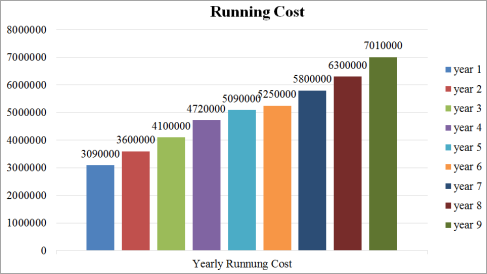
This section presents the purchase price, salvage value and running cost of Toyota Hiance Vehicle of GIGM motors Port Harcourt, for a period of 9 years.
Purchase price (C): N16,000,000
The scrap value (S): N7,500,000 (Assuming the scrap value is constant). Which is the current scrap value for Total Hiance, as given by the operation manager, GIGM Port Harcourt Terminal. The value was assumed constant since the firm did not provide the scrab values for other years.
The Running Cost, as employed in this analysis, is displayed in Table 1 below for the nine-year period (2016–2023). Fuel, driver's compensation, tolls, licenses, and maintenance costs (repairs, replacement of parts, and routine service) are all included in the running costs. Since the company did not provide or grant the researcher access to a comprehensive breakdown of the expenditures, for privacy reasons, the entire operational cost was utilized.
Table 1. The running cost of GIGM motors for a period of 9 years.

Years (n)

1

2

3

4

5

6

7

8

9

Running Cost (in naira) R(n)

3,090,000

3,600,000

4,100,000

4,720,000

5,010,000

5,250,000

5,800,000

6,300,000

7,010,000

Source: GIGM Port Harcourt Terminal Records, 2024.
Figure 1. Bar chart representation of the running cost.
4.2. Analysis of Data
In this section, the analysis of the formation of the Replacement model was carried and the Replacement policy was developed.
Where;
C=purchase price
S= salvage value
R (n)= total Running cost for n period
Depreciation = C-S
Total cost after n years
TC = C-S+R(n)
And the average cost for each nth year is given by
ATC = T(n)/n
Table 2. The Result Output of the formulation of the replacement model.

Years (n) (1)

Running Cost R(n) (2)

Cumulative Running Cost ΣR(n) (3)

Depreciation C-S (4)

Total cost TC=(3)+(4) (5)

Average Total Cost ATC=(5)/n

1

3,090,000

3,090,000

8,500,000

11,590,000

11,590,000

2

3,600,000

6,690,000

8,500,000

15,190,000

7,595,000

3

4,100,000

10,790,000

8,500,000

19,290,000

6,430,000

4

4,720,000

15,510,000

8,500,000

24,010,000

6,002,500

5

5,010,000

20,520,000

8,500,000

29,020,000

5,804,000

6

5,250,000

25,770,000

8,500,000

34,270,000

5,711,667

7

5,800,000

31,570,000

8,500,000

40,070,000

5,724,286

8

6,300,000

37,870,000

8,500,000

46,370,000

5,796,250

9

7,010,000

44,880,000

8,500,000

53,380,000

5,931,111

From table 2 above, it is seen that the average total cost A(n) is minimum at the end of the 6th year and from the next year, that is the 7th year onwards, the value of A(n) increases. Thus, a decision of replacement of the vehicle, would be right to be taken on the 6th year.
5. Summary and Conclusion
5.1. Summary
This study provided a thorough investigation of the formulation, application, and assessment of strategic vehicle replacement plans in the transportation sector on the subject of replacement models in transport companies. The study tackled sustainability issues, improved fleet management, and operational efficiency by highlighting the significance of timely vehicle renewal. The thesis provided a methodical framework for creating and executing a replacement model that is customized to the unique requirements and limitations of transportation firms. This covered the gathering of data and the creation of the model in addition to addressing potential constraints and ethical issues. It was explained how the replacement concept was put into practice utilizing the GIGM transport company.
5.2. Conclusion
To sum up, the thesis on the replacement model in transportation businesses offered a thorough analysis of the industry's strategic approaches to vehicle replacement. The study emphasized how important it is to replace vehicles on schedule in order to maximize fleet management, improve operational effectiveness, and handle sustainability issues. The thesis's conclusions emphasized the variety of elements—such as economic factors, technological developments, legal constraints, and environmental concerns—that affect replacement decisions. In order to achieve sustainable and effective fleet management methods, the thesis thus underlined the significance of evidence-based decision-making, stakeholder engagement, and continual innovation. Transport firms can improve their competitiveness, sustainability, and long-term viability by incorporating economic, operational, and environmental factors.
Abbreviations

GIG

God Is God

d

The Discount Rate or Depreciation Value

C

Purchase Cost of an Item

R

Annual Running Cost

n

Life of the Item in Years

r

Annual Interest Rate

S

Scrap (or Salvage)

R (n)

Total Running Cost for n Period

A(n)

Average Cost for Each nth Year

Pwf

Worth Factor

M(t)

Number of Items Surviving at Time t

M(t-1)

Number of Items That Will Survive at Time (t-1)

N

Total Number of Items Failing in the System

Author Contributions
Nwachukwu Ginikanwa Racheal: Conceptualization, Investigation, Methodology, Writing – original draft
Orumie Ukamaka Cynthia: Conceptualization, Formal Analysis, Funding acquisition, Methodology, Supervision, Writing – review & editing
Conflicts of Interest
The authors declare no conflicts of interest.
References
[1] Offiong A., & Akpan, Whyte. (2013). Development of Vehicle Replacement for a Road Transport Company.
[2] Riechi, Jorge & Mácian, V. & Tormos, B. & Avila, C. (2017). Optimal fleet replacement: A case study on a Spanish urban transport fleet. Journal of the Operational Research Society. 68. 1-9.
[3] Boudart, Jesse & Figliozzi, Miguel. (2012). A Study of the Key Variables Affecting Bus Replacement Age Decisions and 1 Total Costs. Transportation Research Record: Journal of the Transportation Research Board. 2274. 109-113.
[4] Jadi, G. T. and Ojo, O. (2011). An appraisal of property management practice in Metropolitan, Ibadan, Nigeria. The Built and Human Environment Review, 4(1), 167-181.
[5] Ekeocha, R. J. O., Odukwe, A. O., & Aguwambaa, U. J. C. (2011). Machinery replacementproblems model, World Journal of Engineering and Pure and Applied Science, 1(3), 81.
[6] Kparib, D. Y. Suleman S., Eric K. A. (2014) A Bus Replacement Models for the State Transport Company, KUMASI, GHANA International Journal of Innovative and Applied Research, International Journal of Innovative and Applied Research, Volume 2, ISSN 2348 – 0319 Issue (4): 75-87.
[7] Enogwe, Samuel & Oruh, Ben & Ekpenyong, Emmanuel. (2018). A Modified Replacement Model for Items That Fail Suddenly with Variable Replacement Costs. American Journal of Operations Research. 08. 457-473.
[8] Bellman, R. E. (1955). Equipment replacement policy. Journal of the Society for Industrial and Applied Mathematics, 3(3), 133-136.
[9] Besiou, M., Martinez, A. J. P. & Van Wassenhove, L. N. (2012). The effect of earmarked funding on fleet management for relief & development. INSEAD, Working Paper.
[10] Emiliano, William & Alvelos, Filipe & Telhada, José & Lanzer, Edgar. (2020). An optimization model for bus fleet replacement with budgetary and environmental constraints. Transportation Planning and Technology. 43. 1-15.
[11] Mejza, M. C., Barnard, R. E., Corsi, T. M., Keane, T., 2003. Driver management practices of motor carriers with high compliance and safety performance. Transportation Journal (Summer), 16–29.
[12] Odutola, S. O. (1997). The administrative factor in the development of transport in Nigeria, unpublished.
[13] Rashid A. (2011). Dynamic programming based bus replacement policy for Metro-Mass Transit Limited-Kumasi Depot, (M.Sc. Thesis).
[14] Resse, L. P., Clayton, E. R., and Taylor, B. W. Network Simulation Model for Police Patrol Vehicle Maintenance and Replacement Analysis. Computers, Environment and Urban Systems, Vol. 7, No. 3, 1982, pp. 191-196.
Cite This Article
  • APA Style

    Racheal, N. G., Cynthia, O. U. (2024). Applications of Replacement Model Approach in Management of God- Is-Good Transportation Company. Science Journal of Applied Mathematics and Statistics, 12(4), 64-71. https://doi.org/10.11648/j.sjams.20241204.12

    Copy | Download

    ACS Style

    Racheal, N. G.; Cynthia, O. U. Applications of Replacement Model Approach in Management of God- Is-Good Transportation Company. Sci. J. Appl. Math. Stat. 2024, 12(4), 64-71. doi: 10.11648/j.sjams.20241204.12

    Copy | Download

    AMA Style

    Racheal NG, Cynthia OU. Applications of Replacement Model Approach in Management of God- Is-Good Transportation Company. Sci J Appl Math Stat. 2024;12(4):64-71. doi: 10.11648/j.sjams.20241204.12

    Copy | Download

  • @article{10.11648/j.sjams.20241204.12,
      author = {Nwachukwu Ginikanwa Racheal and Orumie Ukamaka Cynthia},
      title = {Applications of Replacement Model Approach in Management of God- Is-Good Transportation Company
    },
      journal = {Science Journal of Applied Mathematics and Statistics},
      volume = {12},
      number = {4},
      pages = {64-71},
      doi = {10.11648/j.sjams.20241204.12},
      url = {https://doi.org/10.11648/j.sjams.20241204.12},
      eprint = {https://article.sciencepublishinggroup.com/pdf/10.11648.j.sjams.20241204.12},
      abstract = {When it comes to replacing the cars in their fleets, transportation companies have a lot of factors to take into account. The age of the cars is one of the most crucial variables because older models typically need more upkeep and repairs, and if possibly replace, which may be expensive both financially and in terms of time. Using God is Good Motors as a case study, the research applied replacement theory in a transportation company to predict when to replace a vehicle using Replacement Policy when Value of Money does not change over time. The study looked at the creation, application, and assessment of a replacement model specifically designed to meet the requirements of God is Good (GIGM) Transport Company, one of Nigeria's top providers of intercity transportation services. The study commenced with an extensive examination of previous research, including current approaches, variables impacting replacement choices, and consequences for both operational and environmental results. On the basis of this framework, a methodical approach is created for creating and executing the replacement model, which includes data gathering, model creation, simulation methods, and validation procedures. The replacement model's practical use within GIGM Transport Company offered insightful information about how to apply abstract ideas to actual situations. The result showed that the average total cost A(n) is minimum at the end of the 6th year and from the next year, that is the 7th year onwards, the value of A(n) increases. Thus, a decision of replacement of the vehicle, would be right to be taken on the 6th year.
    },
     year = {2024}
    }
    

    Copy | Download

  • TY  - JOUR
    T1  - Applications of Replacement Model Approach in Management of God- Is-Good Transportation Company
    
    AU  - Nwachukwu Ginikanwa Racheal
    AU  - Orumie Ukamaka Cynthia
    Y1  - 2024/09/26
    PY  - 2024
    N1  - https://doi.org/10.11648/j.sjams.20241204.12
    DO  - 10.11648/j.sjams.20241204.12
    T2  - Science Journal of Applied Mathematics and Statistics
    JF  - Science Journal of Applied Mathematics and Statistics
    JO  - Science Journal of Applied Mathematics and Statistics
    SP  - 64
    EP  - 71
    PB  - Science Publishing Group
    SN  - 2376-9513
    UR  - https://doi.org/10.11648/j.sjams.20241204.12
    AB  - When it comes to replacing the cars in their fleets, transportation companies have a lot of factors to take into account. The age of the cars is one of the most crucial variables because older models typically need more upkeep and repairs, and if possibly replace, which may be expensive both financially and in terms of time. Using God is Good Motors as a case study, the research applied replacement theory in a transportation company to predict when to replace a vehicle using Replacement Policy when Value of Money does not change over time. The study looked at the creation, application, and assessment of a replacement model specifically designed to meet the requirements of God is Good (GIGM) Transport Company, one of Nigeria's top providers of intercity transportation services. The study commenced with an extensive examination of previous research, including current approaches, variables impacting replacement choices, and consequences for both operational and environmental results. On the basis of this framework, a methodical approach is created for creating and executing the replacement model, which includes data gathering, model creation, simulation methods, and validation procedures. The replacement model's practical use within GIGM Transport Company offered insightful information about how to apply abstract ideas to actual situations. The result showed that the average total cost A(n) is minimum at the end of the 6th year and from the next year, that is the 7th year onwards, the value of A(n) increases. Thus, a decision of replacement of the vehicle, would be right to be taken on the 6th year.
    
    VL  - 12
    IS  - 4
    ER  - 

    Copy | Download

Author Information