Accurate monitoring of electricity consumption is essential for the efficient operation and planning of power distribution systems, particularly in rapidly growing urban areas of developing countries. This article analyzes the evolution of electricity consumption parameters in the city of Mamou (Guinea) over the period 2020-2021, based on annual peak load statistics and energy consumption data for the main lines of the Guinean Electricity Company (EDG) for the years 2020 and 2021. The study aims to characterize consumption trends, load profiles, and factors influencing electricity demand. It analyzes the electricity consumption of the urban municipality of Mamou in order to understand and evaluate the demand for electrical energy in Mamou in order to highlight the capacity of the station in relation to the demand of the municipality in the future. The methodology relies on the statistical analysis of monthly consumption, active and reactive power demand, power factors, and current demand for the various feeders, supplemented by an interannual comparison. The results reveal a noticeable increase in electricity demand, reflecting population growth, urban expansion, and increased socio-economic activities. Seasonal variations in consumption are clearly observed, with higher demand during the dry season due to intensified commercial activities and residential energy use. The results highlight a significant variation in consumption between 2020 and 2021, marked by the impact of the COVID-19 pandemic in 2020 and a gradual resumption of activity in 2021. The analysis of peak demand indicates increasing stress on the existing distribution infrastructure, while power factor trends highlight the persistent presence of reactive power consumption in the network. Furthermore, the load factor values suggest suboptimal utilization of installed capacity, pointing to opportunities for improved demand-side management and reactive power compensation. The findings emphasize the importance of continuous monitoring of consumption parameters to support network optimization, loss reduction, and investment planning. This work provides useful insights for utilities and decision-makers seeking to enhance the reliability and efficiency of electricity supply in Mamou and other medium-sized cities in Guinea with similar characteristics.
This is an Open Access article, distributed under the terms of the Creative Commons Attribution 4.0 International License (http://creativecommons.org/licenses/by/4.0/), which permits unrestricted use, distribution and reproduction in any medium or format, provided the original work is properly cited.
Monitoring of Evolution, Electrical Energy, Production, Consumption, Mamou
1. Introduction
Analyzing electricity consumption is a fundamental tool for planning, operating, and optimizing electricity systems, particularly in developing countries where generation and distribution infrastructure remains limited
[1]
DK Twerefou, KS Iddrisu and EA Twum. Energy Consumption and Economics Growth: Evidence from the West African Sub Region. West African Journal of Applied Ecology, vol. 26(SI), 2018: 217 - 233.
[2]
Modelling and forecasting hourly electricity demand in West African countries. Applied Energy 242: 311-333, 2019.
. Managing energy demand not only improves grid reliability but also guides investment and energy efficiency policies
[11]
Philipp A. Trottera, Marcelle C. McManusa, Roy Maconachie, Electricity planning and implementation in sub-Saharan Africa: A systematic review. Renewable and Sustainable Energy Reviews 74(2017) 1189 -1209.
Maksat Kalimoldayev, Waldemar Wójcik, and Zhazira Shermantayeva, Development Of A Monitoring System For Electric Power Substations Based On Ios And Implementation Of Designs On FPGA. INTL Journal of electronics and Telecommunications, 2023, VOL. 69, NO. 4, PP. 819-824,
. Energy efficiency is the primary driver of electricity consumption, partially offsetting the effects of economic growth, population growth, market share gains, and new uses
[16]
Gabriel Rodrigues Santos, Eduardo Zancul, A framework to assess the impacts of digital electrical substations Smart Energy 12(2023) 100125,
Anderson Silva Ribeiro, Paulo Roberto Duailibe Monteiro and Thiago Trezza Borges. Comparative performance analysis of AIS and GIS substations: A case study.
In Guinea, population growth, progressive urbanization, and the development of economic activities have led to a sustained increase in electricity demand, exacerbating the strain on urban and peri-urban grids
[3]
Abdullahi Muazu, Qian Yu and, Mona Alariqi. The Impact of Renewable Energy Consumption and Economics Growth on Environmental Quality in Africa: A Threshold Regression Analysis. Energies 2023, 16(11), 4533;
N'Famory Camara, Deyi Xu, Emmanuel Binyet. Understanding household energy use, decision making and behavior in Guinea -Conakry by applying behavioral economics. Renewable and Sustainable Energy Reviews. Volume 79, November 2017, Pages 1380-1391.
. Guinea has seen a gradual increase in national electricity consumption in recent years. Total electricity consumption rose from less than 2.1 billion kWh in 2020 to approximately 3.62 billion kWh in 2023, representing continued growth in energy consumption across all sectors (residential, industrial, and commercial) in the country. Secondary cities, such as Mamou, exhibit specific consumption patterns that require in-depth local studies to better understand demand dynamics and the performance of the distribution network
[5]
Benjamin Kolie, Ayman Elshkaki, Geoffrey Sunahara, Mohamed Lamine Diakite, Mamoudou Sangare, Energy and water infrastructure management under energy transition pressure in mineral extraction urban and rural areas: A case study of the Republic of Guinea. The Extractive Industries and Society 17(2024) 101433.
Ansoumane Sakouvogui, Jean Ouere Toupouvogui, Saidou Barry, Elhadj Ousmane Camara. Study of the Management of the Electrical Energy Production and Distribution System Within the National School of Teachers of Mamou, Guinea Science Journal of Energy Engineering 2024, Vol. 12, No. 3, p. 32-36.
Furthermore, the period from 2020 to 2021 was marked by the COVID-19 pandemic, which had a significant impact on electricity consumption patterns worldwide
[4]
N'Famory Camara, Deyi Xu, Emmanuel Binyet. Understanding household energy use, decision making and behavior in Guinea -Conakry by applying behavioral economics. Renewable and Sustainable Energy Reviews. Volume 79, November 2017, Pages 1380-1391.
. Health measures and economic disruptions altered load profiles, particularly in the residential and commercial sectors, making a comparative analysis of this period relevant
[6]
Geoffrey Mutumba, Geoffrey Mubiinzi, David Amwonya. Electricity consumption and economic growth: Evidence from the East African community. June 2024 Energy Strategy Reviews 51(7): 101431.
George Karagiannakis, Mathaios Panteli, Sotirios Argyroudis. Fragility Modeling of Power Grid Infrastructure for Addressing Climate Change Risks and Adaptation. Wiley Interdisciplinary Reviews: Climate Change, 2024; 0: e 930.
In this context, monitoring and analyzing the evolution of electricity consumption parameters in Mamou appears essential to better understand demand dynamics, identify factors influencing consumption, and assess the performance of the distribution network. This article proposes a quantitative analysis of the evolution of the main electricity consumption parameters in the city of Mamou between 2020 and 2021
[9]
Jean Ouere Toupouvogui, Mohamed Ansoumane Camara, Ansoumane Sakouvogui, Mamby Keita, Optimal Sizing of Capacitor Bank for Increasing Substation Capacity of Mamou, World Journal of Engineering and Technology, ISSN: 2331-4249, N 11, pp. 117-133, (2023),
. The study relies on distribution data and annual peak load statistics, as well as energy consumption data from the main lines of Electricité de Guinée (EDG), to characterize consumption trends, assess the performance of the local electricity network, and provide decision-making support for demand management and energy planning
[9]
Jean Ouere Toupouvogui, Mohamed Ansoumane Camara, Ansoumane Sakouvogui, Mamby Keita, Optimal Sizing of Capacitor Bank for Increasing Substation Capacity of Mamou, World Journal of Engineering and Technology, ISSN: 2331-4249, N 11, pp. 117-133, (2023),
The town Mamou, capital of the administrative region of Mamou, is located between 9°54' and 11°10' north latitude and 11°25' and 12°26' west longitude, with an average altitude of 700 m. According to the latest population and housing censuses, it covers an area of 8,000 km² with a population of 318,981 inhabitants, or an average density of 30 inhabitants per km²
[14]
Mhamed Darwish, Gareth Taylor and Ioana Pisica, Control Configurations for Reactive Power Compensation t the Secondary Side of the Low Voltage Substation by sing HybridTransformer. Energies 2021, 14(3), 620;
. It is bounded to the north by the Prefectures of Dalaba and Tougue; to the south by the Republic of Sierra Leone; to the East by the Prefectures of Dabola and Faranah; to the West by the Prefecture of Kindia. Its climate is characterized by two (2) seasons of equal duration: a dry season from November to April and a rainy season from May to October. The rainy season is dominated by short, infrequent showers and violent winds which cause power outages. The population is essentially rural; 79% of the population of Mamou lives in rural areas. Its population density is 30 inhabitants/km² and its climate is tropical
[9]
Jean Ouere Toupouvogui, Mohamed Ansoumane Camara, Ansoumane Sakouvogui, Mamby Keita, Optimal Sizing of Capacitor Bank for Increasing Substation Capacity of Mamou, World Journal of Engineering and Technology, ISSN: 2331-4249, N 11, pp. 117-133, (2023),
Kishan Prudhvi Guddanti, Lin Chen, YangWeng & Yang Yu. Vulnerability of power distribution networks to local temperature changes induced by global climate change. Nature Communications (2025) 16: 5116.
Mamou is located 266 km from Conakry. It is bordered to the north by Boulliwel and Tolo, to the northeast by Dounet, to the southeast by Soyah, and to the west by Konkoure. Mamou, a town located in the heart of Guinea on the Conakry-Kindia-Kankan-Faranah-Labe road, is known as a crossroads town, reflecting the ethnic diversity of Guinea
[8]
Ansoumane Sakouvogui, Jean Ouere Toupouvogui, Saidou Barry, Elhadj Ousmane Camara. Study of the Management of the Electrical Energy Production and Distribution System Within the National School of Teachers of Mamou, Guinea Science Journal of Energy Engineering 2024, Vol. 12, No. 3, p. 32-36.
Jean Ouere Toupouvogui, Mohamed Ansoumane Camara, Ansoumane Sakouvogui, Mamby Keita, Optimal Sizing of Capacitor Bank for Increasing Substation Capacity of Mamou, World Journal of Engineering and Technology, ISSN: 2331-4249, N 11, pp. 117-133, (2023),
. The highest temperatures are observed in March-April (37 and 38°C), while the lowest are recorded in December (11°C)
[9]
Jean Ouere Toupouvogui, Mohamed Ansoumane Camara, Ansoumane Sakouvogui, Mamby Keita, Optimal Sizing of Capacitor Bank for Increasing Substation Capacity of Mamou, World Journal of Engineering and Technology, ISSN: 2331-4249, N 11, pp. 117-133, (2023),
Kishan Prudhvi Guddanti, Lin Chen, YangWeng & Yang Yu. Vulnerability of power distribution networks to local temperature changes induced by global climate change. Nature Communications (2025) 16: 5116.
As part of this work we used Spyder software, a database of peak load statistics for the Mamou substation for the years 2020 and 2021, and the electrical power production of the Electricity of Guinea power plants for the years 2020 and 2021.
2.3. Methodology
The methodology is based on the statistical analysis of monthly consumption, active and reactive power demand, power factors, and current demand from the various feeders of the Mamou electrical substation (110kV/30kV, 15MVA)
[13]
Leonard L. Grigsby, The Electric Power Engineering Handbook, Electric Power Substations Engineering, Third Edition. Visit the Taylor & Francis, 2012, 524 p. Web site at
Mhamed Darwish, Gareth Taylor and Ioana Pisica, Control Configurations for Reactive Power Compensation t the Secondary Side of the Low Voltage Substation by sing HybridTransformer. Energies 2021, 14(3), 620;
. For data collection (energy consumption), electrical parameters are recorded hourly on measuring devices
[18]
Nelson Vera, Pedro Farinango, Rebeca Estrada, Energy Consumption Monitoring and Prediction System for IT Equipment. The 14th International Conference on Sustainable Energy Information Technology (SEIT) August 5-7, 2024, Marshall University, Huntington, WV, USA. Procedia Computer Science 241(2024) 272-279.
[18]
. We obtained the peak load statistics for the Mamou substation, from the annual peak load statistics of Electricity of Guinea (EDG). From this data obtained, we determined the total energy consumption for the urban commune of Mamou.
3. Results and Discussion
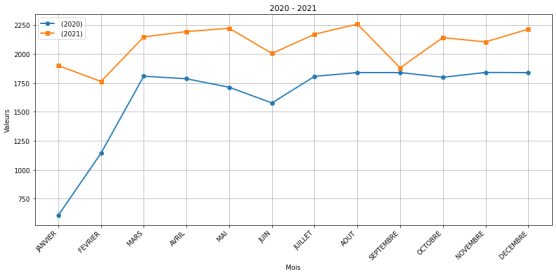
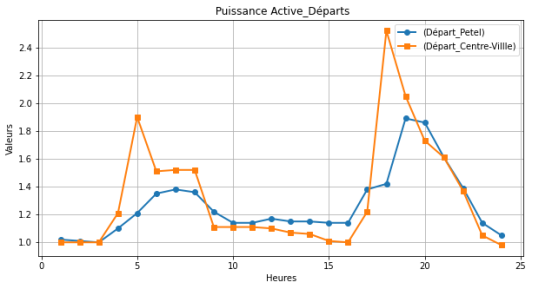
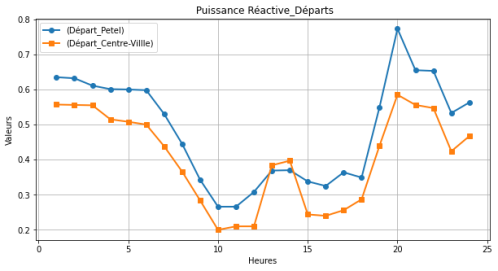
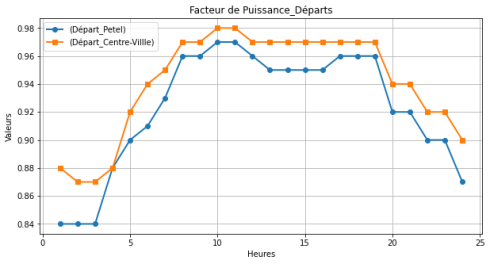
This study shows that in 2020 and 2021 the electricity consumption of Mamou evolved in accordance with the graph in Figures 1, 2, 3 and 4.
3.1. Evolution of Electricity Consumption in Mamou in 2020 and 2021
Figure 1. Electricity consumption of Mamou in 2020 and 2021.
This trend over these different years shows a fluctuation in electricity consumption in the urban commune of Mamou. A decrease in electricity consumption is observed from March until the end of May; this is due to a decrease in electricity production by hydroelectric power plants caused by the drop in water levels in these hydroelectric dams.
3.2. Evolution of Mamou's Energy Parameters
3.2.1. Active Power
The active power of the different feeders supplying the municipality of Mamou is shown in Figure 2.
Figure 3. Reactive power of the different circuits in the municipality of Mamou.
Figures 2 and 3 show that a peak load in the commune of Mamou, around 7 p.m.-8 p.m. due to the massive use of electrical energy in households.
There is a significant variation in reactive power demand across the different circuits of the substation. This leads us to recommend the use of compensated fluorescent lamps and appliances with a good power factor.
3.2.3. Power Factor
To get an overview of the voltage profile of the Mamou power supply network, the power factor of the different feeders is shown in Figure 4.
Figure 4. Variation in the power factor of the different feeders in the municipality of Mamou.
Figure show a poor power factor during nighttime hours, this is due to the use for lighting of fluorescent lamps which have a poor power factor (0.48), uncompensated discharge lamps (0.4 to 0.6); the use of induction furnaces with integrated compensation (0.85), resistance welding machines (0.3 to 0.8), single-phase static arc welding stations (0.5).
3.2.4. Currents from the Different Departures of Mamou
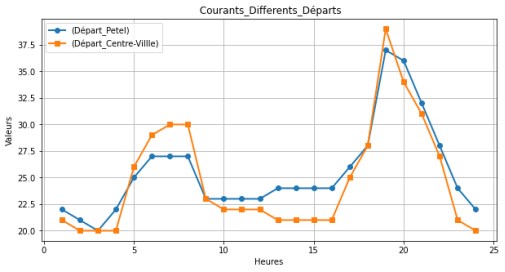
The load curve of the different outlets is shown in Figure 5.
Figure 5. Currents from the different outlets of Mamou.
This figure shows a peak load on the various circuits starting at 5 p.m. The maximum load is observed around 7-8 p.m., due to the massive use of household appliances for cooking, lighting, air conditioning, and other activities
[15]
Diogo Gonzaga Marcelo, Clailton Leopoldo da Silva, Rafael Martins, Júlio Cezar Oliveira Castioni, Germano Lambert-Torres, Ronny Francis Ribeiro Junior, Mateus Mendes Campos, Isac Antônio dos Santos Areias, Frederico de Oliveira Assunção, Luiz Eduardo Borges da Silva. Traveling Wave-Based Fault Location for Gas Insulated Substations. Brazilian Archives of Biology and Technology. Flight. 67: e24230514, 2024.
. We observe an increase in consumption of approximately 98% during these peak hours.
4. Conclusion
This study analyzed the evolution of key electricity consumption parameters in the city of Mamou between 2020 and 2021, using available production and distribution data. The results highlight significant variations in electricity consumption between the two years, heavily influenced by socio-economic disruptions. The residential sector remains predominant, with load profiles characterized by nighttime peaks, reflecting primarily domestic use.
This study has provided an overview of the evolution of energy consumption in Mamou, both present and future, and has proposed solutions applicable to real-life situations such as: planning the maintenance of electrical systems with minimal impact on consumers; and determining the size of electrical equipment that can support this consumption without risk of overloading the electrical network in Mamou.
Peak-hour electricity demand is approximately 95% of off-peak demand. Analyzing per capita electricity consumption, we observed a positive correlation between income level and electricity consumption.
Energy efficiency should be the primary determinant of long-term electricity consumption, partially offsetting the effects of economic growth, demographics, as well as market share gains and new uses.
Looking ahead, future work could incorporate longer data series, more detailed sectoral analysis and the evaluation of optimization solutions such as improved metering, strengthening of distribution infrastructure and integration of decentralized renewable energy sources, in order to contribute to more efficient and sustainable energy planning for the city of Mamou.
Abbreviations
EDG
Electricity of Guinea
Conflicts of Interest
The authors declare no conflicts of interest.
References
[1]
DK Twerefou, KS Iddrisu and EA Twum. Energy Consumption and Economics Growth: Evidence from the West African Sub Region. West African Journal of Applied Ecology, vol. 26(SI), 2018: 217 - 233.
[2]
Modelling and forecasting hourly electricity demand in West African countries. Applied Energy 242: 311-333, 2019.
Abdullahi Muazu, Qian Yu and, Mona Alariqi. The Impact of Renewable Energy Consumption and Economics Growth on Environmental Quality in Africa: A Threshold Regression Analysis. Energies 2023, 16(11), 4533;
N'Famory Camara, Deyi Xu, Emmanuel Binyet. Understanding household energy use, decision making and behavior in Guinea -Conakry by applying behavioral economics. Renewable and Sustainable Energy Reviews. Volume 79, November 2017, Pages 1380-1391.
Benjamin Kolie, Ayman Elshkaki, Geoffrey Sunahara, Mohamed Lamine Diakite, Mamoudou Sangare, Energy and water infrastructure management under energy transition pressure in mineral extraction urban and rural areas: A case study of the Republic of Guinea. The Extractive Industries and Society 17(2024) 101433.
Geoffrey Mutumba, Geoffrey Mubiinzi, David Amwonya. Electricity consumption and economic growth: Evidence from the East African community. June 2024 Energy Strategy Reviews 51(7): 101431.
George Karagiannakis, Mathaios Panteli, Sotirios Argyroudis. Fragility Modeling of Power Grid Infrastructure for Addressing Climate Change Risks and Adaptation. Wiley Interdisciplinary Reviews: Climate Change, 2024; 0: e 930.
Ansoumane Sakouvogui, Jean Ouere Toupouvogui, Saidou Barry, Elhadj Ousmane Camara. Study of the Management of the Electrical Energy Production and Distribution System Within the National School of Teachers of Mamou, Guinea Science Journal of Energy Engineering 2024, Vol. 12, No. 3, p. 32-36.
Jean Ouere Toupouvogui, Mohamed Ansoumane Camara, Ansoumane Sakouvogui, Mamby Keita, Optimal Sizing of Capacitor Bank for Increasing Substation Capacity of Mamou, World Journal of Engineering and Technology, ISSN: 2331-4249, N 11, pp. 117-133, (2023),
Kishan Prudhvi Guddanti, Lin Chen, YangWeng & Yang Yu. Vulnerability of power distribution networks to local temperature changes induced by global climate change. Nature Communications (2025) 16: 5116.
Philipp A. Trottera, Marcelle C. McManusa, Roy Maconachie, Electricity planning and implementation in sub-Saharan Africa: A systematic review. Renewable and Sustainable Energy Reviews 74(2017) 1189 -1209.
Maksat Kalimoldayev, Waldemar Wójcik, and Zhazira Shermantayeva, Development Of A Monitoring System For Electric Power Substations Based On Ios And Implementation Of Designs On FPGA. INTL Journal of electronics and Telecommunications, 2023, VOL. 69, NO. 4, PP. 819-824,
Leonard L. Grigsby, The Electric Power Engineering Handbook, Electric Power Substations Engineering, Third Edition. Visit the Taylor & Francis, 2012, 524 p. Web site at
Mhamed Darwish, Gareth Taylor and Ioana Pisica, Control Configurations for Reactive Power Compensation t the Secondary Side of the Low Voltage Substation by sing HybridTransformer. Energies 2021, 14(3), 620;
Diogo Gonzaga Marcelo, Clailton Leopoldo da Silva, Rafael Martins, Júlio Cezar Oliveira Castioni, Germano Lambert-Torres, Ronny Francis Ribeiro Junior, Mateus Mendes Campos, Isac Antônio dos Santos Areias, Frederico de Oliveira Assunção, Luiz Eduardo Borges da Silva. Traveling Wave-Based Fault Location for Gas Insulated Substations. Brazilian Archives of Biology and Technology. Flight. 67: e24230514, 2024.
Anderson Silva Ribeiro, Paulo Roberto Duailibe Monteiro and Thiago Trezza Borges. Comparative performance analysis of AIS and GIS substations: A case study.
Nelson Vera, Pedro Farinango, Rebeca Estrada, Energy Consumption Monitoring and Prediction System for IT Equipment. The 14th International Conference on Sustainable Energy Information Technology (SEIT) August 5-7, 2024, Marshall University, Huntington, WV, USA. Procedia Computer Science 241(2024) 272-279.
Toupouvogui, J. O., Sakouvogui, A., Camara, M. A., Faye, R. M. (2026). Monitoring the Evolution of Electricity Consumption Parameters in Mamou, Guinea, from 2020 to 2021. Science Journal of Energy Engineering, 14(1), 1-6. https://doi.org/10.11648/j.sjee.20261401.11
Toupouvogui, J. O.; Sakouvogui, A.; Camara, M. A.; Faye, R. M. Monitoring the Evolution of Electricity Consumption Parameters in Mamou, Guinea, from 2020 to 2021. Sci. J. Energy Eng.2026, 14(1), 1-6. doi: 10.11648/j.sjee.20261401.11
Toupouvogui JO, Sakouvogui A, Camara MA, Faye RM. Monitoring the Evolution of Electricity Consumption Parameters in Mamou, Guinea, from 2020 to 2021. Sci J Energy Eng. 2026;14(1):1-6. doi: 10.11648/j.sjee.20261401.11
@article{10.11648/j.sjee.20261401.11,
  author = {Jean Ouere Toupouvogui and Ansoumane Sakouvogui and Mohamed Ansoumane Camara and Roger Marcelin Faye},
  title = {Monitoring the Evolution of Electricity Consumption Parameters in Mamou, Guinea, from 2020 to 2021},
  journal = {Science Journal of Energy Engineering},
  volume = {14},
  number = {1},
  pages = {1-6},
  doi = {10.11648/j.sjee.20261401.11},
  url = {https://doi.org/10.11648/j.sjee.20261401.11},
  eprint = {https://article.sciencepublishinggroup.com/pdf/10.11648.j.sjee.20261401.11},
  abstract = {Accurate monitoring of electricity consumption is essential for the efficient operation and planning of power distribution systems, particularly in rapidly growing urban areas of developing countries. This article analyzes the evolution of electricity consumption parameters in the city of Mamou (Guinea) over the period 2020-2021, based on annual peak load statistics and energy consumption data for the main lines of the Guinean Electricity Company (EDG) for the years 2020 and 2021. The study aims to characterize consumption trends, load profiles, and factors influencing electricity demand. It analyzes the electricity consumption of the urban municipality of Mamou in order to understand and evaluate the demand for electrical energy in Mamou in order to highlight the capacity of the station in relation to the demand of the municipality in the future. The methodology relies on the statistical analysis of monthly consumption, active and reactive power demand, power factors, and current demand for the various feeders, supplemented by an interannual comparison. The results reveal a noticeable increase in electricity demand, reflecting population growth, urban expansion, and increased socio-economic activities. Seasonal variations in consumption are clearly observed, with higher demand during the dry season due to intensified commercial activities and residential energy use. The results highlight a significant variation in consumption between 2020 and 2021, marked by the impact of the COVID-19 pandemic in 2020 and a gradual resumption of activity in 2021. The analysis of peak demand indicates increasing stress on the existing distribution infrastructure, while power factor trends highlight the persistent presence of reactive power consumption in the network. Furthermore, the load factor values suggest suboptimal utilization of installed capacity, pointing to opportunities for improved demand-side management and reactive power compensation. The findings emphasize the importance of continuous monitoring of consumption parameters to support network optimization, loss reduction, and investment planning. This work provides useful insights for utilities and decision-makers seeking to enhance the reliability and efficiency of electricity supply in Mamou and other medium-sized cities in Guinea with similar characteristics.},
 year = {2026}
}
TY  - JOUR
T1  - Monitoring the Evolution of Electricity Consumption Parameters in Mamou, Guinea, from 2020 to 2021
AU  - Jean Ouere Toupouvogui
AU  - Ansoumane Sakouvogui
AU  - Mohamed Ansoumane Camara
AU  - Roger Marcelin Faye
Y1  - 2026/01/30
PY  - 2026
N1  - https://doi.org/10.11648/j.sjee.20261401.11
DO  - 10.11648/j.sjee.20261401.11
T2  - Science Journal of Energy Engineering
JF  - Science Journal of Energy Engineering
JO  - Science Journal of Energy Engineering
SP  - 1
EP  - 6
PB  - Science Publishing Group
SN  - 2376-8126
UR  - https://doi.org/10.11648/j.sjee.20261401.11
AB  - Accurate monitoring of electricity consumption is essential for the efficient operation and planning of power distribution systems, particularly in rapidly growing urban areas of developing countries. This article analyzes the evolution of electricity consumption parameters in the city of Mamou (Guinea) over the period 2020-2021, based on annual peak load statistics and energy consumption data for the main lines of the Guinean Electricity Company (EDG) for the years 2020 and 2021. The study aims to characterize consumption trends, load profiles, and factors influencing electricity demand. It analyzes the electricity consumption of the urban municipality of Mamou in order to understand and evaluate the demand for electrical energy in Mamou in order to highlight the capacity of the station in relation to the demand of the municipality in the future. The methodology relies on the statistical analysis of monthly consumption, active and reactive power demand, power factors, and current demand for the various feeders, supplemented by an interannual comparison. The results reveal a noticeable increase in electricity demand, reflecting population growth, urban expansion, and increased socio-economic activities. Seasonal variations in consumption are clearly observed, with higher demand during the dry season due to intensified commercial activities and residential energy use. The results highlight a significant variation in consumption between 2020 and 2021, marked by the impact of the COVID-19 pandemic in 2020 and a gradual resumption of activity in 2021. The analysis of peak demand indicates increasing stress on the existing distribution infrastructure, while power factor trends highlight the persistent presence of reactive power consumption in the network. Furthermore, the load factor values suggest suboptimal utilization of installed capacity, pointing to opportunities for improved demand-side management and reactive power compensation. The findings emphasize the importance of continuous monitoring of consumption parameters to support network optimization, loss reduction, and investment planning. This work provides useful insights for utilities and decision-makers seeking to enhance the reliability and efficiency of electricity supply in Mamou and other medium-sized cities in Guinea with similar characteristics.
VL  - 14
IS  - 1
ER  -
Toupouvogui, J. O., Sakouvogui, A., Camara, M. A., Faye, R. M. (2026). Monitoring the Evolution of Electricity Consumption Parameters in Mamou, Guinea, from 2020 to 2021. Science Journal of Energy Engineering, 14(1), 1-6. https://doi.org/10.11648/j.sjee.20261401.11
Toupouvogui, J. O.; Sakouvogui, A.; Camara, M. A.; Faye, R. M. Monitoring the Evolution of Electricity Consumption Parameters in Mamou, Guinea, from 2020 to 2021. Sci. J. Energy Eng.2026, 14(1), 1-6. doi: 10.11648/j.sjee.20261401.11
Toupouvogui JO, Sakouvogui A, Camara MA, Faye RM. Monitoring the Evolution of Electricity Consumption Parameters in Mamou, Guinea, from 2020 to 2021. Sci J Energy Eng. 2026;14(1):1-6. doi: 10.11648/j.sjee.20261401.11
@article{10.11648/j.sjee.20261401.11,
  author = {Jean Ouere Toupouvogui and Ansoumane Sakouvogui and Mohamed Ansoumane Camara and Roger Marcelin Faye},
  title = {Monitoring the Evolution of Electricity Consumption Parameters in Mamou, Guinea, from 2020 to 2021},
  journal = {Science Journal of Energy Engineering},
  volume = {14},
  number = {1},
  pages = {1-6},
  doi = {10.11648/j.sjee.20261401.11},
  url = {https://doi.org/10.11648/j.sjee.20261401.11},
  eprint = {https://article.sciencepublishinggroup.com/pdf/10.11648.j.sjee.20261401.11},
  abstract = {Accurate monitoring of electricity consumption is essential for the efficient operation and planning of power distribution systems, particularly in rapidly growing urban areas of developing countries. This article analyzes the evolution of electricity consumption parameters in the city of Mamou (Guinea) over the period 2020-2021, based on annual peak load statistics and energy consumption data for the main lines of the Guinean Electricity Company (EDG) for the years 2020 and 2021. The study aims to characterize consumption trends, load profiles, and factors influencing electricity demand. It analyzes the electricity consumption of the urban municipality of Mamou in order to understand and evaluate the demand for electrical energy in Mamou in order to highlight the capacity of the station in relation to the demand of the municipality in the future. The methodology relies on the statistical analysis of monthly consumption, active and reactive power demand, power factors, and current demand for the various feeders, supplemented by an interannual comparison. The results reveal a noticeable increase in electricity demand, reflecting population growth, urban expansion, and increased socio-economic activities. Seasonal variations in consumption are clearly observed, with higher demand during the dry season due to intensified commercial activities and residential energy use. The results highlight a significant variation in consumption between 2020 and 2021, marked by the impact of the COVID-19 pandemic in 2020 and a gradual resumption of activity in 2021. The analysis of peak demand indicates increasing stress on the existing distribution infrastructure, while power factor trends highlight the persistent presence of reactive power consumption in the network. Furthermore, the load factor values suggest suboptimal utilization of installed capacity, pointing to opportunities for improved demand-side management and reactive power compensation. The findings emphasize the importance of continuous monitoring of consumption parameters to support network optimization, loss reduction, and investment planning. This work provides useful insights for utilities and decision-makers seeking to enhance the reliability and efficiency of electricity supply in Mamou and other medium-sized cities in Guinea with similar characteristics.},
 year = {2026}
}
TY  - JOUR
T1  - Monitoring the Evolution of Electricity Consumption Parameters in Mamou, Guinea, from 2020 to 2021
AU  - Jean Ouere Toupouvogui
AU  - Ansoumane Sakouvogui
AU  - Mohamed Ansoumane Camara
AU  - Roger Marcelin Faye
Y1  - 2026/01/30
PY  - 2026
N1  - https://doi.org/10.11648/j.sjee.20261401.11
DO  - 10.11648/j.sjee.20261401.11
T2  - Science Journal of Energy Engineering
JF  - Science Journal of Energy Engineering
JO  - Science Journal of Energy Engineering
SP  - 1
EP  - 6
PB  - Science Publishing Group
SN  - 2376-8126
UR  - https://doi.org/10.11648/j.sjee.20261401.11
AB  - Accurate monitoring of electricity consumption is essential for the efficient operation and planning of power distribution systems, particularly in rapidly growing urban areas of developing countries. This article analyzes the evolution of electricity consumption parameters in the city of Mamou (Guinea) over the period 2020-2021, based on annual peak load statistics and energy consumption data for the main lines of the Guinean Electricity Company (EDG) for the years 2020 and 2021. The study aims to characterize consumption trends, load profiles, and factors influencing electricity demand. It analyzes the electricity consumption of the urban municipality of Mamou in order to understand and evaluate the demand for electrical energy in Mamou in order to highlight the capacity of the station in relation to the demand of the municipality in the future. The methodology relies on the statistical analysis of monthly consumption, active and reactive power demand, power factors, and current demand for the various feeders, supplemented by an interannual comparison. The results reveal a noticeable increase in electricity demand, reflecting population growth, urban expansion, and increased socio-economic activities. Seasonal variations in consumption are clearly observed, with higher demand during the dry season due to intensified commercial activities and residential energy use. The results highlight a significant variation in consumption between 2020 and 2021, marked by the impact of the COVID-19 pandemic in 2020 and a gradual resumption of activity in 2021. The analysis of peak demand indicates increasing stress on the existing distribution infrastructure, while power factor trends highlight the persistent presence of reactive power consumption in the network. Furthermore, the load factor values suggest suboptimal utilization of installed capacity, pointing to opportunities for improved demand-side management and reactive power compensation. The findings emphasize the importance of continuous monitoring of consumption parameters to support network optimization, loss reduction, and investment planning. This work provides useful insights for utilities and decision-makers seeking to enhance the reliability and efficiency of electricity supply in Mamou and other medium-sized cities in Guinea with similar characteristics.
VL  - 14
IS  - 1
ER  -





 Share This Article
 Twitter
 Linked In
 Facebook
 Copy
Copy Download