
Solar energy is currently one of the most promising sources for meeting global energy needs. Hot water production using solar water heaters represents one of the most promising applications of solar energy for countries like Burkina Faso. However, the efficiency of solar system performance indicators remains a challenge, especially during periods of low sunlight. Our work focuses on a numerical study of a flat-plate solar collector designed and tested at the Higher Teacher Training College (ENS) in Burkina Faso, at the Ouagadougou annex site. The objective of our work is to numerically optimize performance indicators such as efficiency and fluid temperature across several key solar collector parameters in order to improve the quality of the solar system applied to domestic hot water production. In this regard, the numerical results obtained indicate that an optimal efficiency value is achieved when the air gap is between 2 cm and 4 cm. Furthermore, a fiberglass insulation thickness of 8 to 15 cm at the rear is sufficient for optimal instantaneous output and maximum water temperature from the collector. Regarding the glass pane, we determined that 4 cm is the optimal value for performance. Additionally, a 1 cm gap between the tubes is necessary to optimize the performance indicators of our solar collector.
| Published in | Science Journal of Energy Engineering (Volume 14, Issue 1) |
| DOI | 10.11648/j.sjee.20261401.13 |
| Page(s) | 21-31 |
| Creative Commons |
This is an Open Access article, distributed under the terms of the Creative Commons Attribution 4.0 International License (http://creativecommons.org/licenses/by/4.0/), which permits unrestricted use, distribution and reproduction in any medium or format, provided the original work is properly cited. |
| Copyright |
Copyright © The Author(s), 2026. Published by Science Publishing Group |
Thermal, Water Heater, Solar Collector, Optimization
Collector | Galvanized steel |
|---|---|
Glazing Clear glass | ransmissibility: = 83% |
Reflexibility: 8% | |
Absorptivity: =9% | |
Tilt angle | 15° |
Collector dimensions | Length: L=2 m |
Width: l=1 m | |
Gross surface area: S=2 m² | |
Pipe dimensions | Length: Lt=1.80 m |
Diameter DH: 15 mm | |
Diameter: dt=21 mm | |
Number: 12 | |
Maximum operating temperature | Tmax=95°C |
materials | Density (kg m-3) | Thickness (mm) | Thermal capacity (J kg-1 K-1) |
|---|---|---|---|
water | 1000 | - | 4180 |
Glass | 2530 | 5 | 840 |
Absorbent plate | 7800 | 1.5 | 470 |
Tube | 7800 | 2 | 470 |
Internal insulation | 40 | 30 | 840 |
Air | 1.2 | 40 | 1006 |
Glass | Absorbent plate | tube | Glass Wool | Heat transfer fluid | air | |
|---|---|---|---|---|---|---|
Viscosity dynamique (Pa·s) | - | - | - | 1,00·10-3 | 1,81·10-5 | |
absorptivity | 0.02 | 0.95 | 0.95 | - | - | |
conductivity (W m-1 K-1) | 0.78 | 50 | 46.7 | 0.041 | 0.6 | 0.023 |
Emisivity | 0.89 | 0.16 | 0.04 | 0.85 | - | - |
ENS | Ecole Normale Superieur |
| Convection Coefficient and the Tube |
| Between the Tube and the Heat Transfer Fluid |
| Between the External Insulation and the Ambient Air |
| Distance Between the Glass and the Absorber [m] |
| Thermal Conductivity of Air [W.m-1.K-1] |
| Average Nusselt Number |
| Grashoff Dimensionless Number |
| Kinematic Viscosity of Confined Air [m2.s-1] |
g | Acceleration Due to Gravity [m.s-2] |
| The Difference Between the Respective Temperatures of the Upper Surface of the Absorber and the Inner Surface of the Glass [K]. |
| Ambient Temperature [K] |
| Reynolds Numbe |
| Prandtl Numbe |
| Thickness of the Insulation [m] |
| Thermal Conductivity of the Insulation [W.m-2.K-1] |
| Thickness of the Glass [m] |
| Thermal Conductivity of the Glass [W.m-1.K-1] |
| Power Absorbed by the Tube |
| Power Absorbed by the Absorber |
| Surface Area of the Tubes |
| Mass of the Absorber |
| Solar Radiation (W/m²) |
| Optical Factors (%) |
| Thermal Transmission Coefficient (W /m².K) |
| Average Temperature of the Collector (K) |
| Ambient Temperature (K) |
| Sensor Inlet Temperature (K) |
| Sensor Outlet Temperature (k) |
| Absorber Absorption Rate (%) |
| Glazing Transmission Rate (%) |
| External Glass Temperature (°C) |
| Internal Glass Temperature (°C) |
| Ube Temperature (°C) |
| Absorber Temperature (°C) |
| Temperature of Water Entering the Sensor (°C) |
| Temperature of Water Leaving the Sensor (°C) |
| Cold Water Temperaturee(°C) |
| Volume Representing Requirements in L/j |
| Power Representing Requirements in kwh/day |
| Hot Water Temperature(°C) |
| Insulation Temperature(°C) |
| [1] | Maxime PERIER-MUZET, Muriel ALAPHILIPPE, et Pascal STOUFFS, Numerical study of heat transfer in mixed convection for an air/solar heat exchanger, Exp. Therm. Fluid Sci., vol. 34, p.) 900-905, 2010, |
| [2] | omar ketfi von, The flat plate thermal solar collector. 2015. [En ligne]. Disponible sur: |
| [3] | M. BOURAGBI Lakhdarn, «DESIGN AND PERFORMANCE OPTIMIZATION OF A FLAT-PLAN SOLAR COLLECTOR». BADJI-MOKHTAR-ANNABA UNIVERSITY UNIVERSITE BADJI-MOKHTAR-ANNABA, 27 mars 2024. [En ligne]. Disponible sur: t: |
| [4] | Boureima Kaboré, Germain Wende Pouiré Ouedraogo, Boukaré Ouedraogo, et Sié Kam, «Simulation and Experimentation of Water Heating in a Metal Tube Placed in a Solar Collector», Elixir Therm. Engg 165 2022 56213-5621, mai 2022, [En ligne]. Disponible sur: |
| [5] | Y. KANOUTÉ, I. Traore, S. Sanogo, E. Aroudam, et A. BA, «Optimization of the efficiency and temperature of a flat-plate water solar collector by simulation», J. Phys. SOAPHYS, vol. 2, p. C20A03-1, févr. 2021, |
| [6] | Y. Tiana, C. Y. Zhao, «Areviewofsolarcollectors andthermalenergystorageinsolarthermal applications», Appl. Energy, 2013, |
| [7] | Ayompe, L. M. et Duffy, A, in) Analysis of the Thermal Performance of a Solar Water Heating System with Flat Plate Collectors in a Temperate Climate. Applied Thermal Engineering, 58, 447-454., 2013. [En ligne]. Disponible sur: Thermal Performance of a Solar Water Heating System with Flat Plate Collectors in a Temperate Climate. Applie |
| [8] | John A. Duffie (Deceased) et William A. Beckman, Solar Engineering of Thermal Processes. 2013. |
| [9] | Ahmadi, P., Rosen, M. A., & Dincer, I, « Experimental and numerical analysis of flat-plate solar collectors. », Sol. Energy, vol. 201, no 572–584., 2020. |
| [10] | Mekhilef, S., Saidur, R, et Safari, A, «A review on solar energy use in industries», 2018. |
| [11] | Sharma, A., Pandey, A. K., & Kumar, A., « Advances in thermal energy storage for solar applications », J. Energy Storage, vol. 40, no 102713, 2021. |
| [12] | Al-Shetwi, A. Q, «Performance analysis of integrated solar water heating system with innovative insulation design», 2018. |
| [13] | S. Kalogirou, Solar energy engineering: processes and systems. Burlington, MA: Elsevier/Academic Press, 2009. |
| [14] | Jie Deng a b, Yupeng Xu a, et, Xudong Yang, «A dynamic thermal performance model for flat-plate solar collectors based on thermal inertia correction of the steady-state test method», vol. 76, p. 679-686, 2015, |
| [15] | Huseyin Gunerhan et Arif Hepbasli, «Exergetic modeling and performance evaluation of solar water heating systems for building applications», vol. 39, p. 509-516, 2022, |
| [16] | Markku Järvelä, Kari Lappalainen, et Seppo Valkealahti, «Characteristics of the cloud enhancement phenomenon and PV power plants», Sol. Energy, vol. 196, no 137-145, 2020, |
| [17] | Cenker Aktemur et Musa Faruk Çakır, «Optimizing thermal insulation thickness based on wall orientation and solar radiation using the heating degree method», Case Stud. Therm. Eng. J. Homepage Wwwelseviercomlocatecsite, vol. 60, 2024, |
| [18] | Kalogirou, S. A, «Solar Energy Engineering: Processes and Systems», Academic Press, 2014. |
APA Style
Batiana, A. L., Tiendrebeogo, S. E., Tubreoumya, G. C., Sawadogo, E. S., Sara, B. (2026). Theoretical Optimization of Performance Indicators for the Flat-plate Solar Collector of a Thermosiphon Solar Water Heater. Science Journal of Energy Engineering, 14(1), 21-31. https://doi.org/10.11648/j.sjee.20261401.13
ACS Style
Batiana, A. L.; Tiendrebeogo, S. E.; Tubreoumya, G. C.; Sawadogo, E. S.; Sara, B. Theoretical Optimization of Performance Indicators for the Flat-plate Solar Collector of a Thermosiphon Solar Water Heater. Sci. J. Energy Eng. 2026, 14(1), 21-31. doi: 10.11648/j.sjee.20261401.13
@article{10.11648/j.sjee.20261401.13,
  author = {André Luc Batiana and Salmwendé Eloi Tiendrebeogo and Guy Christian Tubreoumya and Emmanuel Sidwaya Sawadogo and Bagré Sara},
  title = {Theoretical Optimization of Performance Indicators for the Flat-plate Solar Collector of a Thermosiphon Solar Water Heater},
  journal = {Science Journal of Energy Engineering},
  volume = {14},
  number = {1},
  pages = {21-31},
  doi = {10.11648/j.sjee.20261401.13},
  url = {https://doi.org/10.11648/j.sjee.20261401.13},
  eprint = {https://article.sciencepublishinggroup.com/pdf/10.11648.j.sjee.20261401.13},
  abstract = {Solar energy is currently one of the most promising sources for meeting global energy needs. Hot water production using solar water heaters represents one of the most promising applications of solar energy for countries like Burkina Faso. However, the efficiency of solar system performance indicators remains a challenge, especially during periods of low sunlight. Our work focuses on a numerical study of a flat-plate solar collector designed and tested at the Higher Teacher Training College (ENS) in Burkina Faso, at the Ouagadougou annex site. The objective of our work is to numerically optimize performance indicators such as efficiency and fluid temperature across several key solar collector parameters in order to improve the quality of the solar system applied to domestic hot water production. In this regard, the numerical results obtained indicate that an optimal efficiency value is achieved when the air gap is between 2 cm and 4 cm. Furthermore, a fiberglass insulation thickness of 8 to 15 cm at the rear is sufficient for optimal instantaneous output and maximum water temperature from the collector. Regarding the glass pane, we determined that 4 cm is the optimal value for performance. Additionally, a 1 cm gap between the tubes is necessary to optimize the performance indicators of our solar collector.},
 year = {2026}
}
TY  - JOUR
T1  - Theoretical Optimization of Performance Indicators for the Flat-plate Solar Collector of a Thermosiphon Solar Water Heater
AU  - André Luc Batiana
AU  - Salmwendé Eloi Tiendrebeogo
AU  - Guy Christian Tubreoumya
AU  - Emmanuel Sidwaya Sawadogo
AU  - Bagré Sara
Y1  - 2026/03/28
PY  - 2026
N1  - https://doi.org/10.11648/j.sjee.20261401.13
DO  - 10.11648/j.sjee.20261401.13
T2  - Science Journal of Energy Engineering
JF  - Science Journal of Energy Engineering
JO  - Science Journal of Energy Engineering
SP  - 21
EP  - 31
PB  - Science Publishing Group
SN  - 2376-8126
UR  - https://doi.org/10.11648/j.sjee.20261401.13
AB  - Solar energy is currently one of the most promising sources for meeting global energy needs. Hot water production using solar water heaters represents one of the most promising applications of solar energy for countries like Burkina Faso. However, the efficiency of solar system performance indicators remains a challenge, especially during periods of low sunlight. Our work focuses on a numerical study of a flat-plate solar collector designed and tested at the Higher Teacher Training College (ENS) in Burkina Faso, at the Ouagadougou annex site. The objective of our work is to numerically optimize performance indicators such as efficiency and fluid temperature across several key solar collector parameters in order to improve the quality of the solar system applied to domestic hot water production. In this regard, the numerical results obtained indicate that an optimal efficiency value is achieved when the air gap is between 2 cm and 4 cm. Furthermore, a fiberglass insulation thickness of 8 to 15 cm at the rear is sufficient for optimal instantaneous output and maximum water temperature from the collector. Regarding the glass pane, we determined that 4 cm is the optimal value for performance. Additionally, a 1 cm gap between the tubes is necessary to optimize the performance indicators of our solar collector.
VL  - 14
IS  - 1
ER  -
Laboratory of Environmental Physics and Chemistry (LPCE), University Joseph Ki-Zerbo, Ouagadougou, Burkina Faso
Departement Energie, Institute for Research in Applied Sciences and Technologies (IRSAT/CNRST), Ouagadougou, Burkina Faso
Laboratory of Environmental Physics and Chemistry (LPCE), University Joseph Ki-Zerbo, Ouagadougou, Burkina Faso
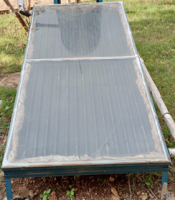
Figure 1. Flat-plate solar collector.
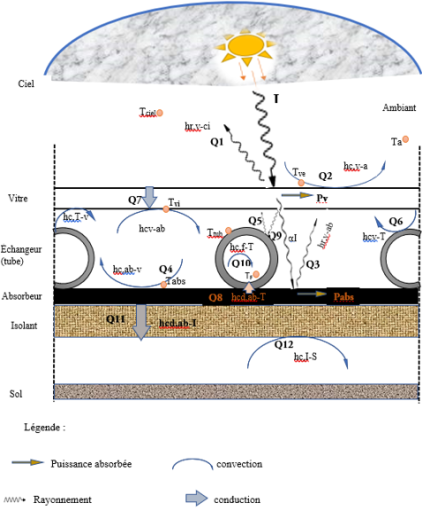
Figure 2. Physical model of the solar collector.
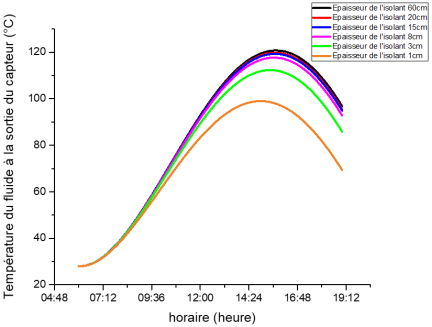
Figure 3. Temperature changes in the water at the sensor outlet as a function of the thickness of the insulation.
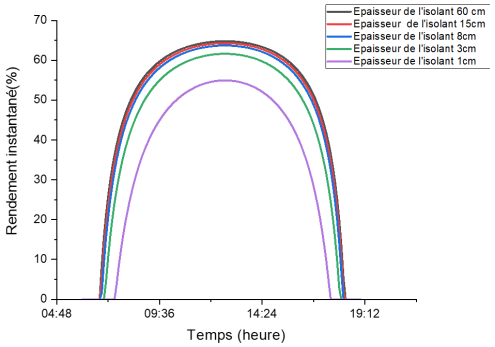
Figure 4. Change in instantaneous efficiency as a function of thickness.
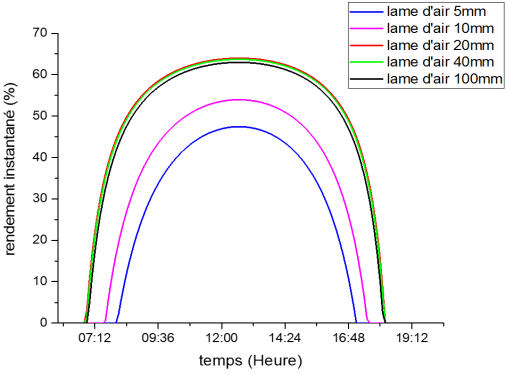
Figure 5. Instantaneous efficiency as a function of air gap.
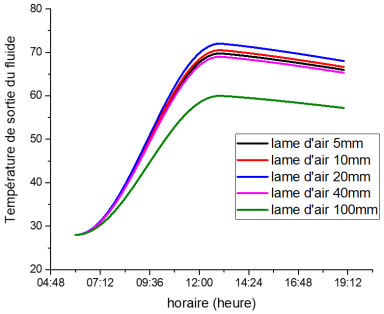
Figure 6. Fluid temperature as a function of the air gap.
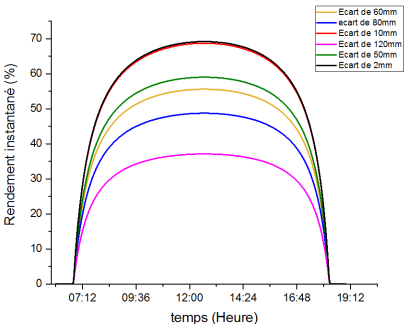
Figure 7. Collector efficiency as a function of the spacing between absorber tubes.
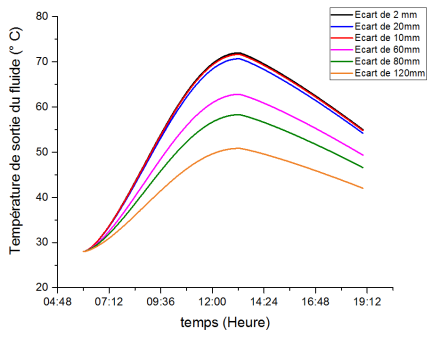
Figure 8. Temperature of the fluid leaving the solar collector as a function of the distance between the absorber tubes.

Information



 Share This Article
 Twitter
 Linked In
 Facebook


 Copy
Copy Download