Abstract
This article aims to describe and analyze post-baccalaureate guidance practices in Benin, using INJEPS as a case study. Using a mixed methodology combining qualitative and quantitative tools, questionnaires were administered to 104 INJEPS students, while semi-structured interviews were conducted with administrative officials from high schools, middle schools, and INJEPS. The data collected revealed that 65.4% of students did not receive guidance counseling and that their main sources of information are parents (62.8%) and friends (37.2%), while institutional supports remain largely underexploited given their virtual non-existence. In addition, the determining factors of choices mainly include professional opportunities (74.5%) and the possibility of obtaining a scholarship (49%). However, the lack of collaboration between high schools and INJEPS, as well as the lack of institutional efforts to provide clear and accessible information, constitute major obstacles. These results highlight that the choices of baccalaureate holders’ courses are influenced by intrinsic and extrinsic motivations, although the absence of structured guidance mechanisms limits the ability to make fully informed study choices. This situation, which is very detrimental for all actors, should be the subject of several well-developed reflections and actions to correct the course and allow students to make better guidance choices; this should allow them to have a better university journey.
|
Published in
|
Teacher Education and Curriculum Studies (Volume 11, Issue 1)
|
|
DOI
|
10.11648/j.tecs.20261101.12
|
|
Page(s)
|
14-21 |
|
Creative Commons
|

This is an Open Access article, distributed under the terms of the Creative Commons Attribution 4.0 International License (http://creativecommons.org/licenses/by/4.0/), which permits unrestricted use, distribution and reproduction in any medium or format, provided the original work is properly cited.
|
|
Copyright
|
Copyright © The Author(s), 2026. Published by Science Publishing Group
|
Keywords
School Guidance, Choice of Courses, Educational Actors, Benin
1. Introduction
Following the example of international organizations such as the United Nations Educational, Scientific and Cultural Organization (UNESCO) and the African Union (AU), which recognize the importance of guaranteeing quality, inclusive, and equitable education for all, with a view to fostering the development of societies
, the Republic of Benin attaches great importance to the education sector. This sector is considered a national priority for shaping the country's future and meeting the aspirations of its citizens. The Beninese State recognizes the role of education in the country's socio-economic development, which is materialized by the existence of a legal and programmatic framework through Law No. 2003-17 of November 11, 2003, Law No. 2005-33 of October 6, 2005, and the Sectoral Education Plan 2018-2030. This legal and programmatic framework defines the guidelines for strengthening the Beninese education system and improving the quality of teaching and learning.
Every school system is composed of levels, and one of their major challenges lies in the issue of guidance. Whether in the educational or professional dimension, guidance is of paramount importance for all actors in the system because it guides the choices that determine the future of individuals and society as a whole. The concept of school guidance encompasses a set of strategies, services, and interventions aimed at guiding learners in their educational and professional choices
. According to
| [6] | Nakhili, N. (2024). Entre socialisation à l’individualisation et selection: experiences de la transition secondaire-superieur des nouveaux bacheliers generaux. Education et socialisation, 72. https://doi.org/10.4000/11w2a204 |
| [1] | African Union. (2016). African Union Continental Education Framework 2030: Transforming Africa through Education: The Ten-Year Program 2016-2025. Ethiopia: African Union. |
[6, 1]
, school guidance is very decisive in building students' self-confidence, perception of competence, and goal setting. It provides information on courses of study and careers, facilitates decision-making, and promotes alignment between the interests, aptitudes, and aspirations of learners.
However, the guidance process is often confronted with challenges such as the predominant use of grades and averages for making orientation decisions. Unfortunately, these guidance decisions may not adequately reflect the unique aspirations, talents, and skills of each learner
. Furthermore, the lack of a coherent policy for the guidance and support of learners, job seekers, and workers can create inconsistencies between training and career prospects
| [9] | Rojewski, J. (2020). Promoting the Career Development of Children and Adolescents in the Twenty-First Century. In S. D. Brown & R. W. Lent (Eds.), Career development and counseling: Putting theory and research to work (3rd ed., pp. 643-674). John Wiley & Sons. |
[9]
. Yet, guidance decisions impact the educational path and career choices of individuals.
In Benin, after obtaining their diploma, baccalaureate holders are invited to make course choices in the hope of being selected to pursue their higher education. Before this reform, the choice of courses where learners wished to be enrolled was made when submitting application files for the baccalaureate examination; learners provided a list of university courses even before taking the exam. In this previous approach, student candidates for the baccalaureate benefited from some explanation sessions on the possibilities for course choices based on their track. However, in the current approach, it is after succeeding the exam that the laureates obtain information on the possibilities for choice; their range of possibilities is defined by their track and their performance on the exam. During the period dedicated to choosing desired courses, presentation sessions for the courses are organized in the training entities of the University of Abomey-Calavi (UAC), including the National Institute of Youth, Physical Education and Sport (INJEPS).
In this context of decision-making after the exam, where possibilities are already limited, how do students proceed to choose their field of study in the youth, physical education, and sport sector? To answer this question, the following methodological approach was implemented.
2. Methodological Approach
This descriptive and analytical research was implemented with a mixed approach, combining quantitative and qualitative tools. It involved one hundred and ten subjects, specifically six administrative officials from INJEPS and neighboring middle schools, as well as one hundred and four INJEPS students. The latter were identified through convenience sampling. Thus, those who agreed to participate in the investigation were questioned. For the administrative officials, purposeful sampling was used. In this case, to be authorized to provide information for this research, one had to be an administrative official of INJEPS or one of the three identified neighboring middle schools and in charge de facto or de jure of the issue of school guidance for university candidates.
For data collection from students, a self-administered questionnaire was used. This tool, besides identification elements, included questions on the guidance practices these students benefited from when they were still high school students, as well as the process and factors that presided over their course choice. Concerning the administrative officials of INJEPS and the middle schools, semi-structured interviews were conducted with a distinct guide for each category. For the middle school officials, attention was focused on the guidance process and resources, collaboration with higher education, as well as the involvement of parents in the guidance process possibly implemented. In the case of INJEPS administrators, the interview guide included themes focused on internal guidance and reorientation policies and practices, collaboration with other actors, including secondary education through high schools and middle schools, and the assessment of student satisfaction regarding their course choice. The information collected during the semi-structured interviews was transcribed and used for thematic analysis. As for the data collected by the questionnaire, they were processed using the IBM SPSS Statistics version 26 software for descriptive and analytical statistics. The results obtained from this approach are presented in the following sections along two main lines: the identified school guidance practices and then the course choice process by university candidates. To ensure the anonymity of the interviewees, INJEPS officials are indicated by "INJ" followed by a number, while those from the middle schools are designated by "SA".
3. School Guidance Practices
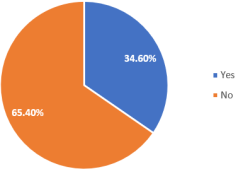
This section deals with the school guidance practices identified through data collection from the research targets. The graph below presents the benefit of guidance counselor services by the students questioned regarding their course choice.
Figure 1. Benefit of Guidance Services.
65.4% of respondents did not benefit from guidance services when choosing their university course. The following graph addresses the availability of sufficient resources provided by the high school or middle school for a judicious choice.
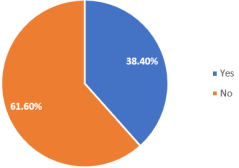
Figure 2. Provision of Resources for an Optimal Course Choice.
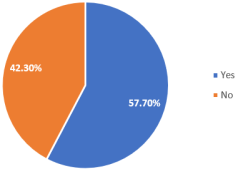
61.60% of respondents believe they did not have sufficient resources available in their high schools or middle schools to make a good choice of university course. Comparing this with Graph 1, a possible massive choice of courses without the consideration or availability of relevant information on the courses of study, their requirements, and their career prospects can be glimpsed. The graph below reports this observation among the respondents.
Figure 3. Course Choice Without Real Information.
It is observed that the majority of respondents (57.70%) made their university course choices without having in their possession relevant information that could lead them to make informed choices. It is therefore understood that high schools and middle schools seem not to take real action to equip their students with the options available to them after the baccalaureate. This statement from a secondary education actor confirms this apprehension.
A few years ago, we were responsible for explaining to students the choices they should make based on their track and with the pamphlet that was sent to us. But now, students choose themselves after the baccalaureate. (SA02).
It is understood from this statement that secondary actors took some responsibility for giving indications to their students applying for the baccalaureate. But in the current system where the choice of courses is made after obtaining the diploma, these students are essentially left to themselves. They are therefore obliged to turn to other means of information about the available and accessible courses given their baccalaureate track and the performance achieved in the exam.
Among these means made available to students to inform them are the presentation sessions for training offers instituted by the University. The excerpt below addresses this subject.
During the course selection period, we organized a guidance session where we presented the available courses, STASE as well as STAPS. (INJ03).
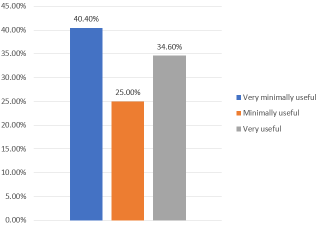
INJEPS, like other entities, organizes an activity to present its training offer during the period when baccalaureate holders choose their courses. The graph below presents the respondents' opinion on the usefulness of the information they received during this session.
Figure 4. Usefulness of Information Received at the INJEPS Guidance Session.
The largest proportion (40.40%) is that of respondents who found the information session very minimally useful for their course choice. The excerpts below present the nature of the collaboration between INJEPS (representing the University) and the middle schools.
There are no presentation sessions for courses for our students. It is during exams that private universities send people to distribute brochures to our candidates. (SA01).
It is understood from this excerpt that students do not benefit from presentation sessions for available university courses. Another secondary actor states:
Universities do not come to us to present their training offers. Ultimately, after their diploma, students follow the sessions organized here and there to get information. (SA02).
These excerpts show that there is no synergy between actors in higher education and those in secondary education for student guidance. Besides the secondary actors, people interviewed at INJEPS provided this information:
There is a service responsible for cooperation. But we do not go to the schools. We organize presentation sessions for our courses when the rectorate gives the instruction. (INJ02).
INJEPS does not reach out to high schools and middle schools to present its courses. The Institute only organizes a session to present its courses during the course selection period upon "instruction" from the UAC rectorate. A lack of collaboration between INJEPS and high schools and middle schools is therefore evident. Another interviewee at INJEPS mentions that all INJEPS actors are responsible for promoting the courses in the community. Our current and former students talk about them, and since young students know them, they are interested and come here. (INJ01).
These excerpts from the people interviewed at INJEPS confirm that there is indeed no guidance policy that takes into account the necessity of partnership between institutions, particularly between middle school and university. Furthermore, based on the statements gathered from these actors, it is understood that the training offer presentation session is more about executing an instruction than a desire to help university candidates. However, according to Godfrey
, collaboration between schools and universities can promote a better transition for learners from high school to university by providing information, resources, and opportunities for guidance and university preparation.
The data presented in this section show that students do not genuinely benefit, or rather do not benefit at all, from guidance services when they are led to make choices for their course of study after obtaining the baccalaureate. The failure to provide them with sufficient informational resources by their high schools/middle schools leads most of them to make choices without having real information about the realities of the chosen courses. This poses a real problem with reference to Rojewski
| [8] | Renn, K. A., & Reason, R. D. (2021). College Students in the United States: Characteristics, Experiences, and Outcomes (2nd edition). Routledge. 276 p.
https://doi.org/10.4324/9781003443445 |
[8]
, who found that individual interventions, such as guidance counseling interviews, allowed counselors to work directly with students to help them explore their interests and aspirations, while collective interventions, such as guidance workshops, offered opportunities for information and discussion on courses and careers. Unfortunately, in view of the data collected and the observations made, such a mechanism is non-existent in Benin.
At the same time, the university (INJEPS in this case) does not deploy sufficient measures to promote its training offer to allow baccalaureate holders to orient themselves knowingly. It is therefore understood that baccalaureate holders make their course choice without being genuinely informed, because, as
showed, universities that offer mentoring programs, career development courses, guidance counseling services, and opportunities for professional experience better prepare students to make informed choices about courses and develop their academic motivation. Students therefore do not have sufficient information on the training possibilities before the baccalaureate to be able to make a choice; this situation does not undergo a real change after obtaining the diploma. Moreover, this virtual non-existence of information does not allow them to develop either intrinsic or extrinsic motivation; they are not able to assess their personal effectiveness based on objective information provided by the authorized structures. However, they should have good intrinsic motivation to support their guidance choice to potentially have a high degree of motivation and resilience in their academic journey.
Despite this non-existence of a guidance mechanism, baccalaureate holders still proceed to choose courses to continue their schooling. The following section describes the process they engage in to do so.
4. Course Choice Process
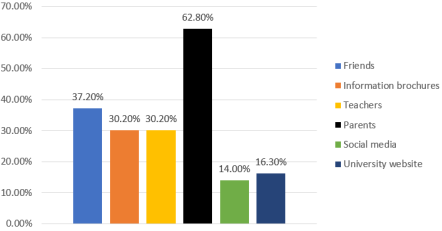
Since baccalaureate holders make course choices in the hope of being ranked there following the work of the ad hoc commission, and despite the biases noted in the previous section, it is important to focus on the process of this choice, characterize it, and draw conclusions. Following this logic, the graph below presents the sources of information that the students had available when choosing their university course.
Parents were the main source of information (62.8% of mentions) for the questioned students when they had to make their course choices. After parents come friends (37.20%), then teachers and information brochures (30.20% per source). Only 16.30% of respondents claimed to have obtained information through the university's website. They also specified that this refers to the UAC web portal since INJEPS does not have its own website. This statement is verified by an INJEPS administrator in these terms.
The available courses and specialties at INJEPS are mentioned on the UAC website. Curious students can go there to get the information they need. INJEPS does not yet have its own website. (INJ02).
Figure 5. Sources of Information When Choosing a Course.
This observation signals a significant problem given the high level of digitalization currently known in all sectors. In a world where the first reflex is to turn to the Internet for information, it is not good that a training institution does not have a website presenting its offer and possible career prospects. This position is reinforced by the literature. Indeed
highlighted the importance of digital platforms as a means of information and guidance. They noted that university websites provide baccalaureate holders with a large amount of information that is decisive for their course choice. This information includes details of study curricula, entry requirements, professional opportunities linked to each field of study, feedback from current students, tools for making a decision, open house dates, and contact details for guidance counselors. The authors
highlighted that these web portals facilitate access to precise and concise information, encourage independent exploration of available choices, and assist high school graduates in making informed decisions regarding their academic orientation. The unavailability of information in the context studied constitutes a major obstacle to decision-making.
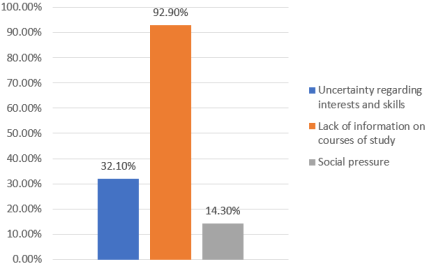
In this regard, the following graph presents the difficulties encountered in the context of their course choice.
Figure 6. Difficulties Encountered in the Course Choice Process.
The difficulty encountered by the largest proportion (92.90%) of respondents is the lack of information on the courses of study. This is well understood when referring to the observations made previously. The following graph addresses the consideration of personal interests and aptitudes by students in their course choice.
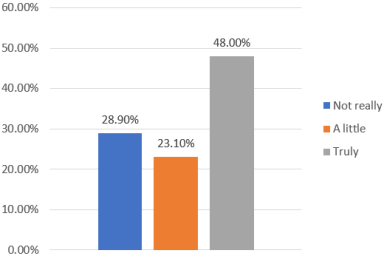
Figure 7. Consideration of Personal Interests and Aptitudes in Course Choice.
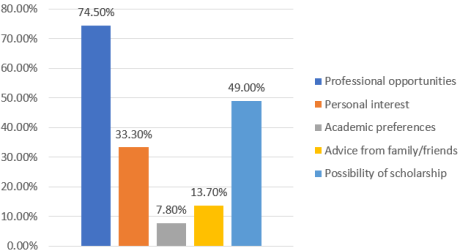
The largest proportion of students (48%) stated that they truly took personal interests and aptitudes into account when choosing their university course. The graph below focuses on the factors considered for the choice of courses by students.
Figure 8. Factors Considered for Course Choice.
Professional opportunities constitute the most cited determining factor by respondents (74.5% of mentions), ahead of the possibility of obtaining a scholarship (49%) and personal interests (33.3%). Therefore, with the information they were able to gather after consulting various sources, students proceed to choose courses based mostly on the professional prospects of the training, the possibility of obtaining a scholarship, and personal interests. This result aligns with those of
| [13] | Watt, H. M., & Richardson, P. W. (2007). Motivational Factors Influencing Teaching as a Career Choice: Development and Validation of the FIT-Choice Scale. The Journal of Experimental Education, 75. pp. 167-202.
https://doi.org/10.3200/JEXE.75.3.167-202212 |
[15, 13]
who showed that students are more likely to choose courses in which they perceive a match between their interests, skills, and future goals. Following them,
found that social norms, beliefs about professional opportunities, socialization experiences, and personal aspirations play an important role in the course choice process. Also, Berlanga and Corti
| [2] | Bandura, A. (1997). Self-efficacy: The exercise of control Freeman. |
[2]
found that the possibility of obtaining a scholarship in a certain course could exert a significant influence on student choice. Scholarships can serve as an extrinsic motivational factor, encouraging students to turn towards courses that offer attractive funding opportunities.
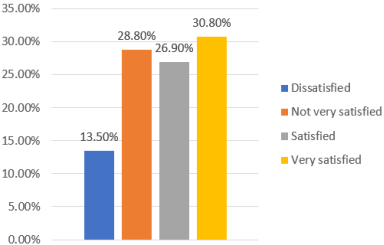
The following graph relates to the degree of satisfaction with the course choice made.
Figure 9. Level of Satisfaction with the Course Choice Made.
The largest proportion of responses at this level is the "very satisfied" option with 30.80% of responses. However, an absence of a true trend is noted, as the proportions of the other options are in the same range: 28.80% and 26.90% for the "not very satisfied" and "satisfied" options, respectively. The positive side is the low relative percentage of respondents who claimed to be dissatisfied with the course choice they made. They particularly mentioned the administration's refusal to change their training specialty. As reported by respondents, students enrolled in the Sport Training option of STAPS would have liked to continue their curriculum in the Physical Education (PE) option. Having received a refusal from the INJEPS administration, most had to continue (especially scholarship students), while a few (enrolled on a paying basis) turned to EFES SAPIENTIA to continue their training in PE. The availability of clear and precise information on the training options and their career prospects could have helped avoid this situation, which is nonetheless regrettable. As
| [3] | Berlanga, V., & Corti, F. (2025). Impact of scholarships on university academic performance: A comparative analysis of students with and without scholarships. Frontiers in Education, 10. https://doi.org/10.3389/feduc.2025.1554073201 |
[3]
showed, access to information on courses and careers is a key element in helping students better understand their options and make informed decisions.
In the context of their university course choices, the new students questioned in this research mainly had their parents and friends as sources of information. They did not benefit from real guidance services and did not have access to precise information on training options and their career prospects. They therefore faced the problem of unavailability of information on the courses of study; this situation is aggravated in the case of INJEPS, which does not have a web portal where its training offer is displayed. Most of these students took into account their personal interests and aptitudes in choosing their courses, and the most determining factors were professional opportunities and the possibility of obtaining a scholarship. It is noted that students made their course choice based on both their extrinsic and intrinsic motivations. Intrinsic motivation is characterized here by the consideration of personal interests and personal capabilities in the course choice, while the possibility of obtaining a scholarship refers to extrinsic motivation. We are therefore facing a situation of mixed motivation, a synergistic motivation. Regarding the determinants of course choice, it is noted that the choice is made based on personal interests and perceived competence. Thus, it is retained that the new students choose INJEPS courses based on their professional interests, their sense of personal capacity, and the expectation of results. It is also important to note the predominant role of the possibility of obtaining a scholarship in the students’ choice.
5. Conclusion
This research made it possible to shed light on the guidance practices in place in high schools and middle schools to support students in their transition from secondary to higher education. Following the investigations, it results that there is no guidance system for the benefit of students transitioning from secondary to higher education; there are only information practices. New baccalaureate holders do not benefit from a real contribution from the education system to make their course choices. They therefore rely on information provided by their parents, their peers, and social media. Some training offer presentation activities are organized during the course selection period, but the information provided does not allow baccalaureate holders to make fully informed choices. With the bits of information they manage to collect, these students make their choices based on their interests, known professional prospects for the courses, and especially the possibility of obtaining a training scholarship. High schools and middle schools, just like universities, do not put in place a mechanism to support students in their choice of university courses. This situation, which is very detrimental for all actors, should be the subject of several well-developed reflections and actions to correct the course and allow students to make better guidance choices; this should allow them to have a better university journey. To achieve this, shouldn't the mission of the university in Benin be reviewed so that it takes into account the need to provide quality information to its clients, who are the students? Could not the possibilities offered by technology be exploited to improve the guidance practices for students? Finally, wouldn't it be time to establish and operationalize a genuine guidance mechanism in Benin?
Abbreviations
AU | African Union |
CEREID | Center for Studies and Research in Education and Social Interventions for Development |
EFES | Higher Education and Training InstitutionPE: Physical Education |
INJEPS | National Institute of Youth, Physical Education and Sport |
PE | Physical Education |
STAPS | Science and Technology of Physical and Sports Activities |
UAC | University of Abomey-Calavi |
UNESCO | United Nations Educational, Scientific and Cultural Organization |
Conflicts of Interest
The authors declare no conflicts of interest.
References
| [1] |
African Union. (2016). African Union Continental Education Framework 2030: Transforming Africa through Education: The Ten-Year Program 2016-2025. Ethiopia: African Union.
|
| [2] |
Bandura, A. (1997). Self-efficacy: The exercise of control Freeman.
|
| [3] |
Berlanga, V., & Corti, F. (2025). Impact of scholarships on university academic performance: A comparative analysis of students with and without scholarships. Frontiers in Education, 10.
https://doi.org/10.3389/feduc.2025.1554073201
|
| [4] |
Gati, I., Krausz, M., & Osipow, S. H. (1996). A taxonomy of difficulties in career decision making. Journal of Counseling Psychology, 43(4), pp. 510-526.
https://doi.org/10.1037/0022-0167.43.4.510202
|
| [5] |
Godfrey, C. (2019). Collaborative Partnerships Between Community Colleges and High Schools (Thesis, Concordia University, St. Paul). Retrieved from
https://digitalcommons.csp.edu/cup_commons_grad_edd/304203
|
| [6] |
Nakhili, N. (2024). Entre socialisation à l’individualisation et selection: experiences de la transition secondaire-superieur des nouveaux bacheliers generaux. Education et socialisation, 72.
https://doi.org/10.4000/11w2a204
|
| [7] |
Odry, D. (2021). Modeles, representations, and paradigms. Orientation in the education system: History, logic, and challenges (p. 83-133). Mardaga.
https://shs.cairn.info/l-orientation-dans-le-systeme-educatif--9782804720063-page-83?lang=fr205
|
| [8] |
Renn, K. A., & Reason, R. D. (2021). College Students in the United States: Characteristics, Experiences, and Outcomes (2nd edition). Routledge. 276 p.
https://doi.org/10.4324/9781003443445
|
| [9] |
Rojewski, J. (2020). Promoting the Career Development of Children and Adolescents in the Twenty-First Century. In S. D. Brown & R. W. Lent (Eds.), Career development and counseling: Putting theory and research to work (3rd ed., pp. 643-674). John Wiley & Sons.
|
| [10] |
Santelmann, P. (2022). Politiques d’insertion et formations qualifiantes: quelle coherence ? Education Permanente, 233, 134-146.
https://doi.org/10.3917/edpe.233.0134208
|
| [11] |
Solaux, G. (2005). Les defis de l’orientation dans le monde. Revue internationale d’education de Sevres, 38. pp. 19-24.
https://doi.org/10.4000/ries.1415209
|
| [12] |
UNESCO. (2015). Education 2030: Incheon Declaration and Framework for Action for the implementation of Sustainable Development Goal 4. United Nations Educational, Scientific and Cultural Organization.
https://unesdoc.unesco.org/ark:/48223/pf0000245656/Pdf/245656eng.pdf.multi210
|
| [13] |
Watt, H. M., & Richardson, P. W. (2007). Motivational Factors Influencing Teaching as a Career Choice: Development and Validation of the FIT-Choice Scale. The Journal of Experimental Education, 75. pp. 167-202.
https://doi.org/10.3200/JEXE.75.3.167-202212
|
Cite This Article
-
APA Style
Hounkonnou, L., Ahouandjinou, R., Tohoun, S. (2026). From Intention to Choice: Factors and Barriers to
Post-secondary Educational Decisions in Sports and Youth Fields in Benin. Teacher Education and Curriculum Studies, 11(1), 14-21. https://doi.org/10.11648/j.tecs.20261101.12
 Copy
|
Copy
|
 Download
ACS Style
Hounkonnou, L.; Ahouandjinou, R.; Tohoun, S. From Intention to Choice: Factors and Barriers to
Post-secondary Educational Decisions in Sports and Youth Fields in Benin. Teach. Educ. Curric. Stud. 2026, 11(1), 14-21. doi: 10.11648/j.tecs.20261101.12
Copy
|
Download
AMA Style
Hounkonnou L, Ahouandjinou R, Tohoun S. From Intention to Choice: Factors and Barriers to
Post-secondary Educational Decisions in Sports and Youth Fields in Benin. Teach Educ Curric Stud. 2026;11(1):14-21. doi: 10.11648/j.tecs.20261101.12
Copy
|
Download
-
@article{10.11648/j.tecs.20261101.12,
  author = {Lionel Hounkonnou and Raymond-Bernard Ahouandjinou and Sebastien Tohoun},
  title = {From Intention to Choice: Factors and Barriers to
Post-secondary Educational Decisions in Sports and Youth Fields in Benin},
  journal = {Teacher Education and Curriculum Studies},
  volume = {11},
  number = {1},
  pages = {14-21},
  doi = {10.11648/j.tecs.20261101.12},
  url = {https://doi.org/10.11648/j.tecs.20261101.12},
  eprint = {https://article.sciencepublishinggroup.com/pdf/10.11648.j.tecs.20261101.12},
  abstract = {This article aims to describe and analyze post-baccalaureate guidance practices in Benin, using INJEPS as a case study. Using a mixed methodology combining qualitative and quantitative tools, questionnaires were administered to 104 INJEPS students, while semi-structured interviews were conducted with administrative officials from high schools, middle schools, and INJEPS. The data collected revealed that 65.4% of students did not receive guidance counseling and that their main sources of information are parents (62.8%) and friends (37.2%), while institutional supports remain largely underexploited given their virtual non-existence. In addition, the determining factors of choices mainly include professional opportunities (74.5%) and the possibility of obtaining a scholarship (49%). However, the lack of collaboration between high schools and INJEPS, as well as the lack of institutional efforts to provide clear and accessible information, constitute major obstacles. These results highlight that the choices of baccalaureate holders’ courses are influenced by intrinsic and extrinsic motivations, although the absence of structured guidance mechanisms limits the ability to make fully informed study choices. This situation, which is very detrimental for all actors, should be the subject of several well-developed reflections and actions to correct the course and allow students to make better guidance choices; this should allow them to have a better university journey.},
 year = {2026}
}
Copy
|
Download
-
TY  - JOUR
T1  - From Intention to Choice: Factors and Barriers to
Post-secondary Educational Decisions in Sports and Youth Fields in Benin
AU  - Lionel Hounkonnou
AU  - Raymond-Bernard Ahouandjinou
AU  - Sebastien Tohoun
Y1  - 2026/01/29
PY  - 2026
N1  - https://doi.org/10.11648/j.tecs.20261101.12
DO  - 10.11648/j.tecs.20261101.12
T2  - Teacher Education and Curriculum Studies
JF  - Teacher Education and Curriculum Studies
JO  - Teacher Education and Curriculum Studies
SP  - 14
EP  - 21
PB  - Science Publishing Group
SN  - 2575-4971
UR  - https://doi.org/10.11648/j.tecs.20261101.12
AB  - This article aims to describe and analyze post-baccalaureate guidance practices in Benin, using INJEPS as a case study. Using a mixed methodology combining qualitative and quantitative tools, questionnaires were administered to 104 INJEPS students, while semi-structured interviews were conducted with administrative officials from high schools, middle schools, and INJEPS. The data collected revealed that 65.4% of students did not receive guidance counseling and that their main sources of information are parents (62.8%) and friends (37.2%), while institutional supports remain largely underexploited given their virtual non-existence. In addition, the determining factors of choices mainly include professional opportunities (74.5%) and the possibility of obtaining a scholarship (49%). However, the lack of collaboration between high schools and INJEPS, as well as the lack of institutional efforts to provide clear and accessible information, constitute major obstacles. These results highlight that the choices of baccalaureate holders’ courses are influenced by intrinsic and extrinsic motivations, although the absence of structured guidance mechanisms limits the ability to make fully informed study choices. This situation, which is very detrimental for all actors, should be the subject of several well-developed reflections and actions to correct the course and allow students to make better guidance choices; this should allow them to have a better university journey.
VL  - 11
IS  - 1
ER  -
Copy
|
Download





 Share This Article
 Twitter
 Linked In
 Facebook