
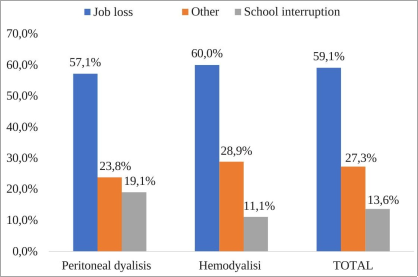
Background: Chronic kidney disease (CKD) represents a major public health burden in sub-Saharan Africa, predominantly affecting young working-age adults. Despite free dialysis policies implemented in Senegal since 2012, the broader socioeconomic consequences of end-stage kidney disease (ESKD) on patients and their families remained poorly documented. Aim: This study aimed to estimate the socioprofessional and economic impact of dialysis on ESKD patients and their families in 2019. Setting: The nephrology and dialysis department of Aristide Le Dantec Hospital, a national level III referral center in Dakar, Senegal. Methods: An analytical cross-sectional study was conducted from January to December 2019. Data were collected through medical record reviews and face-to-face interviews. Direct and indirect costs were calculated, and catastrophic health expenditure was assessed using a 20% annual household income threshold. Results: A total of 89 patients were enrolled. The mean age was 47.83 years and 87.36% had no health insurance. Weekly working hours declined from 38.32 before diagnosis to 4.93 hours after. Job loss affected 59.09% of patients. Nearly all patients (89.53%) reported social repercussions, primarily activity limitations. Additionally, 43.68% sold personal assets to cover treatment costs, and 18.39% contracted loans. Catastrophic health expenditure affected 95.98% of patients, with out-of-pocket costs representing 52.86% of total management expenditures. Conclusion: Despite state subsidies, ESKD imposed a devastating socioeconomic burden on patients and families. Strengthening health insurance coverage and expanding social protection for CKD patients is strongly recommended. Contribution: This study provides critical evidence on the socioprofessional consequences of ESKD in West Africa, informing equitable health policy and resource allocation for kidney disease management in low- and middle-income countries.
| Published in | World Journal of Public Health (Volume 11, Issue 3) |
| DOI | 10.11648/j.wjph.20261103.14 |
| Page(s) | 264-270 |
| Creative Commons |
This is an Open Access article, distributed under the terms of the Creative Commons Attribution 4.0 International License (http://creativecommons.org/licenses/by/4.0/), which permits unrestricted use, distribution and reproduction in any medium or format, provided the original work is properly cited. |
| Copyright |
Copyright © The Author(s), 2026. Published by Science Publishing Group |
Chronic Kidney Disease, Socioprofessional Impact, Out-of-Pocket Expenditures, Catastrophic Health Expenditure, Dialysis, Senegal, Sub-Saharan Africa
Sociodemographic characteristics | N (N=89) | Percentage (%) | Mean |
|---|---|---|---|
Age (years): <20 / 20–29 / 30–39 / 40–49 / 50–59 / >60 | 2 / 7 / 15 / 25 / 21 / 19 | 2 / 8 / 17 / 28 / 24 / 21 | 47.83 ± 13.40 years |
Gender: Male / Female | 43 / 57 | 48.04 / 51.96 | Sex ratio = 0.92 |
Marital status: Married / Single / Divorced / Widowed | 63 / 19 / 3 / 4 | 71.26 / 20.69 / 3.45 / 4.60 | — |
Professional activity: Informal / No activity / Formal / Student | 44 / 37 / 12 / 6 | 44.44 / 37.37 / 12.12 / 6.06 | — |
Health insurance: Private / Mutual org / None | 11 / 0 / 78 | 12.64 / 0 / 87.36 | — |
Category | Peritoneal Dialysis (n=7) | Hemodialysis (n=31) | Total (n=38) | |||
|---|---|---|---|---|---|---|
Freq. | % | Freq. | % | Freq. | % | |
Land plot | 1 | 14.29 | 15 | 48.39 | 16 | 42.11 |
Gold / Jewelry | 4 | 57.14 | 7 | 22.58 | 11 | 28.95 |
Work equipment | 1 | 14.29 | 6 | 19.35 | 7 | 18.42 |
Household appliance | 1 | 14.29 | 2 | 6.45 | 3 | 7.89 |
Transportation / Vehicle | — | — | 1 | 3.23 | 1 | 2.63 |
Total | 7 | 100.00 | 31 | 100.00 | 38 | 100.00 |
Cost types | Total amount (FCFA) | Patients and/or families Amount (%) | State Amount (%) |
|---|---|---|---|
Direct medical costs | 638,583,502 | 124,719,502 (19.53%) | 513,864,000 (80.47%) |
Direct non-medical costs | 151,416,823 | 151,416,823 (100%) | 0 (0%) |
Indirect costs | 346,579,796 | 346,579,796 (100%) | 0 (0%) |
Total costs | 1,136,580,121 | 622,716,121 (54.79%) | 513,864,000 (45.21%) |
Cost types | Total amount (FCFA) | Patients and/or families Amount (%) | State Amount (%) |
|---|---|---|---|
Direct medical costs | 217,413,140 | 32,713,940 (15.05%) | 184,699,200 (84.95%) |
Direct non-medical costs | 19,044,144 | 19,044,144 (100%) | 0 (0%) |
Indirect costs | 108,885,000 | 108,885,000 (100%) | 0 (0%) |
Total costs | 345,342,284 | 160,643,084 (46.52%) | 184,699,200 (53.48%) |
Cost types | Total amount (FCFA) | Patients and/or families Amount (%) | State Amount (%) |
|---|---|---|---|
Direct medical costs | 855,996,642 | 157,433,442 (18.39%) | 698,563,200 (81.61%) |
Direct non-medical costs | 170,460,967 | 170,460,967 (100%) | 0 (0%) |
Indirect costs | 455,464,796 | 455,464,796 (100%) | 0 (0%) |
Total costs | 1,481,922,405 | 783,359,205 (52.86%) | 698,563,200 (47.14%) |
CKD | Chronic Kidney Disease |
ESKD | End-Stage Kidney Disease |
FCFA | Franc De La Communauté Financière Africaine |
HALD | Hôpital Aristide Le Dantec |
CHE | Catastrophic Health Expenditure |
CAPD | Continuous Ambulatory Peritoneal Dialysis |
ANACMU | Agence Nationale De La Couverture Maladie Universelle |
PNA | Pharmacie Nationale d'Approvisionnement |
NCDT | National Council for Donation and Transplantation |
UHC | Universal Health Coverage |
| [1] |
Cuen FR. Chronic renal failure and chronic kidney disease]. In: Néphrologie, 8e edition, chap. 15. Available from:
http://cuen.fr/manuel (accessed 04 Feb 2026). |
| [2] | Ramilitiana B, et al. A retrospective study on the incidence of chronic kidney disease. Thèse médecine. 2016; 23. |
| [3] | Ferris ME, Gipson DS, Kimmel PL, Eggers PW. Trends in treatment and outcomes of survival of adolescents initiating end-stage renal disease care in the United States. Pediatrics. 2006; 117(4): 1212–1219. |
| [4] | Stanifer JW, et al. The epidemiology of CKD in sub-Saharan Africa: a systematic review and meta-analysis. Lancet Global Health. 2014; 2(3): e174–81. |
| [5] | Ndiaye AS. Contribution of the PNA Director on the free management of kidney disease in Senegal. Ministère de la Santé. 2026. |
| [6] | Niang A, et al. Evaluation of cardiac complications among chronic hemodialysis in Dakar. Pan Afr Med J. 2016; 23: 43. |
| [7] | Seck S, et al. Prevalence survey of CKD in northern Senegal. Néphrologie & Thérapeutique. 2014; 10(5): 399. |
| [8] | Falodia J, Singla MK. CKD epidemiology and risk factors. Clinical Queries: Nephrology. 2012; 1(4): 249–52. |
| [9] | Kane K, et al. Decentralization of dialysis in Senegal: one-year experience at the Tambacounda center. ESJ. 2016; 12(36): 164. |
| [10] | Bello AK, et al. Socioeconomic Status and CKD at Presentation to a Renal Service in the UK. Clin J Am Soc Nephrol. 2008; 3(5): 1316–23. |
| [11] | Bruce MA, et al. Association of Socioeconomic Status and CKD Among African Americans: The Jackson Heart Study. J Am Soc Nephrol. 2010; 55(6): 1001–1008. |
| [12] | Loos-Ayav C, et al. Incidence of CRF in the general population, EPIRAN study. Néphrologie & Thérapeutique. 2009; 5: S250–5. |
| [13] | Xu K, Evans DB, Kawabata K, Zeramdini R, Klavus J, Murray CJL. Household catastrophic health expenditure: a multicountry analysis. Lancet. 2003; 362(9378): 111–117. |
| [14] | Mbaye A, et al. Prevalence of cardiovascular risk factors in a semi-rural setting in Senegal. Ann Cardiol Angéiol. 2018; 67(4): 264–9. |
| [15] | Sumaili EK, et al. High prevalence of undiagnosed CKD among at-risk population in Kinshasa, DRC. BMC Nephrology. 2009; 10(1): 18. |
| [16] | Farouki ME, et al. Profile of diabetic CRF patients at the initiation of hemodialysis in Rabat. Pan Afr Med J. 2013; 15(124): 1–6. |
| [17] | Seck SM, et al. Epidemiology of CKD in northern Senegal: a community-based study in 2012. Pan Afr Med J. 2014; 18(1): 307–315. |
| [18] | Burkhalter F, et al. Prevalence and risk factors for CKD in rural Haiti. Swiss Med Weekly. 2014; 144(5152). |
| [19] | Gummidi B, et al. Catastrophic Health Expenditure among Patients with Nondialysis CKD in Uddanam, India. Kidney Int Rep. 2022; 7(2): 319–321. |
| [20] | Valsa Jose V, et al. Out-of-pocket expenditures and quality of life among hemodialysis patients in Kerala, India. Hemodialysis Int. 2022; 26(4): 569–574. |
| [21] | Baye TA, et al. Economic burden of hemodialysis in Addis Ababa, Ethiopia. Cost Eff Resour Alloc. 2024; 22: 25. |
| [22] | Elshahat S, et al. Impact of CKD on developed countries: a systematic scoping review. PLoS One. 2020; 15(3): e0230512. |
| [23] | Ahoui S, et al. Psychosocial consequences of CKD among hemodialysis patients at CNHU-HKM in Cotonou. Rev Sociol Anthropol Psychol. 2017; 16(10/8): 280–294. |
| [24] | Rattanasompattikul M, et al. Association between catastrophic health expenditures and health-related quality of life in CKD patients in Thailand. Qual Life Res. 2020; 29(11): 2965–2976. |
APA Style
Diop, M., Dioum, M. M., Aguiar, M. F. B., Leye, M. M. M. (2026). Socioprofessional Impact on Patients with Chronic Kidney Disease at Aristide Le Dantec Hospital in Dakar: Out-of-Pocket Expenditures Burden and Catastrophic Household Finances. World Journal of Public Health, 11(3), 264-270. https://doi.org/10.11648/j.wjph.20261103.14
ACS Style
Diop, M.; Dioum, M. M.; Aguiar, M. F. B.; Leye, M. M. M. Socioprofessional Impact on Patients with Chronic Kidney Disease at Aristide Le Dantec Hospital in Dakar: Out-of-Pocket Expenditures Burden and Catastrophic Household Finances. World J. Public Health 2026, 11(3), 264-270. doi: 10.11648/j.wjph.20261103.14
AMA Style
Diop M, Dioum MM, Aguiar MFB, Leye MMM. Socioprofessional Impact on Patients with Chronic Kidney Disease at Aristide Le Dantec Hospital in Dakar: Out-of-Pocket Expenditures Burden and Catastrophic Household Finances. World J Public Health. 2026;11(3):264-270. doi: 10.11648/j.wjph.20261103.14
@article{10.11648/j.wjph.20261103.14,
  author = {Mbathio Diop and Mareme Maty Dioum and Morel Fabrice Bignon Aguiar and Mamadou Makhtar Mbacke Leye},
  title = {Socioprofessional Impact on Patients with Chronic Kidney Disease at Aristide Le Dantec Hospital in Dakar:
Out-of-Pocket Expenditures Burden and Catastrophic Household Finances},
  journal = {World Journal of Public Health},
  volume = {11},
  number = {3},
  pages = {264-270},
  doi = {10.11648/j.wjph.20261103.14},
  url = {https://doi.org/10.11648/j.wjph.20261103.14},
  eprint = {https://article.sciencepublishinggroup.com/pdf/10.11648.j.wjph.20261103.14},
  abstract = {Background: Chronic kidney disease (CKD) represents a major public health burden in sub-Saharan Africa, predominantly affecting young working-age adults. Despite free dialysis policies implemented in Senegal since 2012, the broader socioeconomic consequences of end-stage kidney disease (ESKD) on patients and their families remained poorly documented. Aim: This study aimed to estimate the socioprofessional and economic impact of dialysis on ESKD patients and their families in 2019. Setting: The nephrology and dialysis department of Aristide Le Dantec Hospital, a national level III referral center in Dakar, Senegal. Methods: An analytical cross-sectional study was conducted from January to December 2019. Data were collected through medical record reviews and face-to-face interviews. Direct and indirect costs were calculated, and catastrophic health expenditure was assessed using a 20% annual household income threshold. Results: A total of 89 patients were enrolled. The mean age was 47.83 years and 87.36% had no health insurance. Weekly working hours declined from 38.32 before diagnosis to 4.93 hours after. Job loss affected 59.09% of patients. Nearly all patients (89.53%) reported social repercussions, primarily activity limitations. Additionally, 43.68% sold personal assets to cover treatment costs, and 18.39% contracted loans. Catastrophic health expenditure affected 95.98% of patients, with out-of-pocket costs representing 52.86% of total management expenditures. Conclusion: Despite state subsidies, ESKD imposed a devastating socioeconomic burden on patients and families. Strengthening health insurance coverage and expanding social protection for CKD patients is strongly recommended. Contribution: This study provides critical evidence on the socioprofessional consequences of ESKD in West Africa, informing equitable health policy and resource allocation for kidney disease management in low- and middle-income countries.},
 year = {2026}
}
TY  - JOUR
T1  - Socioprofessional Impact on Patients with Chronic Kidney Disease at Aristide Le Dantec Hospital in Dakar:
Out-of-Pocket Expenditures Burden and Catastrophic Household Finances
AU  - Mbathio Diop
AU  - Mareme Maty Dioum
AU  - Morel Fabrice Bignon Aguiar
AU  - Mamadou Makhtar Mbacke Leye
Y1  - 2026/07/24
PY  - 2026
N1  - https://doi.org/10.11648/j.wjph.20261103.14
DO  - 10.11648/j.wjph.20261103.14
T2  - World Journal of Public Health
JF  - World Journal of Public Health
JO  - World Journal of Public Health
SP  - 264
EP  - 270
PB  - Science Publishing Group
SN  - 2637-6059
UR  - https://doi.org/10.11648/j.wjph.20261103.14
AB  - Background: Chronic kidney disease (CKD) represents a major public health burden in sub-Saharan Africa, predominantly affecting young working-age adults. Despite free dialysis policies implemented in Senegal since 2012, the broader socioeconomic consequences of end-stage kidney disease (ESKD) on patients and their families remained poorly documented. Aim: This study aimed to estimate the socioprofessional and economic impact of dialysis on ESKD patients and their families in 2019. Setting: The nephrology and dialysis department of Aristide Le Dantec Hospital, a national level III referral center in Dakar, Senegal. Methods: An analytical cross-sectional study was conducted from January to December 2019. Data were collected through medical record reviews and face-to-face interviews. Direct and indirect costs were calculated, and catastrophic health expenditure was assessed using a 20% annual household income threshold. Results: A total of 89 patients were enrolled. The mean age was 47.83 years and 87.36% had no health insurance. Weekly working hours declined from 38.32 before diagnosis to 4.93 hours after. Job loss affected 59.09% of patients. Nearly all patients (89.53%) reported social repercussions, primarily activity limitations. Additionally, 43.68% sold personal assets to cover treatment costs, and 18.39% contracted loans. Catastrophic health expenditure affected 95.98% of patients, with out-of-pocket costs representing 52.86% of total management expenditures. Conclusion: Despite state subsidies, ESKD imposed a devastating socioeconomic burden on patients and families. Strengthening health insurance coverage and expanding social protection for CKD patients is strongly recommended. Contribution: This study provides critical evidence on the socioprofessional consequences of ESKD in West Africa, informing equitable health policy and resource allocation for kidney disease management in low- and middle-income countries.
VL  - 11
IS  - 3
ER  -
Department of Odonto-Stomatology, University Cheikh Anta Diop, Dakar, Senegal
Institute of Health and Development, University Cheikh Anta Diop, Dakar, Senegal
Department of Odonto-Stomatology, University Cheikh Anta Diop, Dakar, Senegal
Institute of Health and Development, University Cheikh Anta Diop, Dakar, Senegal

Information



 Share This Article
 Twitter
 Linked In
 Facebook
 Copy
Copy Download