Research Article | | Peer-Reviewed

Socio-demographic and Technical Characteristics of Fish Farming in Three Aquaculture Production Basins in Cameroon

Received: 10 June 2026     Accepted: 26 June 2026     Published: 30 July 2026
Views:       Downloads:
Abstract

Background: The natural conditions and geo-climatic diversity of Cameroon are ideal for aquaculture development. The current study aimed to assess the socio-demographic and technical characteristics of aquaculture across three regions in Cameroon. Methods: Data collection was based on the snowball sampling technique, field observations and face-to-face interviews with fish farmers, using a structured questionnaire. Of the 129 fish farmers identified, 46, 69 and 14 from the Littoral, Centre and South regions respectively were interviewed. Results: In the Littoral, Centre and South regions, 87%, 91% and 93% of aquaculture is practiced by men, respectively. Moreover, 74% of fish farmers in the Littoral region are between 26-36 years old, compared to 49% and 57% in the Centre and South regions, which are respectively aged 36-46. Most farms in the Littoral region (46%) are organized as cooperatives, whilst 49% and 50% of those in the Centre and South regions, respectively, have no legal status. Regardless of the region, African catfish, is the predominant species raised for commercial purposes. The main challenges facing fish farmers are the poor quality of locally produced feed (61%) and a lack of financial resources (61%). As regards fish feed production, the main challenges are the high cost of ingredients, an unreliable electricity supply and pests (77%). Conclusion: Given the age of fish farmers, their level of education and training in aquaculture, and the production facilities, the Littoral and Centre regions are emerging as key hubs for the development of fish farming in Cameroon.

Published in Agriculture, Forestry and Fisheries (Volume 15, Issue 4)
DOI 10.11648/j.aff.20261504.12
Page(s) 130-142
Creative Commons

This is an Open Access article, distributed under the terms of the Creative Commons Attribution 4.0 International License (http://creativecommons.org/licenses/by/4.0/), which permits unrestricted use, distribution and reproduction in any medium or format, provided the original work is properly cited.

Copyright

Copyright © The Author(s), 2026. Published by Science Publishing Group

Keywords

Socio-demography, Production Facility, Aquaculture Basin, Cameroon

1. Introduction
Aquaculture is a key sector to ensure food security, create jobs and improve livelihoods at global, regional and local levels. Although it was introduced in Cameroon since 1948, aquaculture development is still limited, despite the country’s many natural assets, such as a favourable climate, an extensive river network and a wide variety of fish fauna . With an annual growth rate of around 2.6%, Cameroon’s population according to the National Institute of Statistics (NIS), is currently estimated at around 30.5 million. Yet, in terms of climate, soil, vegetation and even hydrography, the Cameroon Agricultural Research Institute for Development (IRAD) has divided the country into five agro-ecological zones, which differ from one another in terms of their variability in agro-pastoral potential, making Cameroon a country well-suited to the agro-pastoral production of a wide diversity of crops and livestock species, including fish farming species . However, of the five agro-ecological zones, two of them, namely Zone IV, which comprises the Littoral and South-West regions (characterized by a humid forest with a monomodal rainfall pattern) and Zone V, which encompasses the Centre, South and East regions (characterized by a humid forest with a bimodal rainfall pattern) are also considered to be among the country’s main aquaculture production basins, with a contribution in 2021 of 43.94% to national aquaculture production . The species commonly farmed in these production basins or regions are Orechromis niloticus, Cypinus carpio, Heterotis niloticus and Clarias gariepinus, the latter being the most common species.
While national demand for fisheries products amounts to 500,000 tonnes per year, domestic production, including that from aquaculture, amounts only to 335,000 tonnes. The deficit is being made up by imports, which further contributes to the trade balance deficit. However, the government, through its Ministry of Livestock, Fisheries and Animal Industries (MINEPIA), has initiated a number of measures aimed at providing technical and financial support to the fish farming producers, notably through training, donations of African catfish broodstocks and some essential equipment, facilities in securing bank loans, and exemption from customs duties on aquaculture inputs and equipment, although some of these measures are still struggling to be implemented on the field . Furthermore, difficulties, sometimes linked to land issues and/or financing, are leading to the temporary or permanent closure of certain fish farms, without the master register of fish farms maintained by the Direction of Fisheries, Aquaculture and Marine Industries at MINEPIA being updated. Thus, in order to contribute to the implementation of the 2020–2030 National Development Strategy for Structural Transformation and Inclusive Development, drawn up by the Ministry of the Economy, Planning and Land Management (MINEPAT), which states in its chapter on the structural transformation of the economy that Cameroon has set itself the goal of increasing the quantity and quality of its agro-pastoral production through the modernisation of agriculture, livestock farming, fisheries and aquaculture . A number of research works focusing on the collection of socio-demographic or socio-economic data associated with technical characteristics, have been carried out in several areas of the country. These include, in particular, the studies by in the Mbam and Inoubou Division,. in the Noun Division, Atangana et al. in the East region, in four regions of Cameroon and in the South region. It is therefore, on the one hand, to update the existing data on aquaculture activity in the three regions under study and, on the other hand, to highlight the role these regions play in current national production that the present research work was conducted with the aim of evaluating the socio-demographic and technical characteristics of fish farming in three regions considered as aquaculture production basins in Cameroon.
2. Material and Methods
2.1. Study Area
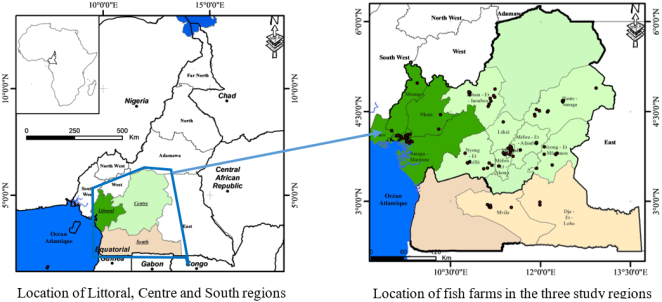
The study was conducted in fish farms located in the Littoral, Centre and South regions of Cameroon (Figure 1). The Littoral region covers an area of 20.248 km2, representing 4.3% of the national territory, and housing 4085142 inhabitants. The region is between 2°6” and 6°12” North latitude, and 8°48” and 10°30” East longitude. The Centre region, located between 3° to 6° North latitude and 10° to 15° East longitude covers 68.953 km2, with a population of 4159492 inhabitants. The South region, for its part, covers of 47.191 km2, with a population of about 749552 inhabitants. The region is between 2°6” to 4°54”/5°48” North latitude and 10°30” to 16°12” East longitude .
2.2. Study Design and Data Collection
The study was conducted between November 2022 and March 2023 in three aquaculture production regions of Cameroon (Littoral, Centre and South). Prior to the beginning of the study, a database of fish farmers of each region was obtained from the Direction of Fisheries, Aquaculture and Marine Industries at the Ministry of Livestock, Fisheries and Animal Industries. After a phone contact with different fish farmers on the database, criteria for consideration as a participant for the study were to accept to take part in the survey and to be functional. Of the 53 fish farmers in the Littoral region listed in the Ministry’s database, 46 met the criteria for participating in the survey. As for the Centre region, of the 85 fish farmers who met the criteria for participating in the survey out of the 155 registered in the database, 69 took part in the survey. In the South region, however, of the 72 fish farmers identified, only 20 met the criteria for participating in the survey; of these, 14 agreed to share the realities of their activities by taking part in the survey. Information (data) on the farmers was collected through a questionnaire, face-to-face interviews with the fish farmers, and direct observations made at their farms. This information concerned:
1) The socio-demographic characteristics, which included age, gender, level of education and training in fish farming;
2) The technical characteristics concerned the legal status and production objectives of fish farms, the types of fish farming system and the products sold, the species of fish farmed and the types of fish feed used, the feed production equipment and the ingredients used in feed manufactured;
3) The bromatological composition of the farms’ made feed and information on the major constraints to fish farming and fish feed production.
2.3. Sampling and Statistical Analysis
The data collected were analyzed using descriptive statistics, with the help of the statistical analysis software SPSS version 20.0. The results obtained are expressed as percentages or means ± standard deviation.
Figure 1. Location of the study areas.
3. Results
3.1. Socio-demographic Characteristics of Fish Farmers in the Regions Surveyed
Table 1. Distribution of fish farmers by sex, age, Level of education and training received in fish farming.

Characteristic

Percentage (frequency)

Littoral region

Centre region

South region

Gender

Male

87% (40)

91% (63)

93% (13)

Female

13% (6)

9% (6)

7% (1)

Age (year)

[16, 26]

4% (2)

0% (0)

0% (0)

[26, 36]

74% (34)

16% (11)

14% (2)

[36, 46]

15% (7)

49% (34)

57% (8)

[46, 56]

0% (0)

23% (16)

14% (2)

[56, 66]

4% (2)

10% (7)

7% (1)

> 66

2% (1)

1% (1)

7% (1)

Level of education

None

2% (1)

0% (0)

0% (0)

Primary

7% (3)

1% (1)

0% (0)

Secondary

2% (1)

45% (31)

50% (7)

Higher

89% (41)

54% (37)

50% (7)

Training in fish farming

Yes

87% (40)

17% (12)

50% (7)

No

13% (6)

83% (57)

50% (7)

Table 1 shows the distribution of fish farmers by gender, age, level of education and training in fish farming, by region of Cameroon. It is noted that, in all the regions studied, fish farming is mainly practiced by men rather than women, with percentages exceeding 80%. Furthermore, the most common age group among fish farmers operating in the Littoral region is 26 to 36 years old, accounting for 74% of the total. In contrast, the most common age group in the regions of the bimodal tropical forest agro-ecological zone is between 36 and 46 years old, accounting for 49% in the Centre region and 57% in the South region. However, with regard to education and training levels, of the 53 fish farming in the Littoral region, 41 have completed higher education and 40 have undergone training in aquaculture, representing rates of 89% and 87% respectively. On the contrary, in the Centre region, 54% of fish farming have completed higher education, while 83% have not undertaken any training in aquaculture. In contrast, in the South region, 50% of fish farmers have completed both secondary and higher education. The same is true of training in fish farming.
3.2. Technical Determinants
3.2.1. Distribution of Fish Farmers by Age of Establishment, Status and Production Objective
The distribution of fish farmers by age of the structure, status and production objective presented in Table 2 reveals that in all the regions surveyed, fish farms of 1 to 4 years old are the most dominant. In the Littoral region, 65% of fish farms have legal status, compared with 35% that operate in illegality. The results of the survey in the central region show that 51% of fish farms have legal status, whilst 49% operate on the fringes of legality. Regarding the results of the survey conducted in the South region, half of the fish farms operate without legal status. However, regardless of the region or the legal status of the fish farms surveyed, between 89% and 93% of fish farmers produce for commercial purposes, whilst less than 10% produce for their own consumption or as a hobby.
Table 2. Distribution of fish farmers by age of the structure, status and production objective.

Characteristic

Percentage (frequency)

Littoral region

Centre region

South region

Farm age (year)

≤01

22% (10)

7% (5)

7% (1)

[01, 04]

74% (34)

68% (47)

57% (8)

[05, 09]

4% (2)

23% (16)

7% (1)

[10, 20]

0% (0)

1% (1)

7% (1)

>20

0% (0)

0% (0)

21% (3)

Structure’s legal status

Private Limited Company

4% (2)

1% (1)

0% (0)

Sole proprietorship

15% (7)

7% (5)

14% (2)

Cooperative societies

46% (21)

42% (29)

36% (5)

Without legal status

35% (16)

49% (34)

50% (7)

Production objective

Hobbies

2% (1)

0% (0)

0% (0)

Self-consumption + donation

9% (4)

7% (5)

7% (1)

Commercialization

89% (41)

93% (64)

93% (13)

3.2.2. Distribution of Fish Farmers by Type of Production System, Type of Farm, Type of Infrastructure and Type of Product Marketed
The distribution of fish farmers by type of production system, type of farm, type of infrastructure and type of product marketed is presented in Table 3. It should be noted that, regardless of the region under study, most fish farmers use open production systems. However, in the Littoral region, they practice intensive outdoor farming, mainly in tarpaulin ponds; whereas in the Centre and South regions, the majority of fish farmers practice semi-intensive outdoor farming, mainly in earthen ponds. In addition to the aquaculture facilities found in all regions, 20% of fish farmers in the Littoral region operate a fish feed production unit, compared with 4% in the Centre region and nothing in the South region. It is also noted that 24% of fish farms in the Littoral region have a hatchery, facilities for grow-out fingerlings and a feed production unit, compared with 3% and 7% respectively in the Centre and South regions.
Table 3. Distribution of fish farmer by type of production system, type of fish farming, type of infrastructure and type of commercialized product.

Characteristic

Percentage (frequency)

Littoral region

Centre region

South region

Type of production system

Open system

65% (30)

71% (49)

71% (10)

Close recirculatory system

35% (16)

29% (20)

29% (4)

Type of fish farming

Extensive

0% (0)

20% (14)

21% (3)

Semi intensive

7% (3)

44% (30)

43% (6)

Intensive

93% (43)

36% (25)

36% (5)

Type of infrastructure

Hatchery-nursery (A)

2% (1)

4% (3)

7% (1)

Earth ponds (B)

7% (3)

36% (25)

36% (5)

Tarpaulin ponds (C)

29% (13)

22% (15)

29% (4)

Concrete tanks (D)

4% (2)

7% (5)

7% (1)

Feed production unit (E)

2% (1)

2% (1)

0% (0)

A+B

2% (1)

4% (3)

7% (1)

A+C

4% (2)

10% (7)

0% (0)

A+B+C+D

2% (1)

7% (5)

0% (0)

A+B+C+D+E

24% (11)

3% (2)

7% (1)

B+C+E

11% (5)

2% (1)

0% (0)

C+D

13% (6)

3% (2)

7% (1)

Type of marketed product

Fingerlings (A)

11% (5)

8% (5)

7% (1)

Fish for consumption (B)

48% (22)

68% (47)

71% (10)

Locally produced feed (C)

6% (3)

1% (1)

0% (0)

A + B

4% (2)

19% (13)

15% (2)

B+C

11% (5)

1% (1)

0% (0)

A + B + C

20% (9)

3% (2)

7% (1)

() = n sample
3.2.3. Distribution of Fish Farmers by Species Produced, Type of Feed Used and Type of Feed Produced
The distribution of fish farmers by species produced, type of feed used and type of feed produced presented in Table 4 indicates that the African catfish is the most represented species in the three regions, representing respectively 87%, 37% and 86% in the Littoral, Centre and South regions. Moreover, apart from viperfish raised in the Centre region alone by 19% of fish farmers, 26% of them, in addition to African catfish produce also Nile tilapia, compared with 9% and 14%, respectively, in the Littoral and South regions.
Table 4. Distribution of fish farmers by species produced, type of fish feed used, type of feed produced and specific feed produced.

Characteristic

Percentage (frequency)

Littoral region

Centre region

South region

Species produced

African catfish (Clarias gariepinus)(A)

87% (40)

37% (26)

86% (12)

Tilapia (Oreochromis niloticus)(B)

2% (1)

6% (4)

0% (0)

Common Carp (Cyprinus carpio)(C)

0% (0)

0% (0)

0% (0)

Kanga (Heterotis niloticus)

0% (0)

0% (0)

0% (0)

Viperfish (Parachanna obscura)

0% (0)

19% (13)

0% (0)

A+B

9% (4)

26% (18)

14% (2)

A+C

0% (0)

3% (2)

0% (0)

A+B+C

2% (1)

9% (6)

0% (0)

Type of fish feed used

Foreign feed

53% (25)

42% (29)

29% (4)

Locally produced feed

15% (7)

22% (15)

21% (3)

Foreign feed + Local feed

30% (14)

36% (25)

50% (7)

Type of fish feed produced

Extruded feed

12% (2)

25% (1)

0% (0)

Granulated feed

59% (10)

75% (3)

100% (1)

Extruded and Granulated feed

29% (5)

0% (0)

0% (0)

Specific feed produced

Extruded feed for fingerlings

0% (0)

0% (0)

0% (0)

Extruded feed for juveniles

29% (5)

25% (1)

0% (0)

Extruded feed for broodstocks

0% (0)

0% (0)

0% (0)

Granulated feed for fingerlings

0% (0)

0% (0)

0% (0)

Granulated feed for juveniles

71% (12)

75% (3)

100% (1)

Granulated feed for broodstocks

0% (0)

0% (0)

0% (0)

3.2.4. Distribution of Fish Farmers Producing Feed by Ingredients Selection Criteria
Table 5 sets out the main ingredients commonly used by fish farmers in the production of fish feed, as well as the selection criteria. It is noted that the main ingredients commonly used in the three regions surveyed are Fish meal, Soybean cake, Groundnut cake, Corn flour, Cassava flour, Wheat bran and Bone meal. However, regarding the selection criteria, the results indicate that out of 17 fish farmers producing feed in the Littoral region, 08 use the nutritional value, compared to 05 and 04 which use the availability and price of ingredients, respectively, corresponding to frequencies of 47%, 25% and 24%, respectively. in contrast, in the South region, the only fish farmer producing fish feed bases his choice of ingredients on their availability; whereas in the central region, out of the four fish farmers producing fish feed, two base their choice of ingredients on their availability, one of the other two on the nutritional value and the last on the price of the ingredients.
Table 5. Common ingredients used and distribution of fish farmers producing feed by ingredients selection criteria.

Characteristic

Percentage (frequency)

Littoral region

Centre region

South region

Criteria for selecting ingredients

Nutritional value

47% (8)

25% (1)

0% (0)

Availability

29% (5)

50% (2)

100% (1)

Price

24% (4)

25% (1)

0% (0)

Ingredients used

Fish meal

100% (17)

100% (4)

100% (1)

Soybean cake

29% (5)

50% (2)

100% (1)

Groundnut cake

82% (14)

100% (4)

100% (1)

Corn flour

82% (14)

100% (4)

100% (1)

Cassava flour

59% (10)

100% (4)

100% (1)

Wheat bran

71% (12)

50% (2)

100% (1)

Bone meal

29% (5)

75% (3)

100% (1)

Palm oil

76% (13)

50% (2)

100% (1)

Salt

76% (13)

100% (4)

100% (1)

3.3. Proximate Composition of Locally Produced Fish Feed and Constraints
3.3.1. Proximate Composition of the Most Available Locally Produced Fish Feed
Table 6 shows the proximate composition of the most common feeds produced in the Littoral and Centre regions. It is noted that it is in the extruded feed (C1) produced in the Centre region that the highest protein (30.93 ± 0.24%), and ash content (32.00 ± 0.01%) were found, whilst the lowest lipid (10%) and moisture (8.00 ± 1.41%) contents were recorded. In contrast, the lowest protein content (11.74 ± 3.11%) and ash (5.83 ± 1.20%), as well as the highest levels of carbohydrates (33.92 ± 5.71%) and fibre (18.27 ± 1.48%) was recorded in the A2 extruded feed produced in the Littoral region. On the other hand, the highest fat content of 20.60 ± 1.77%, was recorded in the D1 pellet feed produced in the Centre region, followed by feed B1 (18.97 ± 2.64%) of the Littoral region.
Table 6. Proximate composition (% dry matter) of the most available feeds produced in the regions surveyed.

Feed

Macronutrient composition

Protein

Lipid

Ash

Carbohydrate

Fibre

Moisture

A1

19.71±0.84

15.66±1.24

29.03±1.19

14.37±3.49

9.07±0.08

12.17±2.68

A2

11.74±3.11

15.52±0.25

5.83±1.20

33.92±5.71

18.27±1.48

14.73±2.64

B1

23.97±1.05

18.97±2.64

16.48±2.26

14.05±2.28

6.34±1.43

20.21±5.10

B2

17.68±3.04

11.91±3.02

8.48±2.55

26.53±0.74

13.36±1.24

22.06±8.12

B3

15.70±0.26

14.14±0.35

24.66±1.29

22.93±0.35

9.51±1.99

13.07±1.67

B4

17.46±1.64

16.23±2.70

28.83±1.80

20.02±0.59

8.04±1.84

9.42±4.04

B5

19.05±0.48

15.57±1.06

28.80±5.36

19.16±1.58

6.61±0.71

10.80±2.96

B6

12.17±0.68

18.24±1.07

30.93±2.16

15.65±1.07

7.38±0.85

15.63±2.33

C1

30.93±0.24

10.32±1.01

32.00±0.01

26.76±0.77

8.50±0.71

8.00±1.41

D1

17.78±1.35

20.60±1.77

25.05±5.38

18.30±1.70

8.53±1.38

9.74±2.58

D2

19.66±2.47

16.95±1.01

23.54±7.17

19.22±0.61

7.48±1.37

13.15±4.46

D3

20.90±0.03

17.43±0.09

17.67±1.24

19.51±0.05

13.49±0.55

11.01±0.52

A: Extruded feed produced in the Littoral region; B: Granulated feed produced in the Littoral region;
C: Extruded feed produced in the Centre region; D: Granulated feed produced in the Centre region
3.3.2. Constraints on Fish Farming and Feed Production
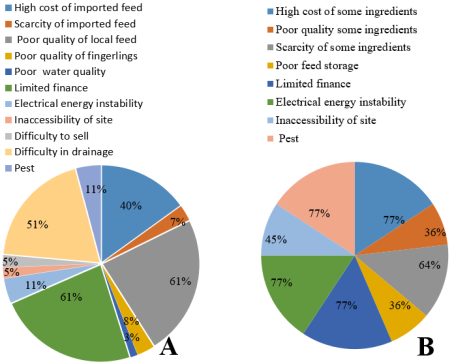
Figure 2 illustrates the constraints related to fish and feed production in the three regions surveyed. It is showed that the two main challenges facing fish farming are the poor quality of locally produced fish feed (61%) and limited finance (61%), closely followed by drainage issues, which account for 51%. Concerning constrains to feed production, it appears that 77% of fish feed producers of the Littoral, Centre and South regions face the problem of high cost of ingredients, limited finance, electrical energy instability and pest. This is closely followed by the scarcity of some ingredients (64%).
Figure 2. Constrains related to fish production (A) and feed production (B).
4. Discussion
Fish farming, which is growing steadily worldwide, provides not only a means of survival but also an essential food source for many communities in a context where wild fish stocks are severely depleted. In order to assess socio-demographic and technical characteristics of fish farming practices, a cross sectional study was performed in 129 fish farmers in three aquaculture production basins in Cameroon, namely the Littoral, Centre and South regions. The socio-demographic analysis of fish farmers in the regions surveyed revealed that fish farming is mainly practiced by men aged between 26 and 36 in the Littoral region (87%) and between 36 and 46 in the Centre and South regions (93%). These findings corroborate those previously obtained by as part of their study on biosecurity practices in fish farms in the Wouri Division, in the Littoral Region of Cameroon, as well as by and in their respective studies on the assessment of the technical efficiency of small-scale aquaculture systems in the Centre Region of Cameroon and on the diagnosis of fish farming in the bimodal humid forest zone of South Cameroon. Thus, although women also participate indirectly in the fish farming sector, generally in the sale and processing of fish, the high proportion of men could be explained by the challenges this sector poses for women, such as access to farmland, lack of capital, lack of management skills and limited access to credit. The Littoral region has a younger fish farming population (aged 26 to 36), unlike the Centre and South regions, where the most common age group is 36–46. Indeed, the higher proportion of young fish farmers in the Littoral region can be explained, on the one hand, by the fact that this region is the country’s economic hub, which attracts large numbers of people, particularly young people. On the other hand, the popularity of fish farming among young people in this region can also be attributed to the presence of numerous high institutes and vocational training centers specializing in fisheries science, whose graduates have settled in the region to put their skills into practice. Furthermore, the prevalence of fish farmers within the age groups 36-46, suggests that aquaculture in these regions is largely driven by middle-aged individuals, who are often in the prime of their economic productivity. The age distribution also points to a youthful trend in the sector, as nearly three-quarters (74%) of the farmers are below 46 years, indicating potential for future growth as younger farmers invest in aquaculture. These findings are consistent with those of who demonstrated that in the Centre Region fish farmers who practice the activity are mostly in the [30-45] age group. In addition to that, the results of this study are consistent with those of , who, in their research conducted in the Littoral, Central and West regions, reported that the average age of fish farmers is between 30 and 45 years. Furthermore, the level of education and Training of the fish farmers revealed that most farmers reached higher education, but 87% have a training in aquaculture in the Littoral region, 50% in the South and only 17% in the Centre region. These results are in contradiction with those obtained by . This discrepancy between educational level and specific fish farming training suggests a potential gap in technical know-how, which could be limiting optimal farm performance. Formal training programs and workshops could help bridge this gap and enhance farming practices across all regions. Furthermore, the disparities between regions indicate that region-specific interventions are necessary to support fish farmers according to their unique challenges and capacities.
For the technical characteristics, the results of the present study indicate that the majority of farms have 1 to 4 years of existence, with “Common Initiative Group” or cooperative model more prevalent in all the regions closely followed by sole proprietorship, promoting community-based farming and the fish produced for commercialization. This shows that many individuals turn to enter in the blue economy legally and are still young in the business. In addition, African catfish farming serves various purposes. They are farmed mainly for sale and to a lesser extent for self-use, with no recreational use, this led to affirmation that the primary goal of farming African catfish is commercial production . The emphasis on sale and self-use aligns with the economic importance of catfish farming in the region. The lack of recreational use suggests that African catfish farming is more of a commercial venture rather than a leisure activity. Moreover, the commercialization of fish for consumption in an open production system mainly using tarpaulin tanks and earth ponds practicing intensive fish farming. This shows that infrastructure choices for fish farming in Cameroon result from a combination of traditional and modern practices, influenced by regional factors such as land availability, economic constraints and water resource management. While ponds remain dominant, particularly in the Centre region, the increasing use of tarpaulin ponds, especially in the Littoral region, reflects a shift towards more efficient, better-controlled and less space-consuming methods. The absence of hapa and floating cages also points to potential areas for development in the country’s aquaculture sector, particularly through technology transfer and investment in more advanced systems. Intensive production systems are dominant especially in the Littoral region (93%), reflecting a focus on maximizing productivity. Similar trends were observed in Ghana and Nigeria, driven by increased fish demand and profitability .
The investigations on fish species farmed indicates that African catfish is the most farmed species, followed by tilapia. These results aligned with those of and who showed that African catfish and tilapia are the dominant species in fish farming. These species are preferred due to their adaptability and market demand. Feed use reveals that, for the classification of feed type used at each stage of development, there is a clear trend towards the use of imported fish feed among farmers rearing African catfish, particularly during the juvenile stage. Imported feeds, are favored for their perceived superior quality and nutritional benefits, which are critical for promoting fish growth. In contrast, local feed produced options are under-utilized, with local extruded feed being less produced than local granulated feed at the juvenile stage. This suggests that many farmers may lack confidence in local feed options, potentially due to concerns over their quality or effectiveness. The results of the present work on the preference of fish farmers for imported feed are in contradiction with those of , whose work carried out in the Division of Noun in the West region of Cameroon has rather indicated a preference for locally produced feed, certainly for their affordable cost. From the surveyed area, with base the regional distribution of fish farms, the Littoral region has the highest feed production and farm participation, suggesting better infrastructure. The Centre region has most fish farms but produces little feed, leading to dependency on external sources. The South region has minimal fish farming and feed production, indicating significant limitations in aquaculture practices. Across all regions, only 17% (22 farms) of the surveyed fish farms produce feed and among these, just over half (55%) have feed available. This reveals a general scarcity of local feed production, which is a critical factor for the sustainability of fish farming operations. Farmers who are unable to produce or access feed locally are likely reliant on more expensive imported feeds, which could increase production costs and limit profitability.
The distribution of farm frequencies according to feed production features of African catfish farmers in the Littoral, Centre and South regions of Cameroon show that 17% of African catfish farmers produce local fish feed, with the majority using a pellet mill and few using an extruder exclusively. The preference for pellet mills among local feed producers suggests a focus on producing uniform feed at affordable cost, which is crucial for the fish growth and health. The use of both extruders and pellet mills by a significant portion of farmers indicates a blend of traditional and modern feed production techniques, aiming to balance cost and quality. Moreover, for the Ingredients used for the production of African catfish local feed, it is shown that, fish meal, soybean and groundnut cake are the most used ingredients for African catfish feed production. Other commonly used ingredients include corn flour, cassava flour, palm oil and cooking salt. The reliance on fish meal and soybean suggests a focus on providing high-quality protein sources, essential for the growth and health of catfish. The use of corn flour, palm oil and groundnut cake indicate an effort to incorporate diverse nutrient sources into the feed. The inclusion of wheat bran and cassava flour highlights the importance of cost-effective, locally available ingredients to supplement the diet. Similar studies in Cameroon, such as the review by , confirm the predominant use of fish meal and soybean due to their high protein content, the inclusion of locally available ingredients like cassava flour is also noted, reflecting efforts to reduce feed costs while maintaining nutritional balance. Furthermore, investigations on the reason for the choice of ingredients indicate that most feed producers choose their ingredients based on availability, while others consider both nutritional value and price. The preference for ingredient availability suggests that farmers prioritize ease of access and cost-effectiveness, which is crucial for small-scale operations. The focus on price and nutritional value indicates a balance between affordability and ensuring the health of the catfish. The cost of feed production aligns with the economic constraints faced by many farmers, highlighting the need for affordable feed options to maintain profitability. Similar works, such as the review by , also emphasize the importance of ingredient availability and cost-effectiveness in feed production.
The proximate composition of feed from fish farms revealed that their protein, fat, ash, carbohydrate, fiber and moisture content fell outside the ranges of the nutritional requirements of the main aquaculture fish species, such as the African catfish, tilapia and common carp, according to the findings of on the knowledge on the nutritional requirement of freshwater fish. This revealing the urge gap between theoretical values given by feed producers and actual analysis. More, it shows that the variability and quality of ingredients have to consider with regard to their different sources before formulating feed. Also, knowledge on different technologies for feed formulations should be acquired and proper analysis should be done both on ingredients and the final produced feed. This might contribute to a better locally produced fish feed quality. The overall results suggest that while being a growing sector in Cameroon, there are notable constraints related to fish and feed production in fish farming. About constrains related to fish production, the results highlight key challenges faced by fish farmers in the Littoral, Centre and South regions of Cameroon. The primary challenges in fish production is that of poor quality of locally produced feed and limited finance which hinder farm productivity and expansion. Closely followed by the difficulty in drainage which accounts for 51%. Drainage issues, especially for pond-based systems, leading to water quality problems. The high cost of imported feed (40%) further strains farmers, who face financial pressures made similar observations in their work on the characteristics of fish farming practices and the use of agrochemicals in four regions of Cameroon as well as in their findings carry out on the causes of the slowdown in the development of fish farming in the city of Bertoua in the East region of Cameroon. These issues are common in tropical regions, where unseasonal rains or flooding can cause significant losses, as reported by in studies on the effects of climate variability on aquaculture in Africa. These findings align with similar studies across Africa, emphasizing the need for better feed quality, financial support and improved infrastructure for sustainable fish farming. In Zambia, reported similar challenges with bird predation and unreliable electricity, particularly for farmers operating near wildlife areas or in regions with unstable power grids. The main constrain faced by fish feed producers are the high cost of some ingredients, finance, electrical energy instability and pests, affecting 77% of producers. Additionally, 64% face ingredient scarcity, 45% struggle with site accessibility, and 36% each have issues with poor ingredient quality and storage. These constraints highlight significant challenges in the feed production process. The high cost of ingredients and limited financial resources create a barrier to producing high-quality feed consistently. Electrical instability further complicates production, particularly for those relying on machinery. Ingredient scarcity and pest issues suggest difficulties in maintaining a steady supply chain and protecting stored feed. Site accessibility problems indicate logistical challenges that could impact overall efficiency and productivity. Addressing these issues through improved access to feed production technology, ingredients and infrastructure could significantly enhance the growth of aquaculture in these regions.
5. Conclusion
This study lead to assess fish farming practices and the level of development of the fish farming sector in the Littoral, Centre and South regions of Cameroon. Thus, regardless of the region studied, fish farming is mainly carried out by a young population aged under 50, organized into cooperatives and practicing intensive aquaculture with two major species: the African catfish and tilapia. A non-neglected proportion of fish farmers are attempting to break free from their dependence on imported feed by producing their own feed for their own use and for sale, although the nutritional quality of this feed needs to be improved.
Abbreviations

FAO

Food and Agricultural Organization

IRAD

Agricultural Research Institute for Development

MINEPAT

Ministry of the Economy, Planning and Land Management

MINEPIA

Ministry of Livestock, Fisheries and Animal Industries

NIS

National Institute of Statistics

Author Contributions
Maureen Yannel Noutchom Yendje: Investigation, Methodology, Software, Writing – original draft
Paulin Nyadjeu: Conceptualization, Data curation, Formal Analysis, Validation, Writing – review & editing
Justin Djimbie Djopnang: Methodology, Writing – original draft, Writing – review & editing
Majeste Mbiada Pahane: Writing – original draft, Writing – review & editing
Minette Eyango Tomedi-Tabi: Conceptualization, Supervision, Validation
Conflicts of Interest
The authors declare no conflicts of interest.
References
[1] Nyadjeu P., Hapsatou A., Justin D. D., Achare E. A., & Minette E. T. (2019). Substituting fish meal with pre-treated lima bean meal on growth, feed utilization and nutrient retention in Clarias gariepinus fingerlings reared in hapa-in-pond system. Global Journal of Science Frontier Research: Agriculture and Veterinary 19(5).
[2] Tang, N. E., Suh, C., Nchinda, V., & Ngome, A. F. (2022). Mapping agroecology actors and practices in cameroon. Institute of Agricultural Research for Development; report August 2022. Pp 16-17.
[3] MINEPIA, Ministry of Livestock, Fisheries and Animal Industries. (2024). Final report of the project for the promotion of inland aquaculture between MINEPIA of the Republic of Cameroon and the Japan International Cooperation Agency. P 20.
[4] Nyadjeu P, Eveline F. K., Maureen Y. N., Dickson J. A., Kevin L. E., & Minette E. T. (2025). Effect of an Extruded Feed Enriched with Garlic and Ginger on Production Parameters and Organosomatic Indices of Red Tilapia Fingerlings Reared in a Concrete Tank. East African Scholars Journal of Agriculture and Life Sciences, 8(10), 250-258.
[5] MINEPAT, Ministry of the Economy, Planning and Land Management. (2020). 2020–2030 National Development Strategy for Structural Transformation and Inclusive Development of Cameroon. 1st edition, P 48-50. 550,
[6] Tiogue T. C., Bibou A., Kenfack J. A., Tchoumboue J. (2020) Socio-economic and technical characteristics of fish farming in the Department of Mbam and Inoubou. International Journal of Biological and Chemical Sciences 14(3): 983-1000.
[7] Wauffo F. D., Miégoué E., Noumbissi B. N. M., Nyah K C., Tobou D. G. F., Tcholong F. H. B., Tendonkeng. (2023). Socio-Economic and Zootechnical Characterization of Fish Farming in the Noun Division (West Region-Cameroon). Clinical Research in Animal Science. 3 (2). CRAS. 000557.
[8] Atangana KJA, Tchawa P, Micha JC (2019) Fish farming in Cameroon: an individual approach case of the municipality of Bertoua 1 in the eastern region of Cameroon. Tropicultura 37(3): 1379.
[9] Bouelet Ntsama S. I., Tambe A. B., Takadong T. J. J., Nama M. G & Kansci G. (2018). Characteristics of fish farming practices and agrochemicals usage therein in four regions of Cameroon. Egyptian Journal of Aquatic Research. 44 (2018): 145–153.
[10] Kenfack D. A., Koutsing K. O. M., Nkontcheu K. D. B., Nana T. A., Efole E. T and Nana P. (2025). Diagnosis of fish farming and acclimation of the common carp (Cyprinus carpio) in the bimodal humid forest zone of South Cameroon. Cameroon Journal of Biological and Biochemical Sciences, 2025, 33, 227-239.
[11] NIS, National Institute of Statistics Regional Office of the National Institute of Statistics, Edition 2022. Statistics yearbook of region Pp 516.
[12] Fonkwa G., Makombu J. G., Kamdem A. H., Kametieu D. F., Nack J., Awah-Ndukum J., Tomedi E. M., & Tchoumboue J. (2023). Determining Factors and Zootechnical Output of Biosecurity Practices in Fish Farms in the Wouri Division, Cameroon, Veterinary Medicine International, 12.
[13] Koagne T. L. J., Soh W. B. D., Mbouemboue Y. R. C., Eloundou E. C. & Fon D. E. (2025). Evaluating the technical efficiency of small-scale fish production systems in the Centre region of Cameroon, Food and Humanity.
[14] Abdoulay N. N., Minette T. E., & Denis P. F. (2025). Technical Performance of Fish Farms in Cameroon: Measurements and Key Factors. International Journal of Research and Innovation in Applied Science, 10 (5): 97-112.
[15] Fonkwa G., Kpoumie N. A., Makombu J. G., Mekouadja U. W., Kametieu D. F. J., & Tchoumboue J. (2024) Biosecurity profile of fish farms in the bimodal-rainfall zone forest of Cameroon, Journal of Aquaculture and Fish Health 13(3): 312-327.
[16] Temegne N. C & Momo N. J. (2019). Review on aquaculture research in Cameroon: fish farming. International Journal of Oceanography & Aquaculture, 3(3): 000170.
[17] Langi S., Maulu S., Hasimuna O. J., Kapula K. V & Tjipute M. (2024). Nutritional requirements and effect of culture conditions on the performance of the African catfish (Clarias gariepinus): a review. Cogent Food & Agriculture, Animal Husbandry & Veterinary Science, 10 (1): 2302642.
[18] Maimoune M., Moumbock A. M. E., Bayoi E., Asedd & Ngaba M. J. Y. (2021). Why is fish farming slow to develop in the city of Bertoua (East Cameroon)?. International Journal of Biological and Chemical Sciences. 15(6): 2568-2580.
[19] FAO, Food and Agricultural Organization. (2018). The State of World Fisheries and Aquaculture. Meeting the sustainable development goals. Rome. Licence: CC BY-NC-SA 3.0 IGO.
[20] Mumba F., Chabalengula V., & Banda A. (2014). Comparing male and female pre-service teachers understanding of the particulate nature of matter. Journal of Baltic Science Education, 13(6): 821-827.
Cite This Article
  • APA Style

    Yendje, M. Y. N., Nyadjeu, P., Djopnang, J. D., Pahane, M. M., Tomedi-Tabi, M. E. (2026). Socio-demographic and Technical Characteristics of Fish Farming in Three Aquaculture Production Basins in Cameroon. Agriculture, Forestry and Fisheries, 15(4), 130-142. https://doi.org/10.11648/j.aff.20261504.12

    Copy | Download

    ACS Style

    Yendje, M. Y. N.; Nyadjeu, P.; Djopnang, J. D.; Pahane, M. M.; Tomedi-Tabi, M. E. Socio-demographic and Technical Characteristics of Fish Farming in Three Aquaculture Production Basins in Cameroon. Agric. For. Fish. 2026, 15(4), 130-142. doi: 10.11648/j.aff.20261504.12

    Copy | Download

    AMA Style

    Yendje MYN, Nyadjeu P, Djopnang JD, Pahane MM, Tomedi-Tabi ME. Socio-demographic and Technical Characteristics of Fish Farming in Three Aquaculture Production Basins in Cameroon. Agric For Fish. 2026;15(4):130-142. doi: 10.11648/j.aff.20261504.12

    Copy | Download

  • @article{10.11648/j.aff.20261504.12,
      author = {Maureen Yannel Noutchom Yendje and Paulin Nyadjeu and Justin Djimbie Djopnang and Majeste Mbiada Pahane and Minette Eyango Tomedi-Tabi},
      title = {Socio-demographic and Technical Characteristics of Fish Farming in Three Aquaculture Production Basins in Cameroon},
      journal = {Agriculture, Forestry and Fisheries},
      volume = {15},
      number = {4},
      pages = {130-142},
      doi = {10.11648/j.aff.20261504.12},
      url = {https://doi.org/10.11648/j.aff.20261504.12},
      eprint = {https://article.sciencepublishinggroup.com/pdf/10.11648.j.aff.20261504.12},
      abstract = {Background: The natural conditions and geo-climatic diversity of Cameroon are ideal for aquaculture development. The current study aimed to assess the socio-demographic and technical characteristics of aquaculture across three regions in Cameroon. Methods: Data collection was based on the snowball sampling technique, field observations and face-to-face interviews with fish farmers, using a structured questionnaire. Of the 129 fish farmers identified, 46, 69 and 14 from the Littoral, Centre and South regions respectively were interviewed. Results: In the Littoral, Centre and South regions, 87%, 91% and 93% of aquaculture is practiced by men, respectively. Moreover, 74% of fish farmers in the Littoral region are between 26-36 years old, compared to 49% and 57% in the Centre and South regions, which are respectively aged 36-46. Most farms in the Littoral region (46%) are organized as cooperatives, whilst 49% and 50% of those in the Centre and South regions, respectively, have no legal status. Regardless of the region, African catfish, is the predominant species raised for commercial purposes. The main challenges facing fish farmers are the poor quality of locally produced feed (61%) and a lack of financial resources (61%). As regards fish feed production, the main challenges are the high cost of ingredients, an unreliable electricity supply and pests (77%). Conclusion: Given the age of fish farmers, their level of education and training in aquaculture, and the production facilities, the Littoral and Centre regions are emerging as key hubs for the development of fish farming in Cameroon.},
     year = {2026}
    }
    

    Copy | Download

  • TY  - JOUR
    T1  - Socio-demographic and Technical Characteristics of Fish Farming in Three Aquaculture Production Basins in Cameroon
    AU  - Maureen Yannel Noutchom Yendje
    AU  - Paulin Nyadjeu
    AU  - Justin Djimbie Djopnang
    AU  - Majeste Mbiada Pahane
    AU  - Minette Eyango Tomedi-Tabi
    Y1  - 2026/07/30
    PY  - 2026
    N1  - https://doi.org/10.11648/j.aff.20261504.12
    DO  - 10.11648/j.aff.20261504.12
    T2  - Agriculture, Forestry and Fisheries
    JF  - Agriculture, Forestry and Fisheries
    JO  - Agriculture, Forestry and Fisheries
    SP  - 130
    EP  - 142
    PB  - Science Publishing Group
    SN  - 2328-5648
    UR  - https://doi.org/10.11648/j.aff.20261504.12
    AB  - Background: The natural conditions and geo-climatic diversity of Cameroon are ideal for aquaculture development. The current study aimed to assess the socio-demographic and technical characteristics of aquaculture across three regions in Cameroon. Methods: Data collection was based on the snowball sampling technique, field observations and face-to-face interviews with fish farmers, using a structured questionnaire. Of the 129 fish farmers identified, 46, 69 and 14 from the Littoral, Centre and South regions respectively were interviewed. Results: In the Littoral, Centre and South regions, 87%, 91% and 93% of aquaculture is practiced by men, respectively. Moreover, 74% of fish farmers in the Littoral region are between 26-36 years old, compared to 49% and 57% in the Centre and South regions, which are respectively aged 36-46. Most farms in the Littoral region (46%) are organized as cooperatives, whilst 49% and 50% of those in the Centre and South regions, respectively, have no legal status. Regardless of the region, African catfish, is the predominant species raised for commercial purposes. The main challenges facing fish farmers are the poor quality of locally produced feed (61%) and a lack of financial resources (61%). As regards fish feed production, the main challenges are the high cost of ingredients, an unreliable electricity supply and pests (77%). Conclusion: Given the age of fish farmers, their level of education and training in aquaculture, and the production facilities, the Littoral and Centre regions are emerging as key hubs for the development of fish farming in Cameroon.
    VL  - 15
    IS  - 4
    ER  - 

    Copy | Download

Author Information
  • Department of Aquaculture, Higher National School of Agronomy, Halieutics and Veterinary Medicine, University of Douala, Cameroon

  • Department of Aquaculture, Higher National School of Agronomy, Halieutics and Veterinary Medicine, University of Douala, Cameroon

  • Department of Agro Pastoral and Sylvo Halieutics Industries, Higher National School of Agronomy, Halieutics and Veterinary Medicine, University of Douala, Cameroon

  • Department of Agro Pastoral and Sylvo Halieutics Industries, Higher National School of Agronomy, Halieutics and Veterinary Medicine, University of Douala, Cameroon

  • Department of Aquaculture, Higher National School of Agronomy, Halieutics and Veterinary Medicine, University of Douala, Cameroon

  • Abstract
  • Keywords
  • Document Sections

    1. 1. Introduction
    2. 2. Material and Methods
    3. 3. Results
    4. 4. Discussion
    5. 5. Conclusion
    Show Full Outline
  • Abbreviations
  • Author Contributions
  • Conflicts of Interest
  • References
  • Cite This Article
  • Author Information